

![50% for Ethereum, 50% for Congress [FP Weekly 33]](/_next/image?url=https%3A%2F%2Fkrotgrfjzckvumudxopj.supabase.co%2Fstorage%2Fv1%2Fobject%2Fpublic%2Fassets%2Fimg%2Fcontent%2Farticle%2Fnotion-import%2F1cg9d7msn1d3j2.png&w=3840&q=75)
Table of Contents
- 1. Major News
- [Institution] U.S. Senate Files Cloture Motion to Begin Consideration of the CLARITY Act
- [Tech] Ethereum Researchers Propose EIP-8363 to Reduce New Issuance to Zero Once 50% of ETH Supply Is Staked
- Others
- 2. Data Spotlight
- A Data-Driven Look at Upbit's Stablecoin Market Expansion Strategy (Link)
- Visa’s Stablecoin Strategy (Link)
- 3. Four Pillars Weekly
- : : How Regulated Token Standards Are Being Designed (Link)
- : : Enhanced: Onchain Structured Product for a $30T Asset, Earning 0% (Link)
- : : 2026 Q2 Hyperliquid Report (Link)
- : : Does Ethereum Need to Cut Issuance Right Now? (Link)
- : : WebX 2026 Field Notes: Japan’s Year of Finance (Link)
- Comments
- 4. Macro & Onchain Metrics
Researcher

1. Major News
[Institution] U.S. Senate Files Cloture Motion to Begin Consideration of the CLARITY Act
What Happened?
On August 8, U.S. Senate Majority Leader John Thune filed cloture on the motion to proceed to the CLARITY Act, a digital asset market structure bill. Cloture is a procedure used to end debate and move toward a vote, and typically requires the support of at least 60 senators. The Senate will remain in recess through September 14, with the cloture vote scheduled for September 15, immediately after lawmakers return. The bill failed to advance before the August recess, but it has now been placed first on the Senate’s voting agenda for September.
The cloture vote is not a vote on final passage. It is the first procedural hurdle that determines whether the Senate will begin floor consideration of the CLARITY Act, requiring 60 votes out of 100. With Republicans holding 53 seats, at least seven Democrats must support the motion. Even if cloture passes, the bill must still go through floor debate, amendments, and a final vote.
The CLARITY Act is a market structure bill that establishes standards for classifying digital assets as securities or commodities and divides jurisdiction between the U.S. Securities and Exchange Commission (SEC) and the Commodity Futures Trading Commission (CFTC). The House passed the bill by a vote of 294 to 134 in July 2025. In the Senate, the Agriculture Committee advanced legislation covering CFTC jurisdiction in January, while the Banking Committee approved its own amended version by a vote of 15 to 9 on May 14. Two Democrats supported the Banking Committee bill but warned that they could oppose it on the floor if the outstanding issues remained unresolved.
The negotiations now center on restrictions on stablecoin rewards, DeFi provisions, and safeguards against conflicts of interest between public officials and crypto businesses. Banks are calling for tighter restrictions, arguing that stablecoin rewards offered by exchanges could drive deposits out of the banking system. Democrats are demanding ethics provisions aimed at President Trump and his family’s crypto businesses. The Senate Banking and Agriculture Committee bills have yet to be consolidated, and the resulting Senate legislation must still be reconciled with the House-passed bill.
What became clear this week is that Republican leadership has chosen to begin the floor process before negotiations are complete. This does not mean it has secured enough votes. The Senate entered recess immediately after cloture was filed, and negotiations will continue until the September vote. Rather than determining whether the CLARITY Act will pass, the September 15 vote will be the first test of whether its bipartisan support has actually reached the 60-vote threshold.
Researcher’s Comment
The market initially expected the CLARITY Act to move through the Senate before the August recess, but the effort failed as Republicans and Democrats were unable to narrow their differences. On Polymarket, the probability of a vote before the recess eventually fell to 0%. The probability that the bill would become law in 2026 has also declined from a February peak of 82% to 21%.
Thune’s announcement of a September 15 cloture vote has increased the likelihood that deliberations will resume immediately after the recess. The market, however, does not view this as a recovery in the bill’s chances of passage. Even if the process resumes in September, several hurdles remain, including assembling 60 votes with Democratic support and reconciling the House and Senate bills.
What, then, does this cloture filing mean for the CLARITY Act? First, Republican leadership has formally signaled its intention to bring the bill to the Senate floor. The attempt to advance it before the August recess failed, but placing it first on the voting calendar after lawmakers return makes clear that Republicans intend to continue pursuing passage during the current Congress.
Second, the filing serves as a political pressure tactic, forcing Democratic senators to state publicly whether they support opening debate on the bill. Republicans cannot reach the required 60 votes on their own. Even with the two Democrats who supported the Banking Committee bill, they still need at least five more. With negotiations over the legislative text still incomplete, Republicans appear to be setting the voting schedule first in order to pressure Democrats and drive the negotiations forward.
The CLARITY Act now faces a tight timetable if it is to pass this year. If floor consideration begins in mid-September, the Senate must consolidate its committee bills, process amendments, hold a final vote, and reconcile the legislation with the House bill, all within the short legislative window before the midterm elections. The composition of Congress could change after the elections, along with the bill’s priority and negotiating terms. The September vote is the starting point for passage, but it is also close to the final window for completing the legislation during the current Congress.
Three developments bear watching. The first is whether banks and the crypto industry can reach a compromise on restrictions on stablecoin rewards, the largest point of contention. The second is how many Democrats withdraw support over demands for public-official conflict-of-interest provisions. Democrats want language preventing the president and other senior officials from holding crypto assets or profiting from related businesses while in office. The third is how far Senate leadership can consolidate the Banking and Agriculture Committee bills before the vote. If any of these issues remains unresolved, securing 60 votes for cloture will be difficult.
[Tech] Ethereum Researchers Propose EIP-8363 to Reduce New Issuance to Zero Once 50% of ETH Supply Is Staked
What Happened?
On August 4, Ethereum researchers submitted Tapered Issuance Burn (TIB), a proposal that would burn a portion of validator rewards at progressively higher rates as Ethereum’s staking ratio increases. It was initially published as EIP-8361 but was renumbered EIP-8363 after the original number was found to have already been assigned to another proposal. The submission came just two days before the August 6 All Core Developers Consensus (ACDC) call discussing proposals under consideration for the next hard fork, Hegotá.
Under the current issuance curve, the consensus-layer yield earned by each validator declines as more ETH is staked, while the total amount of ETH issued by the network continues to rise. The authors argue that there is no explicit mechanism to stop staking growth because a nominal yield of roughly 1.5% would remain even if all ETH were staked.
TIB does not directly modify the existing reward curve. Rewards for attestations, block proposals, and sync committee participation would still be calculated under the current system. A portion of each validator’s ideal reward would then be deducted and burned based on the total active stake. The burn rate rises with the staking ratio. Once active stake reaches approximately 60.25 million ETH, the net consensus-layer reward for a validator that performs all duties correctly falls to zero. At the time of the proposal, this represented roughly 50% of the total ETH supply.
The burn amount is calculated against the ideal reward for assigned duties rather than the reward actually received. Validators that perform their duties correctly have the burn deducted from their rewards. Validators that fail to do so bear the same burn obligation on top of existing penalties. The authors argue that this approach can reduce issuance while preserving the incentive to operate nodes properly. Priority fees and MEV revenue generated on the execution layer are unaffected.
The proposal responds to the rapid increase in staked ETH. Ethereum’s staking ratio surpassed roughly one-third of total supply in April, while the validator entry queue has remained near the protocol limit for several months. The authors project that staked ETH could exceed 70 million by January 2028 if the current pace continues. Institutional inflows through Ethereum digital asset treasuries (DATs) and staking ETFs were cited as major drivers of the increase.
The proposal immediately drew criticism over both its economic effects and the process surrounding its submission. Critics argue that lower yields would push solo stakers and independent operators out first and could also affect DeFi markets built around staking yields. The decision to submit a monetary policy proposal shortly before the Hegotá review schedule, without substantial prior discussion, also became a point of contention.
The August 6 ACDC call did not decide whether TIB would be included in Hegotá. TIB remains a draft and has not been included in any hard fork. The call was not a venue for finalizing a protocol change. Instead, the proposal reopened a broader debate over Ethereum’s appropriate staking ratio and issuance policy.
Researcher’s Comment
TIB starts from the premise that Ethereum’s current issuance structure continues to incentivize more staking than the network needs. Under the current system, individual validator yields decline as staking grows, but total issuance continues to rise. TIB would increase the reward burn rate alongside the staking ratio to discourage additional staking, reducing net consensus-layer issuance to zero once roughly 50% of all ETH is staked.
The problem identified by TIB is valid. The current issuance curve has no explicit ceiling that would halt staking growth, while the security benefit of each additional unit of staked ETH diminishes as the total stake increases. If staking becomes concentrated among institutions and large custodians, ETH ownership and validation power could become concentrated together. Maintaining the current issuance level is therefore not a neutral choice. It amounts to accepting a continued rise in the staking ratio and the resulting dilution of non-stakers.
The problem lies in TIB’s assumption that uniformly reducing rewards for all validators at the protocol level will produce a neutral market outcome. Validator operating costs arise in fiat terms through servers, network connections, personnel, and security certifications, rather than as a percentage of ETH yield. When yields fall, solo stakers and independent operators that struggle to cover fixed costs are likely to exit first. Exchanges, custodians, and ETF providers can absorb the loss through economies of scale and revenue from other business lines.
There is therefore no guarantee that reducing issuance rewards would first stop large operators from expanding their stake. It could instead reduce the number of actual operators and concentrate the validator set among a smaller group of businesses. A reward reduction designed to support decentralization may accelerate centralization in the staking operations market.
As consensus-layer rewards decline, MEV and priority fees also account for a larger share of validator revenue. These earnings are not distributed consistently across all validators and are concentrated in a small number of high-value blocks. Large operators can smooth this volatility across many validators, while solo stakers with fewer block proposal opportunities remain far more exposed to luck. TIB burns rewards at the same rate for everyone, but the resulting revenue structure could favor operators with greater scale.
The effects would extend beyond the validator market. ETH staking yield functions much like a benchmark interest rate for the onchain economy. LST-backed lending, leveraged staking, fixed-income products, and structured products are all built around this yield. If the staking yield falls rapidly, demand for LST collateral and staking loops could contract together. As the yield approaches 0%, related positions may be unwound at scale.
TIB also conflicts with institutional demand. Staking ETFs and Ethereum DATs incorporate relatively predictable staking cash flows into their product structures. Under TIB, an individual investor’s yield would become more sensitive to the rate at which other participants enter the staking market. The proposal seeks to curb institution-driven staking growth by reducing the predictability of the cash flows that institutions prefer.
Ethereum’s issuance model will nevertheless need to be redesigned over the long term. The roles and cost structures of validators will change with the introduction of L1 zkEVMs, ePBS, and lean consensus. If the minimum stake falls and the functions of validation, proving, and block building become separated, the capital requirements, operating costs, and risks associated with each role will need to be recalculated. It will also become difficult to preserve an issuance curve designed around the validator model of the early Beacon Chain.
The sequence matters. Ethereum should first determine what roles future validators will perform, calculate the security budget required to sustain those roles, and then design the issuance structure around them. TIB attempts to reduce issuance before completing this process. This is why it should be considered alongside future changes to Ethereum’s consensus and execution architecture rather than rushed into Hegotá.
TIB is unlikely to be adopted in the near term. Its practical effect has been to bring Ethereum issuance and the appropriate staking ratio back onto the core research agenda. The debate should begin with what kind of validator set the future Ethereum network needs and how much it should pay to sustain that set, rather than how much issuance it should burn.
Others
Crypto
- BitGo moves $7.4 billion WBTC cross-chain standard from LayerZero to Chainlink CCIP
- Uniswap launches pools.trade, combining token launches, auctions, liquidity, and trading
- Western Union and Rain launch a card with USDPT wallet and Visa integration
- Circle names BlackRock, Visa, Mastercard among 11 initial Arc validators
Institution
- Dinari launches tokenized U.S. stock trading for American investors
- U.S. Senate files for cloture ahead of September 15 CLARITY Act vote
- Wintermute secures U.S. broker-dealer registration
- U.S. Treasury sanctions Shelbit and Aban Tether over alleged Iran-linked fund transfers
- Brazil mandates delays of up to 24 hours for overseas crypto transfers above $10,000
- South Africa proposes restricting overseas crypto transfers to authorized providers
- Robinhood secures UK crypto registration ahead of new regulatory regime
- BNY and Galaxy Digital partner on institutional custody and staking infrastructure
- BlackRock launches tokenized share classes for $311 billion European money market fund platform
Tech
- Cloudflare unveils AI agent wallets with spending limits and counterparty controls
- Bitcoin Red Team uncovers 85 critical vulnerabilities across Bitcoin codebases
- BTCPay Server exploit drains funds from LND-based Lightning nodes
- MetaMask launches self-custodial AI agent wallet with spending and protocol controls
Investment
- Polymarket seeks funding at $20 billion valuation as prediction market competition intensifies
- Yellow Card raises $40 million to connect banks with stablecoin payment infrastructure
- JPYC raises $38 million in AZ-COM Maruwa-led Series B
Asia
- Bithumb pushes IPO target to 2028 following corporate restructuring
- Bitget to exit Japan and close remaining user positions by year-end
- Bhutan’s Gelephu allocates part of Bitcoin reserves to 3iQ market-neutral strategy
- Nomura-backed Laser Digital invests in ZIGChain to expand UAE onchain private credit
- Tether expands Middle East tokenization push with Saudi real estate initiative
2. Data Spotlight
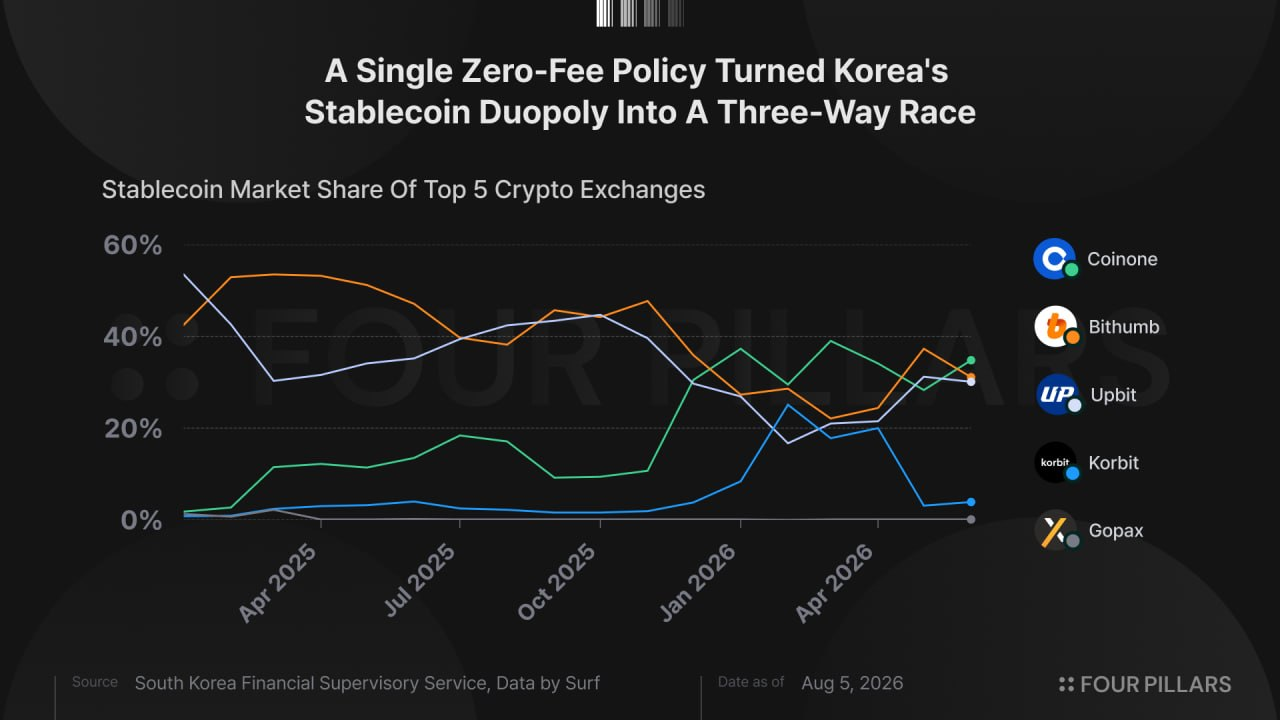
A Data-Driven Look at Upbit's Stablecoin Market Expansion Strategy (Link)
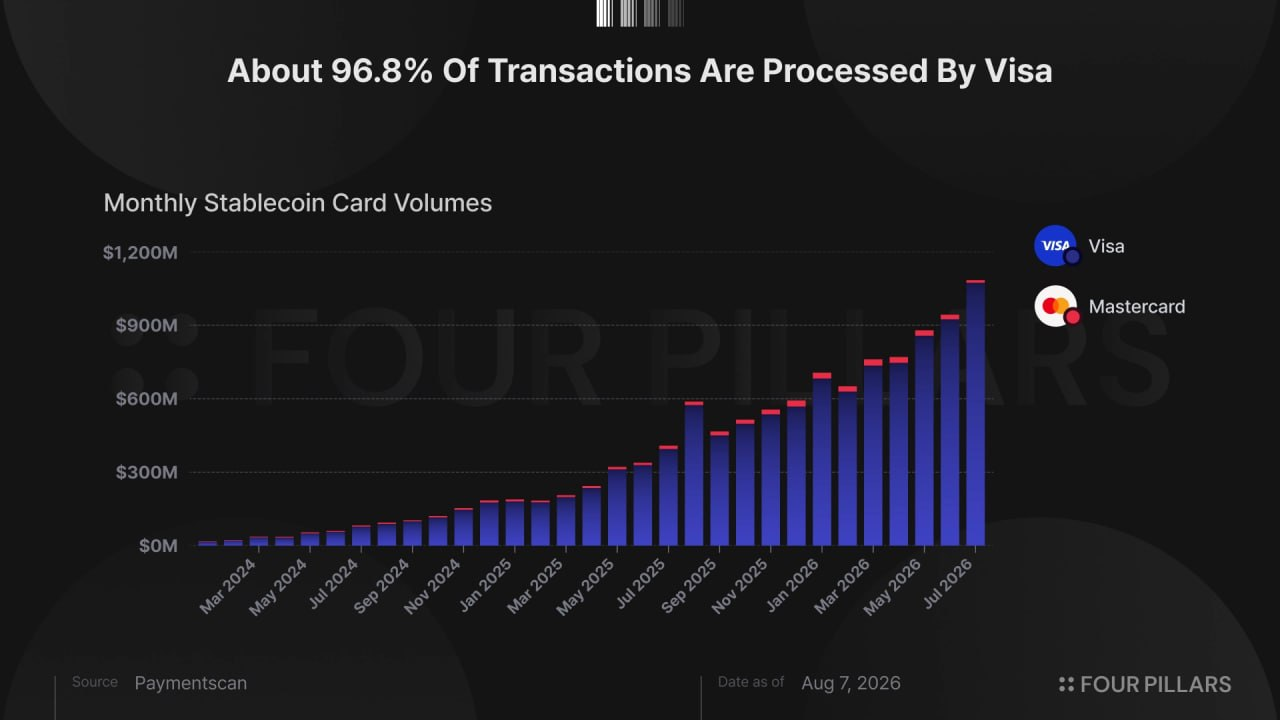
Visa’s Stablecoin Strategy (Link)
3. Four Pillars Weekly
: : How Regulated Token Standards Are Being Designed (Link)
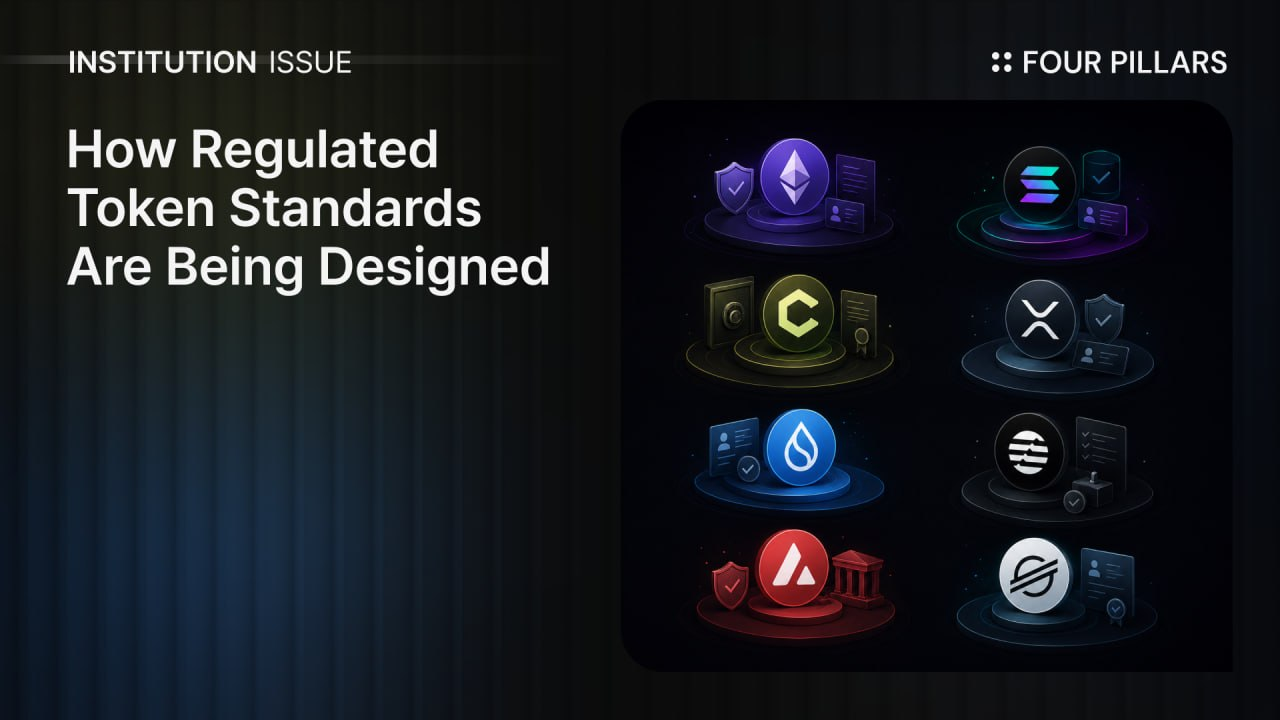
- Regulated-token standards on the EVM have evolved not toward a single unified specification, but toward a division of roles by function. ERC-1450, ERC-3643, and ERC-7943 are therefore better understood not as competing standards, but as complementary components responsible for issuance, identity, enforcement, and integration, respectively.
- The key difference across chains is not whether regulatory functionality exists, but where it is implemented and enforced. The EVM preserves a high degree of flexibility at the level of individual asset contracts; Solana and Move-based chains place more of this functionality in shared token frameworks; Stellar and the XRPL embed it in the ledger; and Canton and Avalanche L1s extend it into the market- and network-operations layers.
- The competitiveness of regulated-token standards will likely depend less on the number of features they support than on how flexibly they can adapt to regulatory change. A more practical direction is a compliance stack that standardizes recurring enforcement functions, such as freezing, forced transfers, and pre-transfer validation, while separating product-specific policies, including identity providers, jurisdictional rules, and holding limits, into replaceable modules.
: : Enhanced: Onchain Structured Product for a $30T Asset, Earning 0% (Link)

- Gold is a $30T+ asset, but it produces no cash flow. The only ways gold has generated yield were lending it out and selling its volatility (covered calls). Covered calls in particular are well proven, yet the yield was only ever accessible through institutions and asset managers, reachable only after absorbing costs such as management fees, issuer credit, fixed strikes, and opaque pricing.
- Onchain gold, offered as the alternative, is ahead on custody and mobility, but on yield alone it falls short of offchain gold. Lending suffers from thin borrow demand, and AMM LPs erode gold's upside exposure through impermanent loss.
- Enhanced is a general-purpose structured product infrastructure. For volatility yield, it can write covered calls via a competitive RFQ auction among institutional market makers, turning the asset’s own volatility into a recurring premium yield.
- The PAXG Volatility Income Vault is introduced as the first of Enhanced's "Thesis Vaults," a class of strategy vaults the Enhanced team created to express a defined payoff or outcome using options and, in the future, even binary-event positions. Specifically for this Vol Income Vault, that outcome is yield on a typically non-income-generating asset.
- Gold is only the starting point. The same engine will expand to tokenized equities, commodities, and the broader RWA universe, marking the beginning of a new generation of onchain structured products: defined outcomes delivered as single-click vaults.
: : 2026 Q2 Hyperliquid Report (Link)

- Q1 proved Hyperliquid could house all of finance. Q2 is the quarter the rest of finance began to catch up.
- The recognition showed first in real-world assets. Perpetuals on HIP-3 set records across equities, commodities, and pre-IPO names, climbing from 1.8% of matched volume to 20.7% to 32.2% across three quarters, $213B in Q2, nearly a third of everything the exchange traded. A private rocket company was priced here on a Saturday with the New York Stock Exchange closed, and by July a Chinese chipmaker traded onchain above where its Shanghai listing had settled. The parallel financial system that keeps its own hours was no longer a description of the future. That record volume now runs through a single deployer, and the $5.6B stablecoin float behind it has standardized on one issuer, the concentration that comes with winning.
- The recognition then took financial form. In Q1, four asset managers filed for HYPE ETFs; in Q2, the first three began trading, giving allocators who cannot custody the token a regulated way to hold it. Treasury companies raised capital and scaled, led by Hyperliquid Strategies at 29.3M HYPE. The Assistance Fund and treasuries now hold 7.7% of supply and keep buying, the Fund to burn and the treasuries to hold, against net issuance under a million tokens a quarter.
- HYPE rose 79% to a new all-time high of $76.90 while Bitcoin fell 14%, a second straight quarter it tracked the business beneath it while the majors sold off. Protocol revenue troughed in April and recovered to its strongest month since November, closing the quarter at $169M with $141M returned to holders through buybacks and cumulative protocol revenue past $1B. A team owed $4.3B in vested tokens claimed 4.3% of it while the price doubled.
- This report is a product of the Hyperliquid Research Collective (HRC), the independent research hub created by GLC Research and Four Pillars to reduce information asymmetry around Hyperliquid. With the continued support of HypurrCollective, Hyperliquid Strategies, Hyperion DeFi, and Altus (prev. B-Harvest), we remain committed to producing accessible, high-quality research. We are grateful to our sponsors for making this work possible.
: : Does Ethereum Need to Cut Issuance Right Now? (Link)
- TIB (EIP-8363, Tapered Issuance Burn) proposes burning a portion of validator rewards so that net staking yield reaches zero once 50% of the ETH supply is staked. It was submitted just two days before the review discussions for Hegotá, the next hard fork, and the community has been critical of both its substance and the way it appeared without prior consultation.
- A burn applies to everyone equally at the protocol level, but it is not neutral in the real validator market. As yield falls, solo stakers and independent operators are pushed out first, the validator set concentrates among a few large players, and the effects reach the entire onchain economy that treats staking yield as its base rate.
- Even so, Ethereum's issuance model must change eventually, because the validator's role and cost structure are being redrawn at the network level. The problem is the order of operations. Agree first on how the validator's role will evolve and how much security budget that role deserves, then design the reward structure to match.
: : WebX 2026 Field Notes: Japan’s Year of Finance (Link)

- WebX is Asia’s largest Web3 conference, hosted by CoinPost in Tokyo on July 13 and 14 with more than 13,000 attendees, roughly 300 speakers, and over 150 companies across four stages.
- Four Pillars participated as the exclusive research partner, and this article organizes what we heard into the eight themes that dominated the conference.
- The defining event of the conference happened partly off stage. Japan’s FIEA amendment, the bill that moves crypto from the Payment Services Act into securities law, cleared its final Upper House committee while the panels discussing it were still running.
- Across every stage, one demand thesis recurred regardless of the topic. The heaviest users of stablecoins and tokenized assets will not be people. By JPYC’s own count, 99.3% of stablecoin payment volume is already non-human.
Comments
4. Macro & Onchain Metrics
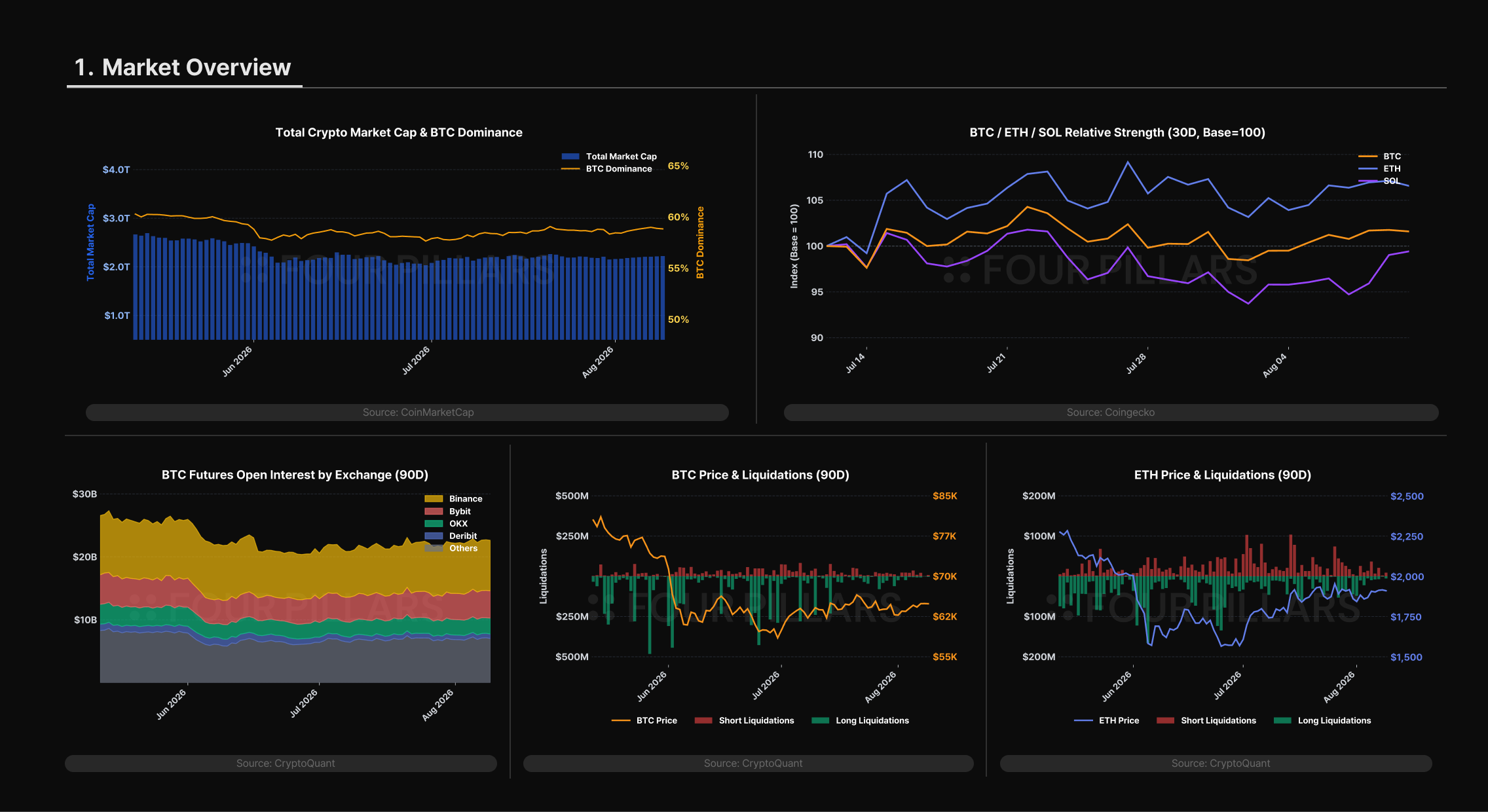
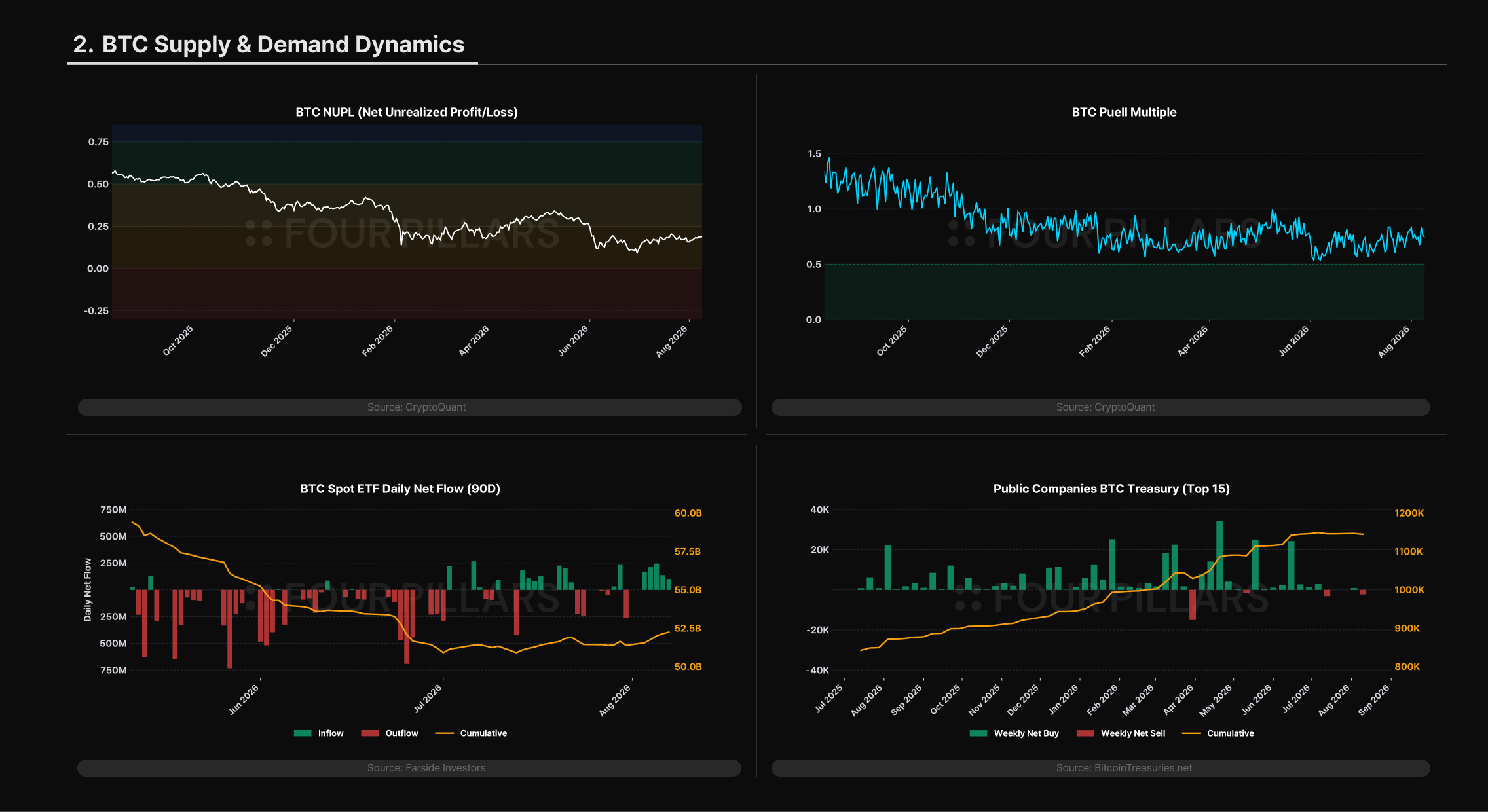
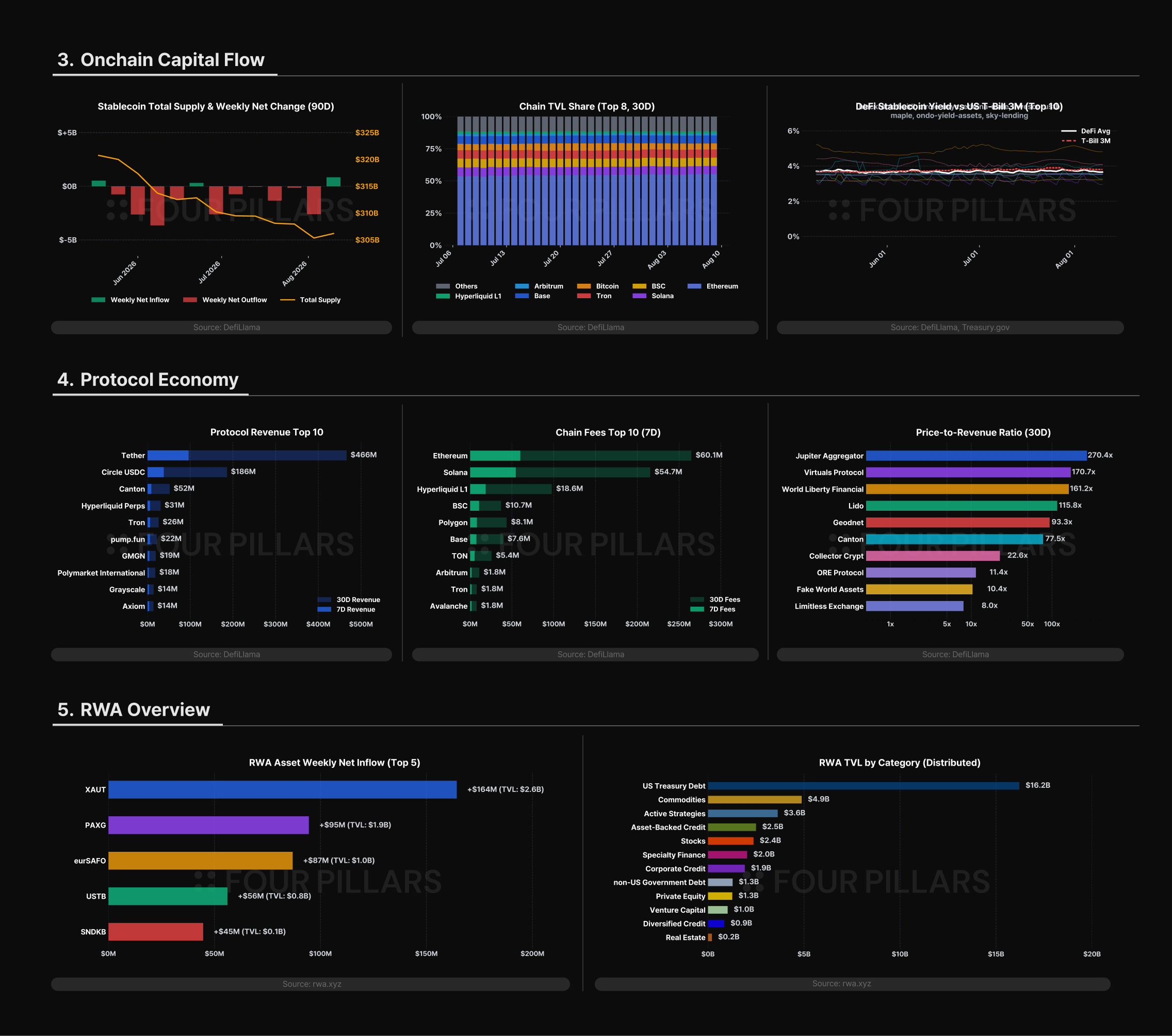
Some of the charts below are powered by CryptoQuant. For those interested in exploring the underlying data in greater detail, CryptoQuant provides access to a comprehensive suite of onchain and market analytics used by institutional participants.
The author of this report may have personal holdings or financial interests in assets or tokens discussed herein. However, the author affirms that no transactions have conducted using material non-public information obtained in the course of research or drafting. This report is intended solely for general information purposes and does not constitute legal, business, investment, or tax advice. It should not be used as a basis for making any investment decisions or as guidance for accounting, legal, or tax matters. Any references to specific assets or securities are made for informational purposes only and should not be construed as an offer, solicitation, or recommendation to invest. The opinions expressed herein are those of the author and may not reflect the views of any affiliated institutions, organizations, or individuals. The opinions and analyses expressed herein are subject to change without prior notice. In addition, beyond the individual disclosures included in each report, Four Pillars, may hold existing or prospective investments in some of the assets or protocols discussed herein. Furthermore, FP Validated, a division of Four Pillars, may already be operating as a node in certain networks or protocols discussed herein or may do so in the future. Please see below links in the footer for FP Validated's participating network disclosures and for broader disclosure details.
![CLARITY Act Fails, the SEC Steps In [FP Weekly 39]](/_next/image?url=https%3A%2F%2Fkrotgrfjzckvumudxopj.supabase.co%2Fstorage%2Fv1%2Fobject%2Fpublic%2Fassets%2Fimg%2Fcontent%2Farticle%2Fnotion-import%2Fmqlpp6muat2oq6.png&w=3840&q=75)

![CLARITY Act Faces the Senate, $LAPTOP Faces Reality [FP Weekly 38]](/_next/image?url=https%3A%2F%2Fkrotgrfjzckvumudxopj.supabase.co%2Fstorage%2Fv1%2Fobject%2Fpublic%2Fassets%2Fimg%2Fcontent%2Farticle%2Fnotion-import%2Fc3ygeemu0lqxb5.png&w=3840&q=75)

![Robinhood Takes Over Onchain
[FP Weekly 37]](/_next/image?url=https%3A%2F%2Fkrotgrfjzckvumudxopj.supabase.co%2Fstorage%2Fv1%2Fobject%2Fpublic%2Fassets%2Fimg%2Fissues%2Frobinhood-takes-over-onchain-fp-weekly-37.png%3Ft%3D1788765790150&w=3840&q=75)