


Table of Contents
Researcher

Key Takeaways
- Regulated-token standards on the EVM have evolved not toward a single unified specification, but toward a division of roles by function. ERC-1450, ERC-3643, and ERC-7943 are therefore better understood not as competing standards, but as complementary components responsible for issuance, identity, enforcement, and integration, respectively.
- The key difference across chains is not whether regulatory functionality exists, but where it is implemented and enforced. The EVM preserves a high degree of flexibility at the level of individual asset contracts; Solana and Move-based chains place more of this functionality in shared token frameworks; Stellar and the XRPL embed it in the ledger; and Canton and Avalanche L1s extend it into the market- and network-operations layers.
- The competitiveness of regulated-token standards will likely depend less on the number of features they support than on how flexibly they can adapt to regulatory change. A more practical direction is a compliance stack that standardizes recurring enforcement functions, such as freezing, forced transfers, and pre-transfer validation, while separating product-specific policies, including identity providers, jurisdictional rules, and holding limits, into replaceable modules.
Even within Ethereum’s EVM, the environment most familiar to institutions, several ERCs address broadly similar requirements for regulated tokens. They commonly support transfer restrictions, investor-eligibility checks, freezing, forced transfers, and the recovery of lost assets. Yet the legal structures and operating authorities assumed by each standard differ in important ways.
Beyond the EVM, other chains have added comparable capabilities at the token-program, ledger, or network layer, further expanding the range of ways in which regulated assets can be implemented.
This reflects, in part, the fact that regulated-token standards have yet to settle into a clear structure. More fundamentally, however, it shows why the functions required by regulated assets are difficult to contain within a single specification. Who maintains the legal record of a security, which institution certifies investor eligibility, and how much control an operator should retain when an incident occurs all vary by product and jurisdiction.
Accordingly, the market appears to be moving not toward one fully self-contained standard, but toward an architecture in which these functions are distributed across multiple layers and combined as needed.
1. Regulated-Token Standards on the EVM
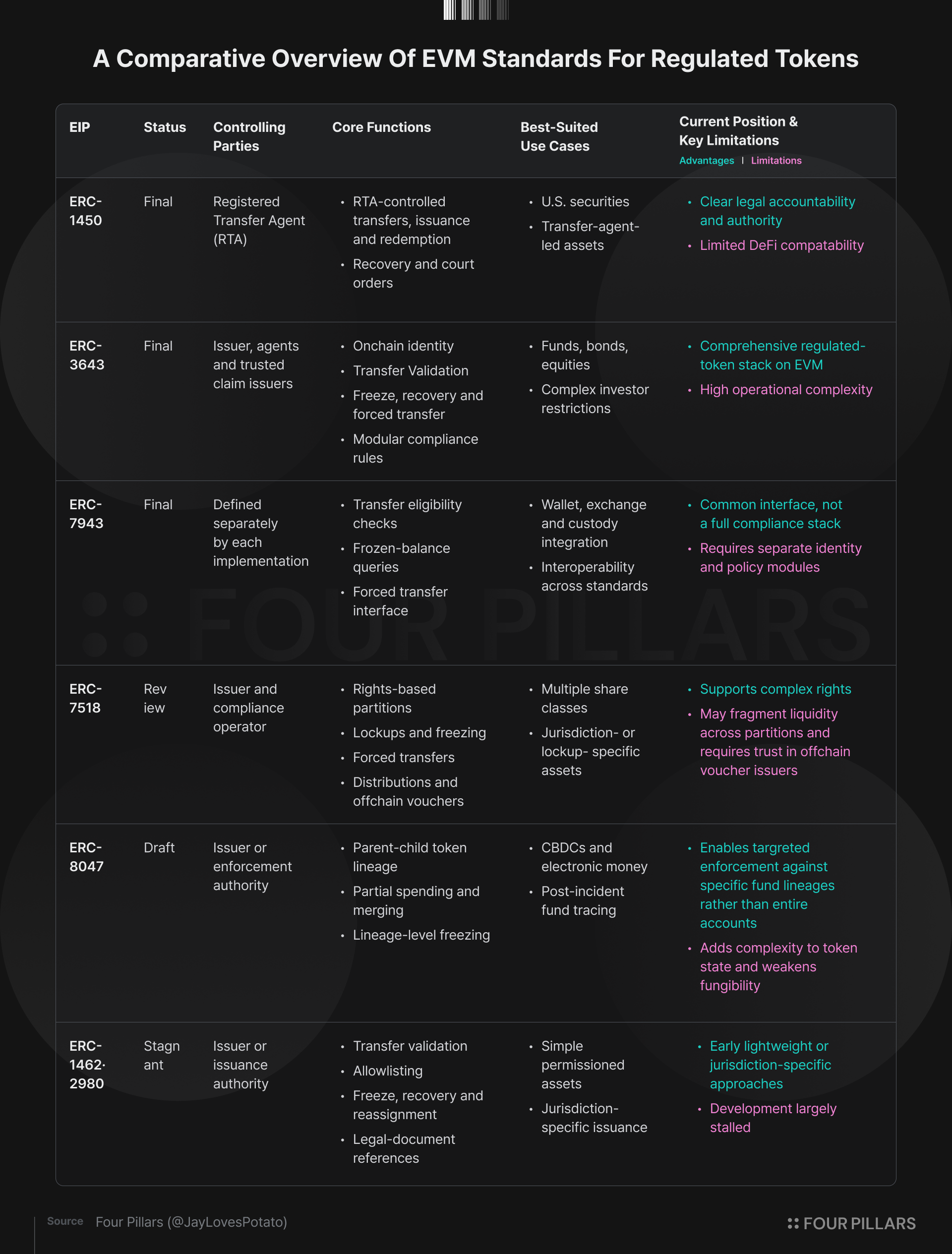
Early standards largely sought to reproduce the operating structure of traditional finance directly within the token contract. Under ERC-1450, a Registered Transfer Agent executes not only issuance and redemption, but every transfer, while ordinary users are restricted from calling transfer and approve. This makes it clear who maintains the legal record and who is responsible for responding to court orders or lost keys. At the same time, however, it sits far from the permissionless asset movement assumed by conventional DEXs and lending protocols.
ERC-3643 distributes these regulatory functions across a token contract, an Identity Registry, a Trusted Issuers Registry, and separate Compliance modules, rather than concentrating them under a single authority. Transfers are validated against claims issued by trusted entities, including KYC status, residency, and accredited-investor eligibility, while issuers can add rules governing matters such as investor counts and country-level holding limits. The ability to replace individual rules while preserving the basic ERC-20 structure is a meaningful advantage. The trade-off is the operational burden of coordinating multiple contracts, identity issuers, and privileged administrative roles.
The more recent ERC-7943 takes a different approach: it does not define the regulatory policy itself. Instead, it exposes a common set of interfaces, including canSend, canReceive, canTransfer, frozen-balance queries, and forced-transfer functions. This allows wallets, exchanges, custodians, and DeFi services to interact with otherwise different regulated assets in a consistent way. Put differently, ERC-3643 is a stack for creating regulated tokens, whereas ERC-7943 is closer to an integration layer that connects multiple stacks. The recent addition of ERC-7943 support to a CMTAT implementation further illustrates how this minimal interface can be layered on top of an existing issuance standard.
ERC-7518 and ERC-8047 address more specialized requirements. ERC-7518 applies different share classes, jurisdictions, and lockup conditions to individual ERC-1155 partitions, while ERC-8047 records parent-child lineage as assets move, allowing enforcement to target a particular flow of funds rather than an entire account. The former makes distinctions in rights within a single asset more explicit; the latter makes post-incident tracing and enforcement more precise. Rather than replacing ERC-3643 as all-in-one standards, both are more likely to serve as modules that complement broader compliance stacks.
2. Where Other Chains Place Regulatory Functionality
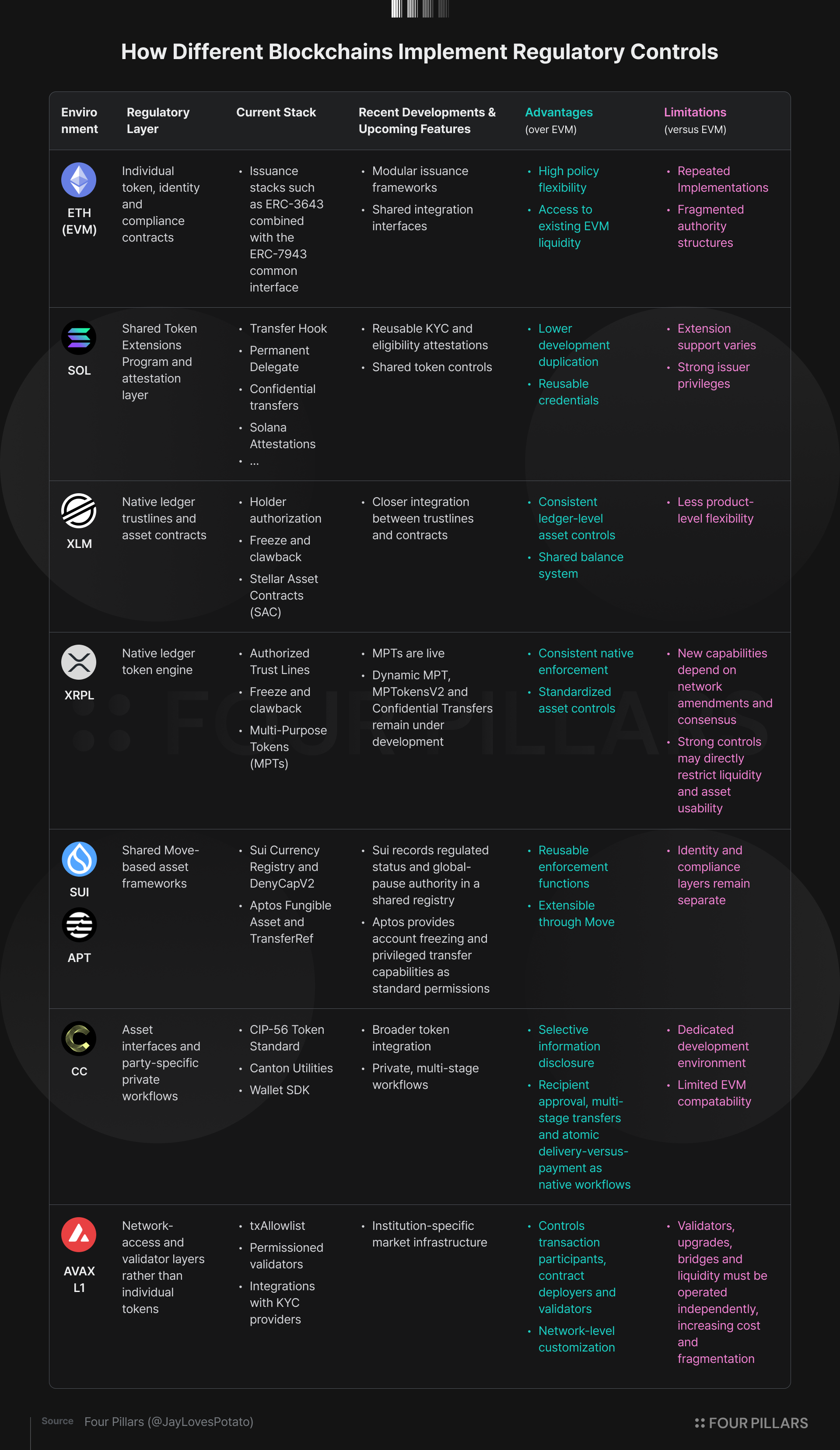
Solana’s approach is distinguished by placing recurring token functionality at a lower, shared layer. Features such as Transfer Hook, Permanent Delegate, and Confidential Transfer are provided through a common Token Extensions library, while the Solana Attestation Service allows applications to reuse offchain information such as KYC status, geography, and investor eligibility. This reduces the need for each issuer to rebuild and audit the same functionality independently. Integration can still break, however, when a wallet or protocol does not support a given extension; moreover, assets configured with powerful issuer controls such as Permanent Delegate must be treated by DeFi applications as carrying an additional layer of counterparty risk.
Stellar and the XRPL expose authorization, freezing, and clawback as properties of ledger-native assets. Because these controls apply consistently across transfers and native trading functionality, applications have less need to reinterpret custom logic for each token contract. Stellar is expanding the connection between ledger assets and smart-contract environments through Stellar Asset Contracts, while the XRPL is building around MPTs, moving from permissioned holding, freezing, and recovery toward privacy-related functionality. The deeper these rules are embedded in the ledger, however, the more their evolution depends on network upgrades and consensus. Control settings may also place more direct constraints on an asset’s liquidity and range of use.
Sui and Aptos sit somewhere between the EVM’s contract-centric model and the ledger-native approach. Sui records deny-list status and global-pause authority for regulated assets in its Currency Registry, while Aptos uses the Fungible Asset framework’s TransferRef to freeze accounts or, where necessary, bypass those restrictions through privileged transfers. Recurring enforcement functions, such as address blocking and emergency pauses, are supplied by the framework. More complex policies, including investor classifications and country-specific holding limits, remain the responsibility of separate Move modules. In this respect, their architecture most closely resembles the modular direction in which the EVM ecosystem itself is moving.
Canton extends the scope of regulation beyond the token and into the operation of the market as a whole. CIP-56 standardizes not only balance transfers, but also party-specific information disclosure, recipient approval, and atomic delivery-versus-payment, while Token Standard V2 is being tested on a separate DevNet in 2026. This design offers stronger operational consistency and privacy, but it also requires a dedicated identity and development environment. As a result, existing public-chain liquidity and applications cannot simply be carried over.
Avalanche L1s are better understood as an option for building a regulated market itself, rather than merely issuing a regulated token. Operators can use allowlists to restrict transaction participants and contract deployers, while requiring validators to satisfy KYC, AML, or licensing conditions. The stack can also connect identity providers such as Jumio and Keyring to txAllowlist, making it well suited to institution-only exchanges or payment networks. The trade-off is operational: validators, upgrades, bridges, and liquidity must all be managed independently, creating greater cost and fragmentation than issuing a single token on an existing EVM network.
3. Separating Common Enforcement Functions from Regulatory Policy
Taken together, these approaches suggest that both extremes come with clear limitations, whether the entire regulatory stack is embedded into the network or every function is left to an individual ERC. Common enforcement functions that recur across most regulated assets, including pre-transfer validation, freezing, forced transfers, emergency pauses, and metadata that discloses administrative powers and their associated risks, are best placed close to the token framework, the ledger, or a minimal interface such as ERC-7943. Doing so reduces implementation variance and audit costs across issuers, while allowing wallets, exchanges, and custodians to identify an asset’s control structure consistently.
By contrast, decisions about which identity providers to trust, which jurisdictions to permit, how to calculate investor-level holding limits and lockups, and who may execute a legal order are better left to asset-specific ERCs or separate modules. These rules differ by product and jurisdiction and must be updated as the law changes. Hard-coding them into a network’s base rules would not only slow down upgrades, but also risk turning the policy choices of a particular financial market into defaults for a general-purpose chain.
In other words, the regulated-token market is more likely to develop as a compliance stack than to converge on a single standard. Under this model, replaceable identity, jurisdiction, and product-specific rules would sit on top of common enforcement functions. Ethereum and the broader EVM ecosystem retain an advantage in policy flexibility and access to existing liquidity; ledger-native chains offer greater consistency of enforcement and operational simplicity; and purpose-built networks such as Canton are strongest in privacy and institutional workflows.
Adoption, therefore, is unlikely to be determined by which standard contains the longest list of features. More important will be whether regulatory policies can change without requiring the asset to be reissued or forcing wallets, exchanges, and custodians to rebuild their integrations from scratch. Another key test will be whether external participants can clearly identify, assess, and manage the powerful control rights embedded in the asset.
The author of this report may have personal holdings or financial interests in assets or tokens discussed herein. However, the author affirms that no transactions have conducted using material non-public information obtained in the course of research or drafting. This report is intended solely for general information purposes and does not constitute legal, business, investment, or tax advice. It should not be used as a basis for making any investment decisions or as guidance for accounting, legal, or tax matters. Any references to specific assets or securities are made for informational purposes only and should not be construed as an offer, solicitation, or recommendation to invest. The opinions expressed herein are those of the author and may not reflect the views of any affiliated institutions, organizations, or individuals. The opinions and analyses expressed herein are subject to change without prior notice. In addition, beyond the individual disclosures included in each report, Four Pillars, may hold existing or prospective investments in some of the assets or protocols discussed herein. Furthermore, FP Validated, a division of Four Pillars, may already be operating as a node in certain networks or protocols discussed herein or may do so in the future. Please see below links in the footer for FP Validated's participating network disclosures and for broader disclosure details.
![CLARITY Act Faces the Senate, $LAPTOP Faces Reality [FP Weekly 38]](/_next/image?url=https%3A%2F%2Fkrotgrfjzckvumudxopj.supabase.co%2Fstorage%2Fv1%2Fobject%2Fpublic%2Fassets%2Fimg%2Fcontent%2Farticle%2Fnotion-import%2Fc3ygeemu0lqxb5.png&w=3840&q=75)

![Robinhood Takes Over Onchain
[FP Weekly 37]](/_next/image?url=https%3A%2F%2Fkrotgrfjzckvumudxopj.supabase.co%2Fstorage%2Fv1%2Fobject%2Fpublic%2Fassets%2Fimg%2Fissues%2Frobinhood-takes-over-onchain-fp-weekly-37.png%3Ft%3D1788765790150&w=3840&q=75)

![ATLAS & Entropy [FP Weekly 36]](/_next/image?url=https%3A%2F%2Fkrotgrfjzckvumudxopj.supabase.co%2Fstorage%2Fv1%2Fobject%2Fpublic%2Fassets%2Fimg%2Fissues%2Fatlas-entropy-fp-weekly-36.png%3Ft%3D1788163807734&w=3840&q=75)