

![ATLAS & Entropy [FP Weekly 36]](/_next/image?url=https%3A%2F%2Fkrotgrfjzckvumudxopj.supabase.co%2Fstorage%2Fv1%2Fobject%2Fpublic%2Fassets%2Fimg%2Fissues%2Fatlas-entropy-fp-weekly-36.png%3Ft%3D1788163807734&w=3840&q=75)
Table of Contents
- 1. Major News
- [Crypto] LayerZero Unveils ATLAS, a Trading Backend for Global Markets
- [Investment] Entropy, the HIP-3 Project Backed by Ribbit Capital
- Others
- 2. Data Spotlight
- Koreans Buy the Alt Top, Not the Bitcoin Top (Link)
- The Paradigm Shift of Web3 Hackathons (Link)
- Korea’s Blockchain Industry Is Falling Behind (Link)
- 3. Four Pillars Weekly
- : : Umia: A New Way to Build Crypto Projects (Link)
- : : Talus v2: Building Trust into Agent Execution (Link)
- : : Monthly EIP - Jul 2026 (ft. What the Issuance Debate Reveals About Ethereum Governance) (Link)
- Comments
- 4. Macro & Onchain Metrics
Researcher

1. Major News
[Crypto] LayerZero Unveils ATLAS, a Trading Backend for Global Markets

What Happened?
On August 25, LayerZero unveiled ATLAS, or Aggregated Trading Liquidity and Settlement. ATLAS is a trading infrastructure layer built on Zero, the high-performance blockchain LayerZero announced in February. It integrates matching, clearing, settlement, and risk management into a single stack. Rather than defining ATLAS as a simple decentralized exchange, LayerZero describes it as a headless exchange, or a trading backend without its own frontend, that can be shared by a wide range of exchanges across both crypto and traditional finance.
There are three main types of participants in the ATLAS structure. Trading Venues are responsible for user interfaces and distribution, Market Creators define the assets and markets available for trading, and Market Makers provide the actual liquidity. ATLAS itself does not operate a consumer-facing application or frontend. Instead, users trade through Trading Venues built on top of ATLAS. In other words, rather than ATLAS directly acquiring users under a single exchange brand, the system is designed so that multiple exchanges can build their own products and user experiences on top of the same trading engine.
This structure is intended to address a structural problem in today’s onchain exchange market. When a separate trading application is built on top of a typical DEX, that application must charge an additional fee on top of the fee already charged by the underlying exchange in order to generate revenue. However, larger traders eventually have an incentive to bypass the application and move directly to the frontend of the underlying exchange. This creates a situation where the infrastructure provider is also the strongest frontend competitor.
The problem is somewhat different in institutional markets. Even a single stock trade today involves order matching, clearing, settlement, and risk management across separate systems and institutions, with additional reconciliation required between each stage. ATLAS aims to integrate these functions into a single stack without operating its own frontend. This would allow not only crypto-native trading applications, but also incumbent exchanges and financial institutions, to use the backend while maintaining their existing customer relationships and businesses.
To support this structure, ATLAS offers two configurations: Open ATLAS and Institutional ATLAS. Open ATLAS is designed for operators building open markets such as crypto trading applications and prediction markets. Institutional ATLAS uses the same engine, while allowing each institution to apply its own rules around areas such as KYC and market access. This is also why LayerZero positions ATLAS not simply as a perpetual futures DEX, but as infrastructure for global markets.
Its performance targets are also highly aggressive. Based on the test environment disclosed by LayerZero, ATLAS has a median latency of less than 1 ms, with p95 latency of 1.418 ms and p99 latency of 2.641 ms. At mainnet launch, the system is expected to be initially provisioned to process 200,000 transactions per second. LayerZero also expects latency to decline further into the tens of microseconds in a colocated environment. However, it is important to distinguish these figures from live mainnet performance, as they were reported in a pre-launch environment.
The headless design is also reflected in ATLAS’s revenue model. ATLAS charges a single all-in fee for each trade and provides Trading Venues with a 20% to 65% rebate depending on trading volume and the amount of ZRO staked. Of the remaining fees after the Trading Venue share, 25% goes to the Market Creator responsible for creating the market, while the remaining 75% is used to buy ZRO from the market and burn it.
As a result, the role of ZRO also expands beyond its function in the existing LayerZero messaging protocol. On Zero, ZRO is used for network security, gas, and governance. Within ATLAS, it also becomes a staking asset that determines a Trading Venue’s rebate tier and an asset that absorbs a portion of trading fees. If trading volume grows according to LayerZero’s intended design, ATLAS usage would therefore translate directly into ZRO buybacks and burns.
Researcher’s Comment
The most obvious comparison for ATLAS is Hyperliquid. The two projects are similar in that both are building high-performance onchain infrastructure optimized specifically for trading, rather than building an exchange on top of a general-purpose blockchain. Just as Hyperliquid’s HyperCore handles the order book and margin engine at the protocol level, ATLAS is also designed to combine CEX-level execution performance with onchain verifiability.
The key difference, however, lies in who owns the user. Hyperliquid is both the trading engine and the largest frontend and liquidity hub within its own ecosystem. Through HIP-3 and Builder Codes, it has expanded the ability for external operators to create their own markets and frontends, but the starting point remains the user base and liquidity that are already concentrated within Hyperliquid itself.
ATLAS, by contrast, is designed from the beginning without its own frontend. Trading Venues own the user experience and distribution, while ATLAS remains a neutral trading engine underneath. For existing exchanges and financial institutions, this matters because it allows them to retain their customers without competing directly against their infrastructure provider.
In that sense, if Hyperliquid represents a model that expands a platform around one dominant onchain exchange, ATLAS is closer to a model that begins with a backend shared by multiple exchanges.
The challenge is liquidity. Hyperliquid operates its own frontend and was able to concentrate early users and liquidity in one place. ATLAS, on the other hand, depends on external Trading Venues and Market Makers to bring those users and liquidity. This is why the headless structure can be both a strength in attracting institutions and exchanges and a weakness during the early stages of market formation.
Ultimately, the first thing to watch with ATLAS is not TPS, but who actually builds exchanges on top of ATLAS and how much liquidity those venues are able to aggregate. If Hyperliquid has demonstrated the potential of a high-performance onchain exchange, ATLAS must prove that the same type of infrastructure can extend beyond a single exchange and become a shared backend for multiple markets.
[Investment] Entropy, the HIP-3 Project Backed by Ribbit Capital
What Happened?
On August 24, Entropy, a HIP-3-based perpetual futures exchange on Hyperliquid, announced that it had raised $14 million in a funding round led by Ribbit Capital. At the same time, the project deposited approximately $40 million worth of HYPE required to operate a HIP-3 market and launched a pre-IPO perpetual futures product tracking the valuation of Anthropic as one of its first major markets.
HIP-3 allows external operators to create their own perpetual futures markets while using Hyperliquid’s existing order book and liquidation infrastructure, provided they deposit 500,000 HYPE. Market operators can decide not only which assets to list, but also parameters such as the oracle used to determine prices, leverage, and open interest limits.
Entropy is focused on assets that are difficult to price in existing onchain markets, including equities, indices, commodities, and private companies. Pre-IPO companies are particularly challenging because they do not have a real-time spot price. To address this, Entropy developed a liquidity-weighted oracle that combines external price information with the actual tradable liquidity available in its own order book. When sufficient bid and ask liquidity accumulates in the order book, the system places greater weight on its own market price. When liquidity is weak, it relies more heavily on external pricing data.
The team is also focused heavily on market structure. Entropy has said that its team includes researchers and traders from Citadel Securities, Optiver, Millennium, and Polymarket. It uses RedStone for pricing data and has identified improving oracle and funding-rate design as a core priority, particularly for assets such as stocks that do not trade 24 hours a day and private companies that lack a reliable external reference price.
The investor that drew particular attention in this funding round was Ribbit Capital. Ribbit is a venture capital firm specializing in fintech and has been an active investor in crypto since the early stages of the market. One of its most notable investments was Coinbase, where it participated beginning with the company’s Series A in 2013 and continued investing across multiple subsequent rounds. More recently, it has also invested in financial and crypto infrastructure projects such as Morpho, Figure, Blockaid, and Gauntlet. Its broader portfolio also includes companies such as Robinhood, Revolut, Nubank, and Uniswap, all of which have played a role in expanding the boundaries between financial services and crypto.
Researcher’s Comment
The market Entropy is entering is not entirely new. HIP-3 already includes projects such as trade.xyz, Kinetiq, Paragon, and HyENA. Among them, trade.xyz operates more than 100 markets spanning equities, indices, commodities, and private companies, and currently accounts for a significant share of HIP-3 trading volume. Entropy, by comparison, is still in its early launch stage and is not yet a direct competitor in terms of scale.
Even so, what stands out about Entropy is that it is trying to differentiate itself through market design rather than simply through the number of listed assets. Under HIP-3, all operators use the same Hyperliquid order book and liquidation infrastructure. This limits the extent to which projects can differentiate themselves solely through execution speed or the basic trading experience. Competitive advantage is therefore more likely to depend on which assets they identify first, how reliably they can price those assets, and how much depth of liquidity they can attract to each market.
Entropy is particularly focused on the price formation problem. For assets such as Anthropic that do not have an underlying spot market, it is difficult to create a perpetual futures market using only external price data. At the same time, relying only on the order book price creates the risk that shallow liquidity can distort the market. Entropy’s liquidity-weighted oracle is designed so that the order book itself takes on a larger role in price discovery as real tradable liquidity develops. If successful, this could allow Entropy to expand beyond private companies into other asset classes where reliable benchmark prices are currently too limited to support derivatives markets.
Another potential advantage is capital and team composition. Operating a HIP-3 market requires a deposit of 500,000 HYPE, while additional market-making capital is also needed to establish initial liquidity. Several HIP-3 operators have already shut down, including Ventuals, which previously operated markets for private companies. Entropy, by contrast, launched with $14 million in funding and approximately $40 million worth of HYPE deposited, while also highlighting a team with backgrounds in traditional market making and prediction markets.
Ultimately, Entropy’s competitive advantage will depend less on the fact that Ribbit Capital invested in the project and more on whether it can solve the unresolved price discovery problems within HIP-3. While trade.xyz has already built broad asset coverage and liquidity, Entropy is pursuing a strategy centered on building better market structures for assets that are inherently more difficult to trade.
The key metric to watch is therefore not simply the number of listed markets, but whether liquidity and open interest can continue to grow in new markets such as Anthropic while the oracle remains stable, and whether the same structure can be replicated across other private companies and new asset classes.
Others
Crypto
- Ethena Foundation proposes fee switch for ENA token buybacks among other updates
- HyENA is sunsetting
- Entropy Raises $14M Led by Ribbit Capital, Launches Anthropic Pre-IPO Perpetual Market on Hyperliquid
- HyperEVM is now supported on the Pumpfun app
- LayerZero introduces ATLAS, a universal backend built to power the future of global markets
Institution
- Tokenized stocks are live on Base
- Gemini to provide crypto prediction markets venue for Apex's brokerage clients
- Hyperliquid Policy Center, TradeXYZ urge CFTC to create path for US oil perpetuals
- BitGo buys NYDIG's institutional trading business, expanding derivatives offering
Tech
- Layer 1 blockchain Fogo halts mainnet after attacker receives 400 million FOGO tokens, 10% of circulating supply
- Avici to Fully Refund 1,685 Users After $500K Solana Card Contract Exploit
Investment
- Fasset reaches unicorn status after $68 million raise led by SBI Group
- SBI Holdings invests $270 million in Ajaib, taking 20% stake amid Asia digital asset push
Asia
- Franklin Templeton partners with HashKey to offer tokenized money market fund in Asia
- South Korea's Shinhan to use Visa's stablecoin platform for 'future finance' initiatives
- Mirae Asset maps out $109 billion digital asset push with Digital X
- Dunamu and Visa partner on stablecoin, AI business; Open Standard's OUSD under consideration
2. Data Spotlight
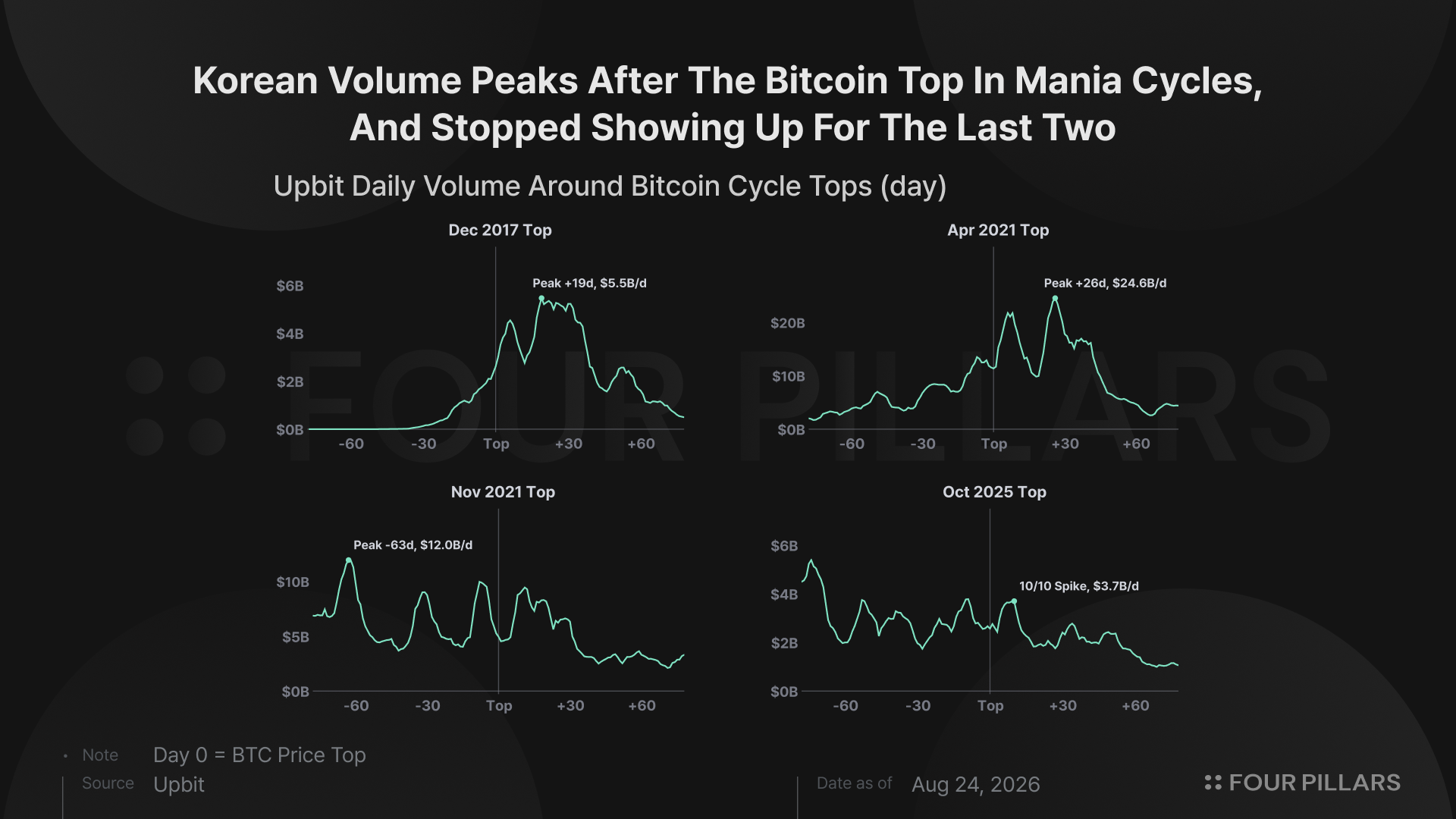
Koreans Buy the Alt Top, Not the Bitcoin Top (Link)
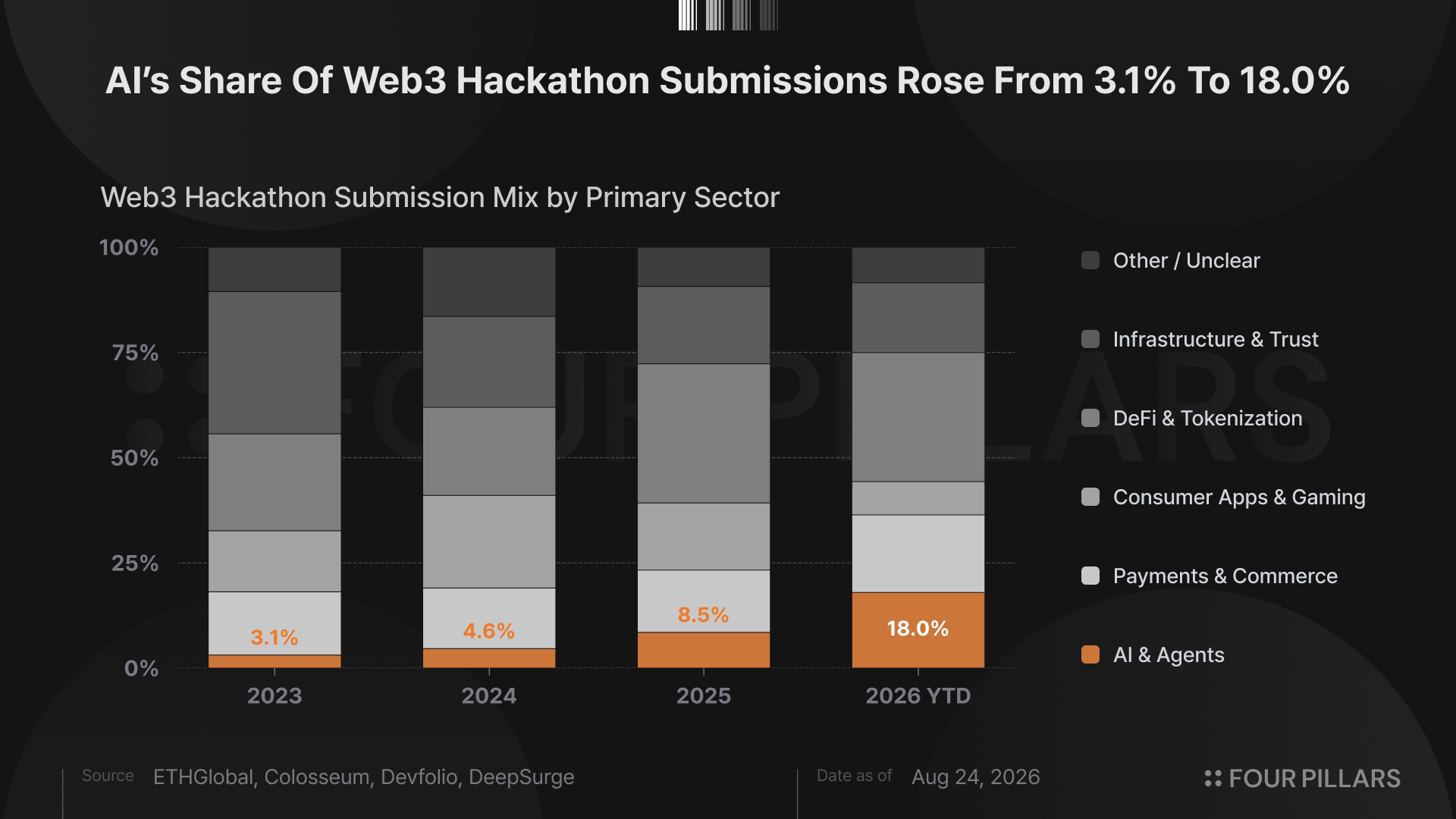
The Paradigm Shift of Web3 Hackathons (Link)
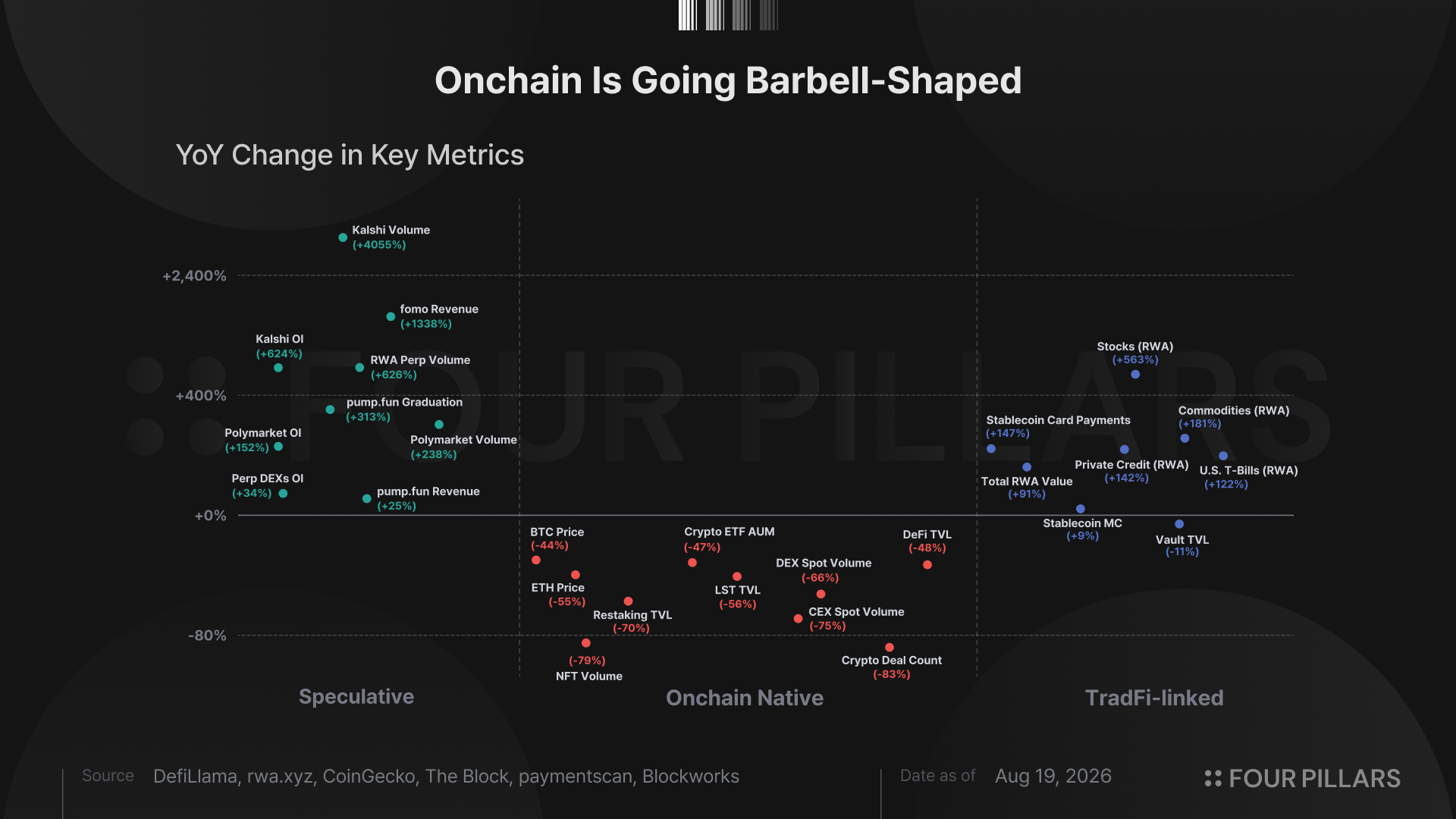
Korea’s Blockchain Industry Is Falling Behind (Link)
3. Four Pillars Weekly
: : Umia: A New Way to Build Crypto Projects (Link)
- If crypto’s real bottleneck is no longer technology but capital formation, Umia is attempting to redesign the entire process onchain—from company formation and token issuance to treasury management.
- What makes Umia particularly interesting is its use of decision markets to govern major corporate decisions, while its Cayman legal structure gives those onchain decisions real-world legal enforceability.
- $UMIA is also designed to align the growth of the ecosystem with the value of the token, making the first auction at the end of August an important test of whether Umia can prove its own capital formation model in practice.
: : Talus v2: Building Trust into Agent Execution (Link)
- Talus v2 merges an agent's permissions, budgets, verification, and scheduling into a single onchain Execution Model. Heavy computation and external data collection stay offchain, while tool permissions, result evidence, payments, and refunds are recorded onchain, making it possible to trace and settle who executed what, under which authority, and at what cost.
- Budgets are fixed before execution: costs are locked per vertex and settled only after the result passes verification, while price snapshots and refunds of unused budget contain mid-run price changes and failures. Three verification paths (basic recording, registered signing keys, and external Move contracts including ZK proofs) let each vertex apply a different level of trust.
- With the v2 mainnet, Leader deposits, tool bonds, and priority fees all converge on the $US token, placing execution records and the token economy on the same settlement layer. Talus's value must now be proven not by registered agents or one-off demos, but by whether the same Task repeatedly generates paid calls, verification decisions, and settlements.
: : Monthly EIP - Jul 2026 (ft. What the Issuance Debate Reveals About Ethereum Governance) (Link)
- July saw a sharp rise in new EIPs. At the Core layer, many proposals focused on redesigning the foundations of Ethereum to keep consensus, verification, and storage costs manageable as the validator set and state continue to grow, including improvements to attestation propagation, post-quantum verification, state tiering, and the state tree. On the ERC side, discussions centered on standardizing regulatory and RWA-related information, while bridging new smart account architectures with existing module ecosystems.
- Following its June restructuring, the Ethereum Foundation stepped up its engagement with governments and institutions, while pushing forward discussions around faster finality. At the same time, it added a board member known for emphasizing security, privacy, and censorship resistance, signaling a clearer effort to expand institutional adoption without losing sight of Ethereum’s core values.
- Meanwhile, the issuance debate reignited by EIP-8363 has grown into a broader governance question, extending well beyond how staking rewards should be adjusted. It exposed the limits of a system in which monetary policy proposals can advance without a sufficiently robust process for validation and stakeholder input, raising a larger question for an increasingly multipolar Ethereum ecosystem: who should build consensus, and through what process?
Comments
4. Macro & Onchain Metrics
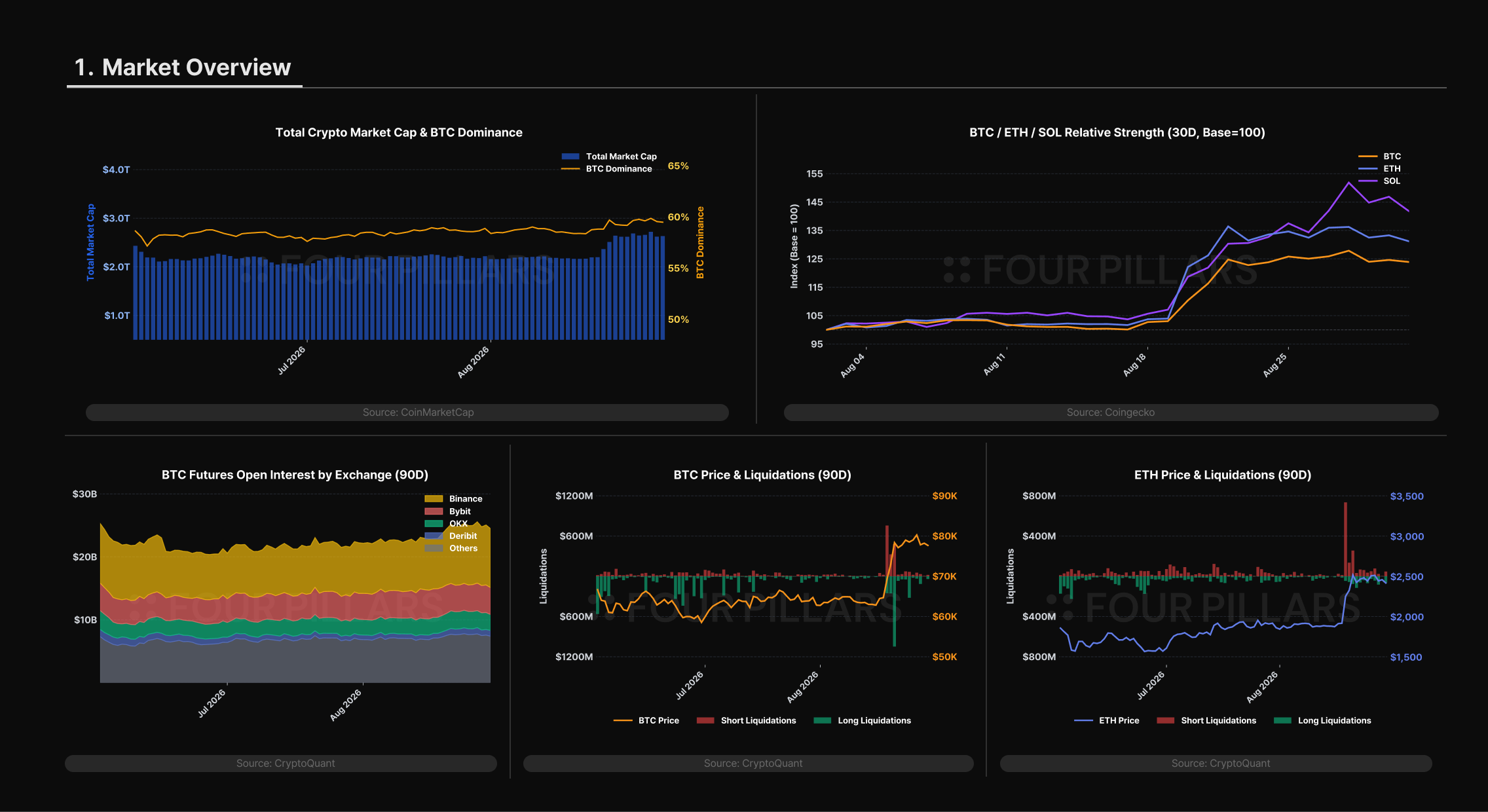
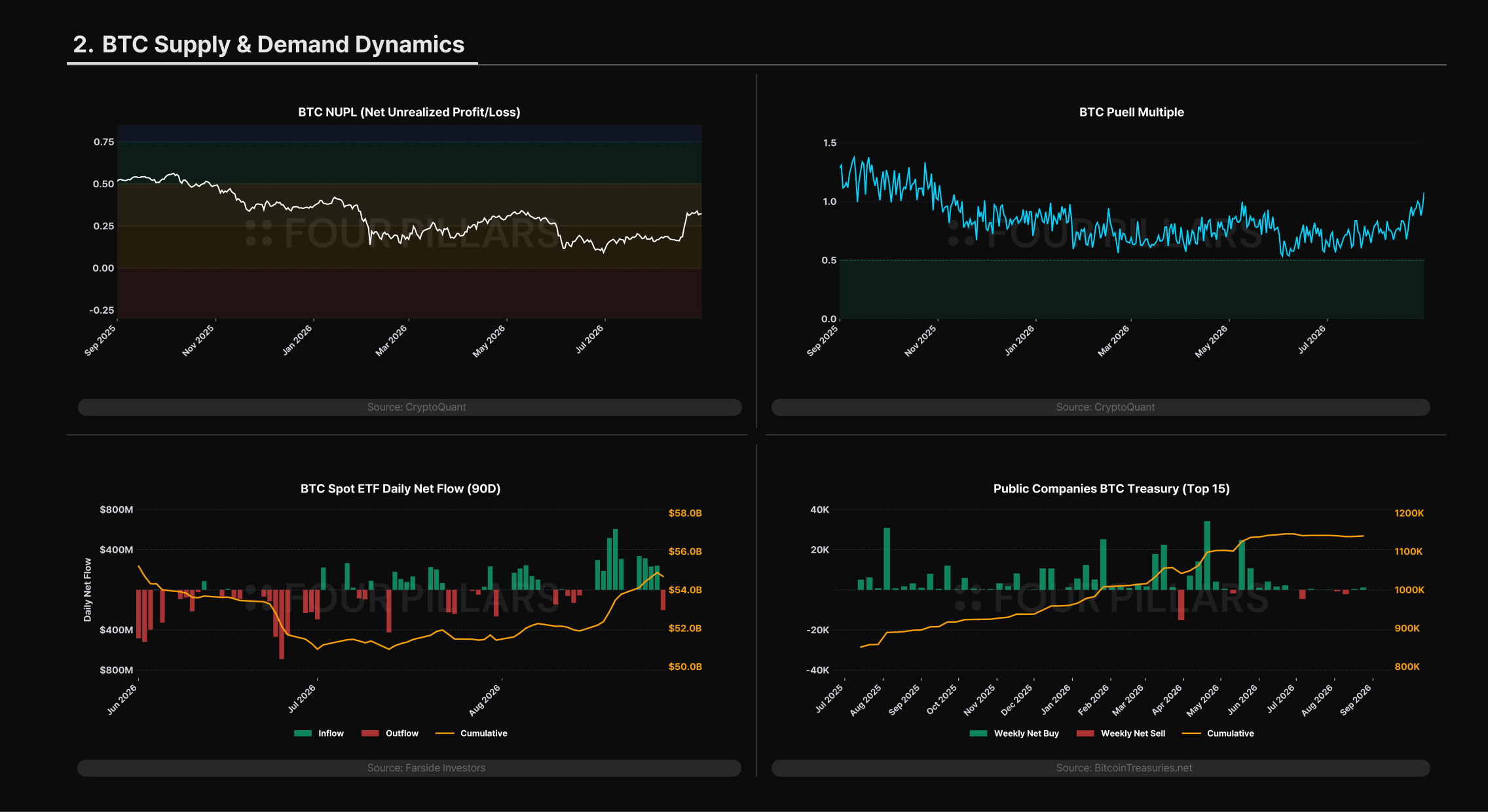
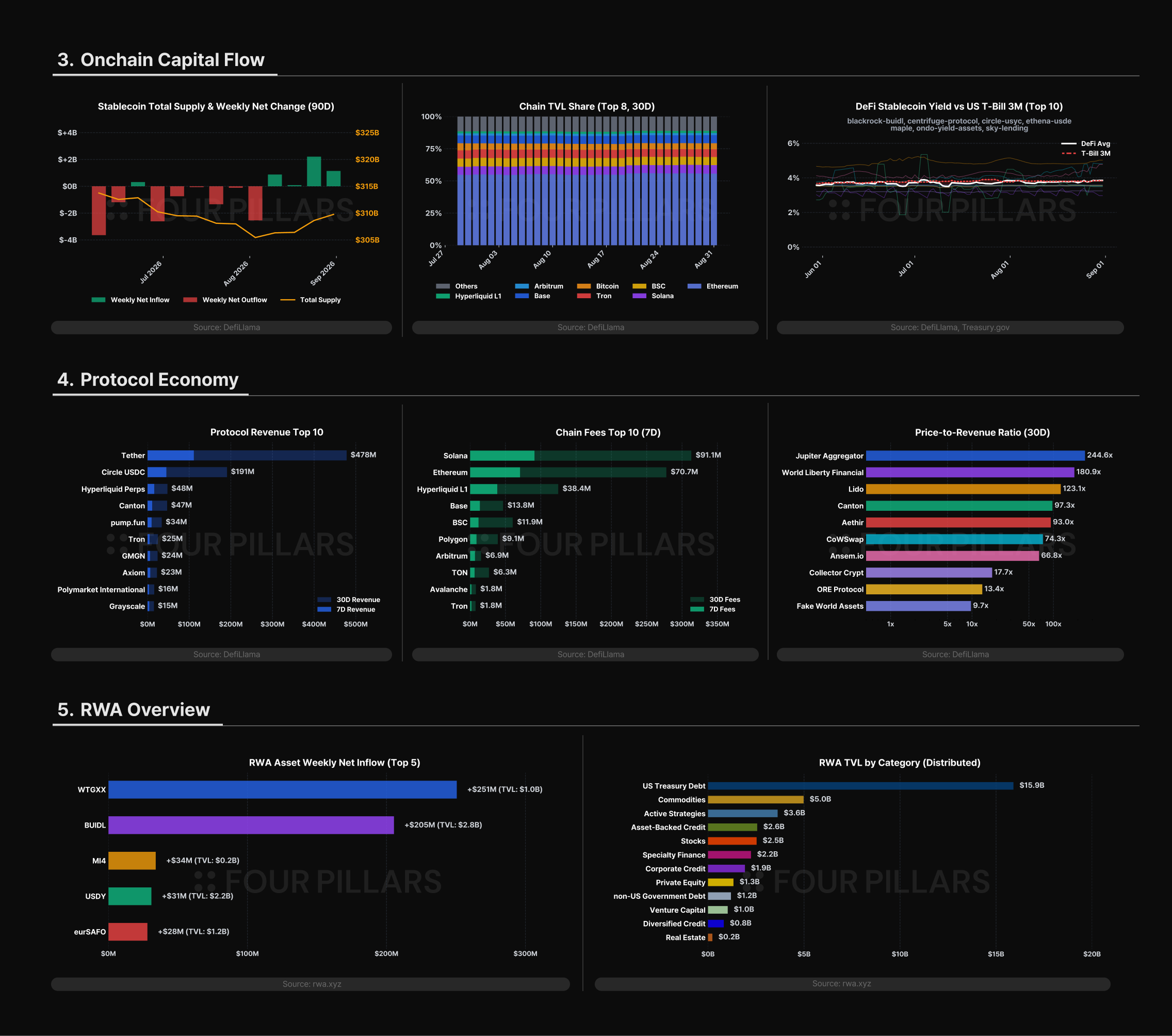
Some of the charts below are powered by CryptoQuant. For those interested in exploring the underlying data in greater detail, CryptoQuant provides access to a comprehensive suite of onchain and market analytics used by institutional participants.
The author of this report may have personal holdings or financial interests in assets or tokens discussed herein. However, the author affirms that no transactions have conducted using material non-public information obtained in the course of research or drafting. This report is intended solely for general information purposes and does not constitute legal, business, investment, or tax advice. It should not be used as a basis for making any investment decisions or as guidance for accounting, legal, or tax matters. Any references to specific assets or securities are made for informational purposes only and should not be construed as an offer, solicitation, or recommendation to invest. The opinions expressed herein are those of the author and may not reflect the views of any affiliated institutions, organizations, or individuals. The opinions and analyses expressed herein are subject to change without prior notice. In addition, beyond the individual disclosures included in each report, Four Pillars, may hold existing or prospective investments in some of the assets or protocols discussed herein. Furthermore, FP Validated, a division of Four Pillars, may already be operating as a node in certain networks or protocols discussed herein or may do so in the future. Please see below links in the footer for FP Validated's participating network disclosures and for broader disclosure details.
![No CLARITY Act, No Problem
[FP Weekly 42]](/_next/image?url=https%3A%2F%2Fkrotgrfjzckvumudxopj.supabase.co%2Fstorage%2Fv1%2Fobject%2Fpublic%2Fassets%2Fimg%2Fcontent%2Farticle%2Fnotion-import%2Fl44zlxmv4r9yqa.png&w=3840&q=75)

![CLARITY Act Fails, the SEC Steps In [FP Weekly 39]](/_next/image?url=https%3A%2F%2Fkrotgrfjzckvumudxopj.supabase.co%2Fstorage%2Fv1%2Fobject%2Fpublic%2Fassets%2Fimg%2Fcontent%2Farticle%2Fnotion-import%2Fmqlpp6muat2oq6.png&w=3840&q=75)

![CLARITY Act Faces the Senate, $LAPTOP Faces Reality [FP Weekly 38]](/_next/image?url=https%3A%2F%2Fkrotgrfjzckvumudxopj.supabase.co%2Fstorage%2Fv1%2Fobject%2Fpublic%2Fassets%2Fimg%2Fcontent%2Farticle%2Fnotion-import%2Fc3ygeemu0lqxb5.png&w=3840&q=75)