


Table of Contents

There is a persistent belief that Korean retail arrives at the end of every bull market and provides the exit. We tested it against the record across Upbit’s 286 KRW markets since 2017, extended back to 2013 with Bithumb and Korbit, and measured against Binance, Coinbase, Bitstamp and Bitfinex. What we found is that Korean mania does mark tops, but the tops it marks belong to the alt market.
1. The Mania Peaks After Bitcoin
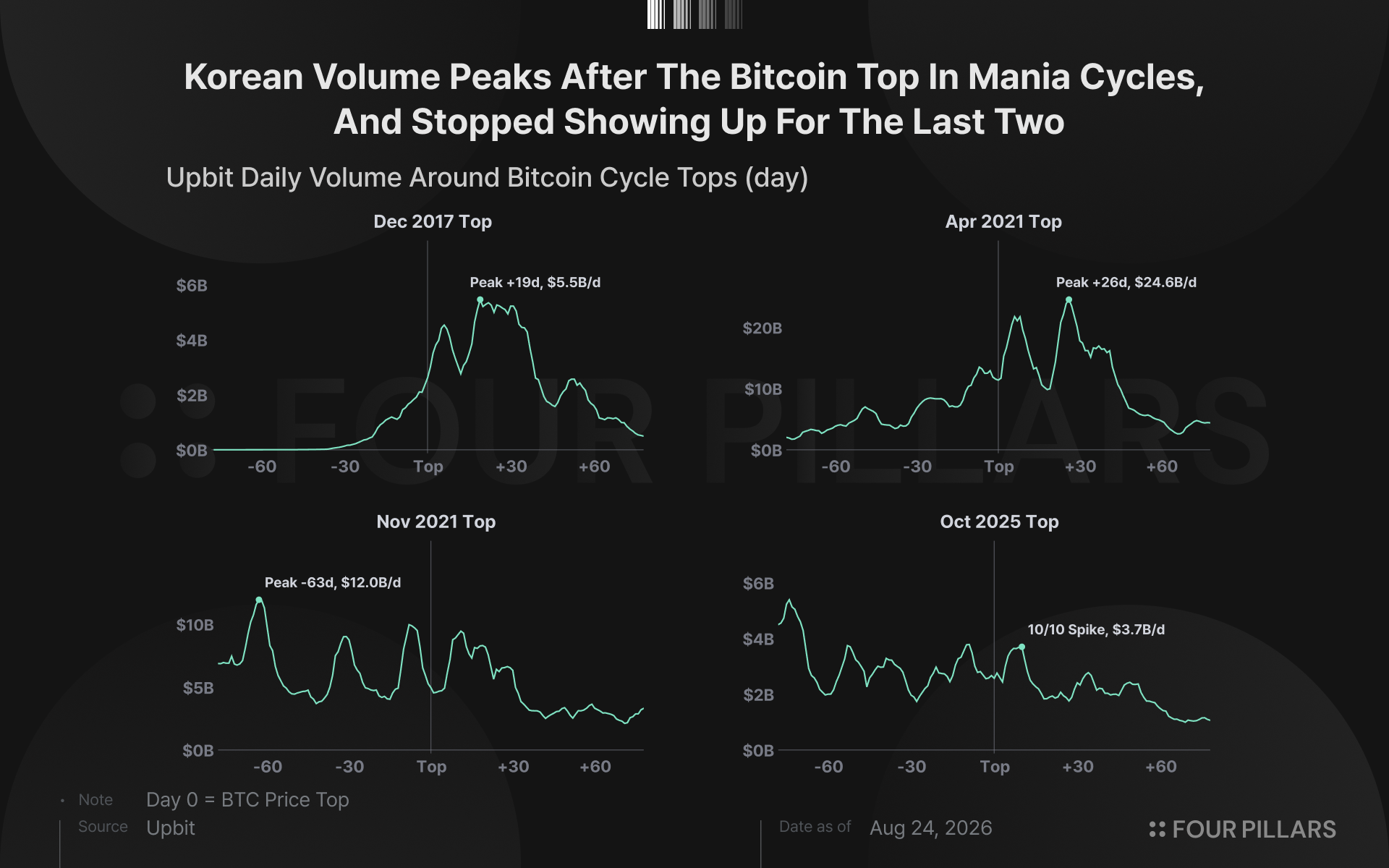
Bitcoin topped on December 16, 2017. Upbit’s volume peaked in the first week of January and averaged $3.9 billion a day that month against $2.8 billion in December, with BTC a fifth of the tape behind XRP, ADA and SNT. The kimchi premium peaked the same week the altcoin market made its high. April 2021 repeated the sequence at higher speed. The eleven largest Upbit volume days on record all sit inside the 6 weeks after April 13, none before it, and the largest of them carried $15.3 billion of DOGE alone. Upbit turned over $331 billion in the first 3 post-top weeks while the premium held double digits.

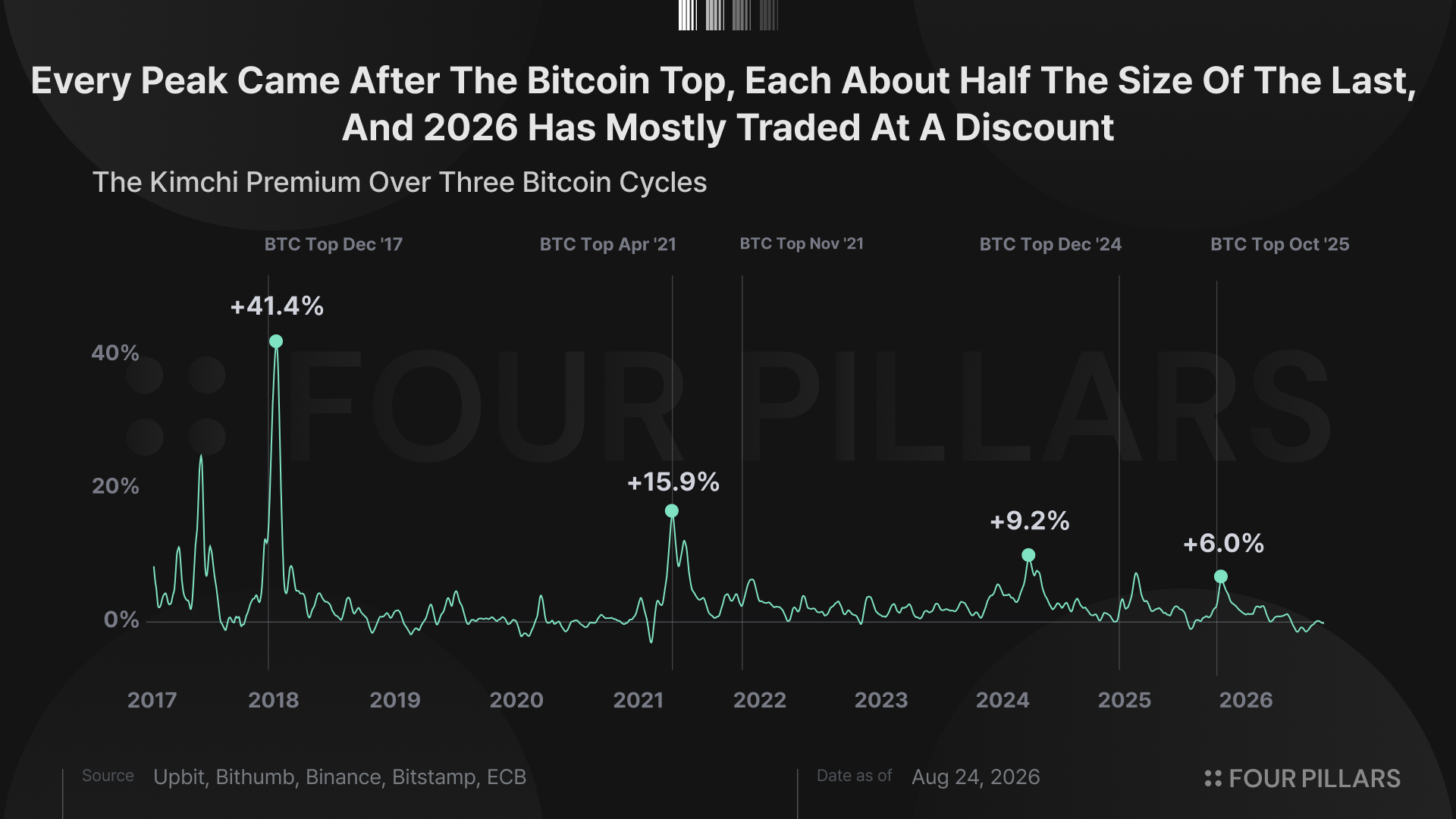
In every cycle the premium confirmed. Its collapse from each blowoff coincided with the start of the post-top drawdown, which makes the second derivative the only tradeable part of the signal.
2. The Arrival Comes Mid Cycle
Korean share of the world’s fiat BTC volume rose from roughly 9% in February 2017 to 15% by May, and the premium moved past 50% on May 25, seven months before the peak, and the 2021 pattern matches. Korean share sat at a cycle low of 3.7~6.2% through the final quarter of 2020 while BTC rose from $13.8K to $29K on institutional flow, then reached 8.7% by January as alts began to move.
Korea has not led the first leg of either bull market. It has arrived, both times, when the alt market started paying.
3. Each Mania Half the Last
Korea’s peak share of BTC volume against the four global venues has halved every cycle, from 44.7% in December 2017 to 11.8% in April 2021, 9.9% in December 2024, and 6.6% in October 2025. Peak premium compressed in step.
November 2021 is the counterexample, since the high everyone remembers arrived with Upbit volume peaking 2 months earlier and no premium blowoff at all. The October 2025 high extended the pattern, with the premium at +0.8% on the day of the top, Upbit running $2~3 billion a day against a 2021 mania an order of magnitude larger, and USDT at 8% of the tape.
One plausible explanation is that the marginal late-cycle buyer changed. ETF and treasury vehicles absorbed the 2025 top, and the crowd the premium measures is no longer large enough to move it. In 2026 the premium has been negative on 134 of 236 days, and Upbit’s volume next to Binance has fallen from 10.1% over the trailing year to 5.4% over the last 3 months.
4. August Rip Has No Kimchi in It
Bitcoin rose 23.6% in the 7 sessions through August 23.

Upbit had averaged $470 million a day over the first half of August. August 22 was its largest day since February 6. XRP’s share of the exchange rose from 8.2% in July to 23.8% during the move, including $1.22 billion on August 22, and TRUMP rose from 0.2% to 7.2%. USDT turnover doubled to 12.1% of the exchange and was its largest market on August 19, ahead of BTC and ETH. BTC’s own share of the tape held near 8%, in line with July. At the equivalent stage of the prior cycle, in January 2021, the premium averaged +1.4%. Every Korean mania in this record began the same way, with the premium turning positive and holding while volume built for weeks.
5. Looking Forward
Korean retail is a mid cycle crowd, not a late one. It arrives when alts start paying, its intensity peaks on the far side of the Bitcoin top, and the tops it actually calls belong to the alt market. Every mania in this record opened the same way, with the premium turning positive and holding while volume built for weeks. The current tape sits at the opposite end of that sequence, a persistent discount interrupted by one day alt spasms. If that sequence starts again, the thing to sell a few weeks later is alts, not Bitcoin.
ran through 286 upbit krw market data since 2017 (bithumb/korbit back to 2013) against binance, coinbase, bitstamp, bitfinex.
key findings:
- they're not super late, they're mid-cycle. kimchi premium blew past 50% in may 2017, seven months before the top. in 2021 they sat out the entire $13.8k → $29k institutional leg, then showed up when alts moved.
- the mania peaks AFTER btc tops, and it top-ticks alts. premium peaked +58.6% on jan 8 2018, 23 days after the btc top, or the week the alt market topped. the 11 biggest upbit days ever all sit inside the 6 weeks after apr 13 2021. biggest: $35b on apr 16, $15.3b of it $DOGE.
- exit liquidity is real: $331b through upbit in the 3 post-top weeks of apr 2021, premium in double digits the whole time
- but every mania is ~half the last. peak korea share of btc volume: 44.7% (dec '17) → 11.8% (apr '21) → 9.9% (dec '24) → 6.6% (oct '25). the oct 2025 top printed +0.8% premium on the day. koreans didn't buy the last top, ETFs did.
- 2026: kimchi discount on 134 of 236 days.
- during last week’s btc pump, kimchi premium deepened to −1.4%. they sold into the pump, punted $XRP (24% of the upbit tape) and $TRUMP, and $USDT was upbit's #1 market on aug 19
every korean mania started with premium flipping positive and holding while volume builds for weeks. we're at the opposite end of that today. when it flips, sell alts, not btc.
The author of this report may have personal holdings or financial interests in assets or tokens discussed herein. However, the author affirms that no transactions have conducted using material non-public information obtained in the course of research or drafting. This report is intended solely for general information purposes and does not constitute legal, business, investment, or tax advice. It should not be used as a basis for making any investment decisions or as guidance for accounting, legal, or tax matters. Any references to specific assets or securities are made for informational purposes only and should not be construed as an offer, solicitation, or recommendation to invest. The opinions expressed herein are those of the author and may not reflect the views of any affiliated institutions, organizations, or individuals. The opinions and analyses expressed herein are subject to change without prior notice. In addition, beyond the individual disclosures included in each report, Four Pillars, may hold existing or prospective investments in some of the assets or protocols discussed herein. Furthermore, FP Validated, a division of Four Pillars, may already be operating as a node in certain networks or protocols discussed herein or may do so in the future. Please see below links in the footer for FP Validated's participating network disclosures and for broader disclosure details.


