Table of Contents

1. Criticism of Korean Digital Asset Exchanges Is Intensifying
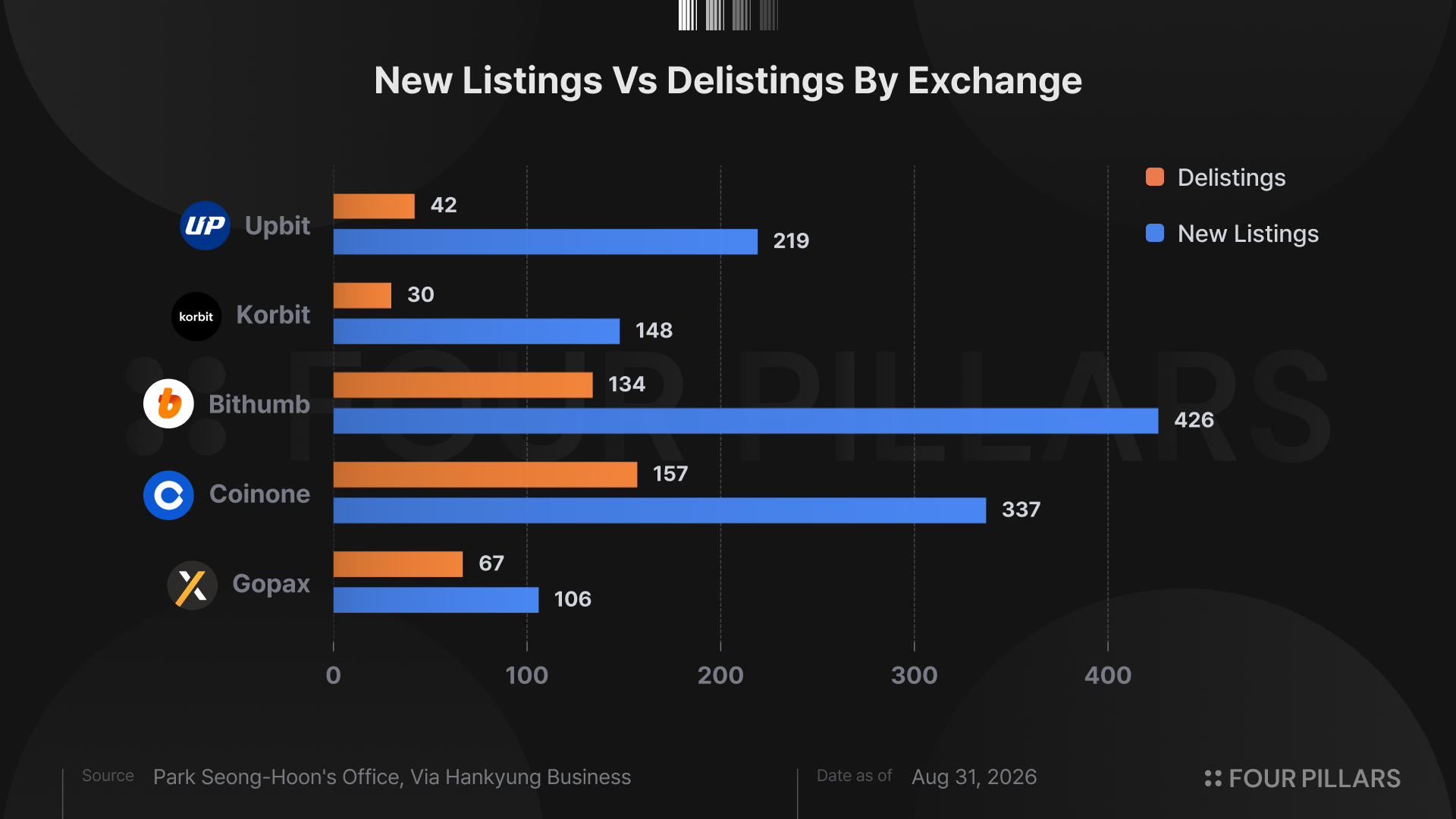
According to data submitted by Korea’s five major KRW-based crypto exchanges to National Assembly member Park Sung-hoon of the National Policy Committee, the exchanges listed a total of 1,236 new altcoins between 2022 and July 2026. Over the same period, trading support was terminated for 430 assets. By exchange, the simple ratio of delistings to new listings was highest at GOPAX at 63.2%, followed by Coinone at 46.6%. The 430 delistings, however, include assets that were originally listed before 2022, so these figures should not be interpreted as actual delisting rates. Still, the fact that more than 1,200 altcoins were newly listed and more than 400 were delisted over just four and a half years illustrates how frequently altcoins have entered and exited Korean exchanges.
The criticism has been equally intense. One lawmaker described the practice as a “coin-listing game of hot potato where exchanges pocket the profits while investors are left holding the losses.” Five days earlier, on August 26, Park Hyeon-joo, Chairman of Mirae Asset Group, was even more direct:
“They recklessly listed hundreds of altcoins that are traded only on Korean exchanges. From my perspective, that is close to fraud.”
He then asked:
“Can you really call it success when a company makes money by listing shitcoins that leave 80–90% of its customers underwater?”
The author largely agrees with these criticisms. If exchanges listed questionable projects without conducting proper due diligence, they deserve criticism. If there were conflicts of interest involved, even more so. But there is one part of the story missing if we explain all of this simply as a product of exchange greed.
What else, other than listing more shitcoins, were Korean exchanges actually allowed to do?
2. 98% vs. 48%
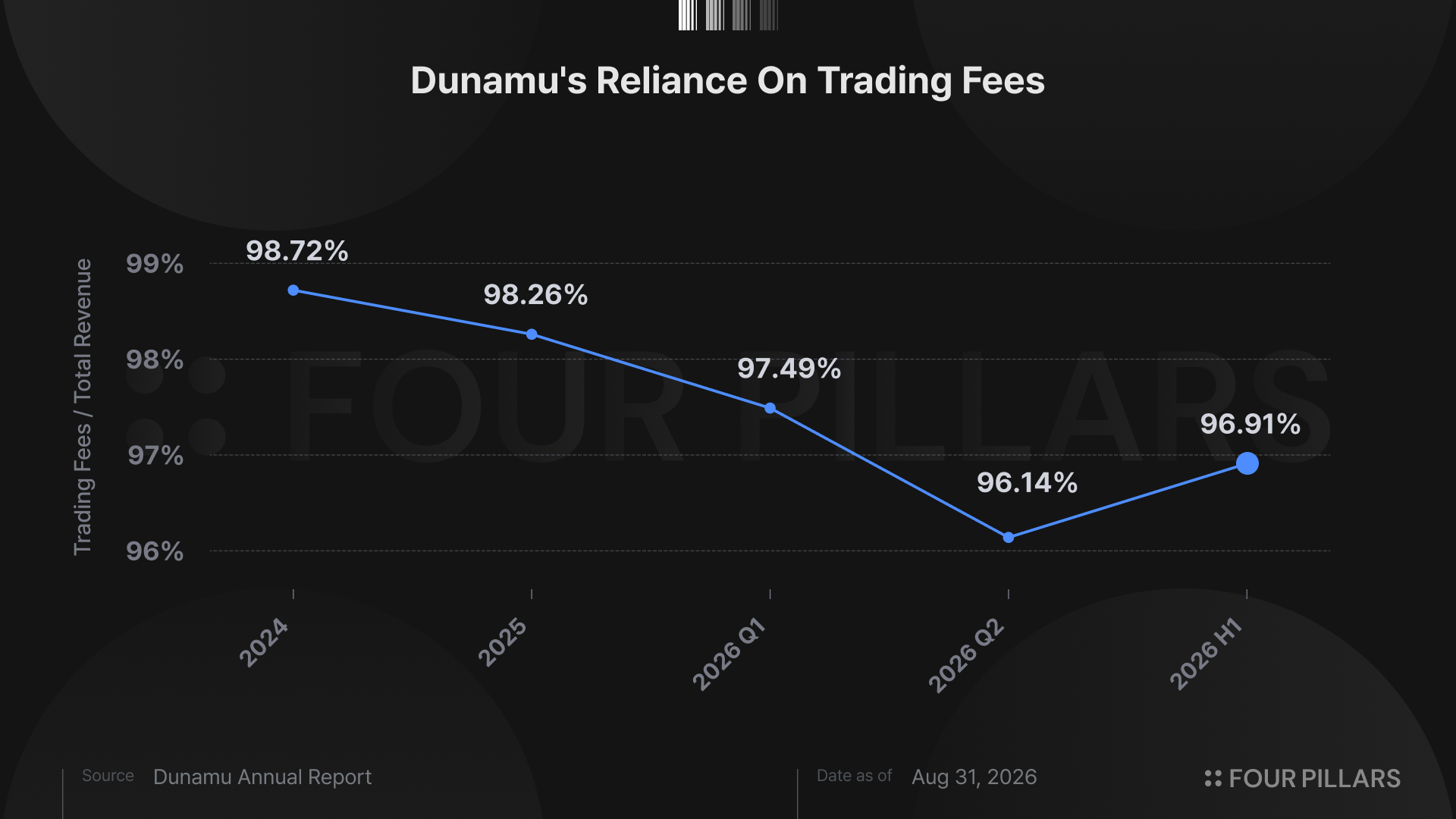
Let’s start with the numbers. In 2025, trading platform fees accounted for 98.26% of Dunamu’s revenue, or KRW 1.531 trillion. All of its other businesses combined—including Securities Plus and Luniverse—generated just KRW 27 billion. The picture remained virtually unchanged in the first quarter of 2026, when trading platform fees still accounted for 97.49% of revenue.
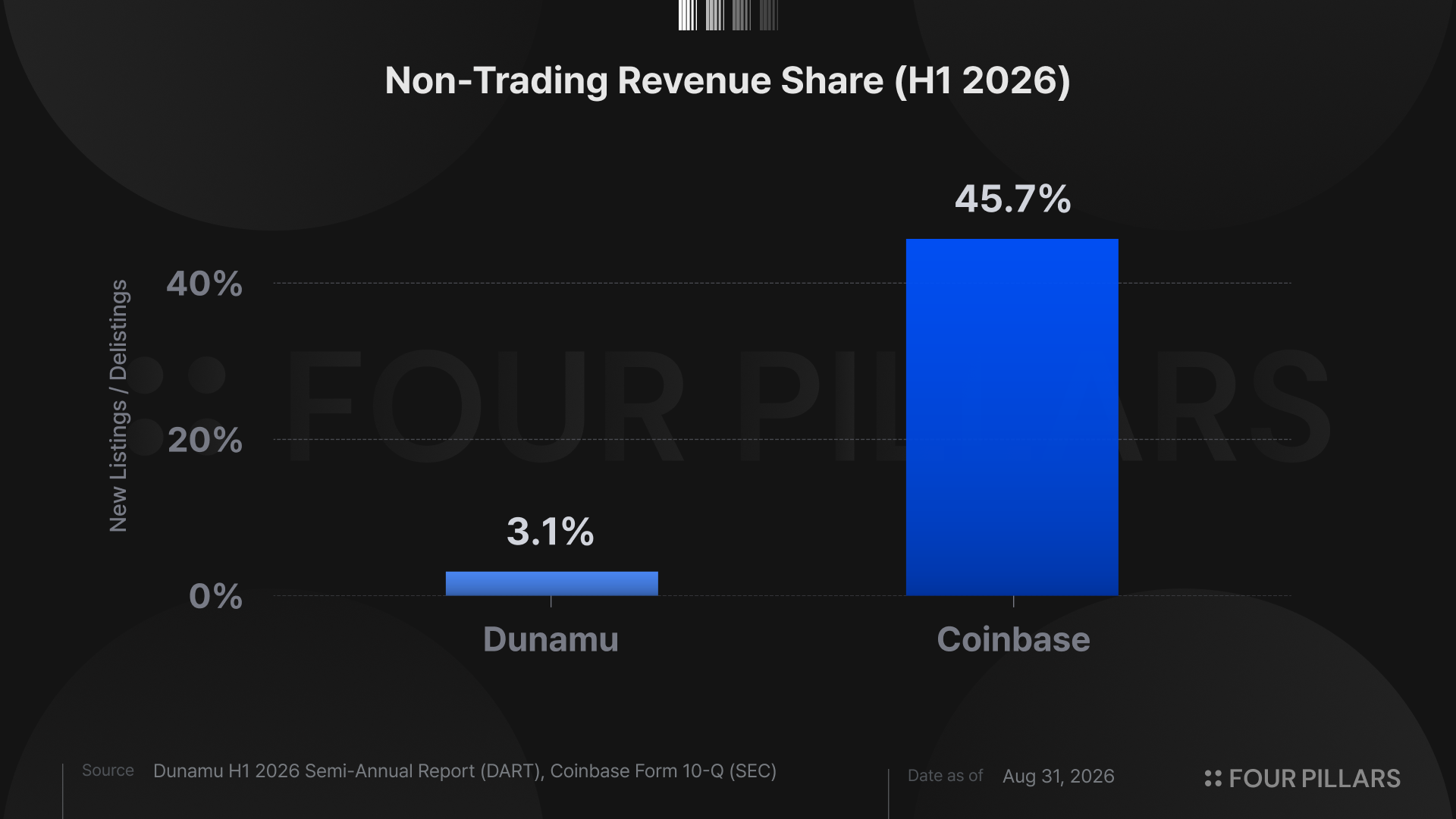
Coinbase looks very different. In the second quarter of 2026, subscription and services revenue reached $555 million, accounting for 48% of net revenue. That figure was just 29% in Q4 2024, meaning the share increased by nearly 20 percentage points in a year and a half. Transaction revenue fell 21% quarter-over-quarter in the same quarter, but Coinbase now has other businesses capable of supporting the company when trading slows.
Break down that 48%, and you find staking, institutional custody, revenue generated from USDC, and Base, among other businesses. The important question, then, is not why Dunamu failed to build the same businesses. It is whether it could have built them in the first place.
Start with custody. Korea does have specialized crypto custodians such as KODA and BDACS. However, they do not operate as custodians licensed under a separate financial business category. Instead, they operate as virtual asset custody and management providers registered under Korea’s Act on Reporting and Using Specified Financial Transaction Information. Upbit, meanwhile, did not begin as a specialized institutional custody provider. The regulatory structure was not one in which a crypto exchange could simply extend its existing business and freely build something comparable to Coinbase Custody.
Even if it could, there was another problem: customers. For years, Korean corporations were effectively restricted from trading crypto, while financial institutions faced significant barriers to holding digital assets directly. In the United States, institutional investors, corporations, and ETF managers became custody clients while holding billions of dollars in crypto assets. In Korea, many of those potential customers could barely enter the market in the first place.
Stablecoins tell a similar story. Coinbase shares in the revenue generated from the reserves backing USDC with Circle. Korea, meanwhile, has yet to finalize even the legal framework for KRW-denominated stablecoins. Even if issuance is eventually permitted, it remains unclear whether exchanges such as Upbit will be allowed to become major issuers. There is also the more fundamental question of whether a KRW stablecoin could ever achieve anything close to the market size of a dollar-denominated stablecoin.
Building a proprietary blockchain is technically possible. The harder question is what an exchange is actually allowed to do on top of it. Many financial services remain in regulatory gray areas. Upbit itself is only now beginning to enter blockchain infrastructure through GIWA.
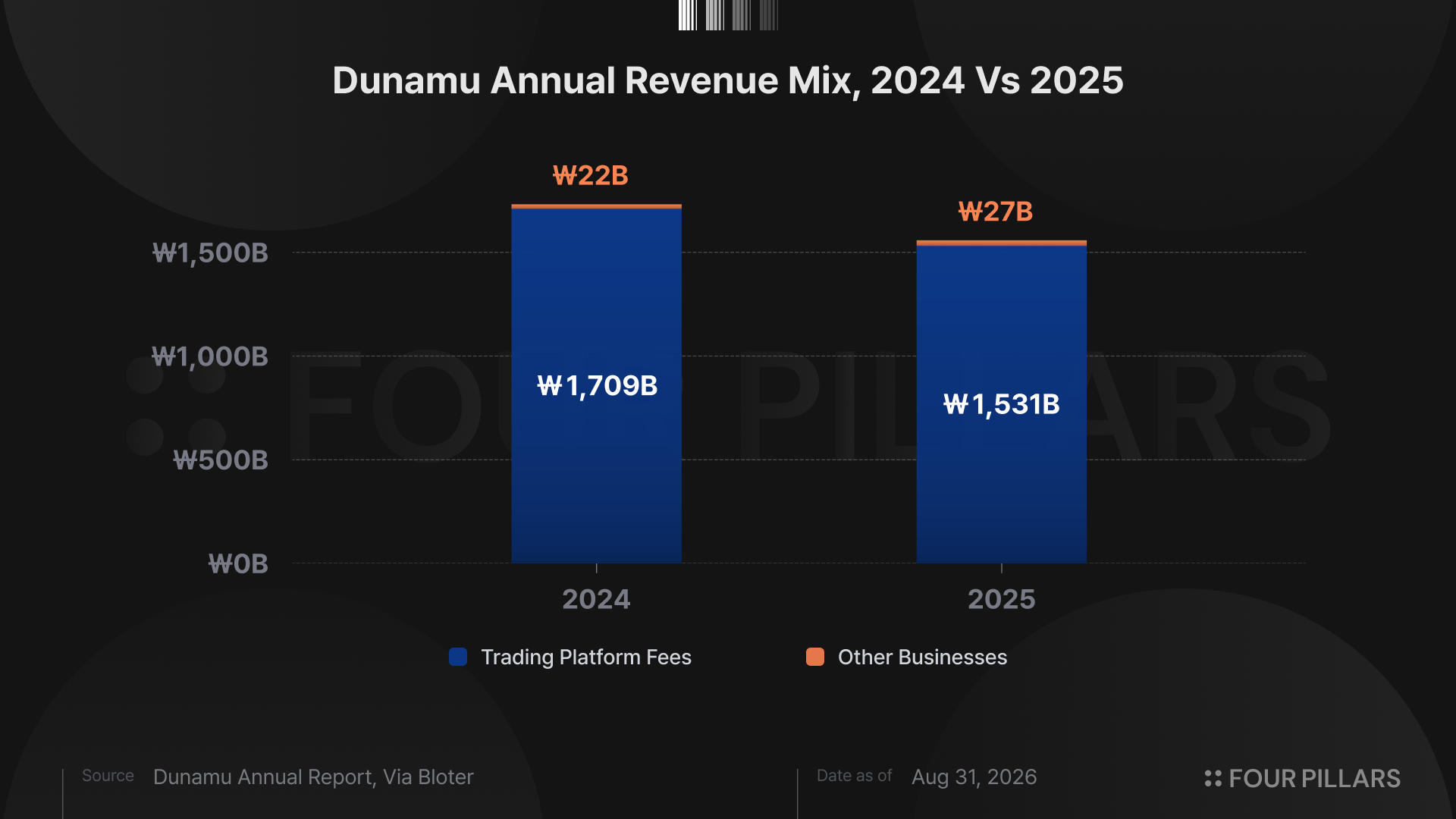
Staking has been one of the few areas with relatively more room to operate. Upbit runs validator infrastructure directly and has attracted more than KRW 1 trillion in staked assets. Yet 98% of Dunamu’s revenue still comes from trading platform fees. The reason is fairly straightforward: most staking rewards generated from customer assets ultimately go back to customers. Unless the business expands into something closer to Coinbase Cloud—providing B2B infrastructure and attracting large delegations from institutions and protocols—it is difficult for retail staking alone to generate enough revenue to meaningfully replace trading fees.
It is therefore misleading to say that Dunamu simply chose not to diversify. The bigger problem was that there was little room for those diversified businesses to grow. Institutions and corporations were largely kept outside the market, while the regulatory foundations for businesses such as custody and stablecoins remained underdeveloped.
That is why Dunamu’s 98% dependence on trading fees deserves a different reading. One could certainly interpret it as evidence that Korean exchanges became complacent with transaction-fee revenue. But it can also be read as the result of a Korean crypto market that never managed to expand beyond retail trading into institutional finance.
3. Perhaps We Have the Causality Backwards
Of course exchanges want to make money. They are businesses. What the author finds strange is a system that leaves exchanges with essentially one way to make money and then criticizes them for making money through that very channel.
If 98% of revenue comes from transaction fees, there is ultimately one straightforward way to grow revenue: increase trading volume. During a bull market, this is not much of a problem. Bitcoin and Ethereum alone can generate enormous volumes. The problem begins in a bear market. When overall trading volume falls, exchanges cannot simply raise their fees, nor can they freely expand into institutional custody, stablecoins, or other businesses.
One of the easiest cards left to play is therefore new listings. A new asset creates a new reason to trade. New trading activity creates new volume, and new volume creates new fee revenue. From the exchange’s perspective, the logic is straightforward.
None of this means exchanges should be free to list whatever they want. Listing standards should be strict, and conflicts of interest should be prevented. But if we want to understand why competition among Korean exchanges has for so long centered on “what should we list next?” rather than “what new service should we build?”, we need to look beyond the morality of the exchanges themselves.
Perhaps we have the causality backwards. What if Korean exchanges did not become dependent on transaction fees because they listed too many altcoins, but instead came to rely so heavily on new listings because there were few other viable ways to make money?
There is an even more ironic possibility. What if regulations introduced in the name of “investor protection” progressively restricted the businesses exchanges could enter, only to push them toward new listings—arguably one of the least investor-friendly revenue models available to them? And what if the investor losses that followed then became the justification for yet another round of regulation?
Regulation always carries the risk of unintended consequences. A rule introduced to solve one problem creates another, which then calls for another rule to fix it. Perhaps Korea’s crypto market is becoming yet another example of the government creating the very problem that it later seeks to regulate.
4. What Should Be Allowed?
What the author wants to see from this debate, therefore, is not simply another proposal to tighten listing standards. Of course stricter standards are necessary. But if regulators tighten listing rules while leaving the revenue structure of exchanges untouched, some exchanges may eventually find that there is simply no viable business left to run.
Exchanges need ways to make money beyond listings. Custody should be established as a properly regulated institutional business. Corporations and financial institutions need a path into the digital asset market. Staking and stablecoins should no longer be left indefinitely in regulatory gray areas; policymakers need to define what is permitted, what is not, and under what rules these businesses can operate. Only then can exchanges begin competing over who provides better services rather than who can list more assets.
There is another important condition: these newly opened markets cannot be reserved exclusively for banks and securities firms. If traditional financial institutions are allowed to enter custody, staking, tokenization, and other new businesses while crypto exchanges remain confined to transaction intermediation, nothing fundamentally changes. Exchanges will still live and die by trading volume, and new listings will remain one of their most powerful growth levers.
Tighter listing regulation and broader permission for non-trading businesses need to move together. If policymakers pursue the former without the latter, the only viable path for Korean crypto exchanges may eventually be to end up under the umbrella of traditional financial groups, as Digital X has. Whether that is really the industry Korea wants to build is a question worth asking.
Calling the indiscriminate listing of unproven altcoins “fraudulent” is a perfectly legitimate criticism. But the discussion should not end there. We should also ask why competition among Korean exchanges has repeatedly converged on new listings in the first place, and create alternative paths for these companies to grow so that the same incentives do not keep producing the same outcome.
Isn’t that precisely the job of lawmakers and policymakers?
The author of this report may have personal holdings or financial interests in assets or tokens discussed herein. However, the author affirms that no transactions have conducted using material non-public information obtained in the course of research or drafting. This report is intended solely for general information purposes and does not constitute legal, business, investment, or tax advice. It should not be used as a basis for making any investment decisions or as guidance for accounting, legal, or tax matters. Any references to specific assets or securities are made for informational purposes only and should not be construed as an offer, solicitation, or recommendation to invest. The opinions expressed herein are those of the author and may not reflect the views of any affiliated institutions, organizations, or individuals. The opinions and analyses expressed herein are subject to change without prior notice. In addition, beyond the individual disclosures included in each report, Four Pillars, may hold existing or prospective investments in some of the assets or protocols discussed herein. Furthermore, FP Validated, a division of Four Pillars, may already be operating as a node in certain networks or protocols discussed herein or may do so in the future. Please see below links in the footer for FP Validated's participating network disclosures and for broader disclosure details.