

Table of Contents

For a long time, the crypto market was regarded as a single market. True to the purpose for which crypto was invented, its home base was borderless offshore exchanges and onchain venues, and the market was neither large enough to be broken down by country nor defined by regulation.
Things look a little different now. As the market expanded both quantitatively and qualitatively, countries began to define the boundaries of their domestic markets more clearly through licensing, taxation, and reporting regimes. As a result, it has become more accurate to view today’s crypto market as divided into a global offshore/onchain market and country-level onshore markets centered on local exchanges.
Governments have a clear purpose in firmly demarcating their onshore markets. It is to manage capital flowing offshore, apply AML obligations, and secure a tax base. Being digital does not mean digital assets can be left outside the oversight of the regulated financial system.
Yet in the face of capital efficiency, the most natural attribute of any market, the binding force of regulation seems to lose its grip time and again. The interesting common pattern is that the higher the barriers to onshore markets rise, the more money always leaves them. South Korea, China, and Japan, East Asian economies that are both large and highly active in crypto, illustrate this phenomenon best, and here Chainalysis’s East Asia report shows where the money has gone based on geographic data.
1. China: A P2P Market Created by Prohibition
China has long been a market that excludes an onshore market altogether. It banned crypto trading and mining outright in 2021 and explicitly declared stablecoins illegal currency in 2025. Even outside of crypto assets, individual overseas remittances are capped at $50K per year.
The intent of the regulation was presumably to cut off crypto-driven capital outflows at the source, but China instead best demonstrates that regulation alone struggles to suppress demand. China’s crypto economy is estimated at no less than $176.3B, and 59.1% of it consists of peer-to-peer (P2P) transactions that bypass exchanges. Chainalysis estimates that China’s P2P share grew 3.5x in a single year and that the number of wallets participating in stablecoin P2P transfers grew 43x between Q1 2024 and Q2 2026.
These circulating stablecoins are a means of payment rather than an investment vehicle. With average holdings of $3.1B, China moved $104.1B across 18.1M transfers in a single year. This means stablecoins changed hands 33.2 times a year, more than three times the global average (9.3x). It indicates working capital that is spent immediately: goods are listed on commerce platforms to find counterparties, and payment is settled by exchanging wallet addresses over Telegram. In other words, in China, where onshore is blocked, onchain has become a channel that substitutes for bank transfers and mobile payments.
2. Japan: Onshore Stagnates, Onchain Grows
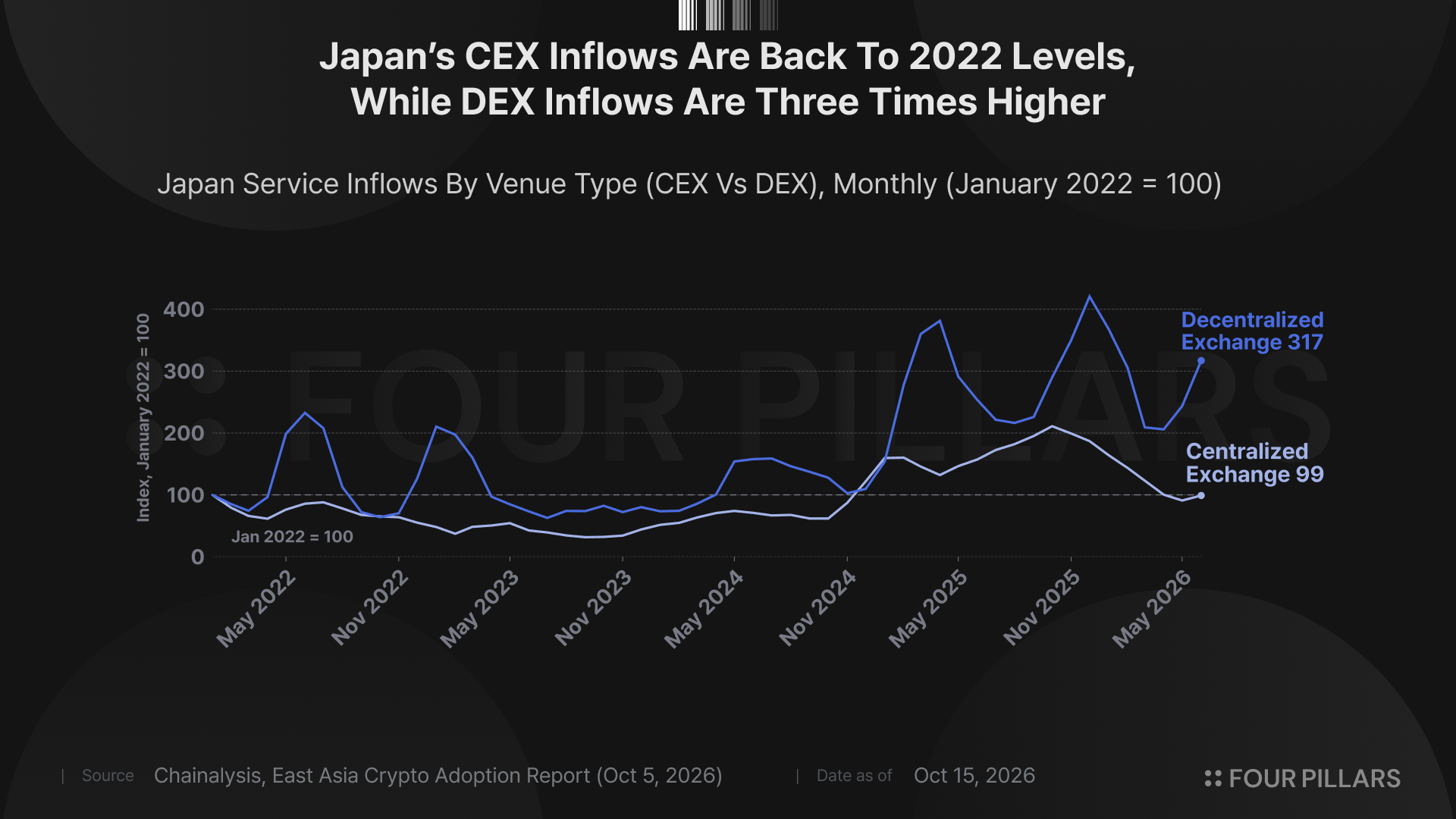
Despite having a mature local exchange market, Japan shows the highest DEX share in East Asia. Of the funds Japanese users sent to crypto services such as exchanges and DEXs, 34.5% went to DEXs, and DEX inflows grew 36% year over year. Since 2022, DEX inflows have risen more than 200% while inflows to local exchanges have stagnated.
The outflows have typically come from small retail users. 65.7% of DEX swaps fall within the $10 to $1,000 range, and roughly one in four users who withdrew from Japanese exchanges later deposited funds into DeFi. A structure appears to have taken hold in which crypto is bought with yen onshore and subsequent trading happens onchain. The role of local exchanges is gradually narrowing to that of a fiat on/off-ramp.
The reason onshore failed to capture this demand lay in regulation. Crypto gains in Japan were subject to a top marginal tax rate of 55%, and retail margin trading leverage at local exchanges has been capped at 2x. An arduous listing process has also limited the number of tradable tokens to around 100. In short, an environment in which the leverage and new tokens investors wanted could not be found onshore has persisted for a long time.
This year, the Japanese government has been lowering these barriers one by one. In April 2026, the Cabinet approved an amendment to the Financial Instruments and Exchange Act (FIEA) reclassifying 105 crypto assets as financial instruments, and in July, a reform lowering the tax rate to a separate taxation rate of around 20% moved forward, but how much of the demand that went onchain will return as a result of this easing remains uncertain.
3. South Korea: An Onshore-Centric Market Shaken by Taxation
Of the three countries, South Korea has the highest onshore share. 99.4% of the total value of crypto assets held domestically sits in KRW markets, and trading is centered on retail spot. South Korea’s crypto economy was the largest in East Asia at $449.1B, and its growth was also driven by the local exchange ecosystem.
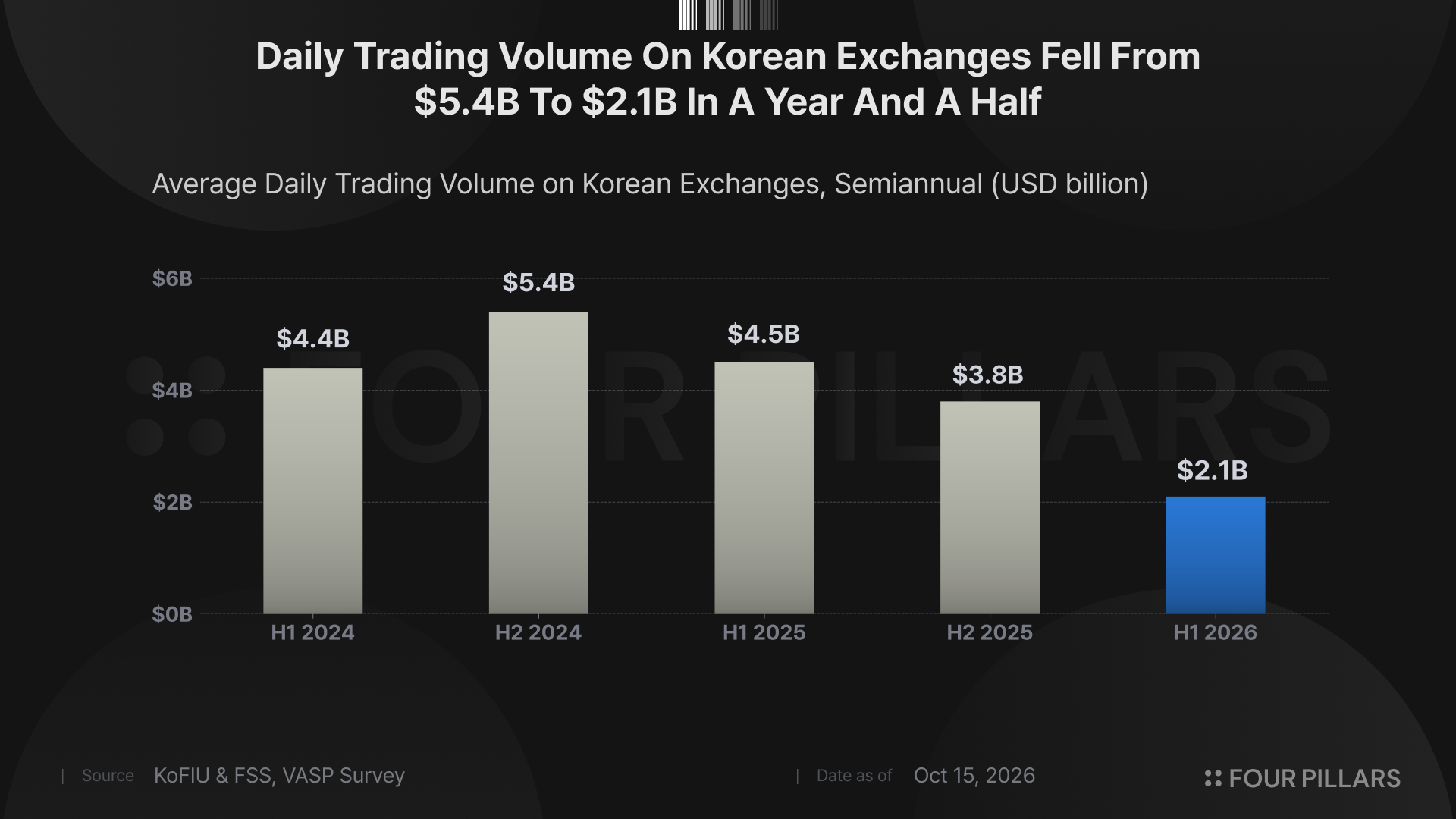
However, the ability of exchanges to hold on to the market is visibly weakening. In H1 2026, average daily trading volume on Korean exchanges was approximately $2.1B, down 44% from the previous half. This of course also reflects the broader crypto market going through a bear market, so it is necessary to look not only at trading volume but also at the size and path of outgoing funds.
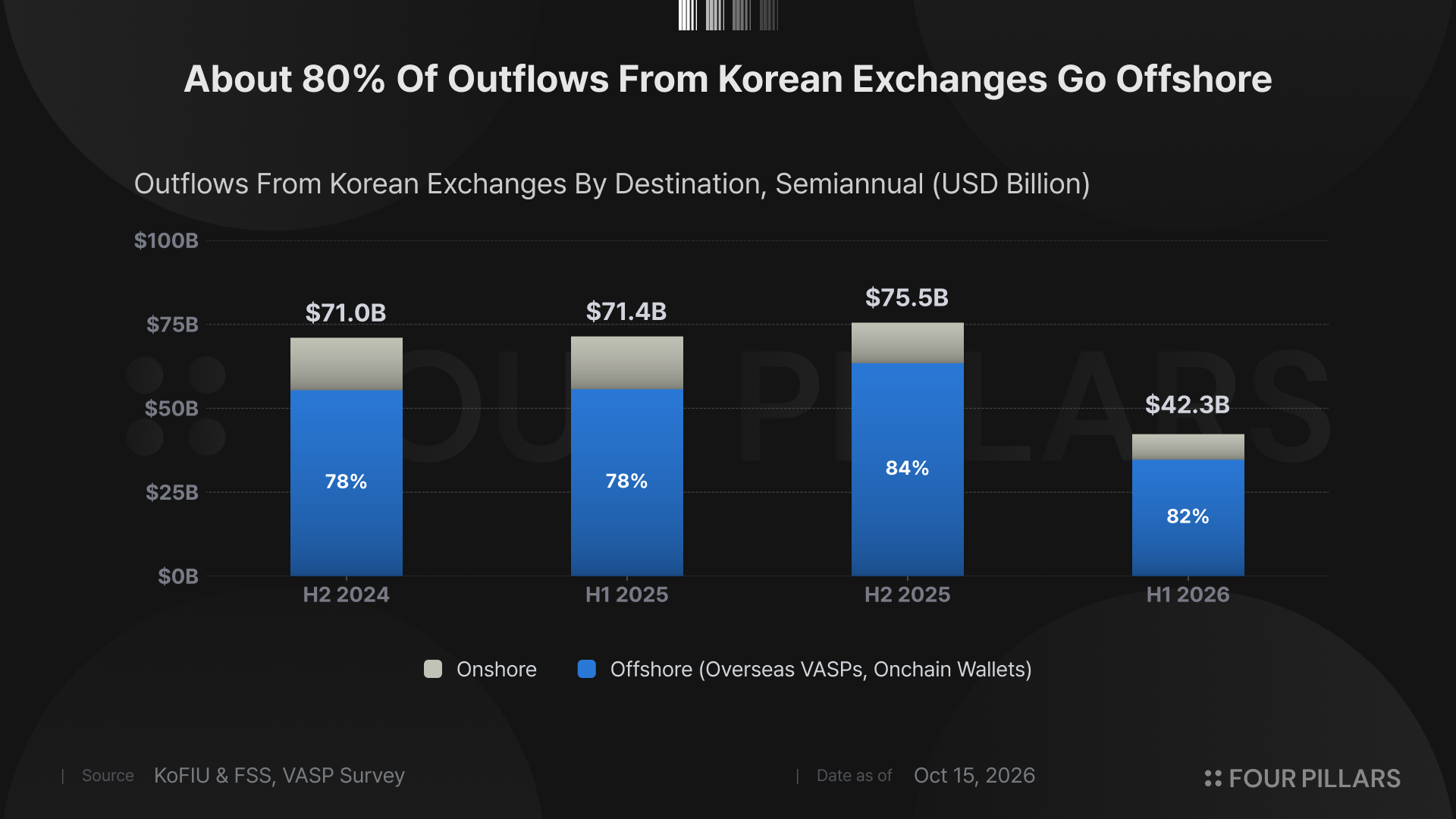
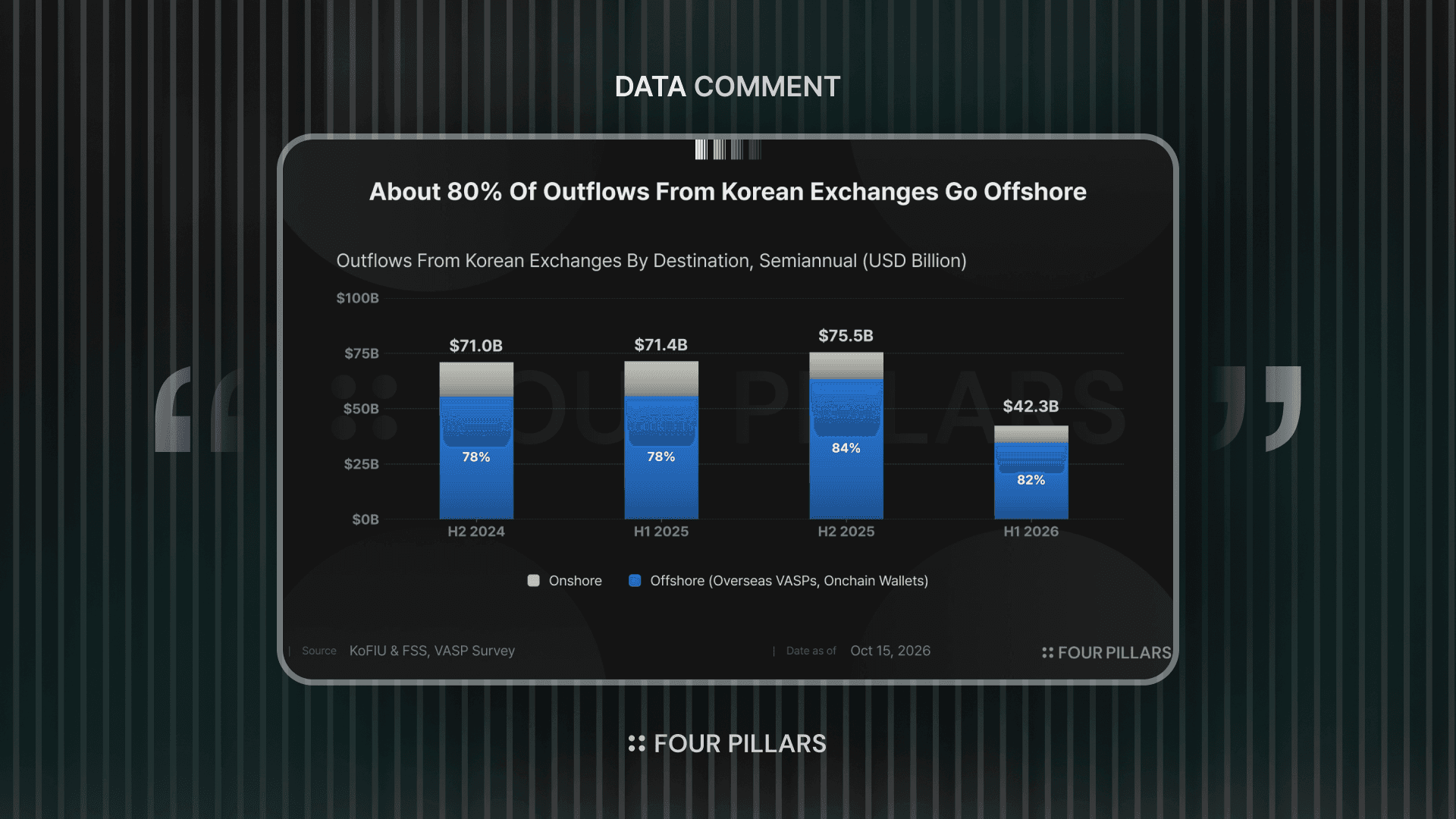
Over the same period, of the $42.3B in outflows from Korean exchanges, $34.8B, or 82%, went to overseas VASPs and private wallets. Total outflows shrank along with the market, but the share heading offshore rose from 78% in H2 2024 to 84% in H2 2025 and has since held in the 80% range. Trading has fallen, but the share of money leaving has not.
Against this backdrop, the hottest issue in the Korean market is taxation. Under the current Income Tax Act, crypto income exceeding KRW 2.5M ($1.7K) per year will be taxed at 22% (including local tax) starting January 2027. Implementation has already been postponed three times, but the government is holding firm on its position to proceed as scheduled.
Pushback from the industry and parts of the political sphere has been strong. A proposal has also emerged to delay taxation until two years after the first Crypto-Asset Reporting Framework (CARF) information exchange, effectively to 2029. The reasoning is that starting taxation without overseas exchange records would concentrate the tax burden only on users of domestic exchanges, which are all the National Tax Service can see. Moreover, even once CARF is operational, its scope extends only to overseas centralized exchanges. With CARF estimated to capture only about 14% of global taxable onchain activity, DEX and private wallet transactions remain outside the regulatory field of view.
4. Where the Tension Between Onshore and Offshore Is Headed
At some point, we grew accustomed to regarding blockchain infrastructure as part of the regulated financial system. But recalling that this technology was invented to operate outside intermediaries and borders, it is a natural response for activity to route around the regulated system as onshore autonomy declines.
South Korea in particular is in a situation where taxation may begin before the means to track overseas and onchain transactions are secured. If, as expected, the tax burden accumulates only onshore, the share of offshore outflows is likely to grow further. As the cases of China and Japan show, when onshore barriers rise, demand reroutes rather than disappears. If this continues, Korean domestic exchanges are also likely to be narrowed, as in Japan, into a channel for converting fiat into crypto and sending it out.
Simply pushing back the start of taxation by a few years will not change this trajectory. The reason domestic users go to overseas exchanges and onchain venues lies, before taxes, in what the domestic market lacks: tokenized products, product diversity, corporate accounts, leverage, and more. Unless the tax debate addresses these issues together, including the expansion of tax infrastructure, a delay will be no more than a way to buy time.
That tightening onshore markets without preparation drives greater outflows has been observed enough times that it should now be treated as a premise rather than a hypothesis.
The author of this report may have personal holdings or financial interests in assets or tokens discussed herein. However, the author affirms that no transactions have conducted using material non-public information obtained in the course of research or drafting. This report is intended solely for general information purposes and does not constitute legal, business, investment, or tax advice. It should not be used as a basis for making any investment decisions or as guidance for accounting, legal, or tax matters. Any references to specific assets or securities are made for informational purposes only and should not be construed as an offer, solicitation, or recommendation to invest. The opinions expressed herein are those of the author and may not reflect the views of any affiliated institutions, organizations, or individuals. The opinions and analyses expressed herein are subject to change without prior notice. In addition, beyond the individual disclosures included in each report, Four Pillars, may hold existing or prospective investments in some of the assets or protocols discussed herein. Furthermore, FP Validated, a division of Four Pillars, may already be operating as a node in certain networks or protocols discussed herein or may do so in the future. Please see below links in the footer for FP Validated's participating network disclosures and for broader disclosure details.


