


Table of Contents
- Key Takeaways
- 1. Maybe Crypto’s Biggest Problem Is No Longer Technology
- 2. The Company, the Auction, and the Treasury
- 3. Umia’s Decision Market: Futarchy in Practice?
- 4. A Decision Market Designed With Prediction Market Failures in Mind
- 5. Adding Enforcement to a System That Has None
- 6. So What Is $UMIA Actually Worth?
- 7. What to Watch
Researcher

Related Projects

Key Takeaways
- If crypto’s real bottleneck is no longer technology but capital formation, Umia is attempting to redesign the entire process onchain—from company formation and token issuance to treasury management.
- What makes Umia particularly interesting is its use of decision markets to govern major corporate decisions, while its Cayman legal structure gives those onchain decisions real-world legal enforceability.
- $UMIA is also designed to align the growth of the ecosystem with the value of the token, making the first auction at the end of August an important test of whether Umia can prove its own capital formation model in practice.
1. Maybe Crypto’s Biggest Problem Is No Longer Technology
I recently came across an interview with Francesco Mosterts, co-founder of Umia, and one part stood out to me. “The infrastructure is already robust enough. It can handle higher throughput and much more TVL.” His argument was that the real bottleneck in crypto is no longer technology, but capital formation.
Looking back, it is a fairly compelling argument. ICOs were once celebrated as a new way for anyone to participate in capital formation, but after countless scams and failures, they effectively disappeared. Venture capital filled the gap, and the crypto market continued to grow. Yet that shift created a different set of problems. For years, we have watched projects with barely any product fork existing blockchains, raise capital at valuations of hundreds of millions of dollars, and eventually leave retail investors absorbing tokens that had already been allocated to early investors on far more favorable terms.
The dual capital structure of equity and tokens created another set of problems. A single operating company could issue both equity and tokens, yet the rights attached to the two assets were fundamentally different. If the company was acquired, early equity investors could exit by selling their shares. Token holders who had invested in the very same project, however, could be left watching the company’s value transfer elsewhere without any meaningful way to participate in or respond to that transfer.
The same disconnect existed when the business began generating revenue. In most cases, the economic value created by that revenue accrued to equity holders, while tokens had no direct mechanism to capture it without some form of buyback. As a result, equity investors and token holders were effectively betting on the growth of the same project, yet when that growth ultimately translated into economic value, they were left with fundamentally different rights to that value.
The backlash against this structure manifested itself in two seemingly opposite ways. One was memecoins. Memecoins may have no intrinsic value, but at least they do not pretend otherwise. This gave rise to the paradoxical argument that a memecoin, where everyone understands from the beginning that there may be nothing underneath it, can actually be fairer than a market where retail investors are expected to absorb tokens previously acquired by early investors at much lower valuations.
The other was Hyperliquid. When Hyperliquid distributed roughly 70% of its total token supply to the community without raising venture capital, the market’s enthusiasm was likely driven by more than just the sheer size of the airdrop. By using a significant portion of the revenue generated by its product to buy back tokens, Hyperliquid introduced a model that stood in stark contrast to the conventional approach to capital formation. Rather than following the familiar structure in which value accrues primarily to early investors before tokens are eventually distributed to the broader market, Hyperliquid chose to return the economic value generated by its product directly to token holders.
Ultimately, the problem was never simply that VCs owned too many tokens. The deeper questions were about who provided capital first and at what price, what rights they received in return, who controlled the capital after it was raised, where the value created by the project ultimately accrued, and who was compensated when that value was realized. Perhaps one of the biggest problems crypto has failed to solve is not technological at all, but structural.
Crypto has spent years proclaiming that it is building a new financial system, yet when it comes to financing startups, it has not moved very far beyond the traditional venture capital model. Umia is attempting to redesign this process across three layers: corporate formation, capital raising, and control over the capital that has been raised. In some ways, it may be proposing a model of capital formation that is more native to crypto itself.
2. The Company, the Auction, and the Treasury
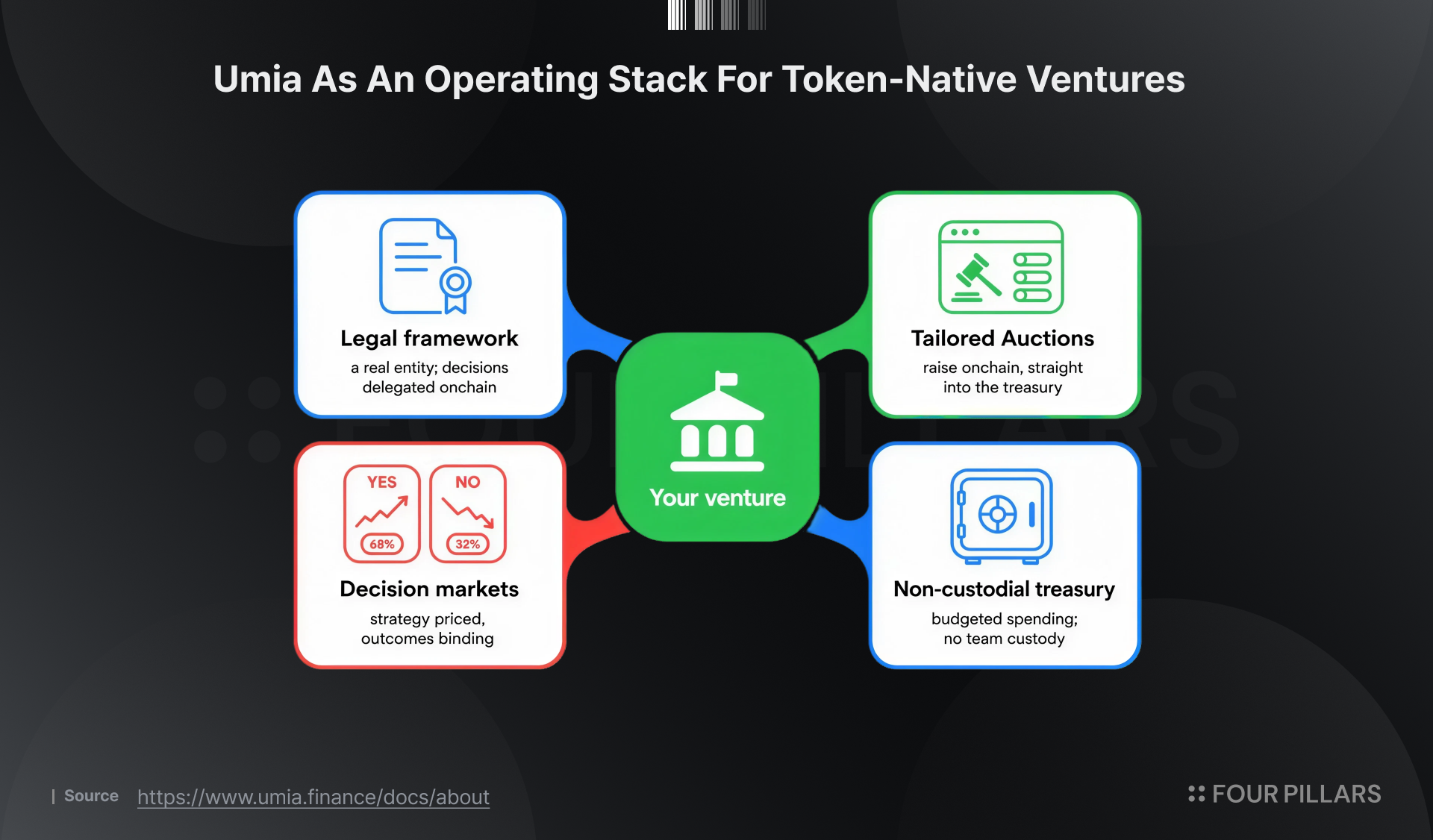
Umia describes itself as an “operating stack for token-native ventures.” Calling it a launchpad would undersell what it is trying to build. Rather than merely helping projects issue tokens, Umia aims to integrate the entire process of forming a company, raising capital, managing that capital, and making major corporate decisions into a single system. Broadly speaking, the architecture can be divided into three components: the legal entity, the auction, and the treasury.
The first is the company itself. Each raise establishes a Cayman-based legal wrapper through Umia. Using MetaLeX’s BORG framework, each project is set up as a segregated portfolio under Umia Launcher SPC structure, with its IP, contracts, and treasury all housed within a single legal entity. Compared with the traditional crypto structure, where the foundation, development company, and DAO often exist as separate entities with complicated rights and obligations between them, this is remarkably simple.
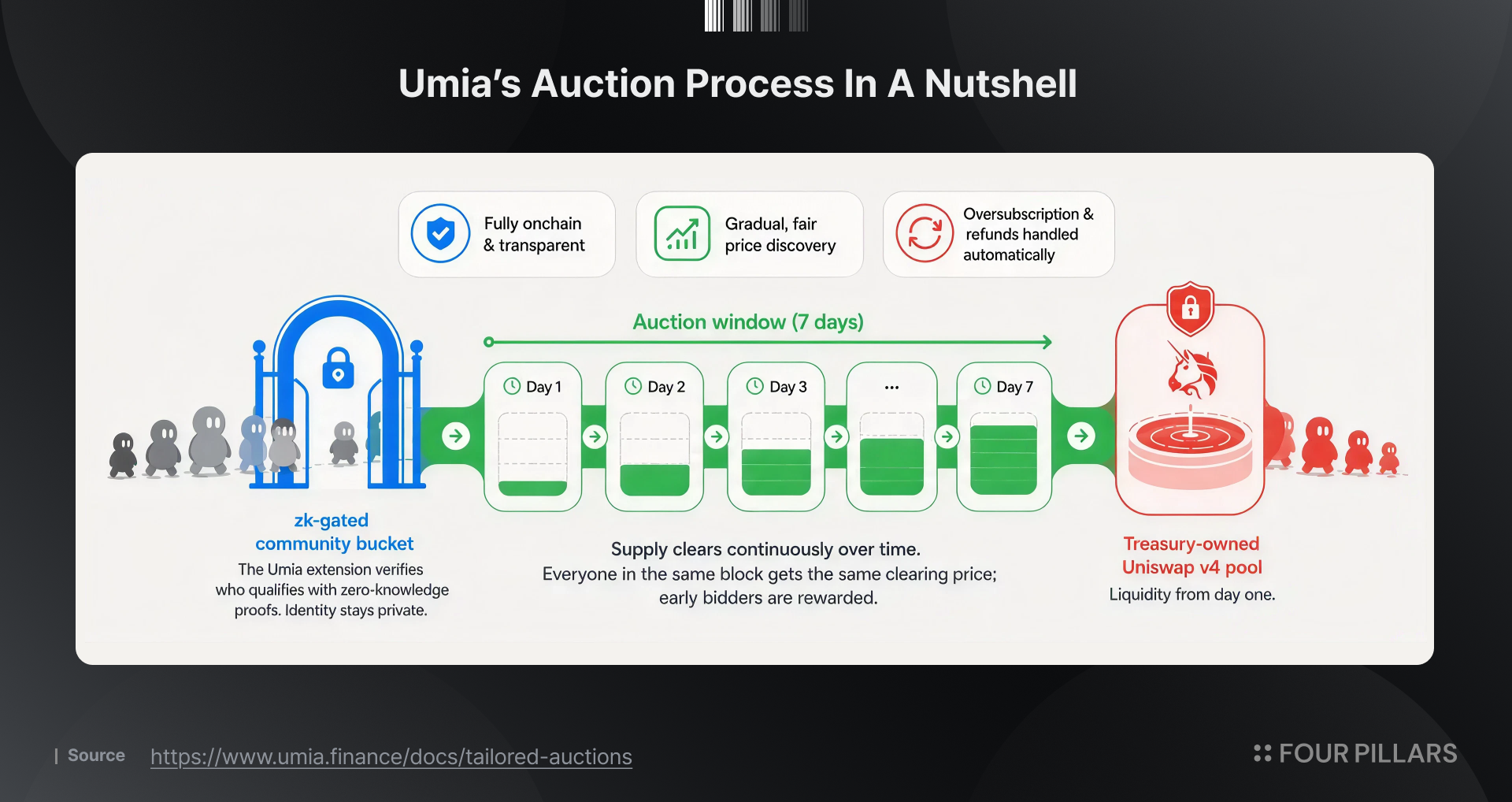
The second component is the auction. Token sales are conducted through Uniswap v4’s CCA (Continuous Clearing Auction). The auction period can be configured by the project and typically lasts around one week. Projects can set minimum and maximum fundraising ranges based on their capital needs, while the final amount raised and token price are determined within those ranges through the CCA’s demand-driven price discovery mechanism.
Rather than selling the entire allocation at once, the CCA clears tokens progressively over time, with participants entering within the same block receiving the same price. This provides a structural alternative to the traditional “land-grab” style of token launches, where outcomes often depended on who could submit transactions first, leaving the process vulnerable to sniping and MEV.
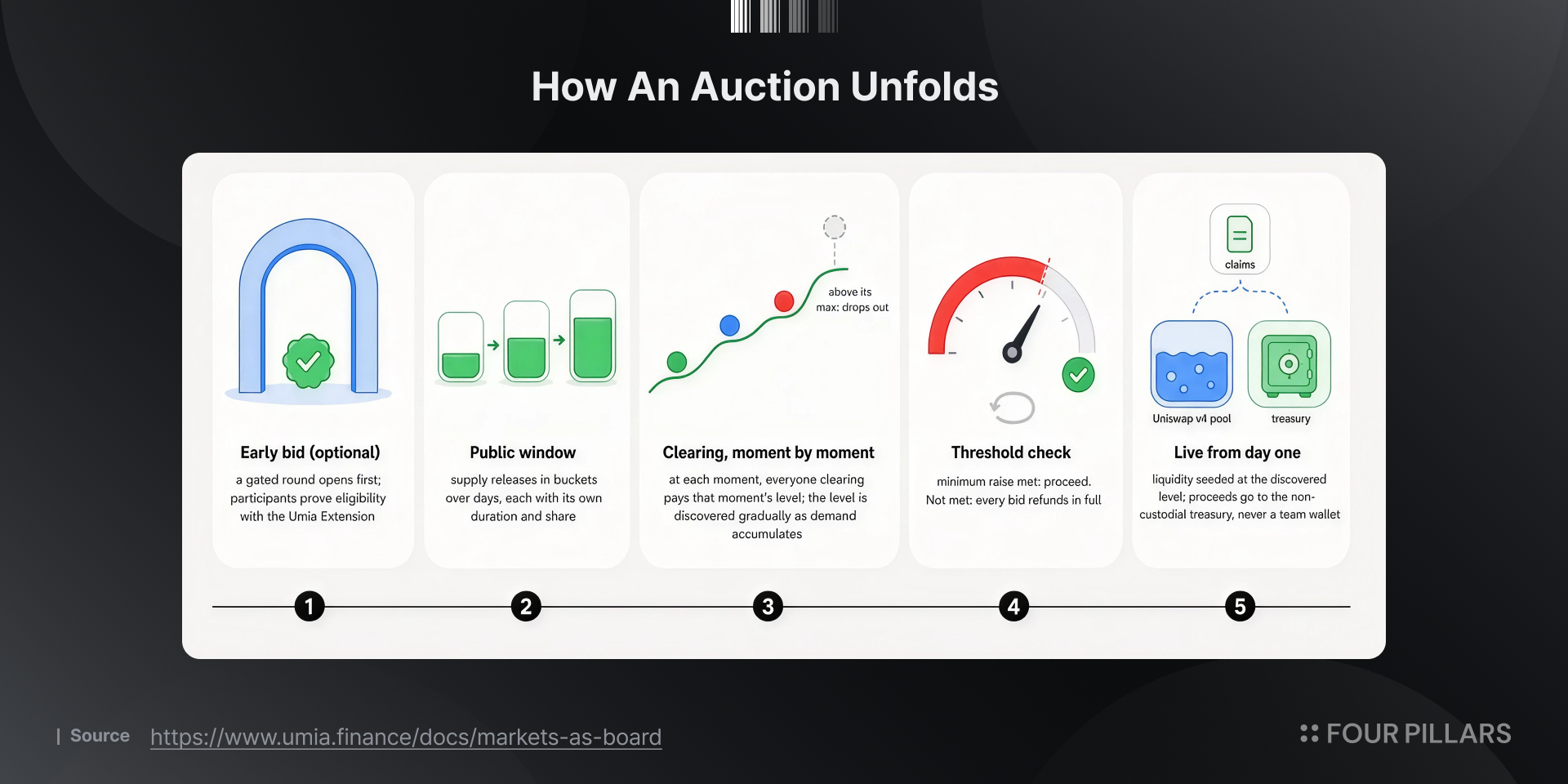
Umia also allows projects to go beyond a fully public auction by introducing a “Early-bid phase,” where selected participants can gain earlier access before the public sale begins. Eligibility can be verified using zkTLS, allowing participants to prove that they meet certain criteria without revealing their identities. This gives founders greater ability to curate the initial holder base, while eligible participants can begin bidding earlier than the broader public and potentially acquire tokens at a lower average cost.
Once the auction ends, part of the proceeds is used to automatically create a Uniswap v4 liquidity pool owned by the project treasury and provide it with initial liquidity. This gives the project a functioning secondary market from day one, while a portion of the trading fees generated by that pool flows back into the treasury. In other words, fundraising, initial liquidity formation, and recurring trading fees all become part of the same runway structure.
The third component is the treasury, and this is arguably Umia’s most important distinction. The funds raised through the auction do not go into a team-controlled wallet or multisig. They are deposited directly into the project’s treasury contract. The team can only access the monthly allowance that was defined when the entity was created. Anything beyond that — larger treasury expenditures, additional token issuance, changes in team compensation, acquisitions, strategic pivots, and even liquidation of the company — must pass through a decision market.
If the legal entity is the container for rights and obligations, the auction is the gateway through which capital enters, and the treasury contract is the mechanism that controls that capital. By connecting all three, Umia is attempting to redesign not only how capital is raised, but also who gets to decide how that capital is used.
3. Umia’s Decision Market: Futarchy in Practice?
In the summer of 2024, I wrote an article about futarchy. The premise was relatively simple. Democracy has structural limitations created by individual self-interest and fixed political terms. If the people making decisions are separated from those who ultimately bear the consequences, what if decision-makers were instead required to put capital behind their own judgments? I concluded that blockchain could serve as an ideal testing ground for experimenting with new systems of governance without immediately imposing those risks on the real world.
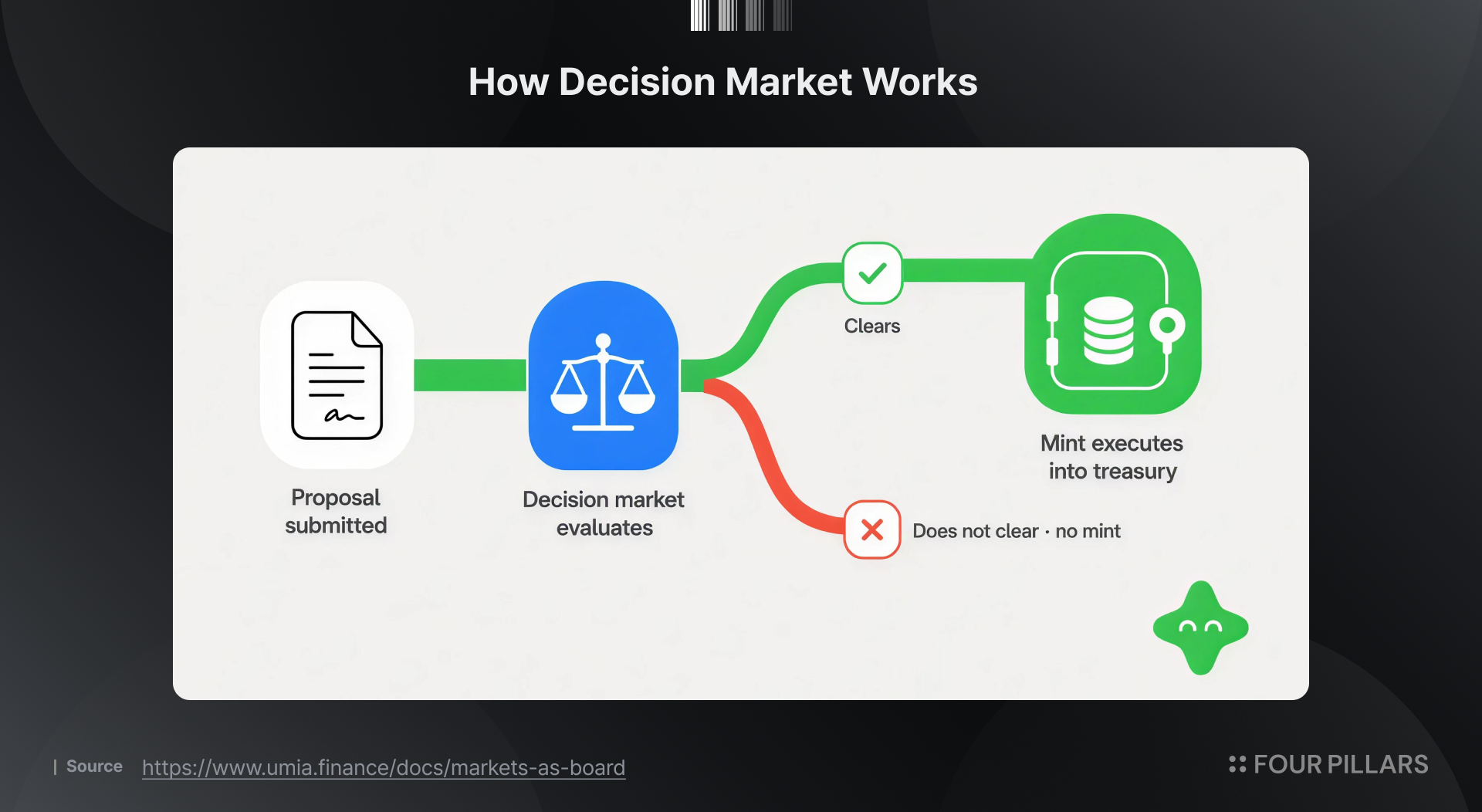
Umia’s decision market looks remarkably similar to the experiment I had in mind at the time. A proposer stakes assets and submits a proposal, after which conditional markets are created for each possible outcome. Participants then trade based on what they believe the project’s token should be worth assuming that a given outcome has already been implemented. Instead of answering the question, “Would this decision benefit the project?” through a simple yes-or-no vote, the market answers with price.
There is also a No-Op market representing the status quo. Price discovery takes place across the conditional markets for a defined period, and a proposal is executed only if its market achieves a TWAP that exceeds the No-Op market by a predetermined threshold. If the market does not demonstrate sufficient conviction, nothing happens. Change is not treated as the default. The system only permits it when the market clearly expects the proposed outcome to be better than maintaining the status quo.
The limited scope of market-based decision-making is also worth noting. When I first wrote about futarchy, I argued that a hybrid model combining representative decision-making with market-based governance would likely be more realistic than a pure form of futarchy in which every decision is delegated to the market. Umia takes a similar approach. Day-to-day operations remain the responsibility of the founders and management team. The market is instead used for decisions such as major treasury expenditures, additional token issuance, acquisitions, and strategic pivots — the kinds of decisions that would traditionally sit with a corporate board. Rather than replacing management with markets, Umia is effectively transferring part of the board’s function to the market’s price-discovery mechanism. That is precisely what makes the project so interesting to me.
For that reason, I find Umia genuinely exciting. Two years ago, I wrote that I hoped someone would eventually take this idea beyond theory and experiment with it in practice. Umia has now turned that kind of governance concept into a product that operates on real companies and real capital.
That said, my own thinking has not remained unchanged over those two years. For futarchy to work, markets must actually be able to aggregate collective judgment into meaningful prices. And after watching prediction markets evolve over the past two years, I have also learned that this assumption may not be as straightforward as it first appears.
4. A Decision Market Designed With Prediction Market Failures in Mind
Last month, I wrote a much more critical piece on prediction markets. The core argument was simple: for a prediction market to function properly, participants should be able to predict an outcome, but they should not be able to change the outcome through their own actions. Once market participants can directly influence the event on which they are betting, the prediction market risks becoming a mechanism for creating outcomes rather than discovering them.
One example I used was Polymarket’s five-minute Bitcoin price markets. When the price of Bitcoin is very close to the settlement threshold shortly before expiry, even a relatively small amount of spot buying or selling can influence the outcome. In some cases, trading activity has been observed clustering immediately before settlement, followed by prices reverting shortly afterward. The incentive can shift from predicting the future to creating the desired result.
Decision markets require an even higher level of robustness because trading does not merely express a prediction. It directly affects real corporate decisions. What is interesting is that Umia appears to have designed its system with many of these issues in mind.
First, Umia does not settle based on the final price at a single point in time. It uses a Time-Weighted Average Price, or TWAP. This makes it much harder to change a decision by briefly pushing the price through a handful of trades just before settlement. Anyone attempting to manipulate the market would need to sustain the distorted price over time while also absorbing the opposing trades of market participants trying to profit from the mispricing. Compared with a five-minute prediction market, the cost and difficulty of manipulation become substantially higher.
The No-Op market and the additional threshold serve as another layer of protection. A proposal is not executed simply because it trades marginally above the status quo. It must exceed the No-Op market by a predefined margin. If the market does not produce a sufficiently strong signal, no action is taken. Umia is therefore attempting to use the market’s price-discovery function without treating every small piece of market noise as a corporate decision.
Liquidity, of course, remains an important prerequisite. TWAP does not make manipulation impossible, and in a sufficiently shallow market, a small number of participants may still exert outsized influence. But this is not a problem unique to Umia. It is a broader challenge for any system that attempts to use markets as a governance mechanism. The real question is whether these mechanisms can attract enough liquidity to remain credible once meaningful amounts of capital are at stake.
What makes Umia’s approach compelling is that it does not simply ignore the known weaknesses of prediction markets and futarchy and hand everything over to the market. Through TWAP, No-Op markets, and execution thresholds, it attempts to preserve the advantages of market-based price discovery while mitigating some of the obvious weaknesses.
Yet even a perfectly functioning market would not be enough. If the team running the actual company simply refuses to follow the market’s decision, then even the most sophisticated onchain market begins to resemble the governance systems we have already seen in traditional DAOs. Once legal entities, contracts, employees, and other real-world relationships are involved, onchain governance alone cannot compel every action.
5. Adding Enforcement to a System That Has None
In that sense, blockchain resembles a state without coercive power. A state can bind participants through law and taxation. Blockchain cannot do so in the same way. Instead, it has historically relied on economic incentives, social consensus, and narratives to keep participants aligned with the system.
Many of the failures we have witnessed in crypto over the past decade stem from this limitation. Founders could disappear with treasury assets or abandon the direction described in their whitepapers, while token holders had little practical ability to stop them or hold them accountable.
Umia proposes a different approach. Rather than leaving the outcome of a decision as merely a governance signal, it creates a structure in which decisions can actually be enforced both onchain and offchain. Onchain state changes, such as moving treasury assets, are restricted at the smart contract level so that they cannot be executed without approval from the decision market. For matters that cannot be governed by code alone, a Cayman legal entity provides the offchain layer of enforcement. If the team disregards a decision made through the market, it can be held accountable within the real-world legal system. What makes Umia particularly interesting, then, is that instead of attempting to solve everything through code and incentives alone, it seeks to bridge the gap between decision-making and execution by relying on the force of code onchain and the force of law offchain.
There is, of course, a trade-off. Entering the legal structure of Umia SPC means that individual ventures rely to some extent on a common legal framework controlled by Umia. A permissionless Community Track has been announced but is not yet live, while the first several projects will launch through a Curated Track selected directly by Umia. At least in its current stage, it would be difficult to describe the system as fully permissionless.
Still, I see this less as a structural flaw and more as a deliberate trade-off. Decentralization does not need to be an end in itself. What I have long considered more important is whether users retain ultimate control over their assets — in other words, whether self-custody is preserved.
From that perspective, Umia’s structure is relatively clear. Raised assets are stored in a treasury contract rather than a team-controlled multisig, and the team cannot arbitrarily withdraw them. Token holders can also propose liquidation through the decision market. If liquidation is approved, the assets remaining in the treasury are distributed proportionally to token holders. Umia describes this liquidation right as the “ultimate safeguard” for token holders.
The important question, then, is not simply whether a centralized entity exists somewhere in the system. It is whether that entity can arbitrarily control user assets. If Umia can obtain legal enforceability through a Cayman structure while leaving ultimate control over the treasury with code and the market, then the principle of self-custody that I care about remains largely intact. If the price of obtaining legal personality and enforceability is having your name appear on a Cayman registry, I do not think that is a particularly bad trade.
So far, we have looked at how Umia intends to raise, control, and deploy capital. But even a well-designed protocol does not necessarily create value for its native token. Whether the growth of the system ultimately accrues to $UMIA is a separate question.
6. So What Is $UMIA Actually Worth?
One lesson I learned from spending time in the Cosmos ecosystem is that even an excellent technology and a growing ecosystem do not necessarily translate into demand for the native token. IBC was unquestionably an important technological achievement in blockchain interoperability, but the growth of IBC-connected chains did not automatically translate into value accruing to $ATOM. Without a clear economic link between the ecosystem and its token, the token can paradoxically become less relevant even as the ecosystem expands.
That was one of the first questions I asked when looking at Umia. If ten or a hundred successful ventures are eventually built on top of Umia, what exactly accrues to $UMIA? The primer provides a relatively clear answer, with three main pathways.
The first is curation. Future admission into the Community Track will itself be determined through decision markets paired with $UMIA. As more projects seek to enter the ecosystem, curation activity should generate additional trading demand for $UMIA.
The second is fees. The protocol controls a configurable fee switch on trading fees generated across both spot markets and decision markets (Conditional AMMs). Project-creation fees are not currently charged, but can be introduced later through governance. As economic activity across the ecosystem increases, the protocol’s ability to capture fees can grow with it.
From this perspective, $UMIA is designed so that its value is tied not simply to collecting a fixed fee, but to the growth of economic activity across the Umia ecosystem. As more projects are launched through Umia and trading activity increases across their spot and decision markets, the amount of fees the protocol can capture grows accordingly. Depending on how each pool is optimized, these fees can accumulate not only in USDC but also in the native tokens of the respective projects.
In other words, as the projects and markets built on Umia grow, a portion of the economic value they generate flows back to the protocol through fees. Where Cosmos ultimately struggled to establish a clear economic link between the growth of its ecosystem and $ATOM, Umia is attempting to build that value-capture mechanism into the protocol from the outset.
Umia also declares that “Umia is the first venture built on Umia.” The idea is to apply the same rules it expects other projects to follow to itself. Umia operates under the same SPC structure, decision-market framework, and treasury rules, effectively making itself the first live experiment of the capital model it is proposing.
Its initial token distribution also takes a different approach from the low-float, high-FDV model that has been criticized repeatedly across the market. The largest single allocation is reserved for the public auction, allowing for relatively high circulating supply at launch. Additional tokens can then be issued only when future capital needs arise and the market approves them through the “Fluid Capital” model. Rather than predicting all future financing needs upfront and creating a massive token supply from day one, supply can expand as actual capital requirements emerge.
There is, however, a clear gap between design and reality. For $UMIA to function as an asset that meaningfully captures exposure to the growth of the Umia ecosystem, a sufficient number of projects first need to be built on Umia, while trading activity across both spot and decision markets needs to reach meaningful scale. Even without the Community Track, $UMIA can still be economically linked to ecosystem growth through its fee structure. At this early stage, however, that linkage has yet to operate at meaningful scale. As the Community Track comes online and more projects and trading activity emerge on Umia, its value-capture mechanism should be able to function more fully. Thus, while $UMIA may ultimately aim to provide exposure to the growth of the broader Umia ecosystem, in its early stages it is likely to function more visibly as a governance token that captures fees generated by decision markets and broader protocol activity.
Another challenge brings us back to the liquidity problem discussed earlier. If admission into the Community Track is determined through decision markets paired with $UMIA, then the depth of the $UMIA market becomes more than just a factor affecting the token’s price; it can influence the ecosystem’s project admission process itself. Each decision market is seeded with liquidity from the underlying spot pool, meaning it does not need to bootstrap liquidity independently from scratch. Still, the robustness of these decision markets ultimately depends on the scale and depth of the spot markets that underpin them. Before the ecosystem reaches sufficient scale, the economic cost of moving market prices enough to influence whether a particular project is admitted could remain relatively low. For Umia’s decision-making system to function as intended, therefore, it is not enough to continuously attract high-quality projects. The markets responsible for selecting those projects must themselves become sufficiently deep and liquid to make manipulation prohibitively difficult.
7. What to Watch
When I look at a new project, I tend to focus on three things. Is it built on top of a proven product-market fit? Does it understand and use existing infrastructure effectively? And finally, can it survive long enough to matter?
On the first two, I would give Umia relatively high marks. Like it or not, issuing tokens and raising capital through them is one of the clearest product-market fits crypto has demonstrated over the past decade. Umia is also not attempting to reinvent every component from scratch. Instead, it combines Uniswap’s CCA, MetaLeX’s legal framework, Reclaim’s zkTLS, and the still-emerging primitive of decision markets into a single operating stack for crypto-native ventures. Innovation does not always require inventing everything yourself. Understanding existing primitives and combining them in the right way is a skill in itself.
The third question remains unanswered. Umia has only just completed its public testnet. The more important test now is whether the same mechanisms can hold up once real capital and real economic interests enter the system. No matter how carefully designed a mechanism may be, it ultimately remains a hypothesis until it is tested under real financial incentives. This is particularly important for a system like Umia, where market-based price discovery is directly tied to corporate capital allocation and governance.
That is why the first thing I will be watching is the initial $UMIA auction scheduled for the end of August. Because Umia will be selling its own token through the platform it built, the auction is more than a TGE. It is effectively the first public demo of the product itself. We will be able to see whether the seven-day price-discovery process works as advertised, whether meaningful liquidity exists immediately after the auction, and whether the relatively high initial circulating supply promised as an alternative to low-float, high-FDV launches actually materializes.
If Umia cannot successfully launch its own token using the model it has designed, the broader narrative of providing a new capital-formation framework for other ventures will inevitably lose some credibility.
Still, I broadly agree with Umia’s diagnosis that the next major bottleneck in crypto may no longer be infrastructure, but the way capital is raised, controlled, and distributed. Looking back at the many attempts over the past decade to rebuild crypto’s financing infrastructure, perhaps the problem was not the pipes themselves, but the valve attached to them: who controls the capital, under what conditions it can be used, and who has the authority to intervene when things go wrong.
Umia wants to take that valve away from teams and foundations and place it in the hands of the market. I think the direction is right. There is still a great deal to prove, but Umia is clearly one of the projects addressing this long-ignored problem most directly.
The first auction at the end of August will be the beginning of that experiment.
The author of this report may have personal holdings or financial interests in assets or tokens discussed herein. With respect to Umia and $UMIA, neither the author nor Four Pillars received any compensation from Umia or its affiliates for the publication of this report. However, the author intends to participate in the upcoming $UMIA token auction and may acquire $UMIA as a result. Readers should consider this potential financial interest when evaluating the views and analysis presented herein. The author affirms that no transactions have been conducted using material non-public information obtained in the course of research or drafting. This report is intended solely for general informational purposes and does not constitute legal, business, investment, or tax advice. It should not be used as a basis for making any investment decisions or as guidance for accounting, legal, or tax matters. Any references to specific assets or securities are made for informational purposes only and should not be construed as an offer, solicitation, or recommendation to invest. The opinions expressed herein are those of the author and may not reflect the views of any affiliated institutions, organizations, or individuals. The opinions and analyses expressed herein are subject to change without prior notice. In addition to the individual disclosures included in each report, Four Pillars may hold existing or prospective investments in some of the assets or protocols discussed herein. Furthermore, FP Validated, a division of Four Pillars, may already operate nodes in certain networks or protocols discussed herein or may do so in the future. Please see the links in the footer for FP Validated's participating network disclosures and broader disclosure details.


