


Table of Contents
- Key Takeaways
- 1. Introduction: Why Korea Needs to Be Read Again
- 1.1 What the "Kimchi Premium" Stands For, and How Korea Has Been Explained
- 1.2 Korea Is Facing a Change in Market Composition
- 2. Structural Characteristics of Korea's Web3 Market: Following KRW Liquidity
- 2.1 Exchange Concentration and Low Onchain Usage
- 2.2 Small Balances, Altcoin Concentration, Fast Turnover
- 2.3 Two Exchanges Splitting 88% of the Market
- 3. Regulation: 2026, Ahead of Phase 2 Legislation
- 3.1 Regulatory Timeline
- 3.2 Exchange Rules and Delayed Corporate Participation
- 3.3 Phase 2 Legislation: Key Issues in the Digital Asset Basic Act
- 3.4 Tokenized Securities (STO)
- 3.5 Crypto Taxation
- 4. Financial Institutions Entering the Digital Asset Business
- 4.1 Banks
- 4.2 Securities Firms
- 4.3 Card Issuers
- 4.4 Fintechs
- 5. Korea as a Market Becoming a Complex System
- 6. KBW: Meeting the Korean Market's Present in Seoul
Researcher

Key Takeaways
- The Korean crypto market has long been explained only through the relationship between (1) KRW exchanges that list tokens, (2) retail investors who trade them, and (3) global projects that issue them. The main indicators were listings, trading volume, and investor sentiment, and for a time that may have been enough to read the market.
- That frame is no longer sufficient to explain Korea in 2026. Complexity has entered the market. Traditional finance and big tech have come in directly by acquiring exchange stakes, and KRW stablecoins, tokenized securities, and spot Bitcoin ETFs have all moved onto the regulatory calendar. A market that sat inside Upbit's order book for years has begun to operate alongside financial infrastructure.
- The 2024 implementation of the Virtual Asset User Protection Act (Phase 1) and the announcement of the corporate participation roadmap, together with the 2026 push for the Digital Asset Basic Act (Phase 2), open the possibility of restructuring the market at its foundation. The institutionalization of KRW stablecoins, the opening of the STO market, and the start of corporate investment are becoming the point at which the crypto market joins regulated financial infrastructure.
- The composition of market participants has also been reorganized within a single year. Shareholder structures changed at four of the five major exchanges, and banks, securities firms, card issuers, and fintechs are each preparing issuance and settlement, tokenization, payment networks, and distribution.
- The cost of reading the market has risen along with its complexity. Korea Blockchain Week (KBW) offers a chance to speak directly with a wide set of market participants and see the market as a whole, which makes it a good opportunity to understand Korea in three dimensions.
1. Introduction: Why Korea Needs to Be Read Again
1.1 What the "Kimchi Premium" Stands For, and How Korea Has Been Explained
Korea has occupied a distinctive position in the crypto market for a long time. During the 2017 ICO boom, KRW trading accounted for a significant share of global Bitcoin volume, and the "kimchi premium," a price gap unique to Korea, served as a weather vane for the global market. Even through tighter regulation and market corrections, Korean investors' interest in crypto did not fade. It reached a new peak during the Bitcoin rally in late 2024.
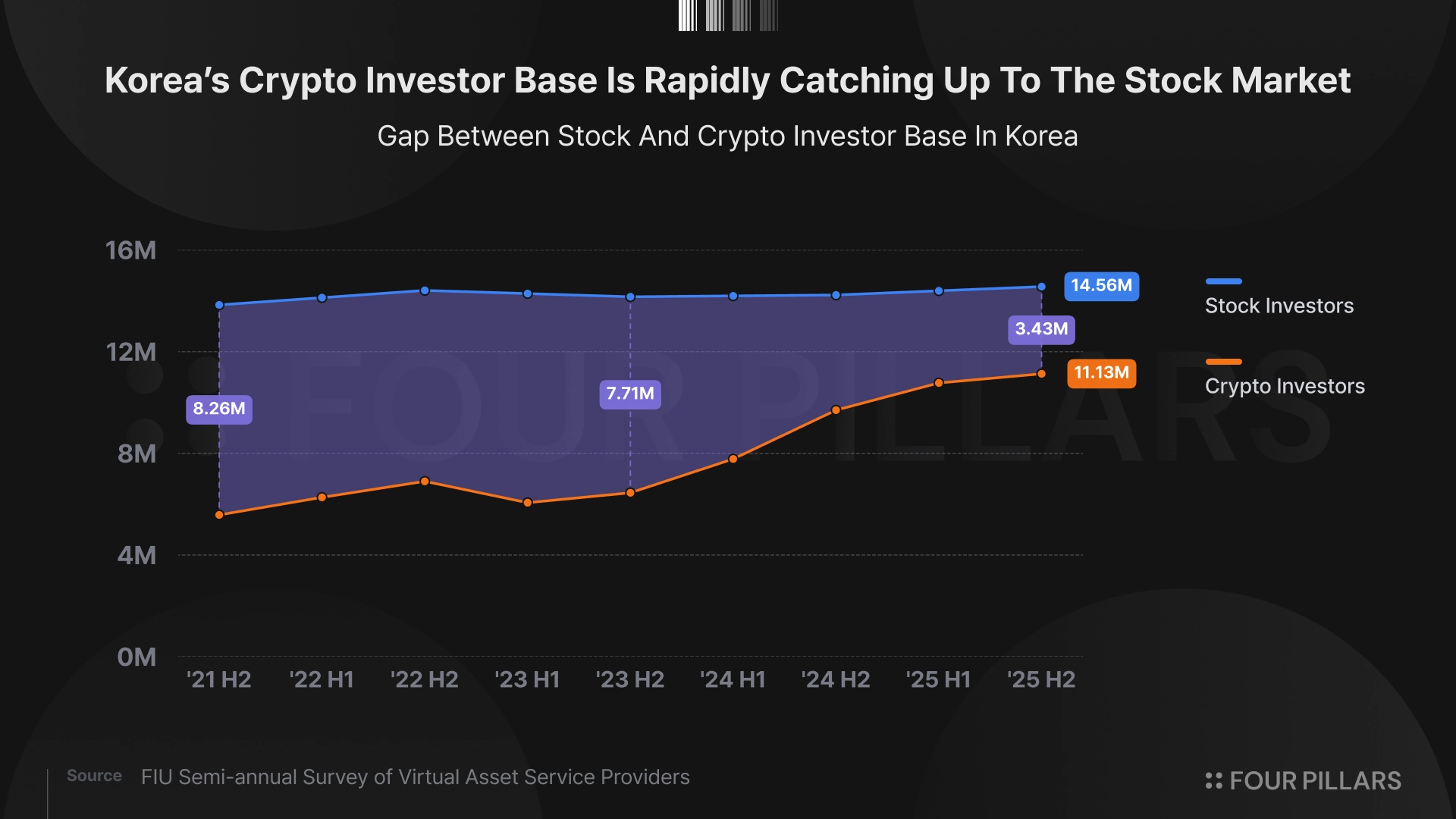
According to the second-half 2025 survey of virtual asset service providers by the Korea Financial Intelligence Unit (FIU) and the Financial Supervisory Service, the number of tradable users at domestic crypto exchanges reached 11.13 million as of the end of December 2025. Given that Korea's economically active population is about 30 million, roughly 37% hold an exchange account. That figure is comparable to the number of Korean stock investors (about 14 million), which shows that crypto has established itself as a mainstream investment vehicle in Korea.
There is another side to this quantitative growth. Users continue to increase, but the indicators that reflect the market's underlying strength all deteriorated in the second half of 2025. Average daily trading volume fell 15% from the first half to KRW 5.4T, market capitalization declined 8% to KRW 87.2T, and exchange operating profit dropped 38% to KRW 380.7B. While the market stalled, capital moved abroad. Crypto transferred to overseas service providers and personal wallets during the year totaled about KRW 169T across both halves.
1.2 Korea Is Facing a Change in Market Composition
This is how the Korean market has been explained so far. Fast turnover among retail investors, order flow that reacts immediately to sentiment, and the kimchi premium that opens up in every overheated phase are the topics that never fail to appear. In short, it is difficult to deny that speculative behavior is the clearest characteristic of the Korean market. This is less a problem to be overcome than a structural cause and effect produced by the conditions of Korean capital markets, including high technology adoption, the available paths to wealth accumulation, and the asset gap between generations.
That frame is no longer sufficient to explain Korea in 2026. Complexity has entered the market. Among participants alone, traditional finance and big tech have come into the market directly by acquiring exchange stakes, and on the regulatory side, KRW stablecoins, tokenized securities, and spot Bitcoin ETFs have all moved onto the institutionalization calendar. A market that sat inside Upbit's order book for years has begun to operate alongside financial infrastructure.
As a market grows more complex, it needs to be observed in more dimensions. This article works from two premises and provides an explanation of what makes Korea distinctive and of the industry as a whole.
The first is a change in the market's composition. The Korean market of the past few years and the market that will form over the next few years will look quite different. Korea is no longer a liquidity exit for the crypto market. It is forming its own market that handles the entire lifecycle of digital assets, including issuance, distribution, trading, remittance, and payments, within its borders, and the regulatory changes now underway in 2026 are pushing that transition quickly.
The second is what is specific to Korea. The institutional market forming inside the regulatory perimeter and the global offshore market operate on different logic. The place where KRW liquidity concentrates and the place where onchain activity happens are also far apart. Understanding this gap matters most when reading the Korean market.
2. Structural Characteristics of Korea's Web3 Market: Following KRW Liquidity
Korea has an exchange user base close in size to its stock market, yet onchain activity is extremely low. This gap is the result of regulatory friction accumulated over a long period.
That friction shows up most clearly in the way capital moves through the Korean market. Investor KRW passes through three chokepoints after entering the market, and at each point the destination of the capital is determined by which routes are open and which are closed. Regulation, rather than the economic choices of individual investors, sets the direction of the flow. The figure below shows those three chokepoints and how paths diverge at each.
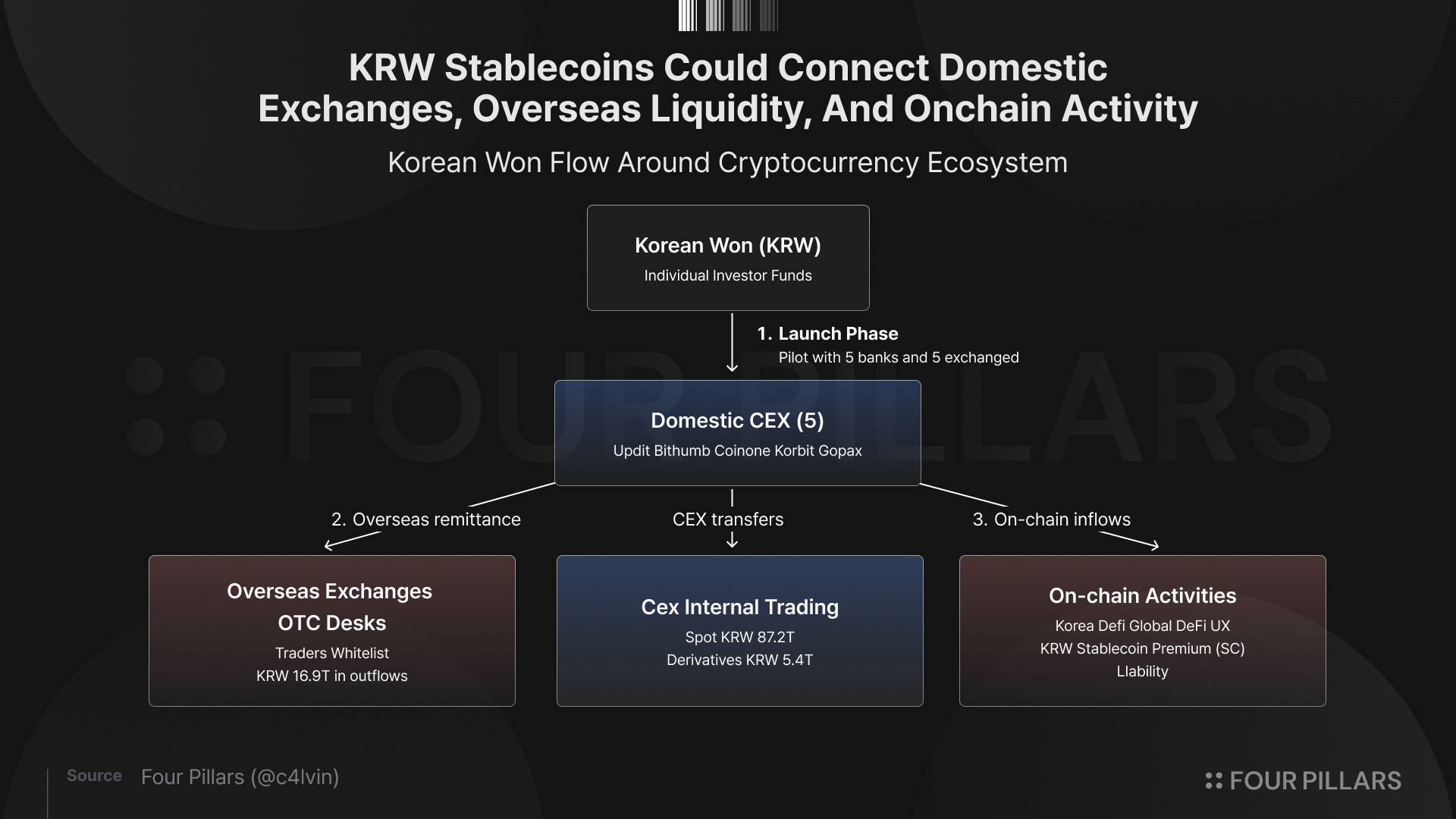
At chokepoint ①, the entry friction created by real-name account linkage concentrates KRW liquidity in a small number of domestic exchanges. The resulting CEX dependence produces knock-on effects in two directions.
At chokepoint ②, capital leaves the country in search of derivatives, broader listed asset coverage, and arbitrage opportunities that domestic exchanges do not offer.
At chokepoint ③, low accessibility of wallets and DeFi protocols, the complexity of managing gas fees and bridges, the absence of a KRW stablecoin, and the lack of Korean language support create a significant user experience gap between trading on a KRW exchange and using onchain services. There is little incentive for KRW liquidity to move onchain, and it stays inside exchanges.
The investor and builder asymmetry, the high level of outflows abroad, and low onchain activity are not separate phenomena. They are the result of one root cause, which is excessive dependence on a single onramp. The sections below use these chokepoints to examine the structural characteristics of the Korean market.
2.1 Exchange Concentration and Low Onchain Usage
Most of the 11.13 million Korean exchange users trade tokens only on centralized exchanges (hereafter CEX), and users who interact directly with DeFi protocols or onchain applications are a small minority. Most of the KRW that enters through chokepoint ① stays inside CEXs without crossing chokepoint ③.
This asymmetry comes from two structural causes:
First, the bottleneck at chokepoint ①. Converting crypto into KRW is possible only through a domestic exchange linked to a real-name verified bank account. In a structure where the exchange functions as the only onramp and offramp, the basic unit of investment activity is an exchange order rather than an onchain transaction.
Second, the friction at chokepoint ③. The lack of Korean language support in major wallets and DeFi protocols, the complexity of gas management and bridging, and the absence of a KRW stablecoin combine to create a significant gap in user experience between trading on a KRW exchange and moving onchain.
The absence of a builder ecosystem creates a cycle that entrenches this asymmetry. In an environment where corporate crypto trading was effectively prohibited, building a token-based business model legally inside Korea was difficult, and it became standard practice for many Korean founders to incorporate in Singapore, Dubai, or the Cayman Islands. When builders leave the country, fewer onchain services remain accessible to domestic users, which reinforces CEX dependence again. The paradox of building in Korea while being unable to serve Korea keeps repeating.
2.2 Small Balances, Altcoin Concentration, Fast Turnover
Capital that passes chokepoint ① mostly circulates inside CEXs.
The user base shows a two-tier structure centered on small balances. 74.2% of all users (8.26 million) hold assets under KRW 1M, and 58.7% of all users (6.54 million) hold less than KRW 500K. At the other end, holders of KRW 1B or more declined from 10,200 in the second half of 2024 to 6,900 at the end of 2025. New inflows come mainly from small participants while large investors exit, which produces a structure where the base widens and the top is shaved down.
Two characteristics stand out in trading behavior.
The first is altcoin concentration. As of the end of December 2025, Bitcoin accounted for 58.4% of market capitalization in the global market but only 34.9% in Korea. The most dramatic difference is XRP, which ranks fifth globally (3.7%) but second in Korea (26.5%). Ethereum (13.1%), Solana (3.3%), and Dogecoin (2.9%) follow, a composition that shows altcoin concentration exists structurally at the level of asset allocation rather than trading volume.
The second is high turnover. Against market capitalization of KRW 87.2T, average daily trading volume is KRW 5.4T, putting the ratio of daily volume to market capitalization at about 6.2%. Market assets turn over roughly once every 16 trading days, which indicates a market dominated by short-term trading rather than long-term holding. Over the same period, crypto price volatility compiled by the FIU was 73%-,%EA%B0%80%EA%B2%A9%EB%B3%80%EB%8F%99%EC%84%B1,-((%EC%B5%9C%EA%B3%A0%EA%B0%80%2D%EC%B5%9C%EC%A0%80%EA%B0%80)/%EC%B5%9C%EA%B3%A0%EA%B0%80), extremely high compared with the KOSPI (28.3%) and KOSDAQ (18.8%). The small-balance user base, altcoin concentration, and high turnover reinforce one another. Small investors prefer altcoins for their leverage effect given the limits of their capital, and the high volatility of altcoins draws them back into short-term trading.
There is also a social context specific to Korea behind this investment behavior. Korea's experience of compressed growth, reaching developed-economy status within a single generation, created a social climate oriented toward rapid asset accumulation, and the long-term rise in real estate prices reinforced it. As barriers to entry into the Seoul metropolitan housing market rose for younger generations, crypto emerged as an alternative route to building assets, particularly among people in their twenties and thirties who found the traditional path blocked.
On top of this, OECD-leading smartphone penetration and high-speed internet infrastructure have created an environment where information spreads in real time and trades can be executed immediately. These social and cultural factors, combined with the CEX-centered market structure, the share of small investors, and a Telegram-based information ecosystem, point to the formation of Korea's distinctive altcoin-heavy, high-turnover market.
2.3 Two Exchanges Splitting 88% of the Market
2.3.1 The Upbit and Bithumb Duopoly
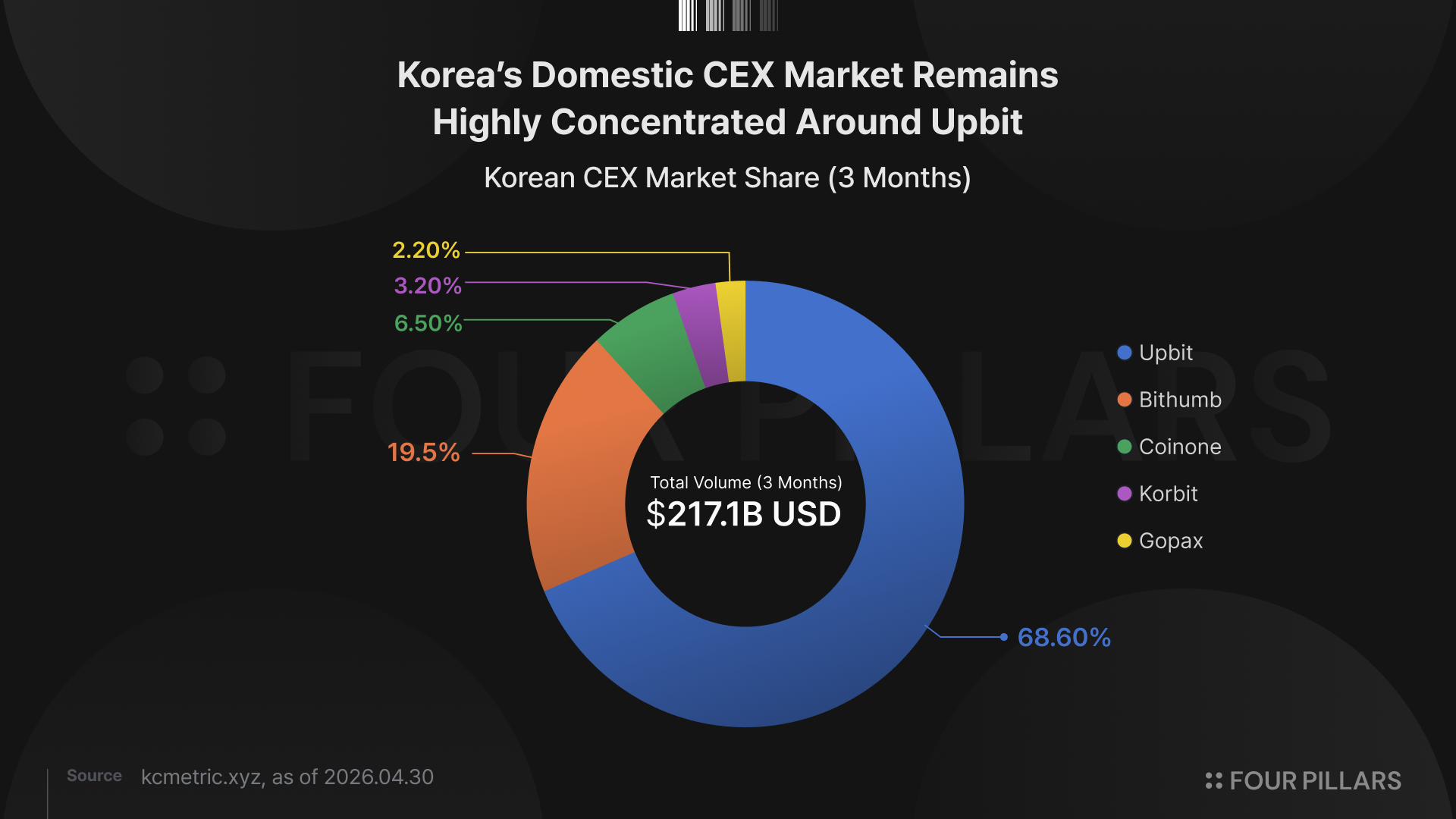
The Korean crypto exchange market has formed a dominant duopoly between Upbit and Bithumb. As of April 30, 2026, of the roughly KRW 320T ($217B) in three-month aggregate trading volume across Korea's five major exchanges (Upbit, Bithumb, Coinone, Korbit, Gopax), Upbit accounted for about 68.6% and Bithumb for about 19.5%, giving the two firms more than 88% of the market. Coinone, Korbit, and Gopax are effectively in a fight for survival.
There are signs of change in this structure. Upbit's share approached 80% through 2024, but declined steadily through 2025 and fell to the low 60% range by the end of the year. Bithumb raised its share through aggressive marketing and the lowest fees in the market, and in September 2025 briefly recorded a 45.7% share, an all-time high, placing the two exchanges in active competition.
That competition for share is also weakening profitability across the industry. Operating profit across all exchanges in the second half of 2025 was KRW 380.7B, down 38% from the first half, and by quarter it fell sharply from KRW 457.9B in the first quarter to KRW 81.1B in the fourth. The average fee rate declined from 0.17% to 0.15%, a result of market weakness combined with intensifying competition such as Bithumb's zero-fee policy. Competition between exchanges helps attract users while eroding the revenue base. The equity capital ratio across all exchanges also fell from 49.3% to 41.2%, putting financial soundness on a deteriorating trend as well.
2.3.2 Changes in Korea's Exchange Landscape
In this environment, a large-scale reorganization that will determine the medium-term landscape of the domestic exchange market is underway. Over the past year, changes in governance or shareholder structure were confirmed at four of the five major exchanges. With big tech, traditional financial firms, and global exchange capital flowing in one after another, the domestic exchange market is moving away from independent operators and forming a new competitive structure.
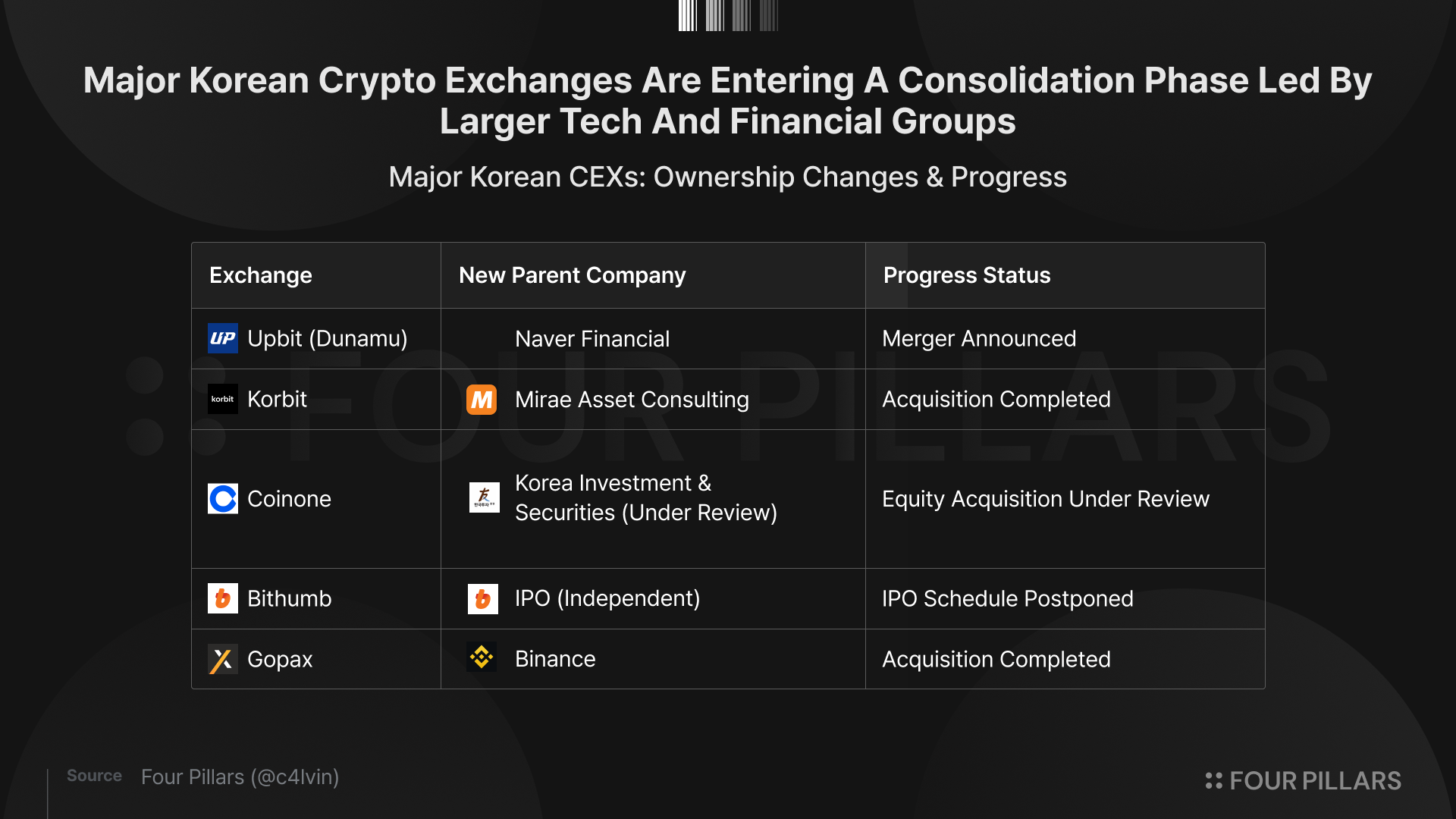
Dunamu is proceeding with a merger with Naver Financial. The transaction carries a combined enterprise value of about KRW 20T, with a shareholder meeting scheduled for November 2026 and a share exchange in December, and the plan calls for forming an IPO committee after the merger.
Bithumb is pursuing a KOSDAQ IPO. For this, Bithumb designed a spin-off structure with Samsung Securities as lead underwriter (surviving entity "Bithumb" plus newly established entity "Bithumb A"), but conflict with financial authorities and governance issues are expected to delay the schedule.
Coinone has reached the point of confirming a new shareholder structure. Korea Investment & Securities and OKX Ventures signed agreements in May 2026 to acquire existing shares and newly issued shares of Coinone respectively, and completed the FIU's approval of the change in largest shareholder filing in July. Each holds a 20% stake, closer to a strategic equity investment than an acquisition of management control.
At Korbit, NXC and SK Planet, previously the first and second largest shareholders, sold their stakes to Mirae Asset Consulting, completing an acquisition at a final stake of 97.15%.
Gopax has completed Binance's acquisition process. Binance acquired about 67% of Streami, Gopax's operator, in 2023, and after more than two years of delay in the approval of its executive change filing, the FIU accepted the filing in October 2025, completing Binance's acquisition.
3. Regulation: 2026, Ahead of Phase 2 Legislation
Korean crypto regulation maintained a stance of prohibition or deferral for a long time, but began a full shift toward institutionalization in 2024. As of 2026, Korea sits in a transitional period in which the Virtual Asset User Protection Act (Phase 1) is in force and legislation for the Digital Asset Basic Act (Phase 2) is being pursued.
3.1 Regulatory Timeline
Korean virtual asset regulation took its current form across three broad periods:
- 2017 to 2021: Real-name accounts mandated and ICOs banned in response to speculative overheating
- 2022 to 2024: Segregated custody of assets, unfair trading rules, and market surveillance obligations introduced after the Terra/Luna collapse
- 2025 to present: Institutionalization extended to corporate participation, stablecoins, token issuance, and ETFs
The first cycle runs from 2017 to 2021. Amid the ICO boom and speculative overheating in 2017, the Minister of Justice stated that closing exchanges was under consideration, and the government blocked trading by minors and foreigners and mandated real-name accounts. Corporate virtual asset trading was effectively blocked in this process, and ICOs were banned in 2018. With the issuance route closed domestically, Korean blockchain projects set up entities in Singapore, the Cayman Islands, and elsewhere to issue tokens, and that practice continues into 2026. When the amended Specific Financial Transactions Act took effect in 2021, the VASP registration regime was introduced, and smaller exchanges that could not secure real-name accounts were pushed out, forming today's five-exchange structure.
The second cycle runs from 2022 to 2024. The collapse of Do Kwon's Terra/Luna project in 2022 caused about $40B in losses globally and brought the need for user protection legislation to the fore. When the Virtual Asset User Protection Act took effect in July 2024, Korea gained its first crypto-specific law, covering segregated custody of user assets, unfair trading rules, and market surveillance obligations.
The third cycle is ongoing. The Virtual Asset User Protection Act established the basic framework for user protection, but token issuance, stablecoins, corporate participation, and spot Bitcoin ETFs remain institutions still under construction. In the meantime, the market found its own solutions through offshore incorporation and overseas capital transfers, and big tech firms are forming stablecoin consortiums ahead of crypto-related legislation. The turning point that will cover this territory is the Digital Asset Basic Act now scheduled for implementation.
In the first cycle, real-name accounts and the VASP framework were introduced, the market structure hardened around a small number of exchanges, and offshore incorporation by domestic projects became standard practice. In the second cycle, segregated custody, unfair trading rules, and market surveillance obligations added user protection and market order to an exchange-centered market that had already formed.
In the third and ongoing cycle, corporate participation, stablecoins, token issuance, and ETFs mean that the participants and the product scope of the market themselves have become the subject of institutionalization. This round of institutionalization is likely to be the moment that decides whether the structure of the Korean crypto market formed during the regulatory gap is maintained or changed toward accepting new participants and infrastructure.
3.2 Exchange Rules and Delayed Corporate Participation
As of September 2026, the Korean regulatory framework consists of three parts. (1) The Specific Financial Transactions Act covers anti-money laundering obligations including business registration, customer due diligence, and suspicious transaction reporting. (2) The Virtual Asset User Protection Act handles protection of user assets and unfair trading rules. (3) The corporate participation roadmap is the policy that gradually widens which entities can enter the market within those rules.
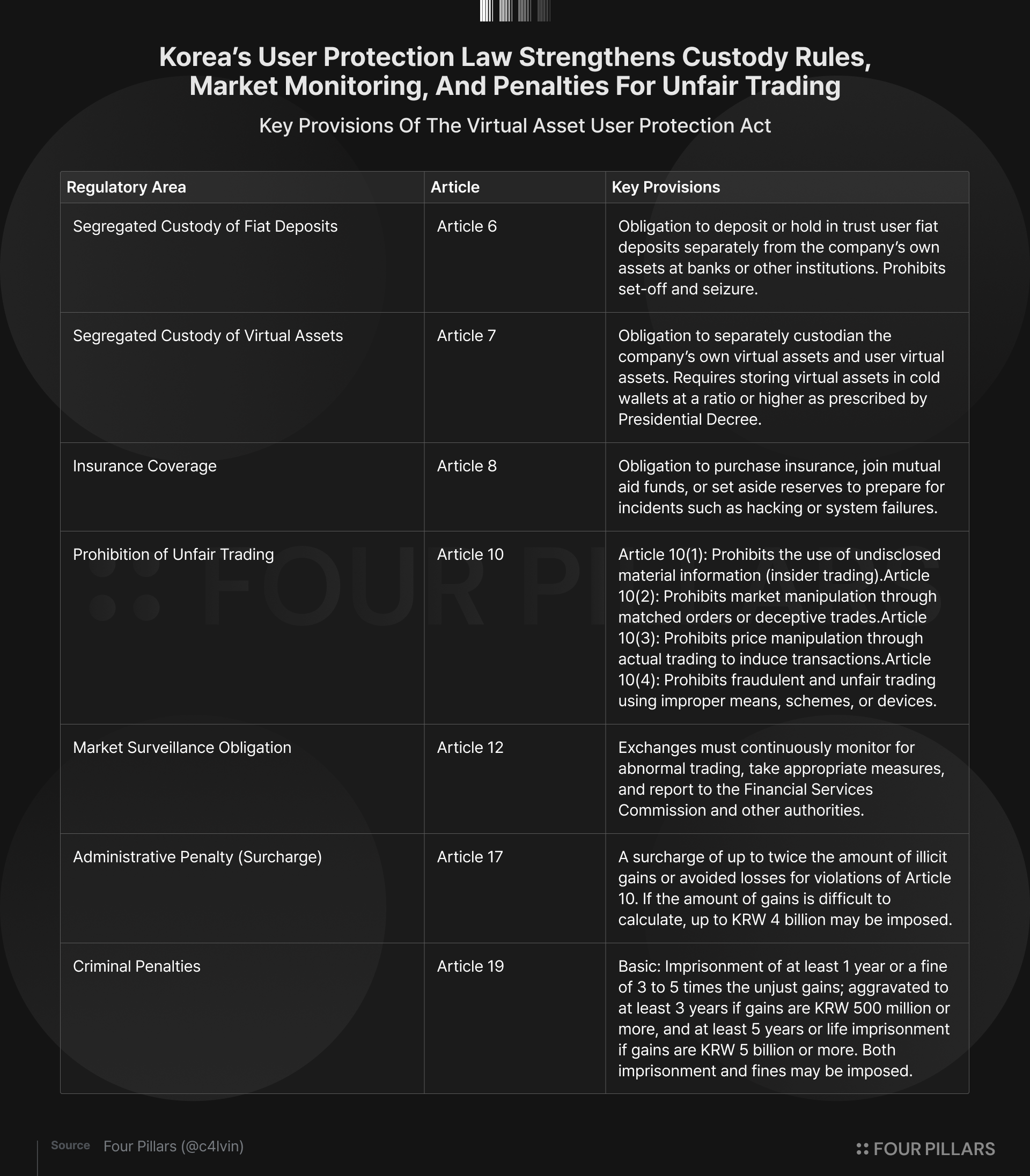
The Virtual Asset User Protection Act, the first crypto-specific law enacted in Korea, covers the following:
- Protection of user assets: Customer deposits and virtual assets must be held separately from the operator's own assets, and insurance or reserves must be arranged for contingencies.
- Unfair trading rules: Use of undisclosed information, price manipulation, and fraudulent trading are prohibited, in line with capital markets rules.
- Market surveillance obligations: Exchanges must monitor abnormal transactions on an ongoing basis and report to financial authorities when necessary.
- Stronger sanctions: Penalty surcharges are imposed on profits from unfair trading, and criminal punishment is possible depending on the severity of the violation.
The Specific Financial Transactions Act framework was also strengthened once. The amended enforcement decree of August 2026 widened the scope of VASP registration review to include the social credibility of the largest shareholder, and added registration requirements covering financial soundness, organization, and personnel. The provision that removes the KRW 1M threshold for the Travel Rule and requires verification of transaction risk with overseas service providers and personal wallets takes effect six months after promulgation.
Litigation over the interpretation of the law has also continued during implementation. The FIU imposed partial business suspensions and penalty surcharges on Upbit, Bithumb, and Coinone for reasons including transactions with unregistered overseas service providers and violations of customer due diligence obligations. In April 2026, the Seoul Administrative Court ruled in favor of Dunamu, Upbit's operator, finding that the specific obligation to block transactions under KRW 1M was not sufficiently specified in the rules at the time. The FIU appealed, and the main proceedings for the sanctions against Bithumb and Coinone are underway following decisions to suspend enforcement.
Corporate participation is moving more slowly than planned. Phase 1, implemented in 2025, established criteria for issuing corporate accounts so that non-profit corporations and virtual asset service providers could sell assets they hold. The next stage, which was to allow listed companies and professional investor corporations to buy and sell on a pilot basis, was originally targeted for the second half of 2025 but has not been implemented as of September 2026. Exchanges have already built dedicated corporate services, yet KRW virtual asset trading by domestic corporations remains closed.
3.3 Phase 2 Legislation: Key Issues in the Digital Asset Basic Act
Korea's current regulation has set two standards, user protection and corporate participation, but much of the core of the market still sits outside the regulatory perimeter. Token issuance (ICOs) has been banned since 2018, there is no legal definition of stablecoins, and classification systems and disclosure obligations for virtual assets remain incomplete. The Digital Asset Basic Act, commonly referred to as "Phase 2 legislation," is being pursued to fill this gap.
The Digital Asset Basic Act is a collective term for the legislation that follows the Virtual Asset User Protection Act. As of 2026, bills from several lawmakers including Min Byoung-dug (Democratic Party of Korea), Lee Kang-il (Democratic Party of Korea), and Kim Jae-sub (People Power Party) have been introduced in the National Assembly, and submission of a government bill is proceeding in parallel with National Assembly review.
The government and the ruling party are pursuing a plan to introduce a consolidated bill reflecting the Financial Services Commission's position in September as lawmaker-initiated legislation, and to review it jointly with the existing bills. A National Assembly public hearing is under discussion for late September, and the government has set legislation within the year as its target.
Passage of the Digital Asset Basic Act within the year remains the expectation, but many problems are still unresolved. The basic design covering issuance, disclosure, and business licensing is largely converging across the bills, while the issuer of KRW stablecoins and the shareholding cap for exchange owners have gone more than a year without conclusion. The sections below first set out the scope the law covers, then review the issues in order.
3.3.1 Scope of the Digital Asset Basic Act
The Digital Asset Basic Act is being designed as a general law that fully replaces the Virtual Asset User Protection Act rather than an amendment that adds provisions to it. Where Phase 1 legislation focused on protection of user assets and unfair trading rules assigned to exchanges, Phase 2 legislation extends the current user-protection-centered rules to cover issuance, distribution, business entry, and supervision of digital assets. The scope covered across the main bills is broadly as follows:
- Definition and classification of assets: Sets the legal scope and types of digital assets and establishes the rules that apply to each type.
- Token issuance and disclosure: Permits domestic token issuance on the condition that an issuance filing is submitted, and separates disclosure obligations at the issuance stage from those after distribution.
- Trading support and termination: Brings exchange listing review, listing maintenance review, and delisting procedures under statutory regulation.
- Business licensing and conduct rules: Divides business areas into trading, brokerage, custody, and transfer, and sets rules applying licensing requirements and conduct regulation to each.
- User protection and unfair trading rules: Covers protection of user assets and market surveillance obligations, and sets prohibitions and sanctions for unfair trading during issuance and distribution.
- Supervisory framework: Sets licensing, examination, and sanction authority over businesses, and specifies the supervisory roles and responsibilities of relevant agencies.
The largest change is issuance. A plan to legally permit domestic token issuance, effectively blocked since 2018, on the condition that an issuance filing is submitted is under discussion, and a framework separating issuance disclosure from distribution disclosure has been presented alongside it. This reverses the practice of domestic entities incorporating offshore in order to issue tokens and brings it back inside the domestic regulatory perimeter. Kaia, for example, is issued by a foundation registered in the Abu Dhabi Global Market (ADGM), and Nexon's NXPC is issued by a UAE entity. If a legal issuance route opens domestically, the need to maintain offshore issuance structures through foreign entities is likely to fall.
Trading support procedures also move into statute. Listing and delisting have so far been left to exchanges' internal standards and self-regulation, but the pending bills take the direction of writing listing review, maintenance review, and termination procedures into law alongside unfair trading rules. Min's bill includes a proposal to establish a separate committee that reviews eligibility for trading support and termination at an exchange's request.
Business regulation shifts from registration to licensing. The Ministry of Economy and Finance's economic growth strategy for the second half of 2026 also included a plan for legislation within the year centered on segmenting the digital asset business and institutionalizing stablecoins. The structure divides the business into trading, brokerage, custody, and transfer and applies entry requirements and conduct rules to each, which could create an entry route for financial companies that cannot currently obtain a license directly.
In effect, this law is the work of granting legal grounding for the first time to the entire process through which a digital asset is issued, listed, traded, and delisted when necessary. Subordinate regulations still need to be arranged after enactment, so even with passage within the year, actual implementation is expected in 2028 or later.
3.3.2 Shareholding Cap for Exchange Owners
One of the hottest issues in the legislative process is the shareholding cap for exchange owners. The ruling party and government argue that as exchanges shift from registration to licensing, their standing, authority, and responsibility all grow, so governance must be reworked as well, and the argument for stronger internal controls gained weight after the Bithumb Bitcoin misallocation incident in February 2026.
The government bill prepared by financial authorities is reported to have settled on applying a uniform cap to all operators rather than varying the rule by exchange size or market share. A cap around 20% is cited as the base proposal. The intent is to prevent a single owner from controlling an exchange alone, and to bring traditional financial companies such as banks, which can bear responsibility when an incident occurs, onto the board. The point that exchanges will be heavily involved in currency and payments once stablecoins are institutionalized is also offered as grounds for the argument.
Industry pushback is strong. If the standard is applied, owner stakes at a significant number of exchanges would exceed the cap. Exchanges oppose it on the grounds of infringement of property rights, and the National Assembly Research Service has pointed out possible unconstitutionality. Some ruling party lawmakers have also come out against the cap, leaving this provision as the largest variable for passage of the government bill.
This issue also connects to the exchange shareholding reorganization discussed earlier. Over the past year, while shareholder structures changed at four of the five major exchanges, most of the acquirers secured their stakes while the cap discussion remained unresolved. Exchange stakes were effectively the only route into the market for financial companies, which cannot easily obtain a VASP license directly. If the cap is actually introduced, the shareholding structures of deals already signed would need to be adjusted first.
3.3.3 KRW Stablecoins
KRW stablecoins are the issue that draws the most attention and discussion in Phase 2 legislation. After President Lee Jae-myung pledged the introduction of a KRW stablecoin during the presidential campaign, a digital asset task force was launched to pursue legislation, but the gap between the Bank of Korea and the Financial Services Commission over the issuer and governance structure has not narrowed.
At the center of the debate is the "51% rule" put forward by the Bank of Korea. It would require banks to hold 51% or more of the equity in the special purpose company (SPC) that issues a stablecoin, and the Bank of Korea cites seven risks as grounds: depegging, bank runs, the absence of deposit protection, erosion of the principle separating banking and commerce, accelerated capital outflows, weakened monetary policy transmission, and impairment of financial intermediation. The Financial Services Commission and the ruling party counter that bank monopoly does not match global standards, and prefer an open structure that guarantees participation by private companies.
The differences among the three bills introduced lie in the entry thresholds and the allocation of supervisory authority. Capital requirements vary widely, at KRW 500M in Min's bill, KRW 1B in Lee's bill, and KRW 5B in Kim's bill. On the Bank of Korea's role, Lee's bill grants special oversight authority and sets the strongest role for the central bank, while Min's and Kim's bills stay at a general level. On domestic distribution of overseas stablecoins (USDT, USDC, and others), Kim's bill is the most open, permitting it through registration alone, while Min's bill is the most restrictive.
Separately from the lawmaker-initiated bills, a government draft led by the Financial Services Commission effectively reached final form in March 2026. The ruling party's digital asset task force initially tried to produce its own consolidated bill, but failed to close the gap with the Financial Services Commission and settled on accepting the government draft. The government draft is structured so that the statute carries only basic principles, while the contested details including capital requirements, the specifics of shareholding regulation, and reserve management methods are delegated to the enforcement decree.
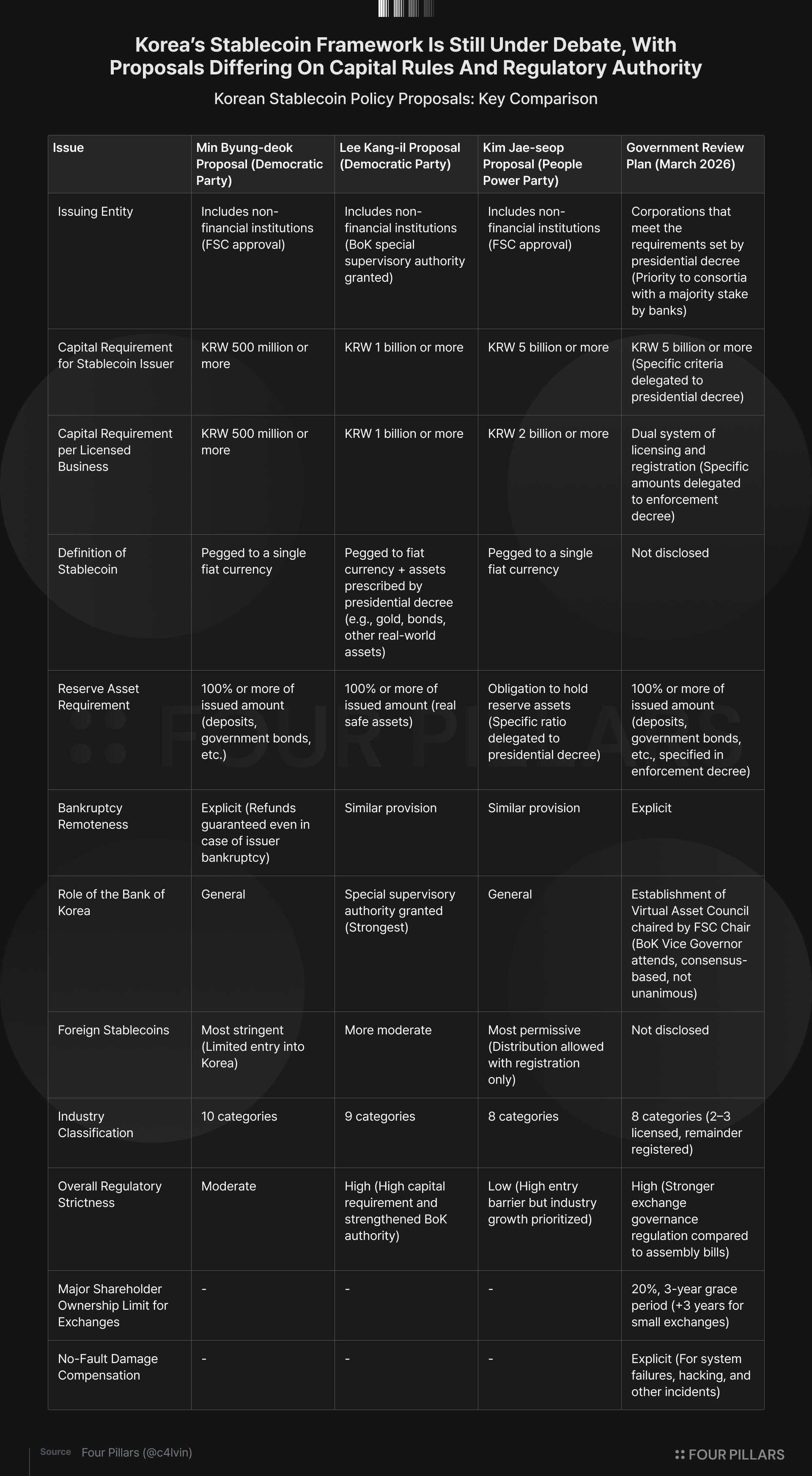
The proposals differ from one another, but points of agreement also exist: (1) an obligation to hold reserve assets of 100% or more, (2) a guaranteed 1:1 redemption right, (3) required authorization from the Financial Services Commission, and (4) the introduction of bankruptcy remoteness arrangements. On the issuer, all three lawmaker bills permit participation by non-financial institutions, while the government draft is pursuing a structure that gives priority to consortiums in which banks hold a majority stake (50% plus one share), leaving the clearest difference of view.
The capital requirement converged on KRW 5B or more in party-government consultations, somewhat higher than the KRW 1B to KRW 3B range originally projected by the Korea Capital Market Institute (KCMI). The final bill is therefore likely to converge on a bank and big tech joint venture model that mandates bank participation while also permitting big tech and fintech firms to hold stakes, with the specific shareholding ratios to be set in the enforcement decree.
Bank of Korea Governor Shin Hyun-song, who took office in April 2026, acknowledges the need for a KRW stablecoin while emphasizing phased introduction. In July he stated that a KRW stablecoin needs to be introduced quickly, while proposing an approach that starts with banks and later widens to non-bank institutions. He also set out the position that central bank digital currency (CBDC), tokenized deposits, and private stablecoins can coexist. This points less to the Bank of Korea opposing private issuance itself than to a direction that prioritizes reserve assets, redemption, and monetary stability safeguards.
3.3.4 How the Korean Market Has Responded to KRW Stablecoins
While the bills stall in the National Assembly, companies are responding to KRW stablecoins with distinctly different strategies.
Among big tech, competitive entry by Kakao, Toss, and Naver is becoming visible.
- Naver: Naver Pay CEO Park Sang-jin stated that the company is ready to play a leading role once relevant policy is in place, and once the Dunamu merger completes, Naver becomes the only camp to have internalized exchange infrastructure, which is expected to give it a distinct advantage in seamless linkage between stablecoin issuance and virtual asset trading.
- Kakao: The group runs a task force in which the CEOs of Kakao, KakaoBank, and Kakao Pay join weekly meetings, and announced that KakaoBank will lead issuance. The Kakao group's main strategy is distribution inside KakaoTalk, the messenger effectively used daily by the entire population.
- Toss: Toss Bank, Toss Payments, and Toss Securities formed a stablecoin task force across the three companies. Toss has disclosed a user base of about 30 million and a plan to deploy 700,000 payment terminals by 2027, presenting offline payment infrastructure as its differentiator.
All of them include bank affiliates in their consortiums to address the Bank of Korea's 51% rule, which shows that the "bank and big tech joint venture model" is converging into a de facto standard. They are also betting on distribution and payments through their existing infrastructure: messenger, offline terminals, and commerce platforms.
The Bank of Korea, meanwhile, is continuing Project Hangang, its tokenized deposit experiment, separately from private stablecoins. After completing the first live transaction test in 2025, the second test beginning in the second half of 2026 expands participating banks to nine and verifies biometric authentication, automatic conversion between deposits and tokenized deposits, and conditional disbursement of EV charging infrastructure subsidies and public agency operating expenses.
In the private sector, KRW stablecoins already in circulation exist ahead of institutionalization. KRWQ, operated through a partnership between IQ and FRAX, trades on the Base chain and passed KRW 1B in trading volume within one month of launch. BDACS's KRW1 uses 100% collateralization with commercial bank KRW deposits and has expanded to Polygon.
3.3.5 Other Issues
There are also regulatory changes under discussion at the same time that are not included in the text of the Digital Asset Basic Act. They range from confirmed implementation to early-stage discussion.
The first is spot Bitcoin ETFs. The United States and Hong Kong permitted spot ETFs in 2024, but in Korea the underlying assets for an ETF are limited under the current Financial Investment Services and Capital Markets Act to financial investment products and domestic and foreign currencies, which makes a product based on virtual assets impossible. In the "economic growth strategy for the second half of 2026" announced in July 2026, the government stated that it would support legislation amending the Capital Markets Act to include virtual assets in the scope of underlying assets, which attached a concrete schedule to a discussion that had remained at the level of campaign pledges and policy tasks for years. Even after the amendment, index calculation standards, custody infrastructure, and foreign exchange regulation still need to be arranged, so actual product launch is expected to take time.
The second is foreign exchange regulation, where the conclusion is already in place. The amendment to the Foreign Exchange Transactions Act that passed the National Assembly plenary session in May 2026 takes effect in December. It defines the act of transferring virtual assets between Korea and abroad as "virtual asset transfer business" and imposes an obligation on operators to register with the Minister of Economy and Finance. Registered operators will report transaction data to foreign exchange authorities, and where intent to obtain improper gain is established for violations of payment procedures, sanctions rise from administrative fines to imprisonment or criminal fines.
The third is the separation of banking and commerce. The current principle restricting financial companies from entering non-financial businesses and holding stakes in them can act as a constraint as banks and financial groups expand their virtual asset businesses. In areas such as KRW stablecoins, where joint participation by banks and fintechs is expected, how the issuer and shareholding structure are designed relates directly to this principle. The reason bank consortiums for KRW stablecoins gather multiple banks is also the equity investment limit under the Banking Act, and whether that principle is left in place or given an exception remains undecided.
3.4 Tokenized Securities (STO)
On tokenized securities, amendments to the Financial Investment Services and Capital Markets Act and the Electronic Securities Act passed the National Assembly plenary session in January 2026 and are scheduled to take effect on February 4, 2027. The amendments recognize distributed ledgers that meet certain requirements as electronic registration account books, and introduce an issuer account management institution regime under which a qualifying issuer can directly register and manage tokenized securities, along with an OTC brokerage regime that intermediates the distribution of investment contract securities and beneficiary certificates of non-monetary trusts.
Korea's early discussion of tokenized securities and its regulatory sandbox concentrated on fractional investment with real estate, art, and music royalties as underlying assets. Fractional investment had simpler rights relationships than existing stocks or bonds and no electronic securities regime in place, which made it easier to test new infrastructure.
As a result, tokenized securities came to be perceived as meaning only non-standard securities such as investment contract securities and beneficiary certificates of non-monetary trusts. Strictly speaking, though, tokenized securities refer to the form of issuance that records rights on a distributed ledger, not to the content of the security. Standard securities such as stocks, bonds, and funds also qualify legally as tokenized securities when issued on a distributed ledger.
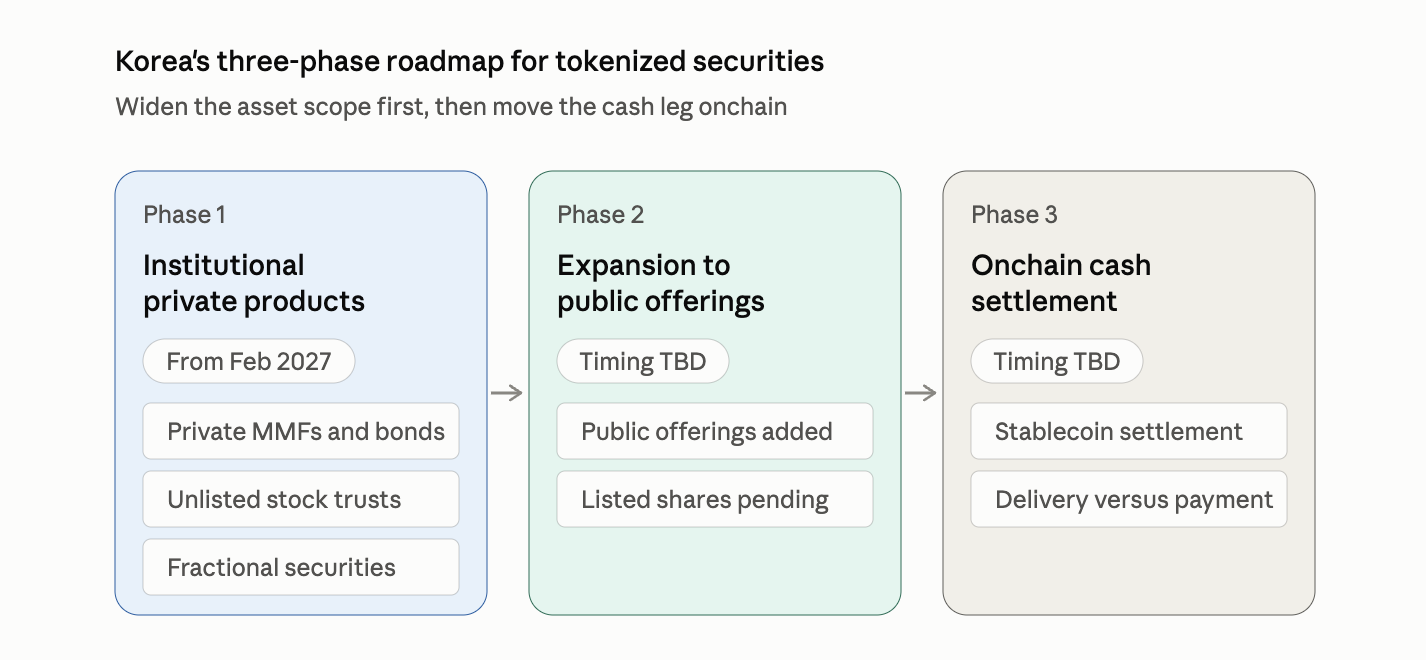
The Financial Services Commission announced its policy direction for tokenized securities at the third meeting of the public-private tokenized securities council in September 2026, presenting a three-phase roadmap that widens the scope of application from fractional investment to existing capital market products. The decision reflects the global spread of standard securities tokenization, such as BlackRock's private MMF "BUIDL" in the United States and Hong Kong's tokenized green bonds. What changes before and after the policy announcement is as follows:
- Before the policy announcement: Eligible assets are effectively limited to investment contract securities and beneficiary certificates of non-monetary trusts based on real estate, art, and music royalties. The issuance form is the existing electronic securities method, permitted case by case through innovative financial service designation in the regulatory sandbox. Tokenization of standard securities is excluded from discussion, and settlement uses the existing clearing and settlement systems as they are.
- After Phase 1 (effective February 2027): Tokenization of institutional-investor-only private MMFs and private bonds is permitted, bringing funds and bonds into scope for the first time. Unlisted shares are pursued through a method in which shares already issued as electronic securities are deposited with the Korea Securities Depository or a trust company and the beneficial interest is tokenized in the form of trust beneficiary certificates. Listed shares are excluded from scope, with separate pilot projects run in parallel centered on the Korea Exchange.
After that, stability, efficiency, and market demand from Phase 1 will be reviewed before widening the scope to publicly offered securities in Phase 2, and Phase 3 plans to introduce stablecoins and similar instruments as a settlement means, implementing settlement in which securities and cash move on the same network. The timing of Phase 2 has not been fixed, as it can shift with the pace of technical readiness among market participants.
Distribution infrastructure is being prepared as the bills pass and the market opens. In February 2026, the Financial Services Commission selected the Nextrade (NXT) consortium and the KDX consortium formed by the Korea Exchange and Koscom as preliminary licensees for fractional investment OTC exchanges, and both applied for full licenses in August. The Korea Exchange is separately preparing to open a market for new types of securities.
The remaining work lies in subordinate regulations and technical requirements. The subordinate regulation amendments included in the policy direction are scheduled for legislative notice in late September 2026, and the permitted scope for public blockchains, transfers to external wallets, and the method of connecting onchain settlement with existing clearing and settlement infrastructure have not yet been specified. Phase 3 onchain settlement in particular can only begin after the issuance requirements, reserve assets, redemption rights, and settlement finality for KRW stablecoins are resolved through legislation.
3.5 Crypto Taxation
Taxation of income from the transfer and lending of virtual assets begins on January 1, 2027 under current law. After annual gains and losses are netted, income exceeding the KRW 2.5M basic deduction is taxed at 22%, combining 20% national tax and 2% local income tax. Acquisition cost is calculated using the total average method per resident, and for assets held before 2027, the higher of the actual acquisition cost and the market price on December 31, 2026 applies. The intent is not to tax gains accrued through the end of 2026. Including domestic transactions, the structure is not withholding-based but requires the taxpayer to compile a full year of gains and losses and file, with the first filing and payment in May 2028 during the comprehensive income tax filing period.
The start date has been postponed three times, but the tax reform proposal announced in August 2026 did not include a further deferral. The government has also ruled out another postponement, which makes implementation in 2027 likely as things stand. The People Power Party has introduced a bill deleting the taxation provision entirely and a separate Income Tax Act amendment pushing the effective date to 2030, and debate within the ruling party over whether to keep the current schedule continues, so political variables remain.
Gaps in the regime also continue to draw criticism. For assets received through airdrops, hard forks, and liquidity provision, the tax burden changes significantly depending on whether acquisition cost is treated as zero or as the market price at the time of receipt, and no specific standard has been set. Proving the actual purchase price is also difficult for assets held for a long time on overseas exchanges or in personal wallets.
The absence of loss carryforward is another problem raised. Gains and losses arising in the same year are netted, but an annual loss cannot be carried into the following year, so an investor who loses KRW 50M in the first year and earns KRW 50M in the second faces about KRW 10.45M in tax despite a cumulative two-year result of zero. Recent proposals include allowing a five-year carryforward, raising the KRW 2.5M basic deduction, and introducing tax incentives that encourage the use of domestic exchanges.
Alongside stronger taxation, the government's collection system for overseas transactions is also being reinforced. Under the Crypto-Asset Reporting Framework (CARF), Korea will automatically exchange information on residents' overseas virtual asset transactions with treaty partners beginning in 2027. Regardless of whether the tax takes effect, the direction in which trading through overseas exchanges falls within the tax authority's field of view is already clear.
4. Financial Institutions Entering the Digital Asset Business
As set out above, regulation is moving in the direction of gradual liberalization. From KRW stablecoins to tokenized securities, crypto asset handling, and the tax framework, the rules are being arranged, and business uncertainty is easing along with them. New business entrants are beginning to come into the market alongside this change.
In 2021, Korean conglomerates entered blockchain businesses in large numbers in line with the market boom. Things did not go as planned. Samsung, SK, Kakao, Naver, LINE, and Hyundai rolled out NFT marketplaces, metaverse platforms, and blockchain subsidiaries one after another, but most were scaled back or wound down through the 2022 to 2023 crypto winter. These were decisions made in step with market sentiment, without confirmed demand for consumer-facing services.
The second wave of entry since 2025 looks different. The target has moved from consumer products to financial infrastructure, and the participants have widened from platform companies to banks, securities firms, and card issuers. Banks handle stablecoin issuance, settlement, and custody, securities firms handle tokenized securities issuance and account management, card issuers handle the connection to merchant payment networks, and fintechs handle distribution and the user interface. Moving as consortiums and shared platforms rather than as scattered attempts by individual companies is another difference from the first generation.
The business conditions they face are not the same as those of global financial institutions. In Korea, real-time account transfers run 24 hours a day at close to no cost, simple payments are already embedded in daily life, and merchant fees have been brought down to 0.40% to 1.45% through regulation. Securities trading is available on mobile in fractional units, and the entire population sits inside the real-name account and electronic securities framework. If filling gaps in payment speed and financial access is the main rationale for adopting stablecoins and tokenization globally, in Korea that gap is not large.
Initial proofs of concept by financial institutions therefore center on cross-border remittance and settlement, inbound payments by foreigners, and institutional issuance and rights management. These are areas that existing infrastructure covers relatively less, that do not collide with domestic revenue, and that can be started before business rules are set.
The next picture is being drawn alongside it. Banks plan to extend into KRW stablecoin issuance and custody, securities firms into publicly offered securities and onchain settlement, card issuers into domestic merchant payments, and fintechs into KRW stablecoin-based distribution, with the timing depending on when the Digital Asset Basic Act and the subordinate regulations for tokenized securities are finalized. The sections below review what players across financial services are preparing now and where they intend to go once the rules open.
4.1 Banks
Banking is the most active area, with industry-level joint projects and individual banks' infrastructure buildouts proceeding at the same time. Preparation across the sector is advancing simultaneously along three lines: a shared remittance network, issuance consortiums, and individual custody infrastructure.
Source: Speee
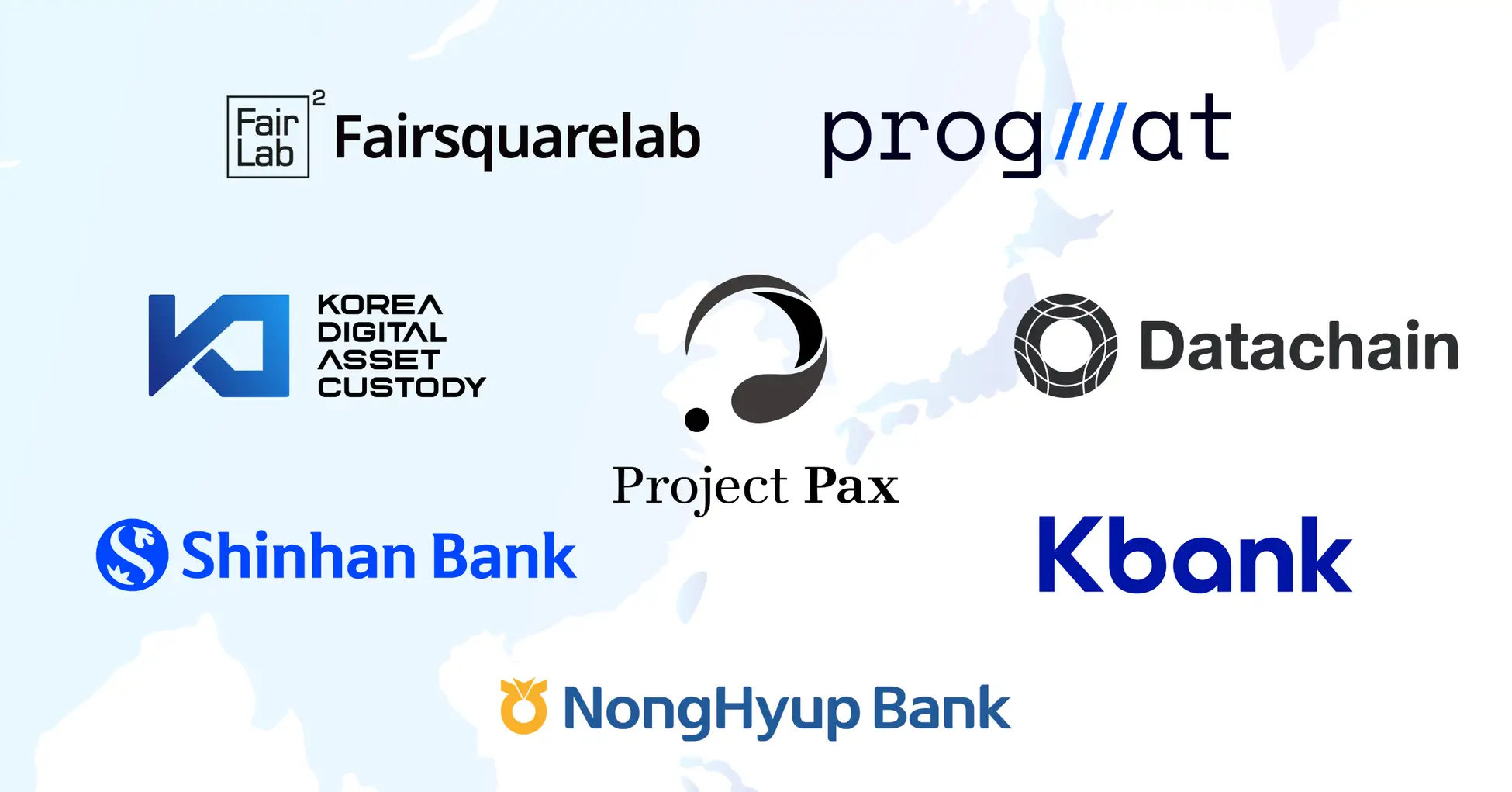
The leading example of a joint project is Project Pax, a proof of concept for cross-border remittance between Korea and Japan. Fair Square Lab and Korea Digital Asset Custody (KDAC) lead the Korean side, while Progmat, Datachain, and Shoko Chukin Bank participate on the Japanese side. Phase 1 on the Korean side included Shinhan Bank, NH NongHyup Bank, and K Bank, and Phase 2 added KB Kookmin Bank and Woori Bank. The design is a sandwich model that converts KRW into a stablecoin, transmits it, and converts it into JPY in Japan, keeping customer deposits and withdrawals on existing financial rails and using blockchain for the transfer in between.
Consortium formation for KRW stablecoin issuance is proceeding in parallel. Under the Banking Act, a bank can in principle hold no more than 15% of another company's shares, which means at least four banks must come together for the combined bank stake in an issuer to reach a majority. With the number of banks itself limited, the structure favors whoever fills the seats first. As of early 2026, Hana Financial was reported to have secured six banks including BNK Financial, iM Financial, SC First Bank, OK Savings Bank, and JB Financial, and KB Financial is reviewing a plan to enter the market together with Toss. Kakao is widening its set of partners by proposing consortium formation to major commercial banks.
Preparation at individual banks is as follows:
- Shinhan Bank: Established a virtual asset task force in February 2025 and participates in global financial infrastructure experiments including Project Agorá, SWIFT's shared ledger, and Project Pax. At the group level, it also began a proof of concept with Visa in August 2026 on using stablecoins for card payment settlement, and is jointly reviewing a plan to connect the infrastructure of Shinhan Bank, Shinhan Card, and Jeju Bank with Visa's payment network.
- KB Kookmin Bank: Secured a point of contact with exchange infrastructure as Bithumb's real-name deposit and withdrawal account partner, and in 2026 technically verified KRW stablecoin issuance, payment, and overseas remittance on Kaia.
- Hana Financial Group: Has built the strongest regulatory foundation for a custody business among Korean banks. It signed an agreement with BitGo in 2023 and established the joint venture BitGo Korea in 2024, and BitGo Korea's VASP filing was accepted by the FIU in August 2026. It is the first case of a global custody specialist setting up a Korean entity and having its filing accepted. With Dunamu, it completed a proof of concept replacing SWIFT remittance messages between Hana Bank's domestic and overseas branches with blockchain messages on the GIWA chain, and is widening the experiment to remittance infrastructure using tokenized deposits.
- Woori Bank: Secured custody infrastructure by acquiring a partial stake in the digital asset custody firm BDACS, and is also pursuing a VASP license to operate its own wallet.
- NH NongHyup Bank: Ran a proof of concept with Fireblocks, Avalanche, Mastercard, and Worldpay to automate VAT refunds for foreign tourists using blockchain and stablecoins.
In Korea, individuals can move funds between accounts almost instantly through a banking app, and services that waive transfer fees are widespread. Looking at domestic remittance alone, the additional benefit a stablecoin can offer is small. Corporate cross-border payments, by contrast, involve currency conversion, local banking networks, and differing business hours across countries. Project Pax and Hana Bank's remittance experiment between overseas branches target that gap. The judgment appears to be that the intermediate processing layer of existing corporate banking services is a better business than getting customers to adopt a new wallet.
4.2 Securities Firms
Securities firms are working to widen the range of products they handle through tokenized securities and to secure new revenue from issuance support, account management, distribution, and brokerage. As the Financial Services Commission set out a policy direction in September 2026 for phased tokenization extending to stocks, bonds, and funds, the regulatory basis for these business preparations is also taking shape. With an effective date fixed at February 4, 2027, their preparation schedule is clearer than in other sectors.
Business preparation splits between joining shared infrastructure and building proprietary platforms. Koscom is preparing "KoSTO," a shared issuance platform for tokenized securities used by multiple securities firms, having completed the issuance infrastructure buildout with LG CNS and a testbed verification linking it with the Korea Securities Depository's total issuance management system. Twelve firms including Kiwoom Securities, NH Investment & Securities, Daishin Securities, Meritz Securities, and Kyobo Securities signed the agreement, and Hyundai Motor Securities joined in September 2026, bringing the total to thirteen.
Korea Investment & Securities, by contrast, is preparing its own system, Meritz Securities is reviewing both options, and Samsung Securities has not set a direction. The pattern suggests that firms with a larger retail brokerage share lean toward the shared platform that splits buildout costs, while firms looking to grow issuance and institutional business lean toward a proprietary platform. Owning issuance infrastructure directly allows a firm to set its own product design and fee structure.
The main business initiatives at individual securities firms are as follows:
- Mirae Asset Securities: Is accumulating actual issuance experience in overseas markets. In January 2026 it issued digital bonds denominated in US dollars and Hong Kong dollars in Hong Kong using HSBC's tokenization platform Orion. Affiliate Mirae Asset Consulting acquired a 97.15% stake in Korbit, securing exchange infrastructure as well.
- Korea Investment & Securities: Is pursuing construction of its own tokenized securities issuance platform. It sent requests for proposal to relevant vendors in late May 2026 and is reviewing an integrated issuance system covering standard securities including bonds and MMFs. In the same month it also secured a 20% stake in Coinone.
- Shinhan Investment & Securities: Is securing account management and distribution infrastructure on the basis of cooperation with fractional investment operators. In 2025 it participated as account management institution in a total of 10 investment contract securities issuances, and in February 2026 pursued investor account management and the provision of the distributed ledger needed for future conversion to tokenized securities through an agreement involving Nextrade and fractional investment operators.
- KB Securities: Is exploring the potential for global distribution of domestic financial products. In June 2026 it signed an agreement with the Canton Foundation and Wavebridge to jointly review applying Canton Network-based infrastructure to domestic capital market transactions.
- NH Investment & Securities: Signed an agreement with Koscom in August 2026 and joined the shared tokenized securities platform. The two firms are reviewing the potential for tokenizing existing securities including debt securities and equity securities, and discussing how to apply blockchain technology to existing issuance and distribution operations.
Whether tokenized securities will be differentiated as a retail product remains unclear. Korean retail investors already trade domestic and overseas stocks and ETFs through brokerage apps and can take small positions through fractional trading, so fractional investment products with thin liquidity alone are unlikely to generate investment demand. The fact that the market has not grown significantly even after several years of fractional investment operating under the regulatory sandbox points in the same direction.
Initial results are therefore more likely to come from institutional operations than from retail inflows. What the Financial Services Commission set out as the Phase 1 scope is institutional-investor-only private MMFs and private bonds, plus unlisted shares through the trust method, and the distributed ledger infrastructure securities firms build is also designed to connect with the Korea Securities Depository's total issuance management system. How much the repeated registration, rights management, and settlement work involved in each issuance can be reduced is likely to become the performance metric.
The timing at which the cash leg is tokenized matters more than the product leg alone. From Phase 3 of the tokenized securities policy direction, which introduces stablecoins as a settlement means, securities and cash move on the same network and settlement cycles change, and the advantage of tokenized securities over existing electronic securities becomes clearer.
4.3 Card Issuers
Card issuers are also active in bringing stablecoins into existing payment networks. Between June and July 2025, major card issuers including Shinhan, KB Kookmin, Woori, Lotte, and BC filed a combined 82 trademark applications related to KRW stablecoins, moving in unison, and have since shifted to technical verification of payment models that use existing card rails and stablecoins together.
- BC Card: After signing an agreement with Coinbase in December 2025, it ran and completed a proof of concept with Coinbase and Wavebridge over roughly three months from April 2026, connecting overseas wallets with domestic card payment infrastructure. The structure has foreign users pay at domestic QR merchants with USDC from a Base wallet while merchants settle in KRW, and it used existing card infrastructure without a separate digital asset payment terminal. It also tested payment cancellation and refunds, which are difficult to implement in a blockchain environment, so that the USDC used is returned to the wallet immediately if a failure occurs. BC Card is preparing development of an interoperability specification linking overseas wallets with domestic merchant networks on this basis.
- KB Kookmin Card: Filed a patent for hybrid payment technology linked to digital assets in January 2026, and announced Avalanche and Open Asset as partners in March.
- Shinhan Card: Completed proofs of concept for six technology tasks using stablecoins and blockchain in April 2026. The tasks covered direct wallet-to-wallet payment, integrated digital asset payment infrastructure, stablecoin-based debit and credit hybrid products, cross-border remittance and settlement, and IC chip-based card-form hardware wallet payments, with Aton and Block Odyssey participating domestically and Solana, Fireblocks, Visa, and Mastercard participating from overseas. It has since widened the scope to transaction proofs in which an AI agent handles search, booking, and payment.
In Korea, stablecoin payments are unlikely to spread on the argument that they are "cheaper than cards" alone. As of the second half of 2025, 95.7% of all credit card merchants already receive a preferential fee rate of 0.4% to 1.45%. Stablecoin payments also include KRW conversion, settlement, and wallet operating costs, which narrows the actual saving. Domestic users need a reason to switch payment methods while giving up the credit extension and discount benefits of existing cards. Low blockchain transfer costs alone are not conditions under which domestic card payments can be replaced in Korea.
Under these conditions, payments by foreigners are an area that can be attempted before changing the payment method of domestic consumers. BC Card's proof of concept in particular was designed so that overseas users spend USDC they hold while domestic merchants accept the payment through existing infrastructure and settle in KRW. Global wallet operators gain a route to Korean merchants, and card issuers take on domestic authorization and settlement for transactions that begin in an overseas wallet. The initial strategy of Korean card issuers reads as using the merchant networks they have already built to prepare transaction processing capability for stablecoin payments as well.
4.4 Fintechs
Fintechs are preparing stablecoin distribution and use on the back of large user bases and daily payment touchpoints. This reads as a plan to connect remittance, shopping, and investment functions in a single app so that user funds are used repeatedly inside the platform.
- Toss: Disclosed its "Currency 3.0" strategy in March 2026, presenting a financial super app built on programmable money and stablecoins. In July it signed an agreement with Circle together with Toss Bank to review overseas payments, remittance, and real-time settlement using USDC, and in the same month began a proof of concept with Optimism and Sunnyside Labs verifying over three months whether the OP Stack can be applied to domestic financial infrastructure. In consortiums, its position is to secure only a minimum stake rather than become the largest shareholder, in order to draw in more participants, and it presents a user base of about 30 million and a plan to deploy 700,000 payment terminals by 2027 as its differentiators.
- Kakao: Runs a group task force in which the CEOs of Kakao, KakaoBank, and Kakao Pay participate weekly, and stated that KakaoBank will lead issuance. It has proposed consortium formation to major commercial banks, and in July 2026 signed an agreement with Circle to jointly review overseas payments, remittance, and merchant settlement. Distribution inside KakaoTalk, which the entire population opens daily, is its main strategy.
- Naver Financial: Is pursuing a comprehensive share exchange with Dunamu. Once the transaction completes, Naver Pay's payment and commerce operations and Upbit's trading and asset custody infrastructure sit within one group, creating the basis for connecting stablecoin issuance directly with virtual asset trading. The share exchange date has been pushed to year-end as the Korea Fair Trade Commission's business combination review has run long.
- Danal Fintech: Completed a proof of concept with JB Jeonbuk Bank in April 2026 implementing KRW stablecoin distribution, merchant payment, and settlement. The method has Danal provide its own platform "IEUM" and a test app while the bank verifies payment scenarios, extending its existing payments business into supplying infrastructure for financial institutions.
Issuer eligibility is likely to be set around banks, while the places where an issued stablecoin is actually used are fintech apps and merchants. Securing distribution routes first is more rational than fighting over issuance leadership, and Toss's statement that it will secure only a minimum stake in a consortium rather than become the largest shareholder reads as the same calculation.
Yet the opening for stablecoins in domestic payments may not be wide. Korean simple payments already operate at close to real-time speed, and it is a market where users choose apps based on points, membership, and card discounts. The user bases of Naver Pay, Kakao Pay, and Toss also overlap substantially, so the same person uses different apps for shopping and for remittance. On top of that, merchant fees have already come down to 0.40% to 1.45%, which weakens the case for reducing payment costs.
Domestically, then, the form likely to take hold first is not a service where users handle stablecoins directly but one where only the way funds are processed changes behind a familiar payment screen. If overseas sellers can receive payments and process refunds on a shorter cycle, or manage proceeds received across multiple countries within a single framework, the reason to adopt arises on the seller side rather than the user side.
5. Korea as a Market Becoming a Complex System
The Korean crypto market has long been explained only through the relationship between (1) KRW exchanges that list tokens, (2) retail investors who trade them, and (3) global projects that issue them. The main indicators were listings, trading volume, and investor sentiment, and for a time that may have been enough to read the market.
As set out above, the Korean market has now begun to take on the character of a complex system. Financial institutions and fintechs are preparing products and payment infrastructure, exchanges are building their own chains, and global companies are partnering with domestic financial firms. As variables multiply across participants, business models, technology, and regulation, the market structure has grown more complex and less predictable. This is why what market opportunity each participant sees, how investment and business demand is changing, and who they need to realize it all have to be examined together. The outlook by participant that can be drawn from these changes is as follows:
- Retail investors: Korean retail investors remain the largest demand base and the core customer of exchanges, but the range of investment demand that domestic infrastructure fails to meet keeps widening. KRW liquidity is increasingly leaving for overseas exchanges or onchain in pursuit of derivatives such as perpetual futures, long-tail assets, and DeFi yield opportunities. Tension will therefore intensify between retail investors moving onchain, exchanges trying to hold them within a vertically integrated business scope through proprietary chains, onchain vault integrations, or lending, and regulators maintaining a conservative stance on onchain access over money laundering and investor protection concerns.
- Exchanges: This year's earnings deterioration showed that a high market share alone cannot offset falling trading volume. Diversifying a revenue structure concentrated in spot trading fees has therefore become a major task for exchanges. A useful precedent has also appeared. Robinhood has posted meaningful results centered on its own chain and tokenized assets, which shows the potential of a business model built on an exchange chain. Business conditions differ, from scale to relative freedom in entering offshore global markets, but even if only part of the retail trading demand Korean exchanges hold follows this route, the potential to grow it into a meaningful new business remains.
- Global projects: The case for a global project to enter Korea no longer rests only on finding investors to buy its token. The supply chains of exporters provide real demand for cross-border payments and trade finance (ex. Injective and POSCO), and banks' overseas remittance networks become adoption sites for blockchain-based payment infrastructure (ex. Ripple and Jeonbuk Bank). Financial institutions' expansion into digital assets creates demand for global custody and wallet infrastructure (ex. Ripple and K Bank), and asset managers' financial products become the underlying assets for global tokenization platforms (ex. Ondo and Mirae Asset). The nature of the partnerships Korea requires is therefore widening beyond listings and marketing into payments, custody, asset tokenization, and institutional financial infrastructure. Korea is changing from a market where liquidity is secured into a market where actual business is conducted.
- Traditional financial institutions: Entry by traditional financial institutions runs in two directions. One is securing the global offshore market through onchain as a new buy side and distribution channel. Securities firms' investments in exchanges and partnerships with global chains are closer to an attempt to access investors and liquidity outside existing sales networks and to secure in advance a new route for distributing tokenized products. The other is preempting the infrastructure for financial operations that recur. Banks' stablecoin consortiums and remittance proofs of concept are the process of building a base for issuance, settlement, and custody, and as tokenization of existing financial products such as MMFs and private bonds accelerates, the opportunity to secure recurring revenue from management, custody, redemption, and settlement grows as well. The current competition for partnerships is preparatory work to preempt new distribution channels and infrastructure, and competition will continue and intensify until a new industry landscape settles after institutionalization.
- Card issuers: The cost savings stablecoin payments make possible are both a business opportunity for Korean card issuers and a threat to their existing revenue. Analysis suggesting that annual merchant cost savings in Korea could reach as much as KRW 5.15T if stablecoins replace 30% of card payments has circulated, and expectations for the payment efficiency of stablecoins are rising. This is why card issuers continue technical verification, from USDC-based QR terminals (ex. BC Card and Coinbase) to granting payment limits against stablecoin collateral (ex. Shinhan Card). Rather than preserving existing fee rates as they are, card issuers are moving toward attracting new payment funds and securing revenue from settlement and credit provision. Since infrastructure such as wallets and stablecoin conversion liquidity is difficult for card issuers to internalize in a short period, partnerships in which card issuers handle merchant management and payment processing while specialist firms supply the infrastructure are expected to expand.
- Regulators: In a Korean market formed around exchanges, responsibility for incidents, disputes, and investor protection has been concentrated almost entirely on exchanges. Going forward, multiple operators will be involved in a single transaction at the same time, as in a structure where a bank-issued stablecoin passes through a fintech wallet and is used on a card issuer's payment network. This is why dividing responsibility according to each participant's role and scope of control is regarded as an important regulatory task before market expansion accelerates. Even so, domestic institutionalization remains far too slow relative to progress in global markets, and given that calls for industry development have not translated into deregulation, authorities are likely to keep opening the market conservatively.
This complexity also means that Korea's potential as a market has grown. The cost of reading the market has risen with it. Unlike the period when checking listings, trading volume, and investor sentiment was enough, judgment now has to be made in three dimensions about who is preparing what on the basis of which rules, and how far that preparation has come. Public material narrows the field this far, and what remains after that is confirming directly how operators need one another.
On that point, Korea Blockchain Week (KBW) is a good opportunity to understand the Korean market in three dimensions.
6. KBW: Meeting the Korean Market's Present in Seoul
Source: KBW2026
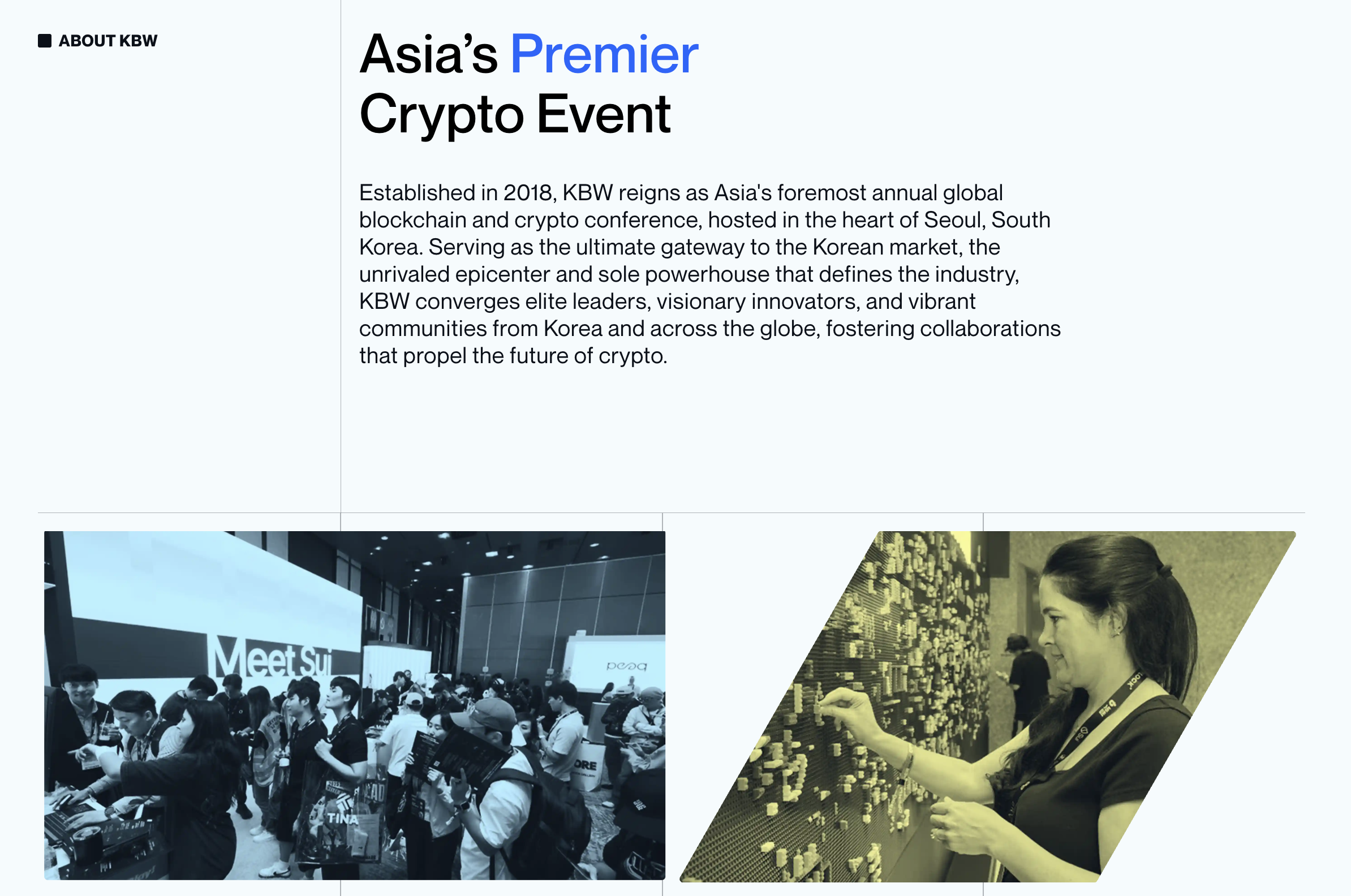
KBW is a global blockchain event FACTBLOCK has held in Seoul since 2018. It has served as a point of contact connecting Korea with the global industry during the period when the domestic market hardened around KRW exchanges, and alongside the main conference, developer events, community meetups, and project-specific side events run across Seoul during the same week. Bringing domestic companies, global projects, investors, and developers together each year, it has established itself as the period for checking in on the Korean market within the Asian crypto calendar.
KBW2026 begins on September 29 with the invitation-only Upbit Institutional Summit, followed by the main conference from September 30 to October 1 at the Grand Walkerhill Seoul. Upbit participates as presenting partner, and 0G, BRV, Stable, Tria, and BitGo are listed as major sponsors. Placing the institutional summit ahead of the main event indicates that the point of contact between exchanges and regulated capital has been put at the very front of this year's schedule.
Source: KBW2026
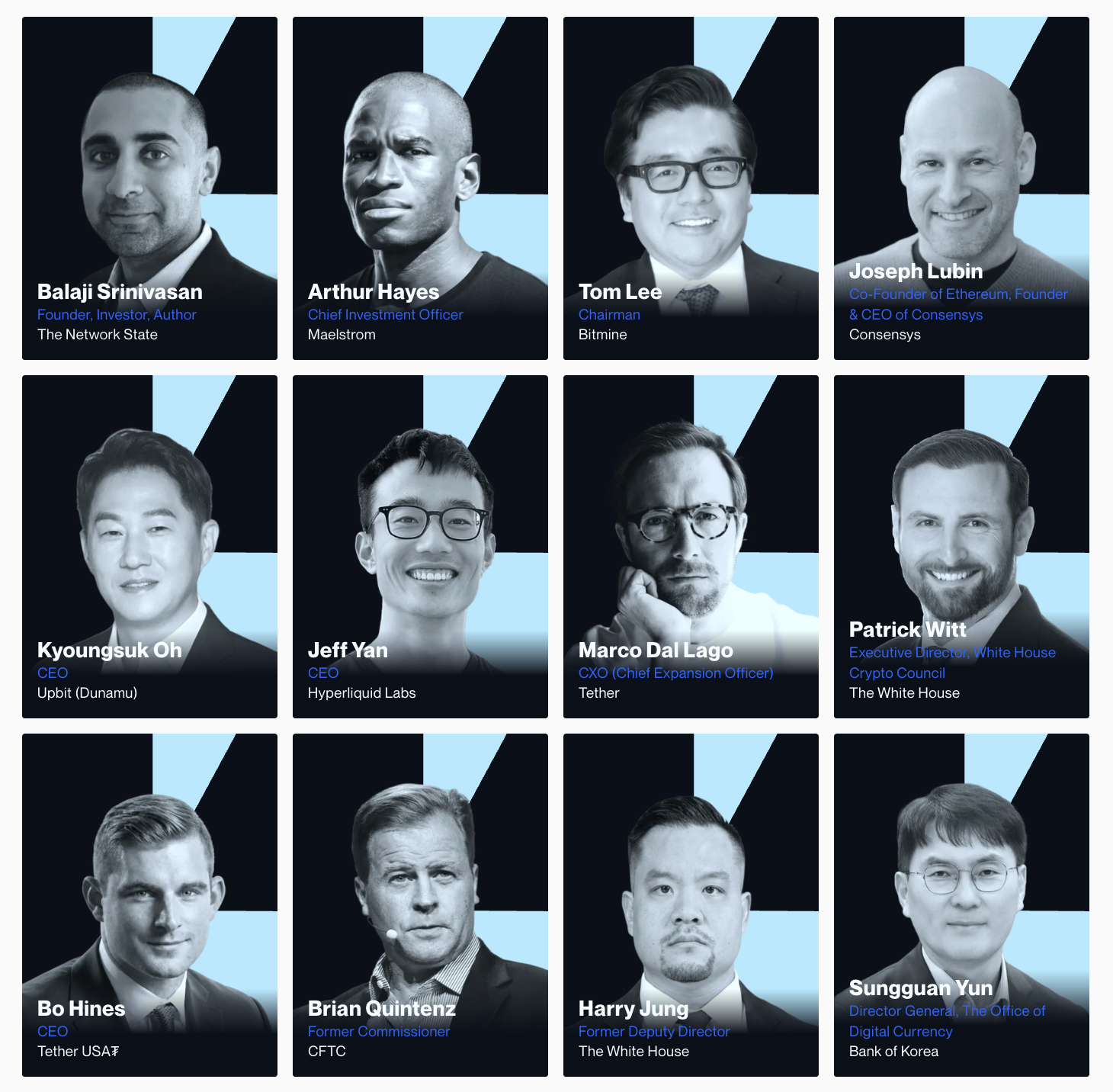
The speaker lineup also reflects the changes set out above. The list includes Patrick Witt, Executive Secretary of the US White House Digital Asset Advisory Committee, Bank of Korea Digital Currency Department head Yoon Sung-kwan, Dunamu's Oh Kyoung-suk, Robinhood crypto head Johann Kerbrat, Morpho co-founder Paul Frambot, and BitGo CEO Mike Belshe. Policy authorities that design the rules, exchange platforms, DeFi companies, and custodians gather at one event, which makes it a place to see directly how the industry activity domestic operators are each preparing, as set out in the preceding chapters, is run overseas, and how far apart the two stand.
If this article has served as background for understanding the overall landscape of the Korean market, KBW can be the place to see directly how new relationships form within it. To take the measure of where Korea stands now and to meet the market participants driving the next change, there is reason enough to come.
The author of this report may have personal holdings or financial interests in assets or tokens discussed herein. However, the author affirms that no transactions have conducted using material non-public information obtained in the course of research or drafting. This report is intended solely for general information purposes and does not constitute legal, business, investment, or tax advice. It should not be used as a basis for making any investment decisions or as guidance for accounting, legal, or tax matters. Any references to specific assets or securities are made for informational purposes only and should not be construed as an offer, solicitation, or recommendation to invest. The opinions expressed herein are those of the author and may not reflect the views of any affiliated institutions, organizations, or individuals. The opinions and analyses expressed herein are subject to change without prior notice. In addition, beyond the individual disclosures included in each report, Four Pillars, may hold existing or prospective investments in some of the assets or protocols discussed herein. Furthermore, FP Validated, a division of Four Pillars, may already be operating as a node in certain networks or protocols discussed herein or may do so in the future. Please see below links in the footer for FP Validated's participating network disclosures and for broader disclosure details.


