


Table of Contents
- Key Takeaways
- 1. There Is No Country for Idealists
- 1.1 The Ideal
- 1.2 The Experiments Had Already Ended
- 1.3 The Experiments Are Now “Really” Ending
- 2. Onchain Has Become a Barbell
- 2.1 The Onchain Ecosystem Is Moving Toward the Extremes
- 2.2 Speculative Demand
- 2.3 Connecting to the Real Economy
- 3. Why Crypto Businesses Are No Longer Sexy
Researcher

Key Takeaways
- Many of crypto’s onchain experiments are shutting down or pivoting without ever proving PMF, and that trend has become even clearer in 2026.
- The onchain market is increasingly polarizing between areas that absorb speculative demand, such as memecoins, perpetual futures, and prediction markets, and areas connected to the real economy, such as stablecoins, RWAs, and vaults.
- As the number of viable markets narrows to a handful of categories, companies that started from very different positions, including Coinbase, Robinhood, MetaMask, and Kalshi, are converging on the same product stack: perpetual futures, prediction markets, memecoins, stablecoins, and RWAs.
- This does not mean the end of onchain-native businesses. Just as a few sectors have matured and proven independent product-market fit, new categories can still emerge through experimentation and develop into sustainable markets.
1. There Is No Country for Idealists

1.1 The Ideal
“Decentralization,” “Read, Write, Own,” “Web3,” “Community Ownership,” “Can’t Be Evil,” “Network State,” “Code Is Law,” “Don’t Trust, Verify,” “Creator Economy,” “Pluralism,” “Futarchy,” …
These ideas went beyond technical concepts. They drew idealists into the blockchain industry through the belief that a more open, free, and fair digital world was possible.
Everyone imagined a different version of the future, but they shared one belief: blockchain could be a tool for redesigning the existing order. People gathered to turn those ideals into reality, launching countless experiments, protocols, and services around ideas like the ones below and steadily expanding the boundaries of the ecosystem.
“DAO,” “Fan Tokens,” “ve(3,3),” “NFT,” “IP,” “Music NFTs,” “Bitcoin Ordinals and Runes,” “Bitcoin L2,” “Play-2-Earn,” “Move-2-Earn,” “Metaverse,” “Fully Onchain Games,” “Gaming Guilds,” “Decentralized Social Media,” “DID,” “Onchain Reputation,” “SBT,” “Algorithmic Stablecoins,” “Restaking,” “InfoFi,” “Ethereum Killers,” “Appchains,” “Modular Blockchains,” “zkEVM,” “Rollup-as-a-Service,” “Intents,” “Chain Abstraction,” “DePIN,” “Decentralized Energy,” “ReFi,” “DeSci,” “Data Markets,” “Decentralized AI Compute,” …
1.2 The Experiments Had Already Ended
But most of these experiments failed. There are too many failed experiments to cover exhaustively, but I will go through as many as I can remember below.
1.2.1 Bitcoin Ecosystem
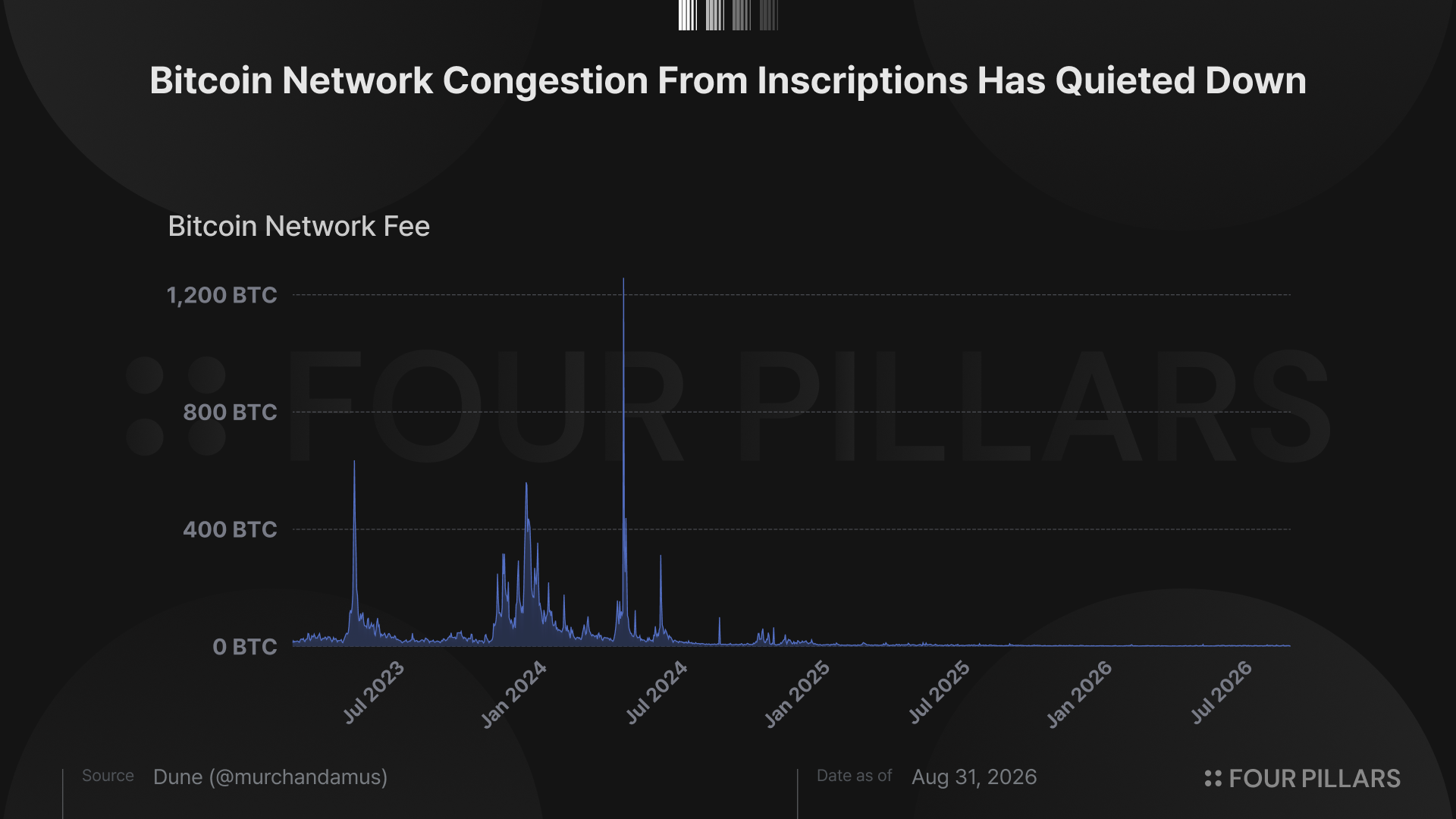
- Ordinals, Inscriptions, and Runes are protocols that use existing parts of Bitcoin’s transaction structure, such as SegWit witness data and OP_RETURN, to record arbitrary data. This fueled the narrative that tokens and NFTs could also be issued on Bitcoin and attracted significant attention. In 2023, inscriptions drove a sharp increase in Bitcoin transaction fees, and some even argued that inscription fees could become an alternative source of miner revenue as BTC block rewards declined. Recently, however, their effect on network fees has become negligible. Ordinal Maxi Biz, once one of the most popular Ordinals NFT collections with a floor price as high as 1.5 BTC, last traded at around 0.018 BTC. Magic Eden, once the largest marketplace for Bitcoin NFT trading volume, ended support for Bitcoin NFT marketplace trading in March this year.
- Bitcoin L2s were once highly anticipated because technologies such as Taproot and BitVM appeared to make it possible to build programmable and scalable L2 networks on top of Bitcoin, arguably the most secure blockchain network. A large number of Bitcoin L2 projects emerged and raised funding from leading VCs. Today, however, ecosystem performance has been deeply disappointing. BOB, the Bitcoin L2 with the highest TVL, currently holds $9.24M in TVL, down 96.6% from its peak. Corn, BEVM, and Lorenzo have fully pivoted, while Botanix recently shut down.
1.2.2 Layer 1 and Layer 2
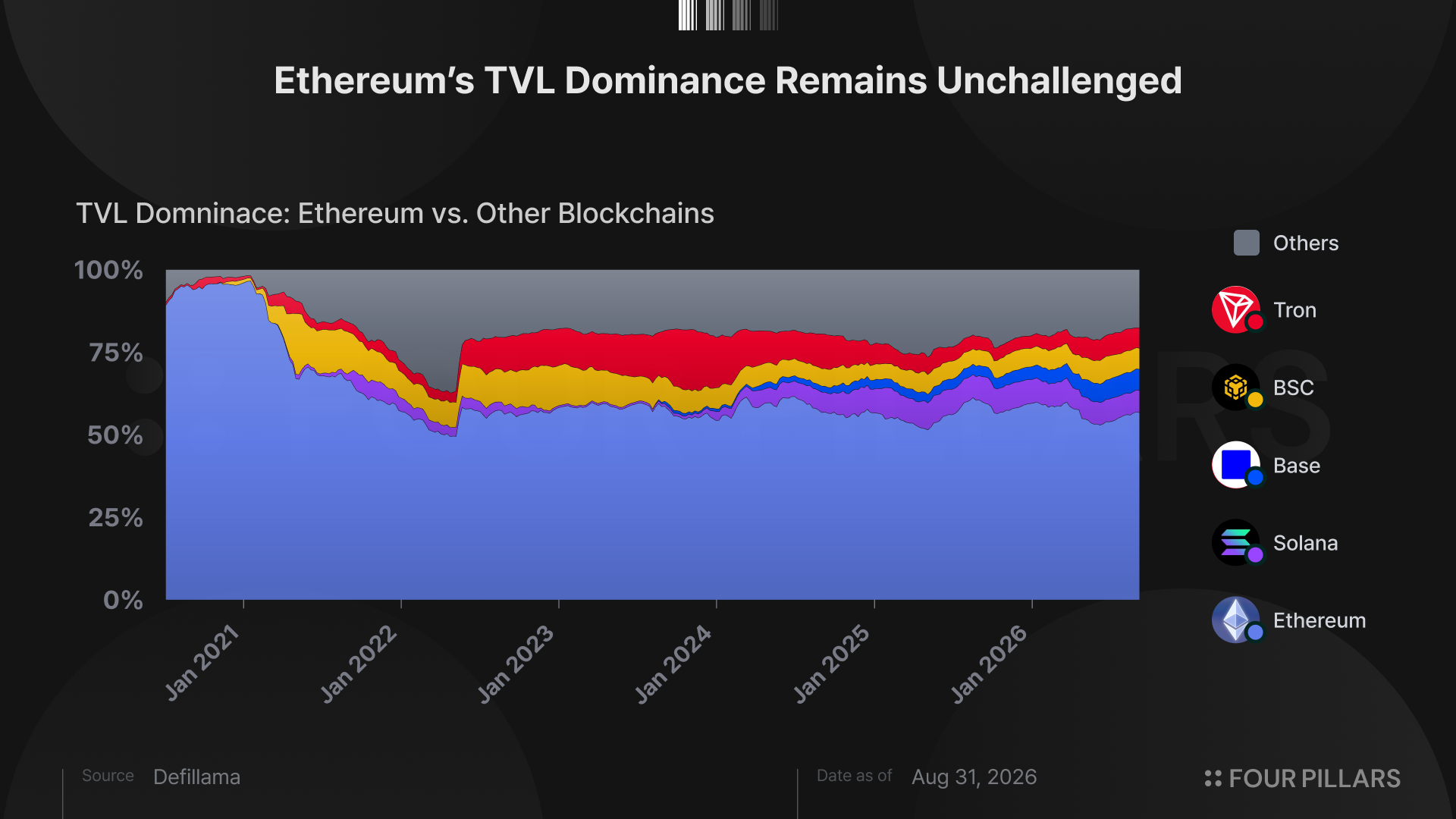
- A large number of Layer 1 and Layer 2 networks once emerged with claims of better scalability, incentive structures, smart contract security, or go-to-market strategies than Ethereum. Today, many of them have failed to find PMF and have effectively become ghost chains. In the end, outside of networks such as BSC, Tron, Solana, and Base that secured meaningful distribution or PMF, most failed to take significant market share from Ethereum.
1.2.3 Infrastructure
- Modular blockchains were one of the hottest themes in blockchain infrastructure in 2022 and 2023, and I remember doing a deep dive on the sector myself as a researcher. Starting with the foundational DA layer, a wide range of startups emerged across categories including shared sequencers, Rollup-as-a-Service, and rollups. The modular blockchain concept itself cannot be dismissed, since several Layer 2 networks, including Arbitrum, Base, and Robinhood Chain, continue to show solid ecosystem performance. Still, most of the modular blockchain infrastructure companies that received attention during that period have either pivoted or shut down. In that sense, the modular blockchain boom of the time can reasonably be viewed as a failed experiment.
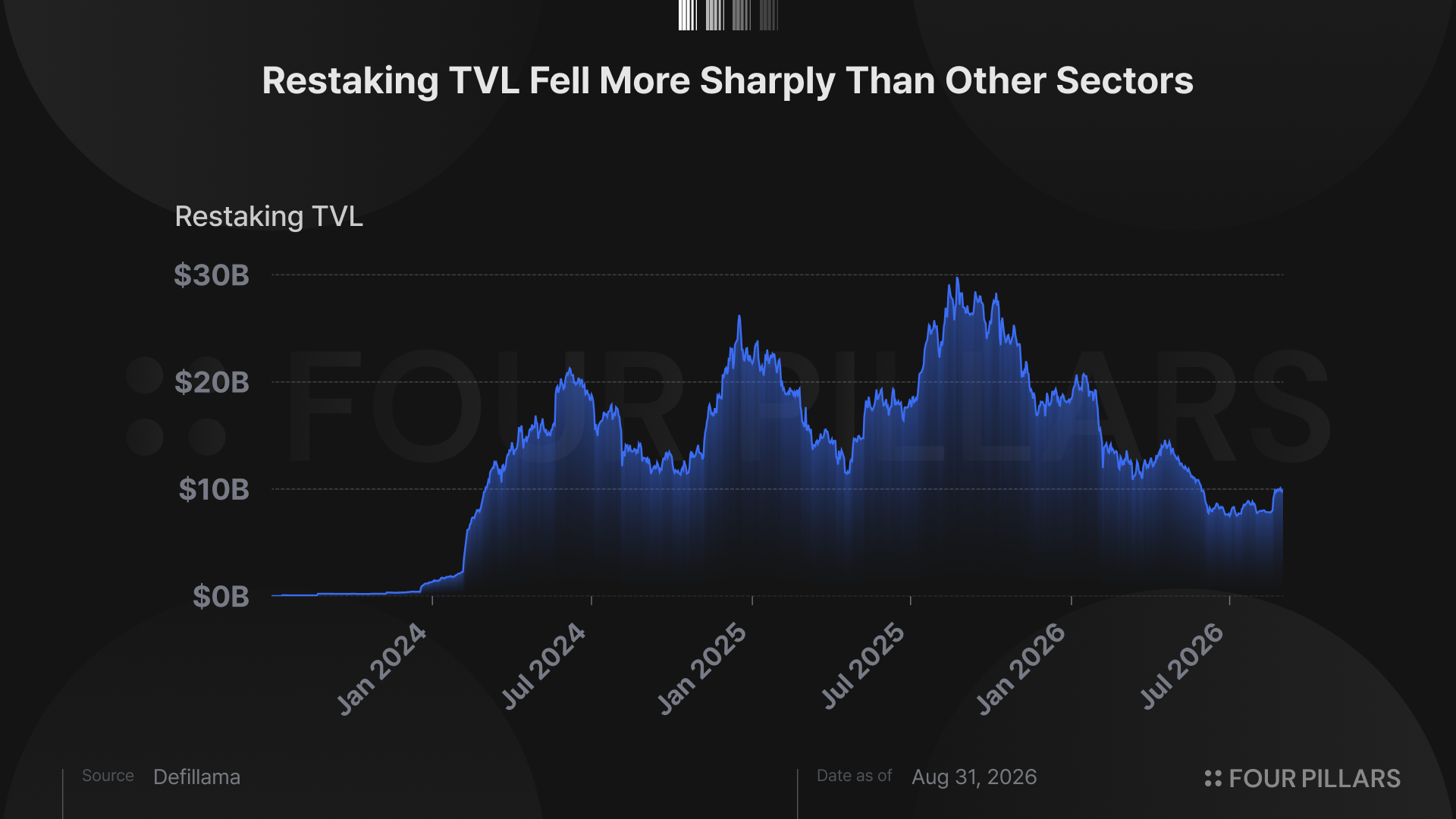
- Restaking is the idea of reusing tokens already staked in a PoS network as economic security for other protocols. The category was pioneered by EigenLayer. After EigenLayer, similar restaking protocols such as Symbiotic and Karak emerged, while projects with related concepts, including Babylon and Solayer, appeared on other networks. At its peak, total TVL in the restaking sector climbed to around $30B. Today, it sits at roughly $8B. The sector still maintains a respectable amount of TVL, but a closer look at the ecosystem suggests that the restaking narrative has lost much of its strength. There is supply of economic security through restaking, but very little demand to use it. EigenLayer has made a soft pivot toward EigenCloud, centered around AI agents. Symbiotic and Karak have made full pivots into a high-performance L1 and a collateral market platform, respectively.
1.2.4 Decentralized Stablecoins
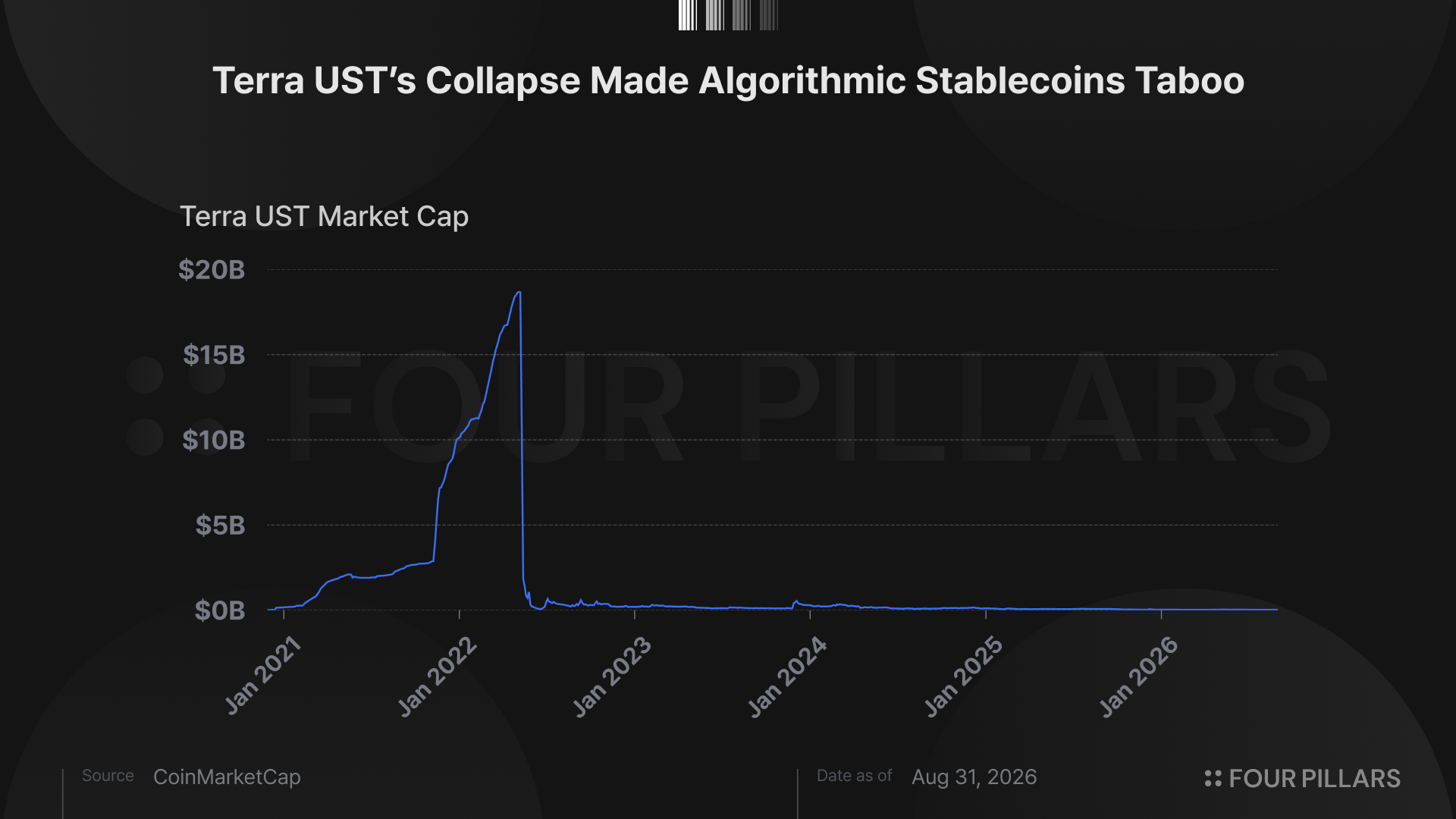
- Algorithmic stablecoins aim to create decentralized and capital-efficient onchain money without collateral. The most popular algorithmic stablecoin was undoubtedly UST in the Terra ecosystem, now known as USTC. At one point, its supply exceeded $18B and it ranked among the top ten cryptocurrencies by market capitalization. External attacks and structural weaknesses ultimately drove UST’s value to zero, bringing down the Terra ecosystem with it. Other algorithmic stablecoins, including FEI, IRON, and ESD, also failed. FRAX initially used an algorithmic model but later pivoted to a fiat-backed structure.
1.2.5 NFT, Metaverse, and Gaming Ecosystem
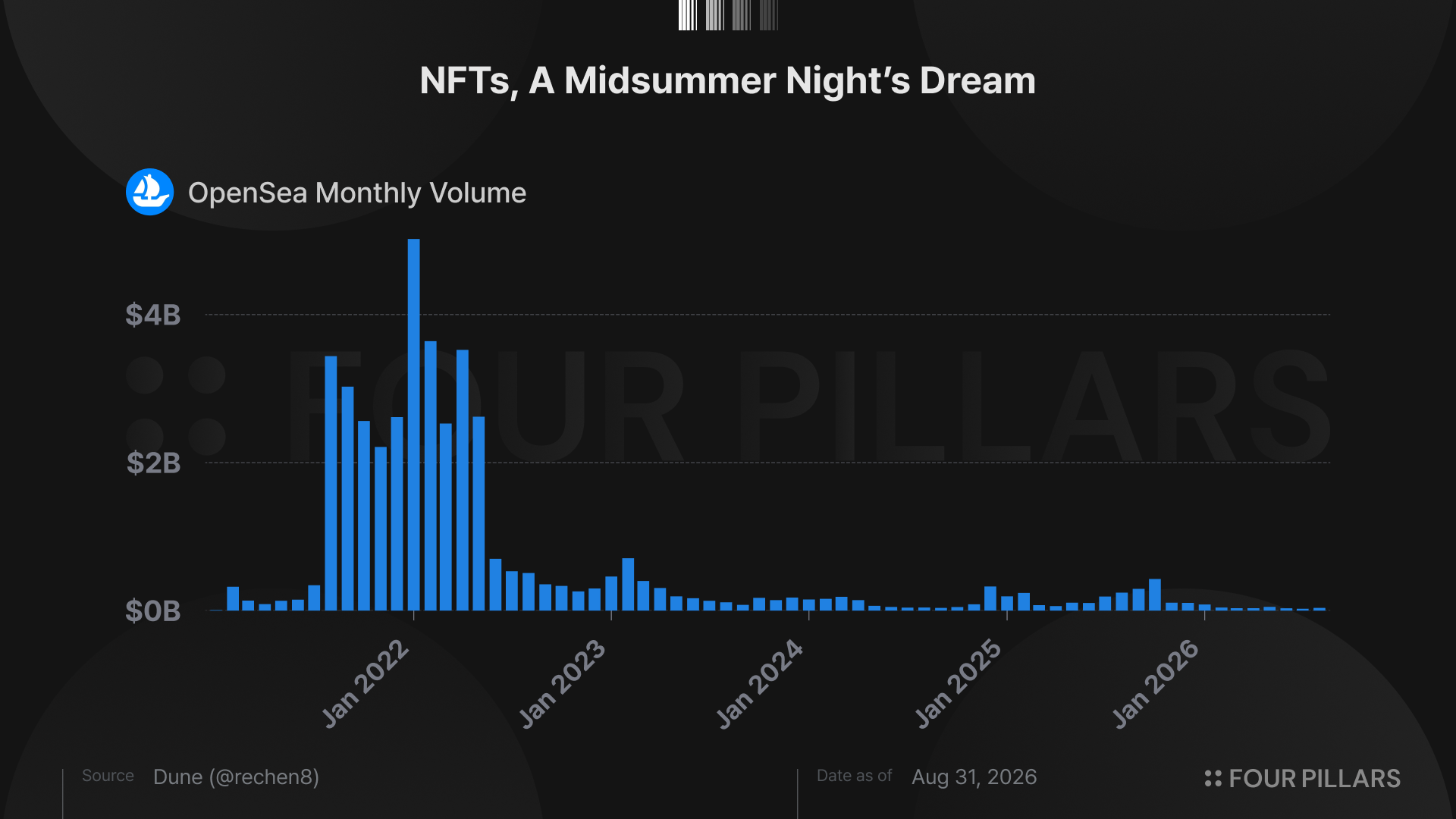
- NFTs were once one of the most popular crypto cultures among the general public. Beginning with Ethereum in 2021, NFTs gained popularity across networks including Solana and Klaytn. Prices of major collections surged, but most have since collapsed. For example, CryptoPunks fell from 125 ETH to 32 ETH, BAYC from 150 ETH to 8 ETH, Pudgy Penguins from 35 ETH to 3.8 ETH, and Azuki from 30 ETH to 0.8 ETH. OpenSea, one of the leading NFT marketplaces, saw monthly trading volume fall from a peak of around $5B to roughly $30M recently.
- Play-2-Earn became highly popular around the idea that users could own part of a game economy and capture part of the value they created by earning crypto through gameplay. But for P2E models to be sustainable, games needed either to create real economic value or convince users to spend more for the sake of playing. That did not happen, and most P2E games failed. Axie Infinity, which kicked off the P2E boom, reached a monthly peak of 6.5M active wallets and $103.8M in fees in 2021. Today, it maintains fewer than 100K active wallets and less than $50K in fees. Alongside the P2E boom, metaverse games built around land NFTs, such as The Sandbox and Decentraland, also became highly popular for a time. The Sandbox land NFTs have since fallen more than 99%, from a peak near $15K to around $50. Move-2-Earn projects combining running with P2E, such as Stepn and Sweat, also quickly lost attention. AAA-style blockchain games such as Star Atlas and Otherside never launched properly, while concepts such as Fully Onchain Gaming, which attempted to put every element of a game onchain, never gained meaningful traction. Most of the blockchain gaming projects once described as the future of gaming ultimately failed.
1.2.6 Social
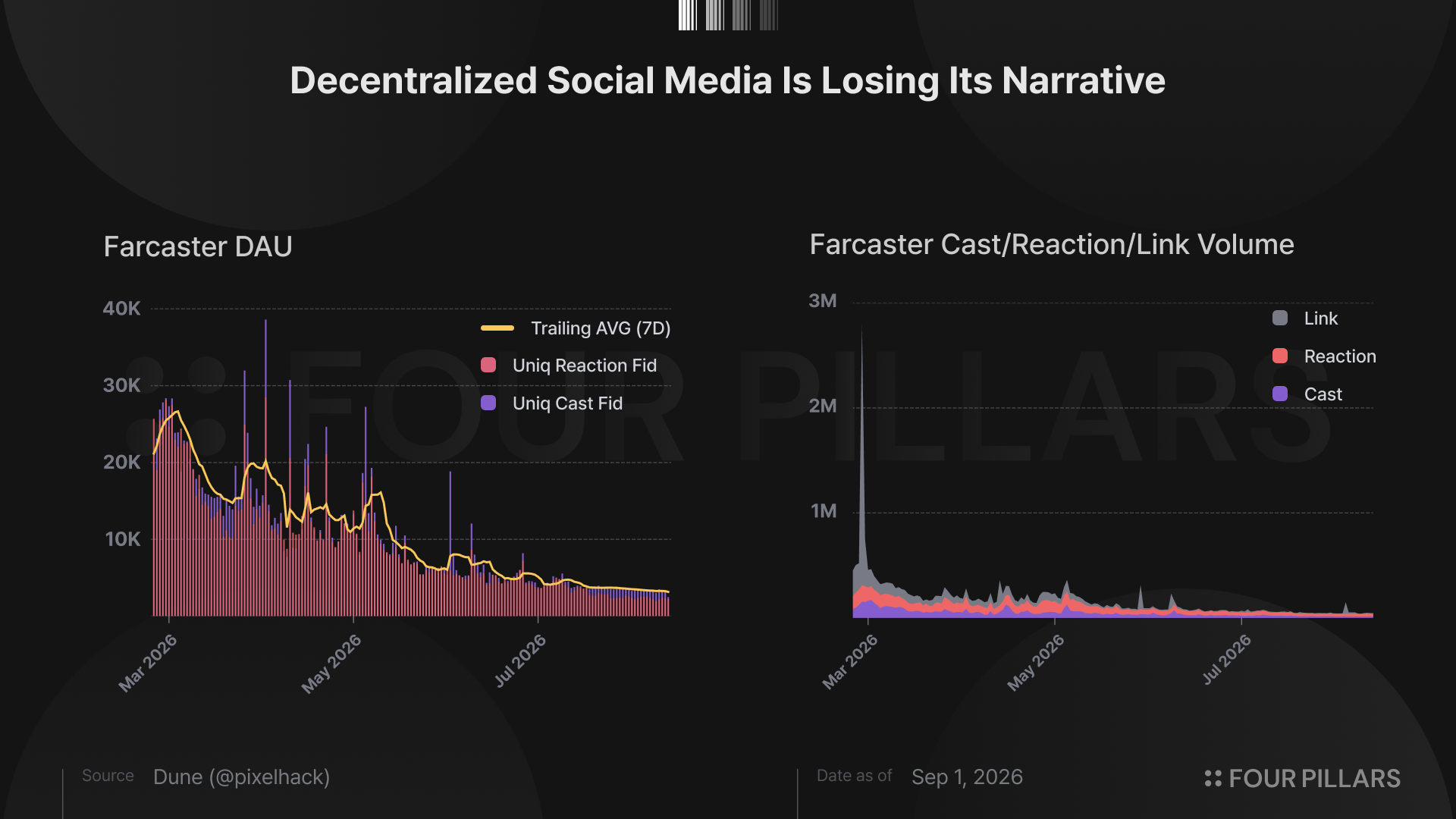
- Decentralized social media was one of the most intuitive ways to express the philosophy that users should own the internet. Compared with centralized social platforms, it promised benefits such as ownership of the social graph, permissionless participation, and censorship resistance. A number of decentralized social platforms emerged, including Farcaster, Lens, and DeSo. But they failed to attract organic users beyond those motivated by early-stage incentives, and traction has since fallen sharply.
- InfoFi, pioneered by Kaito, connected the information and attention generated online with economic rewards. The model initially worked well and produced a significant amount of high-quality information. Over time, however, users focused increasingly on attention farming, spam became rampant, and X cut off API access for InfoFi projects. InfoFi systems including Kaito’s Yaps, Cookie DAO’s Snaps, and Wallchain’s Quacks were all sunset.
The dreams of crypto’s idealists did not materialize in the short term. Still, Bitcoin has at least begun to gain recognition as a form of digital gold, while the traditional financial industry is actively adopting blockchain as a next-generation financial backend. Blockchain has started to find its own PMF.
1.3 The Experiments Are Now “Really” Ending
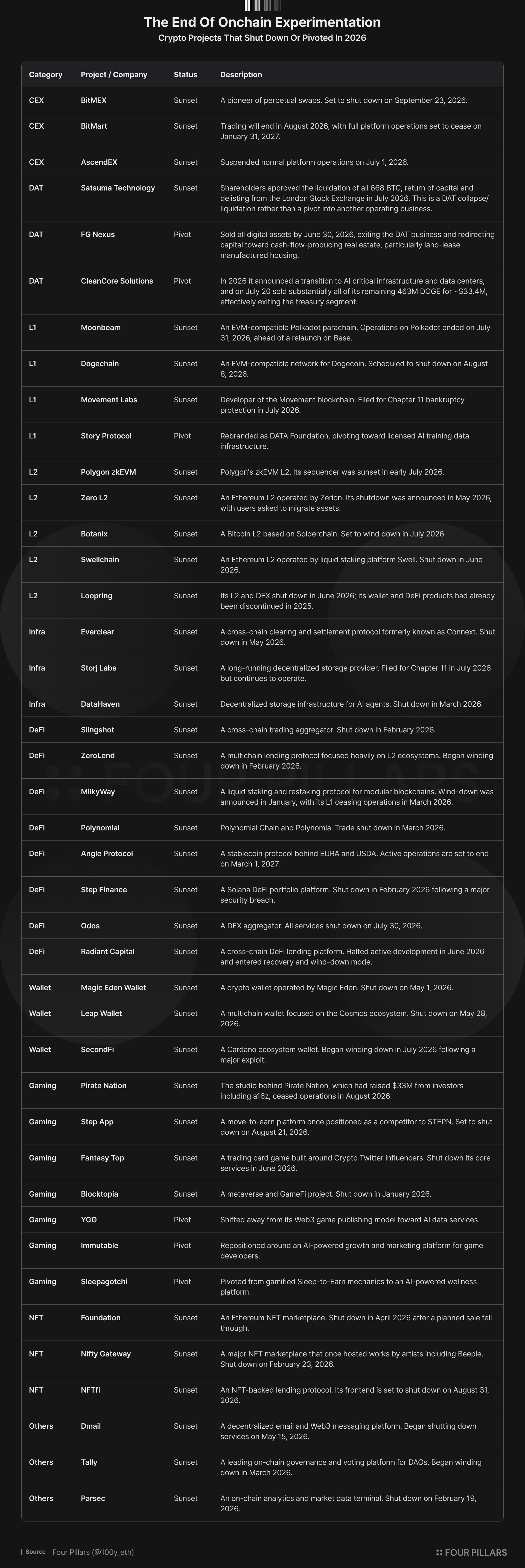
For some time, the crypto industry believed that the idealists’ experiments had already largely come to an end during 2024 and 2025. Market attention shifted away from grand visions built around ideals and toward areas with clearer paths to PMF, such as stablecoins, tokenization, and trading infrastructure. The ideals of the previous cycle seemed to be fading naturally into the background.
Recently, however, the situation has deteriorated further. Back then, new experimentation had stopped and capital and attention were beginning to leave, but protocols built on earlier expectations were still operating on remaining capital and inertia. More recently, those older projects have begun to truly reach the end through pivots and shutdowns.
As the table above shows, 2026 has seen a wave of shutdowns and pivots across nearly every category, including CEXs, DATs, L1/L2s, infrastructure, DeFi, gaming, and NFTs. The experiments are now “really” ending.
That is the crypto industry we have lived through so far. In the end, the world the idealists imagined never arrived.
2. Onchain Has Become a Barbell
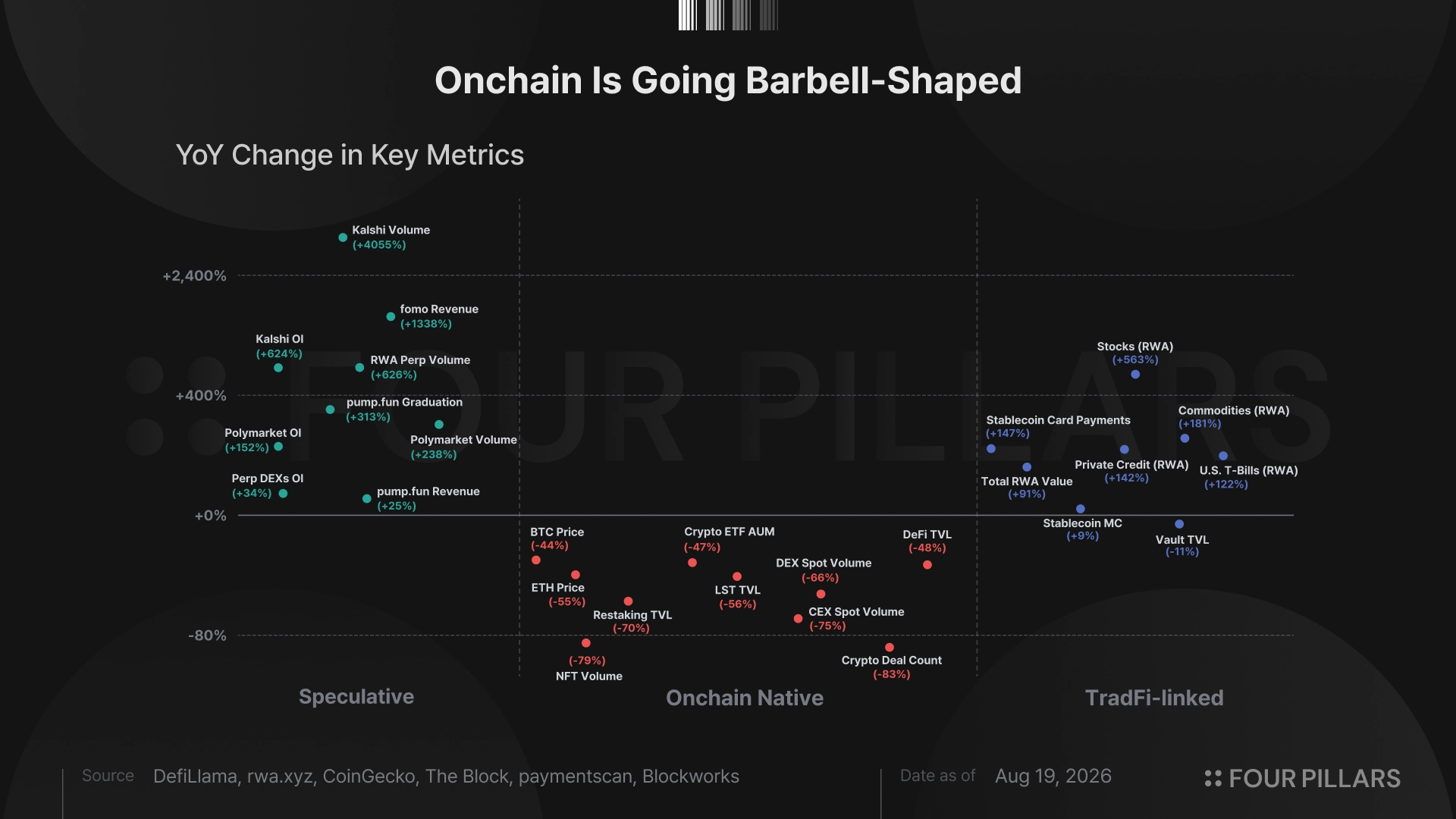
2.1 The Onchain Ecosystem Is Moving Toward the Extremes
After the end of so many onchain experiments, the crypto industry now looks increasingly extreme. One side reflects users’ speculative demand. The other reflects relatively stable demand connected to the real economy.
Onchain-native services that fall somewhere in the middle, with ambiguous risk-reward profiles, are performing very poorly when measured by relevant metrics. There are several reasons for this:
- PMF: As discussed in Part 1, most onchain services failed to find PMF. Even products that initially appeared to have found it were, in hindsight, often driven mainly by speculative demand from early airdrop farming. Very few created meaningful value or delivered sustained utility to users.
- Risk-reward profile: As the crypto market weakened and onchain users learned what works and what does not, the level of expected rewards from using individual protocols fell sharply. In the past, users could reasonably expect 15% to 20% APY from relatively conservative stablecoin farming. Today, even 5% to 10% APY can be difficult to achieve, making the risk-reward profile of ordinary onchain farming much less attractive. This has pushed users toward either the RWA sector, where they can earn roughly 3% to 7% APY with significantly lower risk, or toward memecoins, perpetual futures, and prediction markets, where they can accept much higher risk in exchange for much larger upside.
- Hack risk: The risk of onchain protocol hacks has also increased significantly. As AI technology has advanced and foundation models have become more capable, security risks have risen as well. Over the past year, onchain hacks have occurred with striking frequency. With expected returns already lower, the additional risk of losing all principal to a hack has clearly reduced the appeal of the onchain ecosystem.
Unlike the broader onchain ecosystem, metrics tied to services at either end of the spectrum are showing explosive growth, almost as if the crypto downturn never happened. This suggests that the onchain ecosystem has split into sectors that remain heavily exposed to crypto market conditions and sectors that have found their own PMF and can grow independently of those conditions. The result increasingly resembles a barbell.
2.2 Speculative Demand
Speculation is not unique to crypto. Assets change, but human behavior does not. Demand for speculation has existed throughout history. Only the asset being speculated on has changed, from tulips and land to stocks and crypto.
Onchain markets provide an ideal environment for users with speculative demand. Features such as smart contracts, blockchain transparency, and instant settlement make speculation easier and faster.
Thanks to these characteristics, sectors built on speculative demand have established themselves even during weak market conditions. More recently, as the risk-reward profile of DeFi has become increasingly unattractive, many users who once used DeFi aggressively have migrated into these markets. Memecoins, perpetual futures, and prediction markets are the clearest examples.
2.2.1 Memecoins
Demand for memecoins has persisted from 2013, well before crypto attracted mainstream attention, through today. The category began with DOGE in 2013, followed by SHIB on Ethereum in 2020, BONK on Solana in 2022, and PEPE in 2023. In 2024, memecoin culture exploded on Solana with tokens such as WIF, POPCAT, MEW, GOAT, and FARTCOIN. The project that ultimately changed the structure of memecoin culture was Pump.fun, launched on Solana in 2024. As a memecoin launchpad, it made it easy for anyone to issue a memecoin.
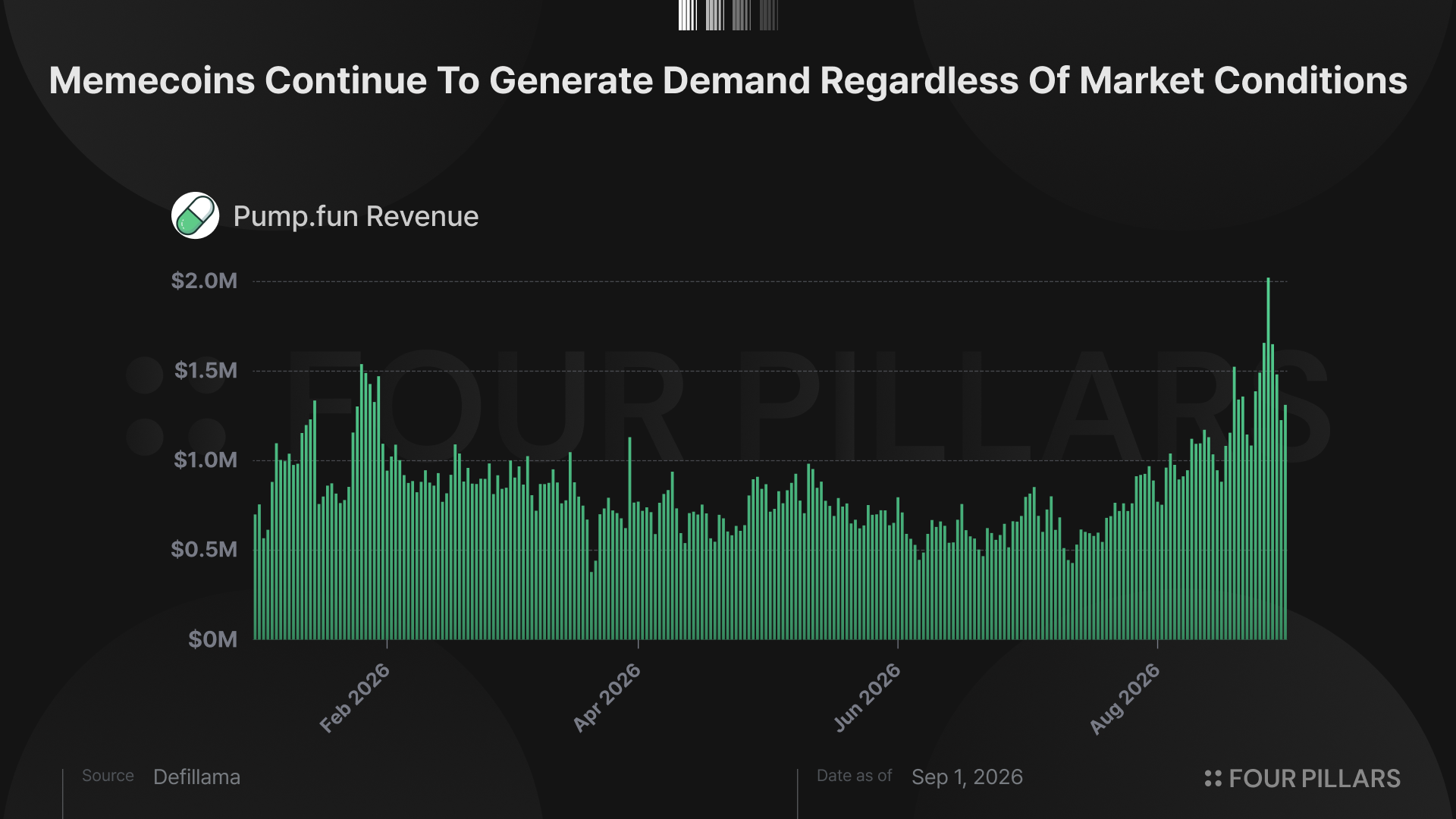
Despite spot DEX trading volume falling by nearly 80% over the past year, revenue at Pump.fun, Solana’s leading memecoin launchpad, has remained resilient. In the past month alone, revenue has more than doubled from its recent low. Pump.fun uses the concept of “graduation,” where a memecoin moves from a bonding curve to an AMM pool after reaching a certain initial market capitalization. The average share of tokens graduating has also increased, from below 1% on average to more than 3% recently.
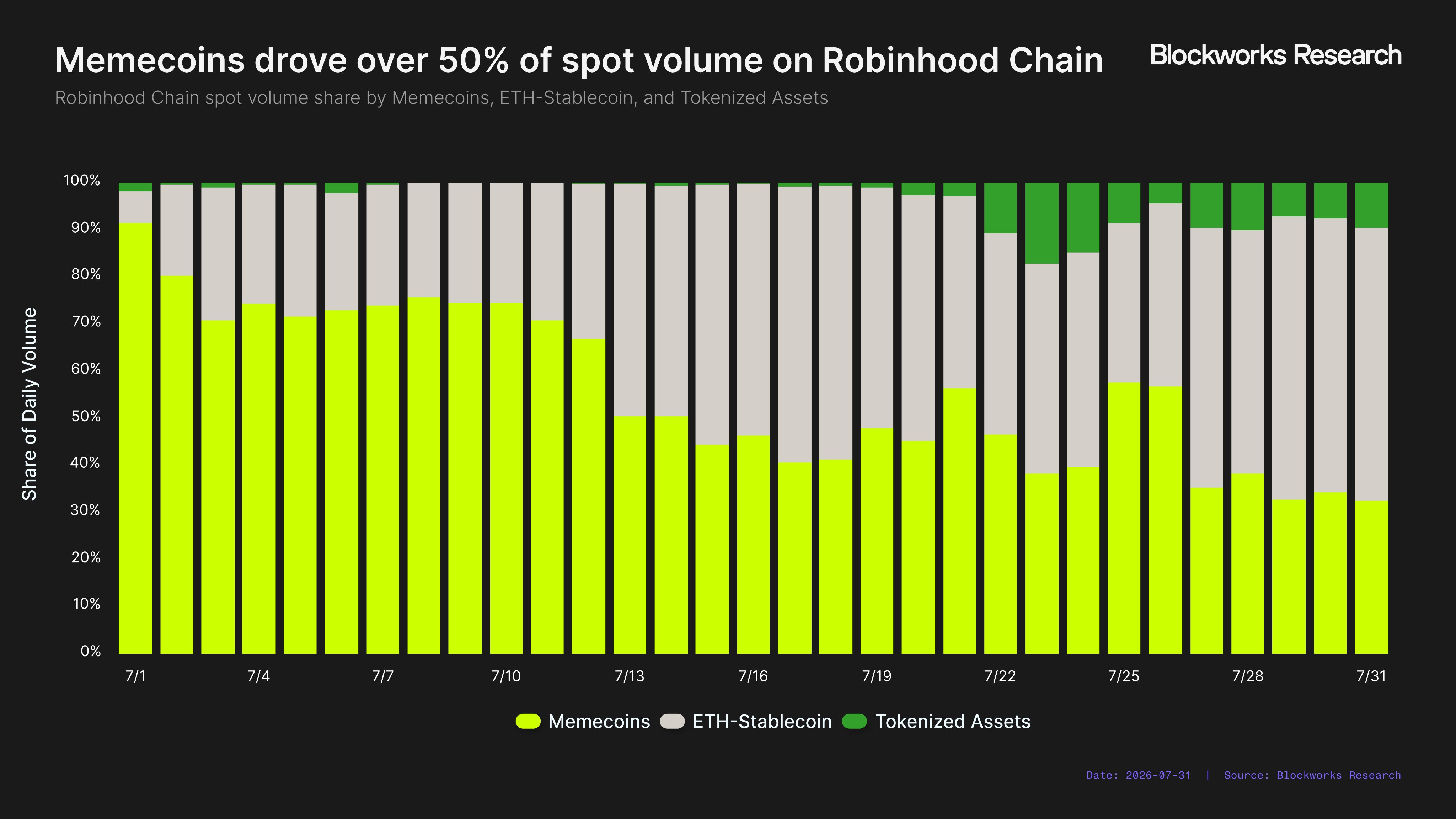
Source: Blockworks Research
A similar pattern is appearing on the recently launched Robinhood Chain. Robinhood Chain initially aimed to build an ecosystem centered on tokenized stocks, but most activity is currently concentrated around memecoins. According to Blockworks, more than half of spot trading volume since launch has come from memecoins. Ironically, persistent memecoin demand has become a major growth engine for a chain originally positioned around RWAs.
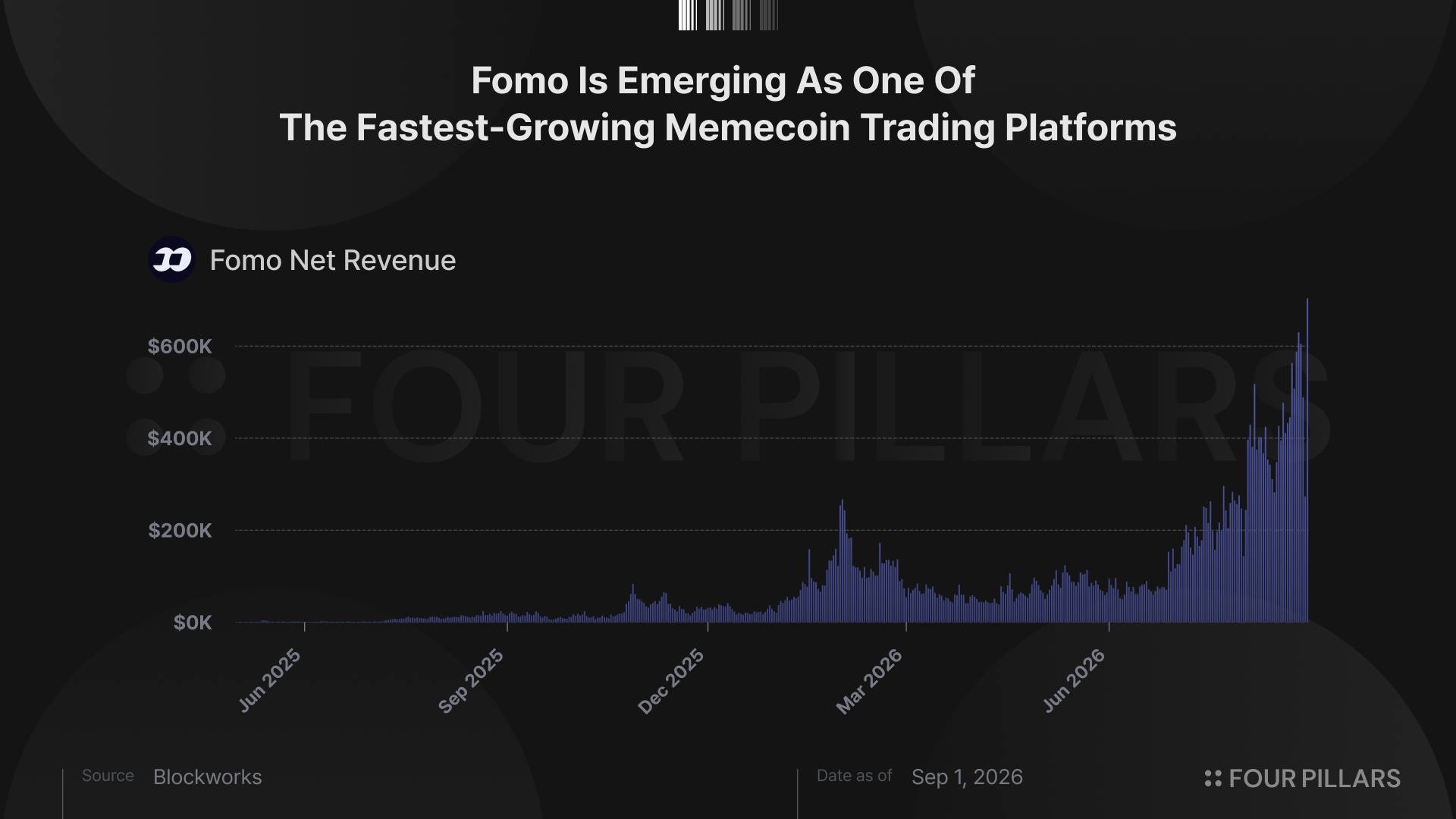
The recent growth of fomo is also worth watching. Built by former dYdX employees, fomo is a trading platform that quickly attracted users through an intuitive UI, faster memecoin discovery, a social feed, and Apple Pay integration. Its average daily platform revenue has recently grown to more than $400K.
The cases of Pump.fun, Robinhood Chain, and fomo show that demand for memecoins remains remarkably resilient regardless of broader market conditions.
In the past, investing in memecoins required a relatively high-friction process: finding alpha on X or Telegram, checking an onchain terminal such as Dexscreener, connecting a wallet to a DEX, and then executing the trade. As a result, the memecoin ecosystem was largely the domain of onchain degens.
Recently, however, memecoin trading culture has spread to mainstream platforms such as TikTok. Users can also fund user-friendly trading apps with Apple Pay and buy memecoins directly. This has made the market much more accessible not only to existing onchain degens, but also to ordinary users.
The deteriorating risk-reward profile of traditional DeFi, combined with easier access to memecoin trading, has been a major reason memecoins have developed into an independent sector that is relatively insulated from broader market conditions.
2.2.2 Prediction Markets
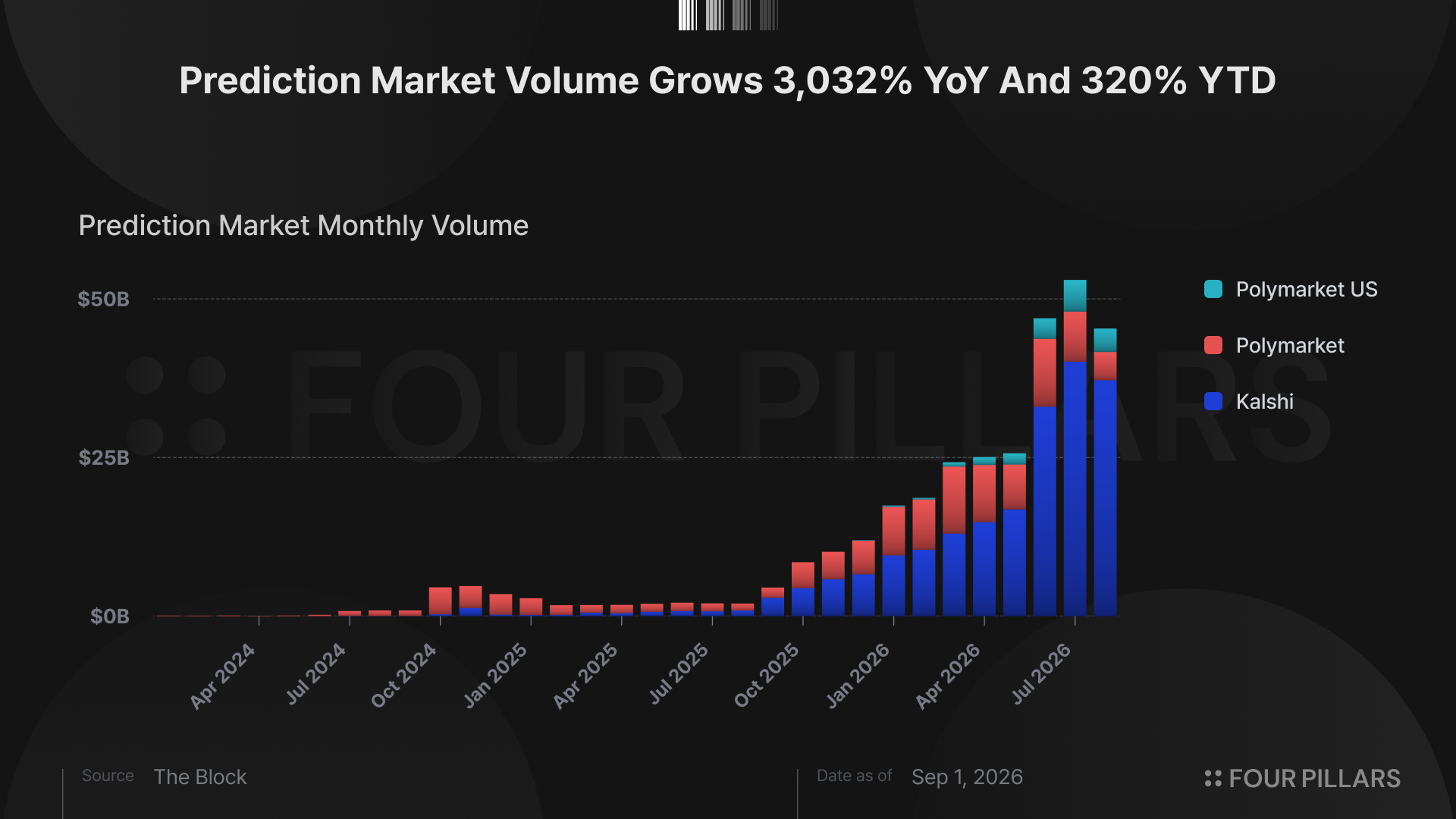
Over the past year, prediction markets have become one of the fastest-growing sectors in the blockchain industry. Trading volume has increased 3,032% year over year and 320% year to date, and momentum has continued recently.
The valuations of leading prediction market platforms Kalshi and Polymarket have risen just as quickly. Kalshi began with a $750K valuation in 2019, reached $40.28M within a year, and raised funding from Series A through Series F over six years, reaching a $22B valuation in May 2026. It is now reportedly negotiating its next round at a $40B valuation. Polymarket began at $18.58M in 2020 and grew to a $15B valuation through seven funding rounds. It is now reportedly negotiating its next round at a valuation above $20B.
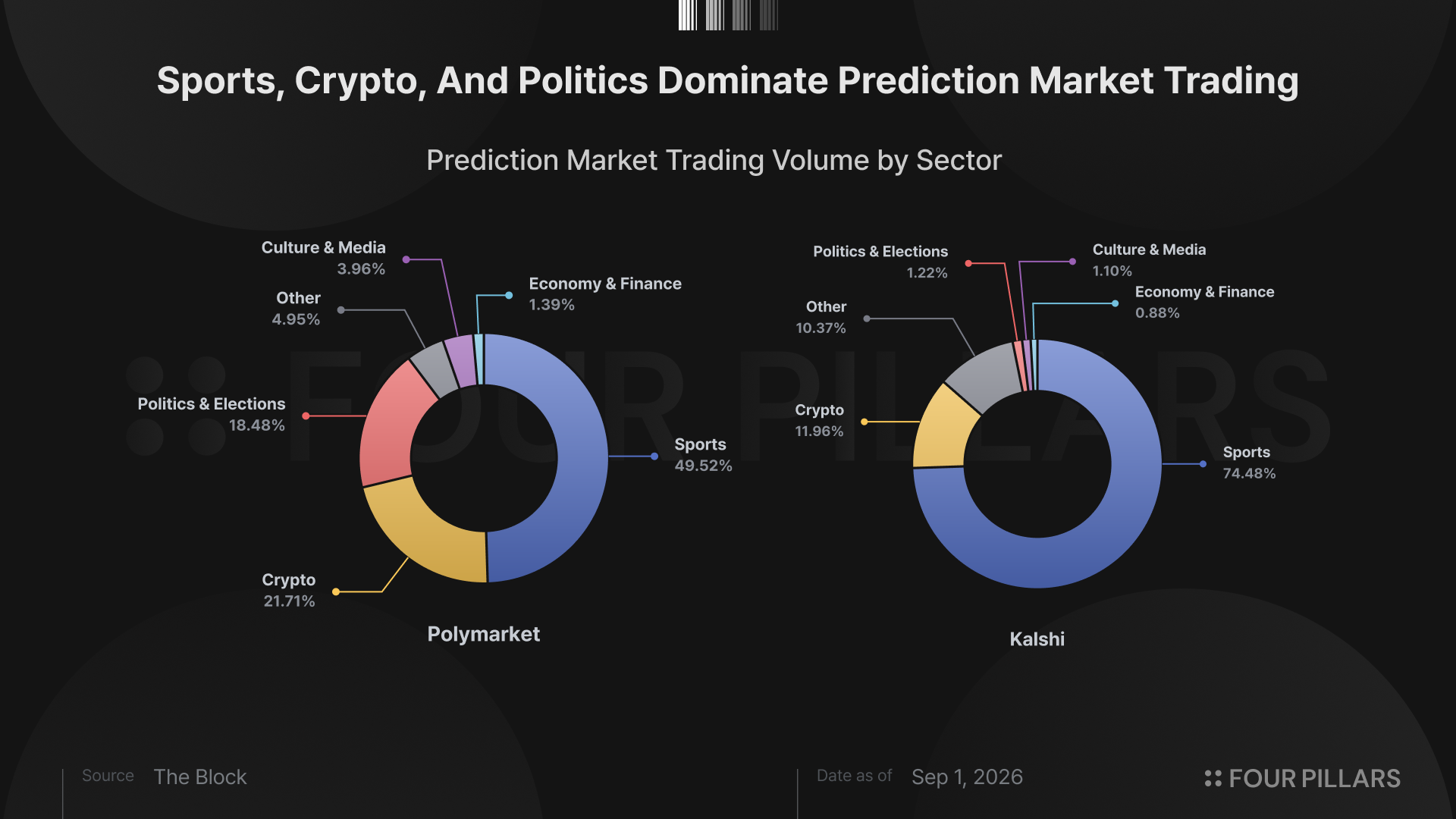
When people discuss the social utility of prediction markets, they often point to information discovery and hedging. So far, however, demand for those use cases remains limited. On Kalshi, sports and crypto markets account for most trading volume. Polymarket’s volume is somewhat more diversified, but it is still concentrated heavily in sports, crypto, and politics.
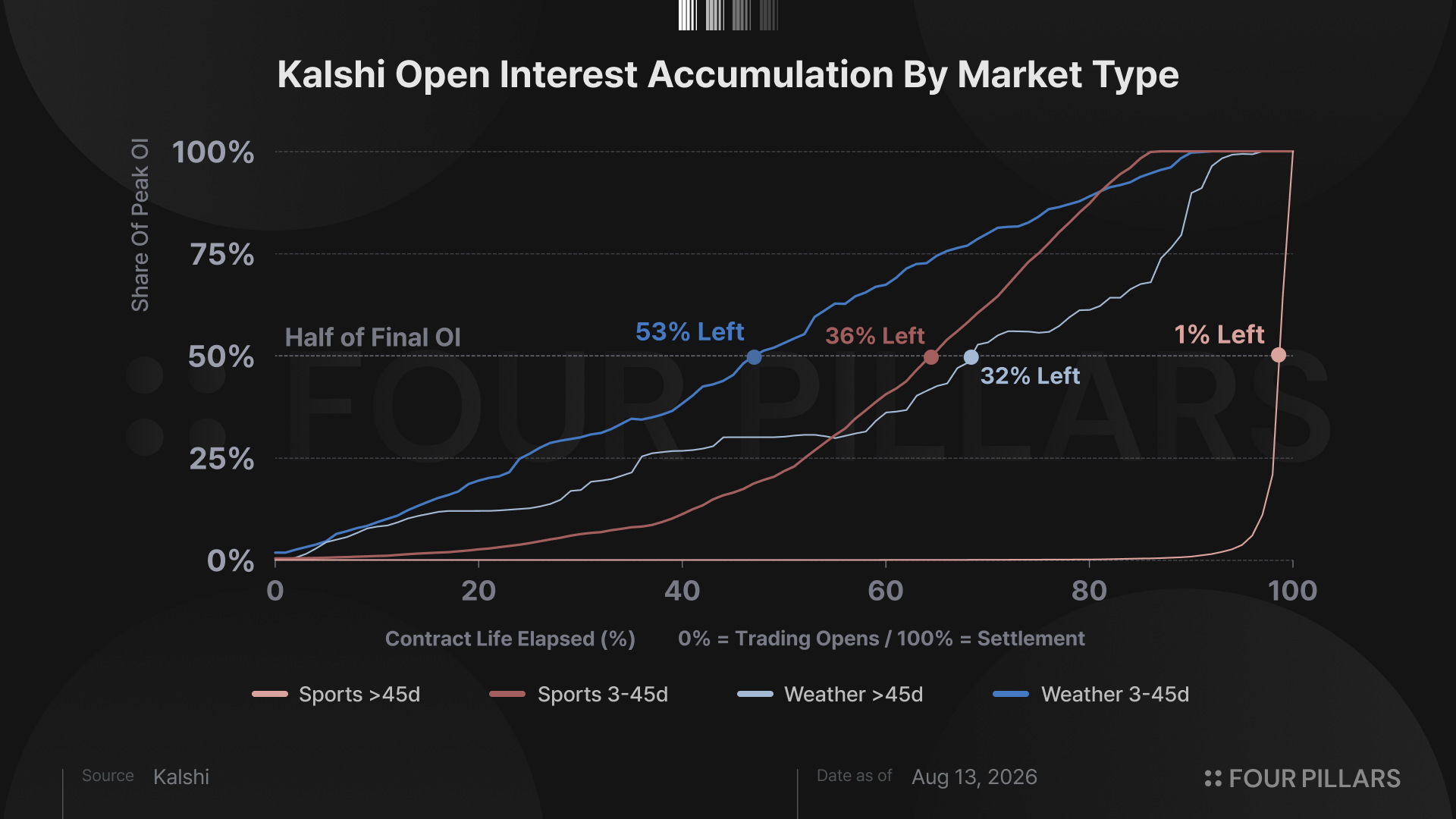
Sports, crypto, and politics are all highly speculative categories. Comparing sports and weather contracts provides a useful example. On average, positions in weather contracts are established much earlier than positions in sports contracts. This suggests that demand in weather contracts is more heavily driven by hedging, while demand in sports contracts is driven more by speculation.
A major reason prediction markets have been able to grow rapidly despite weak market conditions is the influx of new users from outside the existing onchain ecosystem. An analysis of Polymarket users shows that 56.1% are wallets that have never interacted with an onchain DEX. We cannot conclude that all of them were previously non-crypto users, but there is a strong possibility that many were not regular onchain users and used Polymarket as their first blockchain service. The presence of sports and political markets, in addition to crypto markets, is a key driver of new user acquisition regardless of crypto market conditions.
2.2.3 Perpetual Futures DEXs
The perpetual futures DEX sector has not grown as explosively as memecoins or prediction markets. That is understandable, since trading volume naturally declines when the crypto market weakens. Even so, compared with other major onchain metrics, perpetual futures DEXs have performed relatively well.
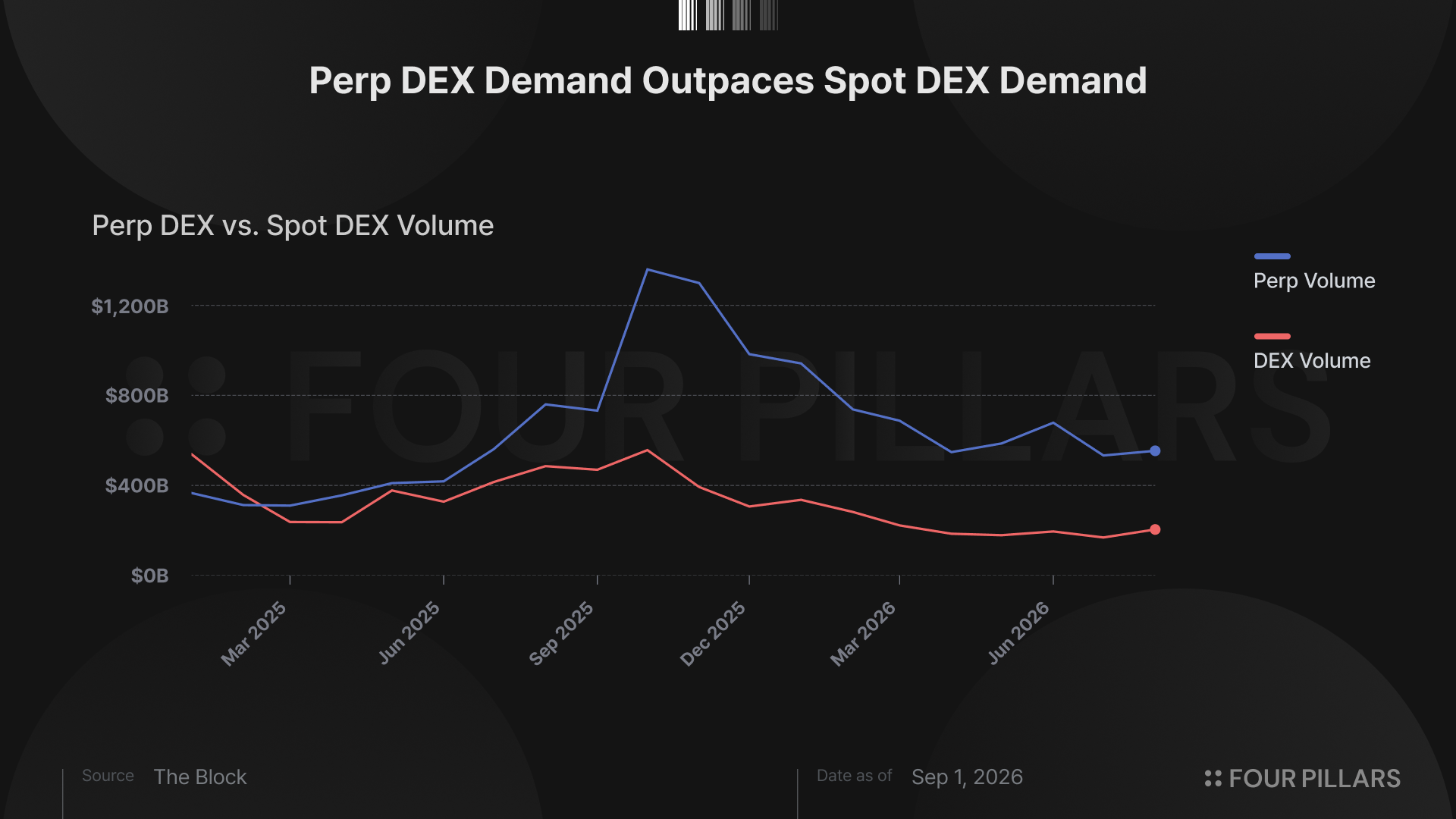
Looking at perpetual futures DEX trading volume over the past year, it has declined less than spot DEX trading volume. This suggests that speculative demand for futures trading remains stronger than demand for spot trading. There are several reasons for this.
- The first is the continued emergence of new perpetual futures DEXs. Following the success of Hyperliquid in 2025, new perpetual futures trading protocols have continued to launch. These include Lighter, Aster, Variational, Grvt, edgeX, Pacifica, Extended, and Arcus. Platforms that did not originally support perpetual futures, including Jito, Jupiter, and Ondo Finance, have also launched new perpetual futures products. Investors have learned the Hyperliquid playbook and now expect that using new perpetual futures protocols can lead to airdrops. As a result, demand for perpetual futures DEXs has remained persistent.
- The second is the growth of RWA perps. In the past, most perpetual futures trading volume came from crypto assets such as BTC and ETH. More recently, crude oil prices rose sharply because of the U.S.-Iran war, while AI-related stocks surged alongside the growth of the AI industry. As a result, perpetual futures DEXs have begun supporting commodities and equities in addition to crypto. In particular, stocks such as SK Hynix, which can be difficult to access for investors outside Korea, have become available on perpetual futures DEXs. At one point, SK Hynix trading volume on Hyperliquid rose to a remarkably high level, reflecting strong demand for RWA perps.
The concept of perpetual futures originated with BitMEX. BitMEX itself is now approaching a shutdown after years of business deterioration, but the perpetual futures market continues to expand. More recently, platforms such as Coinbase, Robinhood, and Kalshi, as well as regulated traditional exchanges including Singapore’s SGX and the U.S. CME, have begun adopting similar trading structures.
2.3 Connecting to the Real Economy
Not every area growing in the onchain market is driven by speculation. In fact, markets at the opposite extreme, stable and relatively boring markets, are also growing rapidly. These are the parts of crypto connected to the real economy.
The recent growth of stablecoins, RWAs, and vaults suggests that they have formed markets that are increasingly independent of the broader crypto market. Even as crypto prices and onchain TVL fell sharply, these sectors continued to trend upward.
At the same time, the size and number of VC deals related to onchain-native protocols have declined sharply, while blockchain deals connected to the real economy have become larger. Recent examples include Rain’s $250M Series C, Airwallex’s $320M Series H, Gauntlet’s $125M funding round, and OpenFX’s $94M funding round.
These examples show that areas of the blockchain industry connected to the real economy have already found independent PMF and may continue to grow regardless of crypto market conditions.
2.3.1 Stablecoins
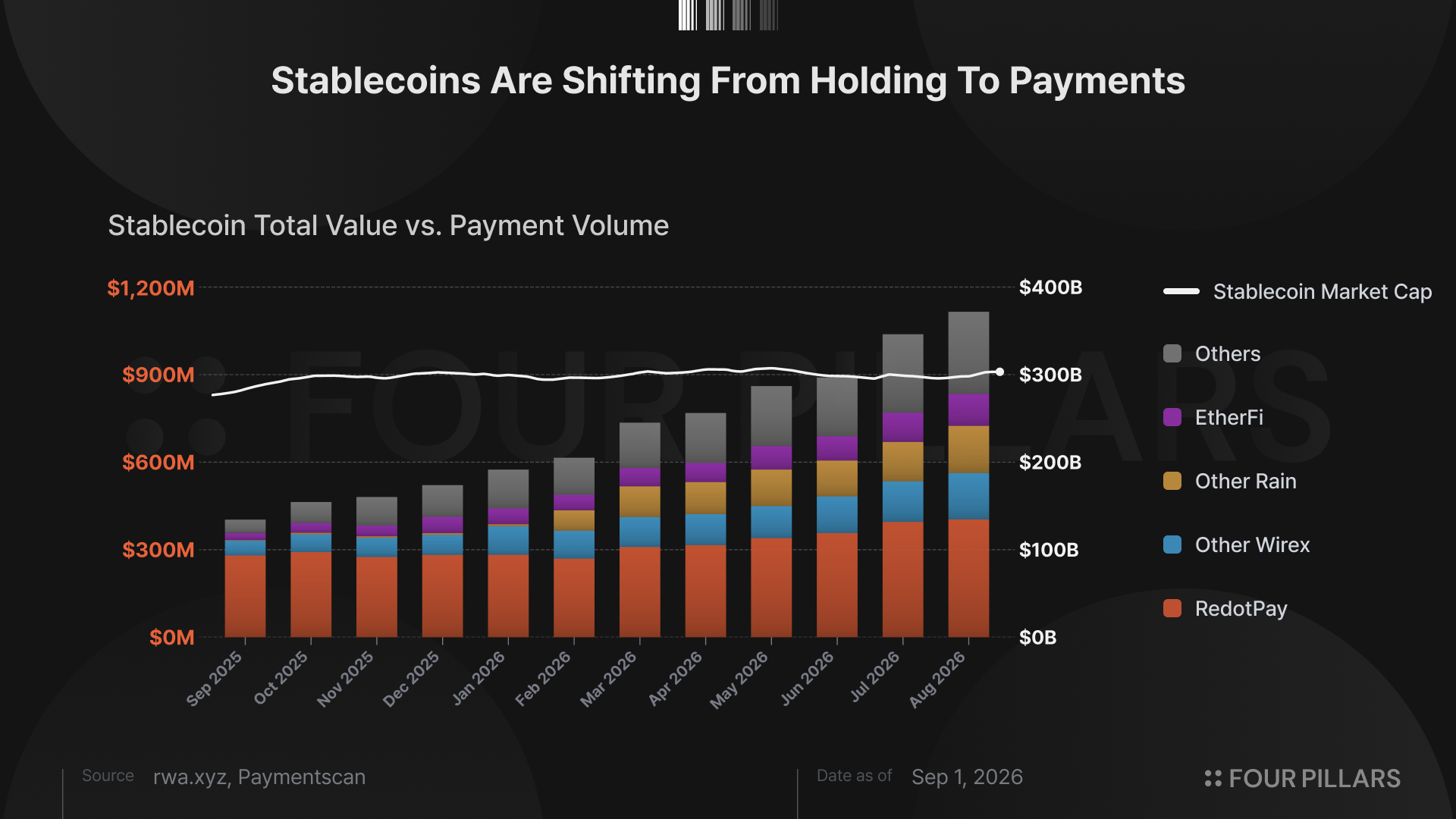
Contrary to common perception, total stablecoin supply did not grow significantly over the past year. While tokenized Treasuries, private credit, and equities grew sharply, stablecoin supply increased by only around 11%. As the chart shows, stablecoin supply has remained almost flat since October 2025.
That does not mean the stablecoin sector is underperforming. First, simply maintaining its scale is meaningful when compared with benchmark crypto metrics such as BTC price and onchain TVL. More importantly, even if stablecoin supply growth has been limited, stablecoins have achieved meaningful growth in actual use cases such as payments.
Stablecoin payments are now taking place through a range of crypto card platforms, including RedotPay, KAST, EtherFi, and Plasma One. Monthly payment volume was only $438.1M in July 2025. By July 2026, one year later, it had nearly tripled to $1.32B.
Stablecoins have now become a sector with PMF independent of broader crypto market conditions. They began primarily as utility assets for crypto trading pairs. More recently, they have become increasingly integrated with the real economy through use cases such as payments. In the future, they also have the potential to become the core form of onchain money used to settle tokenized assets such as RWAs, which we will discuss below.
2.3.2 RWA
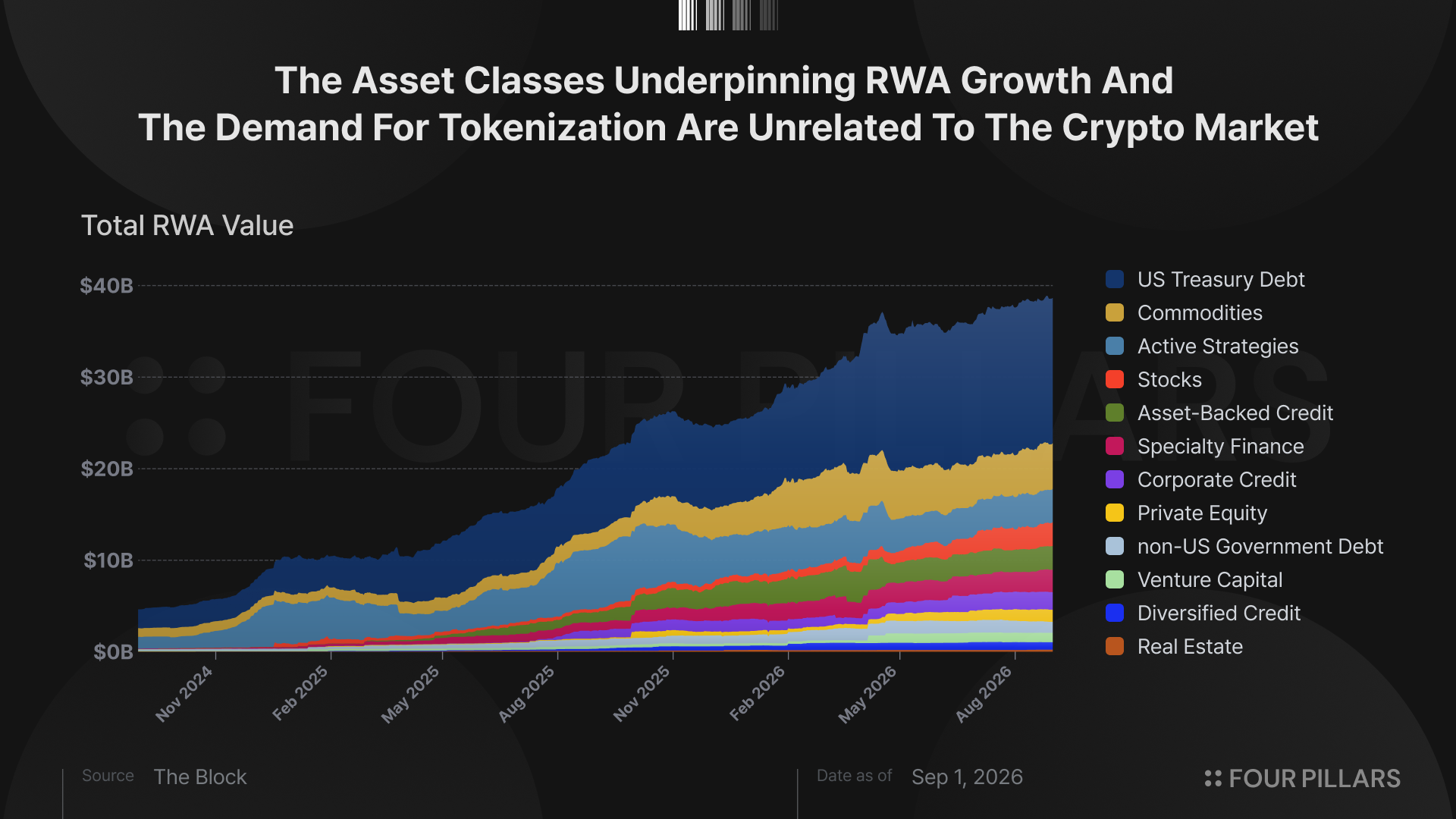
2025 and 2026 were years of significant growth for RWAs. As expectations increased that blockchain systems could replace outdated traditional financial infrastructure, participants from a wide range of backgrounds began tokenizing different asset classes onchain. Early tokenization activity focused heavily on Treasuries and money market funds, where both product structures and tokenization mechanisms were relatively simple. This later expanded into private credit and, more recently, equities.
The underlying asset classes behind RWAs and the logic of tokenizing real-world assets onchain are not heavily dependent on crypto market prices. Based on benefits such as improved efficiency and greater accessibility, the RWA sector can grow independently of broader crypto market conditions. We have covered RWAs extensively in previous Four Pillars research, so I will not go into further detail here.
2.3.3 Vaults
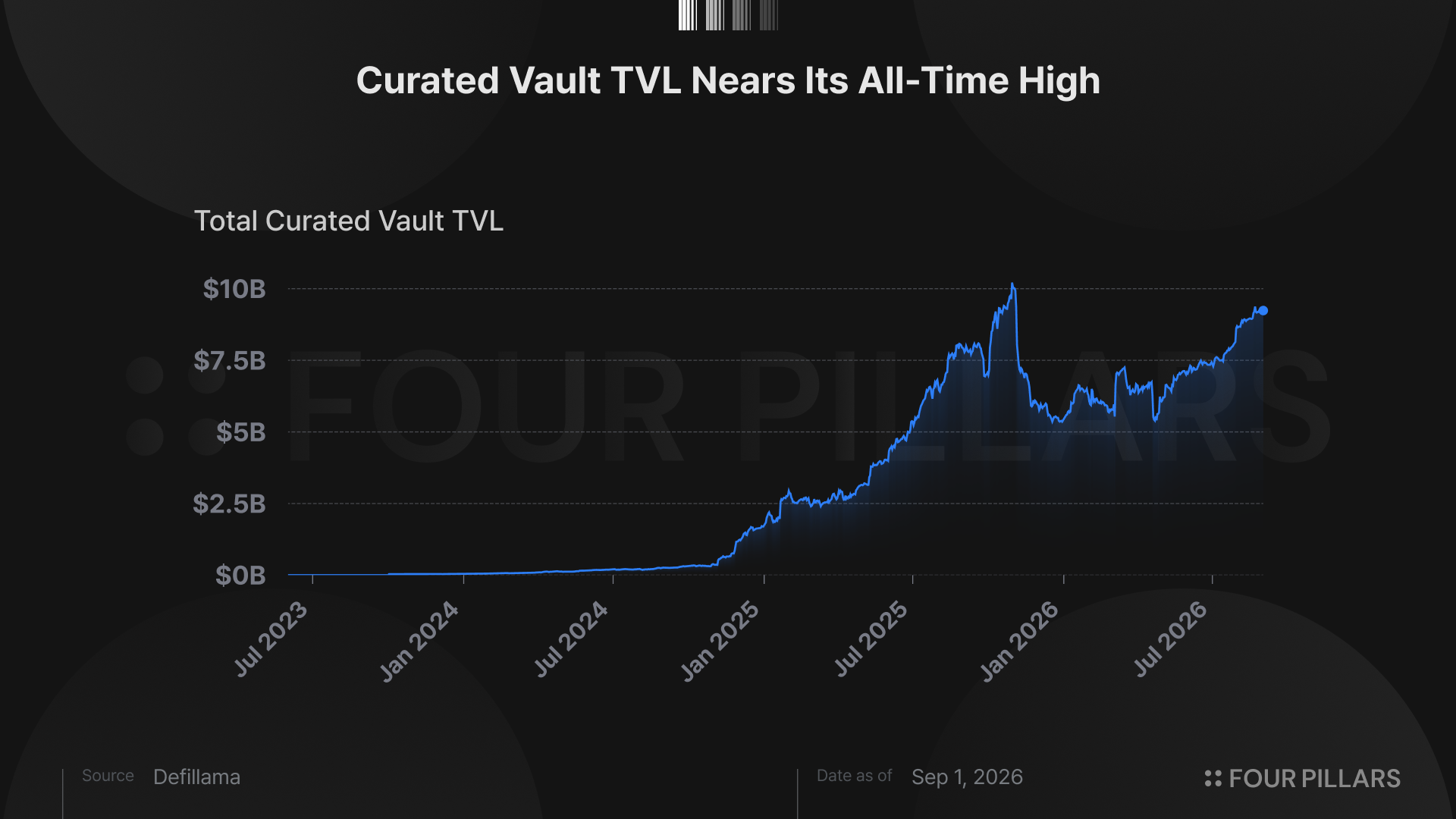
Vaults are not directly connected to the real economy in the same way as RWAs. Still, they have recently attracted attention as a next-generation asset management primitive. They are also indirectly connected to the real economy because they supply capital to lending markets that accept RWAs as collateral.
As of August 28, BTC remained 35% below its all-time high, while TVL in curated vaults was only 4% below its own all-time high. This suggests that the vault ecosystem is also growing independently of broader crypto market conditions.
The vault ecosystem is expected to grow even further. Traditional RWA development focused primarily on issuance. Recently, however, more projects have moved into the utilization stage, creating growing demand for vaults that supply capital to lending markets backed by RWA collateral.
3. Why Crypto Businesses Are No Longer Sexy
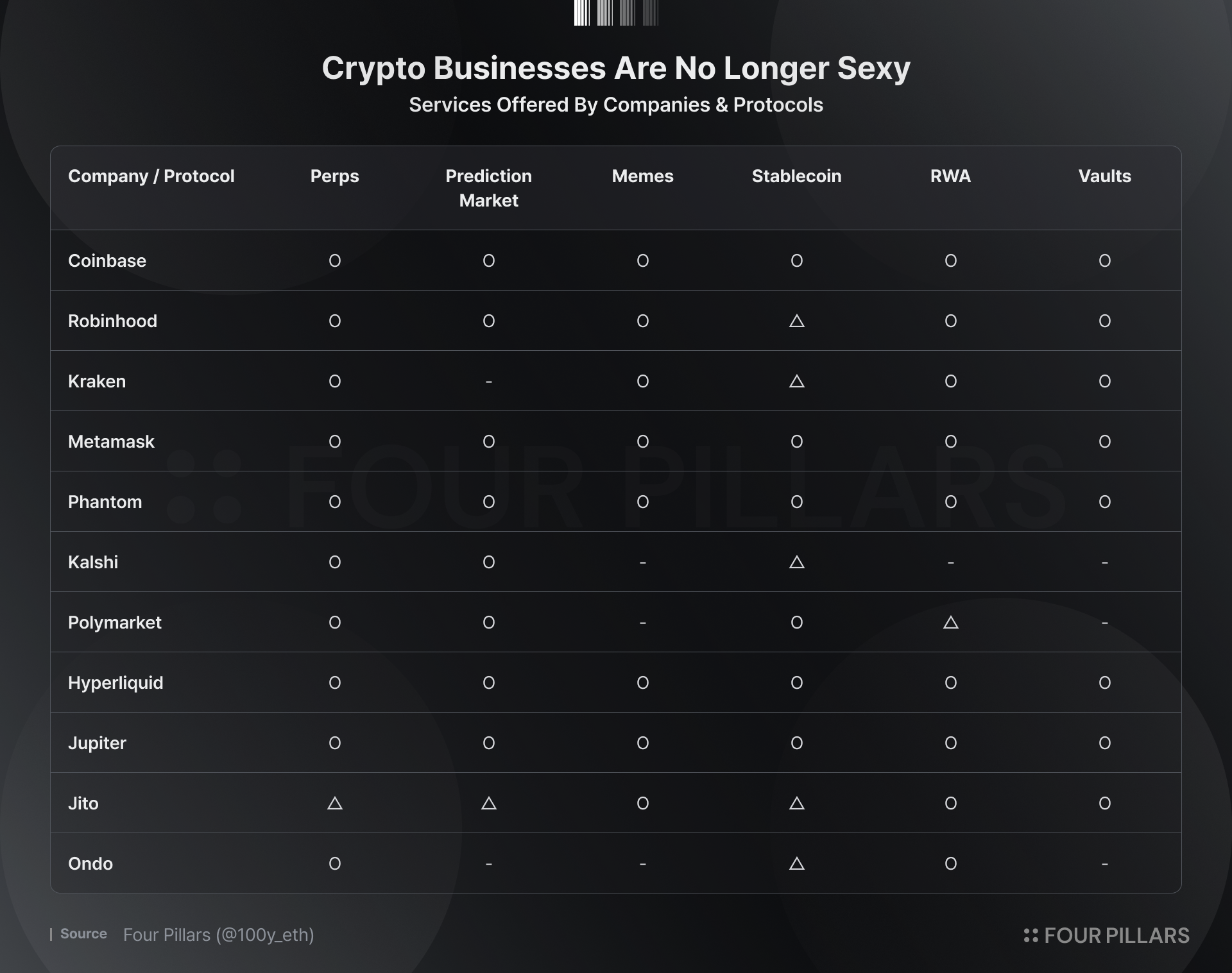
An interesting business phenomenon has emerged in the crypto industry. Blockchain companies that started from very different backgrounds are now launching the same products and competing in the same markets. Everyone is launching perpetual futures, prediction markets, memecoin support, stablecoins, RWA trading, and vaults.
The reason is straightforward. As discussed above, these are effectively the only categories in today’s crypto market that can grow independently of market conditions while generating meaningful revenue. Market conditions have improved recently, but the direction has not changed. A large number of crypto businesses are quietly moving toward sectors that are less sensitive to broader market conditions.
Does that mean every onchain-native business has failed? It would be difficult to say so. Part 1 discussed the end of many experiments, but there are still cases that survived independently and proved PMF. EigenLayer still has a substantial amount of ETH restaked. Even in blockchain gaming, a sector many consider dead, there are cases such as MapleStory Universe that continue to show strong metrics.
The onchain ecosystem has taken on a barbell shape. Viewed negatively, it may seem as though only a handful of sectors are growing. Viewed more positively, it suggests that some of the many businesses created within the blockchain industry have matured enough to establish independent PMF. As the market continues to mature, I hope more sectors can reach that stage on their own.
The author of this report may have personal holdings or financial interests in assets or tokens discussed herein. However, the author affirms that no transactions have conducted using material non-public information obtained in the course of research or drafting. This report is intended solely for general information purposes and does not constitute legal, business, investment, or tax advice. It should not be used as a basis for making any investment decisions or as guidance for accounting, legal, or tax matters. Any references to specific assets or securities are made for informational purposes only and should not be construed as an offer, solicitation, or recommendation to invest. The opinions expressed herein are those of the author and may not reflect the views of any affiliated institutions, organizations, or individuals. The opinions and analyses expressed herein are subject to change without prior notice. In addition, beyond the individual disclosures included in each report, Four Pillars, may hold existing or prospective investments in some of the assets or protocols discussed herein. Furthermore, FP Validated, a division of Four Pillars, may already be operating as a node in certain networks or protocols discussed herein or may do so in the future. Please see below links in the footer for FP Validated's participating network disclosures and for broader disclosure details.


