


Table of Contents
- Key Takeaways
- 1. A different starting point in Web3’s brutal history: Questions for MapleStory Universe
- 2. Three axes that control $NXPC supply pressure: Revenue separation, NFT lock-in, and permanent burns
- 3. MSU’s one-year scorecard: Data that turned a hypothesis into evidence
- 3.1 Platform revenue generated by core gameplay
- 3.2 The lock-in effect that converted active wallets into spending wallets
- 3.3 Q1 2026, when the inequality reversed: The moment spending exceeded rewards
- 4. Beyond a simple game coin: $NXPC’s real future and the market frame it challenges
- 5. Closing: The difference made by restraint
Researcher

Related Projects

Key Takeaways
- MapleStory Universe (MSU) departs from the conventional Web3 game playbook of issuing tokens first and waiting for users and the economic ecosystem to follow. By integrating ownership and economic systems onto the 23-year-proven MapleStory IP and its robust gameplay loop, it has successfully shifted the demand for $NXPC from mere speculation to actual consumption-driven gameplay.
- The primary source of future supply pressure for $NXPC stems from ecosystem contribution rewards, which account for 97.4% of the upcoming circulating supply. However, this is counterbalanced by a tightly interwoven sink structure designed to effectively absorb market supply. This includes in-game expenditures (character growth, equipment enhancement, and marketplace transactions), NFT lock-ins via Fusion and Fission, and a quarterly revenue-linked burn model.
- The published first-year performance data proves that this structure is more than just a theoretical hypothesis. MSU recorded approximately $31 million in ecosystem revenue, with 90.5% generated directly from core game business models (BM). Notably, in Q1 2026, user token consumption surpassed the volume of reward distribution for the first time, validating the tokenomics' sustainability.
- Furthermore, MSU 2.0 and Vibe IP represent an ambitious step to expand the utility of $NXPC from a mere in-game currency to the foundational settlement unit of a Nexon IP-based creator economy. As creators leverage AI-based production tools and game data, and as licensing and settlements are seamlessly processed on the Henesys chain, it establishes a virtuous cycle where the user pool, revenue pool, and token burn volume scale together.
1. A different starting point in Web3’s brutal history: Questions for MapleStory Universe
“Roughly 93% of Web3 gaming projects are now effectively dead.”
The crypto market-making firm Caladan gave a blunt assessment of the Web3 GameFi sector. The GameFi market, which expanded sharply after Axie Infinity in 2021, has been cleared out quickly as many projects showed short lifespans, weak active user metrics, and sharp token price declines. Caladan assessed that about 93% of GameFi projects were effectively dead and that token prices had fallen by about 95% from their 2022 peaks.
The problem was less blockchain itself than the reward structures designed by many P2E, or Play to Earn, projects. Tokens and NFTs were sold before the product came first, and reward funding depended too much on new inflows and trading volume rather than actual gameplay. Users were closer to farmers trying to recover rewards than players enjoying a game. The name was “Play to Earn,” but the market’s center of gravity was always on “Earn,” not “Play.”
MapleStory Universe, or MSU, started from a different point. MapleStory N and $NXPC, the core utility token of the ecosystem, officially launched on May 15, 2025. Nexpace described this as the first step in expanding the 23-year-old MapleStory IP onto blockchain. For MSU, blockchain is closer to a tool for implementing item ownership, trading, rewards, and settlement transparently on top of an already proven gameplay loop. It is not the purpose of the narrative itself.
Now that the first-anniversary events, future roadmap, and one year of data have been released together, this is an appropriate time to review $NXPC again. There are two main questions.
- How has MSU’s proven “Play,” built on a strong IP, connected to $NXPC demand, revenue, and burn structure?
- Is the market still valuing $NXPC through the old P2E frame, meaning the game token framework of one year ago?
2. Three axes that control $NXPC supply pressure: Revenue separation, NFT lock-in, and permanent burns
Source: MapleStory Universe
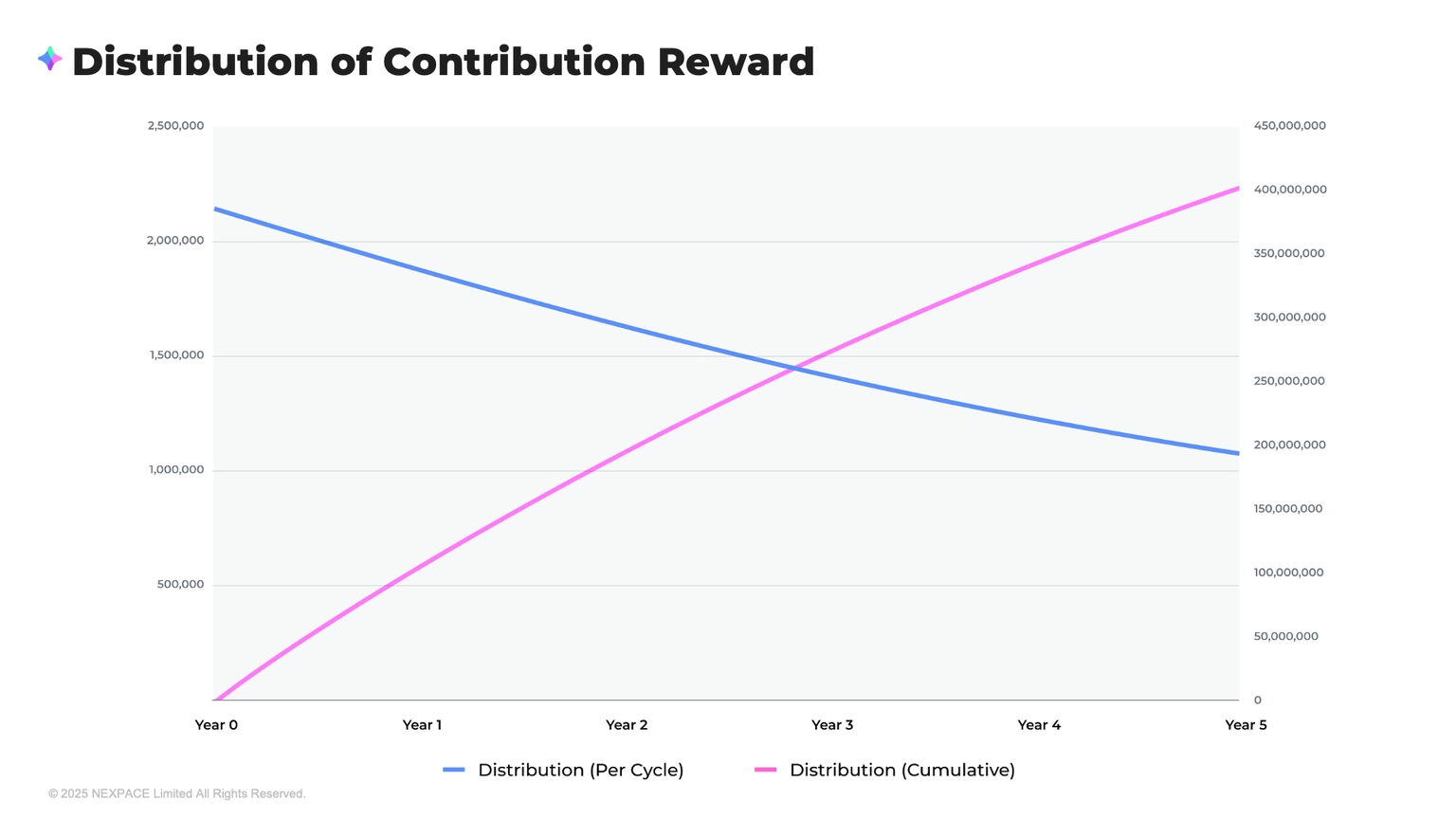
$NXPC is the central asset of the MSU ecosystem. At issuance, total supply was fixed at 1 billion tokens. Of this amount, 800 million $NXPC, or 80%, was allocated to Contribution Rewards. These rewards are distributed in weekly cycles and follow a structure similar to Bitcoin’s halving model, where emissions decline over time.
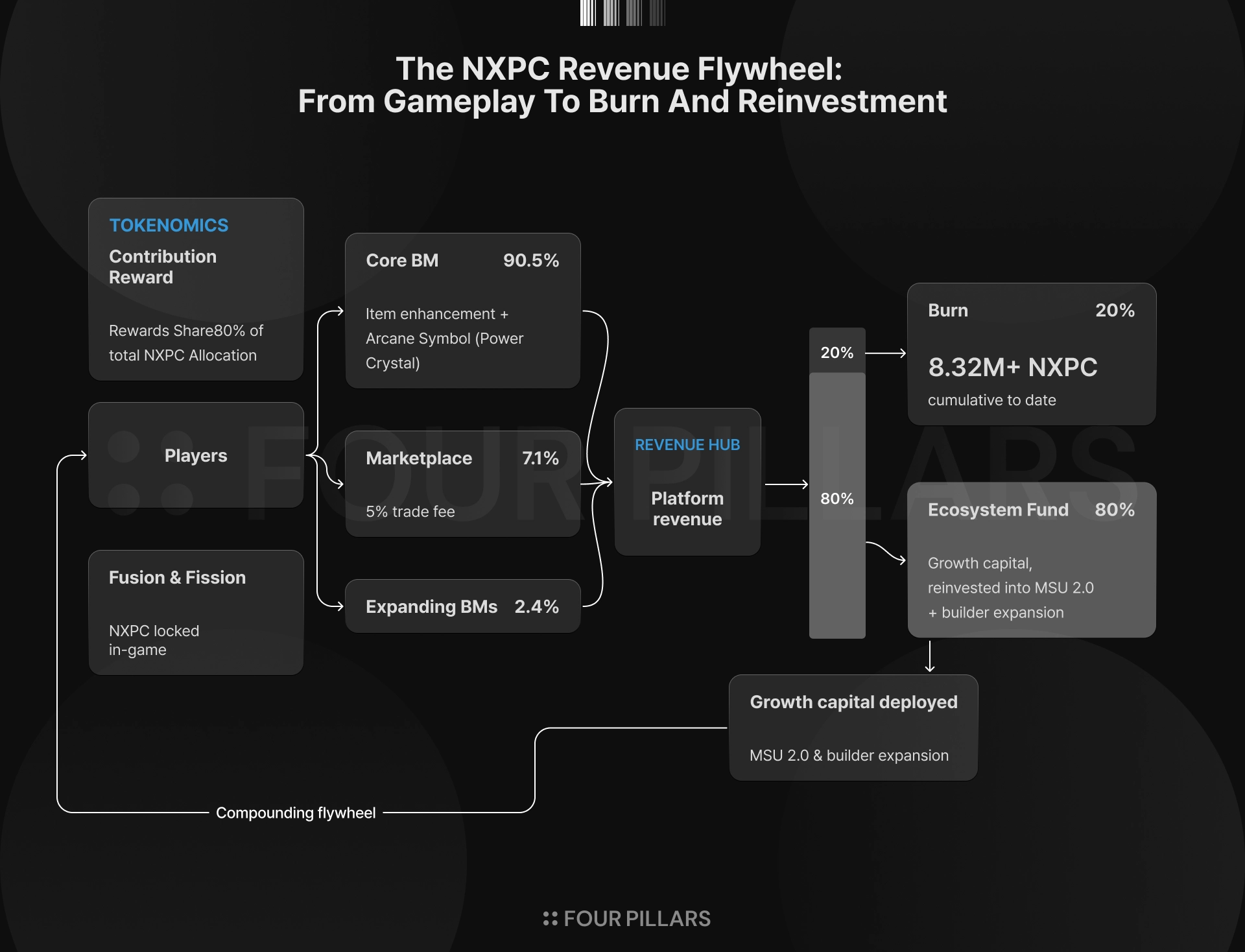
The important point is that user reward funding and platform revenue do not flow through the same pipeline. User rewards are paid in $NXPC from the Contribution Reward pool. As noted above, this amount was already allocated in the tokenomics at the time of issuance.
By contrast, platform revenue is tracked separately as fee revenue generated from enhancements, marketplace transactions, and other user activities. This leaves one question. Can the number of tokens consumed and absorbed inside the game become larger than the number of tokens paid out to users as rewards?
The answer begins with what makes $NXPC different. $NXPC has demand sources inside the ecosystem where it is consumed again, and that demand comes from gameplay rather than speculation. Character progression, equipment upgrades, consumable play loops, marketplace transactions, and creator-based expansion business models are all forms of real demand that arise as users play the game. Demand for the token is created by playing the game, not by buying and selling the token.
Source: MapleStory Universe
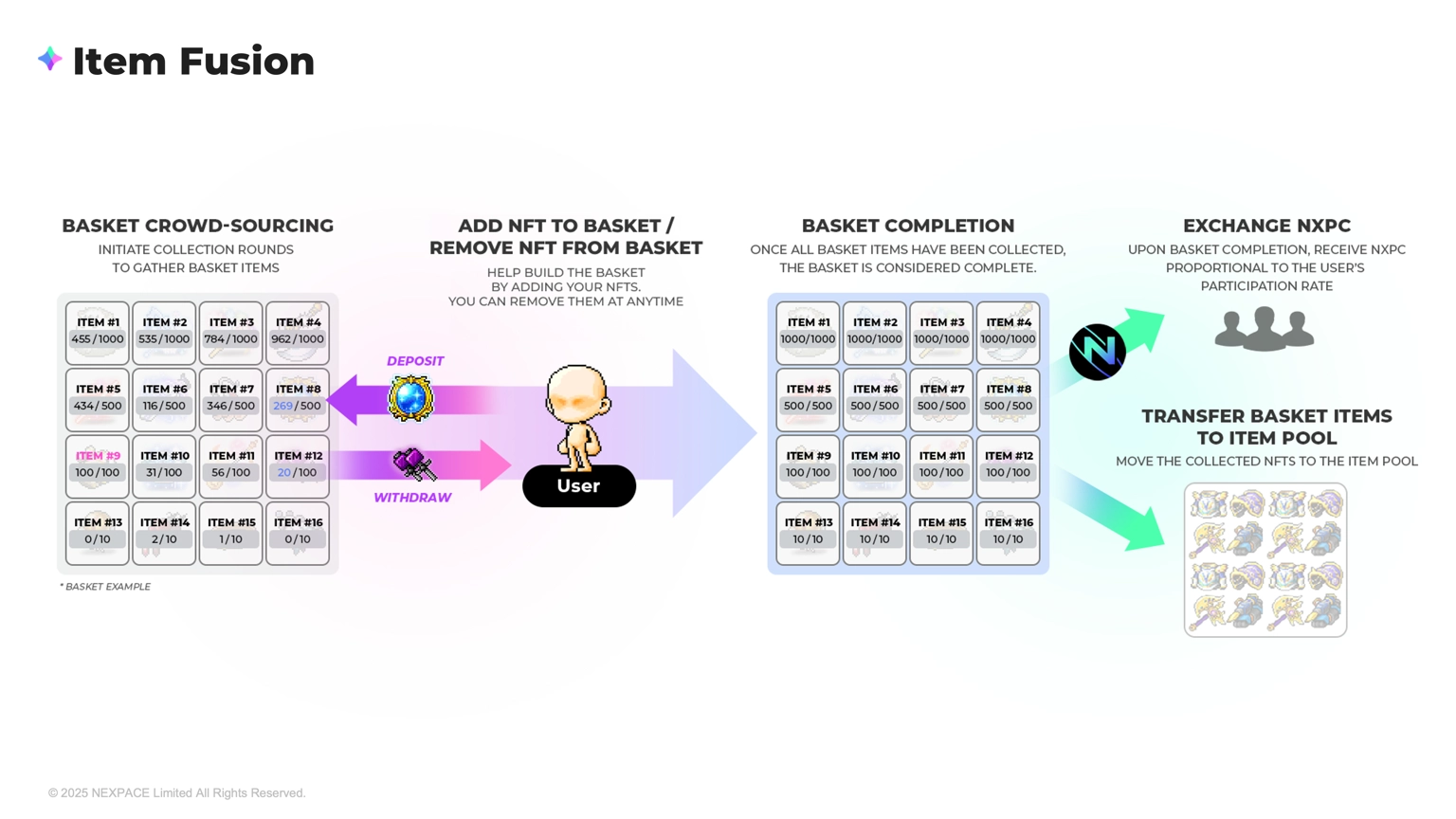
The two-way conversion structure between $NXPC and NFTs through Fusion and Fission is also important. Through this mechanism, major items are issued as fixed-supply NFTs. Users can exchange $NXPC for NFT collections or convert NFT collections back into $NXPC. This exchange is close to a lock that ties $NXPC into NFT form. Considering that 27.3% of the total circulating supply is currently locked as NFTs, the effect is meaningful. Although this is not the same as a permanent burn, it reduces a large portion of circulating supply that could otherwise enter the market and create selling pressure.
Source: MapleStory Universe
In November 2025, Nexpace also introduced a quarterly $NXPC burn mechanism. Under this mechanism, 20% of platform revenue generated from user activity within the MSU ecosystem is burned every quarter. The remaining 80% functions as the Ecosystem Fund for MSU 2.0 and builder-based ecosystem expansion.
The $NXPC circulation structure can therefore be summarized as follows.
User inflow → increased $NXPC use during gameplay, with some supply locked through conversion between $NXPC and NFTs → higher fee revenue → 20% permanent burn + 80% ecosystem reinvestment → lower supply pressure
The next question is clear. Is this structure actually working?
3. MSU’s one-year scorecard: Data that turned a hypothesis into evidence
3.1 Platform revenue generated by core gameplay
Based on the data dashboard released by MSU for its first anniversary, we can now look at where revenue came from, what stage the ecosystem has entered, and whether organic circulation is working in practice.
Over the past year, MSU recorded about $31 million, or 49.1 million $NXPC, in ecosystem revenue. Cumulative on-chain transactions reached 150 million, and active wallets passed 850,000. These figures point to steady ecosystem growth.
The key point is the qualitative nature of the revenue. Most MSU platform revenue did not come from simple NFT secondary transaction fees or speculative token churn. Revenue was driven by the core game business model, including character progression, equipment upgrades, and consumable play loops.
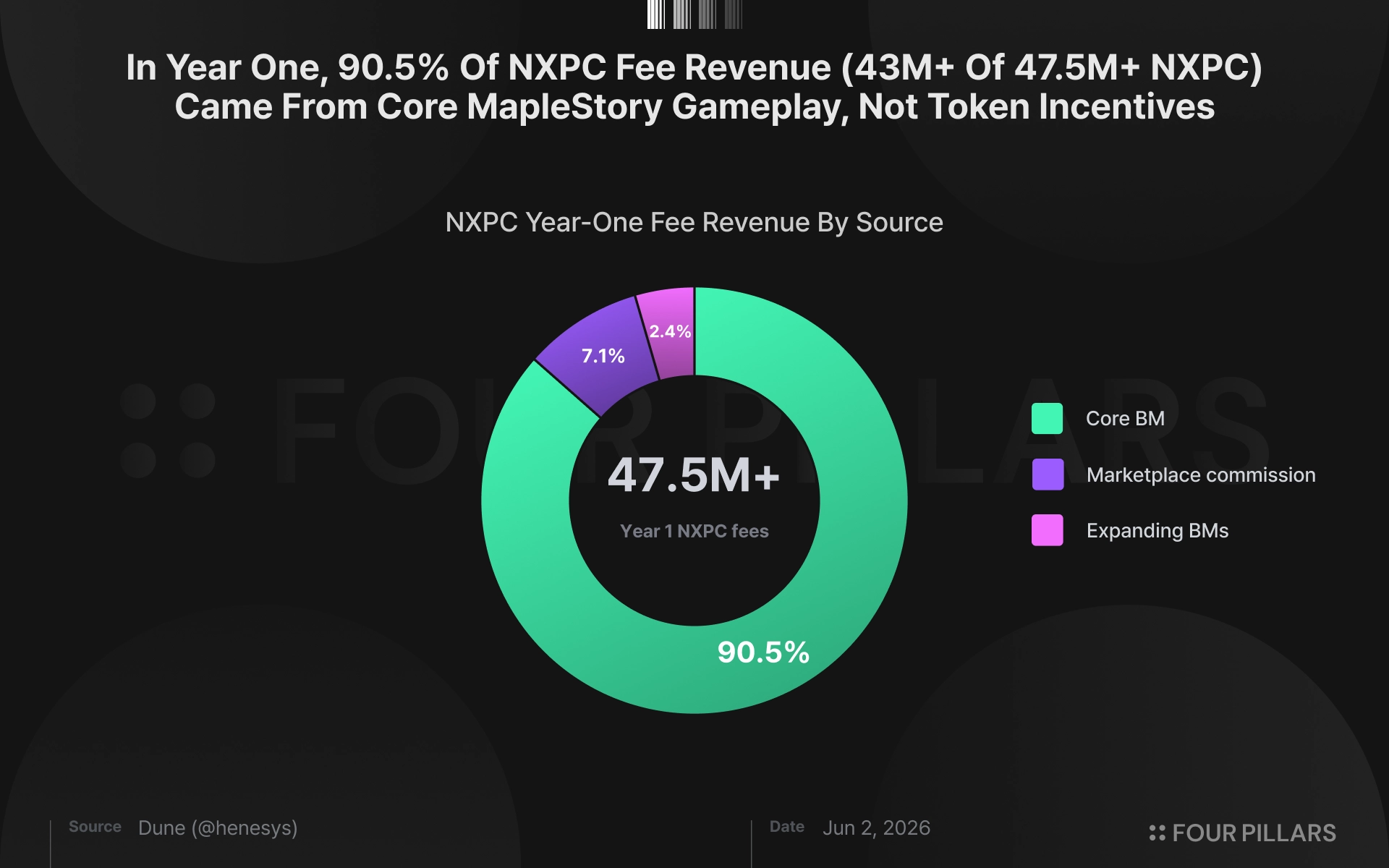
About 90.5% of total revenue over the past year came from the core game business model. Marketplace commissions accounted for 7.1%, while expansion business models accounted for 2.4%. This revenue structure is clear evidence that demand for the $NXPC token comes from the game’s appeal and user needs rather than speculation. In addition, the recently launched “1st Anniversary Special Maple Plus Shop,” which is an expansion business model, generated more revenue than the core game business model in its first week. This shows that MSU’s revenue model is gradually diversifying and becoming less dependent on a single revenue source.
3.2 The lock-in effect that converted active wallets into spending wallets
Among the 850,000 wallets that interacted with the ecosystem, 560,000 wallets, or 65.9%, actually spent $NXPC. In effect, two out of three users who entered the ecosystem converted into paying wallets rather than remaining simple cherry-pickers.
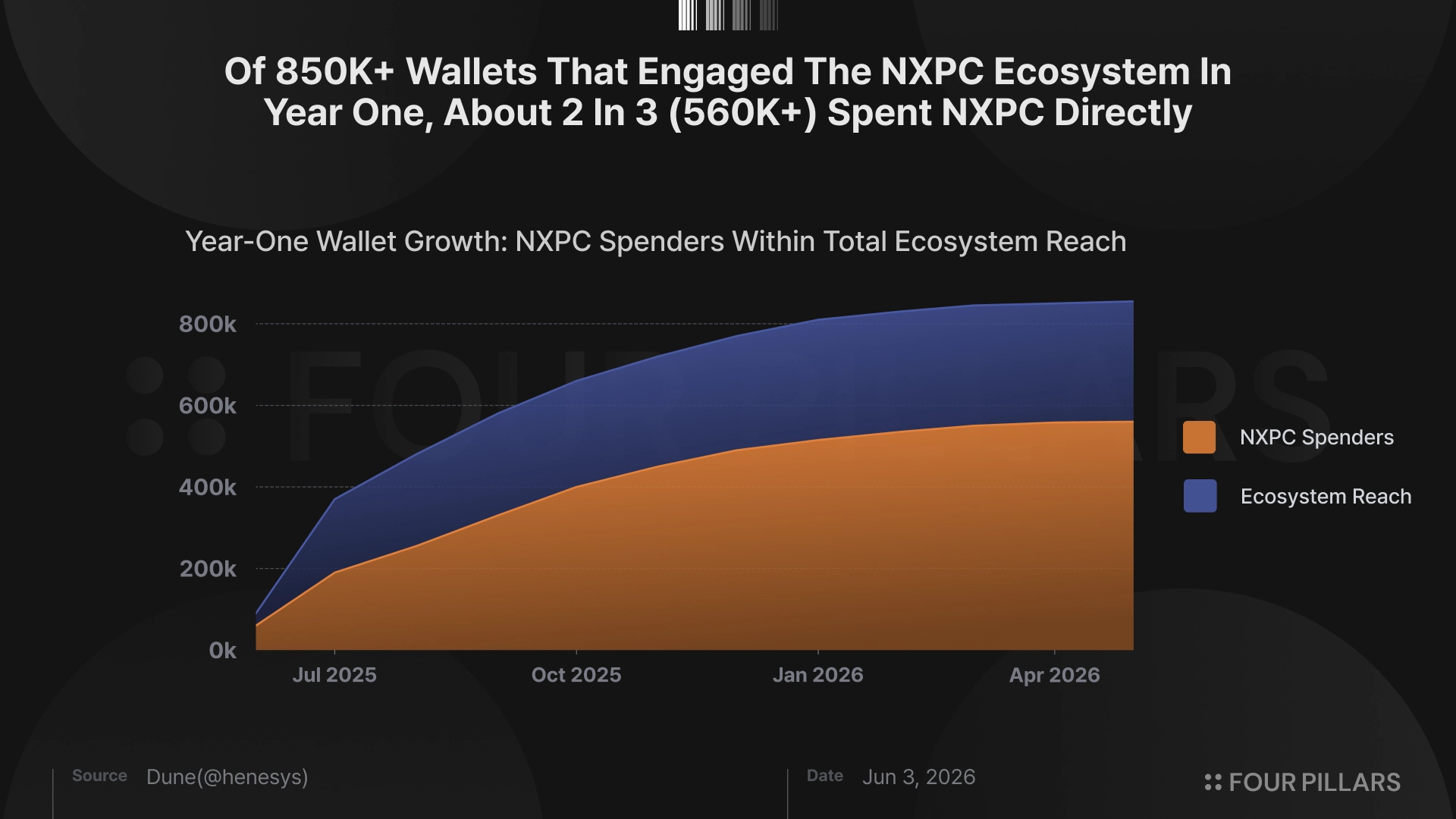
What matters more is that the spending wallet ratio has increased over time. In many projects, the payment base weakens as time passes. MSU has shown the opposite pattern: its core user base has become more stable over time through a lock-in effect.
- Cumulative spending wallet ratio: 51% in the first launch month → 65.9% after one year
- Recent monthly spending ratio: Maintained at around 80%
A typical P2E game’s monthly paying user rate, or PU Rate, usually remains around 1% to 5%. Compared with that range, MSU’s structure differs sharply from the industry norm because a large share of active wallets participates in repeated spending. As the quality of retention among existing users has improved, new users have also continued to enter the ecosystem. This supports the ecosystem’s long-term sustainability.
3.3 Q1 2026, when the inequality reversed: The moment spending exceeded rewards
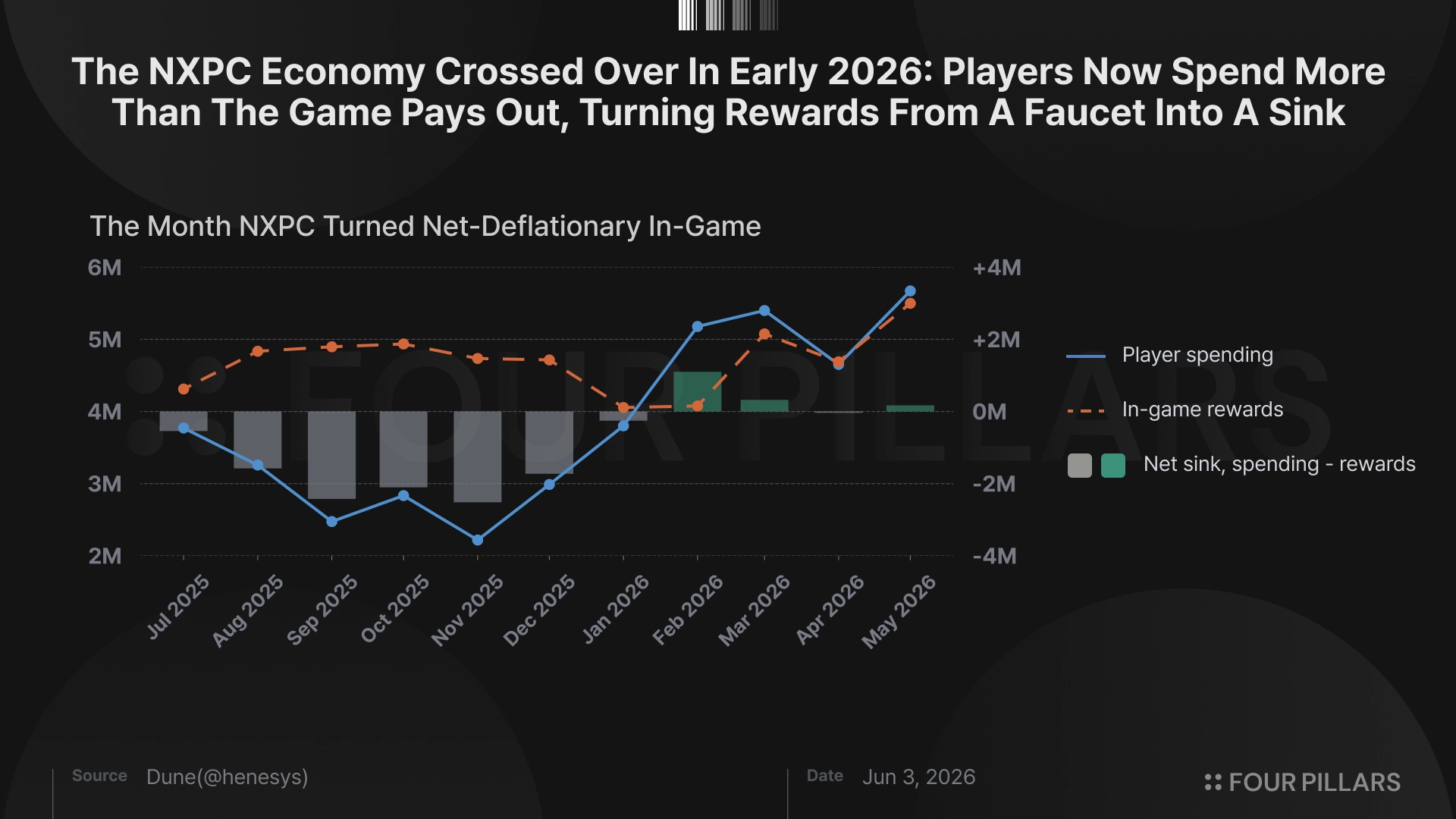
If user growth and the high rate of $NXPC spending are now clear, the next question follows naturally. When does the most desirable phase arrive from a tokenomics perspective, where tokens consumed inside the game exceed tokens released as rewards? According to materials Nexpace published on May 22, 2026, that turning point had already begun.
“By Q1 2026, player spending had outpaced rewards distributed.”
In Q1 2026, in-game token spending exceeded the rewards distributed to users for the first time. For projects whose tokenomics collapsed, the first broken equation was always “emissions > consumption.” Since more tokens came out as rewards than were recovered inside the game, supply kept accumulating in the market. Once new inflows that had absorbed the selling pressure stopped, prices collapsed. This cycle became a recurring problem for many projects. Within one year of launch, MSU took the first step toward reversing this inequality.
Supply reduction through burns is also in place. Under the burn structure discussed in Section 2, 20% of fee revenue generated from in-game spending is permanently burned every quarter. As more users enter, spending exceeds rewards by a wider margin, and burns reduce actual supply. Demand and supply mechanisms therefore move in the same direction. Burns executed over the past six months are as follows:
- First burn, November 2025: 20% of 19.2 million $NXPC in Q2 and Q3 2025 revenue = 3.84 million $NXPC
- Second burn, January 2026: 20% of 8.0 million $NXPC in Q4 2025 revenue = 1.61 million $NXPC
- Third burn, May 2026: 20% of 14.4 million $NXPC in Q1 2026 revenue = 2.88 million $NXPC
Cumulative burns will continue to increase by design. The more important point is that quarterly burn volume expanded again with Q1 2026 revenue growth. Since revenue moved into the 14 million range in 2026, the size of quarterly burns has also begun to rise. This is the starting point of a positive cycle in which higher revenue leads to larger burns. The tokenomics flywheel, which had remained a hypothesis, has begun to turn.
4. Beyond a simple game coin: $NXPC’s real future and the market frame it challenges
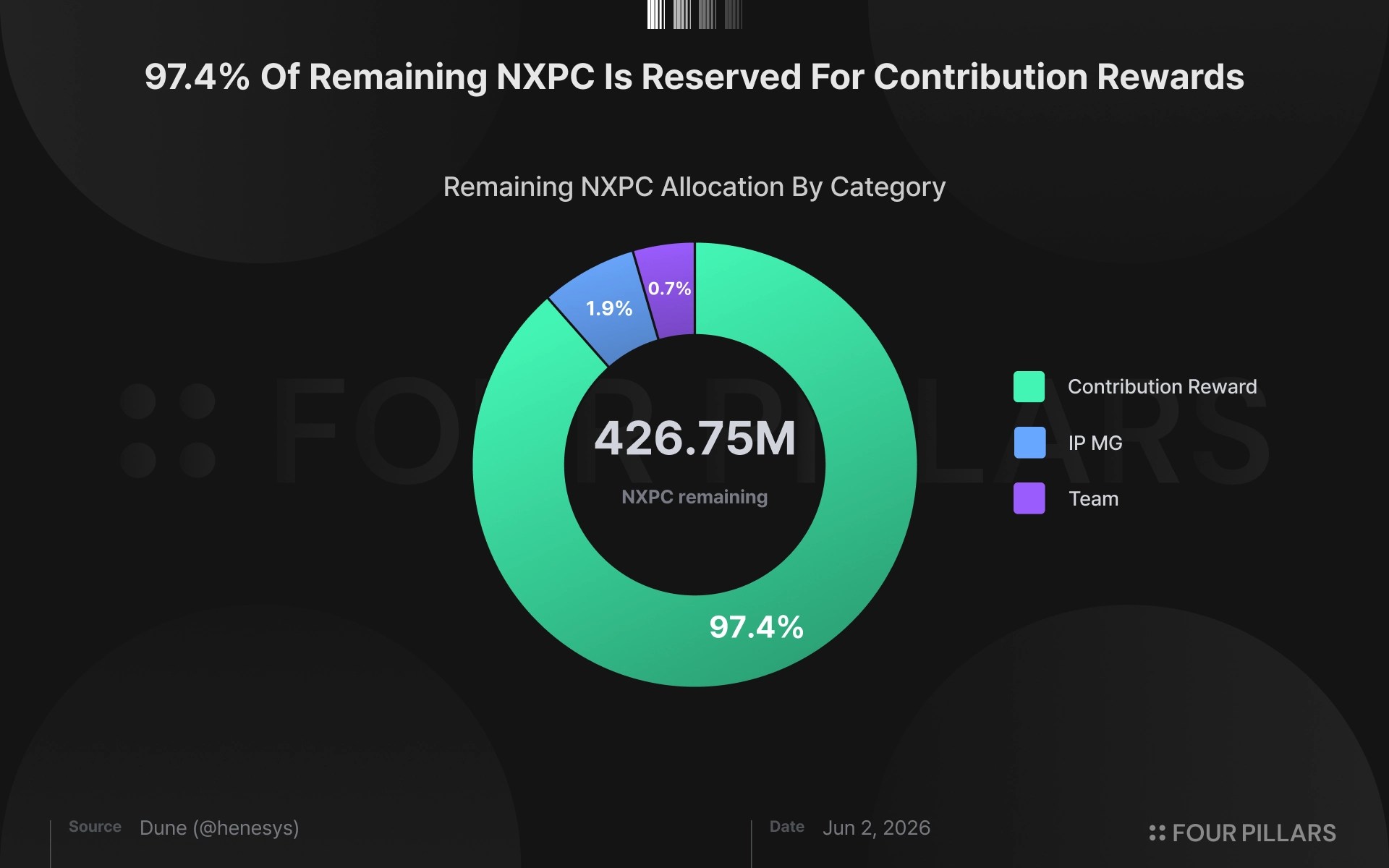
Why is this flywheel so important? $NXPC’s supply structure gives a clear answer. A close look at the tokenomics shows that 97.4% of the supply still to be released is concentrated in one category: Contribution Rewards. Additional supply from other categories is effectively complete. Future supply pressure will be determined only by the reward supply released to users.
The conclusion is simple. This supply has to be absorbed by users who actually spend the token inside the game. Speculative demand alone is not enough. Users enter, spend $NXPC during gameplay, 20% of the resulting fee revenue is burned, and some of the token is locked as NFTs through Fusion and Fission. This flywheel works as deflationary pressure that offsets emission pressure.
In the end, every question converges into one. Are enough users directly playing the game, and are they actually spending tokens? The one-year data is already a clear answer, even before considering the current crypto bear market. About 90% of revenue came from the core loop. The monthly spending wallet ratio reached around 80%. In Q1 2026, spending exceeded rewards.
Source: MapleStory Universe
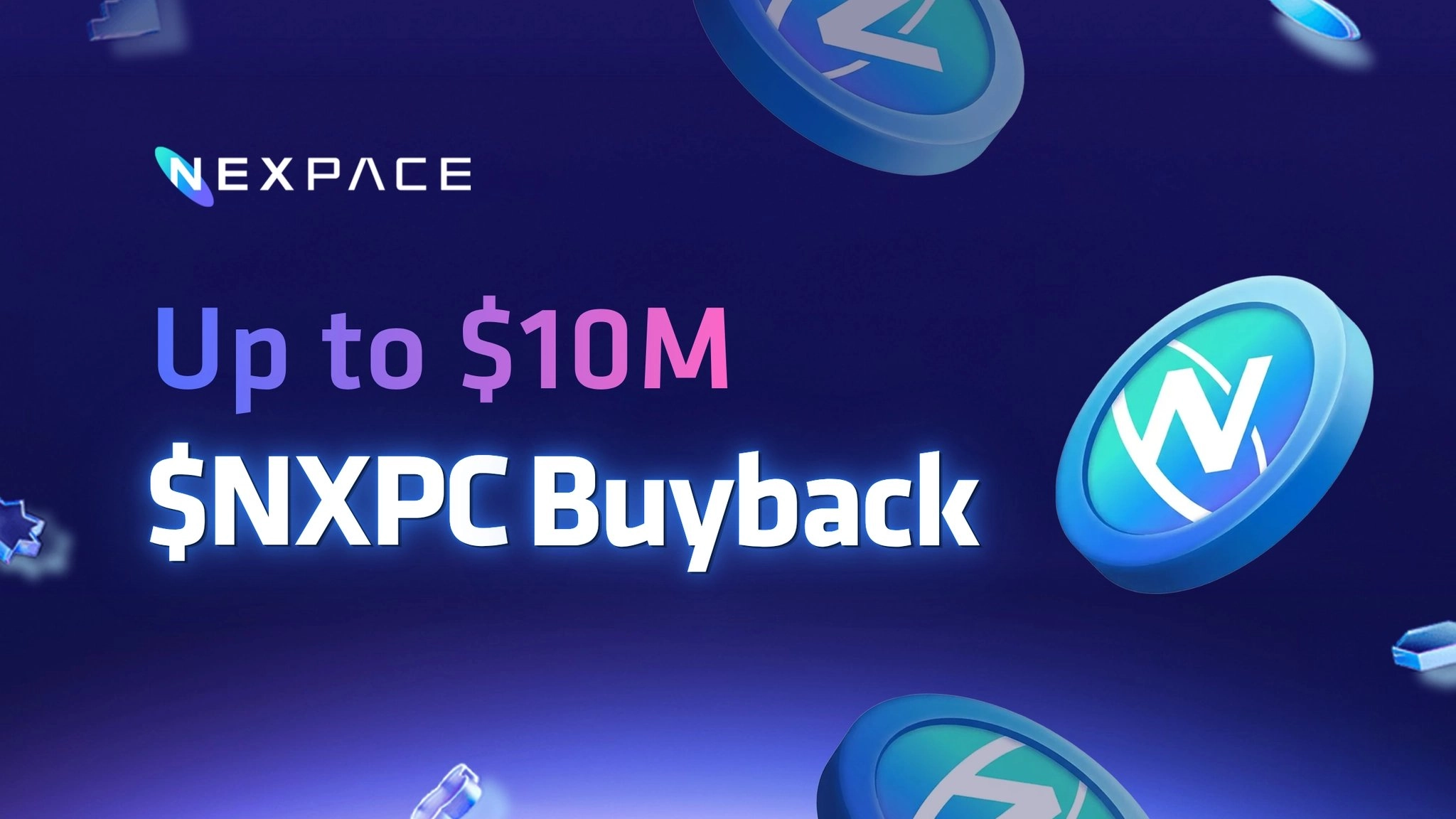
On May 22, 2026, Nexpace announced a $NXPC buyback program of up to $10 million, or about KRW 15.5 billion, in addition to its burn policy. This program will be carried out over three months through open-market purchases on global exchanges. The purchased tokens will be held in the treasury for future ecosystem support. The stated purpose is to strengthen a user-centered and sound token circulation structure.
Source: MapleStory Universe
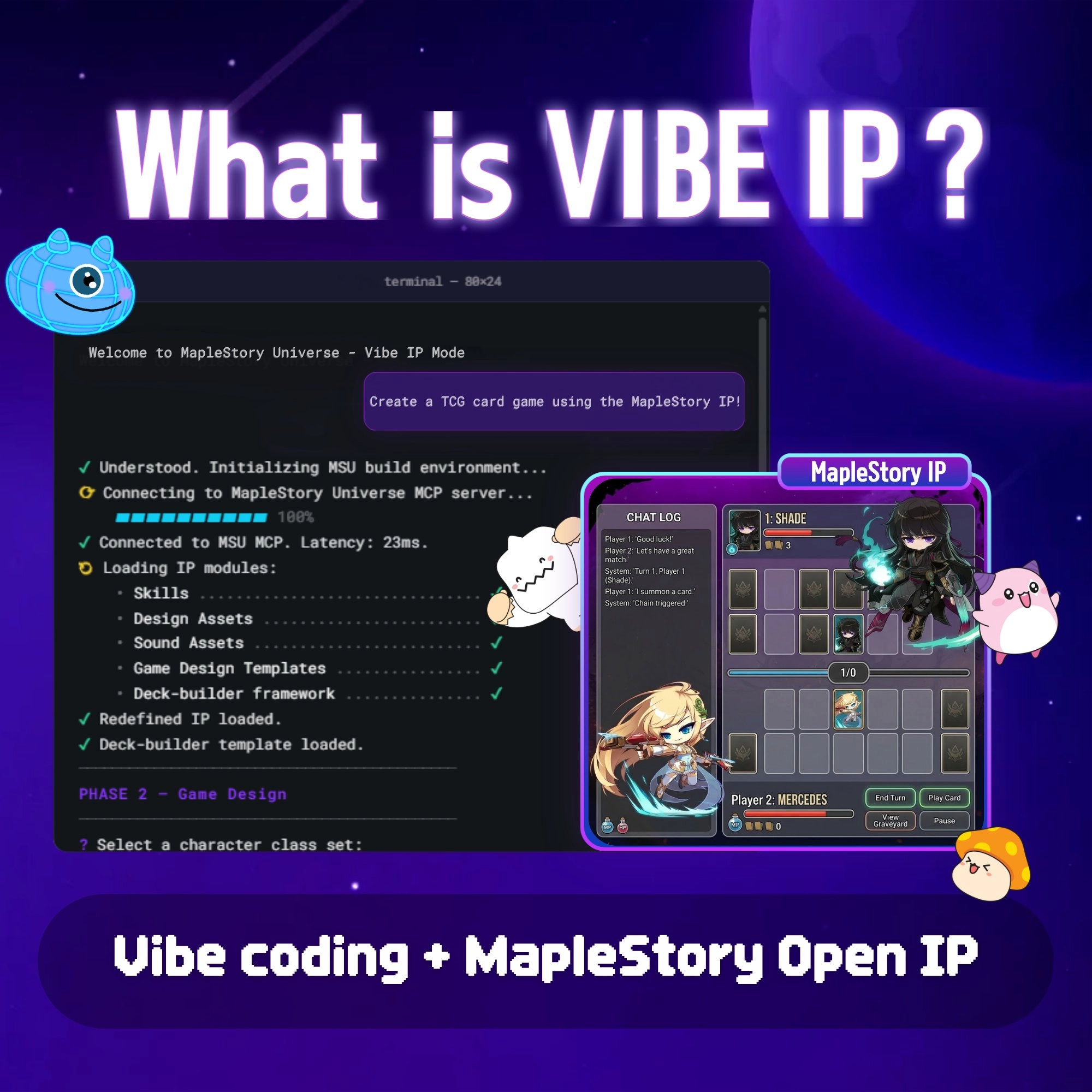
The story does not end with burns and buybacks. Through MSU 2.0, Nexpace is presenting the next stage of ecosystem expansion. A representative example is Vibe IP, which was introduced alongside the first anniversary.
It is designed around two axes. The first is open access to IP. External builders can access MapleStory N game and behavior data through dedicated APIs and create products with AI-based Vibe Coding tools. The entry barrier itself is removed so that anyone can make something with the MapleStory IP, without prior license approval, a development studio, or business registration. The second is an on-chain builder economy on Henesys, an Avalanche L1-based chain. Licensing, settlement, and payments are processed automatically within a single system, and all value flows are settled in $NXPC.
As new IP and builders come onto the same infrastructure, the user pool, revenue pool, and burn pool expand together. Through this structure, $NXPC expands from the currency of one game into the unit of account for the entire Nexon IP creation ecosystem. If the market still sees $NXPC as the game coin of MapleStory N, it is still using the framework from one year ago.
5. Closing: The difference made by restraint
In this genre, I think the real variable is restraint rather than the speed of expansion. The lifespan of an MMORPG depends on not releasing final bosses or top-tier equipment too early, and on managing the item economy within a range that is neither inflationary nor deflationary. Operators always face the temptation to raise short-term performance through patches. In traditional games, the cost remains invisible to users and appears much later as churn.
Blockchain changed this incentive structure. Item supply, token issuance, and burns are all recorded on-chain, so restraint becomes a verifiable public commitment. Core items are fixed-supply NFTs, which constrain inflation at the code level. The operator’s value capture is tied to recurring revenue-linked burns rather than one-time sales, so short-term greed can create long-term losses. The one-year data above shows that Nexpace did maintain this restraint and moved the project in a long-term direction.
Even so, the market still applies an old yardstick to $NXPC. Under the old P2E token evaluation method, $NXPC looks like just another game token. But this asset has 90% of revenue from actual play, permanent quarterly burns of part of that revenue, and infrastructure that can expand a verified burn mechanism across the Nexon IP catalog. This asset should be recalculated by placing content revenue, burns, and the option value of IP expansion in the same model.
Over the past four years, most games built on blockchain were close to Ponzi-like structures aimed at “Earn.” The first year of MapleStory Universe showed, with data, that at least one project can work in a structure where gameplay is proven first and the rationale for token adoption follows. When verified revenue, the burn mechanism, the infrastructure to expand it across Nexon IP, and actual operating data are considered together, this ecosystem is clearly larger than the current yardstick captures. As someone who supports the blockchain ecosystem and is a fan of the MapleStory IP, I think this ecosystem is undervalued relative to what it has built, even with execution risk still on the table.
The report is based on the independent research of the author sponsored/funded by Nexpace. The author of this report may have personal holdings or financial interests in assets or tokens discussed herein. However, the author affirms that no transactions have conducted using material non-public information obtained in the course of research or drafting. This report is intended solely for general information purposes and does not constitute legal, business, investment, or tax advice. It should not be used as a basis for making any investment decisions or as guidance for accounting, legal, or tax matters. Any references to specific assets or securities are made for informational purposes only and should not be construed as an offer, solicitation, or recommendation to invest. The opinions expressed herein are those of the author and may not reflect the views of any affiliated institutions, organizations, or individuals. The opinions and analyses expressed herein are subject to change without prior notice. In addition, beyond the individual disclosures included in each report, Four Pillars, may hold existing or prospective investments in some of the assets or protocols discussed herein. Furthermore, FP Validated, a division of Four Pillars, may already be operating as a node in certain networks or protocols discussed herein or may do so in the future. Please see below links in the footer for FP Validated's participating network disclosures and for broader disclosure details.


