


Table of Contents
- Key Takeaways
- 1. Onchain Markets Need a New Internet
- 1.1 Companies Investing Millions for Milliseconds
- 1.2 Onchain Markets are Encountering Public Internet Limitations
- 1.3 A Dedicated Network Purpose-Built for High-Performance
- 2. DoubleZero's Architecture
- 2.1 Physical Components and Smart Contract-Based Automation System
- 2.2 Multicast
- 3. DoubleZero's Token Economy
- 3.1 The 2Z Token
- 3.2 Sustainable Fee Mechanism
- 3.3 Performance-Based Reward System
- 4. Real Performance: Solana Validator Performance Improvements
- 5. Looking Forward: Perps, Prediction Markets, Agentic Trading
Researcher

Related Projects

Key Takeaways
- New financial systems like onchain markets, and prediction markets have reached a point where they require dedicated infrastructure beyond the limitations of the internet protocol designed 30 years ago. BGP, the routing protocol that has governed internet traffic since the early 1990s, was designed to minimize cost, not to minimize latency. It delivers data on a 'least cost' basis. DoubleZero presents a new paradigm that enables access to high performance, that maintains decentralization by taking advantage of underutilized fiber capacity from various network contributors.
- DoubleZero has successfully stood up a purpose-built network that significantly improves global communication and data transfer. DoubleZero is the first to apply multicast technology to blockchain, solving the inefficiency of repeatedly transmitting identical data to thousands of nodes and reducing network bandwidth usage.
- DoubleZero implemented fair reward distribution model to network contributors based on actual performance contributions through smart contract-based automation and a Shapley value model, without central administrators. Today, over 460+ Solana mainnet validators are connected to DoubleZero, achieving up to 78.1% round-trip time improvements on specific paths compared to the public internet.
1. Onchain Markets Need a New Internet
1.1 Companies Investing Millions for Milliseconds
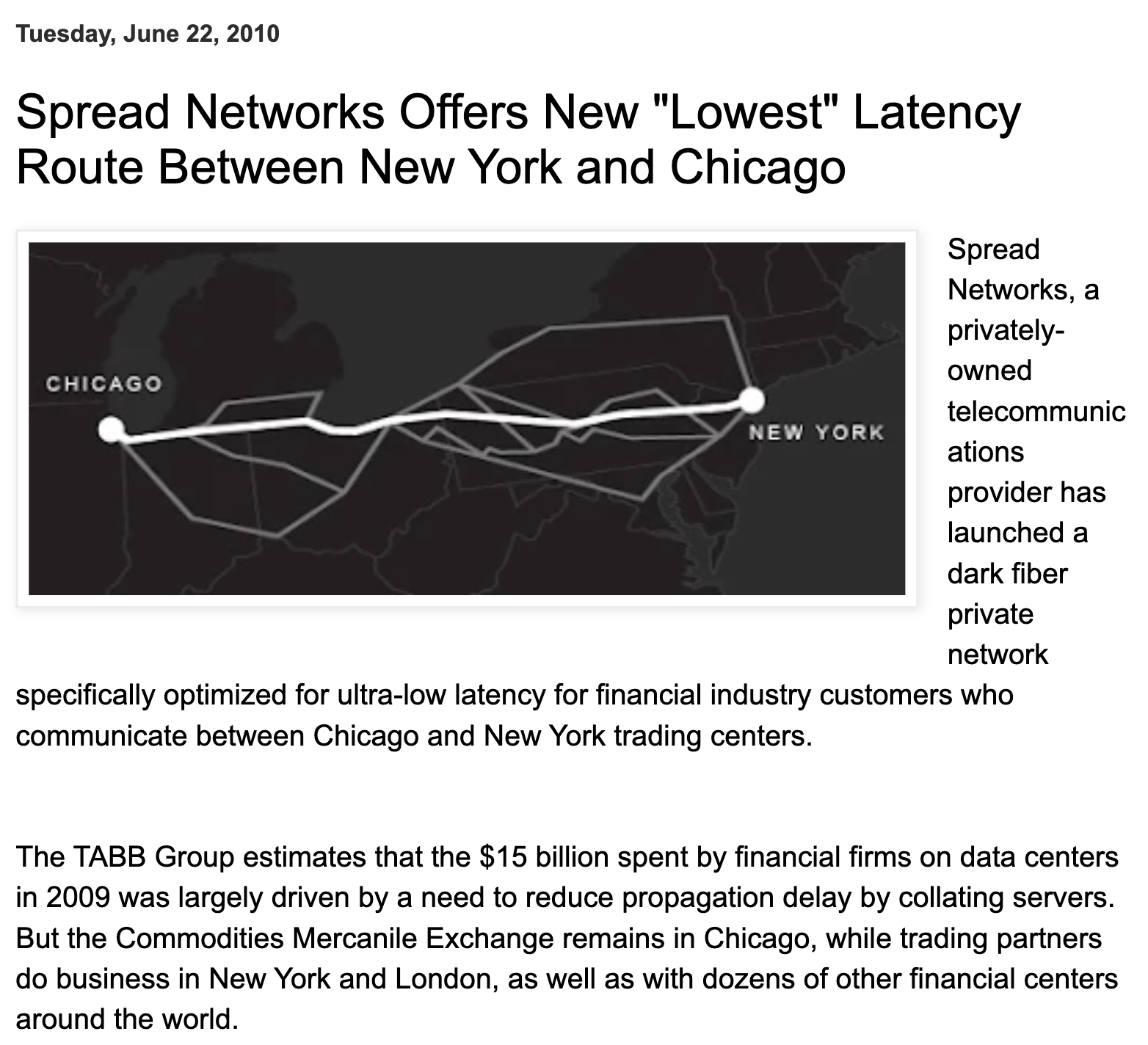
Source: Gary Kim
In 2010, Spread Networks invested $300 million to save just 3 milliseconds. The goal was to lay 1,331 kilometers of fiber optic cable as straight as possible between the Chicago Mercantile Exchange and the Nasdaq data center in New Jersey, reducing round-trip latency from 16 milliseconds to 13 milliseconds.
At the time, many market participants considered the $300 million investment for just 3 milliseconds to be excessive. However, after this project, straight-line fiber networks became a crucial competitive advantage in the high-frequency trading (HFT) industry, and companies without such infrastructure found themselves at a disadvantage. This event gained public attention when detailed in the 2014 bestseller "Flash Boys."
Just two years later, an even more dramatic attempt followed. McKay Brothers began building microwave towers between Chicago and New Jersey. They leveraged the physical property that electromagnetic waves propagate faster through air than through fiber optic cables. While these systems had limitations due to weather conditions, HFT firms willingly paid premiums to purchase such infrastructure for speed advantages.
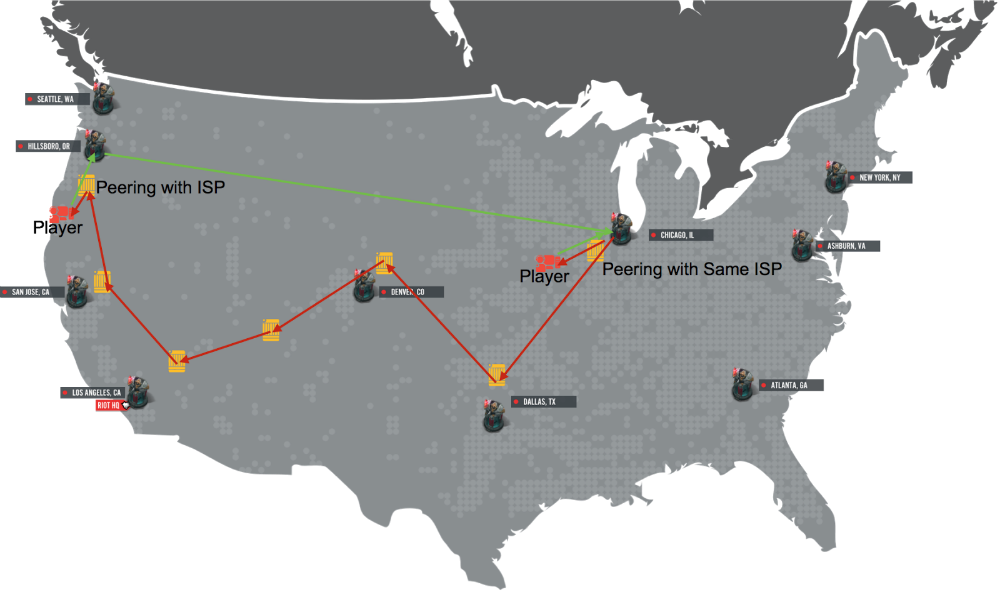
Source: HdM Stuttgart
This infrastructure arms race wasn't limited to financial markets. Netflix built its own content delivery network Open Connect in 2012, choosing a strategy of connecting directly with Internet Service Providers (ISPs), enabling cost savings on bandwidth while improving service quality. Similarly, Riot Games, developer of League of Legends, began building its own internet backbone called Riot Direct in 2014, leasing dedicated fiber optics connecting major cities instead of using the public internet. As a result, Riot Games reduced the average ping for 50% of North American players to under 80ms, fundamentally changing the competitive landscape of esports.
1.2 Onchain Markets are Encountering Public Internet Limitations
The reason for these massive capital investments in dedicated infrastructure is clear. The public internet was designed for universality and reach, but not optimized for extreme performance. Routing protocols designed 30 years ago for email and webpage transmission deliver data on a "best effort" or least-cost basis, accepting packet loss, variable latency (jitter), and unpredictable routing. While sufficient for general web browsing or video streaming, this design has fundamental limitations for financial trading or real-time gaming where milliseconds determine outcomes.
The problems the blockchain ecosystem currently faces from using the public internet can be divided into two main dimensions:
- First is the physical limitations of the public internet itself. Unpredictable jitter causes irregular variations in packet arrival times, destabilizing the consensus process. Routing algorithms that prioritize economics connect nodes regardless of physical distance, creating unnecessary waypoints. Additionally, on the public internet, blockchains must share bandwidth with unrelated data like video streaming or advertising traffic, preventing them from achieving their theoretical maximum performance.
- Second is the fundamental mismatch between blockchain's unique communication paradigm and the existing public internet design. The public internet was designed for the traditional client-server model where one server communicates with many clients. In contrast, blockchain follows a completely different paradigm where thousands of globally distributed nodes exchange data at roughly the same time, all validators must receive identical blocks, transactions, and consensus messages, and each node's role continuously changes according to leader rotation.
This is like driving a Formula One race car on an unpaved road. No matter how much you improve the engine or lighten the chassis, if the road itself isn't suitable for racing, true performance cannot be achieved. In short, blockchain cannot escape the limitations of internet infrastructure designed 30 years ago because the public interent was never designed for high-performance distributed systems. DoubleZero is.
1.3 A Dedicated Network Purpose-Built for High-Performance
So what's the solution?
The most intuitive answer is to build a dedicated blockchain network, like financial companies or gaming companies have done. Building a dedicated blockchain network would allow full bandwidth utilization purely for node-to-node communication without spam or unrelated packets. However, building this from scratch not only costs astronomical amounts but also risks undermining blockchain's fundamental value of decentralization if managed by a single company or consortium.
DoubleZero addresses this through a shared economic model utilizing spare fiber capacity.
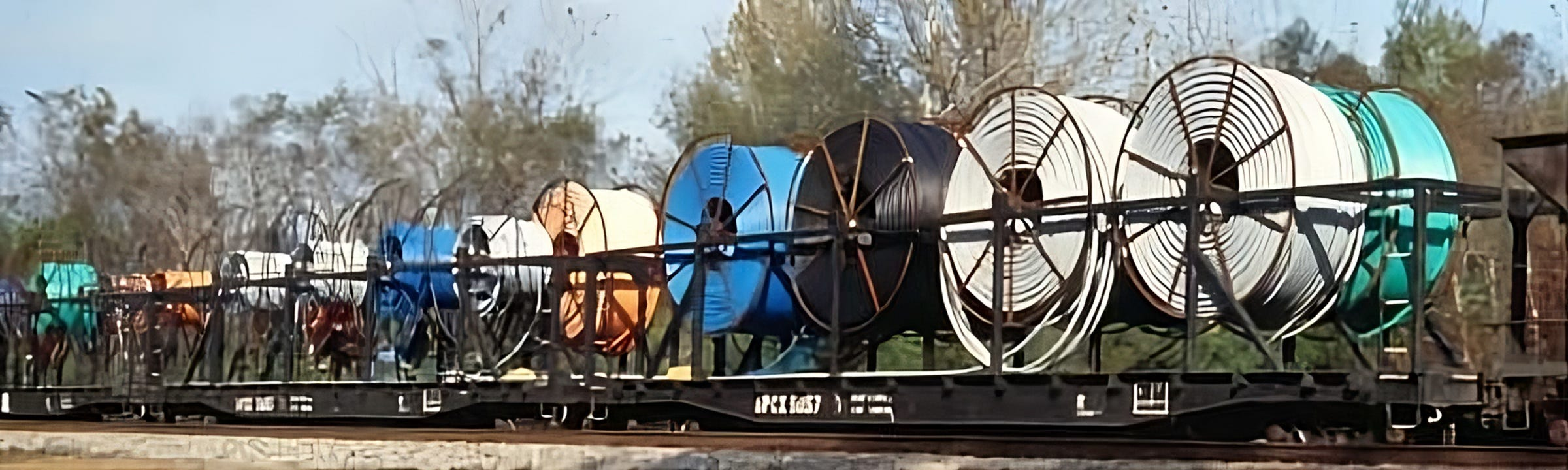
Qwest’s Fiber Optic Cable Housing Trains in 1998. Source: Angelfire
Spare fiber refers to optical fiber that has been installed but is not in use. From the late 1990s to early 2000s, during the dot-com bubble, telecommunications companies competitively built fiber optic networks believing data traffic would grow exponentially. At the time, the amount of data a single fiber strand could transmit was doubling every nine months, and with the emergence of wavelength division multiplexing technology, the capacity of a single fiber increased by up to 100 times.
However, capacity increases from technological advancement paradoxically reduced demand for additional fiber, leading to the tragic bankruptcy of major telecommunications companies like Global Crossing and WorldCom after the dot-com bubble. Looking at Amsterdam's citywide fiber network installation, about 80% of the total cost was labor, with the fiber itself accounting for only 10%. Due to these massive civil engineering costs, telecommunications companies installed far more fiber than immediately needed, which became the origin of today's spare fiber capacity. According to data published by the Federal Communications Commission (FCC) in 2007, only 34% of fiber installed in the United States is utilized, with 66% remaining unused.
DoubleZero utilizes spare fiber for its network, achieving high performance while sharing it in a decentralized manner. The network is designed so that anyone may contribute idle, or spare fiber to generate revenue, while an onchain network protocol dynamically manages network configuration and routing.
In the following sections, we'll examine how DoubleZero specifically designed and built a new, dedicated internet.
2. DoubleZero's Architecture
2.1 Physical Components and Smart Contract-Based Automation System
For DoubleZero's architecture to function as intended, physical infrastructure and logical control systems must be organically combined. DoubleZero has designed three core physical components and a smart contract-based controller for this purpose.
DoubleZero's physical network consists of three core components.
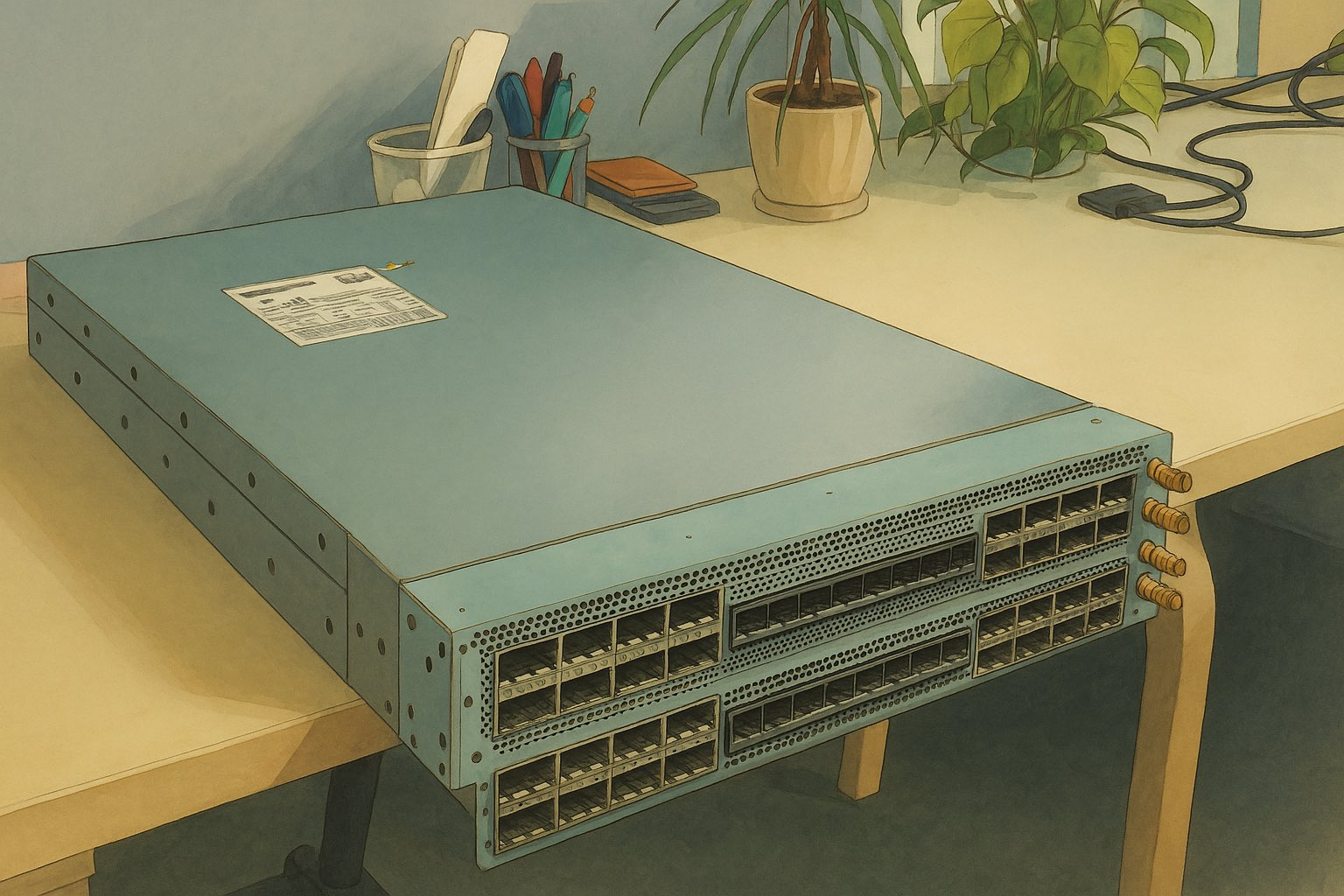
A DoubleZero Device. Source: DoubleZero
The first is DoubleZero Devices (DZD) installed in data centers in each city. DZDs are physical network equipment equipped with FPGAs, serving as switches connecting both ends of fiber optic cables. These devices route traffic according to smart contract instructions.
The second component is fiber links. Spare fiber leased by individuals or companies constitutes DoubleZero’s global network, including both terrestrial and submarine cables. Network contributors connect their fiber to the network and receive compensation in return.
Finally, there are DoubleZero Exchange Points (DZX), central hubs where multiple fiber links meet. DZXs are located in major metropolitan areas to connect fibers, performing a role similar to transfer stations where multiple routes intersect. DZXs are particularly key junction points, where multiple DZDs connect to coordinate traffic flow across the entire network.
The secret to these physical components functioning effectively lies in DoubleZero's unique governance model. The entire DoubleZero network is managed by smart contracts, meaning that an onchain protocol automatically coordinates the network instead of a central control center or single operator. DoubleZero manages network contributors through Service Level Agreements (SLA). For example, if a fiber contributor promises "10Gbps speed and 20ms latency between Seoul and Tokyo," this promise is recorded in a smart contract. The network automatically monitors performance, rewarding promise-keepers and penalizing those who fail.
Routing decisions are likewise automated. Optimal paths are automatically selected based on traffic conditions, and if problems occur on specific links, bypass routes are immediately activated. Pricing also automatically adjusts based on supply and demand, with all transaction records transparently recorded on the blockchain, enabling direct transactions without intermediaries.
2.2 Multicast
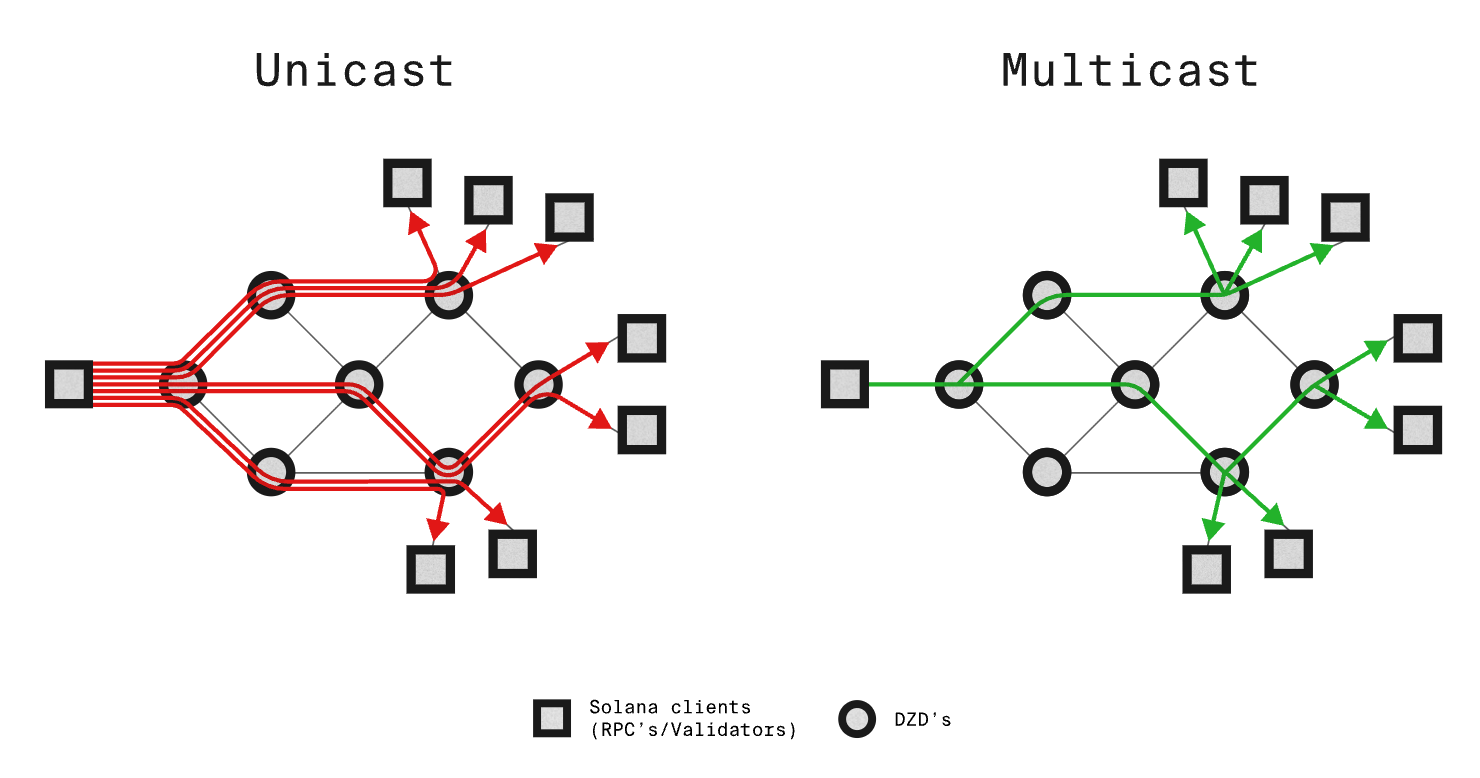
One of the biggest bottlenecks in the blockchain consensus processes is the need to repeatedly transmit the same data to numerous nodes. When a new block is created, it must be delivered to thousands of validators; when consensus votes occur, to all participating nodes; when price information is updated, the same information must be delivered to the entire network. However, individually delivering the same information to everyone creates significant inefficiency.
DoubleZero is the first to apply multicast technology to blockchain networks to solve this problem. Multicast is a technology that efficiently delivers data from a single source to multiple recipients, where a single transmission is automatically replicated by network switches (DZDs in DoubleZero's network) and delivered to all connected nodes at roughly the same time. It is also the same communication technology that has been used for decades in traditional financial trading environments.
Source: DoubleZero
Multicast was generally only possible in private networks controlled by a single entity. In environments where multiple organizations are intertwined like the public internet, sharing information about "who should receive what data" and consistently configuring network devices is much more complex than expected. Despite decades of effort by standardization bodies like IETF, it's still difficult to reliably implement multicast on the public internet. DoubleZero has made multicast generally available in a decentralized environment, specifically in blockchain networks requiring high performance.
DoubleZero 1) defines multicast group properties in the DZ Ledger, 2) allows multicast group owners to define and manage allowed publishers and subscribers in the DZ Ledger, and 3) provides host and network-side configuration for multicast-enabled tunnels.
Multicast shines in all areas involving data propagation, such as block propagation, consensus vote transmission, and real-time sharing of price information or oracle data. The effect is particularly pronounced for Solana, which propagates data through a complex hierarchical structure called the Turbine Tree where each node sequentially forwards to its subordinate nodes. With multicast, all nodes can be reached at once without such complex structures.
DoubleZero Edge is the first application of this multicast capability for onchain market data. DoubleZero Edge introduces the first purpose-built, permissionless platform for onchain market data. At its core is multicast – the same data distribution standard used in finance, now deployed to onchain markets. With multicast distribution, instead of sending the same data repeatedly across independent connections, data is published once and replicated across the network, reducing hops, lowering variance, and accelerating delivery. Validators who publish shreds into the network are able to monetize data they already produce, creating a new revenue stream tied directly to network participation. Traders subscribe per epoch to data feeds through a permissionless, validator-aligned subscription model. Access to Solana Shreds on DoubleZero Edge may be purchased at fastshreds.com. Additional feeds are expected to follow.
3. DoubleZero's Token Economy
3.1 The 2Z Token
DoubleZero has implemented a dedicated network for blockchain, including smart contract-based configuration, and multicast technology. However, no matter how innovative the technology, it cannot function without a sustainable economic model, and DoubleZero has designed one of the most unique and innovative token economies and incentive structures for this purpose.
DoubleZero has two different roles.
First are network contributors who provide spare fiber and operate filtering and routing services. Network contributors are rewarded in proportion to how useful their links are, as a combination of latency, bandwidth, and destinations.
Second are publishers, e.g. Solana validators. These send data over DoubleZero, and are rewarded in proportion to how valuable their data is to the end readers, e.g. how often they publish, how fast they publish, etc. In some cases, the client developers who help build the software to publish data are also rewarded.
3.2 Sustainable Fee Mechanism
Source: DoubleZero
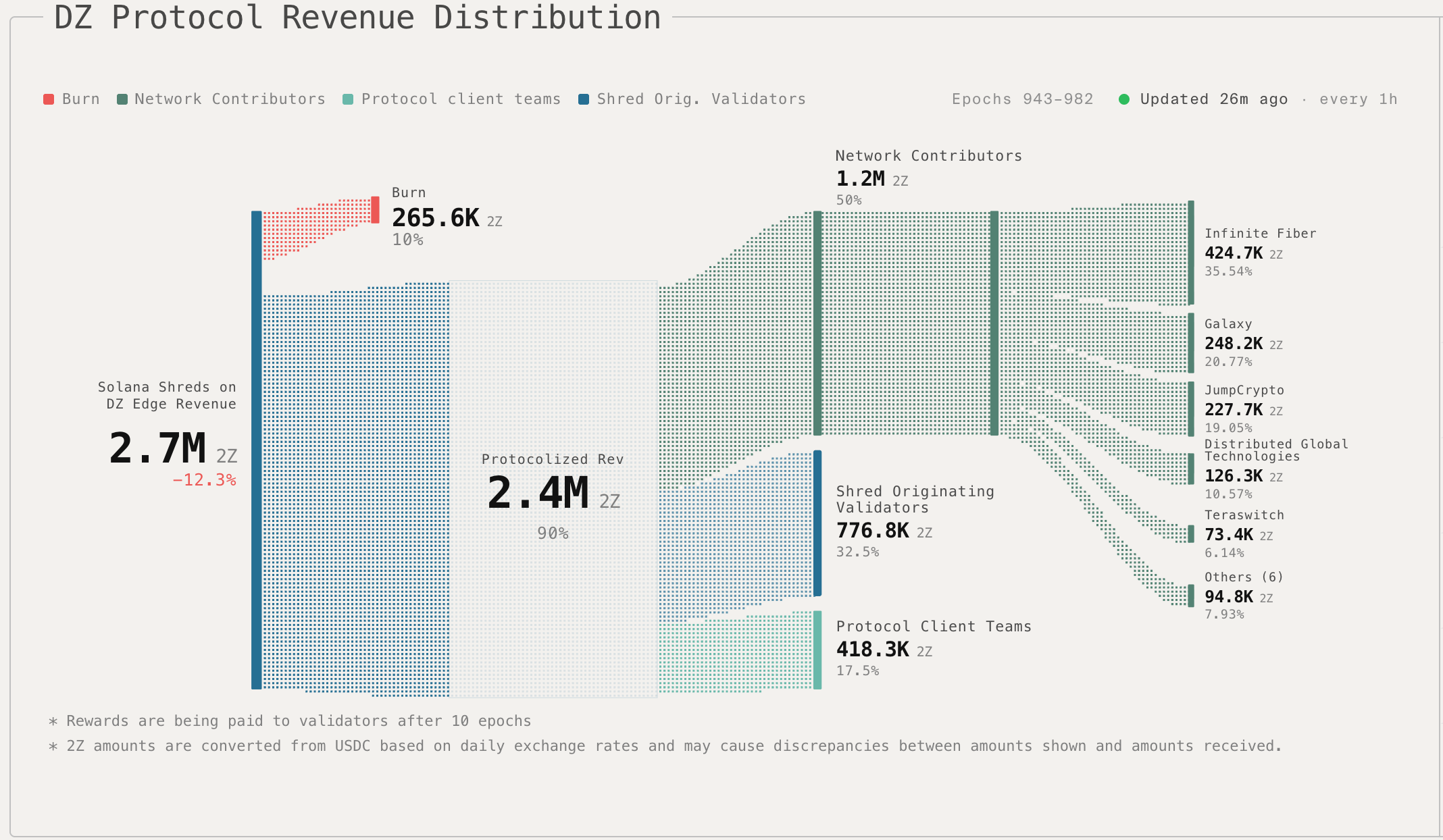
DoubleZero's fee structure achieves both economic sustainability and network security through a unique burn mechanism. Fees distribute programmatically: in the case of Solana, 50% to network contributors, 32.5% to producers, and 17.5% to validator client development teams after applying the security-based protocol burn.
For Solana validators, DoubleZero charges readers of the shred data to consume that data. In an earlier iteration, DoubleZero charged 5% of priority fees.
Some portion of these fees are burned, and the rest are distributed onwards. This partial burn model ensures long-term token value stability while maintaining economic integrity by removing unfair rewards generated from spam or malicious traffic from the network.
3.3 Performance-Based Reward System
DoubleZero applies a mathematical methodology from game theory called the Shapley Value model when distributing rewards to network contributors. This is to reward each party exactly according to their contribution to overall performance.
3.3.1 What is the Shapley Value?
To understand the Shapley value, let's use a simple example. There's a treasure chest containing $1000, and two keys, a and b, are needed to open it. Three adventurers each have the following keys:
- Alice: key a
- Bob: key b
- Charlie: keys a and b
How should they fairly divide the treasure?
At first glance, it might seem Charlie should take all the rewards since he has both keys. However, since Alice and Bob can also open the chest by cooperating, Charlie taking all the rewards would be unfair.
The Shapley value calculates each participant's contribution when participating in all possible combinations, then takes the average. That is:
- If Alice comes first and waits, then Bob joins? They can open the chest together.
- If Bob comes first and waits, then Charlie joins? They can also open the chest.
- Consider all possible orders and combinations to calculate each person's contribution.
Calculating rewards through the Shapley value, Alice and Bob each receive $167, while Charlie receives $667. Charlie receives more but doesn't monopolize everything, achieving a balanced distribution.
3.3.2 How Contribution Rewards are Calculated in DoubleZero
DoubleZero applies these cooperative game theory principles to reward distribution for network contributors. Simply rewarding proportionally to the amount of data transmitted can lead to behaviors that don't actually help improve speed. Examples include connecting additional fiber to routes that already have sufficient fiber to split traffic, or intentionally inserting dummy data to increase transmission volume.
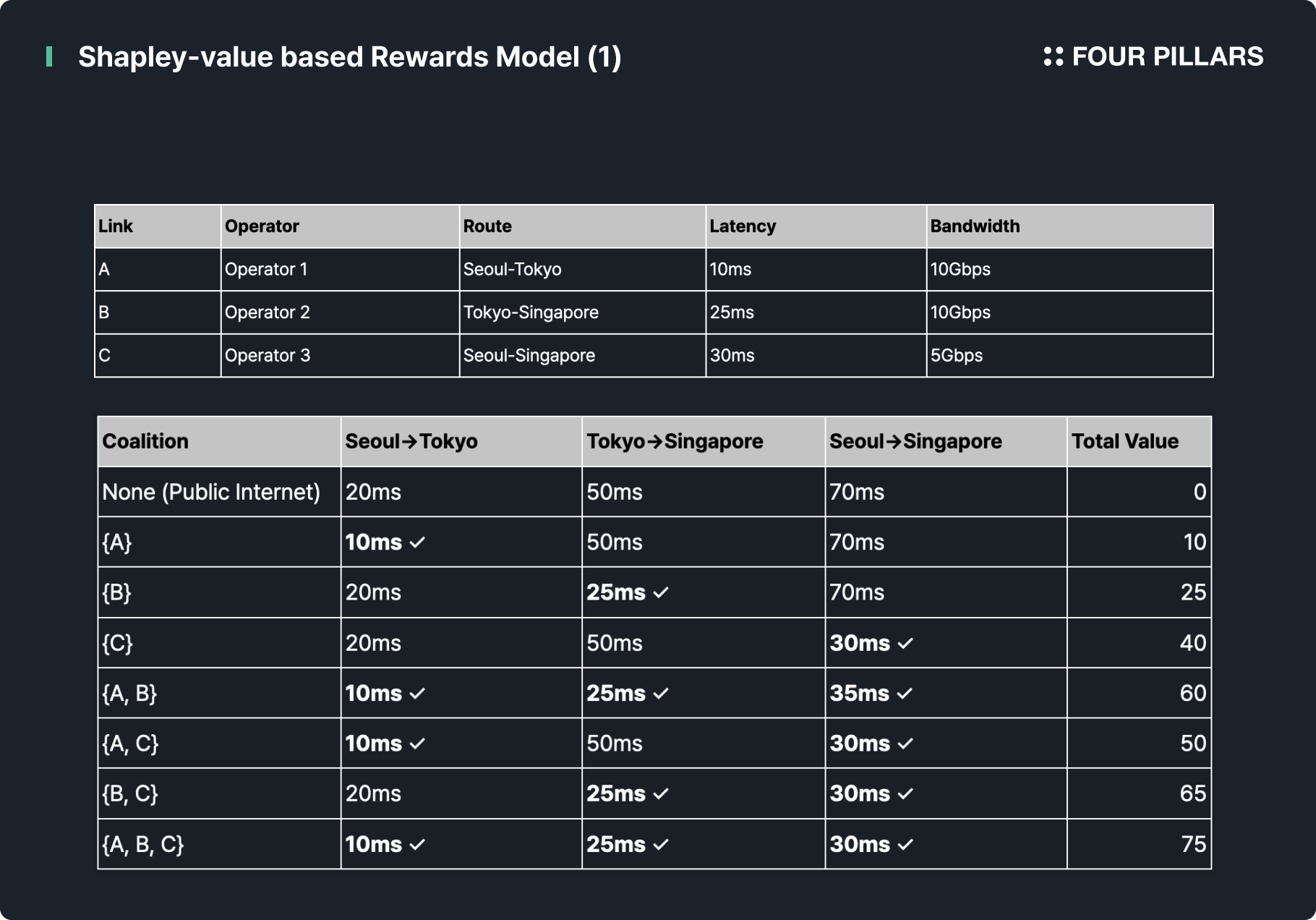
DoubleZero's Shapley value model calculates each link's actual performance contribution to accurately distinguish which links resolve bottlenecks and improve stability versus which are merely decorative and unused. Let's briefly look at DoubleZero's contribution reward calculation method through an example.
Step 1: Evaluate All Combinations
DoubleZero evaluates all possible combinations of network contributors. For example, if there are fibers connecting Seoul-Tokyo, Seoul-Singapore, and Tokyo-Singapore, it compares overall network performance with and without each link.
Step 2: Measure Improvement Over Public Internet
Then, it measures how much performance actually improved compared to the public internet in each combination. Taking the Seoul-Tokyo route as an example:
- Public internet: Seoul-Tokyo 20ms
- With Link A added: 10ms (10ms improvement)
- With Link B added: 20ms (0ms improvement)
- With Links A+B together: 10ms (10ms improvement)
Step 3: Calculate Marginal Contribution
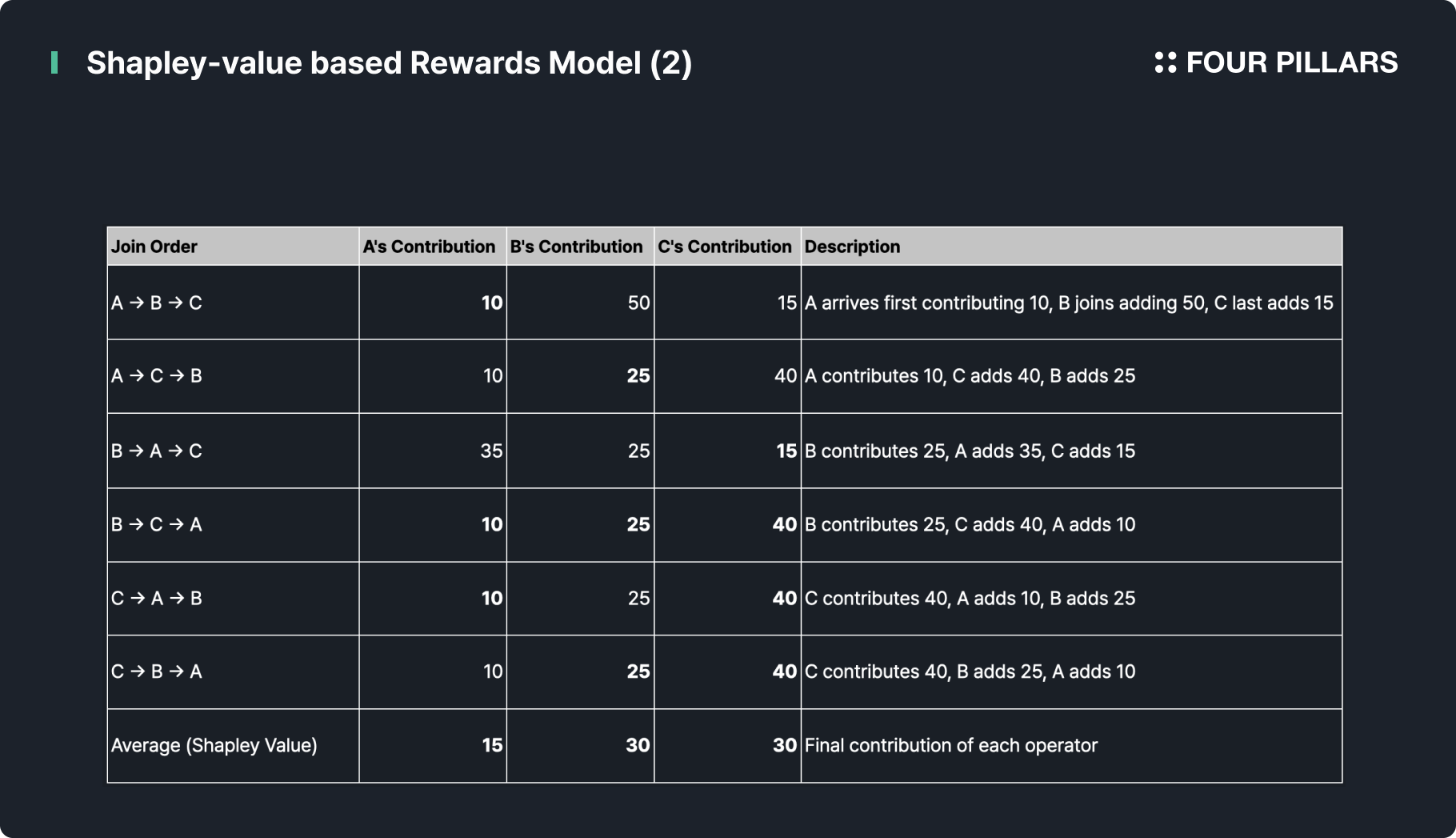
Calculate the additional value created (marginal contribution) when each contributor participates in a specific coalition for all possible orders and take the average. If synergy effects occur due to combinations of links, this synergy is also divided fairly. Each link's contribution is calculated as a Shapley value, and final rewards are distributed based on the Shapley value.
Using the example from the table above, let's discuss whether Shapley value-based distribution was fair:
- First, Link A (Seoul-Tokyo) only improves performance for the shortest segment but significantly improves the Seoul-Singapore route when combined with other links. Therefore, it receives 20% of the rewards.
- Link B (Tokyo-Singapore) greatly improves the longest segment (25ms reduction) and creates strong synergy when combined with A. The 40% reward allocated to Link B seems appropriate.
- Link C (Seoul-Singapore) shows the greatest performance improvement standalone among routes to Seoul-Singapore. It also showed good synergy in combination with other links, so it's evaluated as having high contribution at 40%.
If calculated simply by traffic volume, Link C with small bandwidth would have been disadvantaged. However, through the Shapley value, C's strategic value can be recognized by accurately measuring contribution to actual network performance improvement.
DoubleZero's Shapley value-based reward system has significance beyond a simple mathematical formula. It's proof that fair rewards based on market principles are possible even in decentralized networks. Since each contributor is rewarded exactly according to the actual value they create, they have strong incentives to improve overall network performance.
This approach has the disadvantage that computational complexity increases exponentially with the number of contributors, and contributors may find it harder to understand their earnings compared to simple bandwidth-based rewards, but this is one of DoubleZero's designed efforts to align contributors' actual value creation with rewards.
4. Real Performance: Solana Validator Performance Improvements
Source: DoubleZero, data as of 2026.07.16
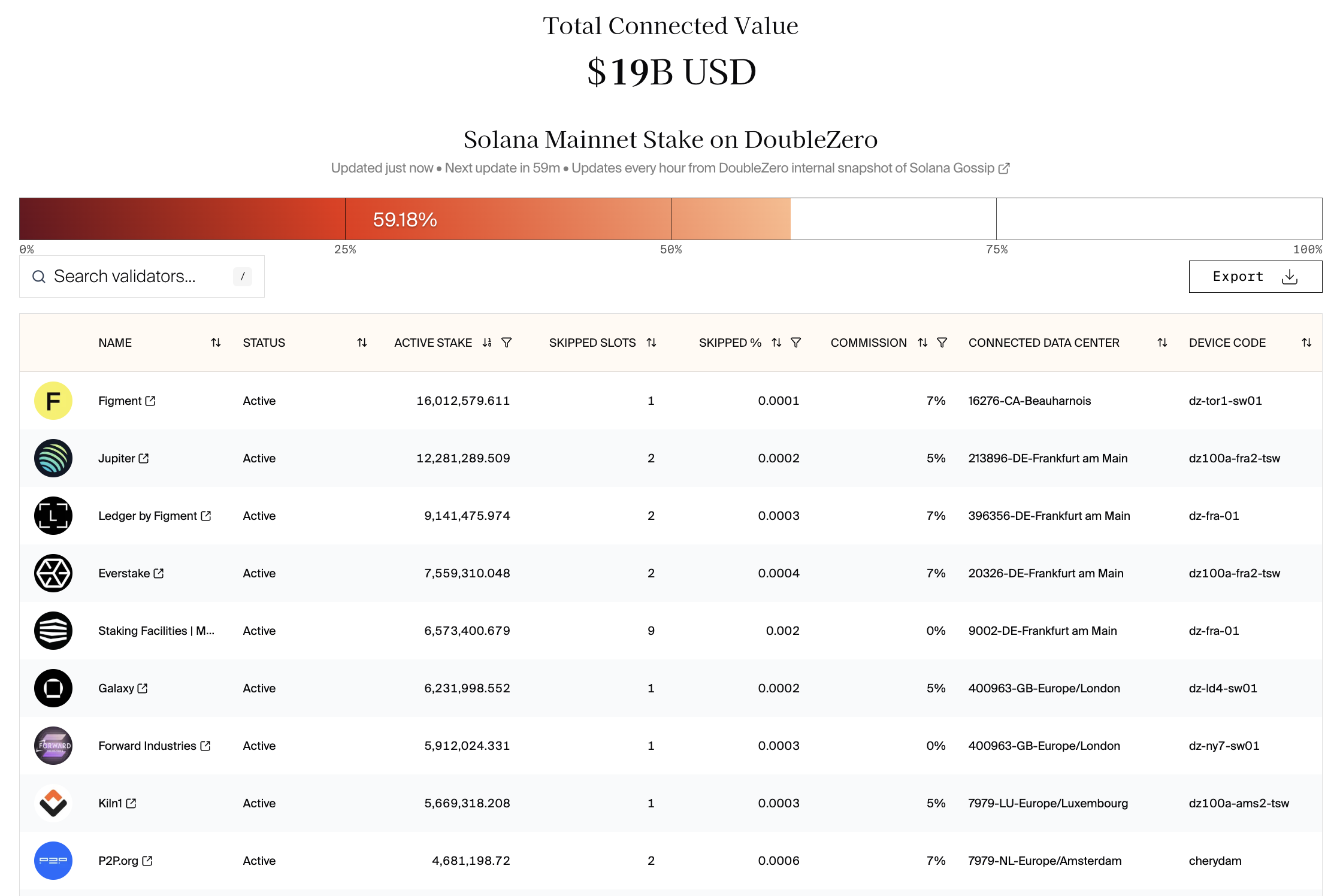
DoubleZero quickly integrated with the Solana ecosystem with its mainnet beta launch, connecting 467 validators with 59.17% of staked SOL in total to the DoubleZero Network. As of July 15, 2026, the Total Connected Value (TCV) of validators connected to DoubleZero is +19B USD, with major Solana network validators achieving improved consensus performance through the DoubleZero network.
DoubleZero links are faster than their public internet counterparts by an average of 24.2%, which translates directly into faster shred propagation, especially over long cross-continental routes. The DoubleZero Edge Scoreboard is a live, public measurement tool that tracks shred delivery across every DoubleZero node in real time, comparing Edge against existing public-internet delivery paths, including Jito ShredStream and native propagation. Every slot and city are updated continuously. On average, Solana leader shreds published via DoubleZero Edge reach traders ~12 milliseconds faster than with other shred distribution services. During periods of high block congestion or degraded network conditions, DoubleZero Edge becomes critical infrastructure, delivering shreds up to 20+ milliseconds faster in Europe, 80+ milliseconds faster in the U.S., and over 100 milliseconds faster in Asia. View live performance data at data.malbeclabs.com/dz/edge/scoreboard.
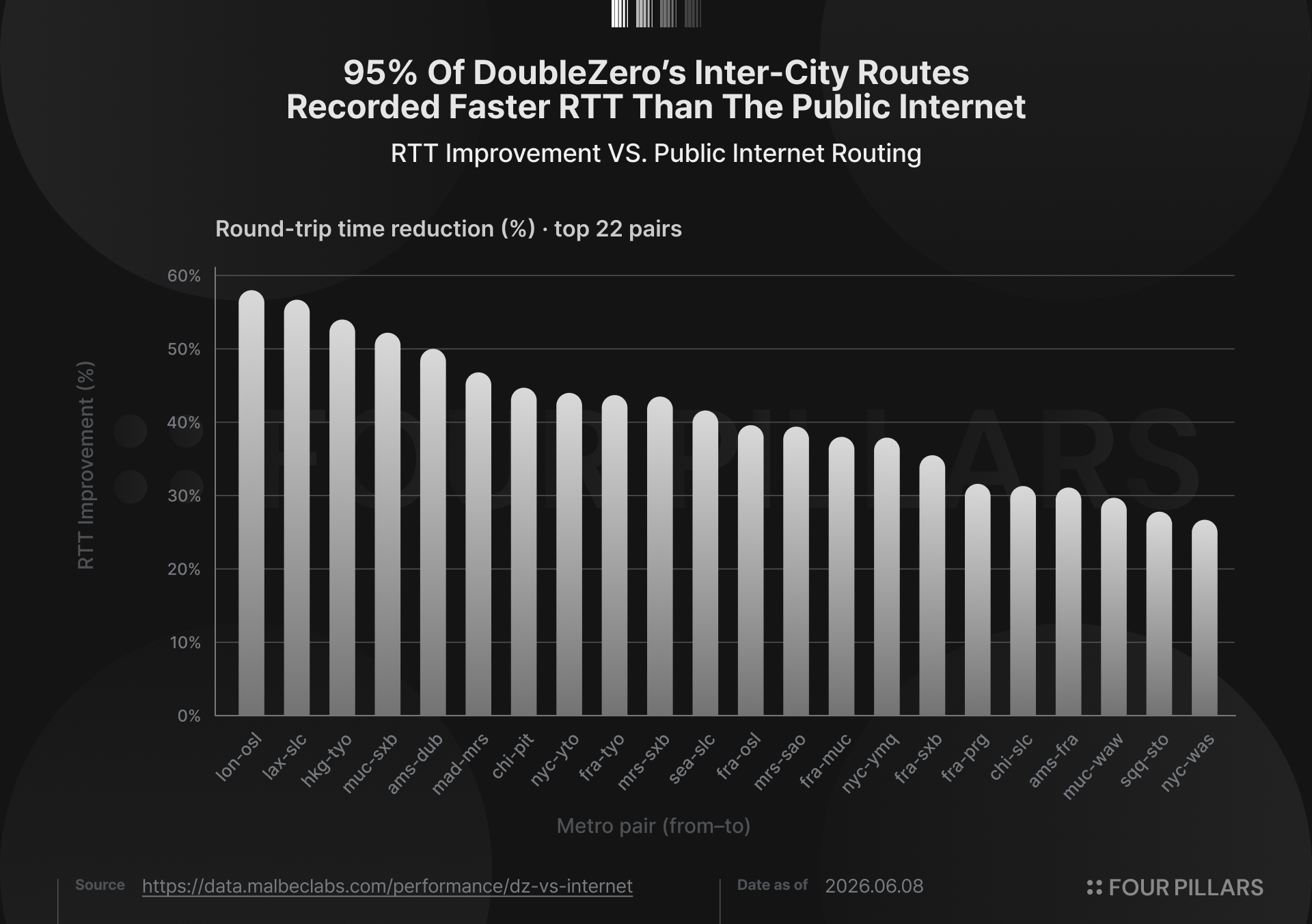
According to DoubleZero's live performance data (as of July 16, 2026), roughly 97% (64 of 66) of the measured inter-city routes recorded faster RTT than the public internet, with the average latency improvement over the public internet reaching about 23.6% and a maximum of around 78.1%.
Communication between validators connected to DoubleZero and those not connected still must partially pass through the public internet. While the DoubleZero network provides optimized paths through dedicated fiber between connected validators, communication with unconnected validators must go back out to the public internet through the DoubleZero network. Ultimately, for the entire Solana network to achieve performance improvements, the adoption rate of the DoubleZero network by validators must gradually increase.
5. Looking Forward: Perps, Prediction Markets, Agentic Trading
DoubleZero's vision extends beyond Solana to other blockchains like Hyperliquid and new financial systems like prediction markets. DoubleZero has already conducted a token sale on CoinList targeting validators/operators from other networks including Sui, Aptos, Avalanche, and Celestia, receiving over 900 expressions of interest. As high-performance blockchains that must process large amounts of data in real-time become a hot topic, the market size where DoubleZero can contribute is expected to grow over time.
DoubleZero plans to expand its scope not only to blockchain but also to prediction market data, accelerating agentic trading, and even gaming in the future. Gaming servers are as latency-sensitive as blockchain, and relatively small companies will be able to use high-cost services like the private internet network built by Riot Games, providing competitive advantages. In the case of distributed AI, bandwidth issues often arise during training processes and agentic trading, and DoubleZero's high-bandwidth connections between data centers can accelerate model snapshot transmission. This could provide an efficient training environment for distributed AI where GPU resources are geographically dispersed.
DoubleZero is leading a paradigm shift in blockchain infrastructure. By acknowledging the limitations of public internet and building a new dedicated transport layer optimized for distributed systems, it's solving the age-old tradeoff between performance and decentralization.
Finance invested $300 million to save 3 milliseconds. Blockchain has entered the same era. DoubleZero is a protocol that enables a global fiber network for high-performance distributed systems. Powered by independent fiber contributors and coordinated by a blockchain-based protocol, DoubleZero delivers low-latency networking and real-time data infrastructure for blockchains and other systems where milliseconds matter. That infrastructure is available today, to anyone, anywhere.
Under the simple yet powerful principle of "New Finance," DoubleZero provides a neutral, high-performance foundation on which next-generation distributed systems can be built. Finance has had purpose-built market data distribution networks for decades. Crypto has not. That changes with DoubleZero. That infrastructure is live today on DoubleZero Edge – the first purpose-built, permissionless platform for onchain market data, delivering raw Solana shreds to traders via multicast across 30+ metros. In a world where milliseconds are worth millions of dollars, DoubleZero democratically provides those milliseconds to everyone. This is the new internet that blockchain and other high-performance systems needed and has finally obtained.
The report is based on the independent research of the author sponsored/funded by Malbec Labs. The author of this report may have personal holdings or financial interests in assets or tokens discussed herein. However, the author affirms that no transactions have conducted using material non-public information obtained in the course of research or drafting. This report is intended solely for general information purposes and does not constitute legal, business, investment, or tax advice. It should not be used as a basis for making any investment decisions or as guidance for accounting, legal, or tax matters. Any references to specific assets or securities are made for informational purposes only and should not be construed as an offer, solicitation, or recommendation to invest. The opinions expressed herein are those of the author and may not reflect the views of any affiliated institutions, organizations, or individuals. The opinions and analyses expressed herein are subject to change without prior notice. In addition, beyond the individual disclosures included in each report, Four Pillars, may hold existing or prospective investments in some of the assets or protocols discussed herein. Furthermore, FP Validated, a division of Four Pillars, may already be operating as a node in certain networks or protocols discussed herein or may do so in the future. Please see below links in the footer for FP Validated's participating network disclosures and for broader disclosure details.


