


Table of Contents
- Key Takeaways
- 0. Introduction: Why Lido, Again
- 1. Lido from Its Beginning to Today
- 1.1 The Founding Context and the Birth of Liquid Staking
- 1.2 Rapid Growth Before the Merge and the Multichain Expansion Attempt
- 1.3 After Shapella: Lido V2
- 1.4 Establishing Lido's Identity: Focusing on Ethereum
- 1.5 The Era of V3, Earn, and Institutional Products
- 2. How Lido Works: Protocol and Infrastructure
- 2.1 The ETH Staker Flow in Lido
- 2.2 Node Operators and Withdrawal
- 2.3 The Lido Oracle System
- 2.4 The Staking Router
- 2.5 The Curated Module
- 2.6 The Simple DVT Module
- 2.7 The Community Staking Module
- 2.8 Changes to the Lido Core After Pectra
- 3. What Lido Offers: New Product Lines
- 3.1 Lido V3 and stVaults: Customized Staking on Shared Liquidity
- 3.2 Lido Earn: Product Expansion Beyond Staking
- 4. Who Owns and Operates Lido: Discourse, Governance, and Token
- 4.1 Is Lido Moving Toward Credibly Neutral Infrastructure
- 4.2 The Lido Governance Framework
- 4.3 The Economic Structure of the LDO Token
- 4.4 The Five-Year Journey and Its Lessons
- 5. Lido's Next Stage
- 5.1 The Competitive Landscape of the Ethereum Staking Market
- 5.2 GOOSE-3
- 5.3 Institutional Staking and Regulated Products
- 5.4 Ethereum's Changes and Lido
- 6. Closing


Key Takeaways
- Understanding Lido lets you understand the changes in the Ethereum staking market and DeFi infrastructure. This article covers how Lido popularized liquid staking by solving the high barrier to entry and the liquidity problem of early Ethereum staking, and how a protocol once criticized as a symbol of centralization risk is evolving into core staking infrastructure aligned with Ethereum's direction of decentralization.
- Lido's history runs alongside the process by which the Ethereum staking market matured through experiment and crisis. Having grown by solving the early user experience problems, Lido went through several risks and learned from them, evolving into more sophisticated staking infrastructure.
- Although Lido protocol's market share has declined significantly since its 2023 peak, its staked ETH has remained relatively resilient, staying near historical highs. This means not so much a weakening of Lido's competitiveness as the rapid maturing of the Ethereum staking market. The differentiation of the staking service itself is leveling off, and today's staking market is no longer a simple competition over share among protocols. It should be seen as a market differentiated by target user segment. Lido too is now expanding from a single liquid staking product into a platform on which various staking demands can sit.
- Lido protocol's decentralization is not a finished state but a process of continually coordinating different trust models and interests. Lido has gradually differentiated its modules, governance, and operating entities, distributing power and accountability more widely.
- Lido's next task is to be redefined as institutional onchain/DeFi infrastructure suited to a changing Ethereum era. As market demand and Ethereum itself change rapidly, Lido's future depends on how safely it can absorb and productize the market's changes. This is why Lido is worth looking at again now. Tracing Lido's history and changes lets you understand, in compressed form, how Ethereum financial infrastructure has been productized, and gauge what form the next standard, demanded by the new institution-centric crypto demand, will take.
0. Introduction: Why Lido, Again
Understanding Lido tells you a great deal about the Ethereum staking market. Lido is the most important protocol on Ethereum. It was the single biggest force in bringing Ethereum staking to a mainstream audience, and it is the foundation of Ethereum's DeFi money lego.
Around 2022, when Lido's market share crossed 30%, the framing that came up most often inside and outside the Ethereum community was that "Lido is the enemy of Ethereum decentralization." In that period, whenever Ethereum's PoS (Proof of Stake) mechanism came under attack on decentralization grounds, Lido was named alongside it and treated as if it were the enemy of decentralization.
As of 2026, though, Lido has become a key driver of the decentralization of the Ethereum staking and validator network. It institutionalized DVT (Distributed Validator Technology) at the protocol level, built an ecosystem with hundreds of participating node operators, and through the CSM (Community Staking Module) opened a path for anyone to participate permissionlessly as an Ethereum operator with a small amount of capital.
Lido is evolving along two axes. The first is functional evolution: the process by which a protocol once criticized as a centralizing factor in Ethereum was able to position itself as a leader in decentralization through specific design choices and institutional mechanisms. This is not a claim that Lido has fully solved its centralization risk. What deserves attention is how Lido has worked through that centralized risk and changed its character.
The second axis is the evolution of its target users. Lido started by reinventing the staking UX for retail users. It solved the staker UX problems of early Ethereum: that you could only participate in staking in units of 32 ETH, that staked Ethereum could not be used, and that the absence of protocol-level delegation forced stakers to run nodes themselves. Today Lido is expanding from a service for retail users into a staking platform for institutions.
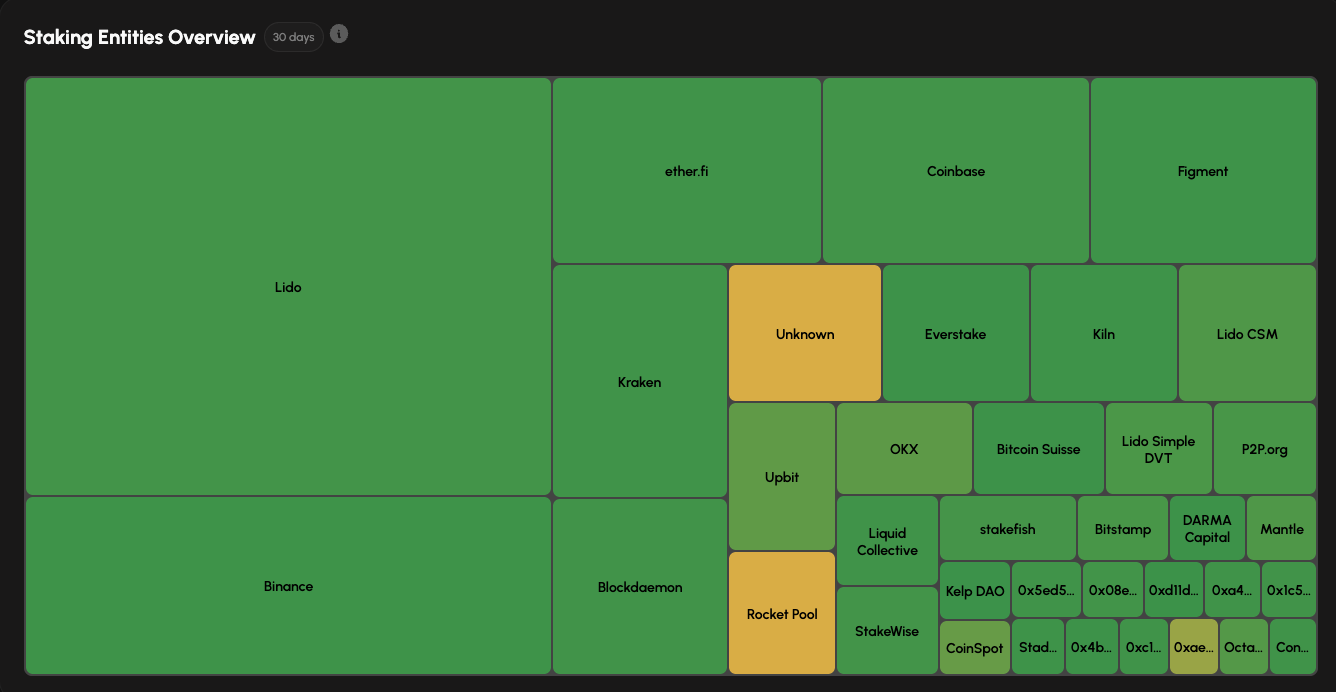
Lido's share, which once operated 33% of all staking on the Ethereum network, has come down to the low 20% range as of 2026. On the surface, this decline looks like a crisis for Lido. But the shift is closer to a signal that the Ethereum staking market is maturing.
Lido's recent sharp drop in share is tied to the direct staking entry of large institutional players such as BitMine and staking ETFs. Large institutions began running validators directly rather than going through an LST like Lido, while exchange-based staking products and LRT (Liquid Restaking Token) protocols are absorbing different user segments. In other words, Lido's declining share shows that the Ethereum staking market and its users have entered a stage where demand is no longer met through a single channel. Lido's relative share has fallen, but the range of problems it addresses has actually widened.
Source: beaconcha.in
Today's crypto market is changing faster than ever. In this market, where regulation is opening up and institutions are entering, the dominant infrastructure is still Ethereum. Against this backdrop, examining the changes at Lido, which anchors a major part of Ethereum infrastructure and DeFi, carries more weight than simply checking the success or failure of one project. Lido's changes are bound up with the changes in DeFi and the Ethereum staking market as a whole. Understanding Lido lets you understand the foundation of the DeFi market and the structure of the Ethereum staking market.
This article examines Lido along five axes: its history, its protocol and infrastructure, its products, its governance, and its future.
1. Lido from Its Beginning to Today
1.1 The Founding Context and the Birth of Liquid Staking
1.1.1 Ethereum Around the Merge
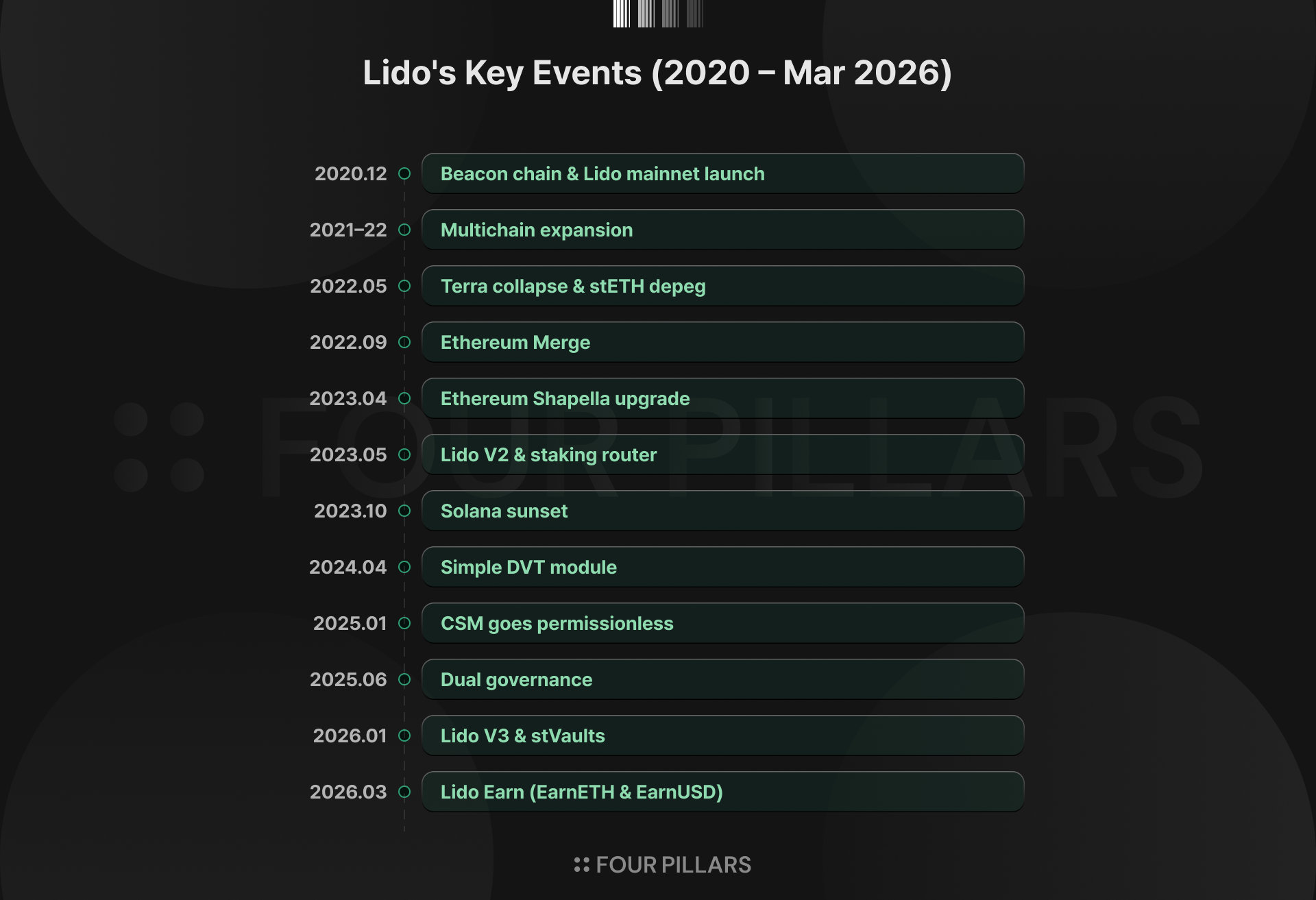
To understand the context in which Lido appeared, you have to go back to before the end of 2020. At the time, Ethereum was not yet a PoS network. Ethereum mainnet ran on PoW (Proof of Work), and it had begun a gradual transition to PoS through a separate chain called the Beacon Chain. The Beacon Chain launched on December 1, 2020, and ran in parallel with Ethereum's PoW mainnet for about a year and ten months. Then, on September 15, 2022, the Merge update combined the Beacon Chain with the existing Ethereum mainnet, and Ethereum transitioned fully to a PoS-based blockchain network.
The arrival of the Beacon Chain was an important turning point in Ethereum's history. After its launch, users could deposit ETH to join the PoS validator set, and after the Merge this structure became Ethereum mainnet's consensus mechanism. But the staking structure was not friendly to ordinary users. To stake on Ethereum and earn rewards, you had to deposit at least 32 ETH and run a validator node yourself. A validator node stores network data, processes transactions, and participates in producing new blocks. This imposed a high capital and technical barrier to entry for ordinary users.
In addition, withdrawals of staked assets were not implemented in the early days of the Beacon Chain. Staked ETH could not be freely withdrawn, and users who deposited ETH had to lock up their assets until a future upgrade. A user had to stake a large unit of capital, 32 ETH, take on validator operation risk directly, and give up liquidity at the same time. These three conditions were the structural reason Ethereum staking was hard to bring mainstream.
Ethereum also does not provide protocol-level native delegation, unlike chains that follow a DPoS (Delegated Proof of Stake) model. A structure where a user delegates stake to a specific validator within the protocol is not part of the base design. Ethereum wanted a decentralized validator set, but its early staking UX was a structure only a fairly limited set of users could access.
These problems are the context in which liquid staking appeared. Liquid staking lets users participate in staking rewards without running a validator themselves, and it goes a step further by tokenizing the staking position to provide liquidity for the staked asset. Liquid staking emerged to solve the limitations of early Ethereum staking within a single product.
1.1.2 Lido's First Product: A Liquid Staking Platform
Lido's first product, a liquid staking platform, is simple. A user deposits native ETH and receives stETH tokens in receipt. stETH is a token that represents 1:1 ownership of the user's staked ETH. When a user deposits ETH, a corresponding amount of stETH is minted, and stETH automatically reflects staking rewards or penalties in the holder's wallet (rebasing). At the same time, stETH is a liquid token usable across DeFi and the Ethereum ecosystem.
Lido's liquid staking service mattered because it turned staking into a token interface, and the benefit this product offered was a powerful force in the staking market. Users no longer had to run a validator themselves, operate a client, manage keys, watch uptime, and bear slashing risk individually. Users could also participate in staking through Lido with less than 32 ETH, and they could keep the liquidity of their staking position by using stETH. The actual staked ETH is locked, but the user can put that position to work elsewhere through stETH. In this sense, stETH was not a simple proof token but an interface connecting Ethereum staking and DeFi. stETH was later integrated into a range of DeFi protocols such as Curve, Aave, MakerDAO, and Pendle, becoming a core asset of the DeFi money lego. For the user, Lido is a simple experience of putting in ETH and receiving stETH, but behind it, professional node operators selected by the DAO handle the actual validator operations.
Lido mainnet went live on December 18, 2020, almost the same time the Beacon Chain went live. The moment Ethereum took its first step toward PoS, a protocol set out at the same time to fill the user-experience gap that transition would create. The timing of Lido's launch carried real significance for the evolution of the Ethereum ecosystem.
1.1.3 The Early DAO and Contributor Structure
Lido started as a DAO rather than a single company from the beginning. Among the people central to Lido's start are Konstantin Lomashuk, Vasiliy Shapovalov, and Jordan Fish. Lomashuk and Shapovalov came from a node operator background, having run a non-custodial staking service called P2P (P2P Validator) since 2018. As of 2020, P2P was already a professional infrastructure operator running validators on several PoS chains. Jordan Fish, known in the crypto community as "Cobie," left the Lido team around 2021, and Lido's operations evolved into a structure driven jointly by a contributor group centered on P2P alumni and a gradually expanding DAO community.
Lido's early fundraising was deeply tied to key figures in the DeFi ecosystem of the time. Lido’s early financing is better understood as a series of treasury allocations to strategic backers rather than traditional equity rounds. In December 2020, the DAO allocated roughly $2 million worth of LDO to early contributors, followed by a $73 million treasury sale led by Paradigm in May 2021 and a $70 million treasury sale to a16z in March 2022. The early investment brought together a range of crypto-focused funds and DeFi builders. This shows that Lido intended from the start not simply to launch a single staking protocol but to position itself as infrastructure that would integrate with the entire DeFi ecosystem.
In a January 2021 post introducing LDO, Lido explained that it built its Ethereum staking protocol as a DAO "to maintain decentralized infrastructure while preserving upgradability and stability." The Lido DAO decides the core parameters of the liquid staking protocol, leads network upgrades, and manages the growth of the Lido community.
Of course, it is hard to say the early Lido DAO was fully decentralized. One billion LDO tokens were issued when the DAO launched, and the founding members held a substantial share of them at the time. The product Lido shipped aimed at being a DAO, but in practice its actual operations and decision-making had to rely heavily on the early contributors and early investors. This became the seed of the centralization debate that would surround Lido.
Beyond that, while Lido offered users a decentralized staking service, trust assumptions existed across several dimensions: node operator selection, governance token distribution, and withdrawal key management. Lido's early withdrawal key generation was in fact carried out through a separate ceremony held from December 13 to 16, 2020. This shows the structure of the time was closer to an early-stage protocol that still had to pursue decentralization gradually than to a fully trustless system.
Lido is an innovative protocol that opened Ethereum staking to a broader public. But it also started out, despite being a DAO, carrying a number of trust assumptions and a centralized governance structure. The Lido that follows develops as a process of narrowing the gap between these two tensions. It began by giving retail users a simple staking UX, but over time Lido has evolved into staking infrastructure with more and increasingly permissionless node operators, more distributed validator operations, and a more sophisticated governance layer.
1.2 Rapid Growth Before the Merge and the Multichain Expansion Attempt
1.2.1 stETH's DeFi Integration
Lido's rapid growth was not simply because it made staking easy. The core of that growth was that stETH, the liquid staking token, became an asset usable within the Ethereum DeFi ecosystem. Right after launch, Lido's focus was to make stETH an asset that actually got used. Held idle, stETH simply sits in the wallet as a claim on staked ETH. Once deployed across DeFi, it becomes a productive asset that functions as a working form of staked ETH. stETH reflects staking rewards and at the same time was quickly integrated so it could serve as collateral, liquidity, and a building block for yield strategies across various DeFi protocols.
ETH deposited into the Beacon Chain was locked until withdrawals were implemented via the Shapella hard fork in April 2023. For Lido, securing enough liquidity for stETH to trade as close to ETH as possible was therefore a make-or-break factor for the product. The Curve stETH/ETH pool played the most important role in this. From January 2021, Lido provided a guide for supplying stETH liquidity through Curve and ran the pool as a venue where users could swap stETH and ETH with low slippage. stETH later expanded to other DeFi protocols such as 1inch and Uniswap.
Integrations that let stETH be used as collateral on Aave and MakerDAO also moved forward. In 2022, stETH was formally listed as a collateral asset on Aave V2, and Aave V3, launched the same year, integrated wstETH (wrapped stETH) in earnest. As discussed later, the rebasing token stETH was hard to make compatible with some DeFi protocols due to its contract structure, so Lido created a wrapping token, wstETH, whose balance does not change and whose value instead changes in proportion to staking rewards. wstETH became one of the largest collateral assets on Aave V3, and users began using a loop staking strategy: borrowing ETH against wstETH collateral and re-staking that ETH on Lido to receive stETH.
The ability to pursue two returns at once with the same capital, staking yield and additional DeFi yield, was a strong incentive for ETH holders, and Lido became the foundation of Ethereum's DeFi money lego.
1.2.2 Merge Anticipation and Lido's Rapid Growth
2021 and 2022 were a period when anticipation for Ethereum's PoS transition peaked. The Beacon Chain and Ethereum staking were already operating, and right up to the Merge hard fork that fully transitioned Ethereum mainnet to PoS, the market saw Lido as "the most direct way to invest in Ethereum's PoS transition." As the Merge approached, ETH holders' staking demand grew, and Lido was the largest absorber of that demand. Having simplified Ethereum's complex staking structure, Lido was the simplest option for users.
In January 2021, Lido's total deposited ETH was around 76,000 ETH, but a month later, in February 2021, it crossed 180,000 ETH, growing 136% in a single month. From this point, Lido began to establish itself as effectively the single dominant protocol in the Ethereum liquid staking market. By 2022, Lido's staking share entered the 30% range, and concerns began to be raised in earnest that a single entity could cross the 33% stake threshold at which it could temporarily affect Ethereum's finality.
Lido's growth meant more than TVL growth. Once Ethereum transitioned to PoS, the amount of ETH staked by a single protocol or node operator could have an influence over network consensus. So the more staking share Lido absorbed, the more it became both the base protocol of the DeFi money lego and infrastructure that affects Ethereum's consensus layer.
1.2.3 Multichain Expansion: Terra, Solana, Polygon, and Kusama
Lido did not stay only on Ethereum. From 2021 to early 2022, Lido treated liquid staking as a general category and tried to expand to several PoS chains. In this period, Lido aimed to be a multichain liquid staking protocol rather than an Ethereum liquid staking protocol. Over roughly a year after launch, Lido shipped liquid staking on several PoS chains including Terra, Solana, Polygon, and Kusama, and each attempt was led by an external contributor team within the Lido DAO's LEGO (Lido Ecosystem Grants Organisation) framework.
Lido on Terra was the first to launch. bLUNA launched on the Terra network in early 2021, structured so that when a user staked LUNA they received bLUNA, which could be used as collateral on Anchor, a core protocol of the Terra DeFi ecosystem. Products in the same vein followed: stLUNA, and bETH, which bridged Ethereum's stETH to the Terra chain. Because Anchor offered UST depositors a fixed yield of around 20%, bETH quickly drew capital as an asset that could pursue Anchor's additional yield on top of stETH's staking yield.
Lido on Solana launched in September 2021 in collaboration with the Chorus One team. It aimed to issue stSOL and integrate with Solana DeFi ecosystem protocols such as Saber, Serum, Raydium, and Mercurial. Solana was growing fast at the time, and with a variety of DeFi services emerging, it was the most suitable chain for an LST after Ethereum.
Lido on Polygon went live in April 2022 with Shard Labs as the developer. It issued stMATIC to tokenize MATIC staking on the Polygon PoS chain and integrated with several DeFi protocols such as Balancer, Aave, and Curve. Lido on Kusama was also run in a form led by a separate contributor team (MixBytes).
In this period Lido clearly aimed to be a multichain LST platform. In each chain's launch announcement, Lido emphasized multichain expansion as a core strategy, going so far as to use the phrase "Future is multichain, so is Lido." This multichain expansion was a natural strategy at the time. PoS chains were steadily increasing, and the liquidity problem for staking assets was common to each chain. Lido sought to be a protocol that could solve this problem repeatedly across many chains.
But multichain expansion also greatly increased the complexity and risk Lido had to bear. Each chain carried a different structure and its own risks, and the stETH model that worked on Ethereum could not simply be copied to other chains. Multichain expansion could extend Lido's brand and category, but it also brought each chain's risks and operating costs into the Lido ecosystem.
1.2.4 The LUNA/UST Collapse and the stETH Depeg
The Terra collapse of 2022 was the first major risk to reach Lido. Over about a week starting May 7, 2022, Terra's UST stablecoin depegged from one dollar and fell apart. UST, which held around $1 on May 9, crashed below $0.30 by May 12, and along with it LUNA's market cap, once around $40 billion, converged on essentially zero. The collapse took down Lido on Terra, one of Lido's multichain expansion lines. More importantly, the Terra collapse was the trigger for a follow-on event: the uncouplingof stETH's secondary market liquidity.
The risk-transmission path was as follows. When Terra fell apart, users who held bETH on Anchor bridged bETH back to Ethereum and converted it to stETH to recover their assets. According to Nansen's analysis, about 615,980 bETH returned to Ethereum during this period. Because withdrawals were still not possible on the Ethereum protocol, this stETH acted as selling pressure in the market, and the selling route was almost entirely the Curve stETH/ETH pool. At the same time, with a broad risk-off mood and a decline in the ETH price itself, the Curve pool's liquidity began to drop sharply. On May 12, 2022 alone, 3AC and Celsius withdrew a combined roughly $780 million of liquidity from the Curve stETH/ETH pool. 3AC pulled out 128k stETH and 73k ETH (about $400 million total) in a single transaction, and Celsius withdrew about $380 million across three transactions the same day. The pool's TVL, around $4.08 billion on May 9, fell more than half to $1.91 billion by May 12. As the pool's liquidity drained, the stETH price began trading at a discount to ETH. stETH fell to about 97% of ETH during May, and dropped further to about 93% by mid-June.
The important point is that this secondary market decoupling was not a technical problem with the Lido protocol. 1 stETH still carried a claim on 1 staked ETH. But staked Ethereum could not yet be withdrawn at the time due to Ethereum protocol technical limitations, and combined with the market mood, this amplified fear among users. Once the uncouplingbegan, large players holding leveraged ETH borrowing positions collateralized by stETH started to deleverage, and that deleveraging itself formed a feedback loop that added further stETH selling pressure. Celsius held about half of its user assets in stETH and had to sell stETH to meet user withdrawal requests. But the deeper the stETH discount, the less ETH the same amount of stETH could be exchanged for. Celsius, already under broader liquidity strain, froze user withdrawals on June 12 and soon entered bankruptcy proceedings. 3AC also sold its stETH position at a loss around the same time, though its collapse was driven mainly by other exposures such as LUNA. For both firms, the stETH discount was one pressure among many rather than the cause of failure.
Throughout the period before withdrawals were possible, stETH did not trade exactly one-to-one against ETH on the secondary market, and some discount was the normal state. What this episode did was widen that discount, which then narrowed only gradually up to the Merge. To be precise, stETH's backing was not broken; the market price gapped open under liquidity pressure in a situation where withdrawals were impossible. After the Merge, the stETH price converged back to its backing value, and once withdrawals were enabled in April 2023, the structural reason for such a discount disappeared entirely. Lido did not take a direct loss in this event. But it left a lesson: the more deeply stETH integrates into DeFi, the more an external protocol's systemic risk can transmit to Lido's users. This is also the background for Lido later making risk isolation a core principle when designing new products such as Lido Earn.
1.3 After Shapella: Lido V2
1.3.1 What Shapella Changed
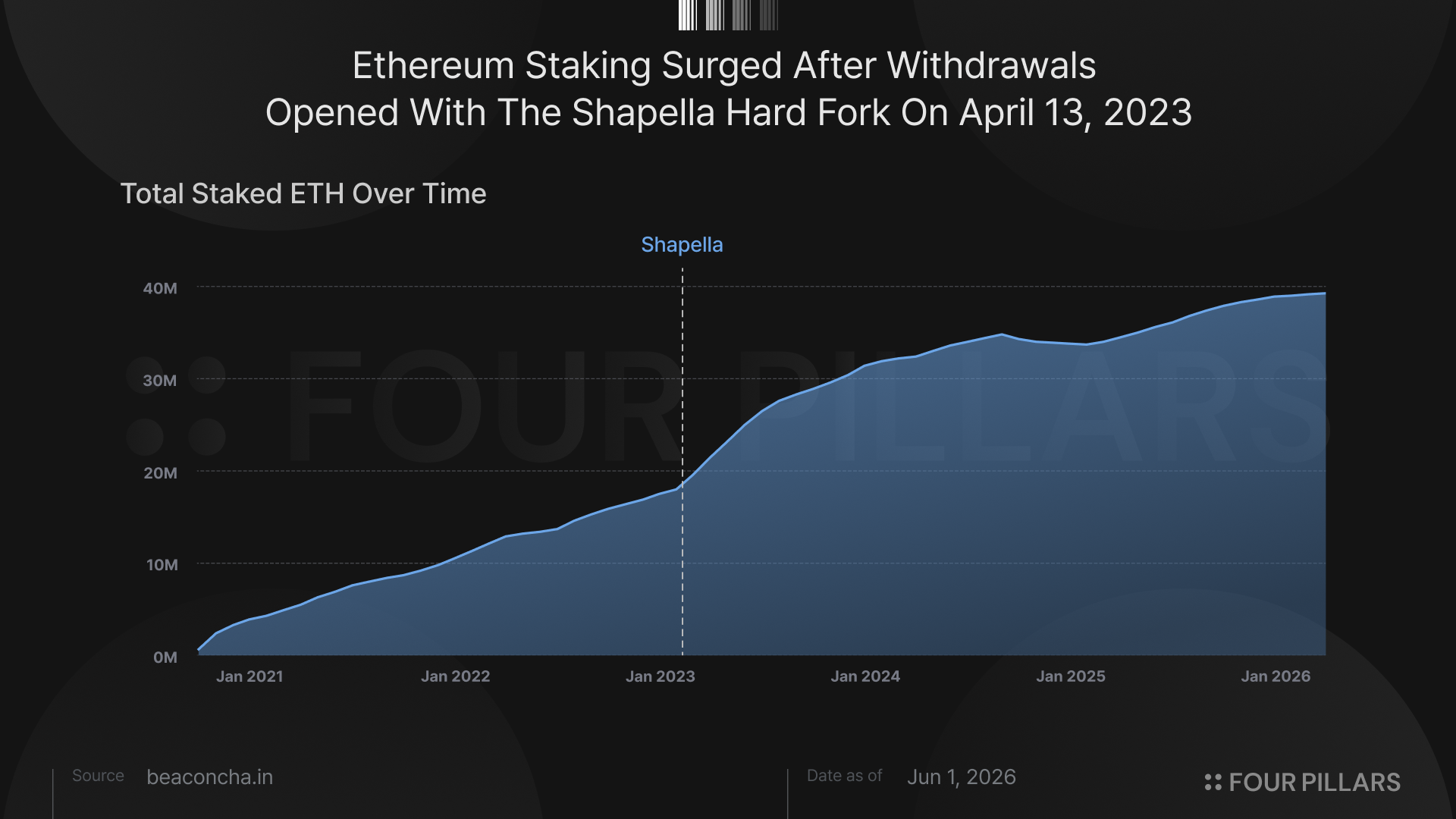
On April 12, 2023, the Shapella (Shanghai-Capella) upgrade went live on Ethereum mainnet. The core of Shapella was enabling withdrawals of ETH deposited into the Beacon Chain. For about two years and four months after the Beacon Chain went live in December 2020, staked ETH could not be withdrawn. After Shapella, stakers could finally withdraw the ETH they had deposited. Many in the crypto community expected the staking ratio on Ethereum to fall once withdrawals opened after Shapella, but with the stability that withdrawability provided, Ethereum staking instead grew explosively.
For Lido, a secondary-market liquidity pool that let users swap stETH for ETH already existed. But the fact that the staked asset itself could not actually be withdrawn was a major source of uncertainty for users. stETH could trade at a discount to ETH depending on market conditions, and the stETH depeg after the Terra collapse, discussed earlier, was a case that illustrated this structural limit.
After the Shapella upgrade, stETH was no longer just a token exchanged for ETH on the secondary market; it became an asset that could actually be withdrawn into ETH. If the stETH price discounted heavily against ETH, a market participant could arbitrage by buying stETH and then withdrawing it into ETH on Lido. This change lowered stETH's risk premium and played an important role in raising the stability of Lido's product.
1.3.2 Lido V2 and the Staking Router
Lido could not let users withdraw stETH into ETH immediately after Shapella went live on Ethereum. Lido V2, which added the withdrawal feature, was activated on mainnet on May 15, 2023, about a month after Shapella. This lag was to secure stability through seven external security audits. Because Lido is an on-chain protocol handling billions of dollars of ETH, it tends to reflect Ethereum protocol changes conservatively, going through audits, governance, and phased rollout rather than reacting immediately.
Lido V2 included two very important upgrades. One is the withdrawal support discussed so far, and the other is the Staking Router. If withdrawal support was Lido supporting a change in Ethereum, the Staking Router was a more fundamental change that altered Lido's direction.
Up to Lido V1, Lido's node operator pool was a single pool of about 30 Curated operators selected directly by the Lido DAO. This structure was favorable for securing operational stability, but it was hard to expand node operator diversity, and it was also a cause of the centralization criticism Lido faced.
The Staking Router is a modular structure that lets Lido separate the forms of node operators running its staked ETH into various staking modules. It keeps the Curated module as is while building an extensible structure where node operator groups of a different nature can be added as separate modules. Each module can have its own operator selection criteria, bond requirements, fee structure, and reward distribution method. The Staking Router laid the groundwork for creating new node operator on-ramps such as solo stakers and DVT clusters, and for bringing a more diverse validator ecosystem into Lido. Lido V2 and the Staking Router are covered in detail in Section 2.4.
The Simple DVT module and CSMthat appear later are all modules that utilize this Staking Router to connect to the protocol, in addition to the existing Curated Module. So Lido V2 was not a simple withdrawal-feature upgrade but the starting point for Lido's evolution from a staking service into modular staking infrastructure.
1.4 Establishing Lido's Identity: Focusing on Ethereum
1.4.1 Winding Down the Multichain Product Line
From 2021 to 2022, Lido pursued a multichain LST protocol strategy, expanding to several chains including Terra, Solana, Polygon, Kusama, and Polkadot. But after 2023, Lido gradually withdrew from chains other than Ethereum and established its identity as staking infrastructure focused on Ethereum.
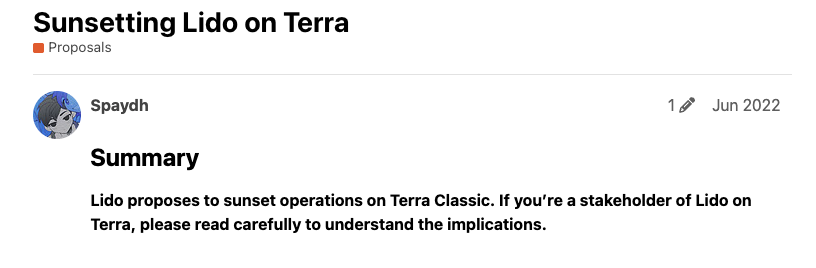
Terra was wound down first. After the Terra collapse in May 2022, Lido on Terra became a service that was no longer viable to maintain, and a proposal to sunset it was posted to the Lido research forum in June 2022. Terra was a case that showed Lido both the upside and the risk of multichain expansion at once. Entering a fast-growing chain let Lido share in that growth, but if the chain fell apart, Lido had to take on that chain's systemic risk as well.
Source: Lido Research Forum
Sunset proposals for Polkadot and Kusama followed in March 2023, and in October 2023 the DAO voted to sunset Solana. The direct reason for this decision, which passed with 92.7% in favor, was financial unsustainability. According to the P2P team that handled the development and operation of Lido on Solana after taking over the responsibilities from Chorus One, revenue generated on Solana up to that point came to about $220,000, while cumulative losses reached about $480,000. P2P asked the Lido DAO for additional funding, but Lido chose to sunset rather than provide more funds. New staking stopped on October 16, 2023, and the front end was fully shut down on February 4, 2024.
Polygon was the last to be wound down. Lido on Polygon's wind down was decided about a year after the Solana sunset, on December 16, 2024. The reason for the Polygon sunset was similar to Solana's, but in its Polygon withdrawal announcement post, Lido added the phrase "strategic refocus on Ethereum." This clearly shows that Lido's strategy converged on an identity that abandoned multichain and focused on Ethereum.
Lido's full withdrawal from chains other than Ethereum should not be read only as "the failure of the multichain strategy." Lido's strongest point is not issuing a liquid staking token itself, but having that token carry enough liquidity and DeFi integration to operate as a foundation of the money lego. The chain where this condition was most strongly met was Ethereum, and rather than spend resources maintaining services across several chains, Lido began to solve harder problems on Ethereum. It sought to evolve beyond a single LST product into a protocol's true "staking infrastructure," with diverse node operator structures and a governance layer.
1.4.2 The Key Turning Points of 2023–2025
From 2023 to 2025, Lido was systematizing its Ethereum-focused identity in practice. The first turning point was Lido V2, discussed earlier in 1.3.2. V2 strengthened stETH's trust structure through withdrawal support, and built the foundation to accommodate several staking modules through the Staking Router.
After the Curated module, the second Lido staking module added through the Staking Router was the Simple DVT module. The Simple DVT module was deployed to mainnet in April 2024, and using Obol- and SSV-based DVT, it opened the first path for solo stakers and community stakers to participate in running Lido validators.
DVT in particular opened an important path for Lido. Rather than a single node operator running one validator, DVT made it possible for several operators to run one validator together as a cluster. Technically this raises the resilience and security of validator operations, and structurally it opens an opportunity for more operators to participate as Lido operators. Simple DVT is not Lido's final form but an early stage toward a more scalable, permissionless DVT-based module.
The next module added was the CSM (Community Staking Module). CSM can be called the most important module in Lido's decentralization strategy, given that it was the first module to allow permissionless entry by node operators via the use of an ETH bonding system. Through CSM, a variety of solo stakers and community operators could be brought into the Lido ecosystem securely. In January 2025, CSM passed its initial testing stage and transitioned to fully permissionless. Simple DVT and CSM are covered in detail in 2.6 and 2.7.
Beyond the staking modules, another important turning point was Dual Governance (LIP-28), activated on July 4th, 2025. Where LDO token holders had previously been the final decision-makers of the protocol, Dual Governance elevates stETH holders to important stakeholders in Lido DAO governance. Dual Governance is a mechanism for resolving, at the protocol level, the structural tension between LDO holders' governance power and stETH holders' interests. This is covered in detail in 4.2.2.
In short, Lido in 2023–2025 wound down multichain expansion and focused on qualitatively advancing Ethereum infrastructure. If the Lido of its 2020 launch was a protocol born to solve Ethereum's staking UX problem and promote decentralized staking, the Lido of 2025 had moved closer to a protocol offering solutions to the various problems of Ethereum staking infrastructure.
1.5 The Era of V3, Earn, and Institutional Products
1.5.1 Why Lido V3 Was Needed
Through V2, Lido introduced withdrawals and the Staking Router, and through Simple DVT and CSM it built a structure where a wider variety of node operators could participate. But as demand for Ethereum staking expanded, new demand emerged that liquid staking alone could not satisfy: institutional demand.
A Lido user can participate in staking through a simple front-end experience of depositing ETH and receiving stETH. The complex parts, node operator selection, validator operation, reward distribution, and withdrawal processing, are handled on the back end by the Lido protocol, the DAO, and node operators. This structure is close to ideal for retail users, and for institutions too, stETH is an attractive option as an alternative way to gain Ethereum staking exposure. Regulated products built on core stETH already exist, such as the WisdomTree ETP and the VanEck S-1 filing.
The one-size-fits-most core pool does, however, have the limit of insufficient flexibility. Certain kinds of stakers, such as advanced DeFi users and some institutions, want conditions the shared pool cannot provide on its own. The current Lido core pool gives no choice over which node operators to use, what risk policy to apply, how to segregate and manage assets, and what fee structure and operating conditions to set.
Institutional users do not look only at "staking yield." They look at accounting segregation, auditability, jurisdiction, custody, withdrawability, and risk control structure. Lido's existing staking approach has the advantage of simplicity but does not reflect these requirements in fine detail. Conversely, bespoke staking, which offers per-client customized staking, provides operational control but has constraints on liquidity. Lido V3 emerged precisely to resolve the trade-off between these two models, not to replace the core pool but to add flexibility for the users who need it.
1.5.2 The Arrival of Lido V3 and stVaults
Source: Lido
On January 30, 2026, Lido V3 launched on Ethereum mainnet. The core of Lido V3 is stVaults. stVaults is a modular staking structure that lets institutions and builders design their own validator operation structure while keeping the shared liquidity of stETH.
Rather than seeing stVaults simply as Lido's institutional product, it should be seen as a mechanism that diversifies the structure of staking operations while keeping a single shared liquidity in stETH. A vault owner can set the node operators, operating conditions, fee structure, and risk parameters they want. The ability to customize the vault while still using stETH's liquidity and DeFi integration is the differentiator from ordinary bespoke staking.
Through stVaults, Lido begins to expand its target users from a retail-centric staking service toward one that encompasses institutions and builders. In the past, Lido was a staking liquidity service for retail users. But after V3, Lido moves closer to an infrastructure protocol that lets institutions, L2s, node operators, and DeFi builders create their own staking products. An institution can secure asset segregation and operational control through a separate vault; an L2 can turn ETH bridged to its chain into a yield-bearing asset; and node operators can move beyond delegated staking that depends on inflows through the existing Lido protocol to build differentiated staking products of their own. The detailed mechanics of V3 and stVaults are covered in earnest in 3.1.
1.5.3 The Arrival of Lido Earn

Source: Lido
If V3 is a change aimed at platformizing Lido's staking structure, Lido Earn is a product-level change aimed at expanding the product portfolio itself. Lido is well known as a liquid staking protocol for ETH. But as the staking market matured and competition intensified, staking services alone began to hit limits for the protocol's growth and revenue expansion.
Lido Earn is a new attempt to overcome this limit. As of May 2026, Lido Earn consists of two services: EarnETH and EarnUSD. EarnETH takes in ETH, WETH, and stETH and allocates capital across several DeFi protocols. EarnUSD takes in USDC and USDT and allocates them to on-chain stablecoin yield strategies. Through Lido Earn, Lido is expanding its product range beyond providing ETH staking rewards to structured DeFi-based yield products. The detailed structure of Lido Earn is covered in more depth in 3.2.
1.5.4 Lido's New Identity in 2026
Now, in 2026, you can see Lido's identity shifting once again through the launch of V3 and Lido Earn. In 2020, Lido emerged to solve Ethereum's staking UX problem. It then tried multichain expansion in 2021–2022, but after 2023 it established an Ethereum-focused identity. As a result, Lido was able to evolve, through the Staking Router and Dual Governance, into a protocol that responds to the various problems of Ethereum staking infrastructure. And in 2026, through V3, stVaults, and Lido Earn, Lido is moving toward a comprehensive staking infrastructure platform that targets a wider set of users.
2. How Lido Works: Protocol and Infrastructure
Having looked at the path Lido has walked, this chapter examines how Lido actually works. The aim is to follow the full process from the moment a user deposits ETH into Lido, through stETH being minted, who runs the nodes and how, how rewards are distributed, and how withdrawals are processed.
As of May 2026, Lido V3 has two structures side by side: the base Lido core pool and stVaults. This chapter explains how the Lido core pool works, where users deposit ETH into a shared staking pool and stETH is minted.
2.1 The ETH Staker Flow in Lido
2.1.1 Deposit ETH, Receive stETH
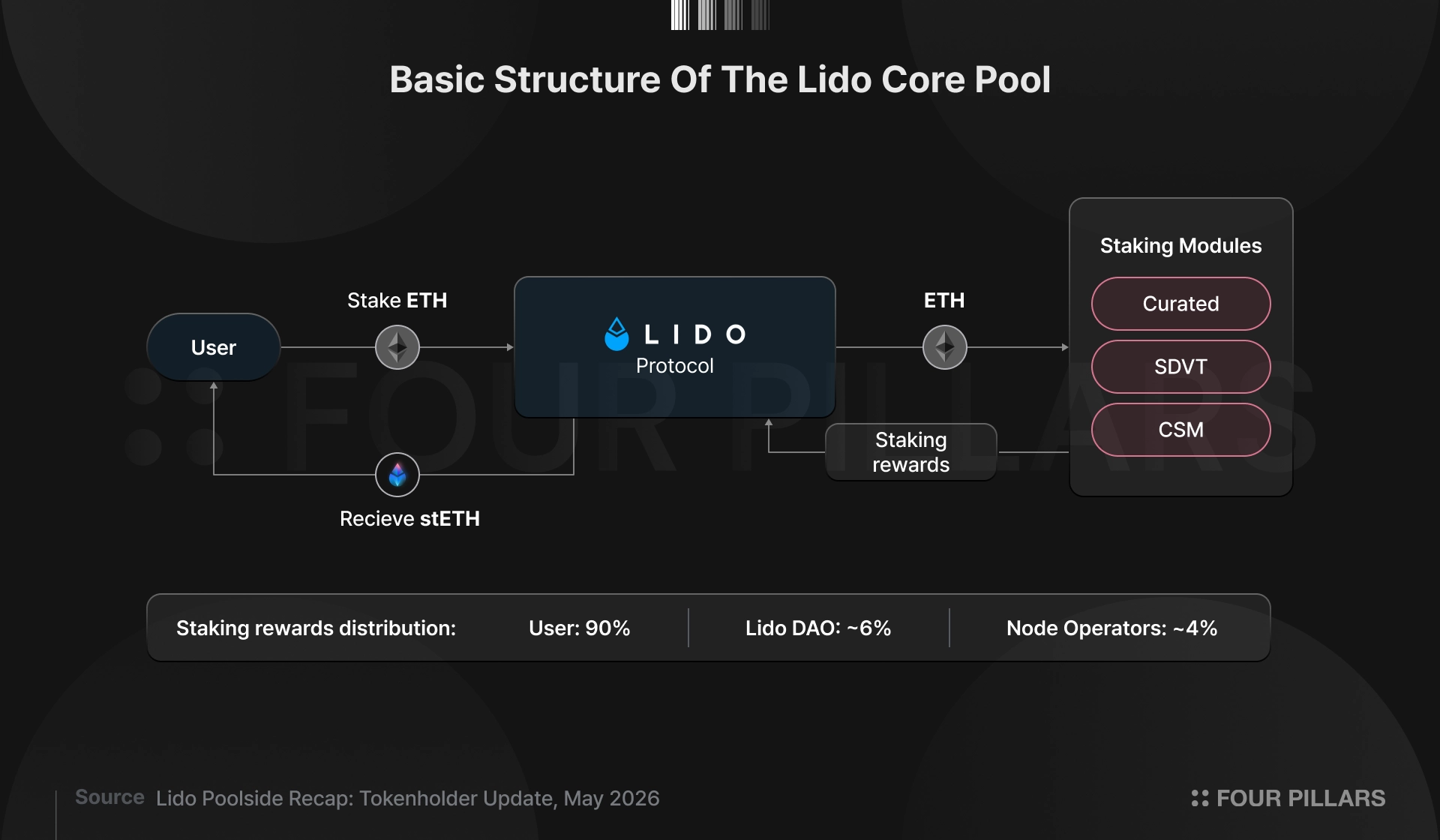
ETH staking in Lido starts with a user sending ETH to a Lido contract. Through the Lido staking website or a direct contract call, the user deposits ETH via the submit() function and receives an equal amount of stETH. The stETH the user receives is a token representing a claim on the ETH staked through the Lido protocol. A stETH holder has the right to withdraw back into ETH on Lido at any time. This right is not instant settlement, however. A withdrawal goes through Lido's withdrawal queue, and the time to receive ETH varies with the queue length, the ETH in the buffer, and node operators' response speed, ranging from a few hours to a few days in normal times and longer when withdrawal demand surges. The detailed withdrawal procedure is covered in 2.2.2.
The important point here is that depositing ETH does not mean this ETH is immediately staked to a validator on Ethereum mainnet's Beacon Chain. The stETH is minted first, and the deposited ETH moves to the protocol's next stage. So the user stakes through a simple experience of receiving stETH immediately on deposit, but on the actual back end an asynchronous process of buffering, routing, and validator deposit follows. This is not directed by any party. It works programmatically, according to the smart contracts of the Staking Router. The detailed allocation logic is covered in 2.4.
2.1.2 The Role of the Buffer
Until the Pectra hard fork, the minimum and maximum stake for a single Ethereum validator was 32 ETH. Within the Lido protocol,the ETH a user deposits is not immediately staked right away; it first enters the buffer. The buffer acts as a cushion that balances Lido's inflows and outflows. When a user deposits ETH, it is first stored in the buffer and then used for two purposes. One is processing withdrawal requests, and the other is staking through the Staking Router. Because Lido prioritizes withdrawals over deposits, if there are processable withdrawal requests remaining, it uses the ETH in the buffer for withdrawals first.
After the MaxEB (EIP-7251, Maximum Effective Balance) increase applied in the Pectra hard fork, the meaning of "using it for staking" needs to be understood a bit more broadly (covered in more detail in 2.8). After Pectra, the MaxEB of an Ethereum validator expanded from 32 ETH to 2,048 ETH, which made it possible not only to keep creating new validators but also to top up and consolidate existing ones. According to Lido's CMv2 migration documentation, depositable ETH is first used for seed deposits, and once there are no more validator keys to seed, it can be used for top-ups. The buffer of the future is therefore more accurately understood not as funds waiting for 32 ETH to accumulate, but as an account that allocates ETH left over after withdrawal processing on a balance basis, across new deposits, top-ups of existing validators, and consolidation.
2.1.3 stETH, a Rebasing Token
The most important feature of stETH is that it is a rebasing token. The stETH balance increases automatically once a day. This mechanism is known as a rebase.
The Lido protocol contract does not store the stETH balance directly; it stores the shares a user holds. The user's actual stETH balance is then computed from each user's shares as follows.
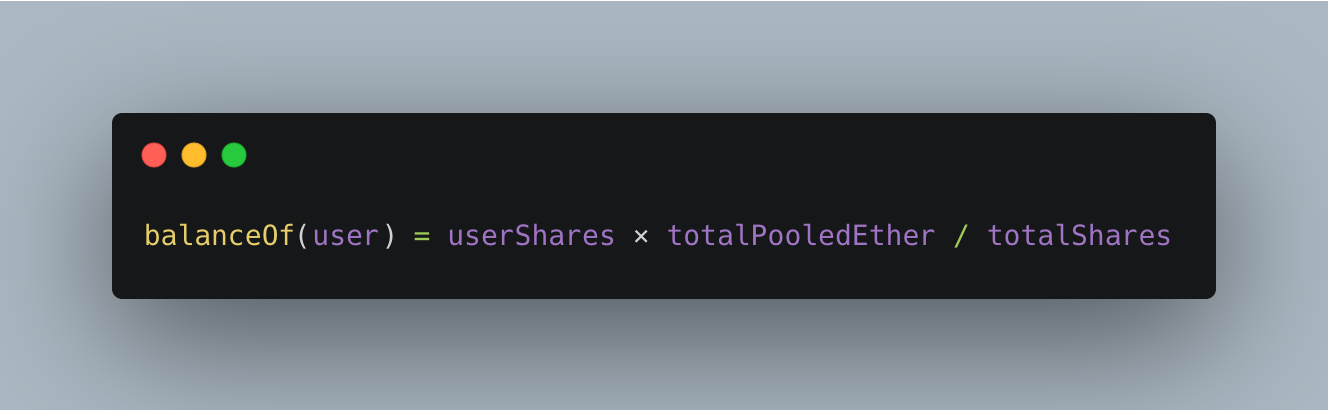
Here, totalPooledEther is the total ETH held by the entire Lido pool, including buffer ETH, Beacon Chain validator balances, execution layer rewards, and ETH pending withdrawal. totalShares is the total of issued stETH shares. The userShares representing a user's shares stays the same after an ETH deposit; the stETH balance changes because totalPooledEther changes. As validator rewards accumulate, totalPooledEther rises, and every stETH holder's balance rises in proportion.
The rebase is triggered once a day at about 12:30 UTC. At that point Lido's oracle contract, AccountingOracle, aggregates Beacon Chain validator balances and EL-side rewards and updates totalPooledEther. AccountingOracle consists of nine independent oracles selected by the Lido DAO and operates on a 5-of-9 quorum, where five of the nine must report the same data for consensus. Once the oracles' agreed data is submitted to the Lido contract, totalPooledEther is updated, and from that moment every stETH balance is recomputed at the new ratio. The user does not need to separately claim stETH or receive it via a transaction; they simply see the updated figure computed at the time they check their stETH balance.
This is why stETH is a special asset, different from an ordinary ERC-20. Usually the balance rises as staking rewards accrue, but a negative rebase is also possible (though has never occured), where supply decreases if slashing or large penalties occur. stETH is more accurately seen not as a token that accrues interest, but as a token where a user's share of the entire Lido pool is repriced daily.
2.1.4 The Arrival of wstETH
stETH's rebase structure is intuitive for users, but it does not always fit DeFi protocols or bridge structures. Many DeFi protocols were designed without assuming an ERC-20 token's balance could change for reasons other than transfer, mint, or burn.
To solve this, Lido introduced wstETH (wrapped stETH), a wrapped form of stETH. wstETH is an ERC-20 token, but unlike stETH its held quantity does not change automatically. Instead, the value of one wstETH changes over time.
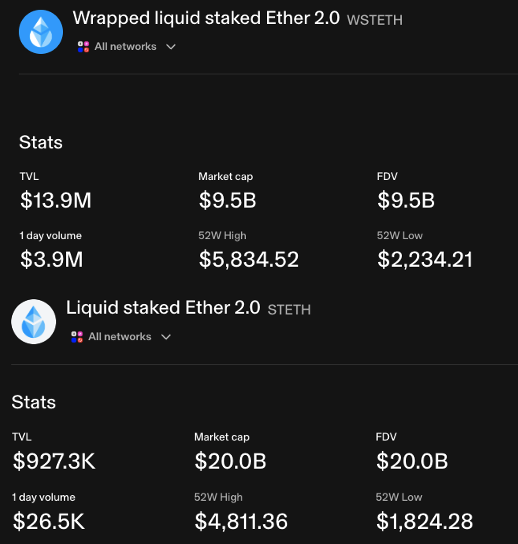
For example, on Uniswap v3, even if a user puts a rebasing token like stETH into an LP, the quantity gained from rebases is not properly reflected in the LP position's accounting. As a result, the LP does not properly capture the yield from rebases. For this reason, Lido recommends using the non-rebasing token wstETH instead of stETH on Uniswap. In practice, the TVL of Uniswap's wstETH pool reaches $13.9M, while the stETH pool is $920K, a clear difference in size.
Source: Uniswap
Since introducing wstETH, Lido recommends it as the standard asset for DeFi integration. On major lending protocols such as Aave, MakerDAO, and Morpho, wstETH has become one of the largest collateral assets. The loop staking strategy through lending protocols, which borrows ETH against wstETH collateral and re-deposits it on Lido, also cannot work without wstETH. When bridging stETH to another chain, the standard is also to bridge via wstETH first and then convert back to stETH on the other chain, to avoid the problem of bridge contracts not handling balance changes.
In short, stETH and wstETH are two representations of the same asset. stETH is the token through which a user can intuitively feel rewards, and wstETH is the token compatible with DeFi infrastructure. Users can freely wrap and unwrap between the two through the Lido interface.
2.2 Node Operators and Withdrawal
If the previous section looked at how a user's ETH becomes the liquid token stETH from a user-experience angle, this section explains who actually runs the validators on the back end, and how the process of a user getting ETH back from stETH works.
2.2.1 The Node Operator's Role and Lifecycle
The ones who actually run validator nodes in Lido are the node operators. Lido is an on-chain protocol that lives on contracts, but the actual operation of validators delegated to Ethereum through those contracts is carried out off-chain by node operators.
A Lido node operator's lifecycle splits broadly into two stages. The first is onboarding, a one-time procedure for node operators to join Lido. Taking the Curated Module as the basis, this stage goes through four steps. A node operator candidate expresses intent to join the Lido protocol's Node Operator setand is approved as an active operator through a DAO vote. This process generally happens via onboarding rounds announced on the Lido Research forum. The approved node operator then submits its signing keys and signatures to the Curated Module, via an optimistic form of governance called Easy Track. At this point the validator keys the node operator submitted finally become eligible targets for Lido to delegate to.
The second stage is ongoing operations. Under SRv2 (Staking Router v2), the Lido protocol allocates the ETH gathered in the buffer to node operators in units of 32 ETH (Curated Module v1). Because delegation to a specific node operator proceeds in the order of the keys a node operator submitted, node operators must make sure that their first unused keys among their submitted keys are ready to run. For the validators they have been delegated, node operators are responsible for running the validator in line with a set of operating policies such as uptime, accuracy of network participation, and slashing prevention.
After a validator is activated, when the Lido oracle (AccountingOracle) reports Beacon Chain balances and rewards earned on the execution layer, fees are distributed to node operators according to the fee rate. Later, when a user requests a withdrawal and a validator exit becomes necessary, the Lido protocol issues an exit signal through a contract. Node operators monitor this signal, and if a validator they run becomes a withdrawal target, they submit a voluntary exit message for that validator to the Beacon Chain.
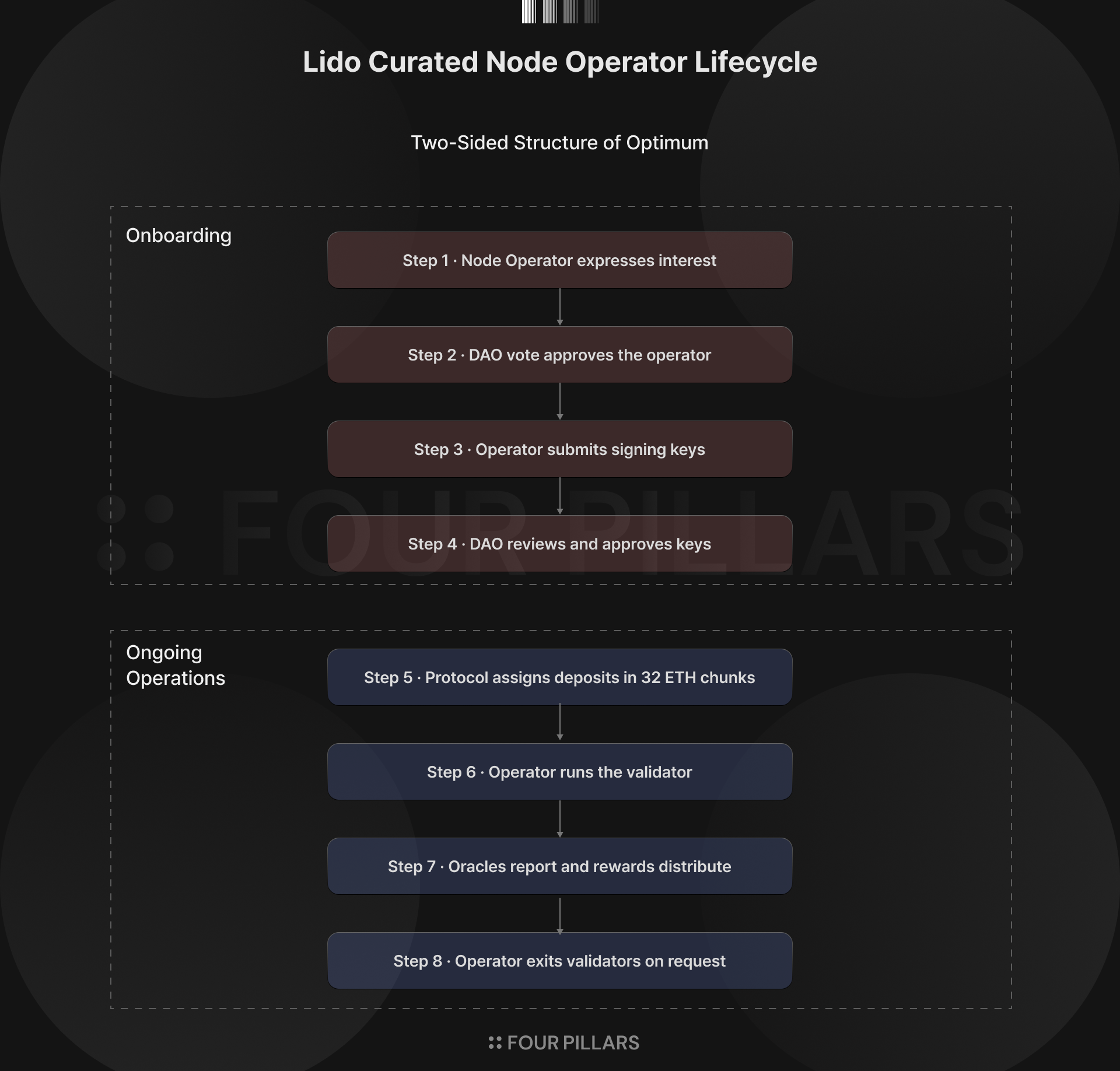
This explanation is limited to the Curated Module; Lido's other node operator modules, Simple DVT and CSM, follow different procedures and operating methods. The Curated Module, currently consisting of 34 active node operators, has the Lido DAO directly vet and approve node operator candidates, whereas CSM is a permissionless module anyone can join by depositing a bonding amount. In Simple DVT, instead of a single operator, SSV- and Obol-based DVT clusters are registered as operators, a structure where several node operators run a validator together. The detailed procedures and differences for each module are covered by module in 2.5, 2.6, and 2.7.
A node operator thus runs the validators staked through Lido, manages validator keys, maintains uptime and performance, and even exits validators when the protocol requires it. Node operators in particular have an obligation to fulfill the protocol's withdrawal requests on time. The Lido DAO continuously monitors their performance, and sanctions follow if this is not upheld.
The important point is that Lido's node operators running validators does not mean they hold control over the funds. In Lido's structure, operation and ownership are separated. Node operators run validator nodes, but the withdrawal credentials that hold final ownership of the ETH assets must match the value the protocol sets. The feeRecipient into which execution layer rewards such as priority fees and MEV from block proposals flow must also be set to the address the protocol designates. A node operator therefore only runs the validator node and cannot arbitrarily take the withdrawal address or execution layer rewards. The Lido protocol programmatically distributes ETH across node operators for delegated assets while maintaining control of assets and reward attribution via smart contracts at the protocol level. A Lido node operator is a validator operator, not a custodian of users' ETH.
2.2.2 Lido's Withdrawal Procedure
The procedure a user goes through to return stETH and withdraw ETH works through cooperation among three parties: the user, the Lido protocol, and node operators. The steps where the user sends transactions directly are only the two ends, the withdrawal request and the ETH claim, a simple experience. But on the back end, the Lido protocol and node operators handle withdrawal queue management, validator exit requests, withdrawal execution, ETH recovery, and finalization.
The full flow, from the user's perspective, is as follows.
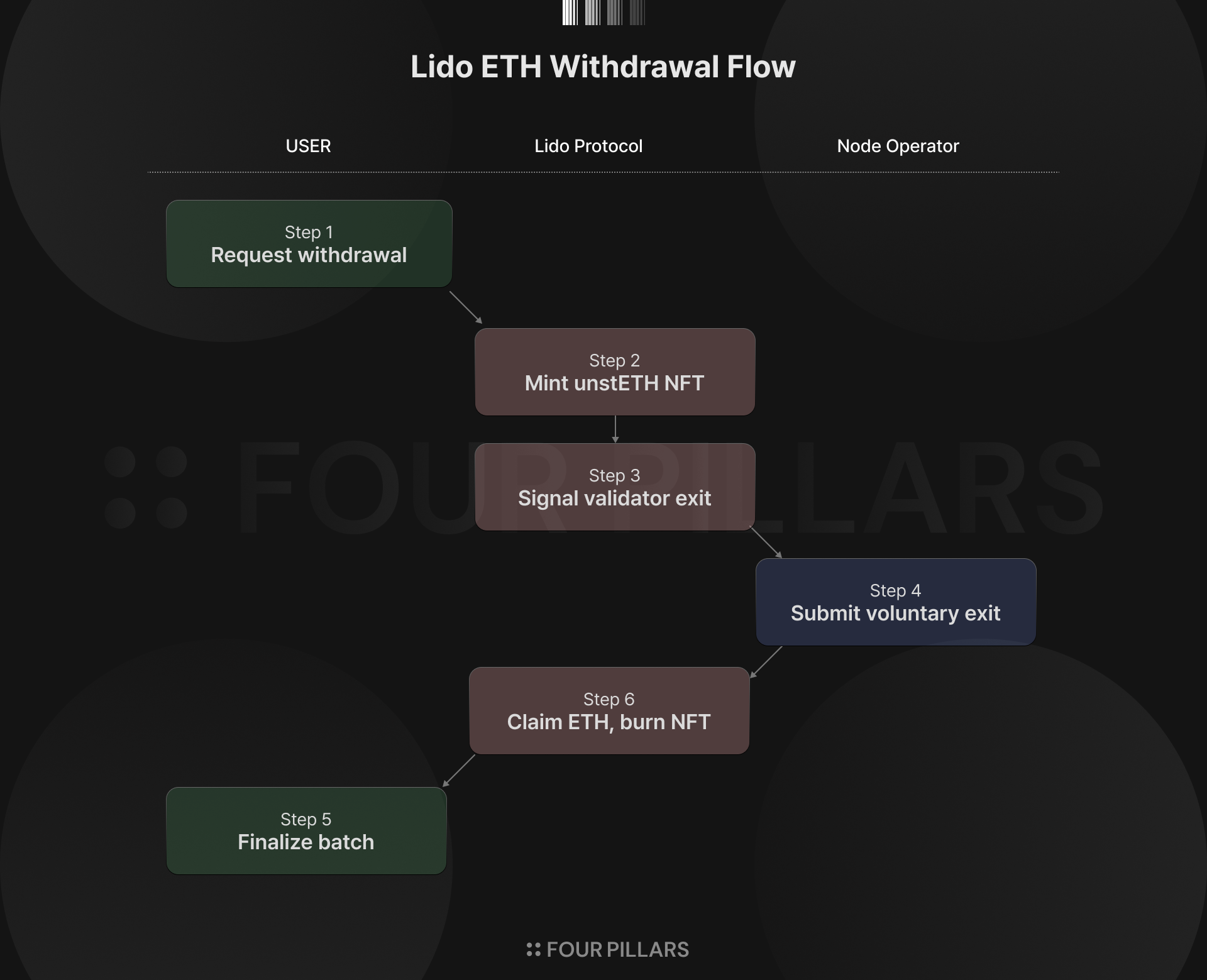
First, the request stage. The user sends stETH or wstETH to Lido's withdrawal contract, WithdrawalQueueERC721, to request a withdrawal. The minimum unit of a request is 100 wei and the maximum is 1,000 stETH. Amounts above 1,000 stETH must be split into several requests. When the user sends a request, a corresponding NFT (ERC-721) called unstETH is minted to the user's wallet. Because this NFT is transferable, the right to withdraw can be moved to another address even while waiting in the queue, and it can be traded on a market such as OpenSea.
Second, the queue-wait and ETH-recovery stage. Lido's withdrawal queue is first-in-first-out, processing the earliest requests in turn. For a request to be finalized, enough ETH to fulfill it must gather in the Lido pool. ETH for withdrawals gathers through two paths: new users' deposit ETH being added to the buffer, and node operators exiting validators to recover ETH from the Beacon Chain.
The node operator's exit process is very important here. When the buffer from new deposits alone cannot fulfill withdrawal requests, the Lido protocol issues a validator exit signal on-chain through ValidatorsExitBusOracle. Node operators monitor this signal, and when they detect an exit request for a validator they run, they submit a voluntary exit message signed with that validator's key to the Beacon Chain. Once the validator exit completes, the ETH that was staked to that validator is recovered into Lido's WithdrawalVault and re-enters the buffer.
Previously, a validator exit was only possible with the validator key the node operator held, so in some cases there was a risk that withdrawals could become permanently impossible. But this dependency is being resolved through EIP-7002, introduced after the Pectra hard fork. This is covered in more detail in 2.8.
Third, the claim stage. Once the user confirms that their unstETH NFT is finalized, they call the contract's claimWithdrawals function to receive ETH. At this point the NFT is burned, and ETH corresponding to the requested amount is transferred to the user's wallet.
Total withdrawal time varies with the length of the queue, the amount of ETH in the buffer, and node operators' response speed. In normal times when Lido operates stably, it ranges from a few hours to a few days, but during periods of a sudden surge in withdrawal requests it can take more than several weeks. Since Lido first enabled withdrawals with the V2 launch in May 2023, the longest queue extensions happened twice, in June 2024 and January 2025, both driven by short-term surges in withdrawal demand following ETH price moves.
Lido processes withdrawals in two modes: Turbo Mode, the normal operating mode, and Bunker Mode, the emergency operating mode. In Turbo Mode, withdrawals are processed as described above. Bunker Mode activates in emergencies such as mass slashing or large-scale validator penalties; in this mode withdrawals are not halted, but the processing speed is intentionally slowed. This is a deliberate mechanism to prevent some users from exiting quickly in an emergency and concentrating losses on the remaining users.
Lido is also steadily working to improve this withdrawal processing speed. In April 2026, a proposal to shorten the VEBO reporting frame was posted to the Lido governance forum. As explained earlier, ValidatorsExitBusOracle issues validator exit signals every fixed frame, and previously this frame was 75 epochs (about 8 hours), with three reports issued per day. The proposal is to reduce this to 45 epochs (about 4.8 hours), increasing it to five times a day. Shortening the oracle's reporting frame reduces the delay from withdrawal request submission to the start of a validator exit. It also has the effect of spreading exit batches more evenly across the day, reducing the volume of exit messages a node operator must process at once.
2.2.3 The Importance of Withdrawal Credentials
Validator operation for Ethereum staking is made up of two key systems. There is the validator key, used for the various signatures needed to participate in the network as a validator, and the withdrawal credentials, which hold the right to withdraw the validator's assets. As stated earlier, in Lido the parties that own these two are clearly separated. Validator keys are generated and held by node operators, but the withdrawal credentials are tied to a Lido protocol smart contract (WithdrawalVault).
The withdrawal credentials address is specified in the deposit message used to register a new validator, and this address must match the address the Lido DAO sets. Node operators must verify this address value through the Staking Router contract's getWithdrawalCredentials function to create the deposit message. Because a node operator cannot arbitrarily set the withdrawal credentials address, the ETH withdrawn upon a validator exit is programmatically routed to the Lido withdrawal vault. Through this structure, Lido can distribute validator operations while ensuring the assets clients deposit follow the proper flow and are available for withdrawal. This is the key mechanism that makes it possible to decentralize Ethereum staking infrastructure, which does not support protocol-level delegation, in a non-custodial form.
2.2.4 Changes After Pectra (EIP-7002, EIP-7251)
The Pectra hard fork, applied to Ethereum mainnet in May 2025, brought two very important changes to the Ethereum staking infrastructure environment: EIP-7002 (Execution Layer triggered exits) and the previously mentioned EIP-7251 (MaxEB).
The new 0x02-type withdrawal credentials introduced in EIP-7251 are the most important change in the staking structure since Ethereum transitioned to PoS. The existing 0x01 credentials have a MaxEB fixed at 32 ETH. The 0x02 type, by contrast, raises the maximum balance that can be staked to a single validator from 32 ETH to 2,048 ETH, and supports a compounding function that automatically accrues rewards as well as partial withdrawals. EIP-7251 is a very important upgrade for large validator operators such as Lido's node operators. It raises node operators' operational efficiency for validator keys they previously had to manage in units of 32 ETH, and it reduces the bandwidth burden on the network as a whole.
EIP-7002 is an upgrade to solve the problem of validator exits depending on the validator key. Before EIP-7002, the only party that could exit a validator and withdraw staked ETH from the Ethereum network was the node operator holding the validator key. So when the Lido protocol needed a specific validator to exit in order to process a user withdrawal request, Lido could not send the exit message directly because it does not know the validator key. Lido had to propagate a signal on-chain through ValidatorsExitBusOracle saying "please exit this validator," and the node operator had to receive that signal and submit a voluntary exit message signed with that validator key to the Beacon Chain. In this structure, if a node operator ignored or delayed the signal, Lido's withdrawal queue processing could be delayed, and in the worst case, if a node operator disappeared without processing the withdrawal, there was a risk that a full withdrawal of the assets could become permanently impossible.
After EIP-7002, a validator exit can be triggered directly through the withdrawal credentials. For Lido, this means the Lido contract can trigger an exit directly, without waiting for a node operator's response. Ethereum is a pure PoS network that does not support protocol-level delegation, and it aimed at a structure where every validator is run directly by the staker. But because most staking in practice proceeded in an indirect, delegated form, this upgrade appears to have been made for that reality. With Ethereum applying EIP-7002 to mainnet, Lido was able to raise the reliability of its withdrawal processing by a level.
Lido did not, however, adopt these two changes into the protocol immediately after the Pectra hard fork. LIP-27 placed the focus of Lido's Pectra response first on "maintaining the protocol's continued compatibility," and stated that new features such as EIP-7002 and EIP-7251 would be handled in separate proposals. As of June 2026, EIP-7002 has been fully applied. This is why the Lido protocol can trigger validator exits through the withdrawal credentials as described above. The shift to 0x02 credentials and balance-based accounting, then, is moving over in phases. stVaults, by contrast, were designed to support 0x02 credentials from the start at launch. The Lido core pool is in a process of moving over in phases, together with CMv2, SRv3 (the upgraded version of the Staking Router), top-ups, and validator consolidation. This migration is covered in earnest in 2.8.
2.3 The Lido Oracle System
2.3.1 Why Lido Needs an Oracle
Every time the workings of the Lido protocol have been explained so far, the "oracle" has come up. Lido depends on the oracle for important parts such as reward processing and withdrawal processing. This is due to a structural feature of Ethereum, where the consensus layer and the execution layer are separated. Information such as Ethereum mainnet user transactions, smart contract execution, and asset balances lives on the execution layer, but staking information such as validator balances, slashing penalties, and withdrawal processing lives on the consensus layer. Above all, there is the problem that execution layer smart contracts cannot directly read consensus layer state. For an Ethereum contract to use consensus layer data, someone has to bring the Beacon Chain data and deliver it to the contract on the execution layer.
Lido takes a user's ETH and stakes it on the consensus layer, but the liquid token stETH is minted and operated on an execution layer contract. For Lido to reflect the correct stETH balance, it has to bring the balance changes of Lido validators on the consensus layer into the Lido contract on the execution layer. The withdrawal queue, node operator rewards, and the handling of slashing and penalties are all consensus layer information as well, so a mechanism is needed to bring them to the execution layer. The Lido oracle is a mechanism for synchronizing information between Ethereum's execution layer and consensus layer.
2.3.2 The Lido Oracle
The Lido oracle system consists of nine independent oracle members. They are selected through a Lido DAO vote, and each member runs its own Ethereum execution client, consensus client, and Lido KeyAPI. A frame begins every 225 epochs (about 24 hours), and at the start of each frame the nine oracle members each gather data and submit a report to the Lido contract. The Lido oracle operates on a 5-of-9 quorum, where consensus is reached only if five of the nine report the same data. Verification of this quorum is performed in a separate contract called HashConsensus.
The Lido oracle system consists of two core contracts: AccountingOracle and ValidatorsExitBusOracle.
First, AccountingOracle is the most important oracle, updating Lido's accounting state. Every frame, once the agreed report is submitted, the following operations execute sequentially within a single transaction.
- Update the total balance of Lido validators on the Beacon Chain and the number of validators that have completed their exit.
- For each module connected to the Staking Router, update the number of already-exited validators and the number of validators that received an exit request but have not yet exited.
- Call the Lido contract's core handle function to update
totalPooledEtherand trigger the stETH rebase. - Distribute rewards to node operators.
- Finalize the withdrawal requests that this report makes processable.
stETH rebasing, finalization of user withdrawals, and node operator reward distribution are thus all processed at once by this single oracle report. It is fair to say that nearly every state change in the Lido protocol happens through AccountingOracle.
Second, the role of ValidatorsExitBusOracle is to decide which validators must be exited to secure the ETH needed to process the withdrawal queue, and to publish that information on-chain. The nine oracle members each look at the current withdrawal queue length, the amount of ETH in the buffer, and the list of active validators, and compute candidate validators to exit. Once a 5-of-9 oracle consensus is reached, that list is published on-chain, and node operators receive the signal and process the exit of the validators on the list.
Because the oracle holds such large power, Lido also keeps a separate on-chain sanity check on it. OracleReportSanityChecker is a dedicated contract that verifies the reports submitted by AccountingOracle and ValidatorsExitBusOracle. Because the data the oracle provides has a very large effect on protocol state, the oracle's report must pass the on-chain sanity check. The Lido oracle is not simply a system that relays external data but a structure where reporting, consensus, and verification are separated in stages.
2.3.3 Accounting Oracle Second Opinion and the ZK Oracle
As discussed, Lido's oracle system already has a distributed committee, HashConsensus, and on-chain sanity checks, but an essential trust assumption still remains: if five or more of the nine oracle members report wrong (or malicious) data at the same time, the Lido protocol's state could be updated incorrectly. There was an awareness of the problem of verifying the oracle's reported data itself more independently, and the Accounting Oracle Second Opinion discussion started from there.
The idea is to prove the accuracy of the oracle report with a zero-knowledge proof, so that the fact that data reported by an oracle member matches the actual state of the Beacon Chain can be verified without a separate trust assumption. In that case the 5-of-9 quorum remains a mechanism for the efficiency of data collection, while the accuracy of the data is guaranteed by the ZK proof.
This discussion is paused as of April 2026, however. Technically, most of the early milestones were met, and the cost of mainnet proving is achievable at the targeted level of "30 minutes at ~$5 per report," a tenth of the $50 it had been. But because Lido currently prioritizes the 0x02 migration and SRv3 integration, the main integration of the ZK oracle is likely to be pushed back until after that. If the ZK oracle is later introduced, the trust model of the Lido oracle will become a level more robust, and it would be one of the most fundamental changes for reducing stETH's systemic risk.
2.4 The Staking Router
2.4.1 The Concept of the Staking Router
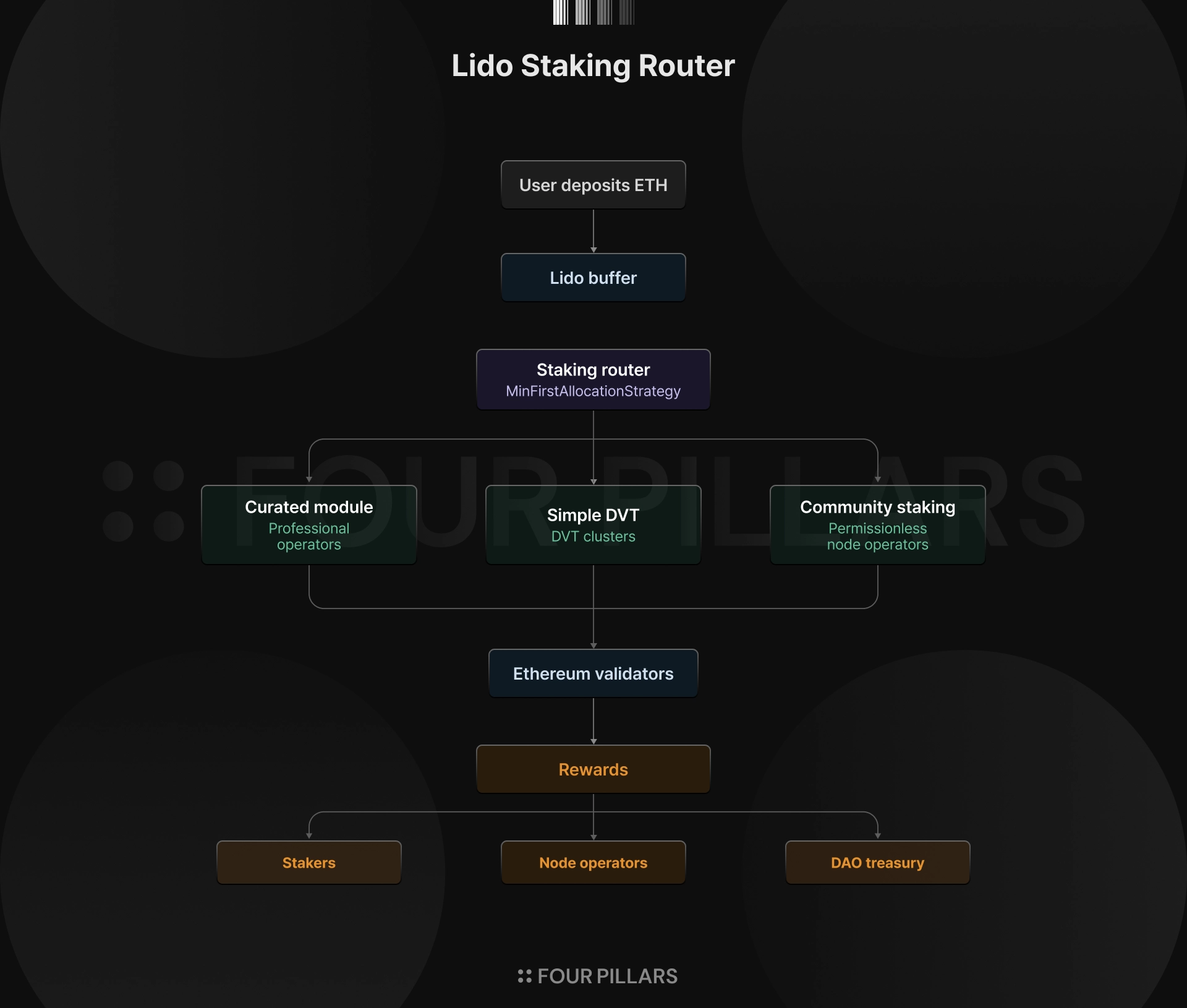
As seen earlier, Lido takes a user's ETH and entrusts the actual validator operation to node operators. Deciding to whom, by what method, and how much ETH to allocate is a very important question. In its early days, the Lido DAO selected sufficiently vetted professional operators as Curated node operators and staked ETH to the validator nodes those professional operators ran.
A Curated pool made up of a few professional node operators was favorable for securing stability and operational quality. But as Lido grew, it sought to bring validator operators of a different nature, such as solo stakers, community operators, and DVT clusters, into the Lido ecosystem, aiming for a more decentralized protocol on the node operator side as well. Lido sought to evolve beyond a simple staking liquidity service into Ethereum staking infrastructure, and that required a structure capable of managing several kinds of operator sets within a single protocol.
The Staking Router, introduced in Lido V2, was built to solve this. The Staking Router is a top-level controller contract that registers multiple staking modules, allocates staking shares to each module, distributes protocol fees, and tracks the related information. Each staking module has its own validator set. For example, the Curated operator set that existed from the start is treated, after V2, as one module within the Staking Router: the Curated Module. Each module has its own operator selection method, bond structure, reward distribution method, and risk management method.
When a user deposits ETH, that ETH first accumulates in the Lido buffer and is then allocated to a specific staking module through the Staking Router. This is not something the user chooses directly; it is carried out through Lido's deposit bot and the DepositSecurityModule. In this process, the Staking Router allocates the ETH in the buffer to validators belonging to a module with a specific _stakingModuleId.
The current Lido core Staking Router manages each module's allocation limit with stakeShareLimit. This is a target share, set by the DAO, that each module can take of total active staking. For example, if a module's stakeShareLimit is 10%, that module can run up to 10% of Lido's total active staking and receives no allocation beyond that. The allocation algorithm is a priority-based method called MinFirstAllocationStrategy. As the name suggests, it allocates ETH first to the module with the fewest active validators, within the bounds of each module's limit.
The core of the Staking Router is that the user still uses a single liquid token, stETH, while on the back end validator operation structures of different natures coexist. Because this structure was in place, Lido could afterward gradually draw not only existing professional node operators but also DVT clusters, community stakers, and permissionless operators into the protocol.
2.4.2 The Problem the Staking Router Solves
Early Lido (V1) had a very complex and slow process for onboarding new node operators. Adding a new node operator required the Lido DAO to approve them one at a time through an LDO vote, and the operator's identity, infrastructure capability, and reputation had to be vetted. This process was effective for stability and security, but it made it hard to expand node operator diversity in a fast-growing LST market. And even if Lido wanted to introduce a different operator model such as permissionless participation, V1's single-pool structure had no real method other than adding operators.
Because each module in the Staking Router has its own operator selection policy and bond policy, Lido could create a separate module per operator model and run them simultaneously. While keeping the stability the Curated Module had, it became possible to add as separate modules the Simple DVT module, which accommodates DVT clusters, and CSM, which anyone can join by depositing a bond. The Lido DAO controls the balance among modules by adjusting each module's stakeShareLimit.
Another important point is that the Staking Router made adding new modules possible. Once the Lido DAO decides to introduce a new staking module, that module can implement an interface compatible with the Staking Router and be connected as part of the Lido core pool within the fee structure and per-module limits the DAO sets. This means Lido's node operator ecosystem is not a structure defined once and for all, but an extensible structure where experimental or more efficient new operator models can be added easily. The Staking Router played a very large role in Lido's move from a protocol seen as a risk of Ethereum validator centralization to one leading decentralized staking infrastructure.
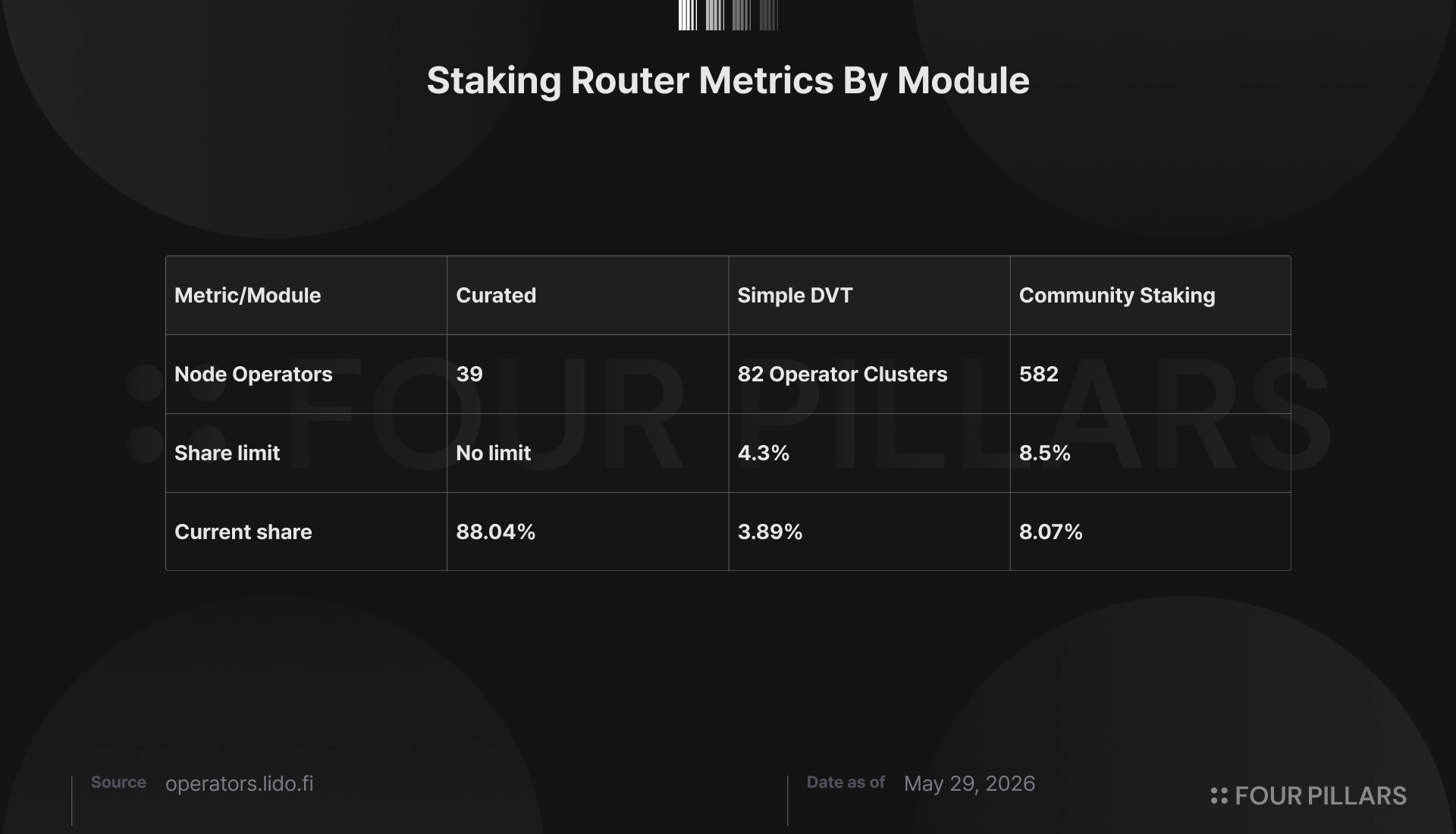
As of May 12, 2026, per the Lido operator dashboard, the Curated Module has 39 registered node operators, the Simple DVT module has 82 SSV- and Obol-based DVT clusters active as operators, and CSM has 578 operators participating permissionlessly. The Curated Module accounts for 88.3%, Simple DVT 3.94%, and CSM 7.76%, but CSM's share is on a steady upward trend. Lido is effectively the protocol running the most diverse node operator network in Ethereum PoS.
2.5 The Curated Module
2.5.1 The Historical Role of the Curated Module
The Curated Module is the oldest staking module, existing since Lido V1. Up to V1, Lido effectively operated as a single pool of Curated operators, and after V2 it was folded into the Staking Router as its first module, named the Curated Module.
The Curated Module is a staking module made up only of professional node operators vetted by the LNOSG (now replaced by the CMC) and approved through a Lido DAO vote. Only node operators whose identity, infrastructure capability, reputation, and business sustainability are sufficiently vetted can participate in this module, and each operator does not deposit a separate bond for validator operation. It is a model of reputation-based participation without a bond. The node operators of the Curated Module are professional node operators selected on the expectation that they will run validators reliably and accurately, without controlling user funds themselves.
Ethereum staking rewards differ with the node operator's skill, and in some cases can lead to a loss of staked principal. Moreover, until EIP-7002 was introduced in the Pectra hard fork, a validator exit absolutely required the validator key the node operator held. This meant that if a node operator suddenly disappeared or did not respond to a withdrawal request, Lido could not exit that validator. Ownership of the assets does not pass to the node operator, but because withdrawal execution depended on the node operator, there was a possibility of ETH that could not be recovered. So a Lido Curated operator had to be vetted not only on operational skill but also on identity, reputation, and business sustainability.
The Curated Module was, in other words, the Lido protocol's "professional operator layer." Lido was able to mint stETH and simplify the staking UX for retail users because vetted professional node operators handled validator operations on the back end. But this structure was also the starting point of the Lido centralization debate. As Lido grew, "who runs Lido's validators" became not a simple operational matter but one directly tied to Ethereum decentralization. The Curated Module provided stability, but it was hard to escape criticism given that operator selection was a permissioned structure chosen directly by the Lido DAO.
As of May 2026, about 88.3% of the Lido core pool is run through the Curated Module. The Curated Module serves as a fallback that operates when other modules' limits are full, when an emergency exit occurs in a problem situation, or when there are no validators available to deposit to. The Curated Module remains the most important module, serving as a safety net for the availability of all of Lido.
2.5.2 LNOSG (Now Transferred to CMC) and Node Operator Selection
Selecting node operators in the Curated Module is very important. As seen in the previous section, validator operation is technically complex, and a node operator's skill can lead to rewards, penalties, and in the worst case slashing. The Lido DAO selected node operators with a professional review process from the start. The separate organization for node operator selection in the Curated Module was LNOSG (Lido Node Operator Sub-Governance Group).
LNOSG's role is closer to that of a recommender through vetting than a final decision-maker. When operator candidates apply, LNOSG evaluates technical capability, infrastructure setup, operational experience, client usage, geographic distribution, and security posture, and proposes a candidate list to the DAO. Which operators are ultimately included is decided through a DAO snapshot vote in which LDO token holders participate.
The onboarding process for a new node operator to join the Curated Module follows a very strict procedure.
- When Lido publicly announces a new node operator recruitment, candidates apply through an official application form.
- LNOSG evaluates the applicants together with Node Operator Mechanism (NOM) workstream contributors. The criteria include not only operational performance but also contribution to Lido's overall decentralization, such as geographic distribution, client diversity, and infrastructure hosting method.
- Candidates LNOSG deems suitable are referred to a Lido DAO snapshot vote.
- Node operators who pass the vote are added to the Curated Module.
- The selected node operator goes through a verification stage on testnet and is then onboarded as a node operator on mainnet.
In the Wave 5 onboarding in 2023, 7 new node operators were selected out of 117 applications submitted by professional node operators.
This strict selection method in the Curated Module brought positive effects to Ethereum infrastructure beyond Lido. Lido evaluated factors important for Ethereum infrastructure decentralization, such as geographic distribution, infrastructure hosting method, and client diversity, as important criteria in Curated Module selection. This was not just a standard for Lido to run its own pool stably; it amounted to Lido presenting the market with an operator standard that contributes to the decentralization of Ethereum PoS as a whole. Criteria such as geographic distribution, client diversity, and infrastructure hosting method gradually became important evaluation factors across Ethereum infrastructure in general, including other LST protocols and institutional staking services.
In practice, the Lido node operator set shows more balanced metrics than the Ethereum network as a whole on geographic distribution, infrastructure composition, and client diversity. Had Lido selected node operators on operational performance alone, all of Lido would likely have ended up dependent on a few large infrastructure providers, which would also have weakened Ethereum's own decentralization. In this sense, the Curated Module's selection criteria played a positive role not only for Lido's own stability but also for the resilience and decentralization of Ethereum PoS.
As discussed later, LNOSG was fully dissolved after a governance vote in March 2026. To build a more granular and systematic governance-based operating process, the roles and responsibilities LNOSG had handled were transferred to a new committee, CMC (Curated Module Committee), which oversees not only CMv1 but also the CMv2 and Simple DVT discussed later.
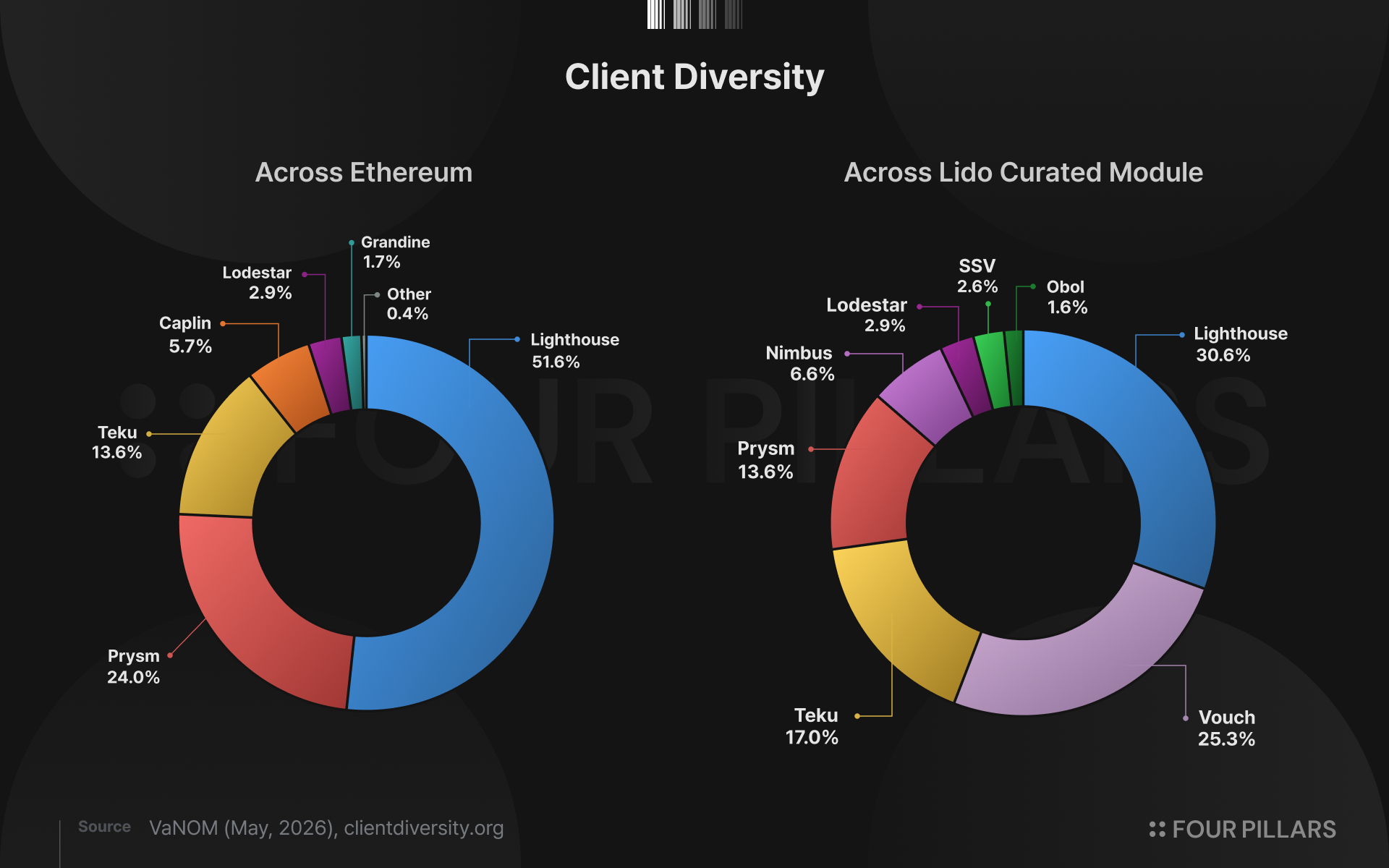
Lido transparently publishes per-module metrics through its quarterly VaNOM (Validator & Node metrics) report, which is an important guide for the entire Ethereum validator community hoping to onboard into the Lido Curated Module.
2.5.3 The Limits of the Curated Module
The Curated Module's biggest strength is stability. Through a Curated Module made up of strictly selected professional node operators, users who stake through Lido can get a stable staking experience without running a validator themselves. But the Curated Module has a few clear limits.
The first limit is that the Curated Module is an unavoidably permissioned structure. Being selected through strict LNOSG vetting was necessary for quality control, but it was also the core reason Lido faced the criticism that it "depends on a few professional operators." Users feel they are participating in decentralized staking through stETH, but the actual validator operation can be concentrated among a few professional operators Lido selected directly.
The second is the limit of reputation-based assurance. The Curated Module selects based on reputation but does not separately bond for validator operation. This means it is a structure that operates optimistically, relying on reputation without measurable collateral or an automated penalty system against the risks that can arise during validator operation. The Curated Module is a trust-based model, and the basis of that trust is the reputation and business sustainability of operators the Lido DAO vetted in advance. This model is effective for assembling an operator set of excellent professional operators, but it carries an essential limit: the protocol's direct means of enforcing operator behavior are limited. Even if operational failure or slashing occurs, automatic recovery such as a bond deduction is impossible, and handling accountability depends on governance decisions and the operator's voluntary cooperation. This is the basis for the bond-based security model introduced in CMv2, discussed in the next section.
The third limit is the governance burden. Changes to the Curated Module, which is responsible for 88% of Lido's delegation, require a DAO vote or a manual operating procedure. Because even routine tasks such as operator address changes, key management, registry updates, penalty processing, and operator status changes must go through a heavy governance procedure each time, it is slow and limits experimental attempts. The bigger Lido grows as infrastructure, the bigger this problem becomes.
These limits make it impossible to expand Lido's operator diversity with Curated operators alone, and they are the reason additional modules that can accommodate other operator models were introduced through the Staking Router.
2.5.4 The Transition to CMv2
CMv2 is an upgrade to improve the Curated Module's limits and move to the next stage in line with Lido's direction. Rather than removing the existing professional operator pool, it redesigns the Curated Module to be more measurable, more automated, and suited to the post-Pectra validator structure. What changes in CMv2 can be organized into four areas: introducing a bond-based security model, operator classification, supporting post-Pectra 0x02-type validators, and a change in the governance operating method.
First, Lido introduces a bond-based security model into the Curated Module. The existing Curated Module operated on reputation alone without a bond, but CMv2 transitions to a structure that requires a bond from node operators. It is a structure where node operators who had participated on reputation alone provide a certain level of collateral, and if performance degradation or operational problems occur, the bond can be partially deducted through a penalty framework. This gives operators clearer economic accountability. It does not replace the reputation of Curated Module node operators but adds measurable economic accountability to that reputation.
Second, in CMv2 Lido seeks to classify all the professional operators of the Curated Module into several types according to the operator's nature and way of contributing, rather than treating them as one. This classification is closer to a typology that distinguishes how an operator contributes to Lido and the Ethereum ecosystem than a simple grading system. A new operator starts as a Professional Operator; an operator with proven prior performance becomes a Professional Trusted Operator; and there are various types such as the Public Good Operator, which contributes to Ethereum client development, the Extra Effort Operator, recognized for additional contributions through LDO holdings and stVaults, and the Decentralization Operator, which contributes to geographic, client, and infrastructure distribution.
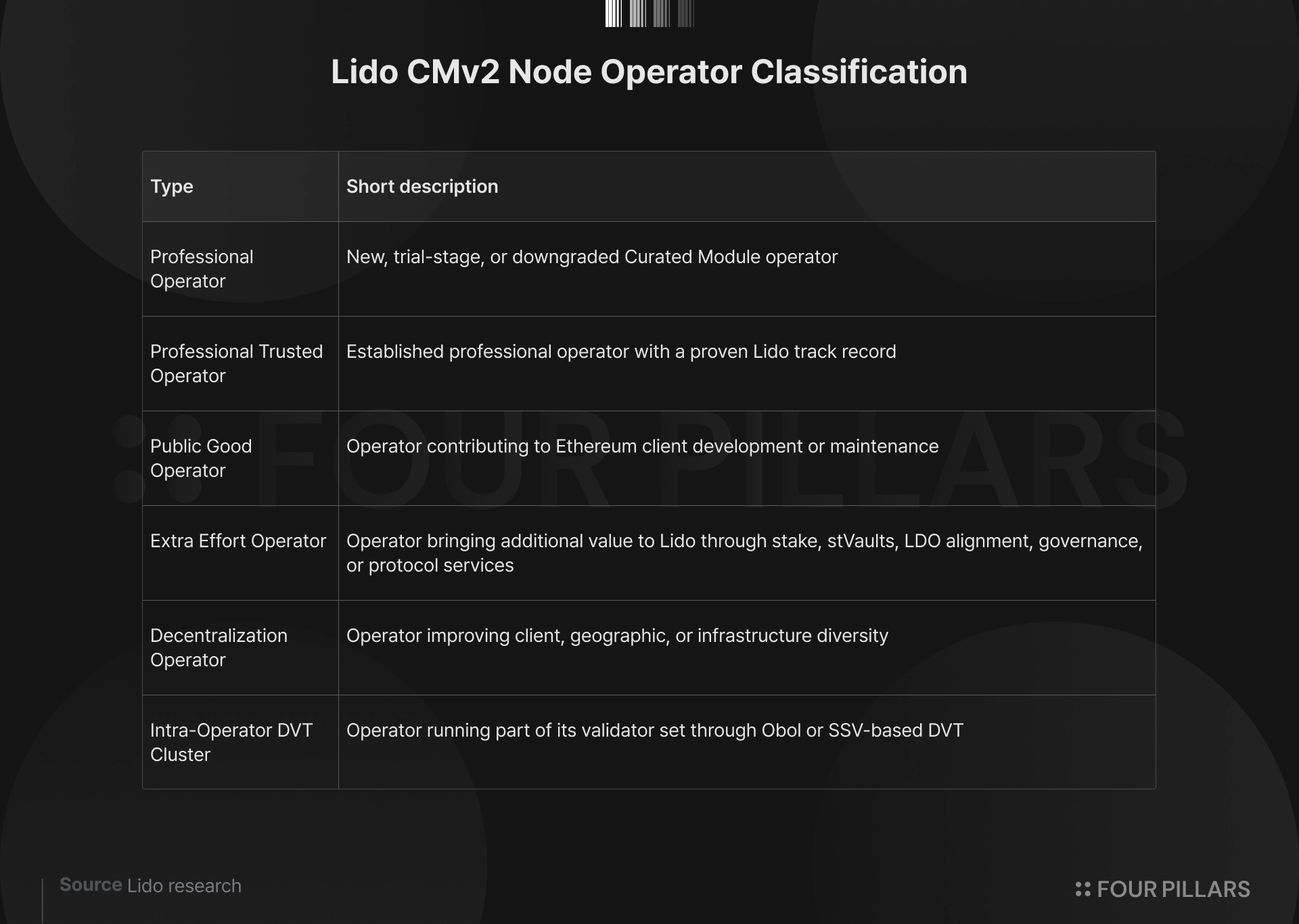
The Decentralization Operator in particular is a type that can be achieved quantitatively through the framework. Lido proposes using VaNOM data to score client diversification, geographic diversity, and infrastructure diversity, and granting this type to operators who receive relatively high scores within a limited number of seats. In this respect, CMv2 is also an attempt to turn the claim that Lido's node operators contribute to decentralization into a more measurable standard.
Next is the response to post-Pectra 0x02 credentials. As discussed, after Pectra Ethereum validators no longer need to be run strictly in units of 32 ETH. Accordingly, the Lido core must also transition from unit-based accounting to balance-based accounting. CMv2 was designed to support post-Pectra 0x02 credentials, and it is likely to be the first migration module in the Lido core pool following the MaxEB change. Because this is a very important and sensitive change, CMv2 will be rolled out in phases rather than applied across the board at once.
Finally, Lido seeks to change the governance structure along with CMv2. Because the existing LNOSG was an advisory committee for node operator selection, it is not suited to the routine operational management CMv2 will expand into. So in March 2026, Lido posted a proposal to convert LNOSG into a new organization, CMC (Curated Module Committee), expanding its role. CMC is a committee with a 5-of-9 multisig structure that can quickly handle tasks such as bond penalties, parameter adjustments, and node operator management. Important decisions such as a new node operator joining still go through a DAO vote, however. CMC is not an organization that replaces the DAO but an executing body that handles repetitive operational work within the scope the DAO sets.
In the end, CMv2 has a direction of making the Curated Module more sophisticated. This shows clearly that Lido's decentralization strategy is not simply about increasing permissionless community operators. It keeps a professional operator pool that can give stability to all of Lido's infrastructure, while changing it into a more transparent, more accountable, and more flexible structure. Through this, the Curated Module moves away from a passive, reputation-based operator pool and becomes a module with bonds, penalties, operator types, and automated operating processes similar to CSM. As a result, the Lido core as a whole moves closer to a modular infrastructure where each module has a different operator model but operates on a common risk management and accounting structure.
2.6 The Simple DVT Module
2.6.1 What Is DVT
To talk about Lido's Simple DVT module, we first have to address what DVT (Distributed Validator Technology) is. DVT is a technology that lets several node operators run a single Ethereum validator together. In an ordinary Ethereum validator node, one validator key is run by one node operator. In this structure, if that operator's infrastructure fails or key management fails, a problem occurs for that validator immediately.
DVT splits one validator key into several pieces, and several operators perform the validator role together using those key shares on their own nodes. It can be understood, simply put, as a structure similar to a multisig for validator operation. This structure enables active-active HA (High Availability) for a single validator, reducing single points of failure and increasing distribution across infrastructure, region, and client.
From the Lido protocol's perspective, DVT has three advantages. First, resilience: even if one node goes temporarily offline, the other nodes can keep performing the validator's duties. Second, security: because the original validator key is not held by one operator but distributed as key shares, the risk of a single operator's key being stolen is reduced. Third, decentralization: because combinations of multiple regions, multiple infrastructures, and multiple clients can be applied within a single validator unit.
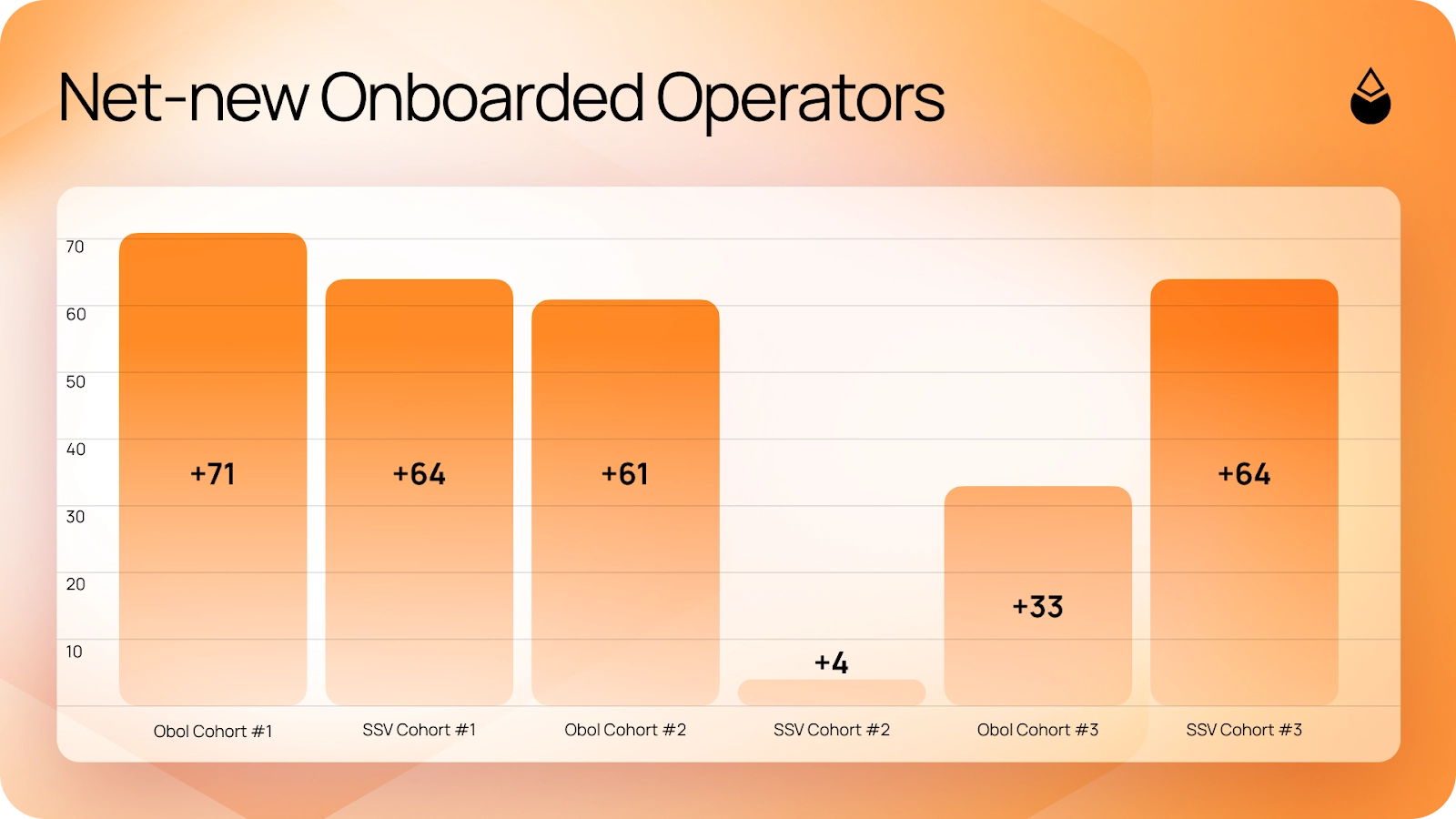
Source: Lido Blog
Lido already had a vetted professional operator set through the Curated Module, but it wanted to bring solo stakers and community operators in at scale. Yet delegating in earnest to insufficiently vetted community operators carried large risk. By letting several operators run one validator together, DVT opened a path for participants with little operational experience or small scale to form a cluster with professional operators and participate as Lido node operators.
2.6.2 The Structure and Meaning of Simple DVT
The biggest reason Lido introduced DVT was to expand its node operator set more quickly and safely. The Curated Module provided a stable professional operator pool but had the limits of being a permissioned structure with a heavy, slow onboarding process. On the other hand, introducing a fully permissionless structure right away carried large risks around performance, slashing, monitoring, and accountability. Simple DVT is an experiment at this middle ground.
Lido approved the introduction of the Simple DVT module in October 2023 and, after a DAO vote in February 2024, added it as the second module of the Lido Staking Router. This module gave solo stakers and community stakers an opportunity to participate as Lido operators through the DVT solutions of Obol and SSV. Simple DVT has a "simple" structure, as the name suggests. Rather than a fully permissionless DVT module, it is a form that requires manual coordination, where each cluster is intentionally curated by Lido so that solo stakers, community stakers, and professional operators are mixed.
Simple DVT is not Lido's final form but an experimental stage for Lido to verify DVT in a real mainnet environment and later introduce a more scalable, permissionless DVT module. Lido's GitHub documentation for the Simple DVT module also states that the Simple DVT module is not operated indefinitely but is to be replaced by a more advanced permissionless DVT module in the future.
Lido gained two main things from introducing the Simple DVT module. First, it could bring a variety of node operators into the Lido operator ecosystem. The mainnet Simple DVT module currently has 82 DVT clusters, each made up of 7 different node operators. Second, Lido could test DVT technology itself in a large-scale Ethereum staking infrastructure environment. This was a process of running thousands of validators in the real Ethereum mainnet environment and verifying DVT's performance and points to improve.
2.6.3 SSV and Obol
Simple DVT adopts and uses both of the Ethereum ecosystem's two representative DVT solutions, SSV and Obol. SSV and Obol provide the same function in that both let several operators run a single validator together, but their specific implementation methods differ. Obol works by inserting the Charon middleware between the existing consensus/validator clients, while SSV works on a separate, independent network. SSV and Obol are third-party infrastructure outside the Ethereum network, and node operators who run validators using them go through a separate layer for distributed key consensus.
As of May 2026, the Simple DVT module has 41 SSV clusters and 41 Obol clusters, each running half of the validator share. Through this structure, Lido verified the possibility of distributing technology-provider risk without depending on a single DVT provider, and it could verify DVT-based validator performance in a mainnet environment through both DVT ecosystems.
By Rated's all-time network RAVER (Rated Effectiveness Rating) standard, the Simple DVT module's performance shows a score that does not lag the Curated Module made up of professional operators. This is a metric that clearly shows the performance of validators run in a distributed way through SSV and Obol clusters is not inferior to that of validators run by a single operator.
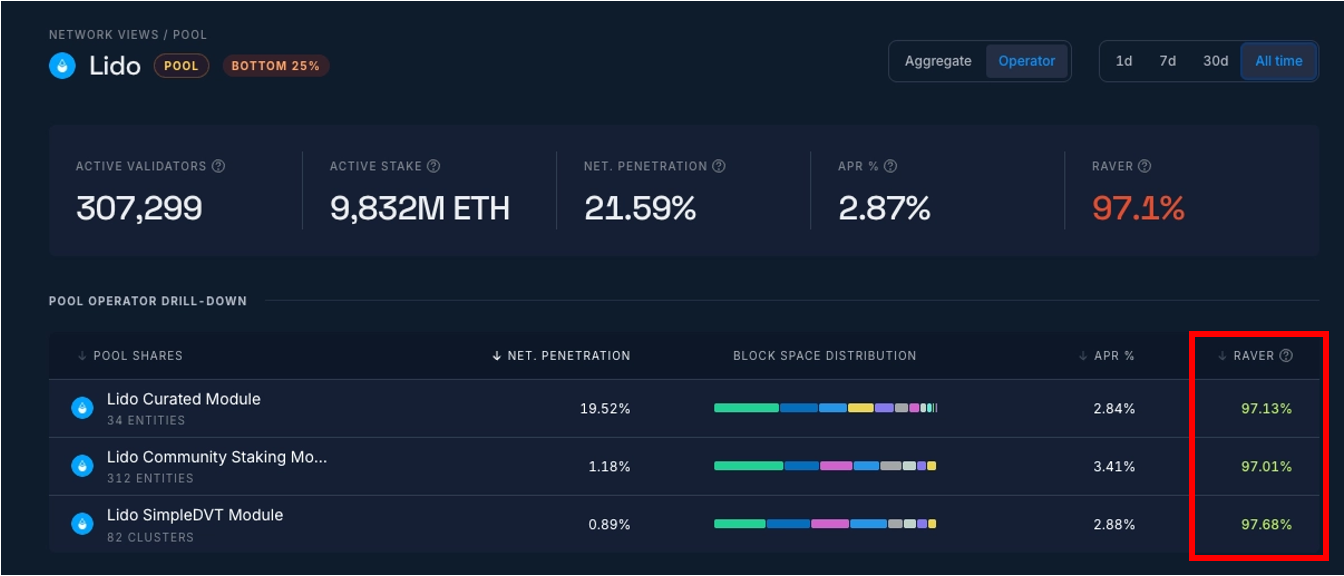
Source: Rated
2.6.4 The Limits of Simple DVT
The most important limit of the Simple DVT module is that it is not a fully permissionless model. To participate in this module, you still have to go through the vetting procedure of LNOSG (CMC). Procedures such as cluster formation, testnet verification, and mainnet onboarding are lighter than the Curated Module's but still require Lido DAO approval. This is the biggest difference from CSM, which anyone can join by simply depositing a bond.
There is also the problem of DVT's own operational complexity. A structure where 7 operators cooperate as a single cluster has higher operational resilience than a single operator, but at the same time the procedure for validator operation becomes very complex. It requires additional infrastructure such as a cluster coordinator, a DKG ceremony, and a splitter contract, and coordination among cluster members is not easy either.
This complexity is reflected in the economic structure as well. The Simple DVT module takes 10% of total staking rewards as a fee, but only 2% of that goes to the DAO treasury, while 8% is distributed to node operators and DVT providers. This differs from the Curated Module's 5%/5% structure and reflects the operating cost of DVT clusters, where several operators must jointly run a small number of validators, and the cost burden of the DVT provider's continued technical support.
Simple DVT was an important achievement in Lido's decentralization strategy, but it is not the final form itself. As specified as a temporary module in the proposal, it is a module with an experimental character. So when evaluating Simple DVT, it should be seen as "a bridge toward a more scalable permissionless DVT module." The more direct permissionless node operator module Lido aims for is CSM, the Community Staking Module, covered in the next section.
2.7 The Community Staking Module
2.7.1 The Purpose of CSM
CSM (Community Staking Module) is the module that represents Lido's decentralization strategy. It is also the first staking module in the Lido protocol to open a full-fledged opportunity for permissionless node operator entry. If the Curated Module is a module of professional node operators the Lido DAO selected directly, and Simple DVT is a module that brought in some community operators in a limited way through DVT clusters, CSM is a channel where a wider range of community operators can participate as Lido node operators on their own, without permission.
Through CSM, anyone who deposits a certain level of bond can run an Ethereum validator using ETH that flowed in through the Lido protocol. So unlike the existing modules, a variety of community operators such as solo stakers, small businesses, and amateur individual operators can participate as Lido node operators without a separate vetting procedure or DAO approval.
Node operator decentralization was not only a matter of strict vetting and approval procedures. The minimum requirement to run an Ethereum validator is 32 ETH, which as of May 2026 is more than $70,000. On top of that, equipment and network costs for node operation were needed, so running an Ethereum validator directly was not capital-efficient for individuals or small organizations.
But CSM has much higher capital efficiency compared with existing Ethereum solo staking. In CSM, a node operator does not deposit the full 32 ETH. The operator deposits a portion as a bond, and the rest of the validator deposit is allocated through the Lido core pool. When CSM transitioned to a fully permissionless module in January 2025, a general operator needed a 2.4 ETH bond to submit a first validator key, and 1.3 ETH for each additional validator afterward. Node operators who participated in the early adoption stage could get a discounted bond requirement of 1.5 ETH even for the first validator. Without going through CSM, 32 ETH can run only one validator, but using CSM, the same 32 ETH can run more than 20 validators.
Another advantage is that CSM's node operation rewards have a socialized rewards structure. A CSM operator does not depend only on the luck of a specific validator they run getting to propose a block; CSM operators who meet performance criteria receive a proportional share of the module's node operator rewards. This structure has the effect of lowering the reward volatility a solo staker running only one or two validators faces.
The bond a node operator puts up is not a simple entry fee but collateral to cover the risk of community operators running the ETH users deposited. If an operator fails to run the validator properly or problems such as performance degradation, downtime, or slashing occur, the deposited bond can be deducted as a penalty. CSM is thus a structure that raises capital efficiency while giving operators economic accountability.
2.7.2 The Significance of CSM

Source: Lido Blog
CSM is not a simple feature addition but an important answer to the political debate surrounding Lido. Lido was once criticized as a centralization risk for Ethereum staking. One of the core criticisms was that, because of Lido, Ethereum PoS validators were concentrated among a few professional node operators Lido selected. As Lido's share rose, political and technical centralization deepened on the node operator side that runs Ethereum validators. In fact, Lido's share grew to over 30%, but node operation was carried out by about 30 Curated operators. This became the basis for the criticism that Lido could become a single point of failure for the Ethereum consensus layer.
Through CSM, a narrative emerges that as Lido gathers ETH, more community operators can participate as Ethereum validators. CSM is also not meaningful simply because it is permissionless. Ethereum is a PoS network that does not support native delegation. Ethereum has no protocol-level mechanism that lets you delegate a staking asset to another operator while safely keeping ownership of that asset. In this situation, CSM can also be seen as the most active attempt to show how far a non-custodial LST can decentralize in Ethereum's environment, which does not support native delegation.
Another significance of CSM concerns Lido's identity itself. Lido was a "protocol that simplifies the Ethereum staking UX" at its early launch, but after CSM it gained a new identity as "infrastructure that decentralizes Ethereum infrastructure and lets anyone participate in staking."
2.7.3 The Limits of CSM
CSM is an important module for Lido's decentralization strategy, but it still has a few limits.
The first lies in the paradox of permissionlessness. CSM's bond requirement is one-twentieth of solo staking, which needs a minimum of 32 ETH, so its capital efficiency is good. But the possibility arose that large operators with capital, rather than small independent operators, would be the first to use CSM's capital efficiency. Permissionlessness has political legitimacy for decentralization in that "anyone can enter," but it also carries the paradox that the operator pool can form differently from the intent, because the protocol's control weakens.
The second is that the bond itself is still a barrier to entry. Under CSM v2, the first validator key requires a 2.4 ETH bond, which is more than $4,000 at the June 2026 ETH price. This may still be a burdensome level for some. And considering the equipment and network costs for running an Ethereum validator node, running only one validator is more likely to result in a loss. Lido frames it as "letting home stakers participate in Lido," but the actual participants are likely to be people who already have tens of thousands of dollars of capital or enterprise-style operators. For grassroots participation in the true sense, this threshold needs to come down further.
The third is that the permissionless structure comes with operational quality risk. The Curated Module vets an operator's identity, infrastructure capability, reputation, and business sustainability in advance. CSM, by contrast, must let anyone enter, so operator quality is likely to be uneven. For this reason, CSM needs a bond as collateral, performance criteria, penalties, and a forced-exit structure. According to Lido's CSM documentation, accumulated penalties, balance decreases, and acts such as siphoning off block rewards can be deducted from a node operator's bond. CSM is not a fully trustless structure but closer to a method of replacing reputation-based pre-vetting with bond-based collateral and an after-the-fact penalty structure.
The fourth is operating cost and the technical burden. Even with the bond barrier lowered, the technical burden of running a node stably 24/7/365 remains. CSM lowered the capital barrier to entry, but the barrier in terms of technology and operating equipment remains largely unchanged. Moreover, the strikes system introduced in CSM v2 can be a burden on solo stakers. This is less a problem of CSM than an essential difficulty of solo staking itself, where an individual runs a validator node, but it is a reason the actual eligible participants are limited compared with the ideal of "anyone can participate" that CSM pursues.
These limits do not mean CSM is a failure. CSM should be seen not as a device that completes Lido's decentralization, but as a device that defines the problem area for decentralization and advances it systematically. In the end, CSM shows that Lido's decentralization strategy has moved from "the problem of selecting more permissioned professional operators" to the harder problem of "how to safely accept unpermissioned operators." The CSM v2, ICS, and IDVTC discussed next are exactly Lido's direction on these problems.
2.7.4 CSM v2
CSM v2 is an upgrade to expand CSM and run it more safely at the same time. If CSM v1 first opened permissionless node operator participation, CSM v2 adds operator types and a sophisticated risk management system on top. CSM v2 has two main goals: expanding the share of permissionless operator staking in the Lido core pool to 10%, and increasing community stakers' actual participation.
With the CSM v2 launch, the stake share limit for permissionless staking rose from 3% to 5%. A path was also approved, through a DAO vote, to expand this share to 10% by early 2026 if certain conditions are met. Unlike Simple DVT, this confirms a direction of expanding CSM not as a mere experimental module but as an operator module that holds a meaningful share within the Lido core pool.
CSM also introduced Entry Gates. Entry Gates are a structure that lets different entry paths and conditions be set per node operator type. In CSM v2, there are entry gates such as Permissionless Operator, ICS (Identified Community Stakers), and Legacy Early Adoption, and different conditions such as reward distribution, bond requirements, and deposit priority can be applied per operator type. In CSM v2, rather than treating all permissionless operators as one group, the structure changes to provide different conditions according to the operator's nature and level of trust.
EIP-7002, introduced to Ethereum mainnet in the Pectra hard fork, is also integrated into Lido in CSM v2. As mentioned, EIP-7002 is an upgrade that lets a validator exit, which was previously dependent on the validator key, be triggered through the withdrawal credentials as well. CSM v2 uses this as the technical basis of the strikes system. Through this, Lido can reduce its dependence on and trust assumptions about node operators in situations of voluntary operator requests or the forced exit of low-performing validators.
The essence of the change CSM v2 brought is the shift from "uniform permissionlessness" to "permissionlessness by type." It keeps the political legitimacy of permissionlessness while letting the Lido protocol design more precisely which type of operator participates under what conditions within that permissionless environment. CSM v2 is also a stage in CSM's evolution rather than a finished model. Lido plans to introduce CSM v3 within 2026.
2.7.5 ICS: Identified Community Stakers
If one had to pick the most important among the operator types introduced in CSM v2, it would be ICS (Identified Community Stakers). ICS is a mechanism to provide better conditions to identified community stakers. Unlike existing CSM operators who remain fully anonymous, an ICS operator proves they are an independent community staker and meets certain criteria. Becoming ICS gives benefits such as commission adjustment, lower bond requirements, and priority delegation. Specifically, an ICS operator can receive a higher commission (6%, versus 3.5% for a general operator) on the first 16 active validators, has the bond requirement for the first key lowered from 2.4 ETH to 1.5 ETH, and can receive priority delegation for the first 10 validators.
The most important point about ICS is that Lido created a mechanism that keeps the political legitimacy of permissionlessness while preventing CSM from being absorbed only by large professional operators, and that protects the participation of actual independent operators. General permissionless participation remains open to anyone. But a solo staker who passes ICS verification receives additional benefits. The data used for eligibility verification are all materials already trusted on Ethereum, not a whitelist Lido makes itself. This is a mechanism that can give priority to the independent community operators Lido targets, without undermining the essence of permissionlessness.
On the other hand, ICS differs from fully anonymous permissionless participation, because an operator must identify themselves and be evaluated to receive better conditions. ICS is therefore a compromise between lower trust assumptions and higher capital efficiency. Base CSM provides a path anyone can enter, and provides better conditions to vetted independent operators who give up anonymity and acquire ICS status. By running these two together, Lido seeks to balance openness and stability.
2.7.6 IDVTC: Identified DVT Cluster
Source: Lido Research Forum
The IDVTC (Identified DVT Cluster) proposal posted to the Lido research forum in March 2026 shows CSM's next evolutionary direction. IDVTC is a form where ICS node operators jointly run validators as a single cluster using DVT. Because DVT has several operators running one validator together, it has higher resilience than a single-operator method and can lower downtime and slashing risk. But because rewards are split among several people at the same time, the appeal of participating can fall unless economic incentives are designed separately. So IDVTC provides separate conditions to match, in bonding requirements, commission, and delegation priority.
An IDVTC cluster must be made up of four independent participants, and each participant must be ICS-approved or an ICS operator. Each cluster must use Obol or SSV, as in Simple DVT, and generate keys through a DKG procedure. Each participant can join only one IDVTC, and if the requirements are not met, that cluster can be downgraded to the base CSM type.
IDVTC's goals are to increase independent stakers' participation and to accelerate DVT adoption within CSM. For IDVTC, the per-person capital cost to participate as a node operator is lower than other CSM types, so capital efficiency can be maximized. And because IDVTC has four operators running a validator together using DVT, operational resilience improves. This provides strong stability to solo stakers who find it hard to build sophisticated monitoring systems and high-availability infrastructure.
IDVTC is targeted for introduction within 2026 along with CSM v3, and the official recruitment process began as of June.
2.8 Changes to the Lido Core After Pectra
The Curated Module, Simple DVT module, and CSM seen above are all staking modules that operate on top of the Lido core. The problem is that the Ethereum staking structure when this Lido core was first designed differs from the Ethereum staking structure as of 2026. EIP-7251 in particular, which raised the maximum effective balance a single validator can earn rewards on from 32 ETH to 2,048 ETH, is a major undertaking that requires redesigning the Lido core's accounting method, the Staking Router, the oracle, node operator rewards, withdrawal processing, and even the per-module share allocation method.
2.8.1 The Lag Between Ethereum Consensus Changes and the Lido Protocol
Changes to the Ethereum protocol, especially those related to validators and staking, have a large effect on staking protocols like Lido. Lido is an on-chain protocol handling assets on the scale of millions of ETH, with DAO governance, external audits, oracles, per-module contracts, and node operator lifecycles all intertwined.
For this reason, Lido responds conservatively to Ethereum mainnet changes. Shapella was activated on April 12, 2023, but Lido V2's withdrawal feature was applied to mainnet about a month later, on May 15. Because Pectra comes with a much more complex set of changes, the Lido core pool's response needs more time. The focus of LIP-27, the proposal for the Pectra hard fork response, was not on Lido reflecting the changes introduced to Ethereum. LIP-27 was a proposal aimed first at maintaining compatibility so the protocol would keep running without issues after the hard fork. Lido's first response to an Ethereum change is always safe compatibility maintenance.
2.8.2 From Unit-Based Accounting to Balance-Based Accounting
The pre-Pectra Lido core was designed from the start on the premise of 0x01-type validators. In this structure, a single validator's effective balance is fixed at 32 ETH, and rewards exceeding 32 ETH are automatically withdrawn to the designated withdrawal credentials address. Under this structure, the most efficient accounting model is the unit-based accounting model. If the Lido pool has N active validators, the total deposited assets of Lido validators are "number of active validators x 32 ETH." Because assets exceeding 32 ETH are automatically withdrawn, the accounting for rewards is also clean.
The 0x02-type validator added after Pectra breaks this assumption. The balance of a 0x02-type validator is fluid, from a minimum of 32 ETH to a maximum of 2,048 ETH. A validator under 2,048 ETH has its rewards compound internally and can also be partially withdrawn manually. A validator's balance being variable means the Lido core pool's Beacon Chain assets can no longer be calculated as "number of active validators x 32 ETH."
For the Lido core pool to work correctly after Pectra, it has to track and calculate each validator's balance individually. This means the accounting model must transition to balance-based. The AccountingOracle's reporting also has to become more precise. Previously it only needed to track the number of active validators and the number of exited validators, but in a balance-based model it must track each validator's actual balance and balance changes (reward accrual, partial withdrawals, penalties, and so on). This transition of the accounting model is the most important part of the Lido core pool's Pectra response. It is not simply changing the validator key format from 0x01 to 0x02; the entire set of Lido core pool contracts must be redesigned to operate on new accounting assumptions. This is where the essence of the changes SRv3 and LIP-33 address lies.
2.8.3 Why stVaults Change Before the Lido Core
The first place 0x02-type validators were introduced in Lido was not the Lido core pool but stVaults. When Lido V3 and stVaults launched on mainnet on January 30, 2026, stVaults' validators were designed to support the 0x02 type from the start. Unlike the Lido core pool, which has operated since 2020, Lido V3 is a structure newly designed on the premise of the post-Pectra environment.
stVaults also have a separate accounting structure per vault. Because the Lido core pool operates with all users' ETH merged into a single pool, an accounting model change affects all users at once, but in stVaults each vault operates as an independent accounting unit. Even if a particular stVault introduces 0x02-type validators, it does not affect users of other vaults or the Lido core pool. This means the operational risk of introducing 0x02 is isolated per vault.
For these two reasons, Lido applies post-Pectra new features to stVaults first and verifies them sufficiently, then introduces them to the Lido core pool in phases based on the results.
2.8.4 LIP-33: CSM v3 and Curated Module v2
LIP-33 is an integrated proposal that migrates the Curated Module and CSM to the post-Pectra environment at the same time. Lido bundled the upgrades of its two major axes, the Curated Module and CSM, into a single integrated proposal. CSM v3 and CMv2 both support 0x02-type validators and transition to a balance-based accounting form. This transition is based on SRv3 (Staking Router v3), explained in the next section, with each module's specialized features layered on top of SRv3.
Apart from the infrastructure upgrade, you can see that Lido's reference module is gradually shifting from the Curated Module to CSM. The LIP-33 proposal states that CMv2 is built on the CSM v2 codebase. In practice, the bond-based security model introduced in CMv2 was introduced first in CSM v2, and other models that may be added to the Lido core pool in the future can be expected to borrow CSM's bond-based model and automated penalty system as well.
2.8.5 SRv3 and ValMart
SRv3 (Staking Router v3) is an infrastructure-level change to actually apply the CSM v3 and CMv2 included in LIP-33. The main changes in SRv3 are as follows.
- Validator Consolidation: SRv3 supports consolidating several 0x01-type validators (32 ETH validators) run by the same node operator into a single 0x02-type validator. For example, if one node operator runs 100 32-ETH validators, after SRv3 these can be consolidated into one or two large 0x02 validators. This greatly reduces a node operator's infrastructure burden, and by reducing the number of validators across the Ethereum network, it also has the effect of reducing the load on the consensus layer.
- Performance-based Stake Allocation: SRv2's existing ETH allocation method,
MinFirstAllocationStrategy, was a simple method of allocating from the least-filled module first. In SRv3, by contrast, ETH allocation is decided considering several variables such as the node operator's performance, cost structure, and contribution to decentralization. The system for this allocation is ValMart, explained next.
ValMart (Validator Marketplace) is a system Lido plans to newly introduce in SRv3. In ValMart, node operators do not simply receive ETH allocations according to a fixed fee and fixed algorithm the DAO sets; they participate in competition based on performance, fees, operator type, and contribution to decentralization. A node operator presents to ValMart the commission they want to receive, the number of validators they can run, and their decentralization contribution (geographic distribution, client diversity, and so on), and ETH is allocated to the operator who is most efficient in the market at that moment.
This becomes a mechanism that introduces competitive pressure into the node operator market, making more capital flow to more efficient operators. A node operator's performance is directly connected to APY and can increase the protocol's overall revenue, and because it includes decentralization contribution as a price variable within the market mechanism, Lido's operator diversity becomes a value reflected directly in capital flows rather than a mere selection criterion. According to materials Lido disclosed at the Poolside Tokenholder Update Call in November 2025, the entire Lido core pool upgrade including ValMart (CMv2 + SRv3 + ValMart) is estimated to secure about 2,600 ETH of additional annual revenue for the Lido DAO treasury.
3. What Lido Offers: New Product Lines
Lido's early product was very simple. A user deposits ETH and receives stETH, a liquid token that reflects staking rewards. But the Lido of 2026 is moving beyond this single-product structure. V3 and stVaults provide customizable staking infrastructure for institutions and builders, and Lido Earn expands the product family with new yield products based on stETH. This chapter looks in concrete terms at the new product lines Lido offers.
3.1 Lido V3 and stVaults: Customized Staking on Shared Liquidity
3.1.1 The Background
Lido was able to become the dominant infrastructure in the Ethereum staking market through pooled liquid staking. But the existing liquid staking product Lido offers has the limit that all users' ETH operates within a single core pool. In this structure, an individual user cannot choose the node operators, risk policy, or fee structure. This simplicity is an advantage for retail users, but it is a constraint for certain institutionsthat haveto choose along complex conditions, not just staking yield: the operating party, jurisdiction, accounting segregation, auditability, custody, and risk control structure.
So institutions have entered Ethereum staking by running validator nodes directly, or by using the services of professional operators who offer bespoke staking. Bespoke staking has high control and is easy to fit to internal accounting standards or compliance requirements, but it is hard to give it liquidity like Lido's stETH.
Lido V3 offers an option that mixes the advantages of Lido and bespoke staking. It keeps the shared liquidity of stETH while letting institutions and builders design their own validator operation structure. The core product for this is stVaults. stVaults is a new product layer that lets you build customized staking vaults on top of the existing Lido infrastructure.
3.1.2 The Structure of stVaults
stVaults are non-custodial smart contracts. Each vault's owner can decide the vault's operating composition on their own: the node operators, the fee structure, validator operating conditions such as client diversity or region, and risk parameters. In the existing Lido core, all ETH a user deposits gathers into one pool and delegation occurs according to the protocol's rules, but in stVaults each vault becomes a separate operating unit. stVaults are an accounting structure separated per vault. What happens in one vault does not affect other vaults or the Lido core pool. This is the biggest difference from the single-pool structure of the existing Lido core pool.
The basic structure of an stVault is as follows.
- Vault Owner: The vault owner is the party that creates the stVault and sets its operating conditions.
- VaultHub: The VaultHub is the registry and coordination contract of stVaults. Each vault mints or burns stETH through the central VaultHub contract, and the VaultHub enforces protocol-level conditions such as the Reserve Ratio, Share Limit, Force Rebalance Threshold, and Fee Rate.
- OperatorGrid: The OperatorGrid can be called the policy layer that manages each vault's risk tier and operator conditions. It sets each vault's Reserve Ratio, Share Limit, Force Rebalance Threshold, and Fee Rate, and tracks the total stETH issuance across all vaults.
What makes stVaults different from ordinary bespoke staking services is that they can optionally mint stETH. A vault owner can mint stETH against the ETH staked in their vault as collateral. Because the minted stETH is the same token as the stETH the Lido core pool mints, depositors in stVaults can enjoy stETH's liquidity just the same.
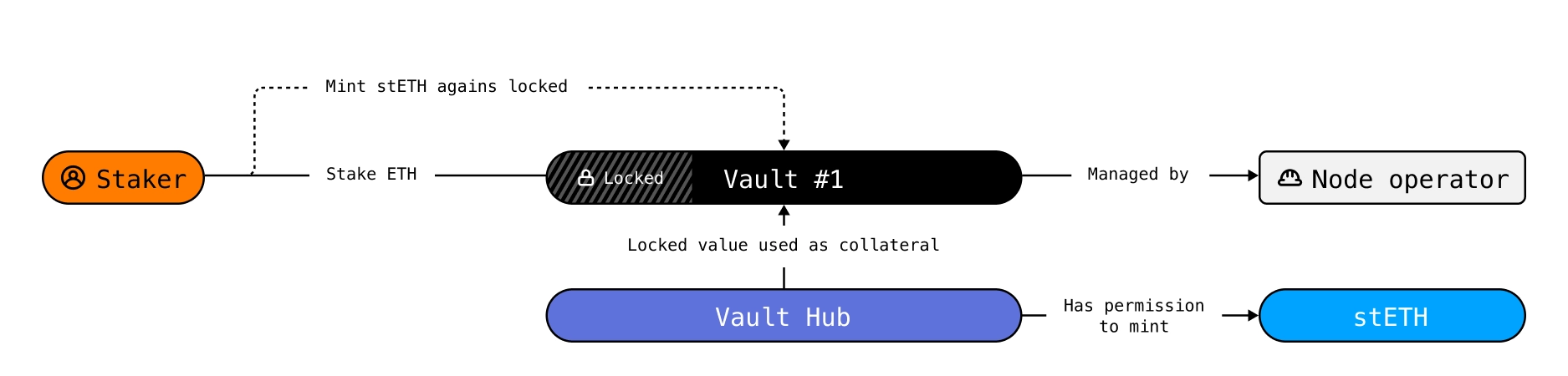
Source: Lido V3 Whitepaper
3.1.3 stETH Redemption Stability and Risk Isolation
The vaults in stVaults each have different node operators, different risk policies, and different operating structures. Yet they all share the same stETH liquidity, so a large loss in one vault could in principle transmit to every stETH holder if that vault's minted stETH were treated identically to all other stETH. The way stVaults guards against this is by not allowing a vault to mint stETH one-to-one against the ETH it holds. A vault must keep part of its ETH aside and can mint stETH only within the remaining ratio, and this gap is what protects stETH as a whole.
The two concepts behind this are liability and reserve. When an stVault mints stETH, it takes on a liability to later return ETH equal to the stETH it minted. The reserve is the cushion asset kept aside to handle that liability stably. Rather than converting all the ETH a vault holds into stETH, a certain percentage is held as reserve, and stETH can be minted only within that ratio. Because a vault is never minted up to a full one-to-one ratio, a loss inside that vault is absorbed first by its own reserve rather than by other stETH holders.
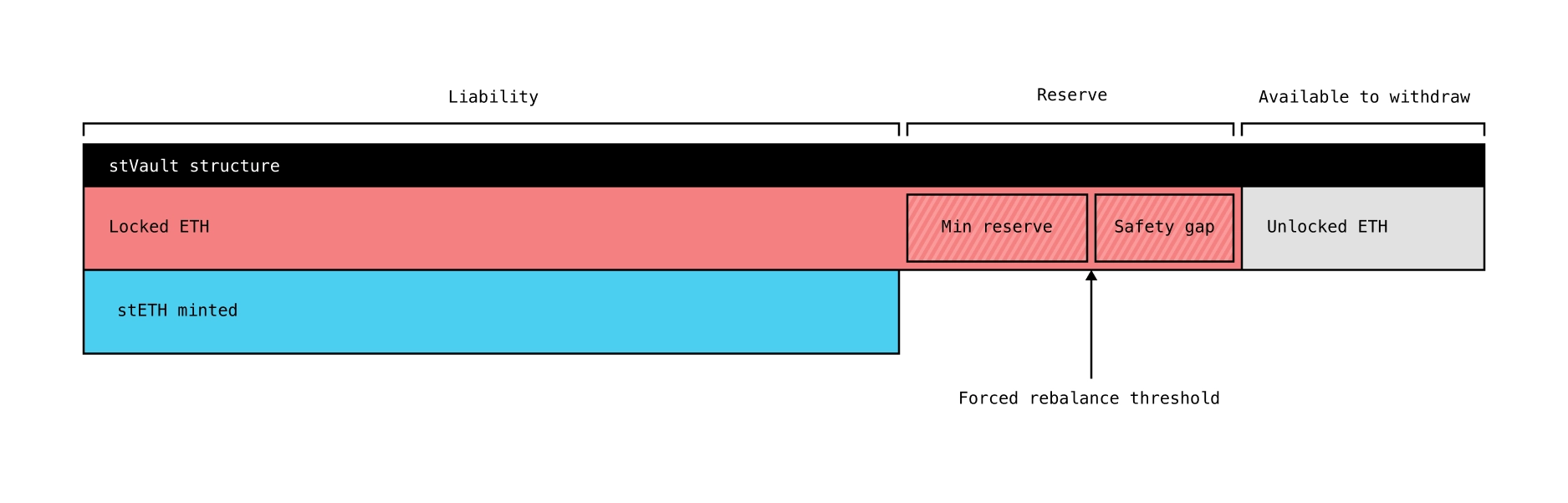
Source: Lido V3 Whitepaper
The parameters for managing this are the RR (Reserve Ratio) and the FRT (Force Rebalance Threshold). The RR is each vault's ratio for the minimum reserve. The FRT is the threshold at which, if the reserve falls below it, the vault is regarded as unhealthy and becomes subject to forced rebalancing. If a vault maintains enough reserve, it can mint additional stETH and operate normally. But if the reserve falls below the RR, new minting is restricted. If the reserve drops further below the FRT, the protocol triggers forced rebalancing to try to restore the vault's state.
Forced rebalancing is an permissionless recovery mechanism to prevent a particular vault's risk from transmitting to all stETH. On Ethereum, there is a possibility that staking assets fall below principal depending on node operation. If a vault's total asset value decreases because its validators accumulate penalties from low performance or are slashed, that vault's reserve can decrease sharply. In this situation, the protocol enables forced rebalancing to adjust the vault's asset composition, reducing the vault's total value and its stETH liability by the same amount to restore the backing ratio.
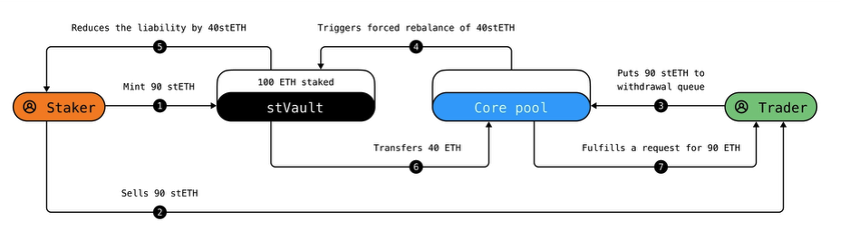
Source: Lido V3 Whitepaper
The RR is applied differently per vault, and the basis for applying the RR is decided by the tier of the node operator running that vault. a lower RR and a higher stETH minting limit apply. Across the verified categories the RR ranges from about 2% to 20% depending on the category, and within a category it is further split into tiers. In the Basic category, which has the simplest onboarding requirements, a node operator is assigned across five tiers with RRs of 5%, 6%, 9%, 14%, and 20%.
A vault run by an unverified node operator (Default Tier) has a strict RR of 50% applied. Because the operational quality of a node operator Lido has not vetted in advance is hard to assure, the vault is forced to keep more than half of its assets as a backing buffer. The minting limit here is a low 5,000 stETH, applied as a common cap shared across all vaults connected to the Default Tier at RR 50%. The stVaults Committee plans to raise this cap in phases, up to 500,000 stETH, as it sees demand.
There is also a protocol-wide cap. The total stETH minted by stVaults cannot exceed 1/3 of all stETH Lido has minted, and in the early launch period it operates at a more conservative 1/4. This is a mechanism to limit the effect that risk arising in stVaults has on Lido core pool users.
These mechanisms exist to strike a balance between shared liquidity and risk isolation. Lido V3 lets several kinds of staking businesses share the same stETH liquidity, while having each vault absorb as much as possible of the risk it creates within that vault.
3.1.4 The Changes V3 Brings to Lido
Through the launch of V3 and stVaults, Lido has moved closer to a platform where several kinds of customized staking businesses can sit on top of a single shared infrastructure, rather than a simple liquid staking service. Specifically, the market impact V3 creates for Lido can be summarized in three points.
First, an entry channel for institutions. The existing Lido, where node operators and specific policies could not be customized, was not attractive to certain institutional users. The sharp decline in Lido's share after institutional Ethereum staking took off stems from this. stVaults solve this, and can be called Lido's important strategic product for absorbing institutional staking demand.
Second, the possibility of integrating staking for L2-bridged ETH. Without a user needing to stake separately, simply bringing ETH onto an L2 turns that ETH into an asset that automatically generates yield through stVaults. ETH bridged to an L2 can be made into a yield token that is a native coin and has the same stability as stETH at the same time. The Linea network is a representative case. If this model spreads to other L2s, it opens the possibility that some of the billions of dollars of ETH locked in L2s is absorbed into Lido in stVault form.
Third, it becomes a new integration opportunity with DeFi and professional node operators. To build a new Ethereum staking product, you previously had to build everything yourself: the infrastructure for non-custodial operation, node operation, and even liquidity paths. Using stVaults can greatly lower this burden. Builders only need to implement the differentiated logic of their own product, because they can solve complex parts such as validator operation, staking infrastructure, stETH minting, and DeFi integration through Lido. As examined further below, Nansen's first staking product launch is a case, and several professional node operators are also launching their own staking services through stVaults.
Lido V3 is not a simple protocol upgrade but a platform-level shift that expands Lido's users and product range. The next section looks at what use cases this structure actually leads to.
3.1.5 Launch Partners and Use Cases
3.1.5.1 Institutional Staking Products
stVaults is a service with a strong strategic character for absorbing institutional Ethereum staking demand. From launch, Lido worked to secure cases targeting a variety of node operators and institutions. The following are representative institutional staking product cases using stVaults.
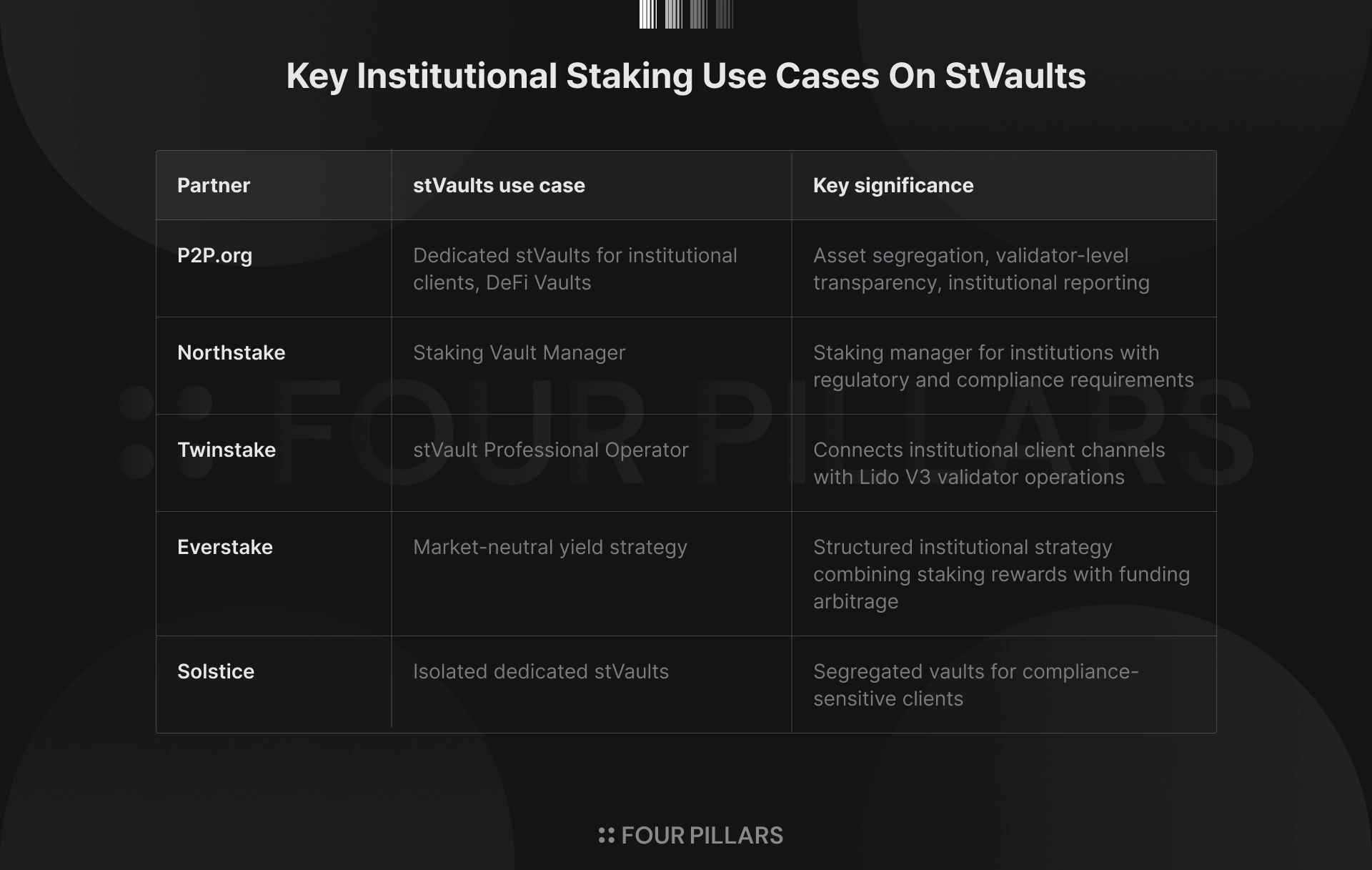
The institutional use cases of stVaults have a range of directions. P2P.org combines per-client dedicated vaults with DeFi vaults; Northstake provides a regulation-tailored staking management tool specialized for regulatory requirements. Twinstake connects its institutional client network and validator operation capability to Lido V3, and Everstake combines staking rewards with hedging strategies to create yield products that reduce exposure to market direction. Solstice focuses on dedicated vaults for clients where asset segregation and regulatory response matter.
These all implement differentiated, customized staking products that were not possible with Lido's existing staking service, while keeping stETH liquidity. stVaults is less a feature that simply lets institutions use Lido than a productization platform that helps build institutional Ethereum staking products.
3.1.5.2 L2 Native Yield: Linea
ETH bridged to an L2 stays as an unproductive asset in the bridge contract on Ethereum mainnet. Attempts are increasing to stake ETH bridged to an L2 on Ethereum L1 so that native yield accrues to the L2 ETH. Among these, Linea handles this process through Lido V3's stVault.
Linea uses an stVault managed by protocol infrastructure for staking bridged ETH, and that stVault is connected to Linea's bridge-native capital flow. This structure lets the L2's ETH generate native yield without undermining the bridge's withdrawal and custody guarantees. Linea also does not stake the bridged ETH directly but maintains a separate liquidity buffer. Through this buffer it supports instant withdrawals in normal situations, but when the buffer is insufficient, it mints stETH from the stVault to provide an alternative withdrawal path. Through this, it can provide native yield to users who bridge ETH to Linea while giving a good experience for deposits and withdrawals as well.
Linea is a case that shows stVaults is not only an institutional staking product. stVaults let protocol infrastructure such as L2s and bridges embed Ethereum staking within their own capital flows. Lido V3 makes Ethereum staking a base yield layer for a protocol's network economy.
3.1.5.3 DeFi Wrapper and Builder Use Cases
stVaults can also be used as a base for building DeFi strategies and per-user customized products. For this, Lido launched a DeFi Wrapper toolkit alongside V3. This is a set of contracts that consolidates several users' deposits into one stVault so that an stVault, which is a single-address-only structure, can be integrated into DeFi. Using this tool, a builder can create a staking product under their own brand without building their own smart contract from scratch.
In addition to per-client customized private stVaults, P2P collaborates with DeFi curators such as Mellow to embed public stVaults into composite strategy products. This becomes a base for offering more complex yield products by combining DeFi strategies that use stETH, while keeping the transparency and stability of institutional staking.
In an stVaults update in April 2026, Lido added a connector to Lido Earn in the DeFi Wrapper. This created an option to route stETH minted from stVaults to Lido Earn. stETH coming out of an stVault can be connected to a DeFi strategy such as Lido Earn without separate, complex infrastructure. This shows stVaults is becoming a productization tool that connects Ethereum staking and DeFi strategies.
Source: Lido Blog
Nansen plans to launch its first Ethereum staking product based on Lido V3 stVaults. Nansen's product provides direct exposure to specific validators and on-chain information on staking performance. In the existing staking pool structure, per-validator performance is often abstracted away, but Nansen's stVaults product clearly connects specific validator operators with performance. On top of this, it seeks to combine Nansen Points or additional permissionless incentives to provide incentives beyond simple staking rewards. Through the Nansen case, you can understand why stVaults is a product development tool. stVaults becomes a base that can combine per-validator information, data infrastructure, performance analysis, additional incentives, and DeFi strategies within a single product.
In the end, the core of the DeFi Wrapper and product-developer use cases is productization speed and differentiation. In the past, building a new staking product required designing the custody structure, staking flow, validator operation, liquidity, DeFi integration, UX, and accounting structure all separately. stVaults and the DeFi Wrapper let a large part of this be solved on top of Lido's infrastructure. As a result, staking product builders can focus on "what staking product to build for which customer segment" rather than "implementing staking infrastructure."
3.1.6 V3 and Governance Risk: Safety Hatch
Lido's smart contracts are upgradable factory contracts. And contract upgrades are driven by DAO governance. The problem is that there can be stVault owners who do not agree with a particular upgrade. There is no problem when a user agrees with Lido's operating direction, but when a DAO decision conflicts with their interests, it becomes a risk factor. This is a very important issue for institutional users in particular.
Safety Hatch is a feature to reduce this risk. It provides an exit by which an stVault owner can separate their vault from the Lido DAO's governance decisions. Safety Hatch is basically a mechanism to trust the Lido DAO while being able to escape in an extreme situation. For stVaults to be adopted by institutions, this option matters. Institutions want liquidity and protocol infrastructure, but at the same time they do not want to be exposed defenselessly to governance changes they cannot control.
The core of Safety Hatch is the pending upgrade opt-out. When the Lido DAO passes a new upgrade proposal, it enters a pending state until the upgrade actually happens. A vault owner can choose to separate their vault from Lido governance before that upgrade is applied to it. A decision by DAO governance is not automatically applied to the vault; per vault, the owner can choose whether to apply the upgrade.
Safety Hatch cannot be used, however, while a vault is minting stETH. If a vault that is minting stETH could unilaterally escape Lido governance, the backing of the stETH minted by that vault would be placed outside the Lido protocol's safeguards. So Safety Hatch provides the governance escape right only for vaults that are not minting stETH. For a particular vault to use Safety Hatch, it must redeem all the stETH it minted.
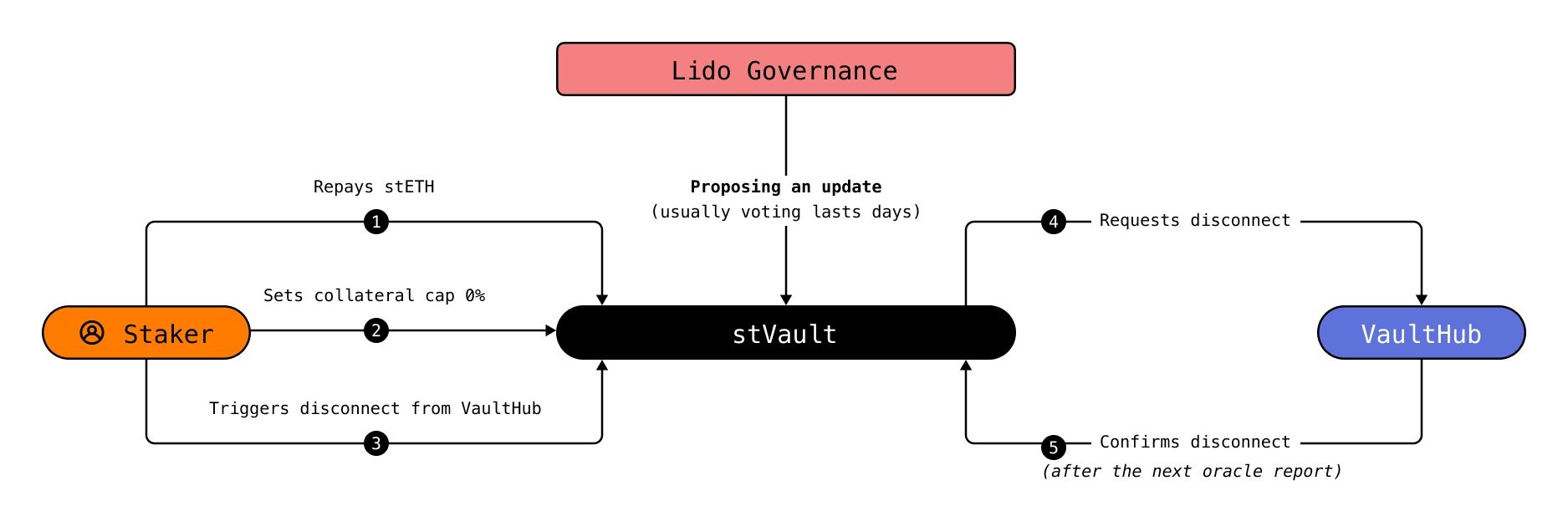
Source: Lido V3 Whitepaper
In addition, Lido provides an ossify option for stVaults. Rather than deciding whether to apply each Lido upgrade, a vault owner can make their vault permanently immutable. Once a vault is ossified, it is not affected by any later Lido governance change. This is an option that goes beyond separating from Lido's governance to making the vault itself an independent contract unrelated to Lido.
Besides Safety Hatch, Lido has Dual Governance, a governance protection mechanism for stETH holders. Dual Governance, explained in 4.2.2, may at first look similar to Safety Hatch, but these are governance safeguards that operate at different layers. If Dual Governance is a mechanism for all stETH holders, Safety Hatch is a structure to protect individual stVault owners. When only the Lido core existed in the past, governance risk could be explained as the interplay between stETH holders and LDO holders. But the stVaults added after V3 created a new stakeholder, the vault owner. A vault owner seeks to use Lido's shared liquidity layer while at the same time keeping their own operating structure and risk conditions. Safety Hatch protects against the risk that comes from the DAO structure by letting a vault owner manage Lido's governance risk directly. Dual Governance is a mechanism at a higher layer that lets stETH holders respond to LDO-based governance. Combined, these make Lido V3 an infrastructure where various stakeholders can each hold an exit right in a governance risk situation.
3.2 Lido Earn: Product Expansion Beyond Staking
3.2.1 What Is Lido Earn
Lido Earn is a new product line Lido built to expand into the DeFi strategy infrastructure space outside of staking. If stVaults was about expanding the customer base of the ETH staking product, Lido Earn is an attempt to expand the product family through DeFi yield strategies outside of staking.
Lido Earn launched in two stages. In September 2025, Lido launched three individual vaults built in collaboration with external curators such as Mellow and Veda: GGV (Golden Goose Vault), DVV (Decentralized Validator Vault), and stRATEGY. These each operate as separate strategies managed by different curators. These three vaults drew about $250M in assets in roughly six months.
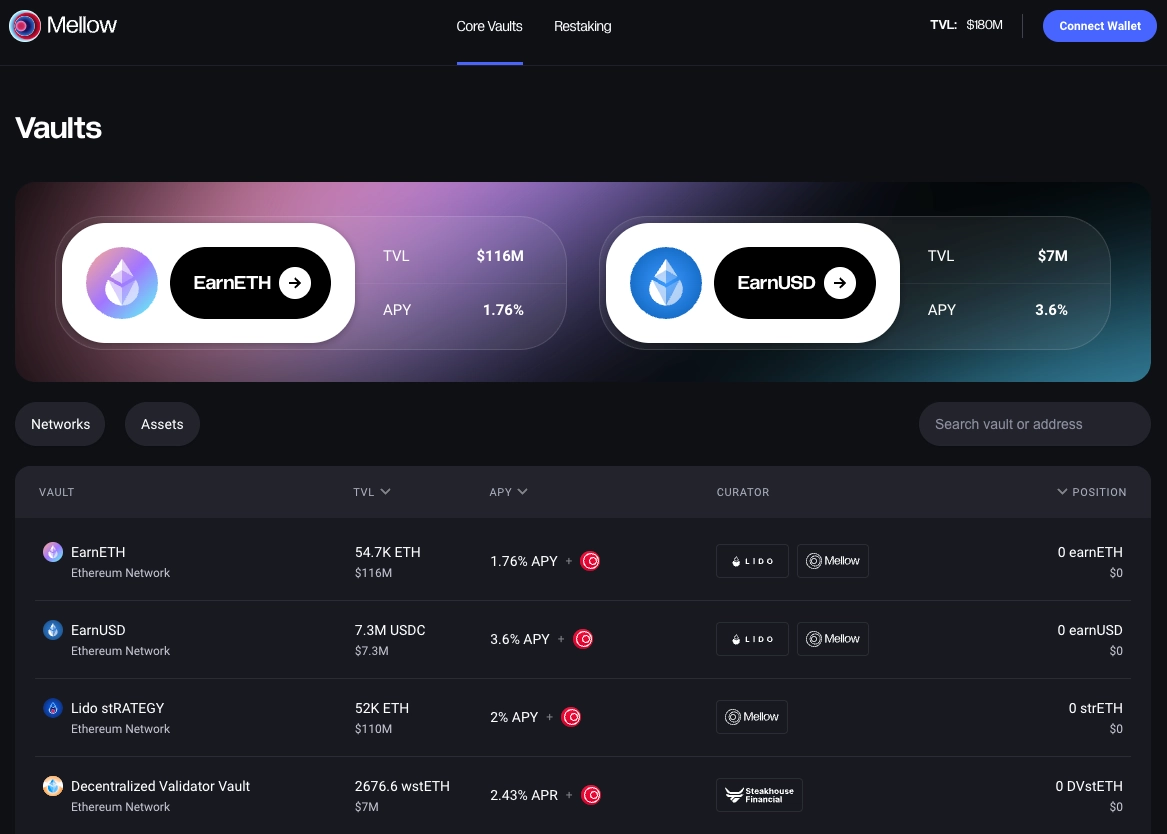
Source: Mellow
Then, in March 2026, Lido reorganized the three vaults into two integrated vaults and launched the Lido Earn system in earnest: EarnETH for ETH-based assets and EarnUSD for stablecoins. GGV, DVV, and stRATEGY were switched to a withdraw-only mode, and users can transfer to the new vaults by depositing their existing vault tokens directly into EarnETH.
In November 2025, Lido announced GOOSE-3, a strategic plan to expand beyond liquid staking into a variety of DeFi infrastructure. A substantial part of the $60M budget allocated to it is earmarked for developing new revenue sources such as Lido Earn. Lido's intent to diversify its revenue structure with vault revenue rather than depending only on Ethereum staking fees is clearly captured in Lido Earn.
3.2.2 The Operating Structure of Lido Earn
Lido Earn is a MetaVault structure. The previous stage, GGV, DVV, and stRATEGY, consisted of individual vaults each with a different curator and strategy combination. But the new Lido Earn, made up of EarnETH and EarnUSD, simplified this. When depositing ETH and stablecoins, users no longer need to agonize over vault choices.
A user deposits once into the MetaVault, and that capital is automatically allocated, according to the MetaVault's internal logic, across several DeFi protocols Lido has vetted in advance. From the user's perspective it looks like a deposit into a single vault, but the capital is distributed behind it across strategies on several protocols such as Aave, Morpho, Pendle, and Gearbox. The MetaVault structure has the advantage of simplifying the user experience while allocating capital more efficiently across several DeFi protocols.
The two core mechanisms for the MetaVault to work are the multi-curator setup and adaptive rebalancing. The multi-curator setup moves away from the existing structure where a single curator decided the vault strategy, to a structure where several curators manage the vault together. This reduces dependence on a single curator and lets various strategies be tried simultaneously according to market conditions.
Adaptive rebalancing is a mechanism that dynamically reallocates vault capital according to market conditions and risk profiles. The smart contract infrastructure continuously monitors the health and risk profile of the integrated protocols, and when a predefined threshold is triggered, it readjusts the capital allocation. If a protocol's liquidity deteriorates or its risk parameters change, capital can automatically move to another protocol.
Lido Earn is made integration-friendly by being offered in an abstracted form not only to individual users but also to external services such as wallets and DeFi aggregators. This shows Lido Earn is not a simple vault product but an attempt to become a standard interface for DeFi yield. It seeks to use, in DeFi vaults, the same strategy that succeeded with stETH, the standard for Ethereum staking liquidity.
3.2.3 EarnETH
EarnETH is Lido Earn's ETH-based yield product. A user can deposit ETH, WETH, stETH, or wstETH and receive earnETH tokens in return. earnETH is a token representing the user's vault share, and its value changes according to the performance of the strategies the vault runs.
EarnETH allocates capital to major DeFi protocols. A user deposits ETH-family assets into EarnETH, and on the back end several curators and DeFi protocols mix to generate yield.
For Lido, EarnETH is a means to expand the stETH-based ecosystem. A user no longer merely holds stETH or uses it as collateral; through Lido Earn it is automatically allocated across several DeFi strategies. The ETH a user deposits is staked into the Lido core pool, and the stETH or wstETH is automatically extended as the base asset of a DeFi yield product.
3.2.4 EarnUSD
EarnUSD is the first stablecoin-related product Lido launches. A user can deposit USDC and USDT, and depositors receive a vault share token called earnUSD.
EarnUSD is a product that mixes conservative third-party lending positions with optional high-performance strategies. As market conditions change, the allocation can also adjust, and it can include on-chain lending markets, real-world-asset-linked strategies, and structured positions. EarnUSD is a structure that bundles several dollar-based on-chain strategies into a single vault.
EarnUSD expands Lido's user base beyond ETH holders. A substantial part of Ethereum DeFi activity takes place on a stablecoin basis, not just ETH. Through EarnUSD, Lido seeks to draw stablecoin capital too into Lido's governance, operating standards, and risk management framework.
3.2.5 External Protocol Risk and First-Loss Absorption Through the DAO Treasury
Lido's staking liquidity, launched at the end of 2020, can be called the safest form of DeFi product on Ethereum. A Lido core user is exposed to the risk of node operators, the oracle, the withdrawal queue, and Ethereum mainnet. This is a relatively simple risk structure. It means the risk of assets being stolen by a hack or of principal loss is low.
Lido Earn, by contrast, is exposed to an environment outside the protocol: external DeFi protocols, curators, leverage structures, and liquidity conditions. Lido Earn is therefore a product expansion and at the same time a path by which external risk enters the Lido ecosystem. If an incident occurs at an external protocol, the capital of Lido Earn users can be affected.
This risk materialized quickly. On April 18, 2026, KelpDAO's cross-chain bridge was hacked, and about 116,500 ETH of rsETH was drained. EarnETH was running an rsETH/ETH leverage position on Aave, which was a size equal to 9% of EarnETH's total funds.
To mitigate this risk, Lido introduced a first-loss absorption system using the DAO treasury. In March 2026, the Lido DAO approved a proposal to allocate $5 million of treasury funds to Lido Earn. This system works so that if a loss occurs in a vault, the vault shares Lido holds are burned first, having the protocol absorb the damage first.
The first-loss absorption system operated for the first time in the KelpDAO case. The first-loss system originally had a 1% trigger, so it would not have activated automatically for this incident, where the loss was under 1%, but the Lido DAO passed a governance decision to lower the threshold one time for this incident only, and was able to cover the remaining loss in EarnETH so that the loss did not fall on users.
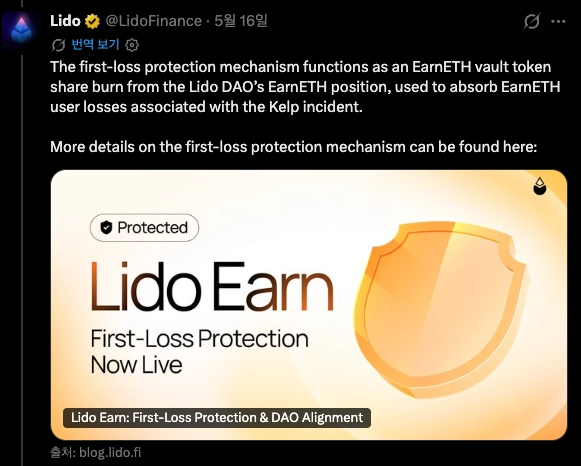
Source: Lido X
A vault's loss-absorption mechanism is ultimately a matter of capital, and capital comes from a sustainable revenue model. A revenue-generating protocol like Lido can convert its treasury into user-protection capital and design this as a repeatable risk management mechanism rather than a one-off. The more complex the structure becomes, the wider the risk surface grows along with it. External risk cannot be entirely removed, but through the KelpDAO case Lido showed that a safeguard for protecting users actually works when risk occurs.
4. Who Owns and Operates Lido: Discourse, Governance, and Token
So far, alongside Lido's history, we have looked at how ETH staked through Lido passes through several modules and provides different value and uses to a range of stakeholders. But as the stakeholders grow more varied and Lido's solutions are used for different purposes and needs, the process of operating it inevitably grows more complex too. Lido in particular is a huge single entity holding about 20% of all staked ETH, and one trying to move toward a more decentralized protocol. From that position, governance does not stay at the level of merely coordinating opinions inside Lido; it becomes a matter that directly and indirectly affects the stability and security of the entire Ethereum network.
This chapter therefore follows the question, "who is it that operates Lido." On the surface, Lido might look like it is operated by the Lido DAO, made up of LDO token holders. But Lido's actual governance framework works on a far more complex structure. For example, stETH holders are core stakeholders of the protocol even if they hold no LDO tokens, and to protect their interests, the Dual Governance structure was introduced in June 2025, granting them a veto over major protocol proposals. Moreover, because LDO tokens have been used mainly for governance functions with fee switching not yet activated, they carry a structural limit where fundamentals and price can diverge.
As Ethereum's largest LST provider, Lido seeks to move, in keeping with that standing, toward a neutral protocol within a more decentralized environment, aligned with Ethereum's philosophy. This chapter looks in turn at the two axes that support this goal: Lido's governance framework and the economic structure of the LDO token formed on top of it.
4.1 Is Lido Moving Toward Credibly Neutral Infrastructure
4.1.1 The Credible Neutrality Problem
Credible Neutrality is a concept Vitalik Buterin introduced in his 2020 piece "Credible Neutrality As A Guiding Principle." It refers to the property that a mechanism is designed not to discriminate against any particular person or outcome, and that this fact is verifiable to outside observers as well. This property is especially important in a decentralized protocol that is sustained by the free participation of an undefined many, each pursuing their own utility. Participation continues only if everyone is guaranteed fair access conditions, without arbitrarily favoring or excluding particular participants.
This concept can in fact be thought of along two lines. One is an observational approach that looks at "how the protocol is behaving now," and the other is a structural approach that looks at "whether the protocol's design itself prevents non-neutral behavior." The former depends on the goodwill of the operators, the latter on the code and governance structure. A protocol reaches credible neutrality in the true sense in the latter case, when the design itself does not allow non-neutrality.
Ethereum itself is a representative example of pursuing this property. On Ethereum, anyone can become a validator and anyone can send a transaction, and the protocol does not produce different outcomes depending on who the sender is. The question is whether Lido, the largest staking layer sitting on top of it, can claim the same property.
Lido was not designed from the start to satisfy this structural neutrality. The Curated Module, which opened the service quickly by curating about 30 vetted institutional-grade node operators at launch, was effective for minimizing slashing risk in the cold-start phase, building user trust quickly, and rising to the front of the LST market. But by the same token, a few operators took on a vast amount of staked Ethereum and their power was outsized, and the LDO-based governance framework was also still at a fragmentary level run by a few contributors, so in the end there was no choice but to lean on their goodwill.
But Lido has gradually redesigned and expanded this structure. First, as seen in 2.4, it introduced the Staking Router to open an extension path where various modules can be attached, and through this it made permissionless entry possible for small and mid-sized operators as well. It also granted veto power, through Dual Governance, not only to LDO token holders but to stETH holders, the actual stakeholders; distributed governance power across around specialized committees; and separated contributor accountability into distinct legal entities through the BORG (Lido-DAO-adjacent organization) foundations structure. Further, through the NEST framework it raised even the token's value proposition to a governance agenda. Each stage was a pattern of acknowledging the limit of the immediately preceding stage and taking it as the starting point of the next.
So to answer the question "is Lido credibly neutral infrastructure" at the present moment, you have to look at the whole system where Lido's journey and its mechanisms come together. This is because each module has a different trust model, and the governance layer on top of them evens out the rights. Take any one moment or one part in isolation and there are shortcomings, but look at the consistency of decisions over five years and where the whole system is heading is clear.
4.1.2 The Tension Between Lido's Market Dominance and Neutrality
In February 2026, in the Lido Token Holder Update, the protocol disclosed its share of the Ethereum staking market at 23%. The share, which peaked at 32.4% in September 2023, fell below 30% in April 2024 and then declined steadily, converging to the low 22% range at the present moment in 2026. With about 10 percentage points of distance from the 33% finality threshold, it may not look like an immediate threat, but this relative distance and its influence are separate matters.
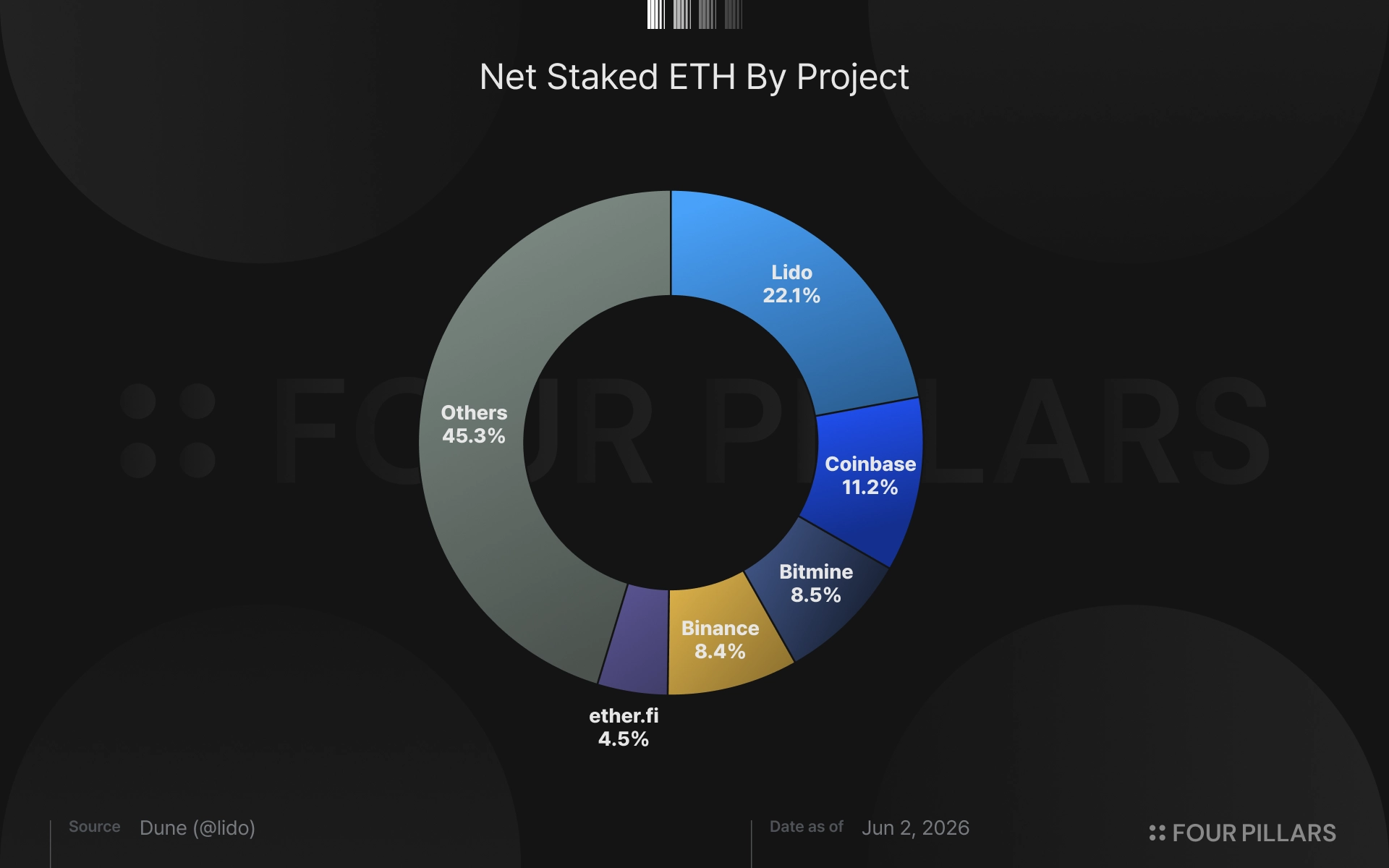
Coinbase, currently second in the Ethereum staking market, is at about 11%, and Bitmine and Binance, third and fourth, are at about 8%. Lido maintains roughly a twofold gap over second place, and considering the depth of stETH's DeFi integration, it has a dependence beyond the quantitative share. Aave, Maker, Curve, Uniswap, Pendle, and numerous LRT/restaking protocols accept stETH or wstETH as a primary collateral asset. This integration network has been operating independently of the share, so the position of the benchmark LST will likely continue for some time.
This is where the tension with the Ethereum network's neutrality arises. For some infrastructure to be truly neutral, the act of using it must not become an act of delegating power to it. But the act of holding stETH through Lido is the same as delegating ETH to the group of node operators Lido curated, and the behavior of this group forms part of Ethereum's consensus safety. A user is not simply holding a token that accrues staking interest on top of Ethereum's value; they are taking an action that adds accountability to a validator pool under a particular governance system. The larger the share, and the deeper that asset's ecosystem integration, the more neutrality becomes an active and heavy responsibility.
Traces that Lido's community is conscious of this responsibility show in various discussions and decisions over the years. The very fact of the 2022 self-limit proposal (even though it was rejected), the pattern of contributors publicly expressing concern each time the 33% threshold was approached, the MEV-Boost relay diversity recommendation, the various discussions and guidelines for client diversity, and the very module design that seeks to send part of new inflows to a distributed pool rather than Curated-Module-centric operators through CSM and Simple DVT are those traces.
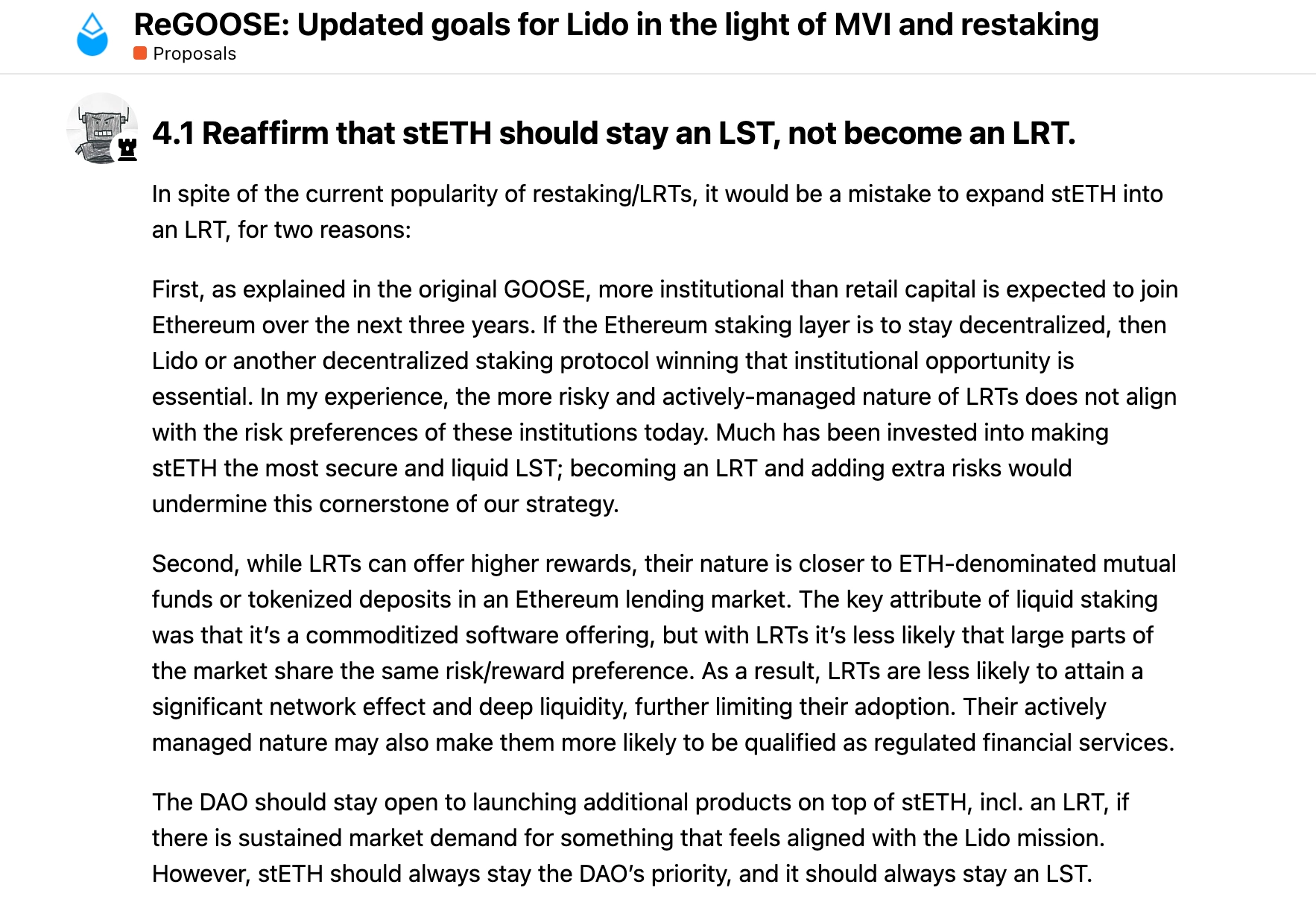
Source: Lido Research Forum
In addition, the context in which the Lido community deliberately treated the opportunity for vertical integration of restaking conservatively, ceding some demand inflow to competitors such as ether.fi and EigenLayer, can also be read as a choice to position itself as a safe and predictable staking primitive aligned with Ethereum's long-term security roadmap, rather than actively chasing an opportunity aimed simply at market dominance. This shows that Lido has carefully coordinated protocol-level expansion to keep credible neutrality.
4.1.3 The Trust Spectrum Among Modules, and Flattening Through Governance
To understand exactly how Lido implements credible neutrality, it helps to look at Lido's whole system divided into a module layer and a governance layer. The two layers each deal with a different dimension of trust scope, and the way they interlock determines the neutrality of the whole system.
Looking at the module layer alone, Lido's trust model is not one but a spectrum. The Curated Module has a high barrier to entry because it goes through DAO curation, but operational trust is correspondingly high. Simple DVT is a middle ground that distributes some trust assumptions through cryptographic joint operation. CSM lowered trust assumptions and raised freedom of entry based on an economic bond. So taking any one module in isolation, it is hard to say Lido fully implements credible neutrality. The Curated Module in particular, even if its operator selection process is transparent, cannot avoid selection and discrimination at the entry stage as long as it goes through a DAO vote and curation.
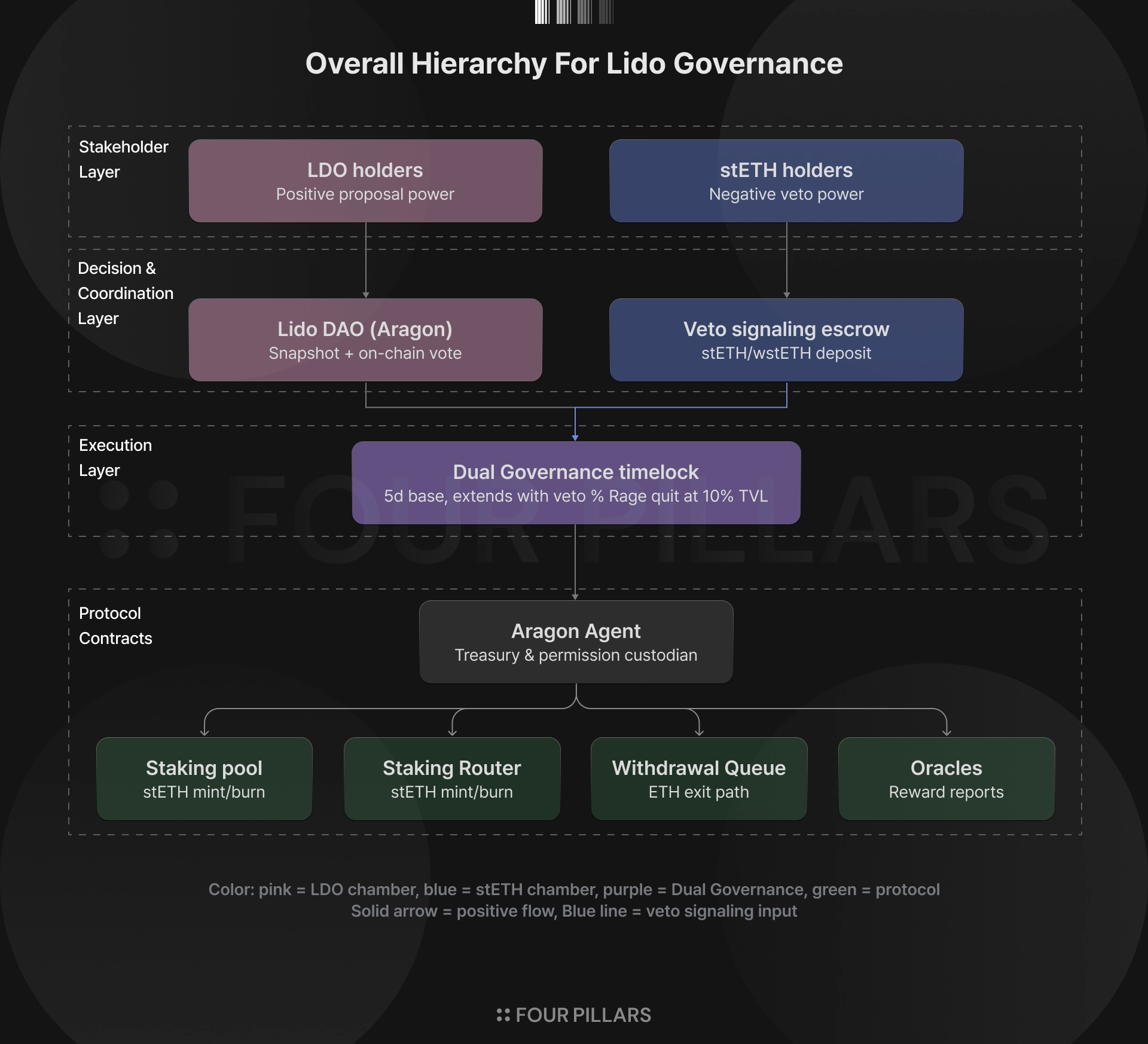
But even though the trust model differs by module like this, the governance layer on top of them levels participants' rights to the same degree. As discussed in the immediately following chapter, the decision-making power for most governance agendas in Lido lies with LDO holders. But it is designed so that those decisions cannot unilaterally infringe the rights of stETH holders, who become the direct stakeholders of the modules. Moreover, a stETH holder has the same rights regardless of which module their stake is delegated to. The way interest is distributed, the withdrawal guarantee (WithdrawalQueue), oracle integrity, and above all the right not to unilaterally bear a change they do not agree with are all the same. Whether a holder disagrees with a particular operator selection in the Curated Module or a holder whose stake flowed to CSM, there is no difference in the rights granted at the governance level. The differences in trust assumptions arising at the module level are absorbed at the governance level like this, and the core mechanism that supports that guarantee is the Dual Governance veto granted to stETH holders.
As long as the governance layer works flexibly like this, the fact that the trust model differs by module is less a flaw than a scalability advantage that can encompass customer segments with diverse needs. Had Lido bound all users to a single trust model, the limit of that trust model would have become the limit of the whole system. Instead, Lido lets each operator choose a trust model suited to their preference, while binding that choice through governance so it does not lead to inequality in stETH holders' rights. In the end, Lido is completing credible neutrality through the whole-system level rather than individual modules.
4.2 The Lido Governance Framework
4.2.1 The LDO Holder Voting Structure and Its Limits
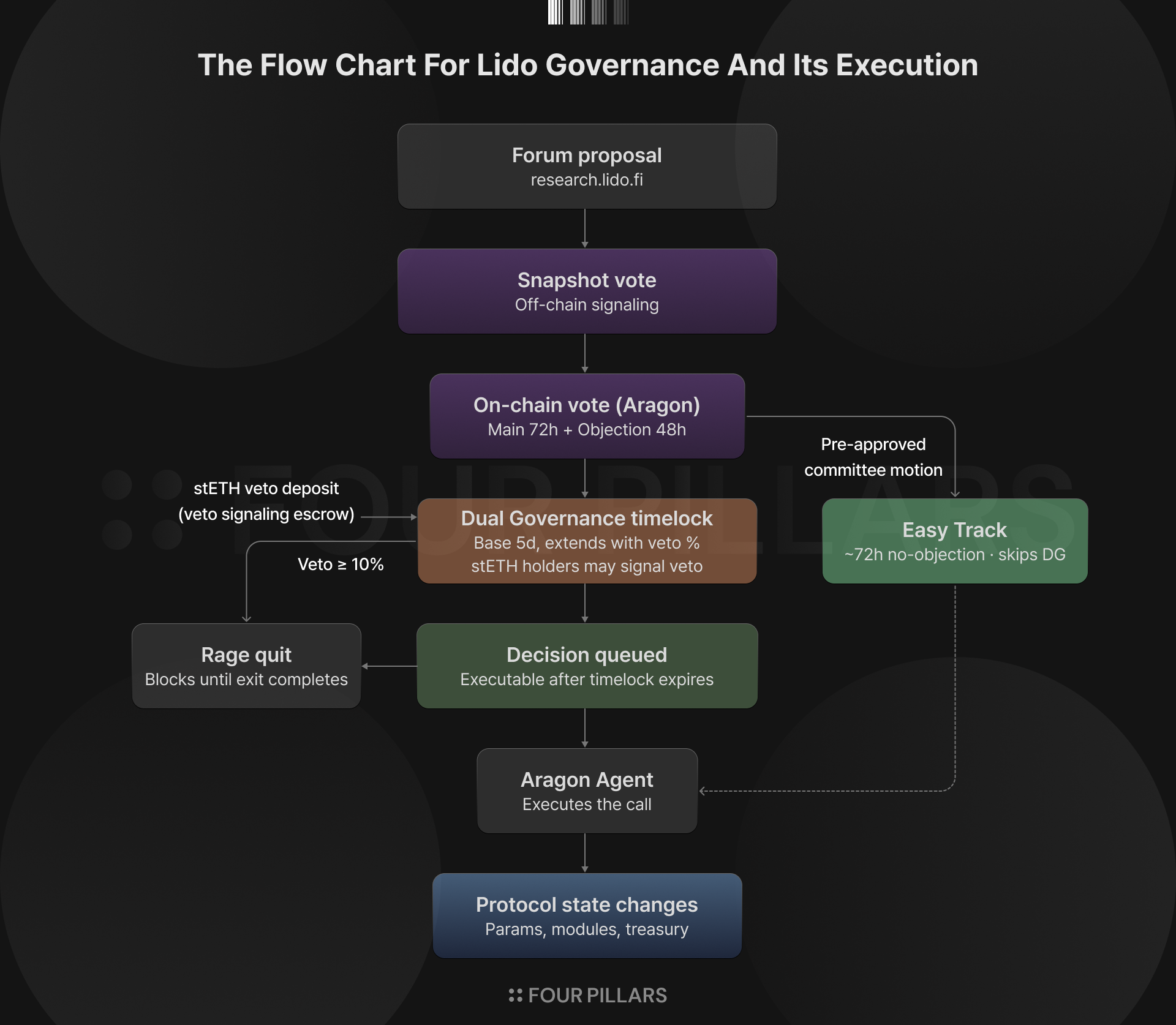
The most basic starting point of LDO governance is the Snapshot vote. After a proposal is posted to the forum and goes through sufficient discussion, LDO holders express their will through an off-chain Snapshot. This stage is only a "signaling" stage that indicates preference for the proposal and has no actual on-chain effect. To have full effect, it must lead to an on-chain vote conducted on the Aragon DAO system.
The on-chain vote has a two-phase structure. The Main Phase runs for about 72 hours, followed by an Objection Phase that runs for an additional 48 hours or so. Even if approval exceeds a majority in the Main Phase, the decision is voided if opposing votes exceed a certain threshold in the Objection Phase. This two-phase structure is a safeguard to prevent a sudden passage. To block a scenario where a large body of LDO holders rushes votes at the last moment to flip the result, the design stops again if enough opposing votes to flip the result gather even late.
The areas where LDO holders can decide directly are broad. Treasury fund execution, new module activation, parameter changes (for example, stake limits and fee rates), node operator registration and removal (Curated Module), oracle committee composition, and emergency committee member appointments are all subject to LDO votes. LDO holders thus effectively hold final authority over all of Lido's non-technical decisions.
But the limits of this structure are also clear:
- Decision fatigue: The broader and more numerous the governance agendas, the harder it is for holders to follow every item. Tracking each item while grasping its context every time is a burden, and the expertise required differs by area, so fully understanding an item is not easy either. On top of that, the act of participating in every vote itself comes with no small inconvenience.
- Governance capture risk: As long as the LDO token is an asset traded in the market, an actor with enough capital can accumulate LDO and capture governance. As of May 2026, LDO's market cap is around $300M, and for a sufficiently large fund or protocol the capital cost of a governance attack may be a manageable level.
- Conflict of interest with stETH holders: Lido's direct users are stETH holders, but decision-making power lies with LDO holders. A fee rate increase can be favorable to LDO holders but unfavorable to stETH holders, and the forced removal of a node operator can be justified in terms of LDO holders' reputation management but can be a change without consent for stETH holders who trusted that operator.
Lido has responded to these limits in turn. For decision fatigue, it introduced the Delegate Incentivization Program in 2024 to encourage delegation of power to delegates who understand Lido's context sufficiently and have a reputation. The Delegate Oversight Committee manages this program, creating a structure where delegated delegates publicly state their positions and are accountable for them. It also routed routine operational decisions through an optimistic governance channel called Easy Track, discussed later, to ease the voting burden, and for the conflict of interest with stETH holders it added a veto layer, Dual Governance, covered in 4.2.2.
Today's Lido governance is thus no longer a single mechanism but has evolved into a multilayered system that takes different paths depending on the proposal type. It is the result of deliberate design so that no decision can be forced through a single mechanism alone, while at the same time governance works efficiently and effectively, all to serve and balance everyone's interests
4.2.2 Dual Governance: The stETH Holder's Veto
Among the limits of the existing Lido governance mentioned earlier, the most fundamental tension started from the fact that "the decision-maker and the capital entruster are different." LDO holders make governance decisions, but stETH holders bear the operational risk from those decisions. This separation may not be a big problem in a typical DAO model, because governance token holders and users often overlap substantially, as with a DEX's LP token or a lending protocol's utility token. But Lido is different. LDO and stETH are different asset classes, and the two holder groups logically barely overlap.
Under the existing LDO-only governance, the only recourse for a stETH holder was withdrawal. Withdrawal was possible, but enough time for sufficient stETH to exit before a governance decision was executed was not guaranteed, so in the end the stETH holder's exit option was closer to an after-the-fact response to a fait accompli.
Dual Governance, starting with a research disclosure and Snapshot vote in early 2024, went through about a year of mechanism design, testnet, and audits by multiple firms (Certora, OpenZeppelin, Statemind, Runtime Verification), and was activated on Ethereum mainnet on June 30, 2025. This is the single largest change in Lido governance history, and at the same time the first large-scale case in the DAO governance field of making the distinction among stakeholders explicit at the protocol level.
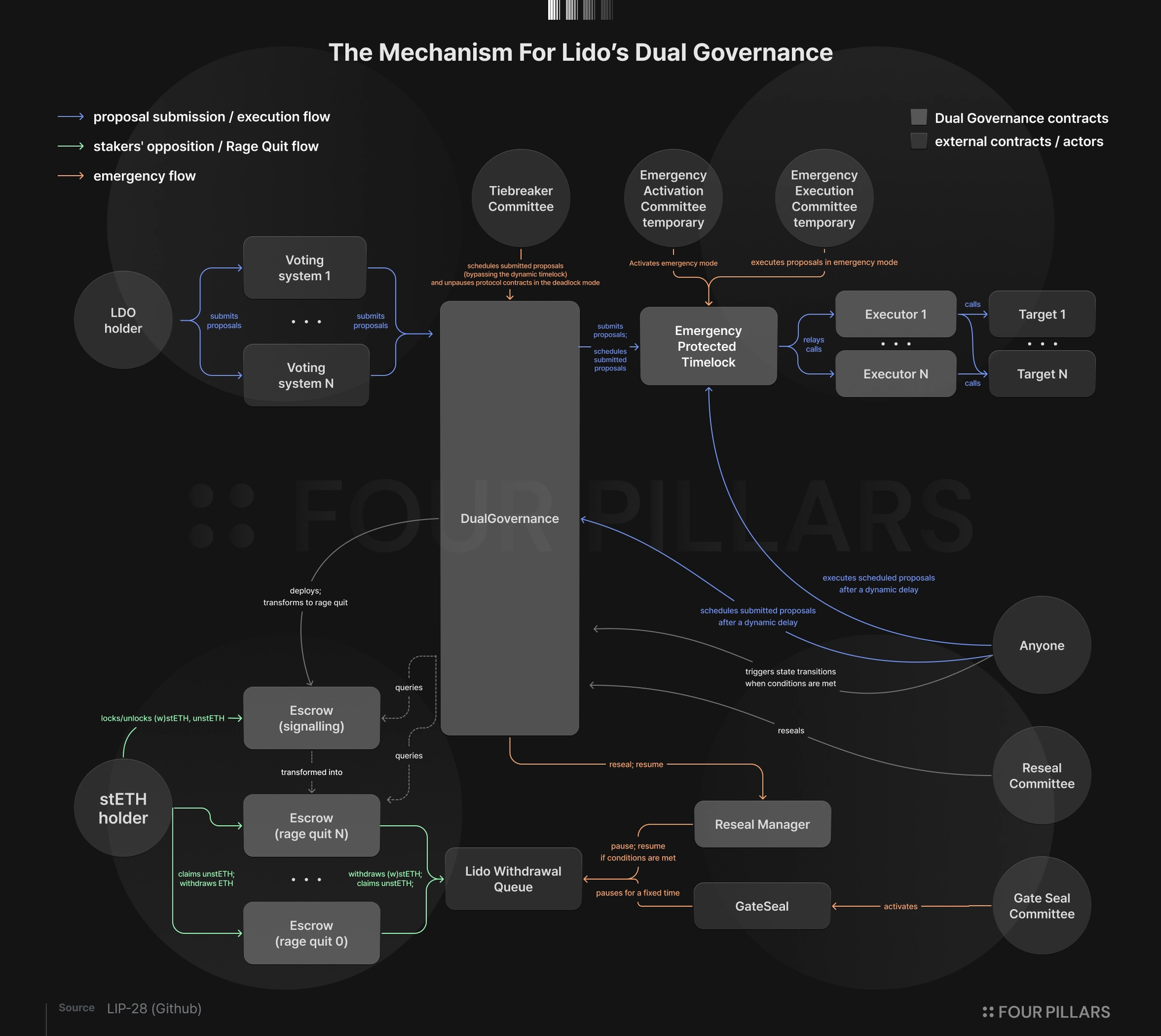
Dual Governance's design goal is simple: to grant stETH holders the right not to be forced into a change against their will by an LDO governance decision. This does not mean taking away LDO holders' decision-making power itself. Every decision still has to go through an LDO vote, and only a decision LDO holders pass becomes a candidate for execution. What Dual Governance adds is a stETH holder veto layer at the execution stage, and thanks to this, all stETH holders hold the same veto regardless of which module their stake sits in.
Dual Governance's core mechanism consists of a dynamic timelock and rage quit. Every governance decision passed by an LDO vote is not executed immediately but goes through a default 5-day timelock. During this timelock, stETH holders can express opposition by depositing stETH or wstETH into a veto signaling escrow. If the ratio of deposited stETH exceeds a certain threshold (about 1%), the timelock is extended, and the higher the opposition ratio, the longer the timelock. If the opposition ratio exceeds 10% of TVL, rage quit is triggered. At this stage the execution of the governance decision is fully blocked, and stETH holders who deposited into the escrow can withdraw their ETH. The governance decision is not executed until all opposing stETH holders complete their withdrawals. Rage quit is thus a tool with the enforcement of "we do not agree with this decision, so we are leaving this protocol, and no decision can be executed until we have all left." It is a design that gives a protocol-level time guarantee to the act of withdrawing, creating a deliberative voice for stETH holders.
As of May 2026, however, there has been no case of rage quit actually being triggered. Most decisions that passed governance after activation were routine parameter changes, module activations, and treasury operating decisions, and there has not yet been a decision that would require active opposition from stETH holders.
4.2.3 Easy Track and the Pool of Specialized Committees
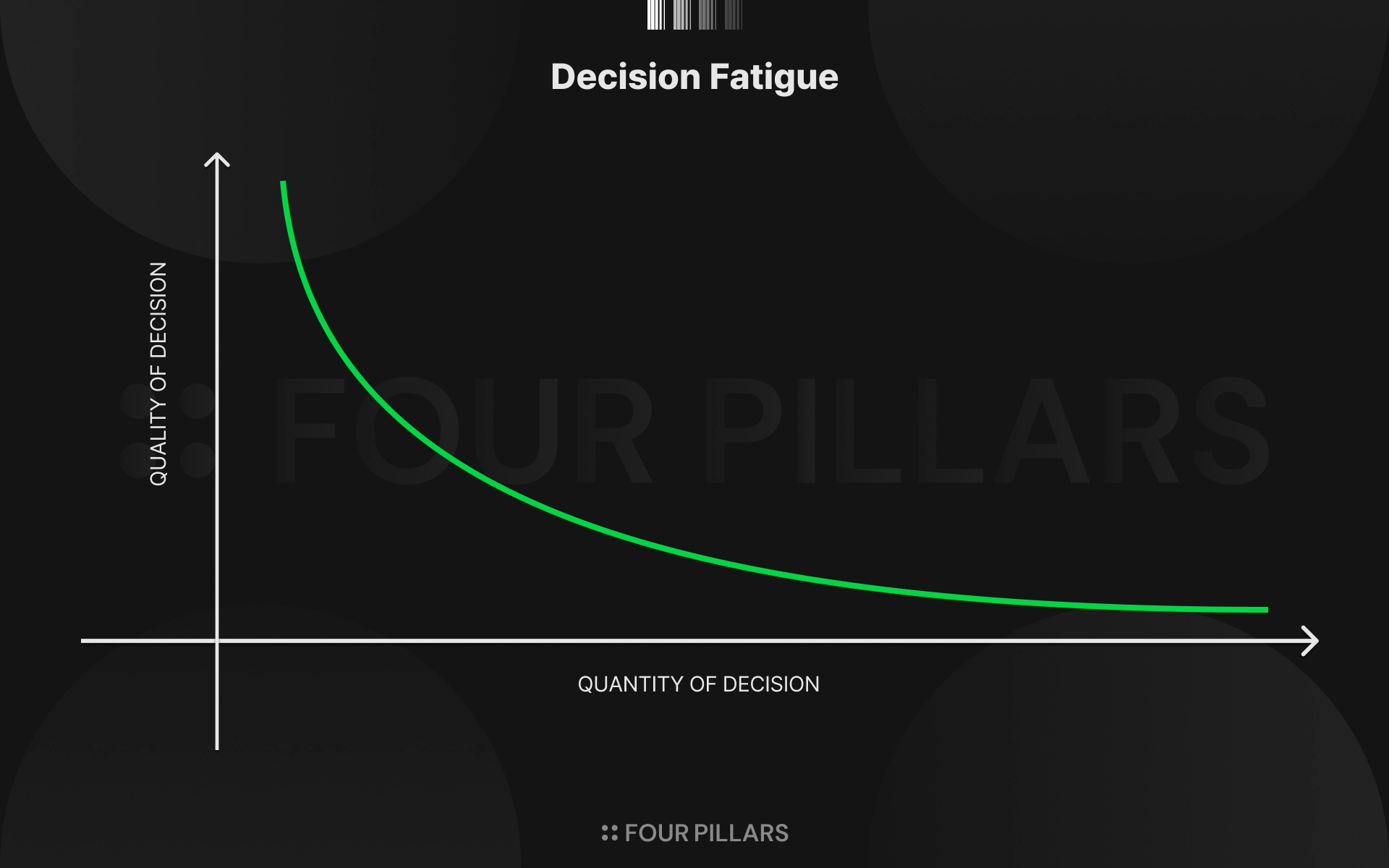
As seen above, given that various stakeholders are intertwined and there are many technical and financial decisions, if the community made up of LDO token holders required a formal voting procedure for every governance decision, the operational burden would explode. Adjusting a Curated Module operator's stake limit each month and executing a regular grant from the treasury would all have to go through voting cycles of several days. The Easy Track process is an optimistic governance channel to solve this burden.
The core idea of Easy Track is that it passes if there are no opposing votes. For motion types pre-approved by an LDO vote, when a designated committee proposes a motion, it passes automatically if opposing votes do not exceed 0.5% of total LDO supply during a set period (about 72 hours). Important protocol-level decisions such as new module activation or fee rate changes still have to go through a formal LDO vote, however.
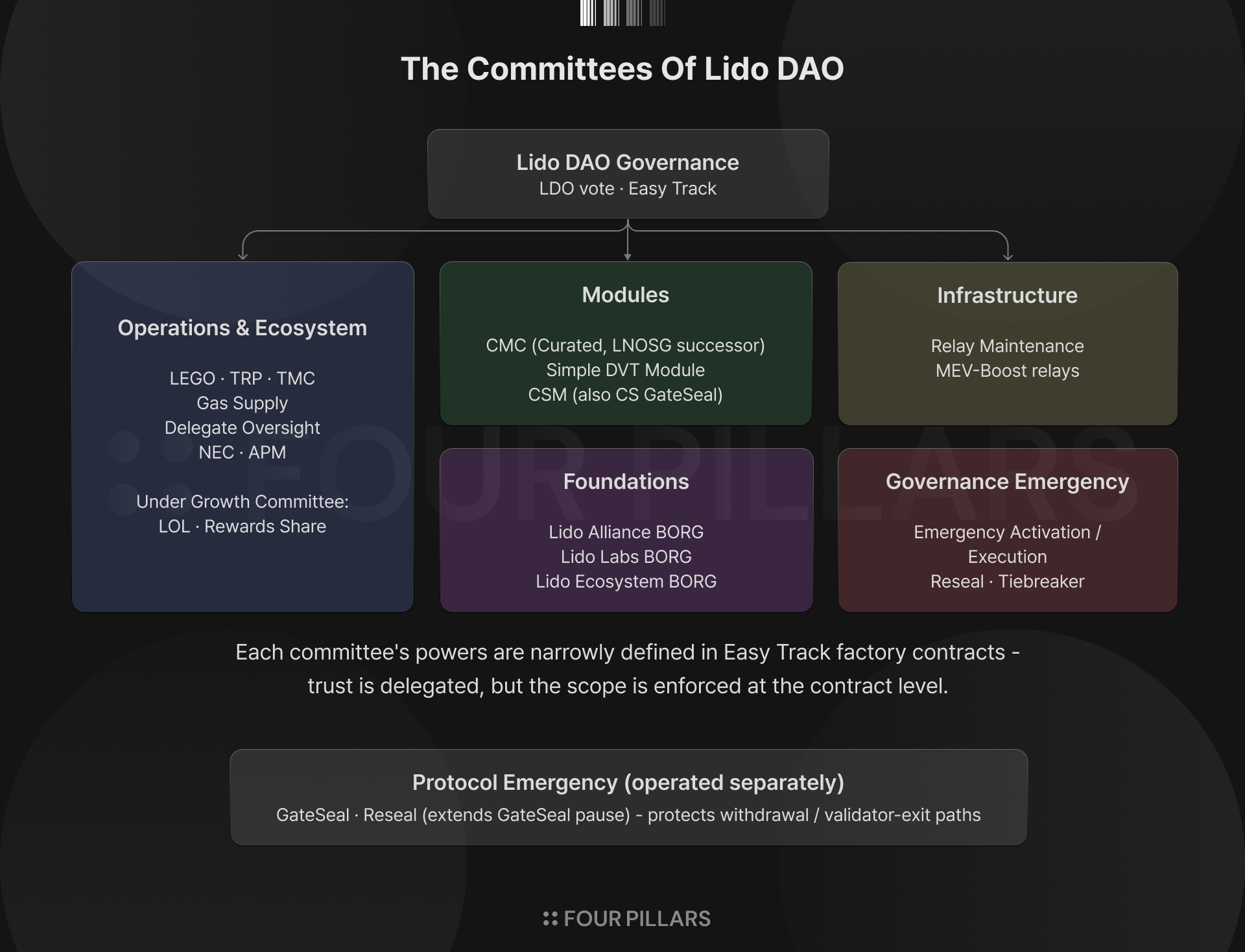
Also, because each governance agenda differs in expertise, the Lido DAO had around twenty specialized committees and entities as of 2026. Grouped by function, there are broadly five branches:
- Operations & Ecosystem (LEGO, TRP, TMC, Gas Supply, Delegate Oversight, NEC, APM, and the Growth Committee's LOL and Rewards Share)
- Modules (Simple DVT Module Committee, CSM Committee)
- Infrastructure (the Relay Maintenance Committee, which manages MEV-Boost relays)
- Foundations (Lido Labs BORG, Lido Ecosystem BORG)
- Governance Emergency (Dual Governance's Emergency Activation, Emergency Execution, Reseal, Tiebreaker)
- The GateSeal and Reseal line, which handles the protocol's own emergency pause, operates separately from these.
The very fact that committees diversify, differentiated by function, shows the gradual decentralization of Lido governance. In Lido's early days, only one informal group existed, LNOSG (Lido Node Operator Sub-Governance Group). Over time, separate committees that professionally handle a limited scope were newly established for each operating area, their scope of authority was explicitly defined, multisig quorums were disclosed, and they were directly connected to Easy Track factory contracts so that arbitrary exercise of authority is constrained at the code level. LNOSG's informal structure was formalized into the CMC (Curated Module Committee) in 2026, gaining a clear scope of authority in the form of a 5/9 multisig and an Easy Track channel.
Each committee can perform only very narrowly defined actions through Easy Track factory contracts. For example, the LEGO committee's multisig can send only tokens registered in AllowedTokensRegistry, and only to predefined recipients. The CSM committee can perform limited actions such as processing MEV theft penalties or changing the bond curve per node operator, and pausing the module through CS GateSeal in an emergency. TMC (Treasury Management Committee) and Gas Supply manage treasury asset operations and operational gas costs, Rewards Share handles staking reward distribution, TRP (Token Rewards Plan) executes contributor token reward vesting, and Relay Maintenance manages the allowlist of MEV-Boost relays for node operators to use.
The trade-off of this division-of-labor structure is clear. Efficiency rises, but a new problem of procedural legitimacy can arise in appointing the members of each committee. To address this, Lido has set up not only the prior sandboxing of each committee's actions (that is, the Easy Track factory contract structure) but also every foundation for procedural and after-the-fact transparency for each committee. For example, every multisig signer, every motion record, and every Easy Track passage result is disclosed on-chain, and discussion for the related processes takes place in each committee's forum thread.
4.2.4 Emergency Pause Mechanisms
Because much of the protocol runs on code, unexpected situations are bound to arise, especially in DeFi, so setting up safeguards is always important. Lido too has steadily developed emergency pause mechanisms in preparation for special situations.
The early model, GateSeal, grants a pre-designated 3/6 multisig committee the power to pause core contracts. The protected targets were mainly two contracts, WithdrawalQueue and ValidatorsExitBus, which govern the user withdrawal and validator exit paths. If someone finds a zero-day vulnerability in these contracts, the GateSeal committee can immediately pause that contract for up to 11 days, securing time for the DAO to decide a patch by vote.
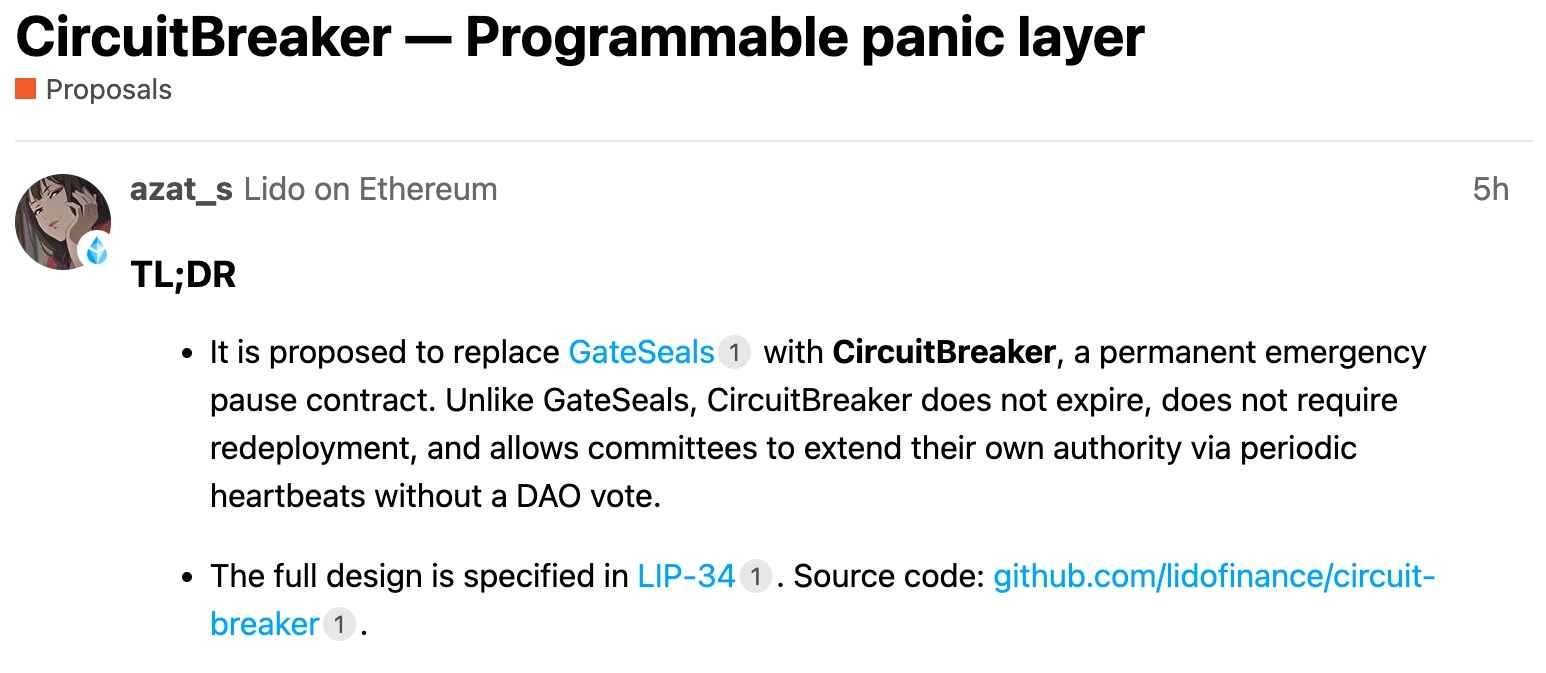
Source: Lido Research Forum
But GateSeal's limit was the time constraint. Once triggered, it auto-releases after 11 days, and after use the committee itself expires, requiring a new committee appointment. It is a single-use safeguard, so in terms of continuous protection the operating burden was large.
With the introduction of Dual Governance in particular, this time constraint created a new problem. Because Dual Governance's dynamic timelock can delay proposal execution by days, a risk arose that GateSeal's pause period would expire before the DAO could even execute a patch. The Reseal committee fills this gap. The Reseal committee has only one power: while Dual Governance is blocking proposal execution, to extend the paused state of an already-paused contract indefinitely until the DAO explicitly releases it. It uses the same signer set as GateSeal but requires a higher quorum, given that it is a decision to prolong a pause. Unlike GateSeal, which needs an immediate response, Reseal moves within an already-secured pause period, so it is a design that prioritizes prudence over speed.
Further, Lido is also developing a more generalized CircuitBreaker concept that does not depend on human multisig decisions. A CircuitBreaker is a mechanism that automatically pauses some functions according to predefined economic triggers such as withdrawal queue length or oracle deviation, and in that it does not depend on human multisig decisions, it is closer to "trust minimalization."
Another example is Dual Governance's emergency committees covered in 4.2.2 (Emergency Activation, Emergency Execution, Reseal, Tiebreaker), which are a meta safety net in case a zero-day vulnerability is found in Dual Governance itself. If GateSeal protects the protocol logic, these protect the governance logic. With two layers protecting different targets working together, Lido has a structure that can respond to both protocol-level and governance-level emergencies.
4.2.5 The BORG Foundation: Separating Legal Accountability
If what we have looked at so far was the question of how power is divided and controlled, the remaining question is how to organize the roles and accountability of the parties that actually execute that power. The bigger and more sophisticated governance grows, the more leaving "who is accountable for what" ambiguous blurs both the efficiency of decisions and the locus of accountability for them. Five years ago, Lido was in fact a system where the boundary between contributors and the DAO was blurry. The same people wrote forum posts, raised proposals, participated in votes, and deployed contracts. It was efficient, but accountability was correspondingly hard to trace.
The structure Lido introduced to resolve this ambiguity is the BORG. A BORG is a workgroup whose powers are constrained on both legal and code fronts: it is incorporated as a foundation in the Cayman Islands, yet the DAO retains control through the flow of funds (an Easy Track veto) and the power to appoint and remove directors. Because its authority is bound not only by legal agreements but also by on-chain mechanisms, it is in effect a "trustless" foundation. Lido maintains three such BORGs, each with a distinct purpose:
- Lido Alliance BORG: The first to be established, in the second half of 2024. At a time when the rise of restaking was intensifying competition across the stETH ecosystem, it took on the role of evaluating and onboarding aligned partner protocols (Allies) and managing the assets they contribute. In short, it is a workgroup for expanding an Ethereum-aligned ecosystem centered on stETH.
- Lido Labs BORG: Established in early 2025 to handle core protocol contributions (e.g., research, engineering, security, and in particular the implementation of Lido v3). It is the foundation that bears the protocol's technical accountability.
- Lido Ecosystem BORG: Established alongside Labs in early 2025, it handles grants, business development, institutional partnerships, and ecosystem expansion. It bears the economic accountability of broadening stETH adoption and liquidity, and also serves as a governance safeguard on the institutional-partnership and compliance side.
All three foundations are legally separate from the Lido DAO — so that regulatory risk does not flow through to the DAO itself — while still receiving funding from the DAO treasury via Easy Track. In sum, it is a division of labor in which Alliance handles ecosystem alignment, Labs handles technology, and Ecosystem handles economics and partnerships. The DAO governs while the three foundations each take on their operational work, and the flow of resources between them is made transparent through public forum proposals and on-chain Easy Track.
4.3 The Economic Structure of the LDO Token
All the governance structures examined so far presuppose one thing: that LDO holders exercise decision-making power, and that this power balances with stETH holders, node operators, and committees. But a more fundamental question hides in this premise. Why do people hold LDO? No matter how finely governance power is designed, if the token that carries that power gives no reason to hold it, the very foundation of governance participation shakes. The structure of power (governance) and the value of the vessel that carries the power (the token economy) are inseparable. This section looks into the economic structure of the LDO token and the gap in its value proposition.
4.3.1 The Limits of a Governance Token and the Price-Fundamentals Divergence
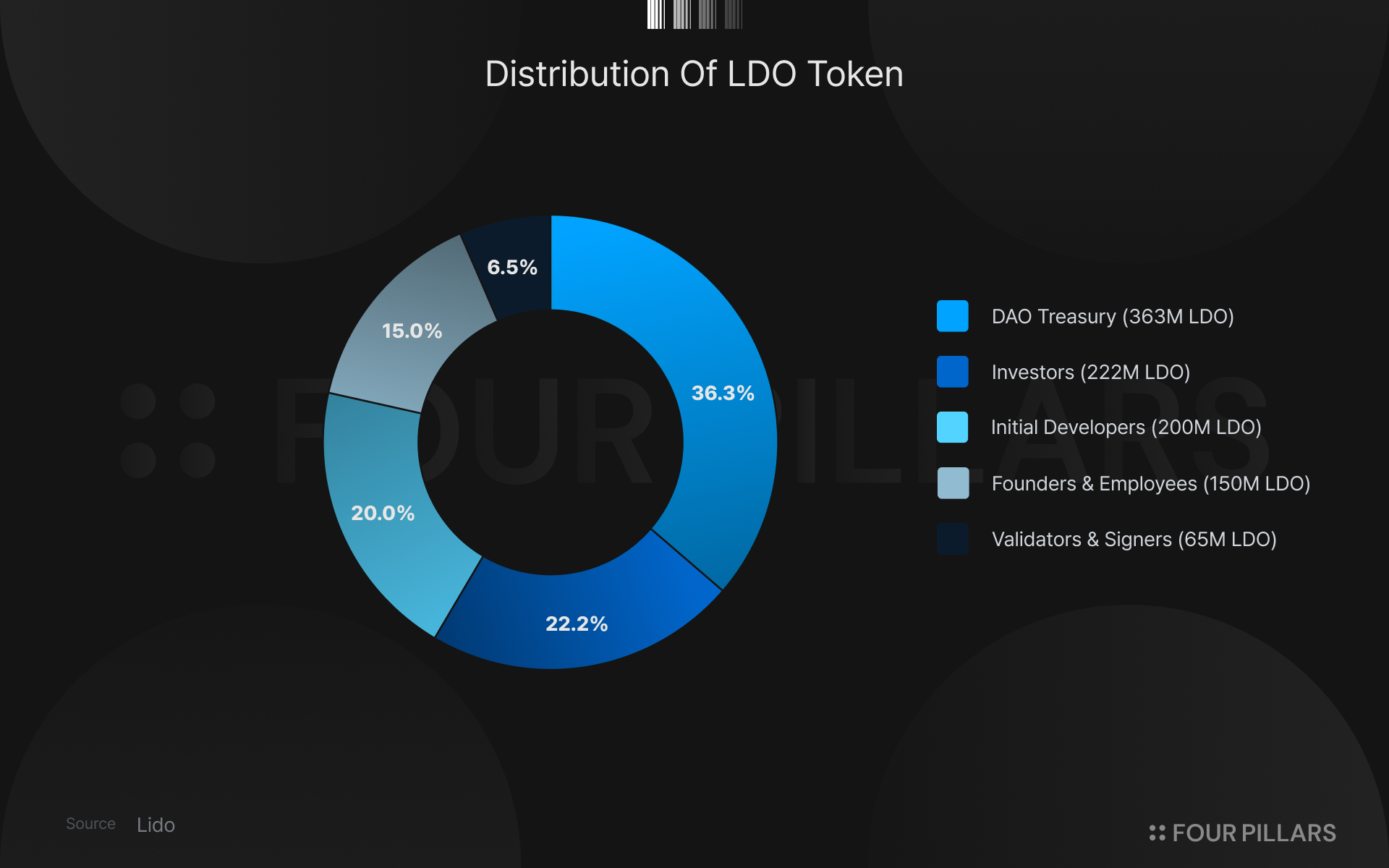
The LDO token was issued at Lido's launch in December 2020, and the initial distribution was divided among founders, early investors, validators, and the DAO treasury. Total issuance was fixed at one billion LDO, with no inflation mechanism. From the start, LDO was positioned as a pure governance token. It did not directly receive fees, holding the token itself did not generate interest, and its value depended solely on the value of governance power. This design was common at the time of the 2020–2022 DeFi summer. Most governance tokens, including UNI, MKR, and COMP, adopted a similar structure, and the token value was formed on the implicit option value that "fee distribution will be switched on someday."
But the problem surfaced between 2024 and 2026, as the very premise of this "option value to be switched on someday" began to shake. Through the bear market, it became clear that governance power alone could not hold up a token price, and the market increasingly began to separate tokens with actual cash flow to holders from those without.
Lido was no exception. Lido takes about 10% of staking rewards as a protocol fee and sends half to node operators and the other half to the DAO treasury, but there was no path for this revenue to flow directly to LDO holders. The treasury is used for operating costs, audit costs, contributor rewards, grant programs, and insurance-type reserves. There is no mechanism for LDO holders to receive staking interest directly, and fee distribution proposals have been raised several times since 2020 but were blocked by taxes, regulatory concerns, and the logic of prioritizing operating reserves.
This divergence becomes sharper when contrasted with other protocols. Aave started a buyback of $1M per week in April 2025 and converted it to a permanent program of $50M per year that October, and Uniswap finally activated the long-deferred fee switch with the 'UNIfication' proposal in December 2025, beginning to route part of trading fees to UNI burns. Interestingly, Uniswap stated in the proposal that "the regulatory environment has changed and DeFi has reached an inflection point of mainstreaming," which conversely shows that the core barrier blocking the fee switch was not technology but regulation around securities classification. Lido's revenue scale is close to Aave's, but the path of value flowing to token holders is still narrower than these.
This divergence is reflected directly in the price. In March 2026, LDO fell to $0.27, an all-time low, and the market cap sank to around $300M. Compared with other blue-chip DeFi protocols with the same revenue, it is in an extremely discounted state, and the Lido DAO itself described this in a buyback proposal as "one of the largest divergences between the LDO market price and the protocol fundamentals." One forum member wrote more bluntly that "until the tokenomics are fixed, LDO is not a dividend-paying stock but merely a voting right with no economic value."
This undervaluation, meanwhile, does not stop at a loss for token holders. As noted earlier in the LDO holder voting structure, LDO is governance power itself, and the lower the market cap, the lower the cost of accumulating that power. That LDO's market cap stays around $300M relative to the scale of assets Lido handles and the weight of its governance power also means that the capital threshold for a governance capture attack is correspondingly low. If Dual Governance is a mechanism that blocks capture attempts after the fact through the stETH holder veto, holding up the token price becomes a complementary measure that suppresses capture in advance by raising the accumulation cost in the first place. The price-fundamentals divergence is thus both a gap in the token's value proposition and a potential vulnerability of governance security, and this is the background for Lido beginning to treat the token price problem as a governance-level agenda beyond a simple market issue.
4.3.2 NEST and the One-Time Accumulation: Turning the Token's Value Proposition into a Governance Matter
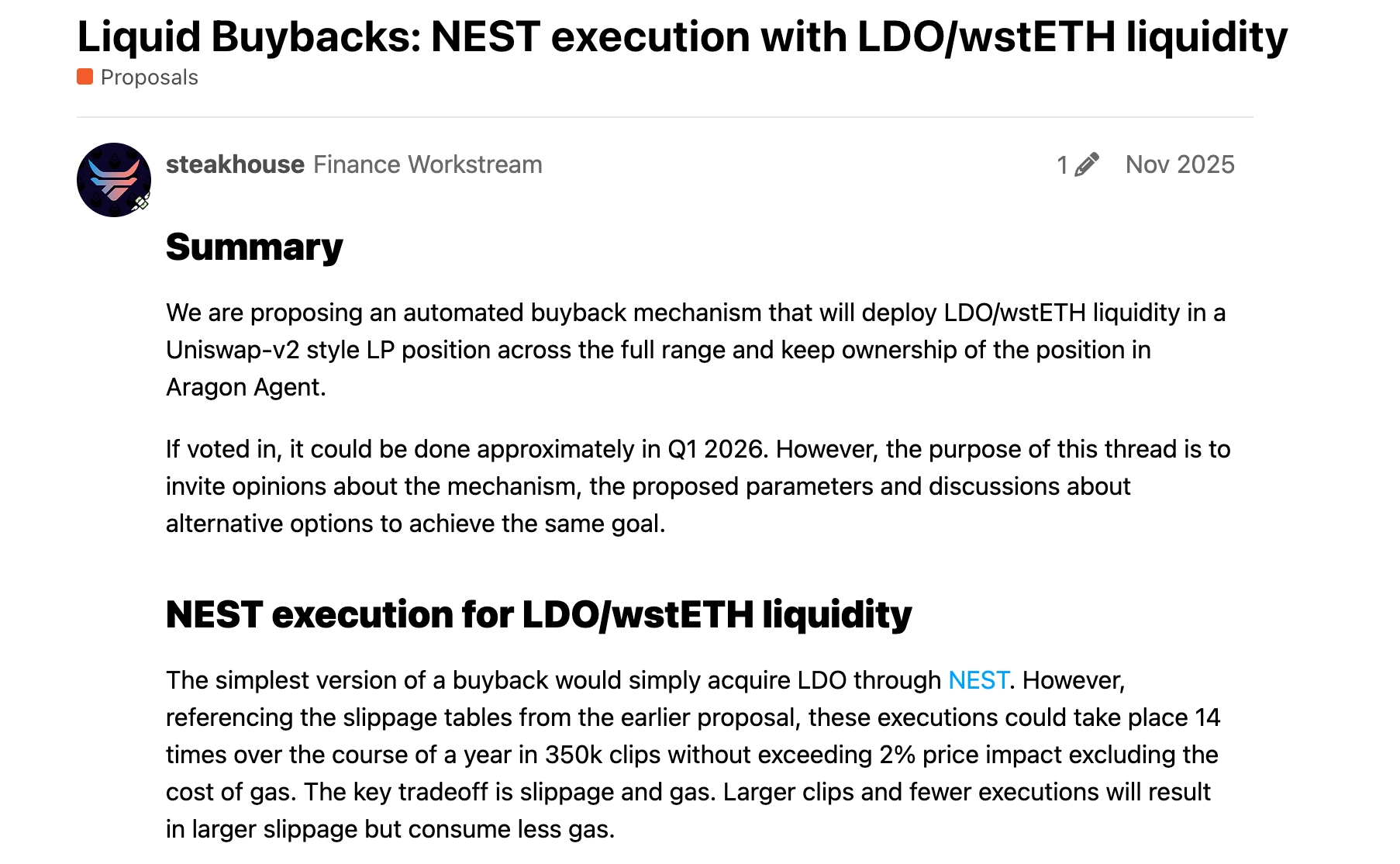
Source: Lido Research Forum
Lido's first response to this was the NEST (Network Economic Support Tokenomics) framework, proposed to the forum in September 2025, developed into a concrete execution plan (Liquid Buybacks) in November, and passed in a Snapshot vote in the first half of 2026 by 52.4 million LDO in favor to 3 million LDO against. The framework's execution is set to be formalized in the second half of 2026.
4.3.2.1 The Mechanism and the Meaning of POL
NEST extends the existing STONKS (treasury swap infrastructure): when stETH accumulates in the treasury, a keeper triggers a CoWSwap order to convert stETH to LDO, and pairs this LDO with wstETH to deposit into a Uniswap v2-style LP pool. Ownership of this LP position is held directly by the Aragon Agent, that is, the DAO. The key is that this is not a simple buyback but the building of POL (Protocol-Owned Liquidity). LDO has extremely shallow on-chain liquidity, with only about $90K of depth in the ±2% band, so a buy immediately lifts the price and a sell immediately collapses it. POL secures both price defense and trading depth by having the DAO own that liquidity itself, and even returns the LP fees to the treasury. In reducing human discretion and room for price manipulation through rule-based automatic execution, it is a design close to MakerDAO's Smart Burn Engine.
4.3.2.2 The Trigger Conditions, and the Criticism
NEST works only when two conditions are met at the same time: an ETH price of $3,000 or more, and Lido annualized revenue of $40M or more. If either breaks, it goes dormant, and once the thresholds are crossed, it uses 50% of staking inflows above the baseline to buy LDO, capped at $10M per year. It is a conservative design that buys only when there is genuine treasury surplus.
There was, of course, no small debate over this design. To forum skepticism that "in a bear market like now, it is far from meeting the trigger and is therefore useless," the proposer side added that they are open to designing it flexibly so the buyback can work even at a lower ETH price once new revenue sources under development are added to the surplus, and that because the mechanism is modular, revenue sources can keep being attached.
Blockworks's analysis also raised two points of criticism. First, the effective scale is small (about $4M per year on a run-rate basis), far short of Aave's $50M or the $26M Uniswap will burn per month through the fee switch; and second, because it works only when both the ETH price and revenue are high, it is a counter-cyclical design that buys when LDO is expensive and goes dormant in the cheapest bear market.
4.3.2.3 The One-Time Accumulation
The Lido DAO accepted this criticism rather than rebutting it. In March 2026, under the name "Utilizing Market Opportunities," it raised a one-time proposal to take up to 10,000 stETH (about $20M) from the treasury and accumulate LDO directly, putting it to a vote from April 7 to 13. The logic targets NEST's flaw precisely. Now, while the NEST trigger is broken (a bear market with ETH below $3,000), is exactly the low point where LDO diverges most from fundamentals, so let the treasury buy directly at the low before the regular mechanism kicks in.
It is twice the scale of NEST, equal to about 8% of circulating supply (about 65 million LDO). The Growth Committee splits it into 1,000-stETH units and executes it across on-chain venues such as CoW Swap, Uniswap, and 1inch and centralized exchanges such as Binance and OKX within a 3% slippage limit; each batch goes through individual token holder approval, and all the purchased LDO is returned to the treasury. The effect is still uncertain, however. Right after the proposal was announced, LDO rebounded about 18%, but in May, skepticism resurfaced on the forum: "why is the price so weak even after a buyback was announced." It is evidence that a one-time accumulation can give a short-term signal but cannot fill the structural value gap.
4.3.2.4 Can a Buyback Replace Fee Distribution, and Who Is It For
A buyback and fee distribution both return value to the token, but they differ in nature. A buyback only indirectly supports the price by reducing supply; it does not distribute cash flow to holders. So as an answer to the question "what is the sustainable reason to hold the token," a buyback is only a half answer. In fact, proposals beyond buybacks were raised on the forum from time to time, such as one to share protocol revenue directly through LDO staking. Whether Lido goes beyond NEST to revenue distribution could become one of the biggest agendas of 2026–2027 governance. This choice matters because it ultimately comes back to who Lido governance works for. Fee distribution gives cash directly to LDO holders, but its source comes from cutting stETH holders' interest and node operators' rewards, whereas a buyback touches neither and uses only the treasury surplus already generated.
4.3.3 A Balanced View of the Token Economy
As seen so far, LDO's value proposition still carries a gap, and neither NEST nor the one-time accumulation fills that gap at a stroke. But stepping back, there is progress worth reading in the very way Lido has handled this problem:
- That it raised the problem to a formal governance agenda rather than avoiding it: The gap in the value proposition is a problem most governance tokens share, but most leave it neglected or defer it behind a vague expectation of "someday." Lido, by contrast, put NEST to a vote and passed it, supplemented it with a one-time accumulation when its limits showed, and is even debating the more fundamental option of fee distribution openly on the forum. Bringing the token economy in as something governance takes responsibility for, rather than a variable left to the market, is itself a meaningful shift in stance.
- That NEST leaves a structural asset rather than being a simple price-support measure: If a typical buyback is a one-off intervention that buys tokens and burns them, NEST converts the purchased LDO into liquidity (POL) the DAO owns permanently by pairing it with wstETH. This thickens the shallow on-chain liquidity that was LDO's chronic weakness over time, and returns even the LP fees generated in the process to the treasury. It is a design that improves the market structure itself rather than the short-term price.
- That even the token economy is designed on the multi-stakeholder principle: Lido chose a buyback before fee distribution because it uses only the treasury surplus already generated, without cutting stETH holders' interest or node operators' rewards. This sense of balance, pursuing token holders' interest without sacrificing other stakeholders, is exactly the same grain as the philosophy Dual Governance showed.
Of course, none of this means the gap in the value proposition has been fully filled. But Lido is pursuing, in addition to the demand-side response of buybacks, a supply-side attempt to grow revenue itself through new products such as Lido Earn and stVaults. As revenue grows, NEST's trigger conditions are met more often, so the two directions reinforce each other. When and in what form LDO's value proposition will be filled is still an open question, but at least it is clear that Lido is moving consistently in that direction.
4.4 The Five-Year Journey and Its Lessons
One of the virtues of good governance is aligning the interests of different participants into one. Over the past five years, Lido lowered the barrier to entry for Ethereum staking and drew in disparate parties from LST users to node operators, and conflict among them was inevitable. Even so, after avoiding concentrating power in one place while keeping that distribution from drifting into disorder, it grew, without a fatal incident, into the largest DeFi protocol with over $17B in TVL as of this writing. We can read three lessons from the five years over which Lido has kept its balance.
- The ability to self-correct: The greatest strength of Lido governance lies not in presenting a perfect design at once, but in having repeated a pattern of acknowledging its own limits and filling them at the next stage. When the 2022 self-limit proposal was rejected by 99.81% opposition, it revealed that LDO-holder-only governance could not capture the interests of stETH holders or of Ethereum as a whole. Lido did not look away from this flaw but responded with entry distribution through CSM and a veto mechanism in Dual Governance. The same pattern repeated in the process of advancing the token economy. When NEST's counter-cyclical flaw was pointed out, it was supplemented with the one-time accumulation proposal, and the reason that supplement was needed was openly acknowledged on the forum. Taking outside criticism as the starting point of the next design rather than defensively rebutting it, treating governance as a process to be continually rewritten rather than a one-off decision, is the way Lido has turned criticism into institution.
- That power distribution actually progressed, and that it was codified: Decentralization is not achieved by declaration alone. In Lido's early days, one informal group, LNOSG, took on node operator evaluation, but as of 2026 that power has been split into specialized committees, and each committee's scope of action and authority is nailed down in code in Easy Track factory contracts. LNOSG itself was formalized into CMC, gaining an explicit multisig quorum and scope of authority. At the same time, as the BORG foundations separated contributors' legal accountability from the DAO, the accountability structure that had been hidden behind the vague phrase "Lido contributor" surfaced. It is also important that, as power split, who exercises that power, within what scope, and under what oversight was clearly constitutionalized along with it. This can become an important foundation for each participant with diverse interests, or a new participant, to understand the protocol's context and join deeper discussion.
- And most simply, the fact that it has scaled without a fatal failure: Lido handles about 8.8 million ETH and has distributed over $4.2 billion in cumulative staking rewards since launch, but during that time no fatal governance failure such as a governance capture or treasury theft has occurred. There have been externally originating shocks, such as the 2023 finality incident (a temporary finality delay due to an Ethereum client bug) and the Hetzner incident (a large hosting provider banning validator hosting), but the governance structure itself has never been exploited to put user funds at risk. It is the result of Lido's multilayered operating structure working as intended, so that no single party can dictate the system alone.
This does not mean Lido governance is complete, of course. Dual Governance's rage quit has not yet been triggered in practice, so how it will work in a real crisis is unknown, and the possibility of governance capture, along with the problem of enhancing LDO value in particular, remains an open risk. The Curated Module's stake-weighted share is still large, and whether to introduce fee distribution and the structural changes that come with it remain unresolved.
But what the past five years have shown is that Lido has acknowledged these limits rather than hiding them and taken them as the starting point of the next design. The basis for judging that governance has worked well lies not in flawlessness but in the consistency of how it responds to flaws. If so, the next chapter of the question that has run through this chapter, "who owns and operates Lido," will also depend on whether the coming five and ten years keep that consistency.
5. Lido's Next Stage
Chapters 1 through 4 covered how Lido changed from its launch to May 2026 and what it looks like now. This chapter looks at the market environment and strategies Lido currently faces, and what those strategies mean for Lido's future identity.
5.1 The Competitive Landscape of the Ethereum Staking Market
5.1.1 The Changing Staking Market in 2026
To talk about Lido's next stage, we first have to lay out what market environment Lido is in now. As of May 2026, the Ethereum staking market differs greatly from the 2020–2022 situation in which Lido launched and grew. In that period, Lido lowered the accessibility of ETH staking, established stETH as the foundation of the DeFi money lego, and grew into an overwhelming market leader.
Even by share alone, Lido's share, which once exceeded 30% of all Ethereum PoS staking, has come down to the low 20% range. Lido's February 2026 token holder update explains the main cause of the share decline as the direct staking entry of large players such as BitMine and Grayscale.
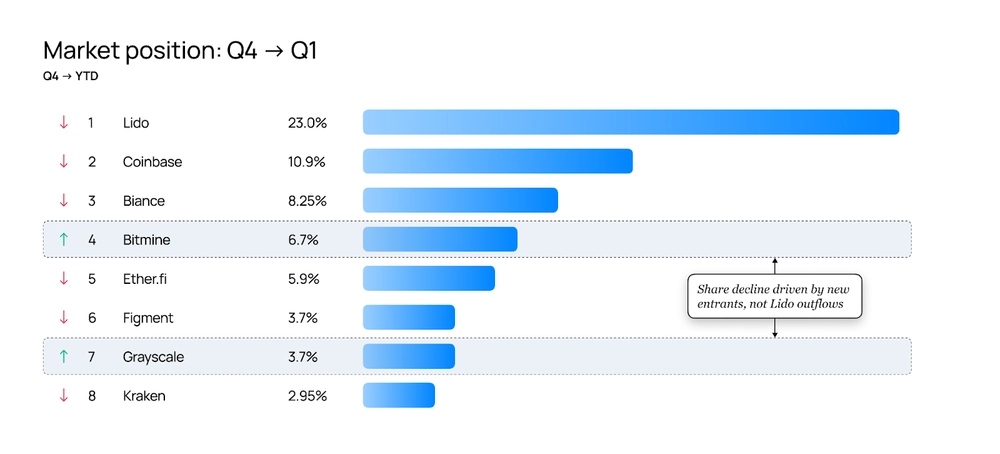
Source: Lido Blog
Lido's declining share cannot be seen simply as a weakening of Lido's competitiveness. In fact, Lido's share fell more than 10 points over four years, from 32.5% in May 2022 to 20.7% as of June 2026, but over the same period the ETH staked on Lido more than doubled, from about 4.1M ETH to 8.8M ETH. Lido's shrinking share is not a drop in the validator stake Lido runs but the result of faster growth in other areas such as institutional staking.
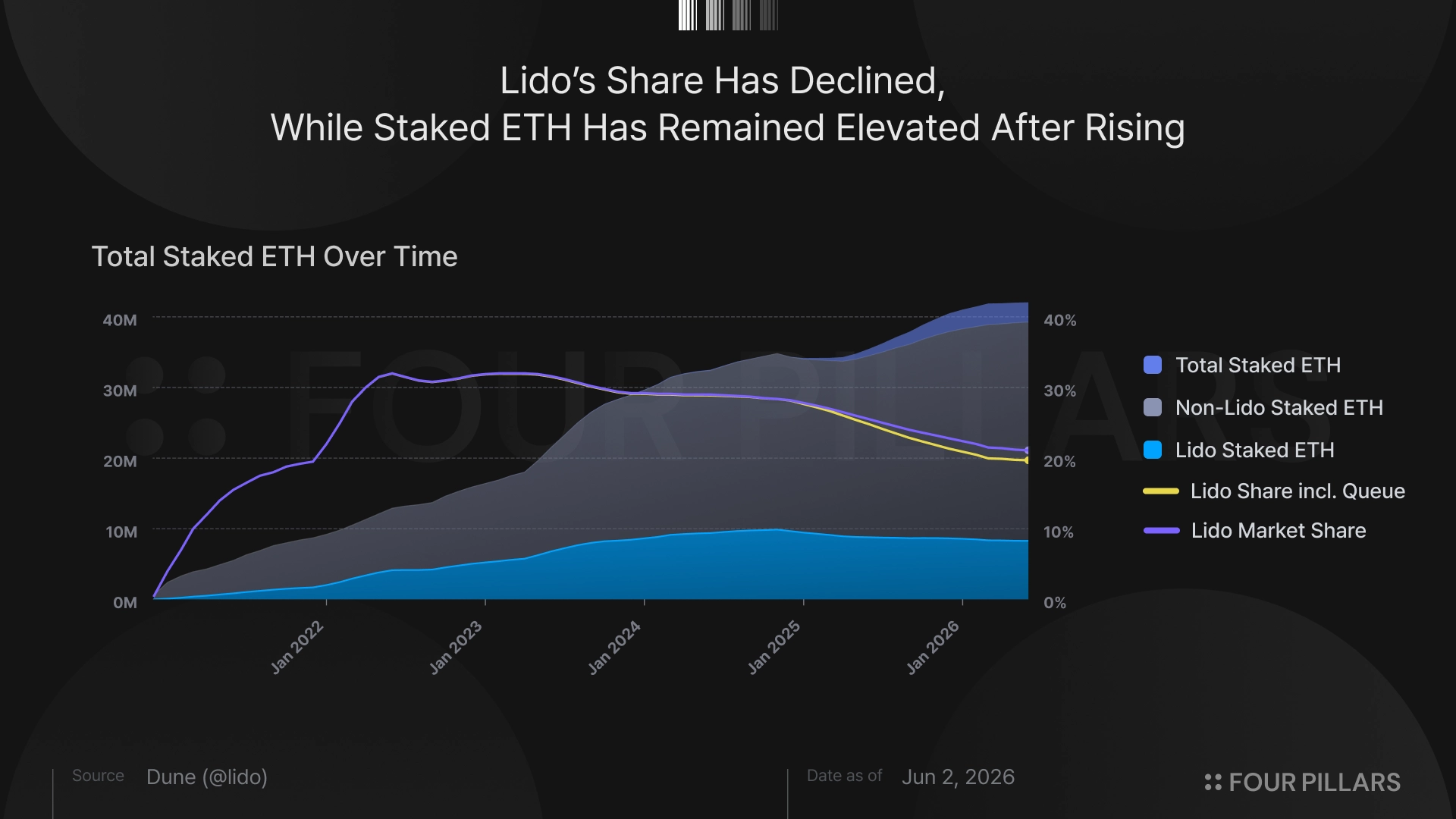
This is a signal that the Ethereum staking market has matured beyond before. Large institutions building their own direct validator operation environments are increasing, and exchange staking products are absorbing the staking demand of retail and custody clients. The Ethereum staking market is moving past the stage where a single LST protocol, Lido, absorbed most of the demand, and is differentiating by user type.
Lido can escape its current plateau only by adapting to this change. As user types differentiate, it must solve through products and strategy the question of what structure to use to provide each user segment the staking exposure it wants. Retail users want a simple UX, institutions want operational control and asset segregation, ETF/ETP issuers want liquidity and a redemption structure within a regulated product, and DeFi users want APY beyond staking yield. This is why Lido is expanding its products and target customer segments through V3, stVaults, and Lido Earn.
5.1.2 The Competitive Environment
The staking market is not only a competition among the same liquid staking protocols; in each segment there are operators with operating models fundamentally different from Lido's. The most important competitor groups at present can be organized into five.
EtherFi, an LRT (Liquid Restaked Token) protocol: Unlike Lido, which provides only liquidity for Ethereum staking, EtherFi pursues higher yield by combining additional exposure such as EigenLayer restaking on top of staked Ethereum. EtherFi has about 4.5% staking share as of May 2026.
Rocket Pool, an alternative for staking decentralization: Rocket Pool, launched in 2021, is a traditional Lido competitor. Through its permissionless node operator model and the liquid token rETH, it was long regarded as the representative alternative to the centralization criticism of Lido. Recently, as Lido introduced a permissionless operator model through CSM, the boundary between the two protocols has narrowed further. Rocket Pool's staking share is about 1.2%, lower than Lido's CSM module, which holds 1.6%.
- Exchange-based staking: Ethereum liquid staking products such as Binance's WBETH, Coinbase's cbETH, and Bybit-Mantle's mETH are based on exchange customers and also have utility on the networks each exchange runs. Exchange-based staking offers retail users the advantages of ease of custody, trading convenience, and fiat on/off-ramps, and based on trusted custody it could absorb institutional staking demand early. At present, Binance's staking share is about 8.4%, Coinbase about 4.4%, Kraken about 3.6%, and Upbit about 1.4%, a fairly high combined share.
- Professional staking providers for institutions: Professional blockchain staking providers such as Figment, Kiln, Blockdaemon, and Everstake. They started as node operators for staking pools like Lido, but recently they have grown fastest with regulation-tailored staking services targeting institutions. Institutional clients have preferred a customized form with asset segregation and operational control over the simplified model of the Lido core pool, and professional staking providers with large Ethereum staking infrastructure experience could prepare this quickly and absorb the demand. This is the area Lido seeks to enter through V3 and stVaults.
- Institutions' direct staking: Large institutions can build direct staking exposure with their own custody, their own infrastructure, internal risk policy, and reporting systems. The institutional staking that newly emerged with high share, such as BitMine and Grayscale, falls here. With their aggressive entry, the queue to enter Ethereum staking has stayed over 50 days from 2026 to now.
5.1.3 The Staking Market Is a Competition by User Segment
Comparing the competition in the Ethereum staking market protocol-to-protocol can be an analysis that distorts the actual picture. The competitive landscape Lido faces is not a market where several protocols fight over the same users. It is a market with various user groups of differing demand, where one must compete with a different strategy for each target user segment. The market by user segment in the Ethereum staking market can be organized in a table as follows.
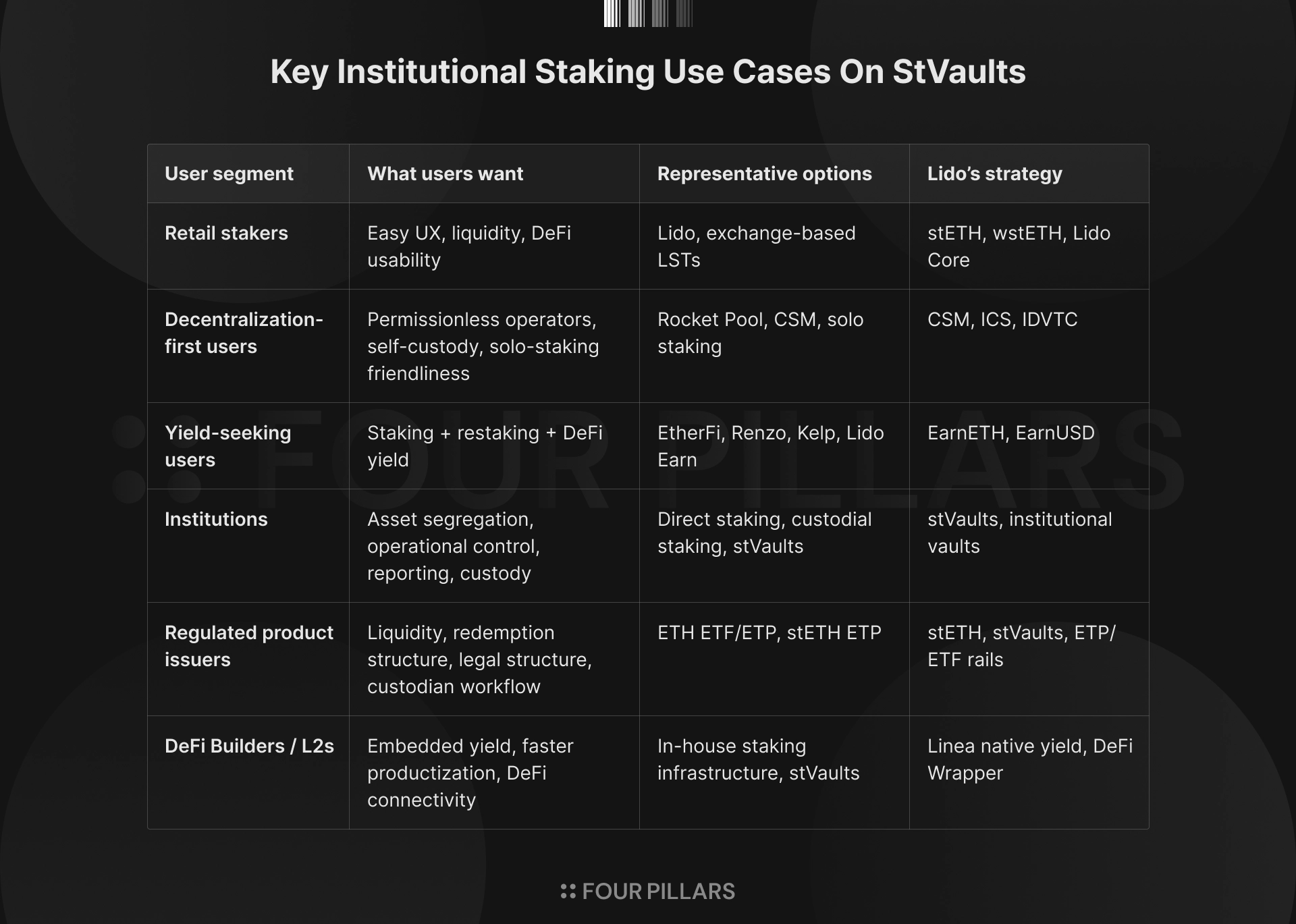
In the end, after 2026 Lido is no longer sufficient with only the identity of the largest Ethereum staking pool. The market is fragmenting further, and each user segment wants to participate in staking in a different form. Lido's strength is stETH, the liquidity layer widely used in the DeFi ecosystem, and the node infrastructure around it. Future competitiveness depends on how many different user segments it can persuade on that basis.
5.2 GOOSE-3
5.2.1 The GOOSE Framework
GOOSE stands for Guided Open Objective Setting Exercise, a framework for setting the Lido DAO's strategic goals. Through GOOSE, LDO token holders can indicate their preferences on 12-month or 36-month goals. Contributors then propose concrete execution plans and budget requests based on these goals. GOOSE is the procedure by which the Lido DAO sets its long-term direction, and EGG (Ecosystem Grants Request) organizes the budget and execution plan needed to carry out that direction. Through GOOSE a strategy is presented, LDO token holders indicate preferences, and the funding needed to achieve the goal is organized into EGG.
Lido manages, together, assets on the scale of millions of ETH, a large-scale liquidity asset in stETH integrated with most major DeFi protocols, a node operator network, oracles, governance committees, and product lines such as Lido Earn and stVaults. As Lido's product lines and target customer segments expand, the interests grow more complex too. In this situation, Lido is not a company where someone can set the roadmap alone but a decentralized autonomous organization based on the LDO token, so it needs a framework to coordinate this. GOOSE organizes which goals Lido's various stakeholders will prioritize, and then connects the budget and execution plan to those goals through EGG.
5.2.2 The Core Direction of GOOSE-3
GOOSE-3 is Lido's 2026 strategic goals and three-year vision direction proposed within the GOOSE framework. The core of the proposal is that Lido must evolve from a single-product-centric liquid staking protocol into an organization with a product portfolio. The growth path GOOSE-3 lays out for Lido can be organized into three broad directions.
- Expansion of the staking product family: Lido seeks to keep stETH at the center while broadening its user base through adjacent products such as stVaults, institutional staking products, and ETPs. Lido is trying to expand from a single staking pool product into a staking product line for several user segments.
- Discovery of new DAO revenue sources: It must create new demand by broadening the product portfolio and diversify the DAO's revenue. This direction connects directly to the launch of Lido Earn, which seeks to capture revenue opportunities outside of simple staking APR. The 2026 EGG proposal for executing GOOSE-3 also specifies Lido Earn as a product for diversifying the DAO's revenue.
- A DeFi gateway for real businesses: GOOSE-3 sees the center of gravity of DeFi gradually moving toward real businesses linked to reality. In this flow, Lido should occupy the position that connects on-chain liquidity and off-chain economic activity. Specifically, it is a long-term direction of developing a product stack that connects the actual financial activities of companies and institutions, such as treasury management, finance, and investment, with on-chain infrastructure.
The 2026 EGG proposed a total budget of $60 million to achieve this strategy. The GOOSE-3 execution goals the 2026 EGG laid out are organized into four: "expanding the staking ecosystem," "upgrading the Lido core," "expanding revenue sources through Lido Earn," and "exploring real-business applications and vertical expansion opportunities." Lido emphasizes Core first in this budget structure. The direction of GOOSE-3 is to keep the core stable while stacking stVaults, Earn, institutional products, and DeFi products for real businesses on top of it.
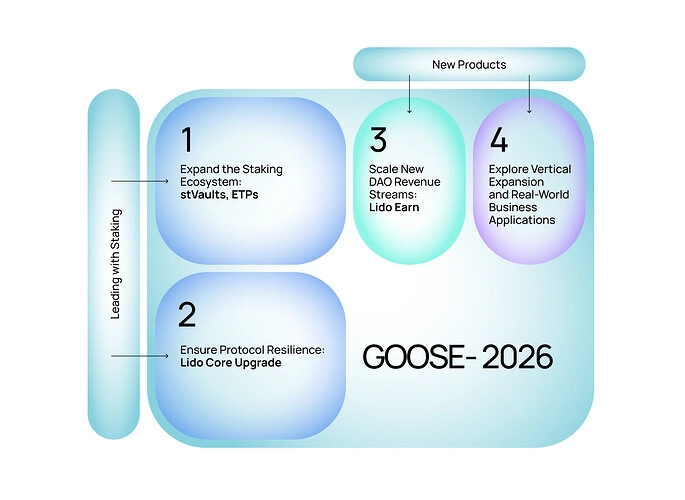
Source: Lido Research Forum
Lido's strategic direction after 2026 can be described as becoming a platform that stacks several product families on top of solid liquid staking infrastructure to absorb a wider range of users, institutions, and real-business demand.
5.2.3 DeFi Gateway for Real Businesses
One of GOOSE-3's strategic goals, "exploring real-business applications and vertical expansion opportunities," is presented as the vision of a "DeFi gateway for real business," first expressed in the November 2025 token holder update.
The real business Lido refers to is not crypto-native users or on-chain DeFi farmers but companies, funds, financial institutions, professionals, and individuals doing economic activity in reality. We are now in a transition period where countless businesses and individuals use blockchain for basic purposes such as stablecoin transfers but do not directly engage with the underlying technology. In this period, "real businesses" want to use blockchain but do not want to handle the complex infrastructure behind it directly. The role of the gateway that fills this gap is the goal of the vision Lido presented.
This does not mean Lido intends to play the role of a bank or asset manager. What Lido seeks to do is organize and productize already-existing on-chain infrastructure into a form companies and institutions can use. Lido seeks to become the infrastructure layer in between, so that real businesses can access DeFi's yield and efficiency without handling DeFi's complexity directly.
As of May 2026, however, Lido is still essentially an Ethereum staking protocol, and non-staking DeFi products such as Lido Earn are only just beginning. The flow of blockchain and crypto from early adopters to the early majority is actually underway, and Lido's vetted infrastructure and liquidity have the potential to play a gateway role in that flow. But for this, conditions such as regulatory clarity, demonstrated trust, and system integration must be met first. These are hard for Lido to meet in the short term, and some of them are outside the area Lido can control. The "DeFi gateway for real businesses" vision should therefore be seen not as a goal achievable in the short term in 2026 but as a long-term direction whose feasibility must be proven over the coming years.
5.3 Institutional Staking and Regulated Products
5.3.1 What Institutions Want
As organized in 5.1, the fastest-growing Ethereum staking segment in 2026 is institutional staking. What institutional users want from staking is fundamentally different from retail users. Retail users want simplicity and liquidity, but institutions require, on top of that, the following four.
- Segregation: Institutions want their assets to be operated separately, not mixed with other users' assets. Per-client segregated accounts and traceable, non-commingled assets are core requirements for institutional onboarding. The Lido core pool structure, where user deposits are merged into a single pool, conflicts with this requirement.
- Compliance control: Institutions must be able to control on their own whether regulatory requirements such as node operators' jurisdiction, KYC/AML, and security certifications are met across the entire staking lifecycle. For a regulated asset manager or ETF issuer, this is not optional but mandatory.
- Operational control and node operator choice: Institutions want to choose directly the node operators that run their deposited assets, and to adjust the validator composition to their own policy.
- Instant liquidity: Institutions want asset segregation and operational control while at the same time being able to liquidate that asset quickly when needed.
Even for the same ETH staking, whether the asset is mixed with other users' assets, what validator infrastructure structure it has, who bears the operational risk, what custody path it is accessed through, and whether audit and reporting are possible all differ. The institutional staking market is therefore not a simple LST market but one where the operating structure, legal structure, and accounting structure must be designed together.
5.3.2 stVaults as Institutional Staking Infrastructure
stVaults is the most important product in Lido's institutional strategy. Since Chapter 3 covered the mechanics of stVaults in detail, here we organize the possibility of stVaults establishing itself as the base infrastructure for institutional staking.
The core value stVaults has as a base for institutional staking is that it solves the four requirements seen above simultaneously on a single infrastructure. Using stVaults, an institution can segregate assets within a vault it controls, choose specific node operators, and set its own risk policy and fee structure. At the same time, it can use stETH liquidity when needed.
Custody integration also matters. stVaults has completed integration with major custody providers such as Fireblocks and Copper. Most institutions' digital assets are managed by custody providers. As stVaults connects with institutional workflows, an institution can build and manage Ethereum staking within its existing custody/approval system without building separate on-chain operating infrastructure itself.
Another strength is that Lido already has a vetted node operator lineup. For an institution to stake on its own, it has to find, evaluate, contract with, and monitor node operators directly, which is the most burdensome due-diligence process for an institution. stVaults provides the option for a vault owner to immediately access Lido's vetted operator pool. It also has the advantage that an institution can lower smart contract risk by putting a product on top of Lido infrastructure without building its own smart contract from scratch.
stVaults thus becomes a rail that lets institutions, node operators, and custody providers each build an Ethereum staking product suited to their own needs. Institutions that want direct staking gain control, institutions that want an LST gain liquidity, and professional node operators can build their own institutional staking products on top of Lido infrastructure.
5.3.3 ETP / ETF / DAT
The second axis of institutional entry is regulated products. If stETH can go beyond a simple on-chain token into traditional financial formats such as ETPs, ETFs, and DATs, Lido can access broader institutional capital without directly increasing on-chain users.
WisdomTree's Physical Lido Staked Ether ETP (Exchange-Traded Product) is a representative case. Launched in December 2025, this product is a physically collateralized ETP that generates staking yield through stETH's daily rebase. As of February 2026, it manages about $36 million in AUM. As Europe's first liquid staking ETP, it opened the first regulated path for traditional capital market investors to gain direct exposure to stETH.
A native-staking-based ETP may have to leave a substantial proportion of ETH unstaked to handle redemptions. A liquid staking ETP using stETH, by contrast, can handle redemptions using stETH's secondary market liquidity, so it has the advantage of keeping more assets in a staked state. Lido presents this as one of the reasons liquid staking is more suitable for an ETH ETF/ETP structure.
Source: Lido Blog
On the ETF side, VanEck filed an S-1 for the VanEck Lido Staked Ethereum ETF. The trust's goal is to reflect stETH's price performance after deducting operating costs. It is not an approved product yet, but the very fact that a US ETF structure with stETH as the underlying asset has appeared in an official filing matters.
From a DAT (Digital Asset Treasury) perspective too, liquid ETH can be an important strategic asset. When a company or foundation holds ETH, unlike simple spot holding, staked ETH participates in network security while generating yield. For Lido, stETH and stVaults provide an option for how a corporate treasury strategy holds ETH. The DAT area is a more fragmented market than ETP/ETF, however, and adoption possibility can vary with each company's accounting/audit/risk policy.
In summary, Lido's strategy for regulated products can be organized into three stages. First, the ETP stage, where stETH is used as the underlying asset of a regulated product. Second, the stage of whether a stETH-based ETF can be approved in a large market such as the US. Third, the stage where stETH is incorporated as a strategic asset within a corporate treasury or DAT structure. If all three flows materialize, Lido's user base can expand beyond on-chain retail and DeFi users into traditional financial products and the corporate treasury area.
5.3.4 The Context for Korean Institutions
Korea's digital asset regulatory environment is still focused on investor protection and market stability. In Korea, the institutionalization of spot crypto ETFs and digital asset products is still in progress, and regulatory, accounting, and custody constraints remain for direct on-chain operation by corporations and institutions. Korea-related legal analysis in early 2026 also shows that legislative proposals for institutionalizing spot crypto ETFs and derivatives continue, but the existing financial authorities maintain a cautious stance on the issuance and brokerage of spot Bitcoin ETFs.
For Korean institutions, Lido becomes a leading case showing how institutional staking products may develop going forward. Ethereum staking is changing from simply depositing ETH to receive rewards into a matter of financial infrastructure that combines custody, accounting, regulation, liquidity, and risk management. The strategies by which Lido is responding to this change are concrete global cases Korean institutions can reference when they enter the Ethereum staking market in the future.
For Korean institutions, there is also room to use position exposure to Lido's stETH as an alternative means of Ethereum staking. Domestically, participation of corporations and institutions in the crypto market is opening in stages, but the standards for the custody, accounting, reward processing, node operation, and slashing risk management needed when an institution stakes ETH directly are not yet sufficiently mature. In this environment, holding stETH can be an indirect means for an institution to gain exposure to ETH staking yield without running a validator directly. stETH is not ETH itself, however; it is a token with Lido protocol risk added. So for Korean institutions, stETH should be seen not as a complete substitute for direct staking but as an intermediate option that can be considered until institutional staking infrastructure matures.
5.4 Ethereum's Changes and Lido
Lido is basically a smart contract application running on top of Ethereum as general-purpose infrastructure, but it is at the same time staking infrastructure directly in contact with the Ethereum core. A change in the Ethereum protocol is therefore not a simple external environment change for Lido but an event that requires redesigning the protocol structure and operating method itself.
As seen earlier in 2.8, a single EIP-7251 introduced in the Pectra hard fork required redesigning the Lido core's accounting, the Staking Router, the oracle, and the withdrawal structure. Such changes will keep recurring. And depending on which direction Ethereum evolves, Lido's role changes too.
Going forward, Ethereum will evolve toward a faster L1, greater scalability, stronger censorship resistance, quantum resistance, and a more efficient validator structure, in the direction of the Strawmap and Lean Ethereum roadmaps. This change is both a new opportunity and a burden for Lido. Through every change, Lido must adapt safely to the new protocol environment without harming stETH's trust and liquidity. It must also be a coordinator that translates that change into a structure usable by the Lido core pool's node operators, the various staking modules, institutional users, and builders.
5.4.1 The Strawmap: Ethereum's 2030 Roadmap
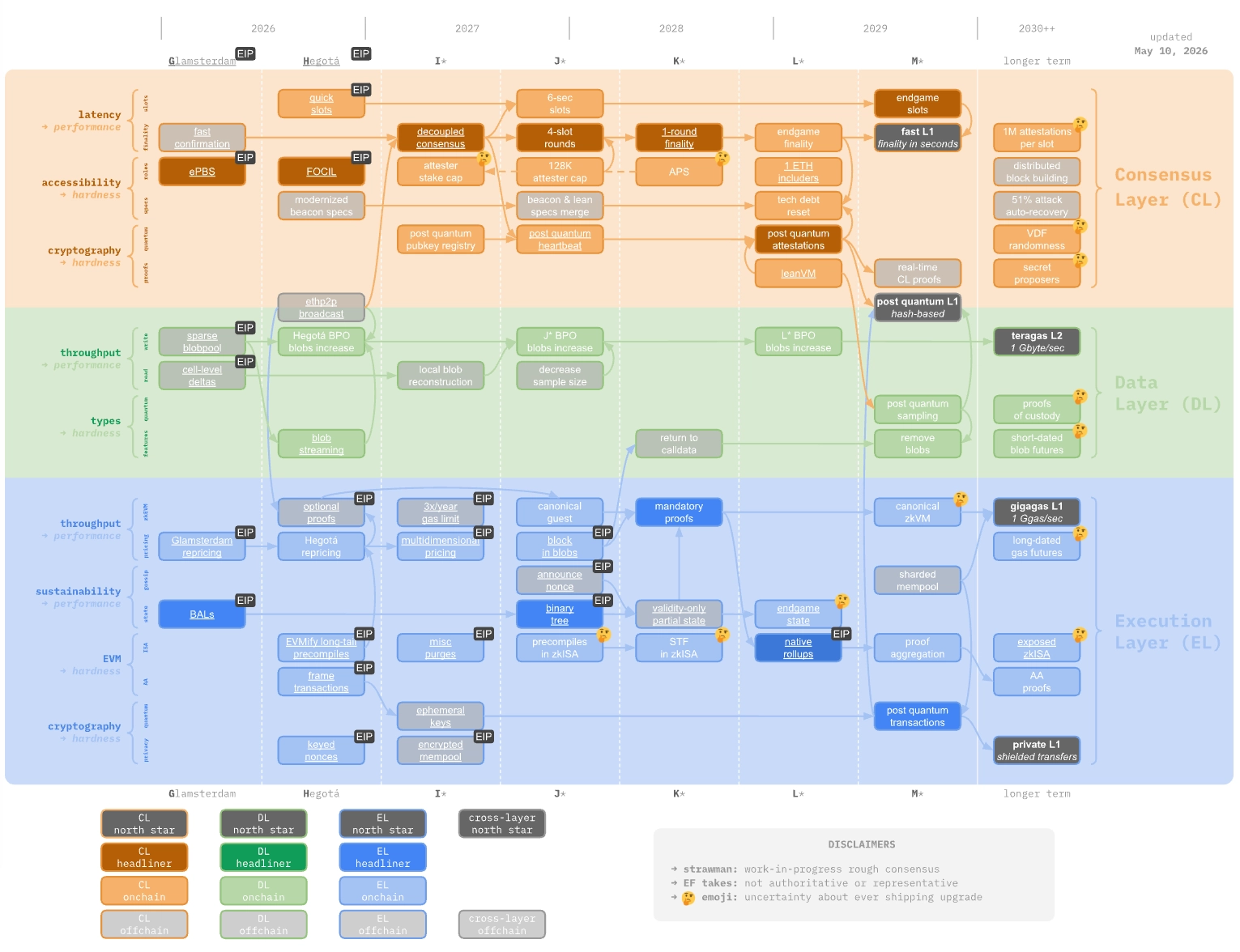
Source: Strawmap
The Strawmap is a roadmap that summarizes the long-term evolutionary direction of Ethereum L1 on a single page. It is a draft and coordination tool for seeing Ethereum upgrades in a unified view, a roadmap that deals with a multi-year timeline. The five big goals the Strawmap presents are as follows.
- Fast L1: It aims to gradually shorten the current 12-second slot time, ultimately reducing it to 2 seconds. It also reduces the current 16-minute finality time to below 16 seconds.
- Gigagas L1: It aims to process 10,000 TPS on L1 through an embedded zkEVM and real-time proof generation. By 2029 it mandates ZK proof generation for block validity, switching to a method where validators verify a zk proof instead of re-executing transactions to validate a block.
- Teragas L2: It achieves 10M TPS across all rollups through data availability sampling.
- Post-Quantum L1: It replaces the current quantum-vulnerable cryptography (ECDSA, BLS) with hash-based signatures and recursive STARKs.
- Private L1: It makes privacy transactions, currently dependent on the application layer, a built-in function at the protocol level. The direction is to treat shielded ETH transfers as a first-class citizen of the protocol.
Lean Ethereum is a vision that fully redesigns this long-term direction at the consensus layer. Lean Ethereum pursues performance, simplicity, and quantum resistance at the same time. Ethereum's consensus will change, through lean consensus, into a next-generation consensus structure aiming at second-level finality. On the simplicity side, through ZK-based verification and a more concise execution structure, full-chain verification will, in the long run, be accessible even from browsers, wallets, and mobile devices.
The more Ethereum evolves into a faster, lighter, more scalable, and more secure network, the more validator operating conditions change as well. Shortening finality, high throughput, real-time proving, quantum-resistant signatures, and privacy features can all create new requirements for node operators in clients, key management, hardware, networking, regulatory response, and monitoring. Because Lido is a protocol that coordinates hundreds of node operators and large-scale stETH liquidity, it is directly affected by these changes.
Through Ethereum's long-term roadmap, Lido can see what kind of staking infrastructure it must change into. Ethereum is an open-source protocol, and Lido is still the largest staking pool and core infrastructure on Ethereum. So Lido needs to go beyond stably following the Ethereum roadmap and raise its voice so that the direction aligns with the values Lido pursues.
5.4.2 Near-Term Hard Forks and Lido: Glamsterdam, Hegota
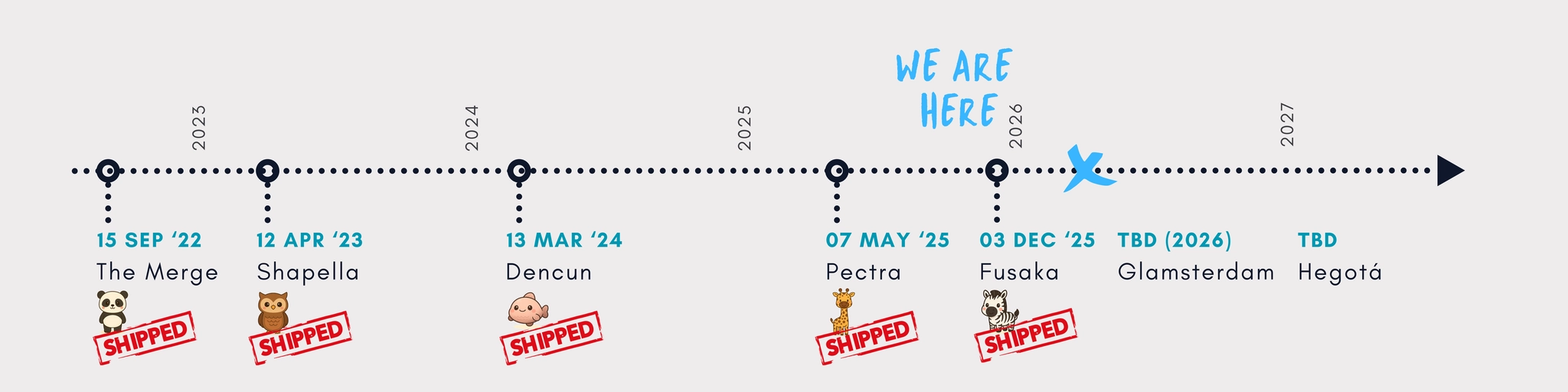
Source: Ethereum Foundation Blog
Ethereum plans to realize the Strawmap's long-term vision on mainnet through hard forks twice a year. The two near-term scheduled Ethereum hard forks are Glamsterdam and Hegota. Glamsterdam targeted June 2026, but the ePBS (Enshrined Proposer-Builder Separation) implementation was trickier than expected, and other features such as BAL (Block-Level Access Lists) and gas repricing also carry complexity, so it was postponed to Q3 2026. Accordingly, Hegota, scheduled for Q4 2026, is likely to be postponed to the first half of 2027.
Glamsterdam includes two core changes, ePBS and BAL. In Ethereum's current block production, the separation of the proposer and builder roles is done through a protocol-external sidecar such as MEV-Boost. ePBS is an upgrade that brings this into the protocol. A change in the block production structure also affects Lido's node operators, because how the builder market, MEV rewards, relay dependence, censorship resistance, and block inclusion policy change can all be connected to the Lido protocol's operating policy and node operator behavior.
Hegota's most important change is FOCIL (Fork-choice Enforced Inclusion Lists, EIP-7805). FOCIL is a censorship-resistance upgrade to reduce the problem of transaction inclusion power being excessively concentrated in particular builders. Each slot, 16 inclusion list committee members are randomly chosen, and they select and propagate a list of transactions that must be included. Block builders and proposers must then reflect the transactions on this list in the block, and attesters vote only for blocks that satisfy the inclusion list condition. This makes it hard for a builder or proposer to arbitrarily exclude valid transactions. By distributing the right to select transactions to a wider validator pool, even if block builders centralize, transaction inclusion power is distributed, so the protocol can have censorship resistance.
FOCIL is politically important for Lido in particular. The Lido DAO manages the allowed MEV-Boost relay list that node operators can use. And it monitors the block payload source and fee recipient of blocks a node operator proposes, watching whether a node operator siphons MEV rewards outside the protocol or uses a relay different from policy. This is to monitor whether a node operator delegated by Lido extracts MEV revenue separately rather than sharing it across the whole pool. But this part also meant Lido could censor through relay choice and block production policy. FOCIL blocks this concern by making censorship itself difficult at the Ethereum protocol level. And because the validator scale in the Lido pool still amounts to a fifth of the total, it also means that through FOCIL, Lido structurally contributes to the censorship resistance of all of Ethereum.
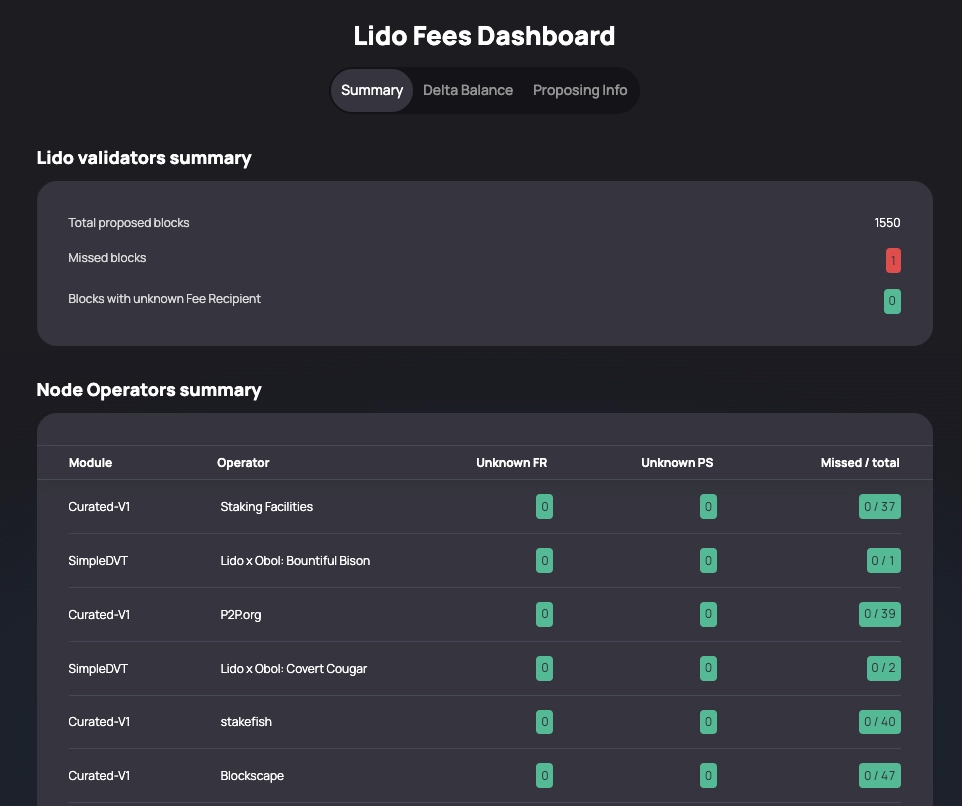
Source: Lido Fees Monitoring Dashboard
In summary, Glamsterdam gives Lido the protocol and its node operators the task of adapting to the post-ePBS block production structure and MEV market change, while Hegota gives Lido the task of having the Lido pool operate more directly as part of Ethereum's censorship resistance through FOCIL.
5.4.3 Validator Operating Conditions Changed by the Ethereum Roadmap
The long-term changes through the Strawmap and Lean Ethereum change the very conditions under which node operators run validators. This is the most fundamental change for a large-scale staking pool like Lido. The most important directions for Lido and its node operators in Ethereum's long-term roadmap can be organized into four dimensions.
First, node lightening and the accessibility of validator operation. Lean Ethereum presents a long-term direction of lowering the cost of full-chain verification through ZK-based verification and a simpler execution structure. If this direction materializes, the accessibility of Ethereum node operation can improve. If, instead of re-executing every transaction, a more efficient verification structure through a ZK-EVM can be used, the barrier to entry for individual operators and community operators falls. This fits well with Lido's community operator strategies such as CSM, ICS, and IDVTC. The decentralization Lido pursues is not simply selecting more professional operators but enabling more individuals and small operators to actually participate in stable validator operation. As organized in 2.7.3, Lido's task moves to how to safely accept unpermissioned operators.
Second, shorter slot time and finality. As slot time shortens and finality time speeds up, validator operators are required to be more responsive. Even on current Ethereum, a validator must perform its duties of attestation, block proposal, and various committees within a limited time. If slot time changes from 12 seconds toward something shorter, network latency, client stability, time synchronization, and node monitoring can become far more important, because small delays or temporary failures become more likely to lead directly to penalties.
This change creates an important shift in operating standards for Lido. It is not enough for Lido simply to secure many node operators. It must assemble an operator set that can perform duties stably within shorter time constraints while maintaining various regions, various infrastructures, and various clients. The balance between "decentralization" and "operational performance" becomes more important. Lean too far toward professional operators and decentralization weakens; open too loosely and performance risk grows. Lido's structures such as CSM, DVT, CMv2, and ValMart can all be interpreted as mechanisms for striking this balance.
Third, the validator key migration work that comes with introducing quantum-resistant signatures. This is a very practical task for Lido. Ethereum validators operate around keys. The validator key is the core of consensus participation, and the withdrawal credentials are connected to the final attribution of assets. If a transition to a quantum-resistant signature scheme is needed in the long run, validator key generation, key storage, key migration, client updates, and security procedures can all change. As a large-scale staking pool, Lido bears this burden heavily. An individual solo staker only has to manage their own key, but Lido has to coordinate keys and operating procedures across numerous node operators and various modules. Quantum resistance is therefore a long-term operational risk management problem for large staking infrastructure like Lido.
Fourth, the changing gap among solo stakers, CSM, and large node operators. If the Ethereum roadmap makes node operation lighter, it is positive for solo stakers and community operators. Lower hardware requirements, a simpler verification structure, and easier client operation help the expansion of permissionless operator modules such as CSM.
But the opposite possibility also exists. If shorter slot times, faster finality, real-time proving, new cryptographic schemes, and a more complex block production structure raise operational difficulty, the relative advantage of large professional operators can grow again, because large operators have better network environments, more engineering staff, more sophisticated monitoring systems, and a faster ability to respond to client updates. In this case Lido has to make a harder choice between its decentralization goal and its performance goal.
Lido is not simply a protocol that allocates stake to operators the market chooses. Lido designs the operator ecosystem through a system-level structure. If the Ethereum roadmap goes in a direction favorable to individual operators, Lido can absorb this through CSM and DVT expansion. Conversely, if the roadmap raises operational difficulty, Lido must further strengthen tooling, education, monitoring, and economic incentives to protect community operators.
In summary, the Strawmap and Lean Ethereum are not a simple future outlook for Lido. This roadmap becomes a pressure that shows what operator set Lido must build, what technical standards it must require, and what decentralization strategy it must maintain going forward. The faster, more scalable, and more secure Ethereum becomes, the more Lido must coordinate so that the change does not work only to the advantage of a few large operators. This is the long-term task Lido must solve to remain the base infrastructure of Ethereum staking.
5.4.4 The Debate Over Reducing Ethereum Staking Rewards and Lido
The Ethereum roadmap covered so far was a change Lido has to adapt to technically. But the debate over reducing Ethereum's new issuance can be the most direct threat to Lido. A substantial part of Ethereum staking rewards is ETH the protocol newly issues. This issuance follows an issuance curve where per-capita rewards decrease as more ETH is staked. As the staked amount grows, the ETH reward rate falls.
Even so, as of 2026 Ethereum staking demand is growing steeply with the full-scale entry of institutions. Although Ethereum staking APR has fallen greatly, from about 3% in early 2025 to about 2.6% as of 2026, the entry queue needed to stake reaches 60 days.
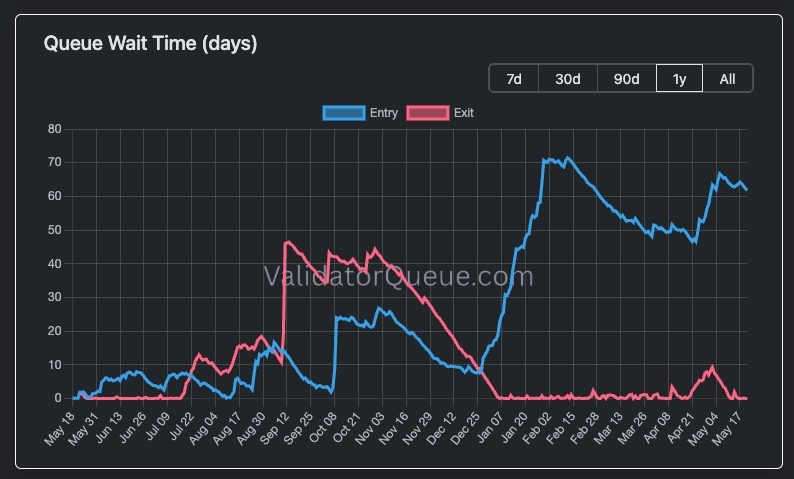
Source: validatorQueue
The first logic of the side arguing for reducing issuance is overspending on security. They view staking above a certain level as creating unnecessary dilution cost for ETH holders rather than greatly increasing network security. The current Ethereum issuance curve was designed before liquid staking took off in earnest. This can induce more staking than necessary, and rewards beyond the level needed for security produce side effects over time. Another is the expanding influence of LSTs and large staking services. This is directly related to Lido: the concern that as the surge of liquid staking and restaking rapidly pulls up the staking ratio, governance power and assets concentrate in LST protocols such as Lido.
This debate is critical for Lido. Reducing issuance pressures the basic profitability of the Lido core. Because Lido's basic revenue is directly connected to the protocol fee arising from staking rewards, if consensus rewards fall, the basic reward rate for stETH holders and the revenue returning to the DAO treasury and node operators also fall. Lido still depends on the single revenue source of staking fees, is dependent on Ethereum protocol policy changes, and is structurally vulnerable. This is the background for why securing new revenue sources such as Lido Earn and stVaults becomes even more important.
But the lower the basic staking reward, the more users may prefer a convenient LST or institutional staking product over solo staking. Paradoxically, if reducing issuance strengthens the relative advantage of large staking infrastructure, Lido could be a beneficiary. For that reason, Lido's responsibility grows too. If reducing issuance makes things harder for solo stakers and small operators, Lido must provide more of a path for small operators to survive within the Lido ecosystem.
5.4.5 Lido's Response: Absorbing and Coordinating Protocol Change
What matters for Lido is not applying a new feature introduced to Ethereum the fastest. More important is keeping the existing staking infrastructure safe and absorbing Ethereum's change without harming stETH's trust and liquidity. Lido is a protocol where assets on the scale of millions of ETH, hundreds of node operators, several staking modules, oracles, the withdrawal structure, and the governance layer are intertwined. An Ethereum protocol upgrade is therefore a complex event that has to coordinate many stakeholders and systems inside and outside Lido together.
Lido must also be a cushion that, against changes in Ethereum's economic policy, lets more independent operators run sustainably within the Lido pool. It must be not simply a device for improving Lido's decentralization image but an infrastructural line of defense that keeps changes in the validator structure and falling reward rates from pushing solo stakers out of the market.
In summary, Lido's response can be reduced to three. Technically, it must absorb Ethereum upgrades stably. Economically, it must maintain DAO revenue and value alignment for the LDO token through product diversification even in an environment of validator structure changes and APR reduction. Socially, it must keep strengthening node operator expansion through CSM, DVT, and the like, so that reduced issuance or changes in operating conditions do not push out solo stakers and community operators.
In the end, the most important capability for Lido going forward is the ability to safely absorb Ethereum's change as staking infrastructure and to translate and deliver it into a structure usable by node operators, stETH holders, institutional users entering Ethereum, and DeFi builders. If it fails at this role, Lido could become a large protocol that cannot keep up with the pace of Ethereum's change, and stETH could remain a bottleneck between protocol change and user demand. If it succeeds at this role, Lido can remain staking infrastructure that keeps expanding together with Ethereum and a foundation of DeFi.
6. Closing
Lido's first task was to break out of the frame of being a centralization threat to Ethereum PoS and change into a protocol that actually leads the decentralization of Ethereum staking infrastructure. Lido has absorbed the criticism of centralization into its protocol structure. CSM in particular expanded the decentralization strategy beyond the problem of selecting more permissioned professional operators to the harder problem of how to safely accept unpermissioned operators.
As a result, Lido went beyond defending its own weaknesses to become a protocol that presents standards for the decentralization of the entire Ethereum staking infrastructure. The metrics Lido publishes each quarter, such as geographic distribution, client diversity, and infrastructure diversity, and the evaluation criteria for Lido operator onboarding have become important reference standards for the Ethereum node operator ecosystem. A protocol once pointed to as the largest risk to Ethereum decentralization has now become one of the protocols most actively institutionalizing the decentralization standards of Ethereum staking infrastructure.
But the Lido of today faces a harder problem. The Ethereum staking market is no longer the same as in 2021. In the past, providing retail staking accessibility and issuing a liquid token usable in DeFi was enough for competitiveness. But now the differentiation of the staking service itself is steadily shrinking. Exchanges provide a sense of stability and easier onboarding, and institutions prefer their own infrastructure tailored to the regulatory environment or professional staking providers. Newly emerging products also package staking exposure in regulated forms such as ETFs and ETPs.
On top of that, the Ethereum protocol itself, on which the staking market directly depends, is also changing fast. Depending on the roadmap, the infrastructure operating environment and validator structure change, and reward reduction is being discussed. The task going forward is a matter of survival beyond political legitimacy.
So Lido's main task going forward is to diversify its revenue structure. This proceeds in two directions. One is vertical expansion, modularizing the staking domain to diversify customer segments and product families as a single infrastructure. The other is horizontal expansion. Through Lido Earn and the like, Lido is broadening beyond liquid staking into DeFi yield in general, and in the long run it aims to become the gateway through which real businesses access DeFi.
But simply making many products is not enough. Lido's biggest success factor was that it solved the problems of PoS staking with a liquid staking token and became the base infrastructure of the DeFi money lego. Ethereum does not provide native delegation at the protocol level, and Lido grew by filling that gap, filling the gap between Ethereum and user demand. And now, Ethereum is changing again. The protocol is evolving, and the users of Ethereum are changing too. In the end, Lido's next stage is also a matter of finding and solving new problems in this changed era, and building anew the standard infrastructure suited to that era.
Let us return to the opening question. Why Lido, Again, now? Because Lido's changes are a leading indicator of what form Ethereum-based financial infrastructure will be productized into going forward. Regardless of future success or failure, Lido is the existing DeFi protocol and staking pool with the largest TVL. And the background of Lido's growth so far, its current environment and strategy, and its next direction contain, in the most compressed form, the changes in the Ethereum staking and DeFi markets. Going forward too, Lido is the subject those trying to read the market's direction should watch most closely.
The author of this report may have personal holdings or financial interests in assets or tokens discussed herein. However, the author affirms that no transactions have conducted using material non-public information obtained in the course of research or drafting. This report is intended solely for general information purposes and does not constitute legal, business, investment, or tax advice. It should not be used as a basis for making any investment decisions or as guidance for accounting, legal, or tax matters. Any references to specific assets or securities are made for informational purposes only and should not be construed as an offer, solicitation, or recommendation to invest. The opinions expressed herein are those of the author and may not reflect the views of any affiliated institutions, organizations, or individuals. The opinions and analyses expressed herein are subject to change without prior notice. In addition, beyond the individual disclosures included in each report, Four Pillars, may hold existing or prospective investments in some of the assets or protocols discussed herein. Furthermore, FP Validated, a division of Four Pillars, may already be operating as a node in certain networks or protocols discussed herein or may do so in the future. Please see below links in the footer for FP Validated's participating network disclosures and for broader disclosure details.


