


Table of Contents
Researcher

Related Projects

Key Takeaways
- Every dominant anime franchise built IP product by product, not story first. Azuki is running the same sequence (physical TCG as the first playable entry point) in a market that just posted $13B in annual sales and is growing at 10% CAGR.
- Three independent macro forces are compressing onto trading cards simultaneously. A physical supercycle, the institutionalization of cards as an investable asset class, and $2B in on-chain card volume with $193M in gross revenue. Azuki sits at the intersection of all three.
- The structural decisions in Gates Awakened map directly to every failure mode in the market. Physical product in game stores, competitive infrastructure from day one, optional blockchain integration that stays invisible to players who don’t want it.
- No other TCG publisher controls the full stack. Azuki owns the IP, builds the game, runs competitive play, has professional grading from CGC/PSA/BGS, and operates the digital trading platform. Value doesn’t leak through licensing splits or subsidiary structures.
- collect.anime.xyz is more than just a marketplace; it’s an acquisition channel. Pokemon and One Piece collectors are building Animechain wallets now, before Gates Awakened cards are tokenized. The platform creates the audience before the product needs it.
1. Why TCG?
Every major anime franchise looks obvious in hindsight because the IP already feels complete by the time the rest of the world sees it. Pokemon is Pokemon. One Piece is One Piece. Dragon Ball is Dragon Ball. But none of them started as fully formed cross-media universes.
They were built product by product.
Pokemon started as a Game Boy game in 1996. The TCG came two years later, the anime after that, and combined franchise value today sits above $100B. One Piece started as a manga in 1997. Its TCG launched twenty-five years later and became the #3 selling card game globally within three years, because the IP already had 500M+ readers waiting. Dragon Ball, Yu-Gi-Oh, same sequence. The medium that introduces the world is not always the medium that scales it. Each product creates a new kind of fan, and every new fan becomes a distribution channel for the rest of the universe.
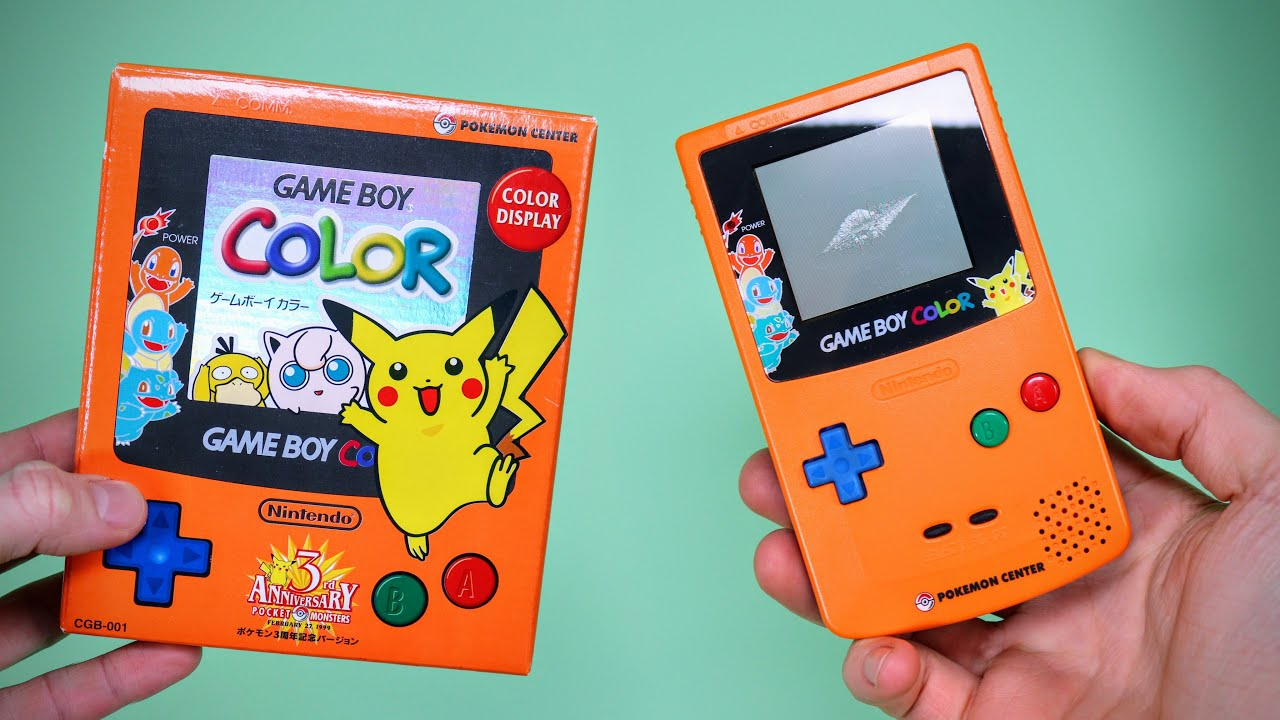
This is the frame that makes Azuki interesting.
Azuki launched in January 2022 as a 10K PFP collection and climbed to #2 by floor price behind BAYC. Beanz and Elementals followed. The TCG came years later. While the evolution from PFP to IP studio happened through iteration, not grand strategy executed on schedule, the pattern it’s following is the one that built the most valuable entertainment franchises in history.
Zagabond’s reasoning for why this evolution makes sense is coherent. “Great IP doesn’t have to start with story.” The early collectors were buying into a world that didn’t fully exist yet, and the TCG is “the first playable entry point into the Azuki universe.” The protagonist Shao appears in the cards before the manga, the same way Ash appeared in the Game Boy game before the anime aired. When the team decided to build a physical card game, there were holders insisting it should be digital and run on tokens. Zagabond’s response was direct: “If your target audience hates crypto, why tf would you shove it in their face?” They built the product for game stores and TCG players, not for tokenholders.
Another criticism runs along the lines of “no money flows back to holders for the use of their IP” and “if alignment is only in the IP, then there’s no real alignment at all.” Zagabond’s framing is that alignment at the earliest formative stages of an IP means alignment in identity and shared values, not financial distribution. “Is the Pokemon Company in a discord with you sharing their plans?” Whether that framing holds depends on whether the IP actually becomes valuable, which is the same bet early Nintendo shareholders made.
2. The Three Forces
The case for Azuki depends on the read that cards are having a much bigger moment than crypto people realize.
Not just Pokemon nostalgia. Not just a pandemic collectibles hangover. Cards have become a strange intersection of game, culture, financial asset, livestream commerce, grading infrastructure, and now tokenized vaults.
Start with the physical market.
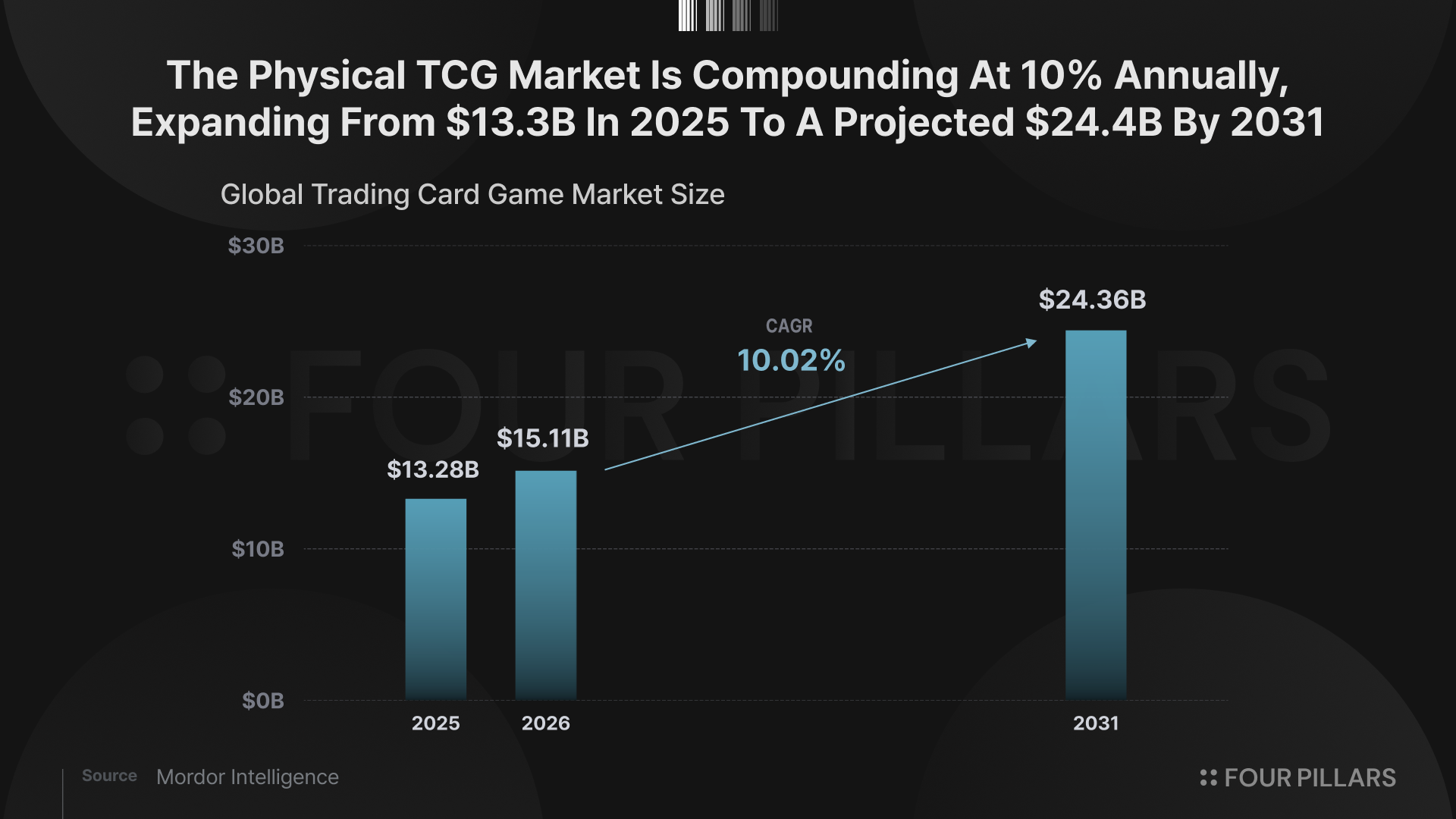
The physical TCG market hit $13.28B in 2025 and is projected to reach $24.36B by 2031 at a 10% CAGR. The Pokemon Company posted ¥411B ($2.9B) in net sales for FY2025, up 38% year-over-year, with its first ¥100B ($700M) operating profit in company history across 10.2 billion printed cards. Magic: The Gathering generated $1.72B in 2025, up 59%, its most successful year in three decades, now constituting 37% of all Hasbro sales. One Piece TCG went from zero to $500-700M in cumulative revenue within three years, overtaking Yu-Gi-Oh as the #3 game on TCGplayer. Bandai’s total card games division hit ¥286.3B ($1.99B).
The important part is that the market is still letting new winners in. Riftbound, the League of Legends card game, debuted #5 on TCGplayer in its first quarter. Lorcana sold 2.1 billion cards in under three years. Flesh and Blood built $50-75M annual revenue from zero IP. Retail confirms the same thing. Target TCG sales grew 70% year-over-year and are on track to surpass $1B in 2025, StockX Pokemon card sales jumped 367% in H1 2025, and eBay TCG sales increased for 10 straight quarters with $290M+ in September 2025 alone. Pokemon TCG Pocket grossed $1.6B in its first eighteen months, creating a new generation of digital-first collectors who are bridging to physical. The addressable audience is growing, not recycling.
The second force is the institutionalization of cards as an asset class. A PSA 10 Pikachu Illustrator sold for $16.5M at Goldin in February 2026, the most expensive trading card ever. The buyer, AJ Scaramucci of Solari Capital said “They should be treated as investments because that’s what they are.” His card portfolio grew 11x in six years. Card Ladder’s Pokemon index returned 3,821% since 2004 against the S&P 500’s 483%, with the last twelve months delivering 114-130% returns.

Source: Lemonde
Whatnot, whose primary product is card trading, reached $6B+ in GMV and an $11.5B valuation in its October 2025 Series F. When a VC-backed $11.5B company is built entirely on card trading, the asset class is legitimized without anyone having to argue for it. MemeStrategy, a Hong Kong-listed public company, launched the first tokenized Pokemon card fund targeting $940M+ in PSA 10 Pikachu cards with biannual Deloitte proof-of-reserve. PSA graded 26.8M cards in 2025, up 32% year-over-year, and TCG submissions specifically surged 95% while sports card submissions declined 12%. The categories are inverting.
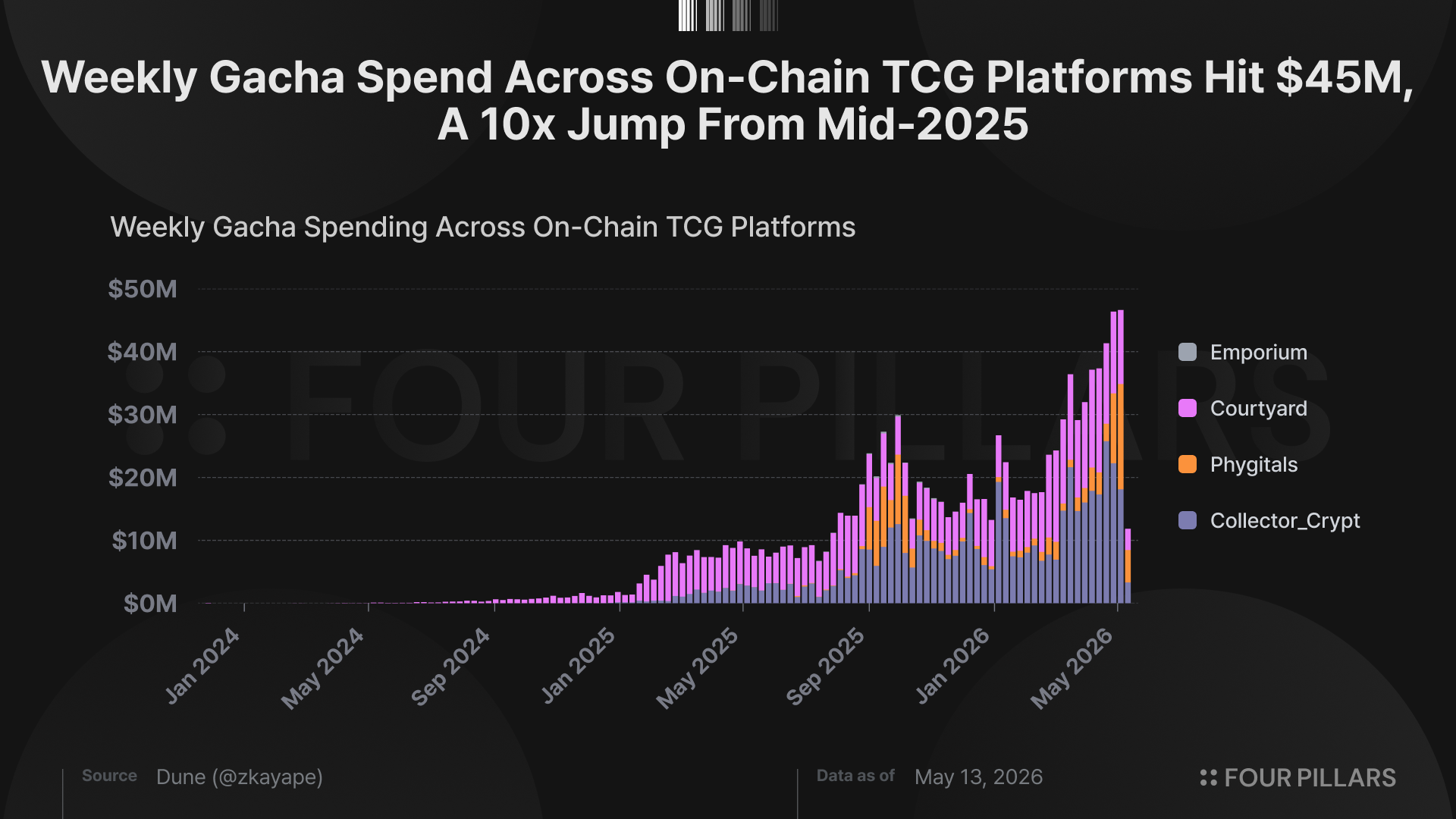
The third force is on-chain card rails. Courtyard, Collector Crypt, and Phygitals have collectively processed about $2.03B of tokenized physical card volume across 488K users, with $193M of gross revenue and 11.5M pack openings. The model is vault the physical card in insured storage, mint as NFT, trade 24/7, redeem anytime. Gacha is the revenue engine and buyback at 85-90% of fair market value provides exit liquidity. GameStop launched Power Packs in April 2026, the same model without blockchain. GameStop doesn’t innovate; instead, they follow validated demand.
The growth has also attracted a wave of failures. MetaZoo rode speculative mania to $8K booster boxes and filed Chapter 7 bankruptcy within four years . Parallel built a crypto-first digital TCG and PRIME now sits at $0.30 with no game store presence, no physical cards. Lorcana launched strong on Disney IP but watched speculators leave when the competitive game couldn’t retain them, sliding from #3 to #8 on TCGplayer.
These three forces are independent. The physical supercycle doesn’t need on-chain rails. The institutional asset class doesn’t need new IP. The on-chain economy doesn’t need a specific card game. A project at the intersection (new anime IP, physical TCG, on-chain card platform) compounds a set of tailwinds that don’t otherwise overlap.
3. Gates Awakened
The graveyard from Section 2 establishes a consistent finding, that the structural design of a new TCG matters more than the IP behind it. MetaZoo had a concept, Parallel had crypto, but neither had the architecture that makes a game store owner take a stocking decision seriously. Every design choice in Gates Awakened maps to a specific failure mode in the market.
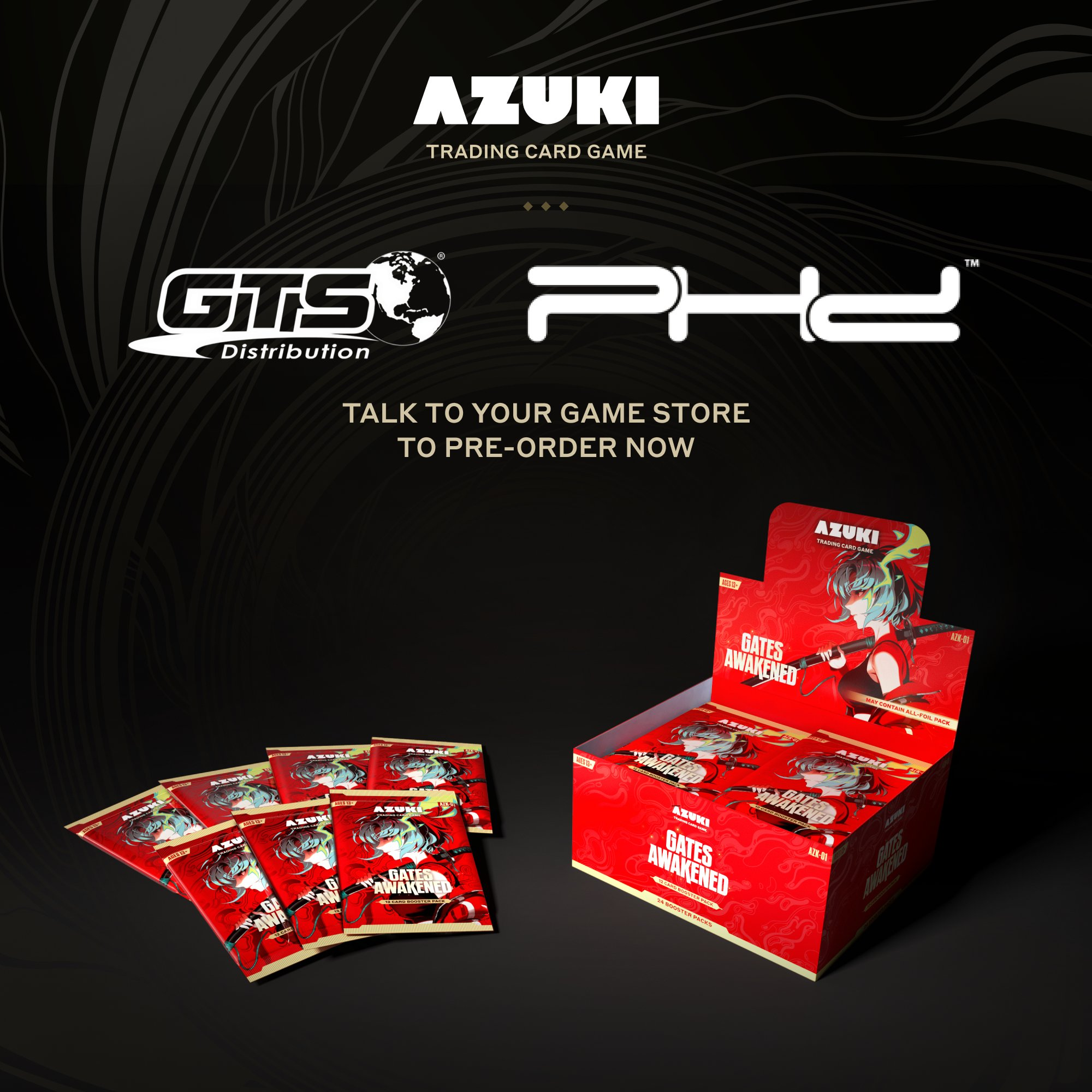
Physical product for game stores, because digital-only fails. Azuki generated $1M+ in direct presale revenue through its own storefront. A demand signal, not a revenue milestone in a $13B market, but regardless proves an original anime IP with zero mainstream awareness, and people are pre-ordering boxes at $119.99 before the game hits shelves. The product is a 2-player combat game with roughly 20-minute matches, booster packs at $119.99 per box (24 packs of 12 cards), starter decks, and a set composition running from 54 commons through to 2 portrait rare alt arts, which is enough depth for competitive variety, enough scarcity at the top for collector demand. Retail distribution is set for summer 2026 through GTS Distribution and DA Card World, the same hobby channels that One Piece, Riftbound, and Lorcana used to reach shelves.
Source: X (@AzukiTCG)
Competitive play from day one, because collecting without play stalls. CoreTCG is the official tournament organizer, the same operation that runs Yu-Gi-Oh and Bandai national events. There’s a $100K prize pool committed for Season 1 and the first invitational ran in LA in January 2026, with an iOS/Android app live for event discovery, registration, and live standings.
For context, Pokemon Worlds pays $50K to its TCG Masters winner alone, and Flesh and Blood grew to $50-75M annual revenue over seven years with a $2M annual prize pool across 47 countries. $100K for a debut season from original IP is an opening commitment. A trade show reviewer at GAMA compared the gameplay favorably to Bandai titles, an encouraging early signal, though the real test is competitive play at scale this summer.
Professional grading from launch, because cards-as-assets demand authentication. CGC is officially grading Azuki TCG cards, and the set is compatible with PSA and BGS. Three major grading houses from day one is unusual for a debut set and signals to the collector market that these cards are designed to hold value.

Source: X (@SteveG60117)
Then there’s the design philosophy that I think separates this from every crypto-adjacent TCG attempt. The cards have NFC BEAN chips embedded in rares that use Azuki’s PBT (Physical Backed Token) standard. Scan with your phone and it mints or transfers a PBT on Ethereum, which appears on a digital collector profile. Players who don’t care about blockchain never see it. Players who do get provenance and a digital showcase. This is the structural lesson from Parallel’s failure: crypto integration that’s visible and mandatory repels the core TCG audience. Azuki made it invisible and optional, which means the blockchain earns its place by being useful rather than required.
The creative foundation underneath all of this is Arnold Tsang’s art direction. Hand-drawn anime from community artists, no AI art, and cultural crossover that signals IP breadth: Azuki x 424 appeared at Paris Fashion Week AW26 in January 2026, with TCG characters on the runway. The visual identity translates across media, from cards to fashion to digital, the same pattern that made Pikachu or Goku recognizable independent of any single product.
4. Platform Precedes the Game
An interesting part of Azuki’s strategy is not the TCG by itself. It is that the TCG plugs into a marketplace that is already acquiring card collectors.
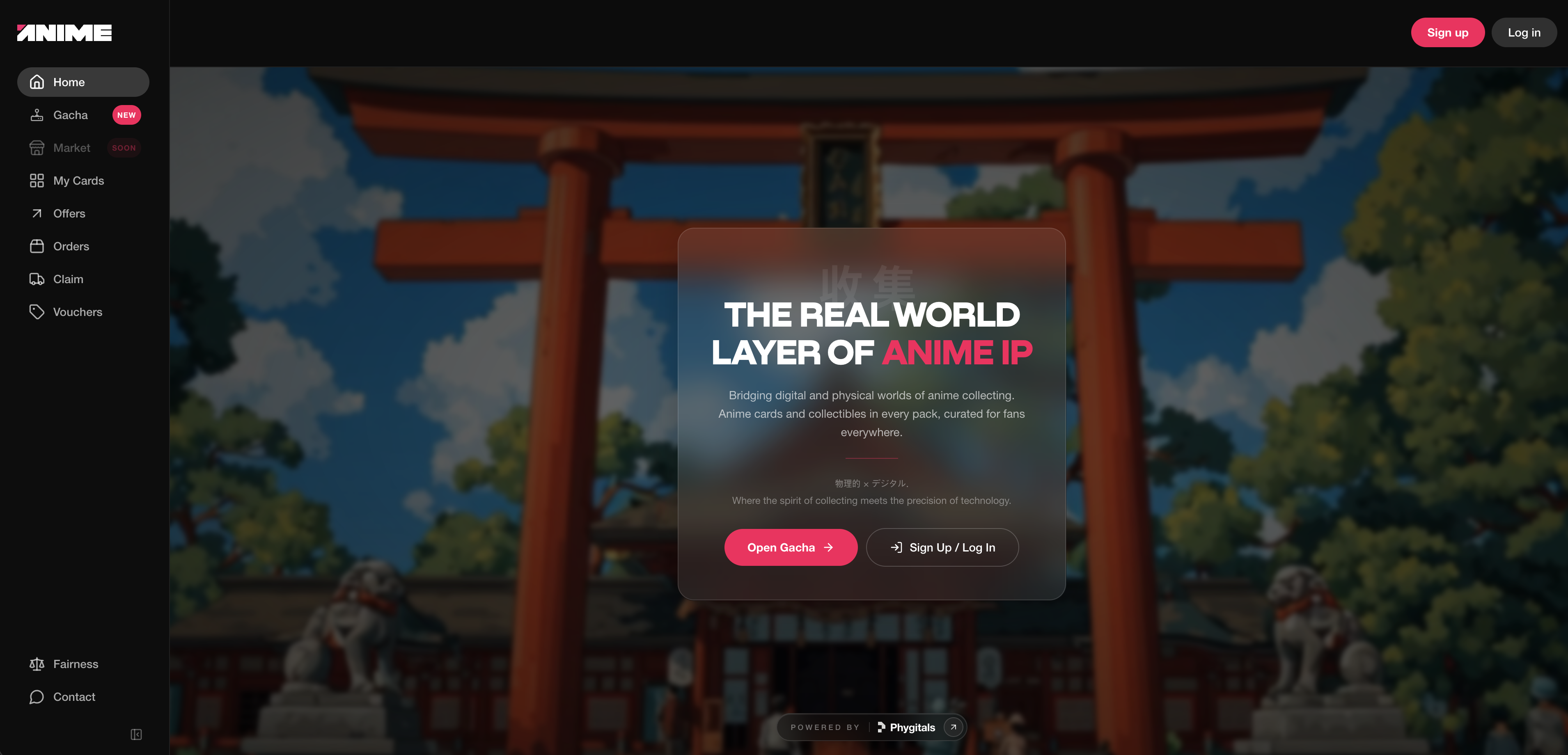
collect.anime.xyz is powered by Phygitals’ backend, which has processed $171M in volume across 28.5K users with 500K+ RWA transactions on Solana and 60K+ cards tokenized. Instant buyback at 85-90% FMV within 30 minutes, and already 30-40% of volume comes from web2 users paying with credit cards through Privy and Crossmint. The platform currently lists Pokemon and One Piece card packs at $50, $250, and $1,000 tiers (the crypto is invisible for a large chunk of those users).
Source: collect.anime.xyz
The $171M in Phygitals volume was built on other people’s IP. This isn’t Azuki’s traction in the traditional sense, but it is something more interesting: an acquisition channel. Pokemon TCG gacha on Solana alone generated $233.8M in cumulative spend since January 2026, averaging $21.3M per week and peaking at $35.2M in mid-March. The platform acquires card collectors through IP with hundreds of millions of existing fans, gives them Animechain wallets, and then they exist on the same infrastructure where Azuki content lives. When Gates Awakened cards are tokenized on collect.anime.xyz after the full game launch, physical TCG players gain a 24/7 digital trading layer that One Piece and Lorcana don’t have. The platform makes Azuki cards more liquid and more accessible than any competitor’s.
The scale of that top-of-funnel is already non-trivial. Over 1M Anime.com users have created Animechain wallets through the Privy integration, and most of those users are not necessarily Azuki buyers today. That is exactly the point. The wallet is created before the user has to care about Azuki, tokens, or even the chain itself.
The flywheel, when it works, runs in both directions. Azuki as IP owner captures publisher revenue from Gates Awakened card sales. Azuki as platform operator captures fees from every Pokemon and One Piece pack opened on the same infrastructure. More IPs on the platform means more collectors, more liquidity, and more incentive for additional IPs to list. The dual position, publisher and platform, is what no other TCG company occupies. Bandai doesn’t run a marketplace. The Pokemon Company doesn’t own the secondary trading layer. Those companies print cards and license IP; the secondary economy happens elsewhere, on eBay and TCGplayer and Whatnot, and none of those fees come back to the publisher.
The early traction is still small compared to the physical TCG market, but the shape of the demand matters. Animechain’s OpenSea launch generated 615K mints in a single day through Gate #0, a free TCG card mint. collect.anime.xyz launched in beta in April, and its first revenue-generating mint sold out in 90 minutes. Within two weeks, the platform crossed $100K in revenue with over 700 unique pack buyers. These are not franchise-defining numbers yet, but they show that users are willing to mint, open packs, and spend before Azuki TCG has even reached its full launch.
That said, the cross-IP bridge (Pokemon collectors discovering and buying Azuki cards) hasn’t been tested yet. The initial demand from Azuki’s community is encouraging, but whether it extends beyond that community is the open question that 2026 will answer.
5. No Seams
Bandai publishes the One Piece TCG but doesn’t own the manga IP (that belongs to Shueisha). Ravensburger licenses Disney for Lorcana. Hasbro owns MTG through a subsidiary, Wizards of the Coast. In each case, there’s a split between the IP owner and the publisher, or between the publisher and the platform, or between the game and the competitive infrastructure. Value leaks through every seam.
Azuki owns the IP, builds the game in-house under Arnold Tsang’s art direction, runs competitive play through CoreTCG, has professional grading from CGC, PSA, and BGS, distributes to hobby shops through GTS and DA Card World, and operates the digital trading platform at collect.anime.xyz. No other TCG publisher in the market controls this configuration. Every dollar of value generated, from card sales, tournament entry, digital trading fees, to eventual brand licensing, accrues to the same entity. The vertical integration is the moat.
The challenge is proportional to the ambition. Every successful new TCG of this era either had a massive pre-existing fanbase (One Piece’s 500M manga readers, Riftbound’s 180M League of Legends players) or spent years building competitive credibility from scratch, Flesh and Blood taking seven years to reach $50-75M annually across 47 countries. Azuki has neither yet. The bet is that the TCG creates players, collect.anime.xyz creates collectors, anime.com creates casual fans, and the cultural touchpoints collectively build the audience that doesn’t exist today. That’s a harder bootstrapping problem than any of the successful comps faced.
Summer 2026 is when the cards reach retail through hobby distribution, CoreTCG’s Season 1 competitive circuit runs its full schedule, and the first players who’ve never heard of Azuki pick up a booster pack because the art caught their eye. First edition manga and Solana marketplace integration are on the roadmap for collect.anime.xyz. The moment of truth is when tokenized Azuki TCG cards land on the platform.
The market for trading cards is $13B and growing. The on-chain rails handle $2B in volume. The IP-building pattern that created Pokemon, One Piece, and Dragon Ball (product first, story second, each medium creating fans for the others) is the same sequence Azuki is running. The difference is that Azuki also owns the platform where the digital economy lives, with no licensing split, no subsidiary structure, no seam for value to leak through. Whether the game is good enough to earn its shelf space is the question summer answers. Everything else is already in place.
IKZ.
The report is based on the independent research of the author sponsored/funded by Azuki Labs, Inc. The author of this report may have personal holdings or financial interests in assets or tokens discussed herein. However, the author affirms that no transactions have conducted using material non-public information obtained in the course of research or drafting. This report is intended solely for general information purposes and does not constitute legal, business, investment, or tax advice. It should not be used as a basis for making any investment decisions or as guidance for accounting, legal, or tax matters. Any references to specific assets or securities are made for informational purposes only and should not be construed as an offer, solicitation, or recommendation to invest. The opinions expressed herein are those of the author and may not reflect the views of any affiliated institutions, organizations, or individuals. The opinions and analyses expressed herein are subject to change without prior notice. In addition, beyond the individual disclosures included in each report, Four Pillars, may hold existing or prospective investments in some of the assets or protocols discussed herein. Furthermore, FP Validated, a division of Four Pillars, may already be operating as a node in certain networks or protocols discussed herein or may do so in the future. Please see below links in the footer for FP Validated's participating network disclosures and for broader disclosure details.


