


Table of Contents

Korea’s Crypto Glory Days
Korea is still an attractive crypto market for global protocols.
Yes, trading volumes on exchanges like Upbit and Bithumb dropped sharply during the recent prolonged bear market. But once sentiment started to turn, volumes bounced back 2.5 to 3x in a short period.
That says something important about Korea: Retail liquidity in crypto can come back very quickly.
But the industry itself is a different story.
Compared to the past, Korea’s crypto ecosystem has lost a lot of its appeal.
Back in the 2021 bull market, Korea had a real presence in global crypto. It had a strong investor base, active communities, and a wave of companies and projects across L1s, DeFi, P2E, NFTs, infrastructure, wallets, and more.
Then Terra collapsed in 2022. Everything changed.
Onchain Is Moving to the Extremes
While Korea’s crypto industry slowed down, the global blockchain industry went in a pretty interesting direction.
Bitcoin’s 2025 peak was almost twice as high as its 2021 peak. But the onchain-native products that exploded in 2021 and 2022 did not grow anywhere near as much.
So the market clearly got bigger. The question is: what actually benefited?
The answer is pretty simple. Products driven by speculative demand, and products connected to the real economy.
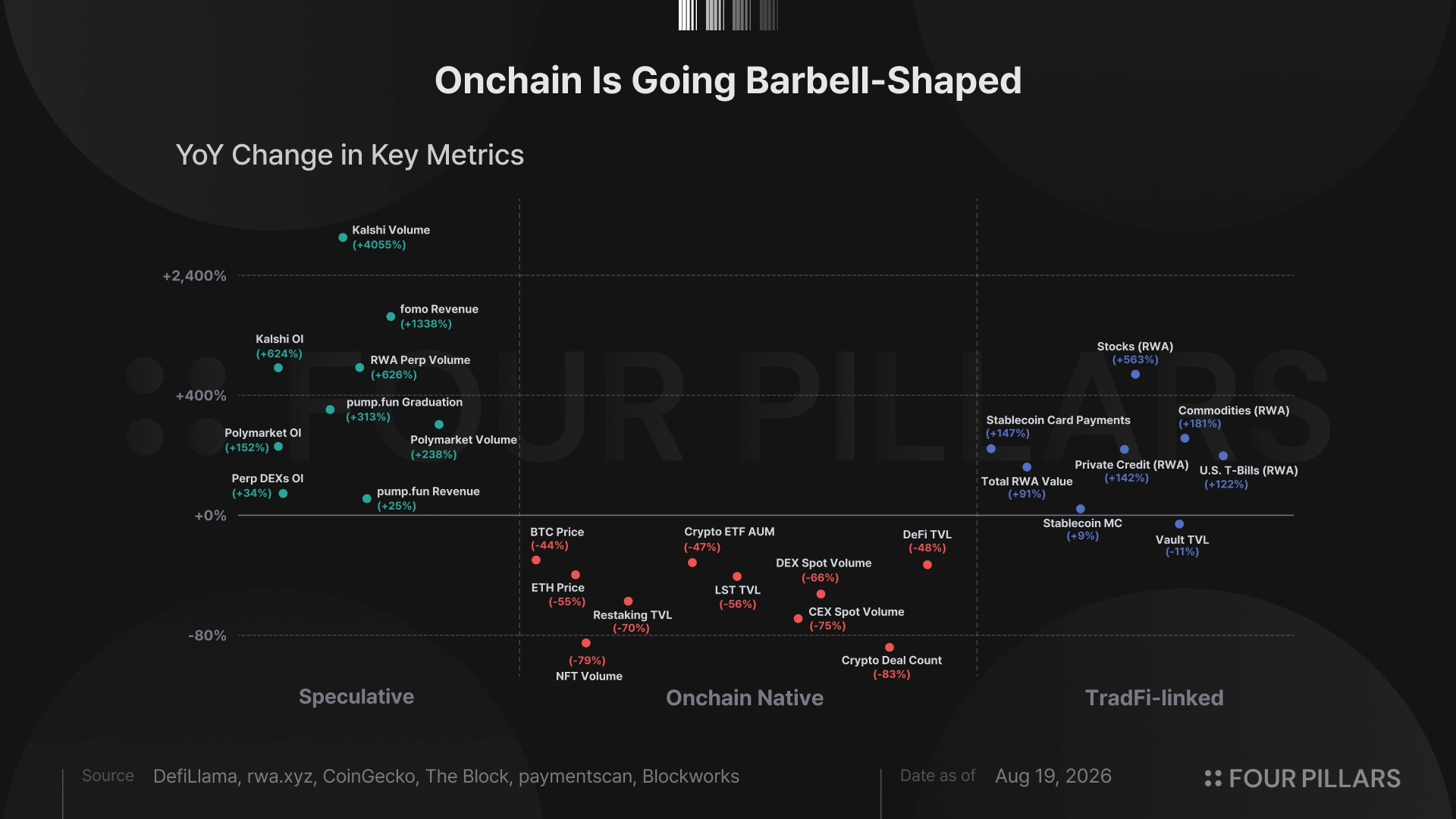
When the market was recently trading near its lows, the YoY numbers told a clear story.
DeFi TVL fell sharply. So did DEX and CEX spot volumes, LST TVL, NFT trading volume, and the number of crypto funding deals.
In other words, the onchain-native products that defined the last bull market are having an even harder time than Bitcoin itself, the market’s de facto benchmark, when you compare the size of the declines.
But there is another side to the story: A few sectors have grown explosively even in this difficult market.
- Perpetual futures, or perps, and prediction markets grew on speculative demand.
- Stablecoins and RWAs grew by connecting crypto to the real economy.
So yes, the blockchain industry did grow this cycle. But the shape of that growth matters.
It looks like a barbell: Speculation at one extreme. Integration with the real economy at the other.
Korea’s Blockchain Industry Is Falling Behind
Perps. Prediction markets. Stablecoins. RWAs. These are the four sectors that saw the most explosive growth in the global blockchain industry this cycle.
So what happened in Korea? How many of these sectors were actually able to grow here?
Zero.
Today, there is no legal path for Korea’s blockchain industry to properly offer services in any of these four sectors.
- Perpetual futures: Korea does not have a law that explicitly bans perpetual futures. But Korea’s Financial Services Commission, or FSC, takes a very conservative stance on crypto-based credit provision. Under the current legal framework, there is also no legal basis for formally offering crypto derivatives domestically.
- Prediction markets: In Korea, prediction markets are generally treated as illegal gambling. More recently, the Korea Communications Standards Commission also blocked domestic access to Polymarket.
- Stablecoins: The Digital Asset Basic Act, or DABA, which is expected to include stablecoin regulation, keeps getting delayed. Right now, there is no legal basis for companies to issue and distribute stablecoins.
- RWA: Korea does have an STO framework, but it is closely tied to fractional investment products. That is quite different from what the global market generally means by RWA. Korea currently has no regulatory framework for RWA. Regulators recently said that selling tokens issued overseas and backed by Korean securities only to overseas investors would be difficult to classify as a violation of the Electronic Securities Act. But Korean institutional investors still face clear limitations when it comes to accessing RWA products.
Perpetual futures are one of the trading innovations created by the crypto market. Singapore’s SGX launched BTC and ETH perpetual futures. The CFTC approved BTC perpetual futures from KalshiEX.
Prediction markets are another kind of innovation. They turn almost anything in the world into a trading interface. And more recently, they have started to show potential as hedging venues for almost anything, and eventually even as a new generation of insurance products.
Stablecoins and RWAs are different again. They have already found product-market fit independently of crypto market sentiment. They are becoming the backend infrastructure for the next generation of finance.
None of these innovations are really happening in Korea.
And that creates a strange paradox: The gap between Korea and the global market is actually much wider today than it was in 2021.
That does not mean nobody is trying. There is still no clear regulatory framework, but financial institutions are already preparing stablecoin businesses. In RWA, some players are trying to issue products overseas first.
Korea still has one major advantage. Once the regulatory environment is in place, it has the potential to grow the industry faster than almost any other country.
Hopefully, Korea gets clear regulatory frameworks for perps, prediction markets, stablecoins, RWAs, and related sectors soon. That would finally give Korea’s blockchain industry room to grow again.
The author of this report may have personal holdings or financial interests in assets or tokens discussed herein. However, the author affirms that no transactions have conducted using material non-public information obtained in the course of research or drafting. This report is intended solely for general information purposes and does not constitute legal, business, investment, or tax advice. It should not be used as a basis for making any investment decisions or as guidance for accounting, legal, or tax matters. Any references to specific assets or securities are made for informational purposes only and should not be construed as an offer, solicitation, or recommendation to invest. The opinions expressed herein are those of the author and may not reflect the views of any affiliated institutions, organizations, or individuals. The opinions and analyses expressed herein are subject to change without prior notice. In addition, beyond the individual disclosures included in each report, Four Pillars, may hold existing or prospective investments in some of the assets or protocols discussed herein. Furthermore, FP Validated, a division of Four Pillars, may already be operating as a node in certain networks or protocols discussed herein or may do so in the future. Please see below links in the footer for FP Validated's participating network disclosures and for broader disclosure details.


