


Table of Contents

When an ecosystem distributes funds to builders, its aim is strategic investment in the ecosystem’s own growth. The funds are not charitable grants. First, as a funded project grows, onchain activity increases and the chain’s revenue base, including fees, expands with it. Successful projects also attract new services and users, allowing the ecosystem to grow nonlinearly and become more stable. If a project introduces a new model, the chain gains attention and symbolic status as the place where that model began. STEPN(@stepnofficial) during the m2e era is one example.
The influx of bounty hunters and cherry-pickers has weakened this original purpose. Funds intended to identify builders who would contribute to the ecosystem over the long term often went to projects interested only in a one-time prize. Many winning projects were abandoned or disappeared within months, sometimes within days. In the early years of blockchain, hackathon participation often indicated a willingness to remain in the ecosystem. As ecosystems matured and hackathons became routine, winning became an endpoint for many participants, followed by their departure with the prize money.
Of the many hackathon winners that received large prizes after 2022, how many remain active today and have become core parts of their ecosystems?
This problem extends beyond blockchain. Hackathons in every field face similar limits. Advances in AI tools now allow people with limited development experience to build proof-of-concept products with relative ease. The ability to produce a working demo in a short period no longer shows whether a team can keep building or contribute over time. As traditional hackathons lose this screening function, new formats have begun to emerge to restore it.
From onboarding to deal sourcing
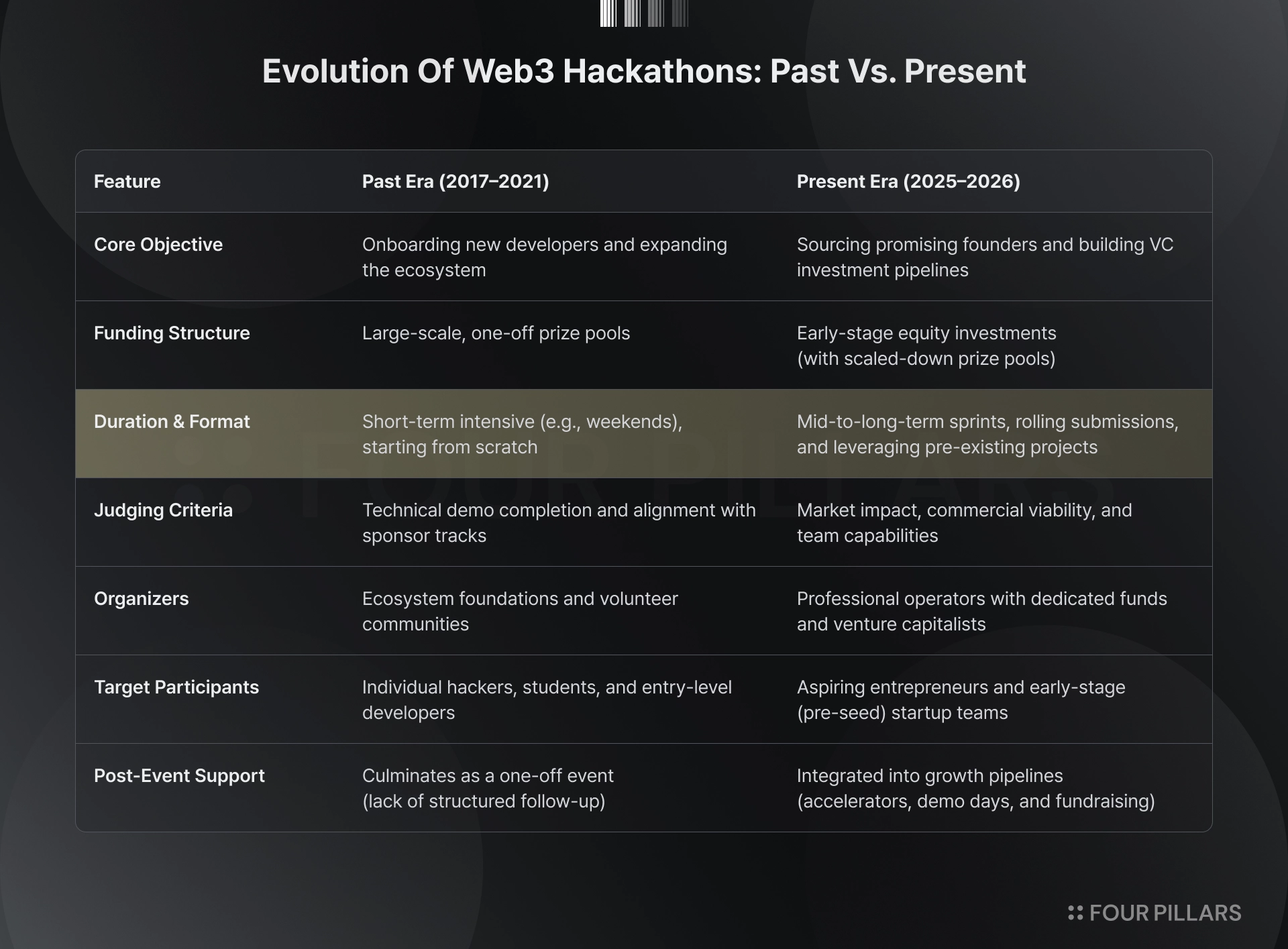
The first clear change is the funding structure. Past hackathons resembled one-time events that distributed large prize pools. Recent programs reduce prize money and instead make early-stage investments in selected teams. Evaluation criteria have expanded beyond the quality of a technical demo and its fit with sponsor tracks. Judges now consider market impact, business potential, and the team’s ability to execute. Participants have also shifted from individual hackers toward startup founders and pre-seed teams. Solana’s Colosseum (@colosseum) and Base Batches show this change most clearly.
Solana was an early example of this approach. It operated its hackathons internally from its first online event in 2020 through Hyperdrive in 2023. In 2024, it ended internal operations and partnered with Colosseum, an independent organization. Beginning with Renaissance in March of that year, Solana combined a hackathon, an accelerator, and a venture fund within a single pipeline. Colosseum now runs an eight-week program. Teams selected from the hackathon winners receive a $250,000 pre-seed investment.
In 2025, Colosseum also launched Eternal, a permanent program that allows participants to begin a four-week development sprint at any time between hackathons. Frontier in 2026 removed the existing tracks and sponsor bounties altogether. Teams were evaluated based on the expected impact of their products on the Solana ecosystem. The program now operates as an incubator that tests a team’s execution speed and business potential over time, rather than focusing on the polish of a product built within a few days.
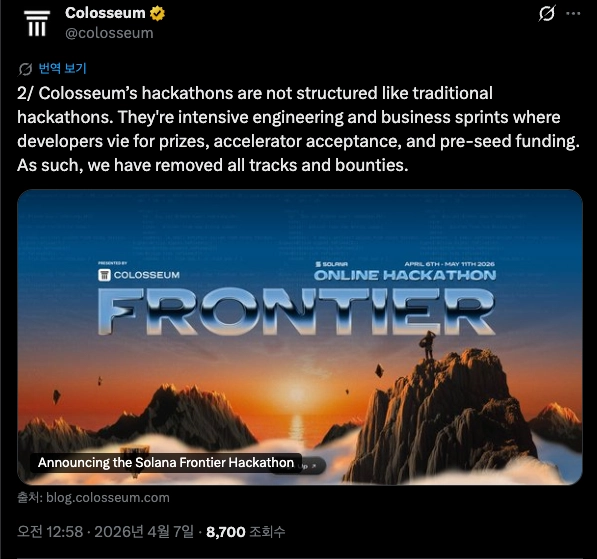
Source: X(@colosseum)
Base has made this shift more explicitly. Base Batches 001 began in 2025 as a long-duration global hackathon. Seventy-seven finalist teams received mentoring and participated in a demo day. More than $1 million was distributed among 40 of those teams. The program retained the hackathon format but added further evaluation of finalists and funded only a selected group. This structure helped screen out bounty hunters.
Base Batches 002 kept a hackathon-style builder track for early teams and introduced a startup track for teams that already had products and were seeking investment. It was a transitional format in which a hackathon and an accelerator operated side by side.
By Base Batches 003, the formal program had removed the hackathon stage altogether. The organizers interviewed about 120 of the 1,175 applicant teams and selected 12. These teams joined a seven-week virtual accelerator followed by a demo day in San Francisco. The selection criteria were also rewritten around founder-market fit, early traction, clarity of problem definition, and team execution speed. These criteria closely resemble a venture capital investment review. Base Batches has become an accelerator that identifies promising early-stage teams and develops them into investment-ready companies. Base Batches 004 follows the same model and is currently accepting applications.
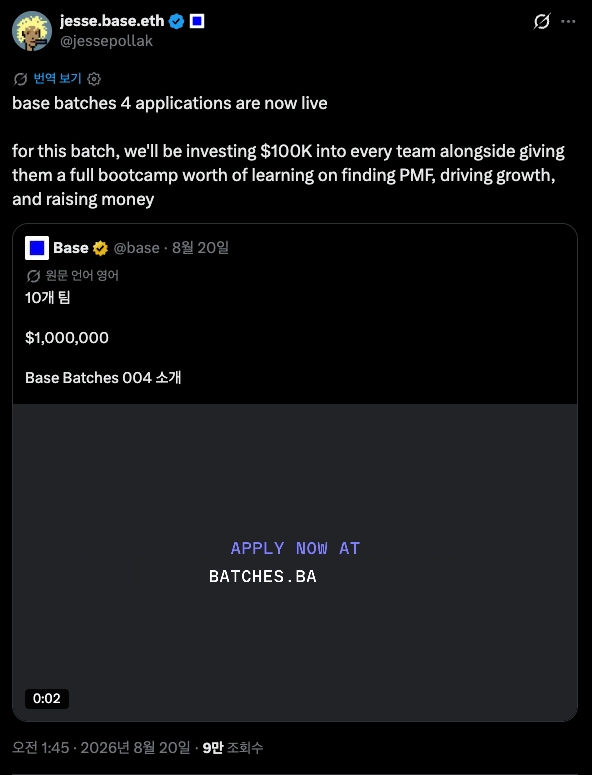
Source: X(@jessepollak)
Taken together, hackathons are moving away from one-time events. They are becoming entry points into deal-sourcing pipelines that identify, support, and invest in promising founding teams. Traditional hackathons for developer onboarding and technical experimentation will remain. However, deal-sourcing programs are rapidly taking over their role as a core means of allocating ecosystem capital.
Founder identity checks and follow-up reviews during the selection and incubation process also reduce the risk of rug pulls, a recurring problem among past hackathon entries. Higher project credibility gives ordinary users and consumers, many of whom had grown indifferent to hackathon results, a reason to pay serious attention to them again.
Ecosystems want capable founding teams that can build sustainable businesses, rather than a large number of empty submissions used to meet KPIs. They have no reason to keep distributing prizes to projects whose potential for long-term contribution has not been proven.
Institutional use cases and the rise of AI and agents
As hackathons become deal-sourcing pipelines, the problems that builders choose to solve are changing as well.
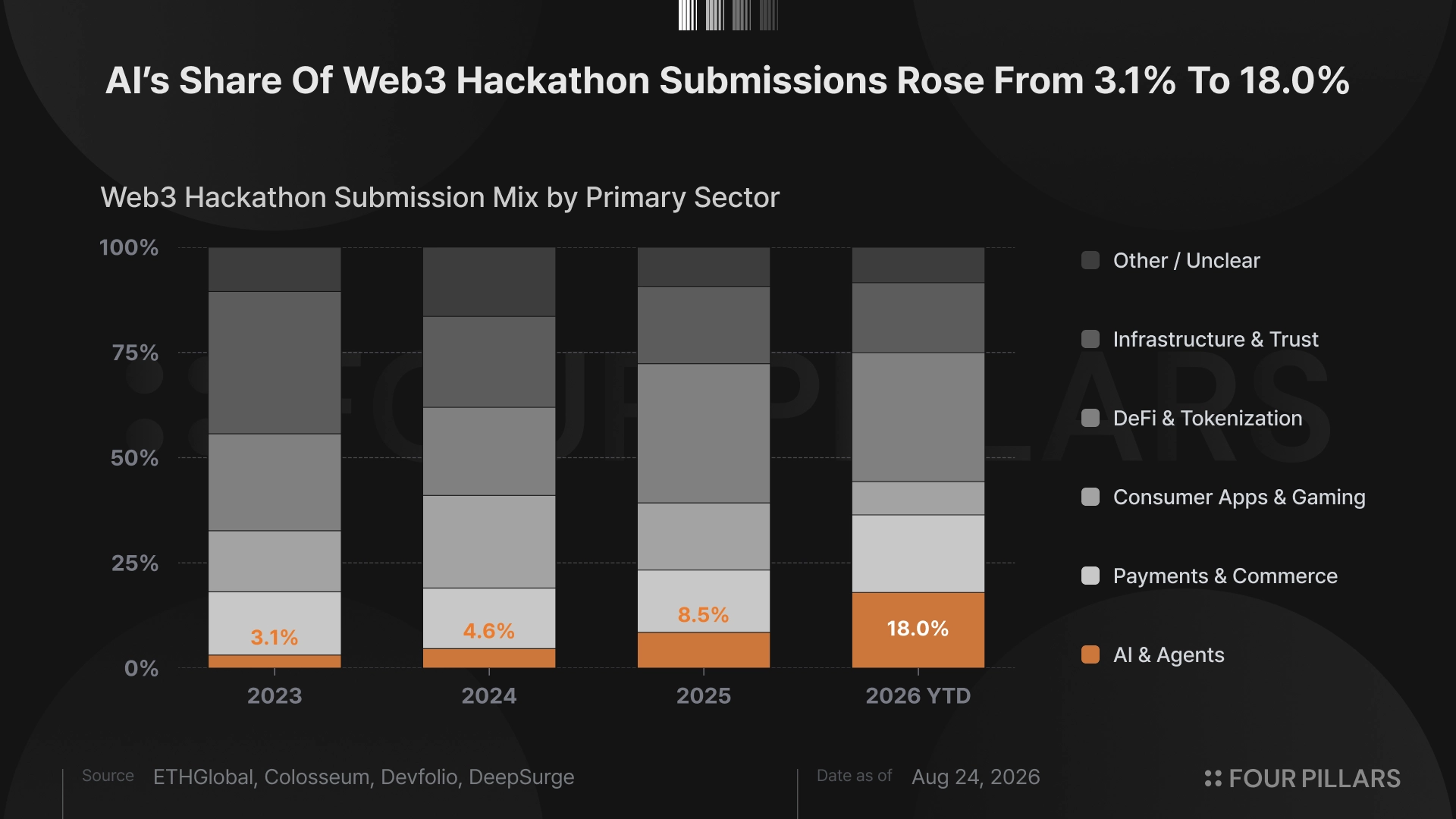
This analysis uses data from 25,010 projects submitted to 88 global Web3 hackathons across 20 ecosystems between January 2023 and August 2026. The dataset minimizes thematic bias and tracks annual changes in sector composition.
Changes in annual submission trends:
- 2023, infrastructure and foundations for trust: Most projects focused on protocols, security, and developer infrastructure needed for onchain finance.
- 2024, consumer applications: As market conditions improved, submissions shifted toward onchain applications focused on user experience in gaming, social products, and creator services.
- 2025 to 2026, institutional adoption and the return of DeFi: As institutions entered the market and formal frameworks took shape, more projects focused on DeFi, stablecoins, and asset tokenization. These sectors also held the largest share in 2026.
One change stands out. The share of AI and agent projects, which had grown steadily since 2023, rose sharply in 2026. This partly reflects advances in global AI infrastructure and changes in how software is built. Given the parallel growth of payment and commerce projects, the share of AI and agents is likely to increase further.
AI tools have also made it much easier to produce basic proof-of-concept products. This tendency is especially visible in AI and agent projects. Hackathon participants must therefore move beyond simple implementation. The real test is whether they can connect AI agents to actual onchain transactions and payments, then generate meaningful transaction volume on a sustained basis.
If they cannot solve this problem, even a product built with great enthusiasm will end up as “anonymous submission #N, another piece of AI slop.”
Applicants must design for value accrual to the chain
Deal-sourcing hackathons can screen out bounty hunters, but a project’s success does not automatically translate into success for the chain. A conventional venture fund can consider an investment successful once it exits at a higher valuation. A chain can justify the same investment only when the project continues to leave transactions and liquidity on its network.
Consider what happens as a project grows. At the initial investment stage, the chain providing the capital holds the bargaining power. The balance changes once the project has built a user base. As it expands across multiple chains, its ties to the original ecosystem weaken. In some cases, the relationship reverses and the chain becomes more dependent on the project.
Chain ecosystems therefore seek projects whose growth directly accumulates value and demand on their networks. Standalone project quality is insufficient.
AI has sharply lowered the barrier to building a product. Builders who design for value accrual to the chain from the outset can stand apart from formulaic submissions and earn the ecosystem’s backing.
The author of this report may have personal holdings or financial interests in assets or tokens discussed herein. However, the author affirms that no transactions have conducted using material non-public information obtained in the course of research or drafting. This report is intended solely for general information purposes and does not constitute legal, business, investment, or tax advice. It should not be used as a basis for making any investment decisions or as guidance for accounting, legal, or tax matters. Any references to specific assets or securities are made for informational purposes only and should not be construed as an offer, solicitation, or recommendation to invest. The opinions expressed herein are those of the author and may not reflect the views of any affiliated institutions, organizations, or individuals. The opinions and analyses expressed herein are subject to change without prior notice. In addition, beyond the individual disclosures included in each report, Four Pillars, may hold existing or prospective investments in some of the assets or protocols discussed herein. Furthermore, FP Validated, a division of Four Pillars, may already be operating as a node in certain networks or protocols discussed herein or may do so in the future. Please see below links in the footer for FP Validated's participating network disclosures and for broader disclosure details.


