

![No CLARITY Act, No Problem
[FP Weekly 42]](/_next/image?url=https%3A%2F%2Fkrotgrfjzckvumudxopj.supabase.co%2Fstorage%2Fv1%2Fobject%2Fpublic%2Fassets%2Fimg%2Fcontent%2Farticle%2Fnotion-import%2Fl44zlxmv4r9yqa.png&w=3840&q=75)
Table of Contents
- 1. Major News
- [Institution] CFTC Moves to Establish Federal Regulatory Framework for Leveraged Retail Crypto Trading
- [Institution] Securitize Launches 'Securitize Stocks,' Offering 1:1-Backed Tokenized Equities with Shareholder Rights
- Others
- 2. Four Pillars Weekly
- : : Mantle Q3 Recap: Powering Borderless Access to Global Capital Markets (Link)
- : : KBW 2026: A Field Guide to Korea's Crypto Market (Link)
- : : ASA Report: How to Read Asia's Digital Money Market (Link)
- : : Road to Internet Capital Markets (Link)
- : : How Exchange Intelligence Should Be Built: A Look at the Case of Surf and Bithumb (Link)
- : : Ethereum Korea One: Ethereum in 2026 and beyond (Link)
- Comments
- 3. Macro & Onchain Metrics
Researcher

1. Major News
[Institution] CFTC Moves to Establish Federal Regulatory Framework for Leveraged Retail Crypto Trading
What Happened?
On October 5, the U.S. Commodity Futures Trading Commission (CFTC) initiated the process of establishing a new federal regulatory framework for leveraged and margined crypto asset transactions involving retail investors. The agency issued an Advance Notice of Proposed Rulemaking (ANPRM), seeking public comment on crypto-specific regulatory requirements and a new exchange registration framework. The initiative comes amid delays in the passage of the CLARITY Act, a comprehensive crypto market structure bill, and reflects the CFTC's efforts to establish federal oversight of crypto markets under its existing statutory authority.
At the center of the initiative are two proposed regulatory frameworks: Regulation Crypto Asset Transactions (Regulation CTX) and Regulation Crypto Asset Markets (Regulation CAM). Regulation CTX aims to establish specific requirements for retail crypto asset transactions (CTXs) subject to Section 2(c)(2)(D) of the Commodity Exchange Act. This provision generally covers retail commodity transactions conducted on a leveraged, margined, or financed basis. Meanwhile, Regulation CAM would introduce a new subcategory of Designated Contract Market (DCM) registration, known as a Crypto Asset Market (CAM), specifically designed for crypto exchanges offering such transactions.
Historically, many U.S. crypto spot exchanges have operated under state-level licenses, including Money Transmitter Licenses. However, state-level regulatory requirements vary across jurisdictions and were primarily designed for money transmission and payment services, leaving gaps in addressing financial market-specific risks such as leveraged trading and market manipulation. Under the proposed framework, exchanges could opt into a unified federal regulatory regime under CFTC oversight rather than relying solely on state-level licensing structures. This would create a pathway for exchanges to offer leveraged and margined trading services to retail investors while complying with standardized requirements for market manipulation prevention, conflict-of-interest management, customer asset protection, and trading transparency.
However, the initiative does not seek to bring all crypto spot transactions under CFTC supervision. CFTC Chairman Michael Selig explicitly stated that the agency lacks the statutory authority to require all crypto asset transactions to take place on CFTC-registered exchanges. Accordingly, the proposed framework would provide an alternative registration pathway for exchanges seeking federal oversight rather than fully replacing existing state-level regulations. Specific leverage limits and detailed regulatory requirements have yet to be determined, and the CFTC will consider further rulemaking following a 60-day public comment period after publication in the Federal Register.
Researcher's Comment
The CFTC's latest initiative signals a broader shift in U.S. crypto regulation from an enforcement-driven approach toward a more proactive framework for market oversight. The U.S. crypto market has long faced regulatory uncertainty stemming from the lack of a clear jurisdictional boundary between the SEC and CFTC. In particular, despite substantial global demand for leveraged crypto trading, regulatory pathways for offering such services in the U.S. have remained limited. The CFTC's decision to explore a crypto-specific exchange registration category suggests a growing willingness to accommodate these activities within the existing financial market regulatory framework.
Notably, the proposal prioritizes leveraged and margined transactions rather than seeking to regulate the entire crypto spot market. While the CFTC does not possess comprehensive supervisory authority over ordinary spot transactions, Section 2(c)(2)(D) of the Commodity Exchange Act allows it to regulate certain leveraged retail commodity transactions. In other words, the agency has identified an area where it can expand oversight of crypto trading within the scope of existing statutory authority without requiring additional legislation from Congress. This demonstrates how regulatory agencies may provide a degree of regulatory clarity even in the absence of comprehensive market structure legislation such as the CLARITY Act.
From an exchange perspective, the proposed registration framework could also reshape existing business models. Platforms that currently offer leveraged products through offshore entities or separate trading venues may gain a pathway to introduce compliant products in the U.S. market. Furthermore, a unified federal regulatory framework could improve regulatory consistency and legal predictability compared to structures dependent on multiple state-level licenses. However, applying financial market-level supervisory standards, including customer asset segregation, market surveillance, risk management, and intermediary requirements, could also increase operating costs and raise barriers to entry for crypto exchanges.
Nevertheless, the announcement should not be interpreted as a blanket authorization of leveraged crypto trading in the U.S. The CFTC has only initiated a public consultation process to inform potential future rulemaking, rather than finalizing a specific set of regulations. Key details, including permissible leverage limits, exchange capital requirements, and customer protection measures, remain subject to further discussion. More importantly, a structural limitation remains: agency rulemaking alone cannot establish comprehensive regulatory authority over the broader crypto spot market.
Ultimately, the significance of this initiative lies less in the potential near-term expansion of leveraged trading and more in the gradual development of federally regulated crypto trading infrastructure in the U.S. The effectiveness of the proposed framework will depend on the level of investor protection and operational requirements ultimately established by the CFTC, as well as whether exchanges find sufficient economic incentives to pursue CAM registration.
[Institution] Securitize Launches 'Securitize Stocks,' Offering 1:1-Backed Tokenized Equities with Shareholder Rights
What Happened?
On October 8, real-world asset (RWA) tokenization platform Securitize launched Securitize Stocks, a new service enabling blockchain-based trading of U.S.-listed equities. The platform offers tokenized stocks backed 1:1 by actual underlying shares and is available to eligible investors in the U.S., European Union (EU), and other permitted jurisdictions. The initial offering includes Apple (AAPL), Microsoft (MSFT), Nvidia (NVDA), Alphabet (GOOG), Tesla (TSLA), Meta (META), Amazon (AMZN), Netflix (NFLX), Circle (CRCL), Strategy (MSTR), Palantir (PLTR), and SPCX. Trading takes place on Solana through Securitize's registered broker-dealer platform, with transactions settling in USDC.
The key distinction of Securitize Stocks is that, unlike certain existing tokenized equity products that primarily provide economic exposure to stock price movements, the platform is designed to preserve legal entitlements and economic benefits associated with the underlying shares. Each token is backed by one actual share and represents a security entitlement under Article 8 of the Uniform Commercial Code (UCC). This structure allows investors to receive applicable shareholder rights and economic benefits, including dividends and voting rights where available. The underlying shares are held in segregated accounts and are not lent out. However, the tokens do not currently represent shares directly recorded on the issuer's shareholder register. Instead, investors hold legally protected security entitlements to the underlying equities.
To support this structure, Securitize introduced the Convertible Entitlement Token (CET) framework. CETs are designed to allow investors to convert their existing security entitlements into shares directly recorded on an issuer's shareholder register, maintained by its transfer agent, once issuer-sponsored tokenization becomes available. Securitize is developing this conversion pathway through partnerships with major transfer agents, including Computershare. This approach establishes a potential bridge between the current model of issuing tokens backed by existing shares and a future market in which issuers directly issue and manage equities onchain.
On the trading infrastructure side, Jump Trading will participate as a liquidity provider and market maker. At launch, Securitize Stocks will support extended trading hours beyond regular U.S. market sessions through a Solana-based PropAMM, with plans to expand toward 24/7 trading. Securitize also intends to make the products available on the New York Stock Exchange's (NYSE) upcoming digital securities trading platform and the Tokenized Securities Venue (TSV) operated by OKXICE, a joint venture between OKX and Intercontinental Exchange (ICE). However, these trading venue integrations and round-the-clock trading capabilities remain planned developments, subject to the launch of the respective platforms and applicable regulatory requirements.
Researcher's Comment
The launch of Securitize Stocks suggests that competition in the tokenized equity market is evolving beyond simply offering products that track stock prices toward integrating legally recognized securities entitlements and traditional capital market infrastructure with blockchain networks. Historically, certain tokenized equity products have focused primarily on providing investors with economic exposure to underlying asset prices, while differing from conventional equity investments in terms of shareholder rights and legal ownership structures. In contrast, Securitize aims to combine the legal protections of traditional financial markets with the efficiency of onchain trading through 1:1 backing by actual shares and security entitlements under UCC Article 8. This development suggests that tokenized equities are gradually evolving from blockchain-based representations of existing financial assets into products more closely integrated with regulated securities markets.
A particularly notable aspect is how Securitize's CET framework creates a potential bridge between the tokenization of existing shares and issuer-sponsored tokenization. While Securitize Stocks currently represent security entitlements backed by actual equities, investors may eventually convert these entitlements into shares recorded directly on an issuer's shareholder register once the issuer adopts tokenization. This structure allows Securitize to expand onchain access to existing listed equities without requiring immediate issuer participation, while establishing a foundation for a longer-term transition toward issuer-integrated onchain securities markets. Given that Securitize has already pursued the tokenization of its own publicly listed shares, SECZ, and established partnerships with Computershare, the launch can be viewed as part of a broader strategy to extend its existing securities issuance and management infrastructure across a wider range of publicly traded equities.
Another important implication is the potential expansion of tokenized equities in terms of distribution and utility. Traditional equity markets have long been constrained by trading hours, brokerage account requirements, and established clearing and settlement infrastructure. In contrast, tokenized equities can be traded and settled through blockchain networks, potentially enabling 24/7 trading, faster settlement, and integration with onchain financial applications over time. Securitize has also identified collateralization and lending through DeFi protocols such as Aave as potential areas for future expansion. This suggests that tokenized equities could evolve beyond conventional investment products into assets that provide liquidity and collateral within onchain financial markets. However, these applications remain dependent on further technical integration and regulatory compliance, rather than being universally available across permissionless DeFi protocols at launch.
Nevertheless, 1:1 backing and the preservation of shareholder rights do not necessarily translate into a trading experience identical to that of traditional equity markets. Investors in Securitize Stocks hold security entitlements rather than directly registered shares, meaning the exercise of shareholder rights and custody of underlying assets still depend on broker-dealers and related intermediary infrastructure. Furthermore, even when trading occurs onchain, liquidity and price discovery remain influenced by market maker participation and connectivity with the underlying equity markets. During extended trading hours, limited liquidity in the underlying markets could result in price discrepancies and higher trading costs. Investor eligibility requirements, KYC/AML procedures, and jurisdiction-specific securities regulations also distinguish these products from fully permissionless DeFi assets in terms of accessibility.
Ultimately, the significance of this launch lies less in the introduction of another onchain trading option for U.S. equities and more in the growing effort to establish blockchain-based secondary markets while preserving legally recognized rights to underlying shares and existing securities market infrastructure. The long-term growth of the tokenized equity market will likely depend not simply on the number of assets issued, but on the ability to establish sufficient trading liquidity, achieve efficient integration with traditional financial markets, facilitate the transition toward issuer-sponsored tokenization, and enable meaningful utility within DeFi ecosystems.
Others
Crypto
- Polymarket rolls out V2 upgrade with single ERC-1155 positions contract, pUSD collateral
- Pudgy Penguins-backed Ethereum L2 Abstract to shut down after losing 'tens of millions'
- Polygon Open Money Stack Expands to TRON, Extending Network Access to Regulated U.S. Payment Rails
- Samsung to launch USDC transfers on Solana for US Galaxy users
Institution
- CFTC proposes new federal framework for leveraged retail crypto trading
- Robinhood adds $25 million worth of bitcoin to balance sheet as it deepens crypto push
- Securitize launches 1:1-backed tokenized stocks, starting with Apple, Nvidia, Strategy and more
Tech
- Crypto industry split over Justin Drake's AI warning
- Ledger investigates wallet drains involving CryptoBilis buyers; estimate tops $86 million in losses
Investment
- Umia raises $6.1 million at $18 million FDV to help crypto projects launch tokens
- Solana treasury DeFi Development authorizes CHAD preferred stock buyback program
- Solana's Orca merges with Loopscale in push to finance AI, robotics and defense
Asia
- Standard Chartered to expand crypto custody services in Singapore
- Thailand SEC issues bitcoin and ether ETF rules set to take effect Oct. 16
2. Four Pillars Weekly
: : Mantle Q3 Recap: Powering Borderless Access to Global Capital Markets (Link)
- Mantle’s Q3 was built around the three barriers named in its 18 August brand refresh, geography, gatekeepers and market hours, on the way to borderless access to global capital markets.
- Stablecoin supply on Mantle grew 8.6% to $572m, and Paxos’s USDG went live as a natively issued dollar with Mantle joining the Global Dollar Network.
- More than 1,300 tokenized stocks are now available on Mantle, up from four tokenized assets of any kind a year ago, with SpaceX, Bending Spoons, Jersey Mike’s and SHEIN listed within days of their IPOs and pre-IPO allocations opened through OpenStock.
- Bybit’s wallets on Mantle reached $674m, the largest holder onchain, and a new DeFi vault opened to any wallet on the back of the Mantle Vault’s growth on Bybit.
: : KBW 2026: A Field Guide to Korea's Crypto Market (Link)
- The Korean crypto market has long been explained only through the relationship between (1) KRW exchanges that list tokens, (2) retail investors who trade them, and (3) global projects that issue them. The main indicators were listings, trading volume, and investor sentiment, and for a time that may have been enough to read the market.
- That frame is no longer sufficient to explain Korea in 2026. Complexity has entered the market. Traditional finance and big tech have come in directly by acquiring exchange stakes, and KRW stablecoins, tokenized securities, and spot Bitcoin ETFs have all moved onto the regulatory calendar. A market that sat inside Upbit's order book for years has begun to operate alongside financial infrastructure.
- The 2024 implementation of the Virtual Asset User Protection Act (Phase 1) and the announcement of the corporate participation roadmap, together with the 2026 push for the Digital Asset Basic Act (Phase 2), open the possibility of restructuring the market at its foundation. The institutionalization of KRW stablecoins, the opening of the STO market, and the start of corporate investment are becoming the point at which the crypto market joins regulated financial infrastructure.
- The composition of market participants has also been reorganized within a single year. Shareholder structures changed at four of the five major exchanges, and banks, securities firms, card issuers, and fintechs are each preparing issuance and settlement, tokenization, payment networks, and distribution.
- The cost of reading the market has risen along with its complexity. Korea Blockchain Week (KBW) offers a chance to speak directly with a wide set of market participants and see the market as a whole, which makes it a good opportunity to understand Korea in three dimensions.
: : ASA Report: How to Read Asia's Digital Money Market (Link)

- Asia's digital money landscape is taking shape as one where CBDCs, deposit tokens, and stablecoins coexist rather than following a single stablecoin-led path. While the US and Europe treat public-chain stablecoins as the default form of digital money, Asia runs CBDCs and deposit tokens in parallel as core options. National initiatives that use a CBDC as the final settlement asset and circulate deposit tokens on top are also concentrated in Asia.
- The strategies of the ten countries in Asia fall into three broad models. Korea, Japan, and the Philippines follow a full-layer design that brings CBDCs, deposit tokens, and stablecoins inside the regulated system, while China, India, and Indonesia lean toward upper-layer control, reinforcing CBDCs while either blocking stablecoins or tying them to state assets. Singapore, Hong Kong, and the UAE fit an inverted pyramid model that deploys stablecoins as an export product of their financial hubs.
- Asian policymakers' preference for CBDCs and deposit tokens is closely tied to protecting both monetary sovereignty and the stability of the existing financial system. The main drivers are digital dollarization, in which dollar stablecoin inflows push down the local currency and raise dollar funding costs; payment infrastructure where integrated settlement networks built around a few large banks already work; and avoiding institutional friction over bank deposit flight.
- Policy intent and market demand do not necessarily move in the same direction. Asia-originated stablecoin payments reach $245 billion a year, or 60% of the global total. Korea posts the largest stablecoin trading volume in Asia against its local currency at about $65 billion over 12 months, yet every asset traded is USDT or USDC. In India, Vietnam, and China as well, demand is forming offshore regardless of tax measures or outright bans.
- The opportunity for local-currency stablecoins lies not in becoming a global standard currency but in serving as a gateway that connects domestic currencies to dollar rails and onchain finance. This plays out across three markets: access to the dollar standard rail (XSGD, JPYC, PHPC), multi-country payments through onchain FX, and the cash leg of onchain capital markets. Deposit tokens in particular struggle to enter DeFi liquidity pools because of their legal nature as bank liabilities, making this a market only stablecoins can open.
- Asia is not a single market. The region spans more than 40 countries and over half the world's population, from the world's second-largest economy to its least developed nations, with no overarching body like the EU to coordinate policy. Since the same technology plays different roles in each country, opportunities will come from understanding each market's monetary system, payment infrastructure, and regulation rather than from a broad "Asia strategy."
: : Road to Internet Capital Markets (Link)
- The core value of tokenization lies not in issuance but in post-issuance distribution and utilization; the SEC's Innovation Exemption and Orca's Permissioned Pool both signal that the focus of regulation and infrastructure has already shifted to the distribution layer.
- Solana processed 9.8 billion non-vote transactions at an average of 1,250 TPS in Q2 2026 and has led all mainnets in app protocol revenue for nine consecutive quarters, proving both the infrastructure performance and real profitability needed to power Internet Capital Markets (ICM).
- Tokenized real-world assets (RWA) on Solana account for 32% of spot trading volume across all chains, and 63% of tokenized stock trading occurs outside U.S. market hours, showing that Solana functions as a distribution-driven market rather than a mere asset custody chain.
- Built on $16.3 billion in stablecoin liquidity, the composability that links issuance, distribution, collateral, and payments dramatically expands what onchain assets can do, and this financial flywheel of capital circulating 24/7 is the very backbone of Internet Capital Markets.
: : How Exchange Intelligence Should Be Built: A Look at the Case of Surf and Bithumb (Link)
- The use of AI at CEXs can be divided into two layers: an execution layer that turns user intent into orders, and a decision layer that produces the information and interpretation needed to decide what to buy and sell. The decision layer splits further into a conversational type, which returns the model's answers as they are, and a publishing type, in which the exchange sets the evidence and verification standards and releases the results under its own name. The more an exchange opens execution to outside agents, the more user judgment and trust are formed outside the exchange. This is where the incentive for exchanges to build their own publishing-type decision layer comes from.
- Traditional finance was able to deploy language models within compliance not because it trusted the models, but because it built systems that did not require trusting them. For a language model to be used in finance while remaining compliant, four measures are needed: selecting the material the model may reference, defining what the model will not do, evaluating outputs against expert standards, and placing a final checkpoint before anything is released.
- Bithumb AI, jointly developed by Bithumb and Surf, implements these four measures through point-in-time snapshots, the separation of calculation from explanation, an evaluator trained on reviewer labels, and the withholding of publication. The case of Bithumb AI shows that the competitiveness of exchange intelligence lies not in the type of analysis offered, but in the standards that govern everything from data selection to publication.
: : Ethereum Korea One: Ethereum in 2026 and beyond (Link)
- Institutional adoption is already underway. Global financial institutions are validating operations in permissioned environments while also operating products and payment instruments on public Ethereum and Layer 2 networks.
- Public networks and institutional rules can be designed together. KYC, investor eligibility, transfer restrictions, privacy protection, and supervisory access can be implemented at different layers: the asset, the application, or the network.
- The value of tokenization is determined after issuance. New demand emerges only when tokenized assets connect to distribution, collateral, reserve assets, payments, and overseas markets.
- Institutional adoption is completed through operating procedures. Custody, approval, signing, ledger reconciliation, outsourcing, incident response, and recovery procedures must be tested in both actual transactions and emergency situations.
Comments
3. Macro & Onchain Metrics
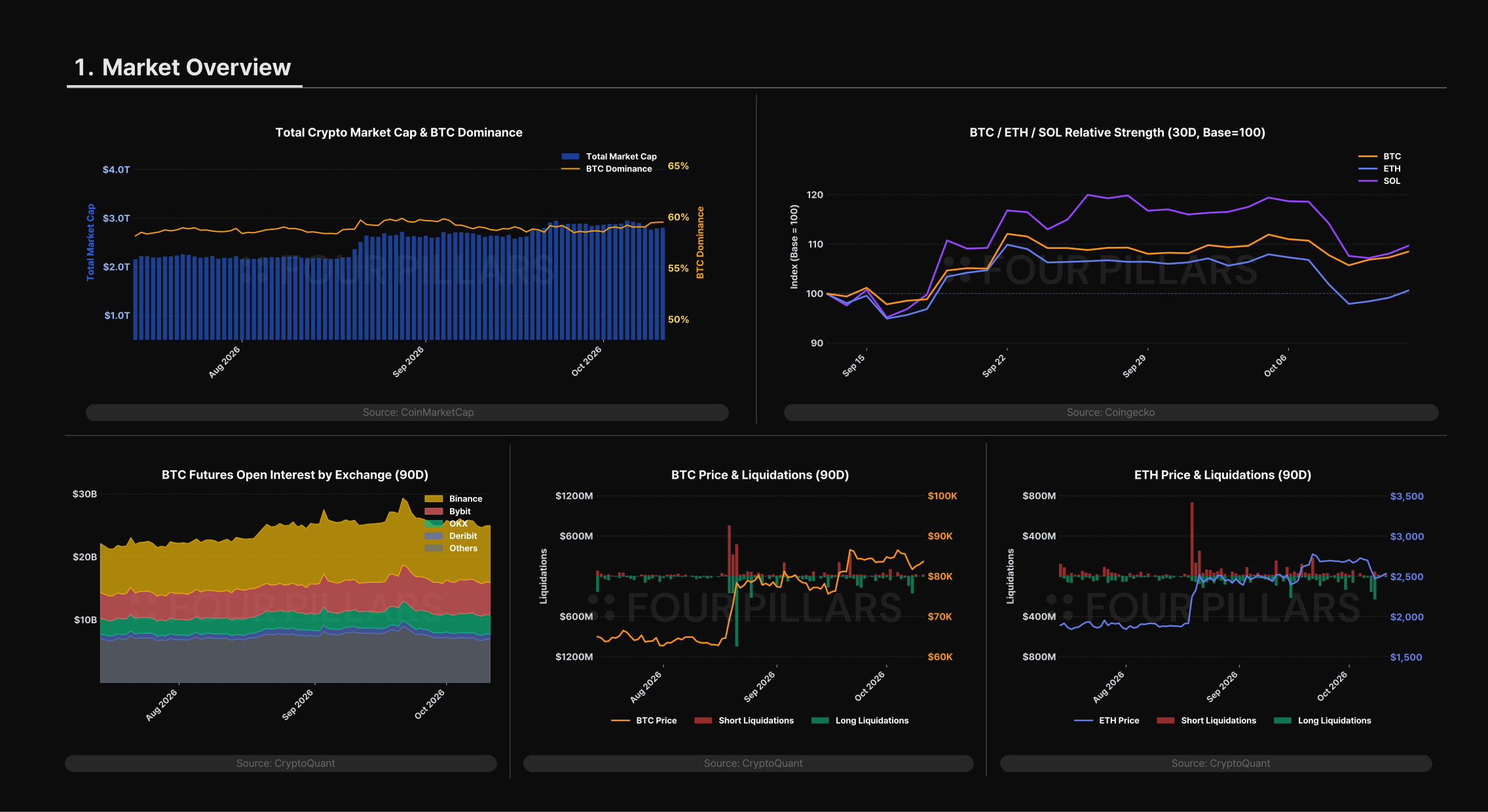
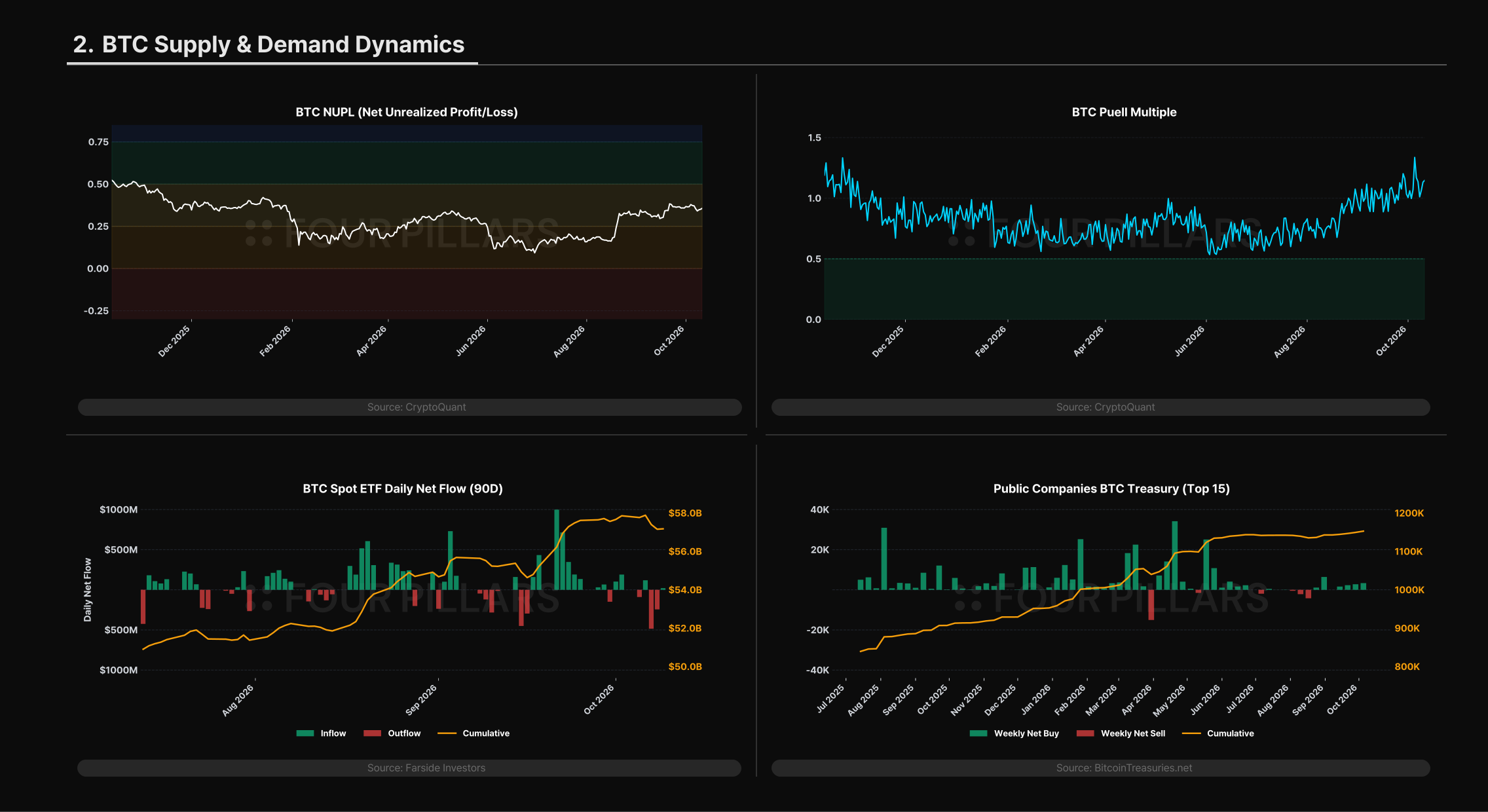
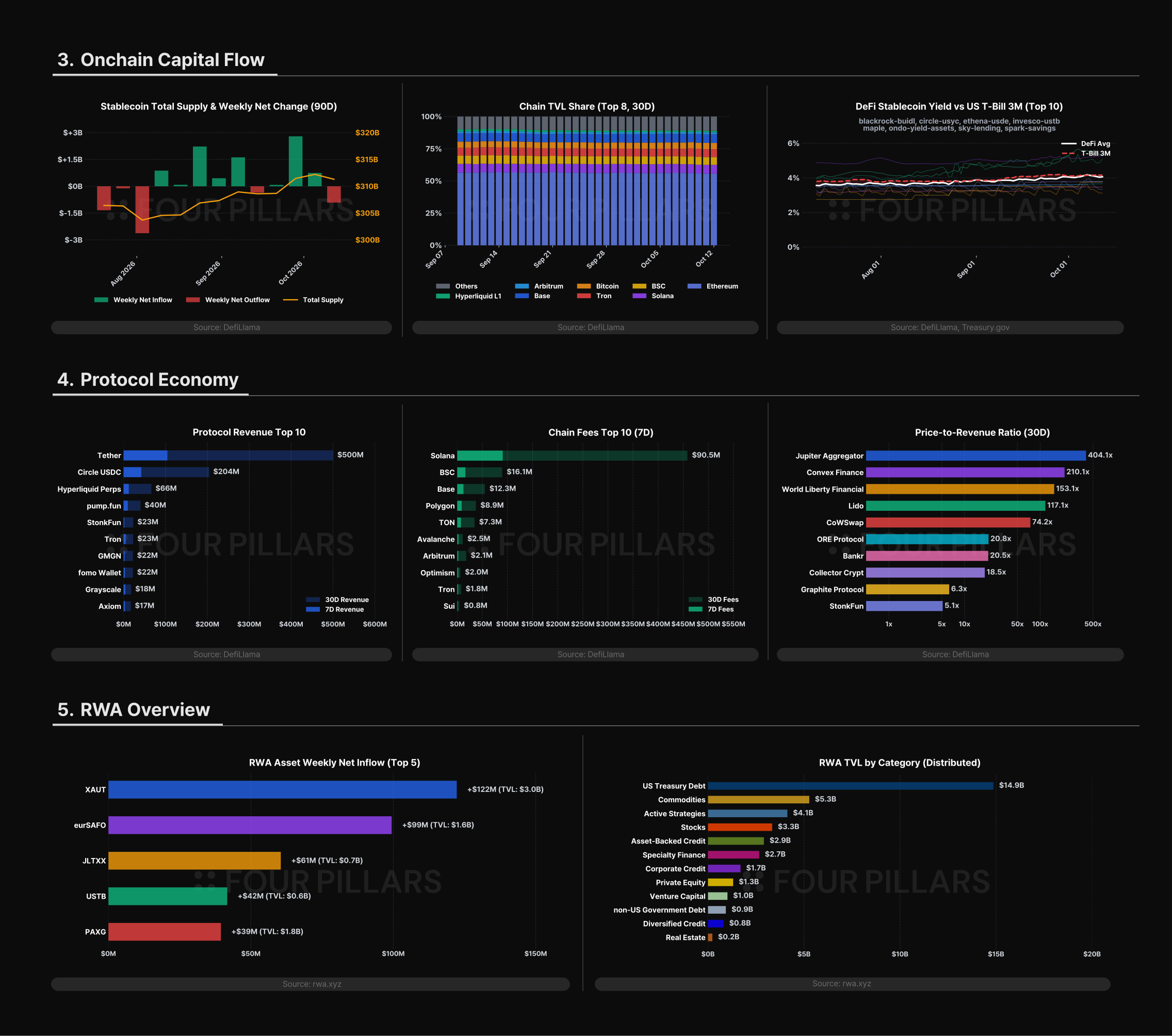
Some of the charts below are powered by CryptoQuant. For those interested in exploring the underlying data in greater detail, CryptoQuant provides access to a comprehensive suite of onchain and market analytics used by institutional participants.
The author of this report may have personal holdings or financial interests in assets or tokens discussed herein. However, the author affirms that no transactions have conducted using material non-public information obtained in the course of research or drafting. This report is intended solely for general information purposes and does not constitute legal, business, investment, or tax advice. It should not be used as a basis for making any investment decisions or as guidance for accounting, legal, or tax matters. Any references to specific assets or securities are made for informational purposes only and should not be construed as an offer, solicitation, or recommendation to invest. The opinions expressed herein are those of the author and may not reflect the views of any affiliated institutions, organizations, or individuals. The opinions and analyses expressed herein are subject to change without prior notice. In addition, beyond the individual disclosures included in each report, Four Pillars, may hold existing or prospective investments in some of the assets or protocols discussed herein. Furthermore, FP Validated, a division of Four Pillars, may already be operating as a node in certain networks or protocols discussed herein or may do so in the future. Please see below links in the footer for FP Validated's participating network disclosures and for broader disclosure details.
![CLARITY Act Fails, the SEC Steps In [FP Weekly 39]](/_next/image?url=https%3A%2F%2Fkrotgrfjzckvumudxopj.supabase.co%2Fstorage%2Fv1%2Fobject%2Fpublic%2Fassets%2Fimg%2Fcontent%2Farticle%2Fnotion-import%2Fmqlpp6muat2oq6.png&w=3840&q=75)

![CLARITY Act Faces the Senate, $LAPTOP Faces Reality [FP Weekly 38]](/_next/image?url=https%3A%2F%2Fkrotgrfjzckvumudxopj.supabase.co%2Fstorage%2Fv1%2Fobject%2Fpublic%2Fassets%2Fimg%2Fcontent%2Farticle%2Fnotion-import%2Fc3ygeemu0lqxb5.png&w=3840&q=75)

![Robinhood Takes Over Onchain
[FP Weekly 37]](/_next/image?url=https%3A%2F%2Fkrotgrfjzckvumudxopj.supabase.co%2Fstorage%2Fv1%2Fobject%2Fpublic%2Fassets%2Fimg%2Fissues%2Frobinhood-takes-over-onchain-fp-weekly-37.png%3Ft%3D1788765790150&w=3840&q=75)