


Table of Contents
Researcher

Related Projects

Key Takeaways
- Mantle’s Q3 was built around the three barriers named in its 18 August brand refresh, geography, gatekeepers and market hours, on the way to borderless access to global capital markets.
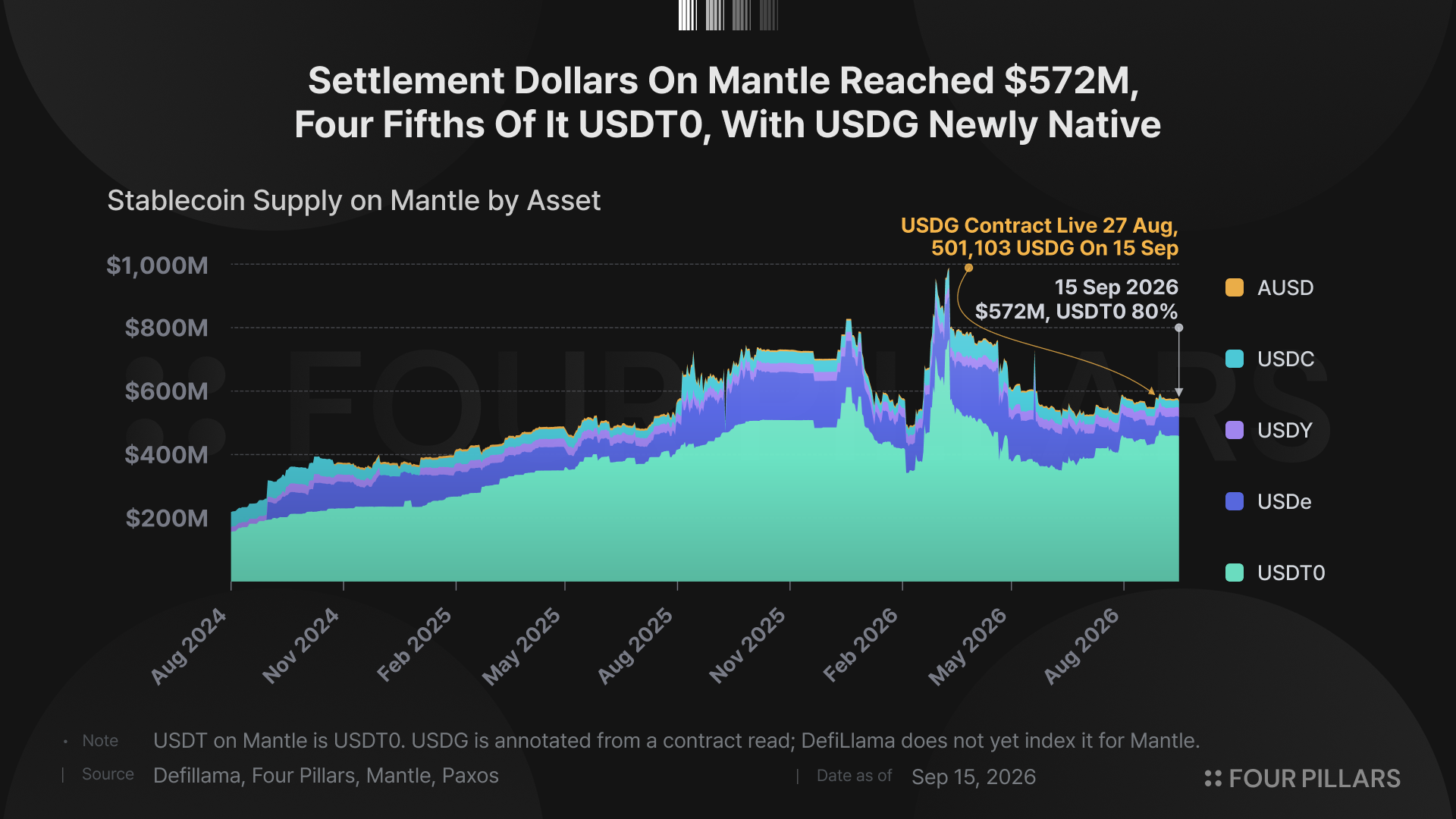
- Stablecoin supply on Mantle grew 8.6% to $572m, and Paxos’s USDG went live as a natively issued dollar with Mantle joining the Global Dollar Network.
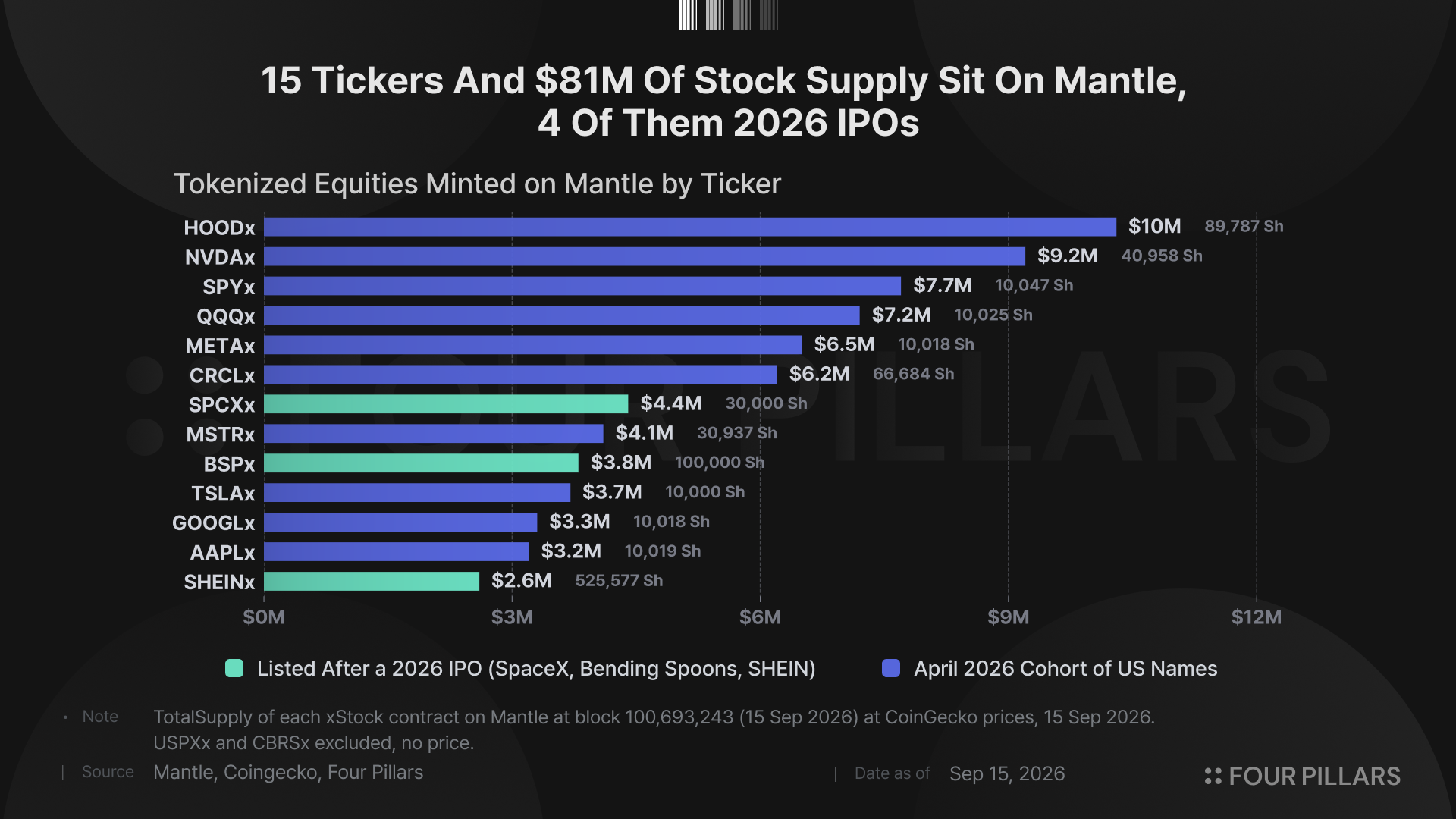
- More than 1,300 tokenized stocks are now available on Mantle, up from four tokenized assets of any kind a year ago, with SpaceX, Bending Spoons, Jersey Mike’s and SHEIN listed within days of their IPOs and pre-IPO allocations opened through OpenStock.
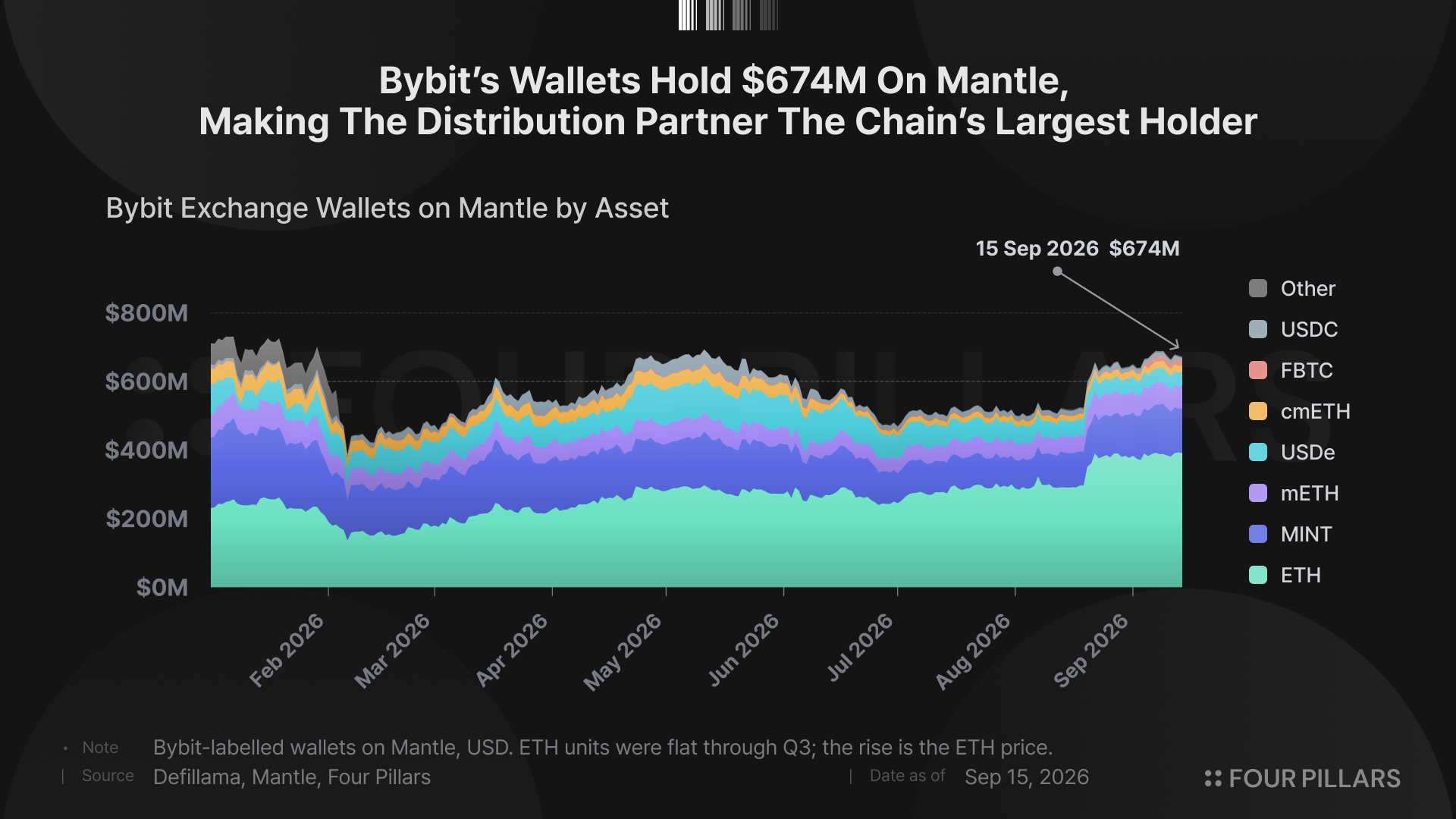
- Bybit’s wallets on Mantle reached $674m, the largest holder onchain, and a new DeFi vault opened to any wallet on the back of the Mantle Vault’s growth on Bybit.
Mantle’s stated purpose is borderless access to global capital markets, and its route there is to remove the three barriers that keep most of the world’s investors away from most of the world’s assets. Geography decides which markets a person can reach, gatekeepers decide who gets an allocation, and market hours decide when anyone can act. The brand refresh on 18 August made those three barriers the organising frame for the network, and Q3’s product updates and growth show how Mantle is working to break each of them down.
Over the quarter Mantle brought Paxos’s USDG onto the network as a natively issued dollar and joined the Global Dollar Network, moved its MNT bridge onto Chainlink CCIP, listed SpaceX, Bending Spoons, Jersey Mike’s and SHEIN as tokenized equities within days of their IPOs, opened pre-IPO allocations through OpenStock, and launched a DeFi vault on the back of the Mantle Vault’s growth on Bybit.
Since 20 August the network’s financials, stablecoins, tokenized assets, lending and DEX activity have sat on a public Blockworks dashboard, which is where most of the figures below can be checked. On 15 September it listed 1,327 tokenized assets on Mantle, up from 71 in January, and put the value in circulation at $344m, 71% higher than at the start of the year.
1. The Quarter in Order

2. Beyond Borders
The first barrier is geography, which in practice means the dollar a person is allowed to hold and the chains their assets can move between. Stablecoin supply on Mantle rose to $572m (+8.6% over the quarter) with USDT0 accounting for $458m of it, roughly 11% of all USDT0 in circulation, and Ethena’s USDe, Ondo’s USDY, USDC and Agora’s AUSD make up the rest. L2Beat counts $1.45bn of value secured on Mantle at quarter’s end, up 16.5% over the three months, with USDT0 at $445m its single largest line ahead of bridged ETH at $406m.
2.1 A Regulated Dollar Comes to Mantle
The addition was Global Dollar (USDG), Paxos’s stablecoin regulated in Singapore by MAS and in Europe under MiCA. The contract has been live on Mantle since 27 August, and with the 3 September announcement Mantle became a network partner in the Global Dollar Network alongside more than 150 firms and roughly $3.5bn of USDG in circulation. Joshua Cheong, Mantle’s Head of Business Development and Product, framed the point as fiat moving intraday on and off the network, and the Global Dollar Network’s own framing is that every tokenized fund and lending market on the chain now has a regulated dollar to settle in. A regulated issuer choosing to mint natively is also a statement about the network it mints on, and Mantle points to its compliance stack, including Chainalysis KYT coverage, as part of what institutional issuers require before they deploy.
2.2 MNT Moves onto CCIP
The other cross-border change in the quarter was to MNT’s own rails. The Super Portal, the bridge co-built with Bybit that carries MNT between Ethereum and Solana, migrated from LayerZero’s OFT standard to Chainlink CCIP over a scheduled window of 9 to 15 July, with Mantle now configuring its own transfer controls under the CCT standard. Chainlink’s Q2 review lists the migration, and its token directory shows MNT pools live on Ethereum, Solana and HyperEVM. Taken together, a dollar issued under two regulators and a token that moves across three chains under Mantle’s own controls are what borderless looks like at the settlement layer.
3. Beyond Gatekeepers
The second barrier is the gatekeeper, the broker, the allocation desk or the exchange account that decides who gets in. Three things that used to sit behind one of them became reachable from a wallet in Q3: 1) newly listed equities through xStocks, 2) pre-IPO allocations through OpenStock, and 3) a new DeFi vault that builds on the Mantle Vault’s growth on Bybit.
3.1 From Pre-IPO Access to Public Markets
SpaceX listed on 19 June, Franklin Templeton’s US equity index on 23 June, Bending Spoons on 7 July, Jersey Mike’s on 24 July and SHEIN on 4 September, each within days of the underlying IPO or launch. Reading the token contracts directly on Mantle mainnet confirms the supply is on the chain, 30,000 SPCXx, 100,000 BSPx, 152,356 JMKEx and 525,577 SHEINx among them. Those names sit inside a much larger shelf. Blockworks counts 743 priced tokenized stocks on Mantle as of 15 September, rwa.xyz counts more than 730 xStocks contracts, and a year ago the network carried four tokenized assets of any kind. Distribution runs through Fluxion, Merchant Moe and Bybit, which has supported xStocks deposits and withdrawals on Mantle since April.
OpenStock, built by Polynomial, extends that access to the stage before listing. It went live on Mantle on 2 July with pre-IPO vaults, where depositors put in USDT0 and hold a token for their share of an allocation, the underlying shares sit in a named, audited SPV, and the token redeems at net proceeds once the company lists. The first vault was Zhongji Innolight, the optical-module supplier that Polynomial describes as a $197bn company, ahead of its Hong Kong listing, and by 30 July Mantle reported $9.3m into the vault within days, with nearly half of first-day deposits coming through Mantle. With OpenStock providing pre-IPO access, xStocks covering the listing itself and Fluxion enabling 24/7/365 secondary trading, Mantle now covers the full lifecycle of a listing from one wallet.
3.2 Distribution Beyond the Exchange
The next phase is getting that supply into holder wallets. Blockworks shows about $4.0bn of issuer-minted stock supply on the network against $4.5m in circulation, and rwa.xyz counts the same $4.5m in distributed hands with RWA holders on the network up 18% over the past 30 days to 3,973. Availability is far ahead of demand, and both figures will move together as Bybit routes more of its xStocks flow on-chain. Bybit’s own wallets on Mantle already hold $674m across ETH, MNT and stablecoins, which makes the distribution partner the largest single holder on the chain.
The Mantle Vault on Bybit, a CeFi product, drew its first $100m within a month of launch. Building on that growth, Mantle launched a separate DeFi vault on 25 August that is open to any wallet, with CIAN packaging the strategy, Grove allocating into Sky’s Savings Rate and Fluxion providing the front end. Deposits are USDC and USDT0, the structure is non-custodial and unleveraged, and a 5.14m GROVE incentive program backs the launch. It is the first time a Mantle yield product has been available without an exchange account.
4. Beyond Market Hours
The third barrier is the clock, and Mantle’s version of the claim covers both when assets trade and whether they earn while they wait. SHEINx listed in Hong Kong on 1 September and moved onto Fluxion’s AMM on 4 September, and from that point it has traded through the hours the Hong Kong exchange is closed. Fluxion pairs its AMM with RFQ execution, which Mantle describes as atomic RFQ, so that larger orders can clear against quotes while the pools carry the continuous market. Every xStock listing on Mantle also comes with a rewards layer, xPoints and a share of 1m Fluxion Points for trading, holding and providing liquidity, which Mantle framed in August as the step that turns a listing into a productive asset.
Productive is the operative word. On 17 July Mantle reported $116.4m in tokenized active strategies running on the network, third across all chains on RWA Foundation data, and it puts 96% of the RWA value on Mantle in yield-bearing assets, a split rwa.xyz’s platform table supports, with the MI4 index fund, the CCIP-bridged strategy and USDY on one side and AUSD and xStocks on the other. Blockworks’ category view of the $344m in circulation reads the same way, $149m in the MI4 fund, $141m in yield-bearing stablecoins from Ethena and Maple, $29m in treasuries and $21m in tokenized gold. Capital on Mantle is earning through the hours that traditional venues are closed, which is the other half of the market-hours claim.
The same barrier applies to markets that never had fixed hours to begin with. InsightX, the prediction market built on Mantle, reported trading volume at a new high of $23m on 7 July and passed $500m of total network volume in its first month on 15 July, with every prediction settling on Mantle in seconds. Between tokenized equities that trade after their home exchange closes, capital that earns around the clock and prediction markets that settle continuously, the network’s answer to the market-hours barrier is that the venue is always open.
5. Heading to 4Q26
Mantle Key Advisor Emily Bao, who also runs spot at Bybit, put Mantle’s view of the year in one line in the H1 recap. “The future won’t be defined by who tokenizes the most assets, but by who builds the markets around them.” Q3 put the pieces in place, a regulated dollar, cross-chain rails on CCIP, more than 700 tokenized stocks on the shelf, pre-IPO access through OpenStock and a new DeFi vault open to any wallet.
The demand side of that sentence is no longer hypothetical. Robinhood Chain went live in June with stock tokens as its base asset, and once launchpads such as Pons and long.xyz let memecoins launch paired against those stock tokens, DEX volume went from between $3bn and $4.6bn a week through July and August to $11.4bn in the week of 31 August and $13.1bn the week after, with $132m of fees in a single week and Pons alone collecting $121m since mid August. Chain TVL went from zero at the start of July to $930m.
On Solana, where xStocks first listed, the tokens held $450m on 15 September, up 32% over the quarter and nearly six times the level of a year earlier. Tokenized equities now hold roughly $2.8bn, and the two fastest-growing ones are the two where a market formed around the tokens.
Mantle enters the fourth quarter with the shelf stocked, with pre-IPO allocations already running through OpenStock, and with a distribution partner whose wallets hold $674m on the chain. What Robinhood Chain and Solana showed over the same months is how quickly volume arrives once a market forms around tokenized equities, and that is the half of Bao’s sentence the fourth quarter is for. Mantle RWA Day at Token2049 Singapore on 6 October, with Franklin Templeton and Chainlink on the bill, is the first place to look for it.
The report is based on the independent research of the author sponsored/funded by Mantle. The author of this report may have personal holdings or financial interests in assets or tokens discussed herein. However, the author affirms that no transactions have conducted using material non-public information obtained in the course of research or drafting. This report is intended solely for general information purposes and does not constitute legal, business, investment, or tax advice. It should not be used as a basis for making any investment decisions or as guidance for accounting, legal, or tax matters. Any references to specific assets or securities are made for informational purposes only and should not be construed as an offer, solicitation, or recommendation to invest. The opinions expressed herein are those of the author and may not reflect the views of any affiliated institutions, organizations, or individuals. The opinions and analyses expressed herein are subject to change without prior notice. In addition, beyond the individual disclosures included in each report, Four Pillars, may hold existing or prospective investments in some of the assets or protocols discussed herein. Furthermore, FP Validated, a division of Four Pillars, may already be operating as a node in certain networks or protocols discussed herein or may do so in the future. Please see below links in the footer for FP Validated's participating network disclosures and for broader disclosure details.


