


Table of Contents
Researcher

Related Projects

Key Takeaways
- While the price of Bitcoin fell to less than half its peak, mining costs actually rose. Hashprice stayed in breakeven territory for more than two months, and MARA, Riot, CleanSpark, American Bitcoin, and Bitdeer all posted net losses in the second quarter. As a result, mining difficulty has declined for ten straight months since its October 2025 peak of 155.97T, falling to 125.81T. A prolonged decline of this kind, with no external event like China's 2021 mining ban behind it, is virtually unprecedented.
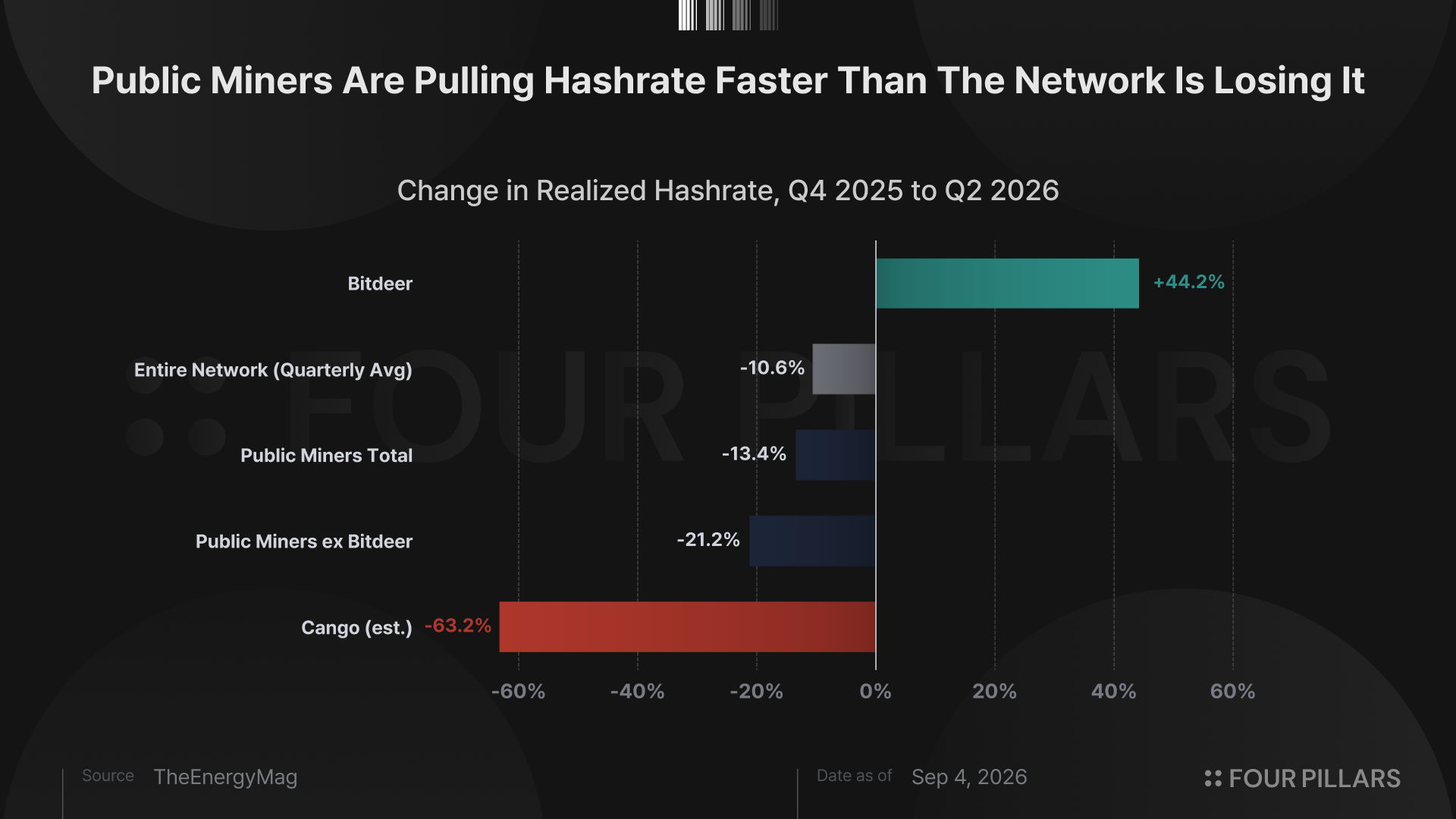
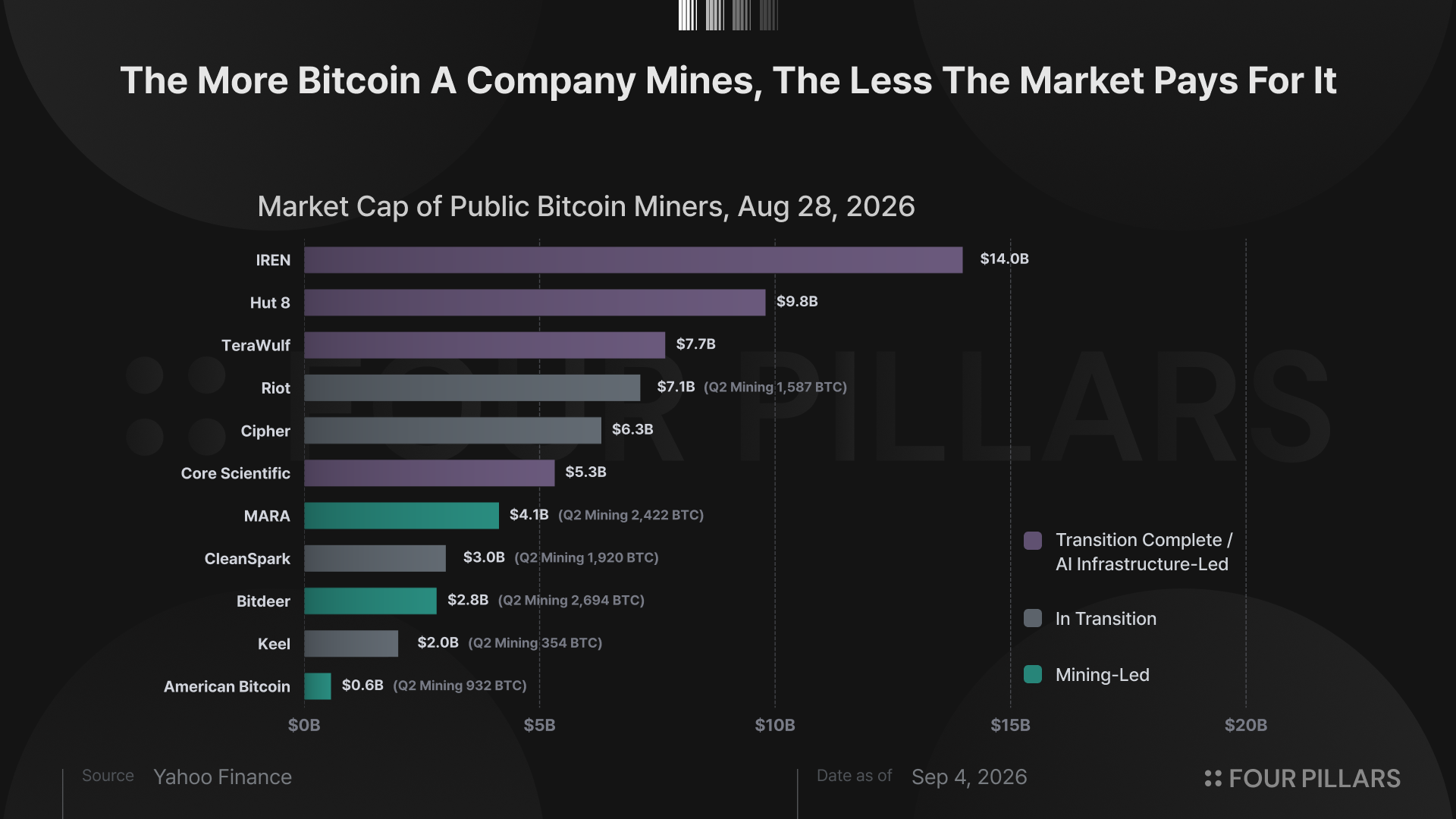
- Publicly listed miners sold more than 32,000 BTC in the first quarter alone, the largest quarterly sale on record. This cash is not being used simply to ride out the downturn. It is moving into power infrastructure, including power plant acquisitions, long-term AI data center leases, and full pivots to AI cloud services. As a result, the hashrate of listed miners fell 13.4% in six months, a faster decline than the network as a whole (-10.6%), and the stock market has endorsed this direction by assigning lower valuations to the companies that mine the most.
- The late-August rally lifted hashprice 43% from its June low and out of breakeven territory, yet hashrate has stayed flat at around 900 EH/s. For the first time in well over a decade, hashrate has stopped tracking price. This confirms that the equipment and power already assigned to AI are unlikely to come back to mining.
The profitability of Bitcoin miners deteriorated noticeably in 2026. While the price of Bitcoin fell to roughly half its peak, mining costs held at similar levels, and the major listed mining companies all posted net losses in the second quarter. This article looks at how this decline in profitability is reshaping the structure of the mining industry, and what effect the recent rebound in Bitcoin's price has had on it.
1. A Quiet Decline in Mining Difficulty
The indicator that captures this decline in profitability most succinctly is mining difficulty.
Bitcoin mining difficulty hit an all-time high of 155.97T in late October 2025. Since then it has stepped down for nearly ten months without recovering that peak, and as of September 1, 2026 it stands at 125.81T. This pattern is rarer than it looks. In Bitcoin's history, difficulty has fallen year over year only once, when China banned mining outright in 2021. That decline had a clear cause in the form of government action, and it ended within two months, with recovery beginning right away. This time, the downtrend has continued for ten months with no such event, which makes it a virtually unprecedented stretch. The rebound in Bitcoin's price in late August raised some hopes of a trend reversal, but so far difficulty has shown little movement.
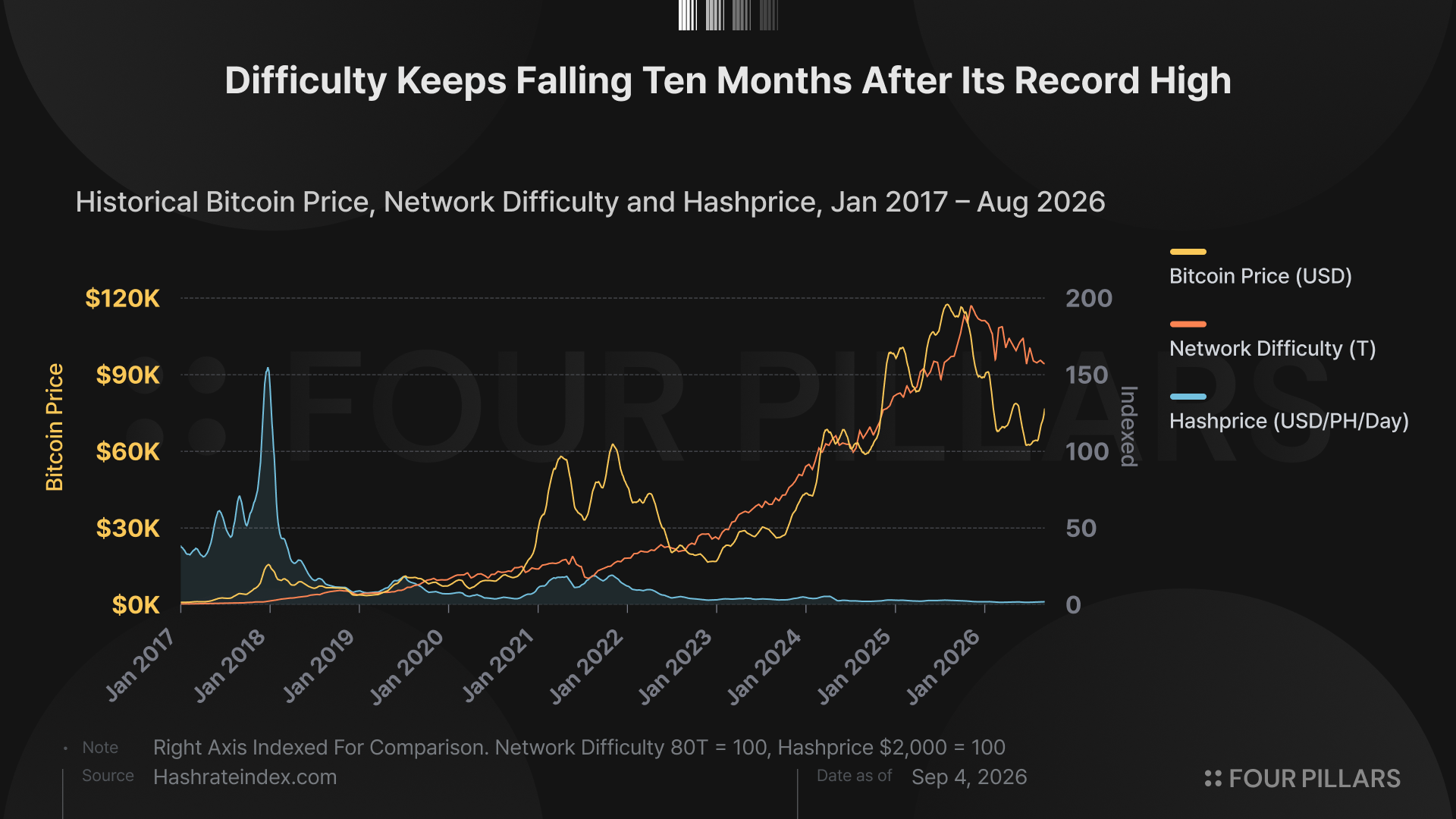
Source: hashrateindex.com
Difficulty reflects the total amount of equipment that miners are actually running. So if difficulty is not recovering even after a price rebound of more than 20%, it means one of two things: either mining has not become profitable enough to justify switching idle machines back on, or that equipment and power have already been moved somewhere they cannot come back from. As we will see later, both are true.
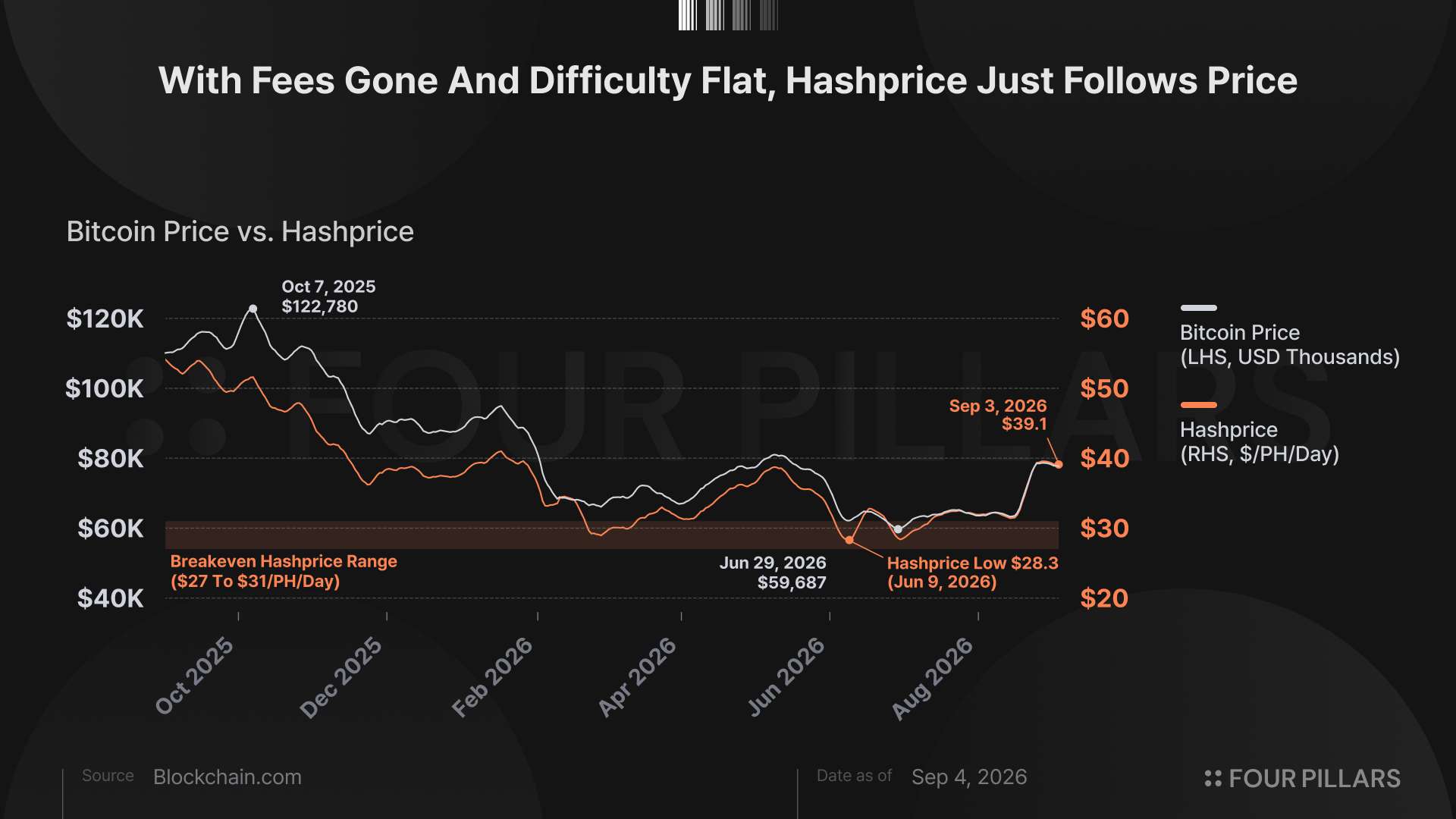
Starting with profitability, as Bitcoin's price fell by more than half, from $125,000 in October 2025 to around $58,500 at the end of June, hashprice (daily revenue per PH/s) dipped below $28 at one point in June. According to Hashrate Index, the low $30s is a range where many miners fall below breakeven, depending on their hardware and electricity costs. Hashprice stayed in that range for more than two months, through mid-August. As the chart below shows, hashprice tracks price almost exactly. With fees gone and difficulty flat, price is the only variable left to move.
Fees are no help either. Of the 3,178 BTC in block rewards that miners received during one week in mid-August, transaction fees accounted for just 22 BTC, or 0.69%. In effect, miner revenue is almost entirely the block subsidy, and that subsidy is set to be cut in half again at the 2028 halving.
2. More Mined, Less Earned
This revenue environment is reflected directly in the second-quarter income statements of individual companies. The common pattern is that production rose while revenue fell. MARA mined 3% more than a year earlier but saw revenue drop 27%, and Riot mined 11% more while its mining revenue fell 19%. The average price of the Bitcoin CleanSpark mined between April and June was $71,881, down 27% from $98,736 in the same period a year earlier. Adding hashrate did not bring more revenue. In the end, it was a quarter in which price alone decided everything.
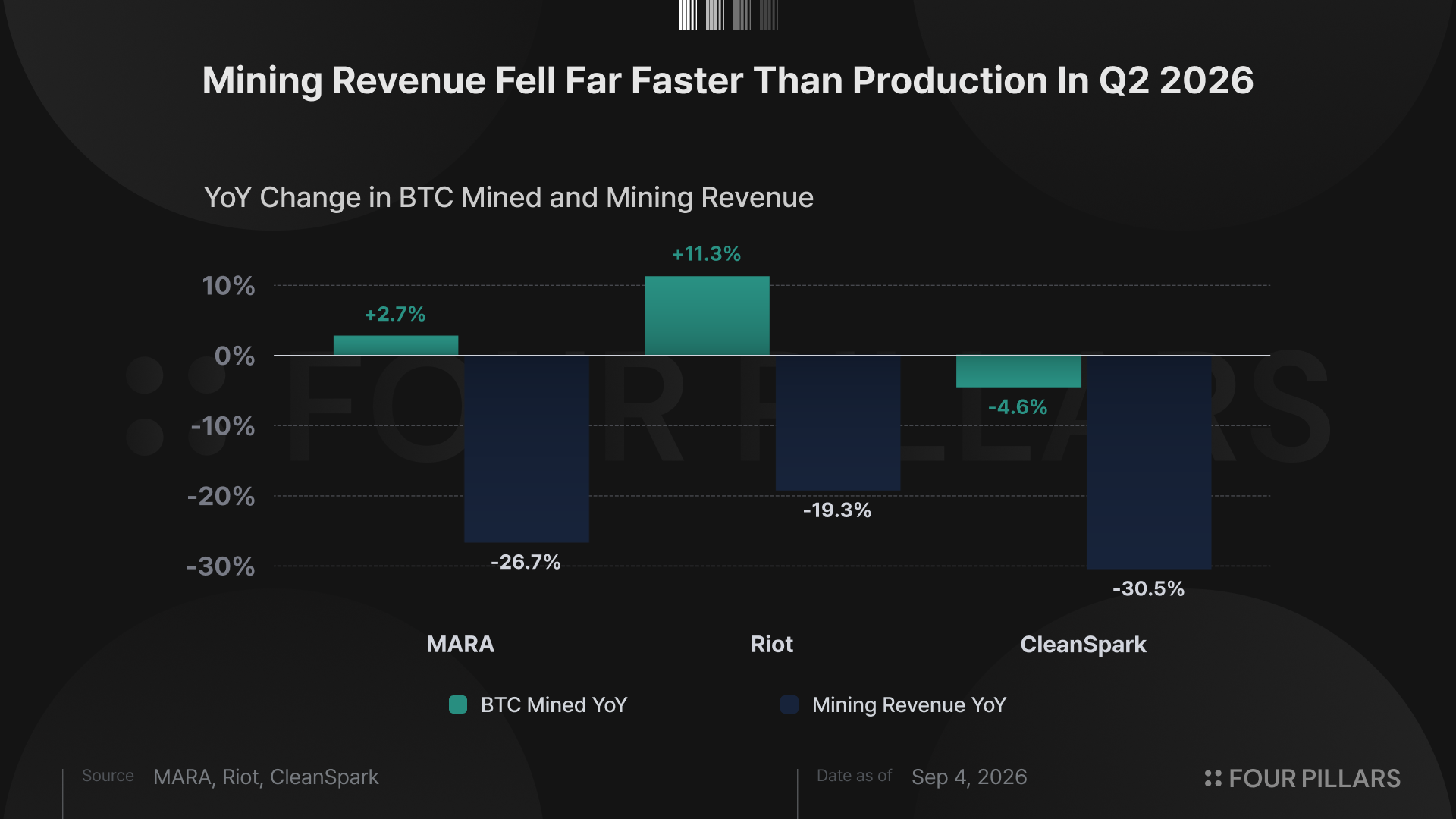
The problem is that costs actually rose while price was falling.
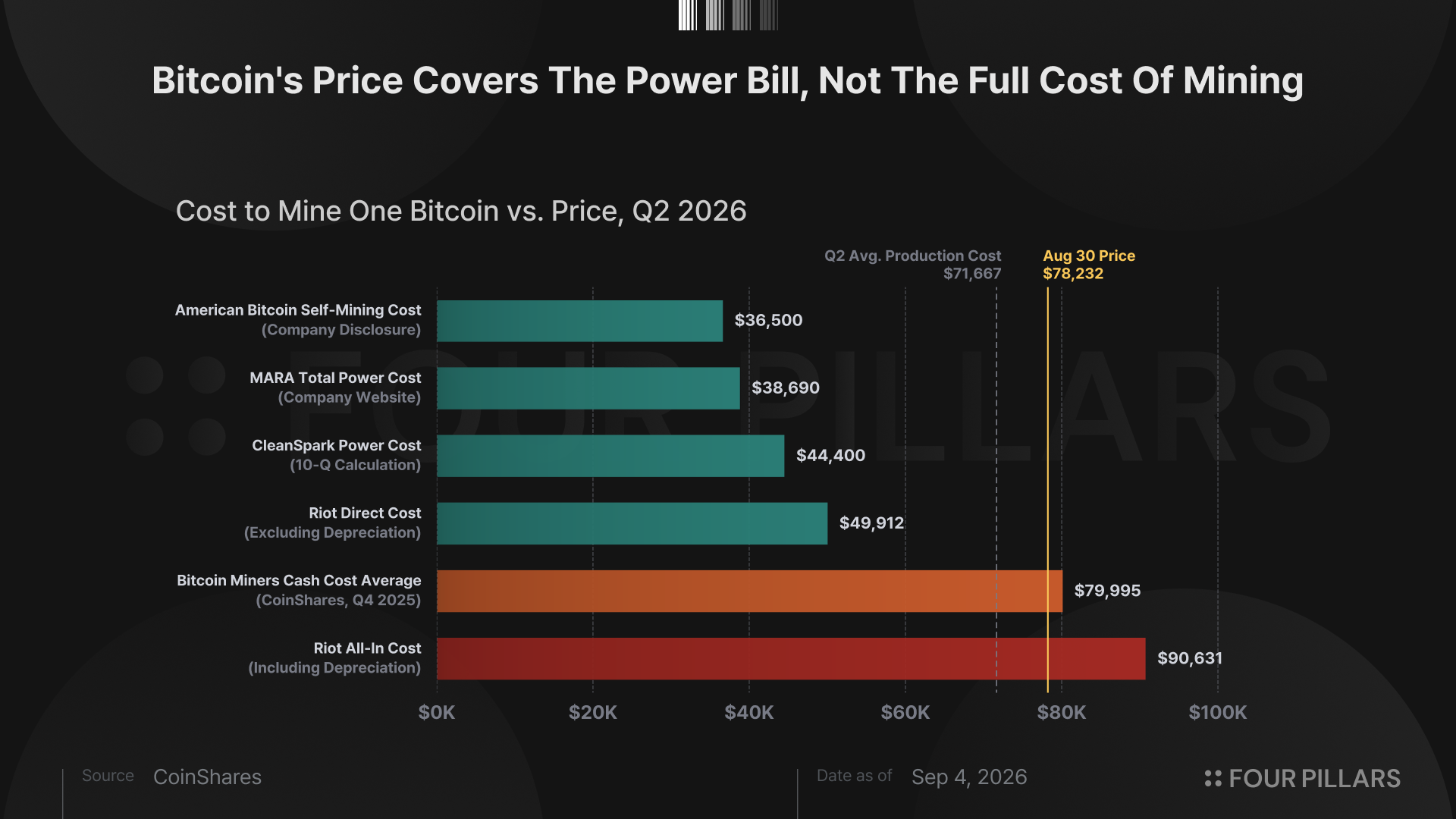
Riot's mining cost per BTC, excluding depreciation, was $49,912, or about 70% of the $71,667 that Bitcoin was worth at the time it was mined. The catch is that a year earlier, this ratio was around 50%. Once depreciation of mining rigs and other equipment is included, the cost rises to $90,631, which means the company is effectively mining at a loss.
MARA is in the same position. Even with power at $0.04 per kWh, among the lowest rates in the industry, its electricity cost per BTC rose from $33,735 to $38,690 over the past year. Although difficulty has come down from its peak, the second-quarter average was still higher than a year earlier, so the amount of electricity needed to mine a single Bitcoin has itself increased.
The net losses are the result of valuation losses on Bitcoin holdings layered on top of this cost structure. On a cash basis, many miners still have some margin left, but once depreciation and valuation losses are included, MARA, Riot, CleanSpark, American Bitcoin, and Bitdeer all posted net losses in the second quarter. The nature of these losses differs from company to company, however. In MARA's case, more than half of the net loss came from unrealized losses on its Bitcoin holdings, whereas Bitdeer posted a gross loss, with cost of revenue exceeding revenue, even after increasing its mining output nearly fivefold.
3. Bitcoin Miners Diversify Their Businesses
With income statements looking like this, how miners have actually responded shows up in what they are doing with the Bitcoin they mine. According to figures compiled by TheEnergyMag, listed miners sold more than 32,000 BTC in the first quarter of 2026 alone. That is more than their net sales for all of 2025, and it exceeds the roughly 20,000 BTC sold in the second quarter of 2022, when the Terra collapse hit, making it the largest quarterly sale on record. These are the same companies that were net buyers of 17,593 BTC as recently as 2024, pushing their combined holdings above 100,000 BTC. Within a year, they have swung in the opposite direction.
But a look at where this money went makes clear that these were not simply sales to stay afloat.
Power Assets
- MARA: Sold 23,093 BTC in the first half of the year to raise about $1.63 billion. It is using this money to buy back $1 billion of 0% convertible notes at a 9% discount to face value, while at the same time proceeding with the $1.5 billion acquisition of Long Ridge, a 505 MW gas-fired power plant in Ohio. It had already purchased a 114 MW wind farm in Texas in early 2025, and it has secured a site of up to 2 GW in Matagorda County, Texas, with plans to expand its power portfolio to 4.8 GW. As its holdings have shrunk from 53,822 BTC to 35,577 BTC, the company has come to look less like a miner and more like a power producer.
- Hut 8: Went as far as splitting its corporate structure. It spun off its mining business as a separately listed subsidiary, American Bitcoin, while the parent company remained a power platform holding generation assets and data centers, with a contracted AI infrastructure portfolio of $26.6 billion.
Long-Term AI Data Center Leases
- Core Scientific: With CoreWeave as its anchor tenant, it has secured about 1.1 GW of contracted power capacity and more than $24 billion in potential contract revenue. Colocation revenue of $136.7 million in the second quarter accounted for 83% of total revenue.
- TeraWulf: After landing a lease at its Lake Mariner campus in New York with part of the rent guaranteed by Google, it signed a 20-year lease worth about $19 billion with Anthropic in July. Operations will not begin until the second half of 2027, but as of the second quarter, HPC lease revenue of $31.9 million already made up 71% of total revenue.
- Cipher: Leased its entire Texas data center to Fluidstack. Google guaranteed about $1.7 billion of Fluidstack's rent and in return received warrants equivalent to roughly a 5.4% stake in Cipher. Cipher also signed a 15-year, $5.5 billion contract with AWS and delivered the first capacity in early August.
- Riot: After the quarter ended, it announced a roughly $9.1 billion deal to lease a data center to a frontier AI lab for 20 years, and it has been converting a 600 MW data center for AI/HPC use. The company said the 9,665 BTC it sold in the first half went toward operating funds and data center expansion, and about half of its remaining 11,380 BTC is pledged as collateral for a credit facility.
- CleanSpark: Signed a 20-year, $6.6 billion lease for its Georgia data center. Management explained that it does not intend to wind down mining right away, but to use it as a source of funding and a bridge for this transition.
- Keel Infrastructure (formerly Bitfarms): The most radical case. In the second quarter it dismantled all of its mining operations in the United States and changed its corporate name, and it plans to sell its remaining 1,861 BTC in full by the end of the year. It is negotiating with tenants at three sites, backed by a 2.2 GW pipeline and $819 million in liquidity, but no lease has been signed yet.
Expanding Mining Operations
- Bitdeer: Chose vertical integration, building mining rigs with its own SEALMINER chips, running them itself, and selling them to outside buyers as well. It raised its self-mining hashrate to 73 EH/s within a year. It is also growing an AI cloud business, which has reached $76 million in annualized revenue.
- American Bitcoin: Closer to rejecting diversification altogether. It increased its holdings 14% to 8,002 BTC in the second quarter, and management has said it has no intention of pivoting to AI, citing a simple principle: mine Bitcoin when it is worth more than the cost to produce it, and buy it when it is worth less.
A Full Pivot to AI Cloud Services
- IREN: Starting with a five-year, $9.7 billion cloud contract with Microsoft, it went on to add Nvidia and, in August, a frontier AI lab as customers. Contracted ARR based on 2026 capacity has reached $4 billion, of which $1 billion was actually in operation as of August 26. For the full fiscal year ended in June, 82% of its $707 million in revenue still came from mining, but in the April to June quarter alone, AI cloud revenue of $70.5 million surpassed mining revenue of $66.7 million for the first time. The price of that transition was a $638.8 million impairment charge for the year from retiring mining rigs early, and the net loss for the year was $702.6 million.
In short, the cash raised from selling Bitcoin is not being used only to hold on. It is moving into power infrastructure such as power plants, sites, and data centers. As a result, the combined realized hashrate of listed miners fell 13.4% in six months, from 368.3 EH/s to 319.0 EH/s, and excluding Bitdeer, which is actually expanding on the strength of its own chips, the drop was as much as 21.2%. The network's total hashrate fell 10.6% over the same period, so listed miners are pulling out far faster than the network average. This is what lies behind the decline in difficulty seen in Section 1. Some equipment was switched off because mining became unprofitable, but the bigger trend is that the best-capitalized miners are taking their equipment offline by choice and redirecting that power to other uses.
What is interesting is that the stock market has already endorsed this direction. Based on closing prices on August 28, IREN's market capitalization was $12.7 billion, Hut 8's was $9.8 billion, and TeraWulf's was $7.7 billion. By contrast, MARA, which mines more Bitcoin than any other listed company, was valued at just $4.1 billion, and Bitdeer at $2.8 billion. The more mining a company does, the lower its valuation.
Of course, what these valuations reflect is contracts, not revenue, at least for now. TeraWulf's 20-year contract with Anthropic is worth $19 billion, but its second-quarter HPC revenue was only $31.9 million, and while Riot announced a $9.1 billion deal, its second-quarter data center lease revenue was $4.9 million. Miners are filling the gap between winning a contract and actually generating revenue by selling Bitcoin and issuing shares.
4. The Impact of the Recent Rally
Bitcoin rose from $64,000 on August 15 to an intraday high of $81,330 on the 27th, then slipped back into the $77,000 range on the 28th after Fed Chair Warsh's Jackson Hole speech was read as hawkish. A nine-day streak of net inflows into spot ETFs also ended that day with $200 million in net outflows. Even so, the price is still up more than 20% from mid-August, so it is worth asking how much of the profitability decline described in the introduction this rally has reversed.
On price metrics alone, things have clearly improved. Hashprice stood at $39.06 as of August 24, up 43% from its June low, climbing out of the breakeven range described in Section 1 after a little more than two months. The difficulty adjustment on August 22, which came in at a 1.31% decrease, helped a little, but most of the rebound came from price. The more notable change is in the futures market. As recently as late July, Luxor's hashprice futures were pricing the six-month average at $31.85. As of August 24, the August and September contracts were trading at $38.63, and the January 2027 contract at $35.75. In other words, the market has begun to see much of this rebound holding through early next year.
But the higher price has not brought more miners back. Network hashrate remained around 900 EH/s through late August, still some distance from the 1 ZH/s seen at the end of 2025. This comes down to margins that are still thin, combined with power that has already been assigned to AI. Putting ASICs back into a site where GPUs have been installed or a lease has been signed is a very different matter from simply turning idle machines back on.
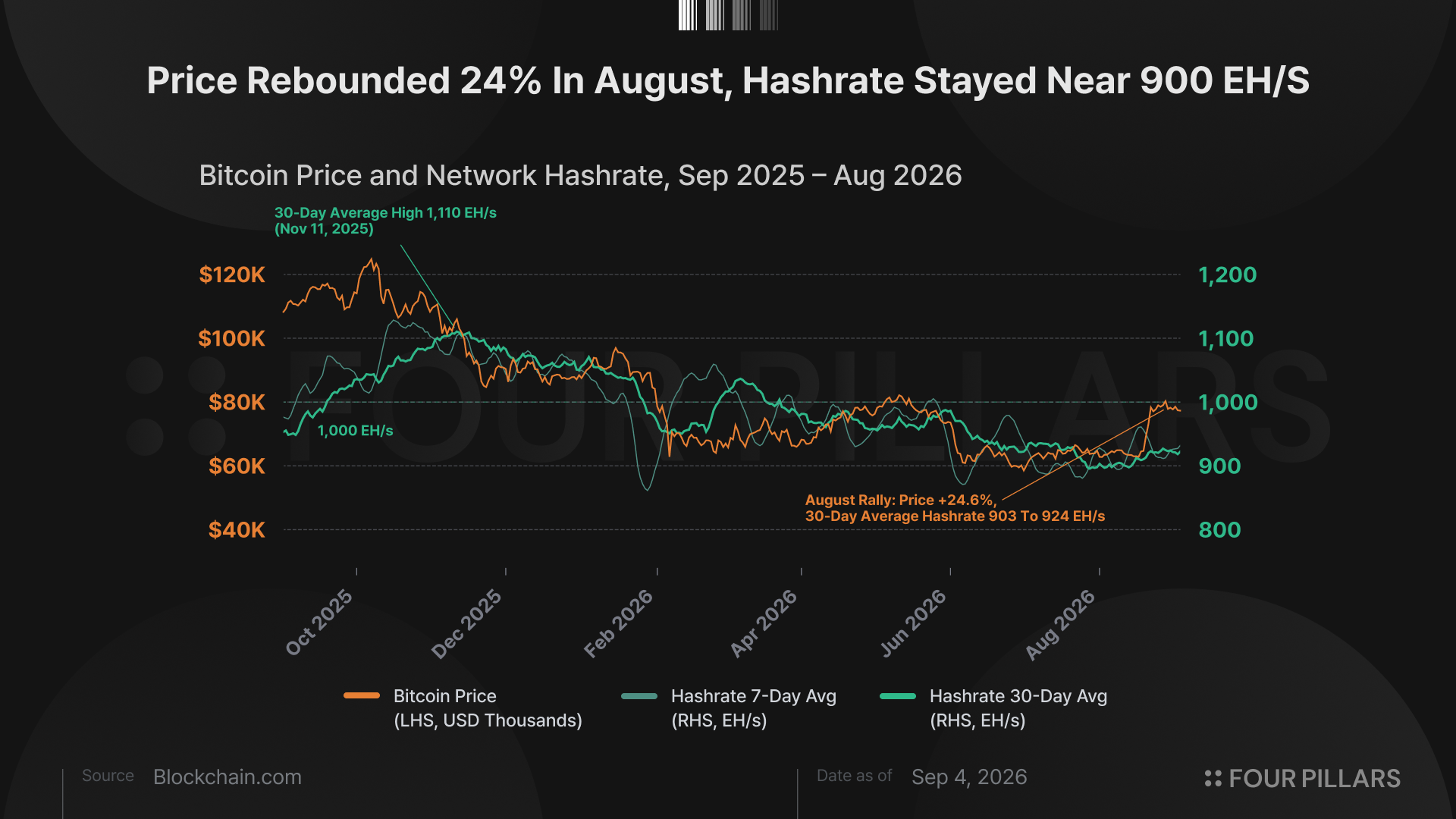
Tracing the relationship between price and hashrate on a monthly average basis makes this change even clearer. In 2025, hashrate rose along with price, and in the first half of 2026, the two fell together. In August, however, hashrate has stayed at its June level even as price recovered from the $60,000s to $78,000. Hashrate, which has responded to price for well over a decade, is not responding this time.
Comparing the data against the costs of the miners that remain, the answer depends on the company. At $78,000, the price comfortably clears MARA's electricity cost of $38,690 per BTC and Riot's direct cost of $49,912, but it still falls short of Riot's $90,631 cost including depreciation. CoinShares puts the weighted average cash cost of listed miners at about $80,000 as of the fourth quarter of 2025. By that measure, a price around $80,000 is enough to pay the power bill and leave a little cash, but not enough to buy the next generation of mining rigs.
The stock market's reaction was a little more intuitive. While Bitcoin rose 21% from August 17 to 28, MARA and Bitdeer each gained 10% and American Bitcoin gained 8%, whereas IREN fell 21%, Cipher and Core Scientific fell 18%, and TeraWulf fell 13% over the same period. Only the companies still focused on mining rose, while those that have completed or are in the middle of a transition fell.
That said, AI infrastructure stocks were under pressure across the board during this period because of concerns about rate hikes, so it is too early to read this as the return of a mining premium. The rally narrowed the gap between mining stocks, but not enough to overturn the market cap rankings.
To sum up, this rally brought hashprice back to its highest level since May, easing the price problem, which is one side of the profitability decline, for now. But it has not touched the underlying structure, in which equipment and power are moving out of mining. If anything, the fact that hashrate is not returning even at this price confirms that the shift is irreversible. Whether miners used this rebound as a selling opportunity will only become clear from the monthly production reports due in September.
5. How to Read This
In summary, the listed miners of 2026 are splitting into three broad groups: those staying in mining on the strength of low costs or their own chips, those that have already become AI infrastructure companies, and those somewhere in between, still making the transition. Financially, the third group is naturally the most vulnerable. Their mining revenue is shrinking, their data center revenue has not yet arrived, and they are getting by on Bitcoin sales in the meantime. This rally has given them some breathing room, but how much more Bitcoin will be sold and how much dilution will occur before their data centers are delivered in 2027 remains something to watch.
From the perspective of the Bitcoin network, a decline in difficulty is self-adjustment working as designed, so it is hard to call it a problem in itself. Still, what drove hashrate growth after 2021 was ultimately the ability of listed miners to raise capital. That this capital now has to compete for the same power against AI demand paying fixed rent for 20 years is a significant change. Given a choice between a business fully exposed to spot hashprice and a long-term contract backed by investment-grade credit enhancement, it hardly needs saying which one capital will choose.
In that sense, the 2026 financial statements of miners are less a story about the mining industry struggling than a story about the operators who put the most money into the Bitcoin network deciding to make their money elsewhere. A modest rise in price will not reverse that decision, and how hashrate is reshaped as miners with different cost structures fill the space left behind is something to watch until the next halving.
The author of this report may have personal holdings or financial interests in assets or tokens discussed herein. However, the author affirms that no transactions have conducted using material non-public information obtained in the course of research or drafting. This report is intended solely for general information purposes and does not constitute legal, business, investment, or tax advice. It should not be used as a basis for making any investment decisions or as guidance for accounting, legal, or tax matters. Any references to specific assets or securities are made for informational purposes only and should not be construed as an offer, solicitation, or recommendation to invest. The opinions expressed herein are those of the author and may not reflect the views of any affiliated institutions, organizations, or individuals. The opinions and analyses expressed herein are subject to change without prior notice. In addition, beyond the individual disclosures included in each report, Four Pillars, may hold existing or prospective investments in some of the assets or protocols discussed herein. Furthermore, FP Validated, a division of Four Pillars, may already be operating as a node in certain networks or protocols discussed herein or may do so in the future. Please see below links in the footer for FP Validated's participating network disclosures and for broader disclosure details.


