

![Robinhood Takes Over Onchain
[FP Weekly 37]](/_next/image?url=https%3A%2F%2Fkrotgrfjzckvumudxopj.supabase.co%2Fstorage%2Fv1%2Fobject%2Fpublic%2Fassets%2Fimg%2Fissues%2Frobinhood-takes-over-onchain-fp-weekly-37.png%3Ft%3D1788765790150&w=3840&q=75)
Table of Contents
- 1. Major News
- [Crypto] AMC Signals Legal Action Against Robinhood's Stock Token, Intensifying the Tokenized-Stock Debate
- [Crypto] Robinhood Chain Rises to No. 1 in Daily Fees Just Two Months After Launch
- Others
- 2. Data Spotlight
- Why Do Korean Crypto Exchanges List So Many Shitcoins? (Link)
- 3. Four Pillars Weekly
- : : Trade[XYZ] 2026 Q2 (Link)
- : : Permissionless Deployment Triples HIP-4 Volume, With Permission the Remaining Constraint (Link)
- : : More Mined, Less Earned: Inside the 2026 Bitcoin Miners (Link)
- Comments
- 4. Macro & Onchain Metrics
Researcher

1. Major News
[Crypto] AMC Signals Legal Action Against Robinhood's Stock Token, Intensifying the Tokenized-Stock Debate
What Happened?
On September 3, AMC Entertainment CEO Adam Aron sharply criticized Robinhood for issuing a token tracking AMC shares without the company's consent. Aron described the practice as "contemptible, outrageous, disgusting" (I find this practice to be contemptible, outrageous, disgusting…), stating that the Robinhood token is not registered under U.S. securities laws and that AMC has never endorsed it. On September 4, Aron formally demanded that Robinhood halt trading of the token and signaled legal action.
Robinhood refused the demand. CEO Vlad Tenev pushed back by asking "What's the concern?", holding to the position that tokenization does not require a company's consent, while Chief Legal Officer and former SEC Commissioner Dan Gallagher retorted to AMC, "send the lawyers." Robinhood's line of defense is that its stock token is a debt instrument issued by an affiliate based in Jersey and is not sold to U.S. residents.
Reactions were split within the industry as well. Investor Ross Gerber likened synthetic securities to a "Ponzi scheme" and warned they could trigger a financial crisis. Securitize CEO Carlos Domingo, whose company runs a tokenization platform, pointed to a case in which one AMC token pair on Robinhood Chain printed at roughly 60 times the actual share price due to thin liquidity and limited arbitrage.
Researcher's Comment
This debate stems from the fact that different legal structures are mixed together within today's tokenized stocks. The biggest difference is whether the investor becomes an actual shareholder or holds only a contractual right that tracks the economic performance of the underlying share. In the Robinhood model, a special purpose vehicle (SPV) based in Jersey holds the actual shares and issues a derivative debt instrument on that basis. The investor gains economic exposure that tracks the share price but does not hold shareholder rights such as voting rights or ownership. The issuer-led model, by contrast, puts the registered shares themselves onchain with the company's consent, so the token represents a legal right to the actual shares.
The reason Adam Aron's pushback drew attention is that a listed-company CEO went as far as signaling legal action against tokenization done without the issuer's consent. There had been a case where OpenAI drew a line against tokens unrelated to itself, but this is the first time a listed-company executive personally objected. The objection also has grounds. If token demand becomes separated from actual share demand, a separate market can form outside the company's control, and because retail investors cannot directly redeem the token for actual shares, the price gap can also widen.
This concern soon materialized onchain. On September 3, following Adam Aron's criticism, a meme coin named AMC (A Meme Coin, $MEME) was issued on Robinhood Chain using tokenized AMC stock as its pair asset. As a result, in the process of buying and selling $MEME, the counter asset, the AMC stock token, was traded alongside it, creating a pattern in which speculative demand for the meme coin led directly to trading of the AMC token.
At the time it was Thursday night with U.S. markets closed, and the arbitrage that would narrow the gap between the underlying's market price and the stock token price also did not function. With low liquidity layered on top, the AMC token at one point soared to $18.04, surpassing six times the underlying before pulling back. After this move drew market attention, AMC's underlying shares recorded a jump of as much as 21% to $3.07 in the next day's pre-market. Robinhood argues that the stock token merely tracks the underlying price and does not affect the underlying shares, but this case showed the possibility that movements in the token market can flow back to the underlying asset through investor attention and trading activity.
Along with this situation, the debate over the regulatory issue of third-party tokenized stocks is likely to continue for the time being. On this front, the SEC, through a joint staff statement this past January, distinguished between securities tokenized directly by the issuer and those tokenized by an unrelated third party, and stated that a change in form does not by itself change the application of securities laws. Robinhood falls under the third-party tokenization model, but because that statement is staff guidance rather than a binding rule, room for interpretation remains over how far Robinhood's offshore issuance structure can be permitted.
Going forward, attention turns to how this debate will affect the formation of standards in the tokenized-stock market. The tokenized-stock market grew from $2.5 billion at the start of the year to $13.4 billion as of September. As the market grows, the number of companies pushing back against tokenization that uses their shares without consent is also likely to increase. Which structure will settle in as the market standard is not yet decided, but the AMC case remains one that brought to the fore the debate over how much to require in terms of issuer consent, shareholder rights, and linkage with the underlying shares.
[Crypto] Robinhood Chain Rises to No. 1 in Daily Fees Just Two Months After Launch
What Happened?
Robinhood Chain recorded $3.75 million in user-paid fees in a single day on September 1, surpassing the Ethereum mainnet and Coinbase's Base that day to become the network with the highest fees among all blockchains. It was a fourth consecutive record high, and a two-month-old L2 outpaced networks that had operated for years in daily fees. The next day, September 2, it recorded $4.01 million in chain revenue, surpassing Solana (about $81,000), Ethereum, and Tron all at once.
Robinhood Chain is an Ethereum L2 based on Arbitrum Orbit that launched its public mainnet on July 1. In two months since launch, cumulative decentralized exchange (DEX) trading volume surpassed $47 billion, and on September 1 daily DEX volume was $1.5 billion and total value locked (TVL) reached $750 million.
To distinguish user-paid fees from chain revenue here, user-paid fees are the total gas fees incurred in the trading process, while chain revenue is the amount left to Robinhood Chain after excluding the Ethereum settlement cost and the Arbitrum allocation. On September 2, of the $4.45 million users paid, about $4.01 million accrued as chain revenue. Most of the chain activity came from the meme coin launchpad Pons. On September 2 it issued about 25,000 tokens in a day and processed $544 million in trading volume. The app fees users paid on Pons alone reached about $5.95 million.
Simply annualizing the $4.01 million in daily chain revenue comes to about $1.46 billion. If this level is sustained, Robinhood Chain would establish itself as a substantial revenue source beyond merely an extension of its infrastructure product line. In line with this, Robinhood's stock price also rose sharply over the same period. On September 3, HOOD closed at $124.72, up 16.6% from the previous day, marking its highest closing price since this past December.
Researcher's Comment
What is notable about Robinhood Chain's performance is how differently Robinhood implemented the "exchange chain" model that Coinbase first presented through Base. Base designed a structure linking the exchange's user base with its own chain infrastructure, but struggled to connect this with high-frequency financial products. The assessment that Base ceded the initiative in high-growth areas such as perpetual futures, prediction markets, and tokenization while it concentrated its early development capacity on social apps and creator coins falls in the same line.
Rather than losing time on building an app ecosystem and searching for potential use cases as a general-purpose blockchain, Robinhood prioritized placing the elements needed for trading, such as assets, liquidity, leverage, and lending. Along with the mainnet launch, it put tokenized stocks onchain and set up spot liquidity infrastructure including Uniswap, Lighter's perpetual futures, and a Morpho-based lending market. Afterward, meme coin issuance and trading surged around Pons, and some meme coins began trading using tokenized stocks as their pair asset, drawing popularity among traders.
However, high chain fees do not mean that Robinhood's retail customers have entered onchain en masse. ARK Invest analyzed Robinhood Chain's contract data and found that trades clearly identifiable as originating from Robinhood Wallet were less than 1% of the total. Most of the remaining identifiable activity occurred on external trading terminals such as GMGN, Axiom, and OKX. ARK Invest's head of digital asset research, Lorenzo Valente, assessed this as "the result of existing degens moving to a new chain" rather than an inflow of new users.
The fact that tokenized stocks account for only about 3% of Robinhood Chain's total DEX trading volume shows the same limitation. Today's fees are less the validated result of the long-term strategy of tokenized stocks than a performance created by crypto-native capital that moved along with the meme coin hype. Such capital moves quickly to another chain once the profit opportunity disappears.
The important development path now is to create reasons for capital to stay on the chain, beyond speculative trading. The Morpho-based Robinhood Earn provides a USDG lending market, and Pendle integrated with Robinhood Chain on September 4, opening its first market where principal and yield can be separated and traded. Pendle's first supported asset is not a tokenized-stock-related interest-rate product but sNET, yet it is meaningful that a foundation was added for using assets as fixed-rate and yield products, going beyond simply trading them.
Ultimately, Robinhood Chain's long-term success or failure depends on two things. It must prove the distribution power to actually bring Robinhood app's retail customers and new capital onchain, and at the same time build trading, lending, and yield markets centered on tokenized stocks. Only then does liquidity form that stays on the chain to hold and use tokenized stocks, rather than mercenary capital that moves in pursuit of trading opportunities. Today's fee record showed the ability to draw in speculative demand, but it does not mean the two conditions have been met. Only when these materialize can Robinhood Chain establish itself as a financial market operating around tokenized stocks, beyond a network with temporarily high fees.
Others
Crypto
- Ethena launches Ethena Pay, a USDe-based neobank app, on iOS in around 50 countries
- Wallets flagged by Arkham as linked to Lazarus sold more than $30 million worth of BTC on Hyperliquid over the past three weeks
- Crypto project token buybacks reach a record $638 million in 2026, with Hyperliquid and pump.fun accounting for around 90%
- Tether-backed exchange Orionx suspends withdrawals and begins winding down after an audit finds a custody asset shortfall of more than $7 million
Institution
- SEC proposes amendments to registered transfer agent rules to reflect blockchain-based securities issuance and share transfers
- 21 financial institutions, including Bank of America, Citi, and Goldman Sachs, move to establish a joint venture to launch a U.S. dollar stablecoin in the first half of 2027
- London Stock Exchange and Payward to develop a tokenization framework for UK-listed equities and pursue an xStocks listing on LSE 24 in 2027
- Intercontinental Exchange invests in tZERO and agrees to jointly develop transfer agent and settlement infrastructure for the NYSE tokenized securities market
Tech
- Ethereum core developers set October 6 as the target date for deploying Glamsterdam to the Sepolia testnet
- Solana deploys Transaction v1 to testnet, increasing the maximum transaction size from 1,232 bytes to 4,096 bytes, with mainnet activation scheduled for September 9
Investment
- Diameter Pay raises $10 million in a Series A co-led by CMT Digital and Lightspeed Faction
- Plenti raises $3 million in a Tether-led seed round
- Polymarket valued at $21 billion in a $1 billion funding round led by 1789 Capital
Asia
- South Korea’s Financial Services Commission to gradually introduce tokenized securities issuance infrastructure covering traditional securities, including stocks, bonds, and funds, from February 2027
- Australia’s ASIC sets September 30 as the deadline for digital asset firms to apply for financial services licenses and warns non-compliant firms could face penalties of up to 10% of annual revenue
- Southeast Asian blockchain companies raise $680 million in 2026, more than double the total for all of last year
- Monetary Authority of Singapore commits S$220 million over the next three years to support fintech innovation
2. Data Spotlight
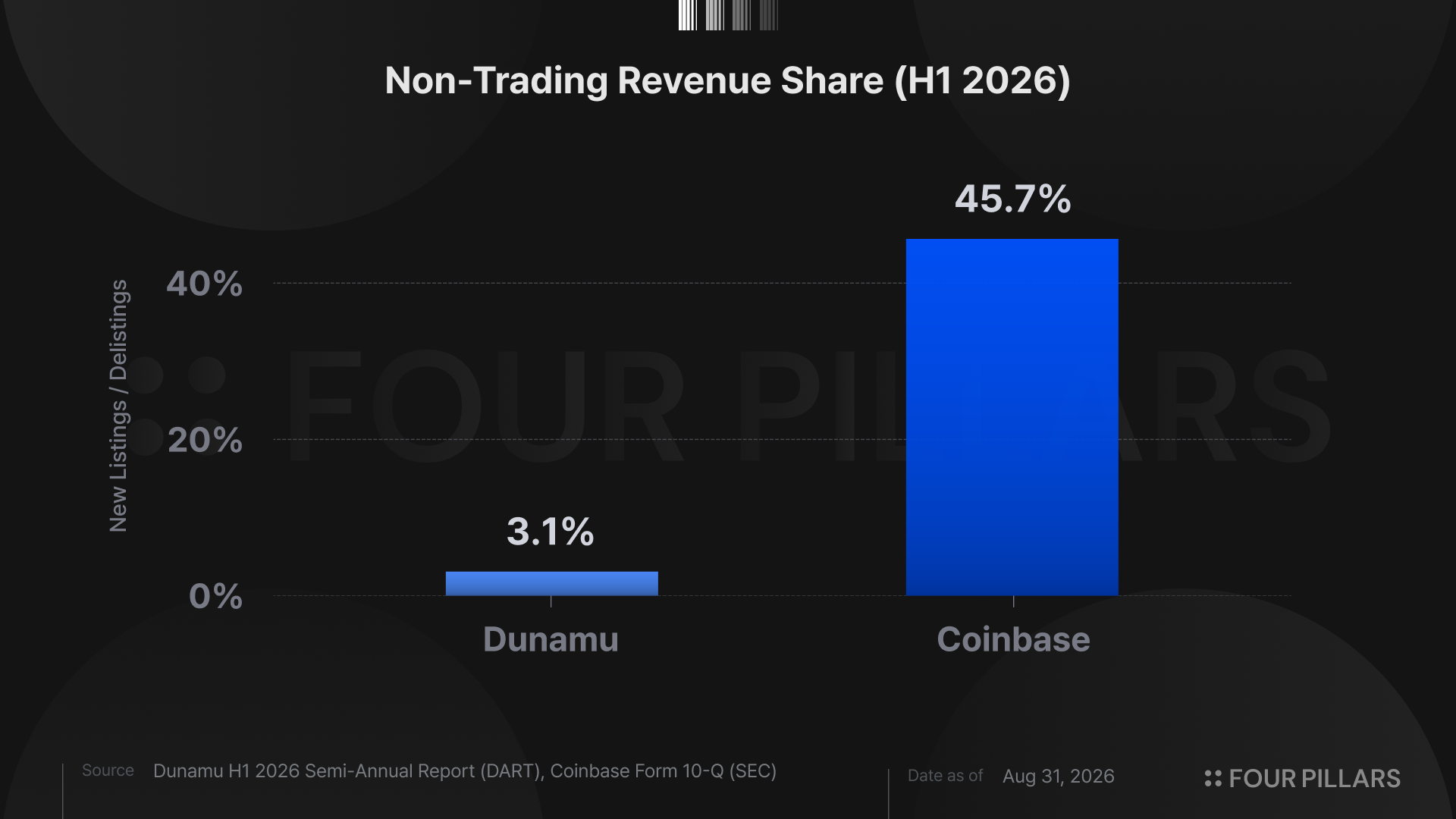
Why Do Korean Crypto Exchanges List So Many Shitcoins? (Link)
3. Four Pillars Weekly
: : Trade[XYZ] 2026 Q2 (Link)
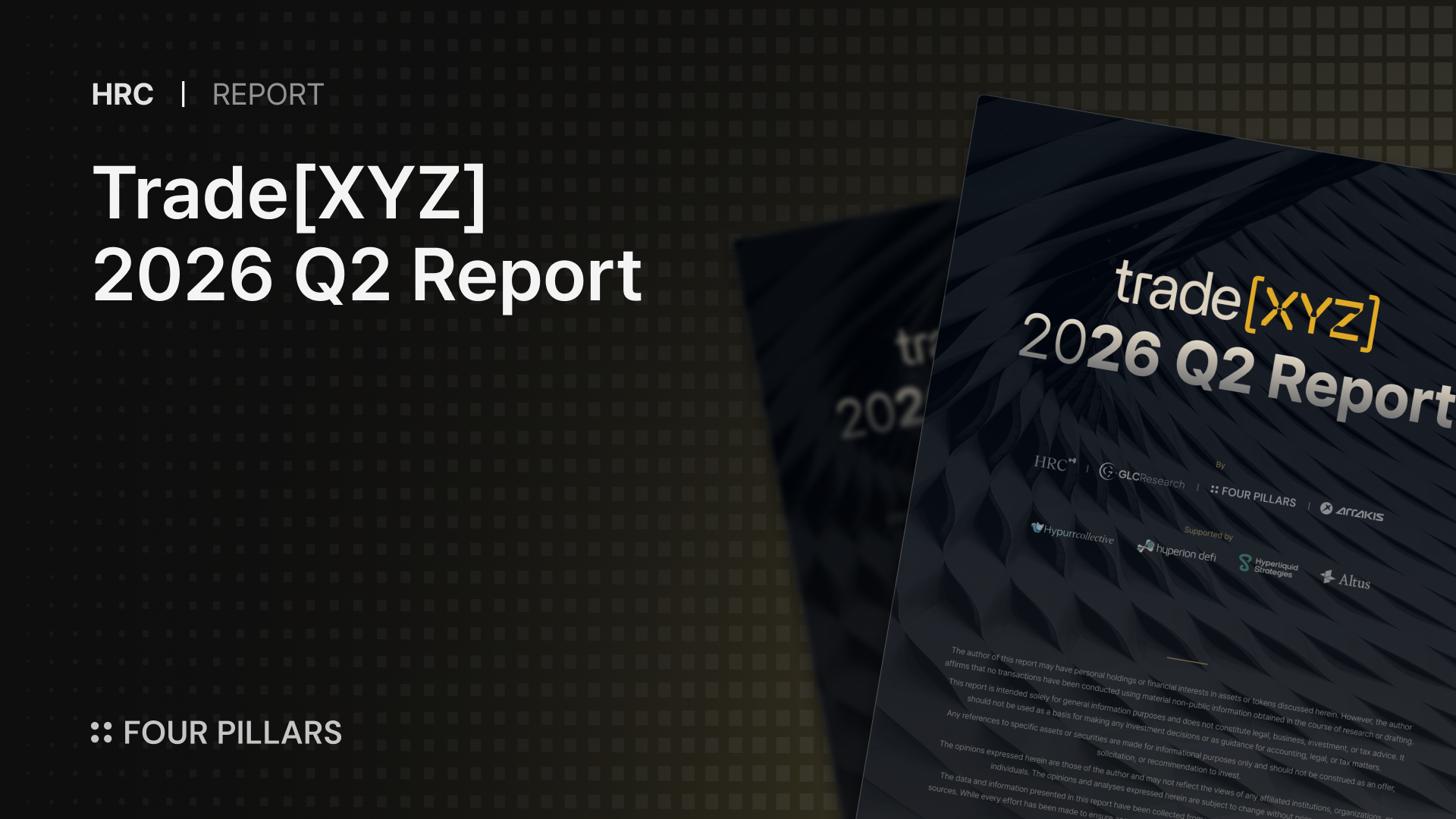
- Trade[XYZ] volume rose 79.2% QoQ to $202.36B, while its share of HIP-3 reached 95.1% for the quarter and roughly 99.5% on a trailing 30-day basis. Revenue grew 32.9% to $7.59M despite a lower take rate.
- Growth broadened beyond commodities. Equity volume rose 377% to $58.9B, indices grew 133%, and Pre-IPO Perpetuals took Cerebras, Quantinuum, and SpaceX from pre-listing trading through their IPOs.
- The pre-IPO product worked, but three listings are not enough to establish a persistent forecasting edge. Much of the final price convergence came only after Nasdaq auction indications appeared.
- With US users still excluded and nearly all HIP-3 activity concentrated on one deployer, regulation is now both Trade[XYZ]'s largest upside and its largest external risk.
: : Permissionless Deployment Triples HIP-4 Volume, With Permission the Remaining Constraint (Link)

- Permissionless deployment on August 29 took HIP-4 from a $545,000 August average to $1.97 million on August 31, with Outcome capturing 70% of that session.
- Hyperliquid settles outcomes against prices its own validators publish every 3 seconds and holds them in the same account as perpetuals and HIP-3, so a binary can hedge a perp on the identical mark. Neither Kalshi nor Polymarket can match that.
- Sports is the largest identified upside. HIP-4 traded $189.5 million across the 39-day World Cup, roughly 3% of World Cup prediction market volume against 0.05% of the field in an ordinary week.
- Deployment is permissionless, US market access is not. Nothing HIP-4 lists today engages the CFTC's gaming screen, sports would be the first, and the securities-referencing markets raise SEC jurisdiction instead.
: : More Mined, Less Earned: Inside the 2026 Bitcoin Miners (Link)

- While the price of Bitcoin fell to less than half its peak, mining costs actually rose. Hashprice stayed in breakeven territory for more than two months, and MARA, Riot, CleanSpark, American Bitcoin, and Bitdeer all posted net losses in the second quarter. As a result, mining difficulty has declined for ten straight months since its October 2025 peak of 155.97T, falling to 125.81T. A prolonged decline of this kind, with no external event like China's 2021 mining ban behind it, is virtually unprecedented.
- Publicly listed miners sold more than 32,000 BTC in the first quarter alone, the largest quarterly sale on record. This cash is not being used simply to ride out the downturn. It is moving into power infrastructure, including power plant acquisitions, long-term AI data center leases, and full pivots to AI cloud services. As a result, the hashrate of listed miners fell 13.4% in six months, a faster decline than the network as a whole (-10.6%), and the stock market has endorsed this direction by assigning lower valuations to the companies that mine the most.
- The late-August rally lifted hashprice 43% from its June low and out of breakeven territory, yet hashrate has stayed flat at around 900 EH/s. For the first time in well over a decade, hashrate has stopped tracking price. This confirms that the equipment and power already assigned to AI are unlikely to come back to mining.
Comments
4. Macro & Onchain Metrics
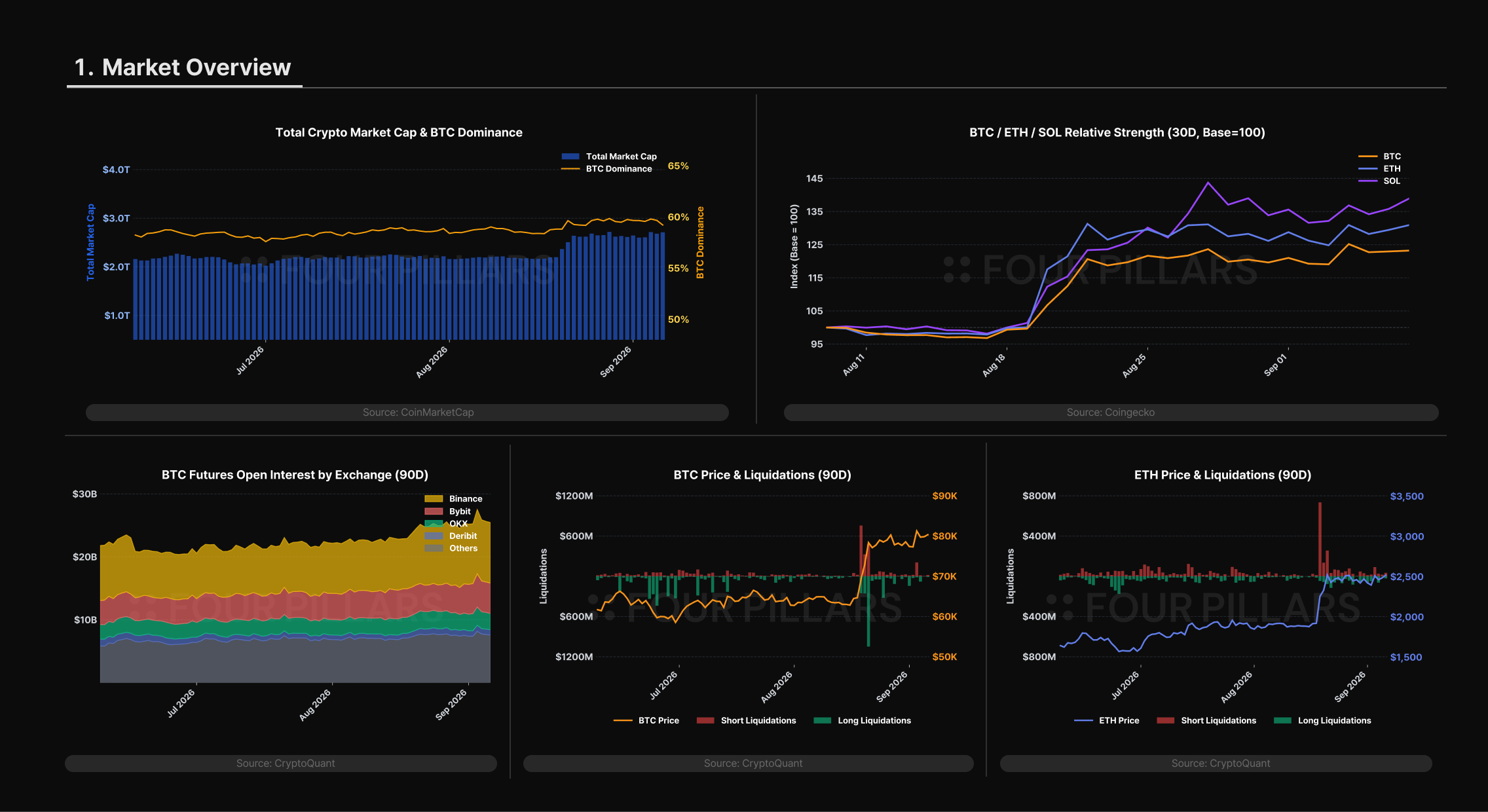
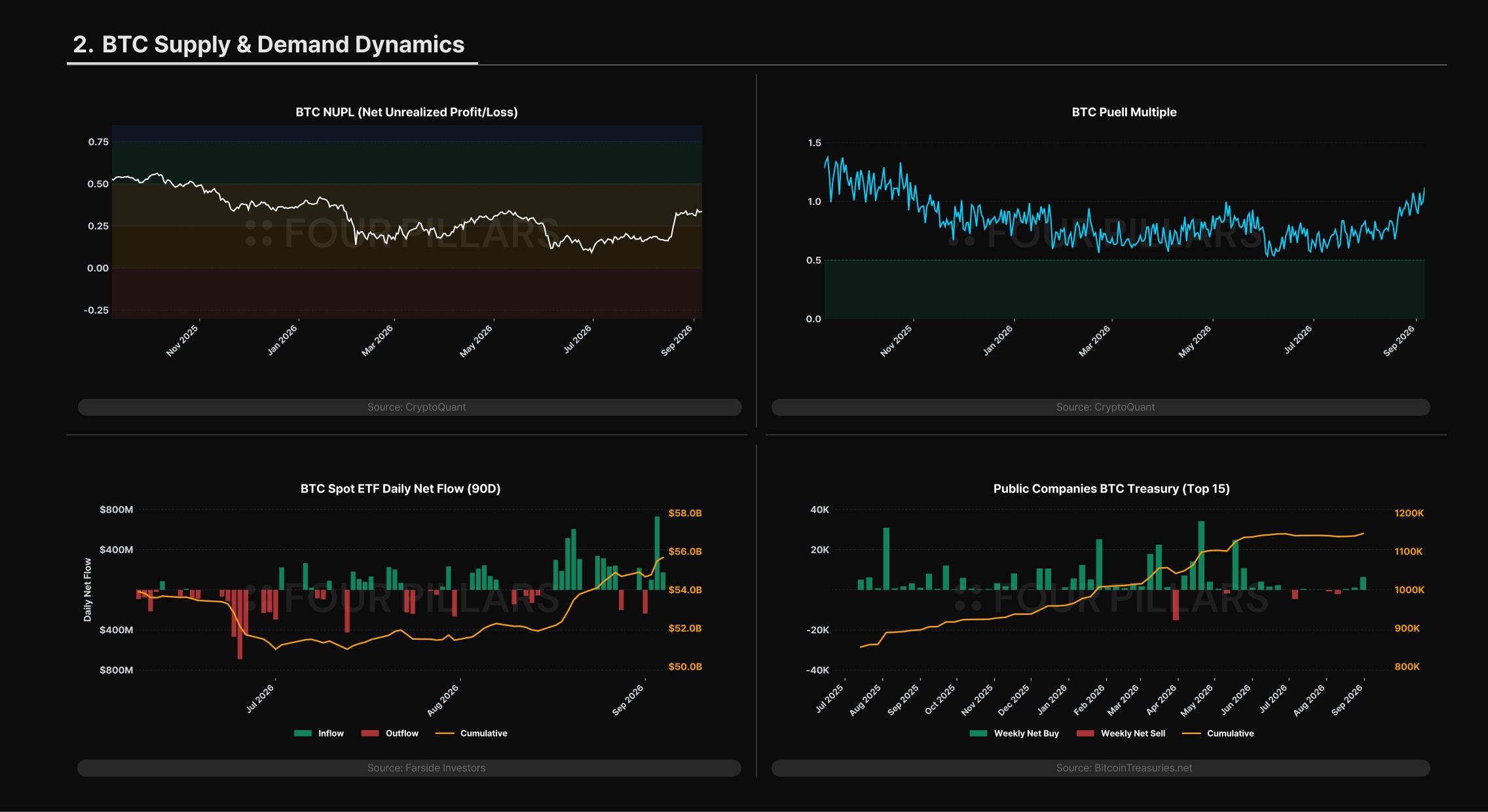
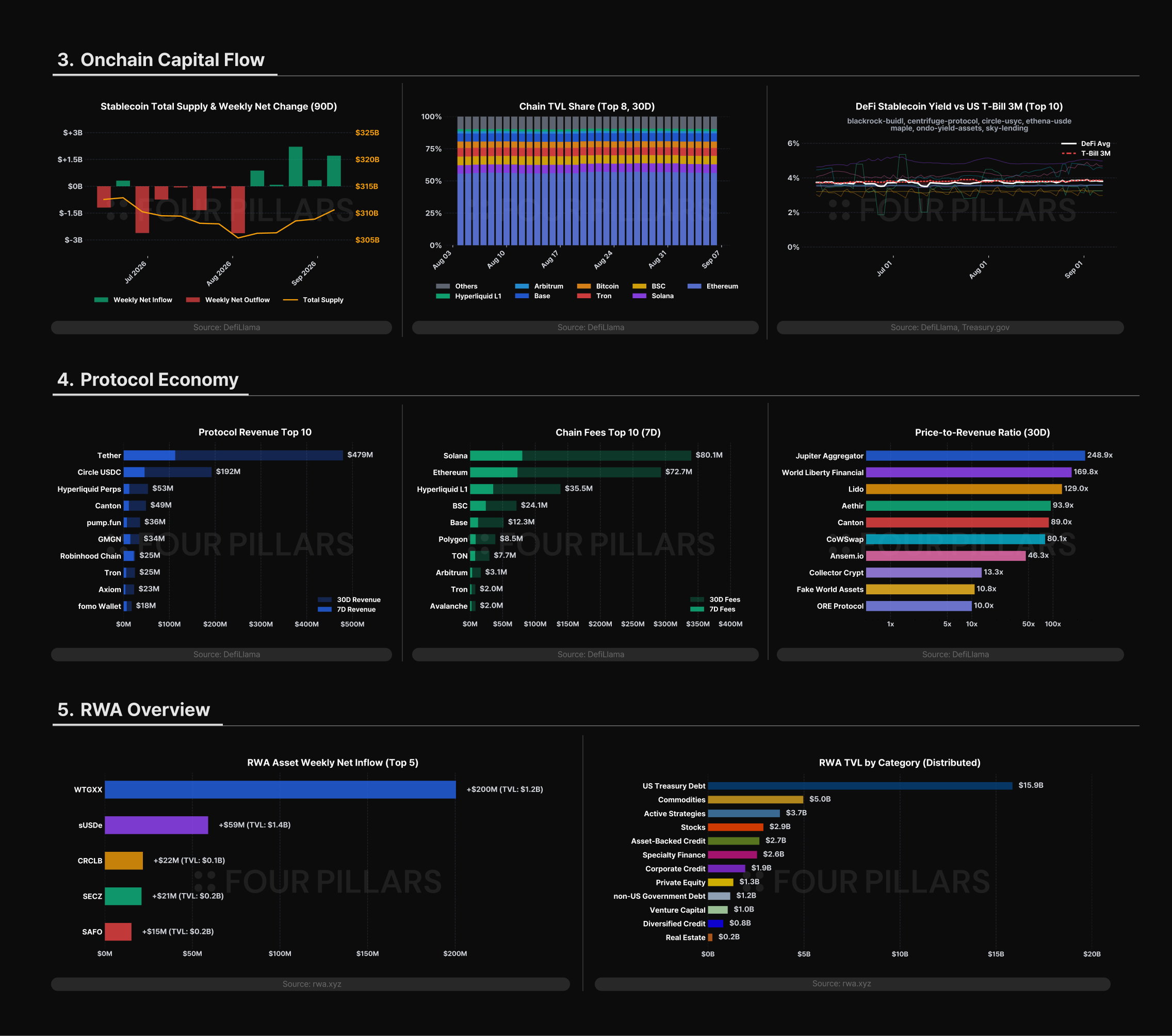
Some of the charts below are powered by CryptoQuant. For those interested in exploring the underlying data in greater detail, CryptoQuant provides access to a comprehensive suite of onchain and market analytics used by institutional participants.
The author of this report may have personal holdings or financial interests in assets or tokens discussed herein. However, the author affirms that no transactions have conducted using material non-public information obtained in the course of research or drafting. This report is intended solely for general information purposes and does not constitute legal, business, investment, or tax advice. It should not be used as a basis for making any investment decisions or as guidance for accounting, legal, or tax matters. Any references to specific assets or securities are made for informational purposes only and should not be construed as an offer, solicitation, or recommendation to invest. The opinions expressed herein are those of the author and may not reflect the views of any affiliated institutions, organizations, or individuals. The opinions and analyses expressed herein are subject to change without prior notice. In addition, beyond the individual disclosures included in each report, Four Pillars, may hold existing or prospective investments in some of the assets or protocols discussed herein. Furthermore, FP Validated, a division of Four Pillars, may already be operating as a node in certain networks or protocols discussed herein or may do so in the future. Please see below links in the footer for FP Validated's participating network disclosures and for broader disclosure details.
![Equity Markets Still Cold on Tokenized Stocks, DATs [FP Weekly 43]](/_next/image?url=https%3A%2F%2Fkrotgrfjzckvumudxopj.supabase.co%2Fstorage%2Fv1%2Fobject%2Fpublic%2Fassets%2Fimg%2Fissues%2Fequity-markets-still-cold-on-tokenized-stocks-dats-fp-weekly-43.png%3Ft%3D1792399234196&w=3840&q=75)

![No CLARITY Act, No Problem
[FP Weekly 42]](/_next/image?url=https%3A%2F%2Fkrotgrfjzckvumudxopj.supabase.co%2Fstorage%2Fv1%2Fobject%2Fpublic%2Fassets%2Fimg%2Fcontent%2Farticle%2Fnotion-import%2Fl44zlxmv4r9yqa.png&w=3840&q=75)

![CLARITY Act Fails, the SEC Steps In [FP Weekly 39]](/_next/image?url=https%3A%2F%2Fkrotgrfjzckvumudxopj.supabase.co%2Fstorage%2Fv1%2Fobject%2Fpublic%2Fassets%2Fimg%2Fcontent%2Farticle%2Fnotion-import%2Fmqlpp6muat2oq6.png&w=3840&q=75)