


Researcher

Related Projects

Robinhood Chain Is on Fire
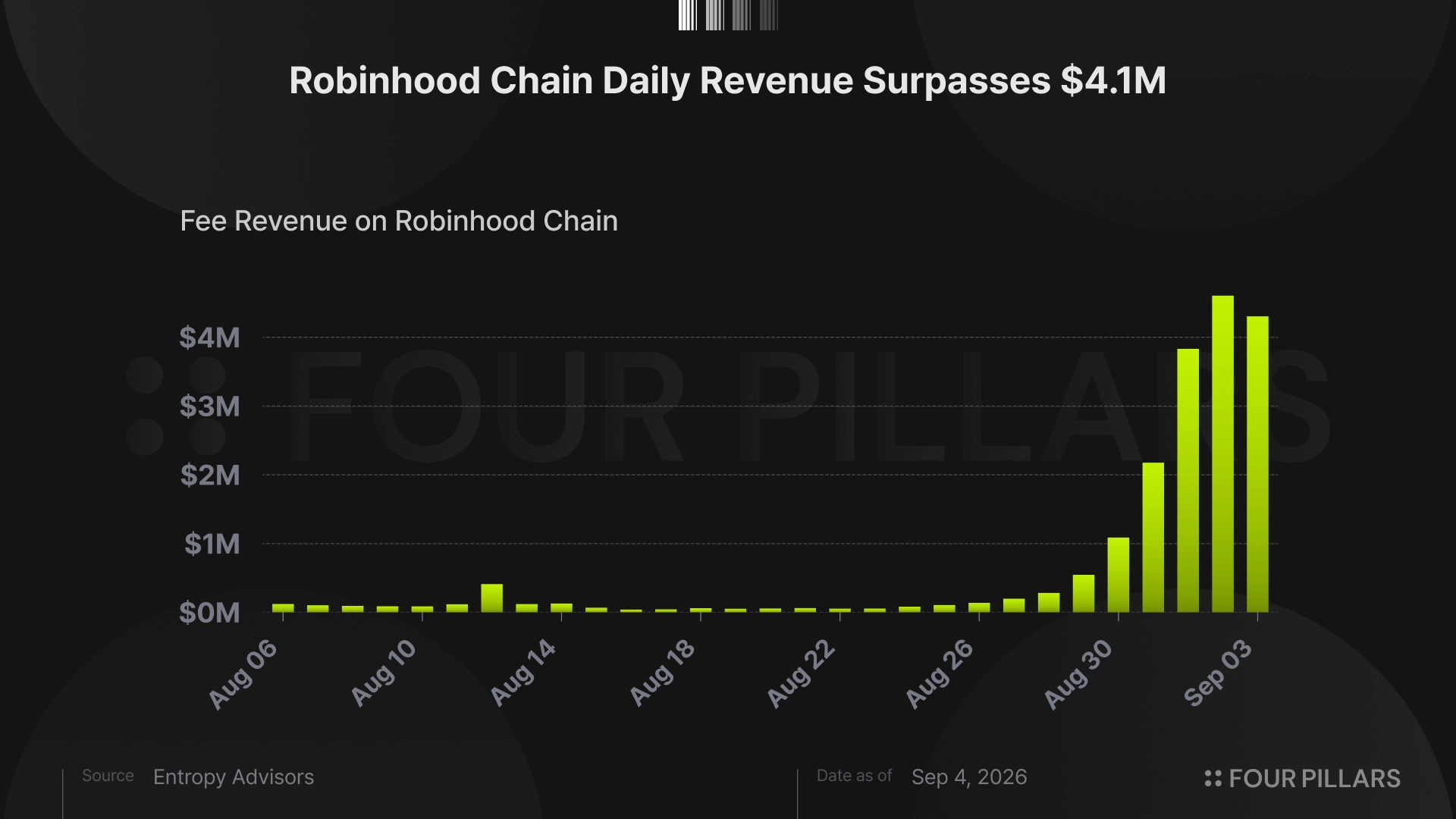
Robinhood Chain is seeing unprecedented growth.
Just two months after launch, its daily revenue has surpassed $4M. That is roughly 2x Hyperliquid and 5 to 6x Tron and Solana. This means Robinhood Chain has overtaken projects with FDVs in the tens of billions of dollars. It even accounts for two-thirds of all revenue generated across Ethereum L2s.
But if you look at the trajectory behind Robinhood Chain’s explosive growth, something feels different.
This is not the growth playbook we are used to seeing.
Robinhood Chain Is Running the Playbook Backwards
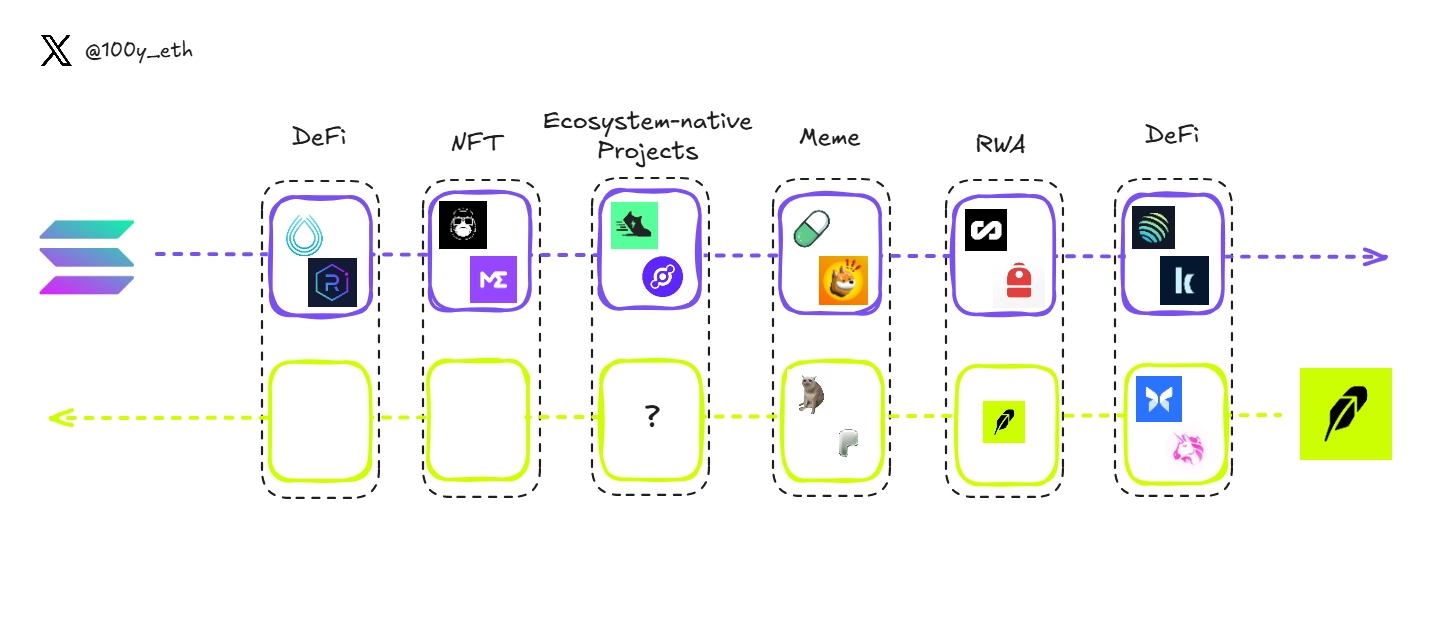
Most blockchain networks we have seen followed a similar growth playbook.
They usually started with basic DeFi protocols like DEXs and lending markets. Then came flagship NFT projects. After that, ecosystem support programs and hackathons brought in a wave of ecosystem-native, non-financial projects that made the ecosystem richer and more diverse.
Eventually, retail-driven speculative projects like memecoins started taking off. And once the ecosystem began hitting its growth ceiling, it turned to RWA and institutional DeFi in search of the next leg of growth.
Robinhood is doing almost the exact opposite.
At its core, Robinhood Chain is an ecosystem built for stock tokens, as Robinhood itself makes clear on its official website. From Day 1, Robinhood Chain supported stock token issuance, along with foundational DeFi protocols such as Uniswap and Morpho.
Things stayed relatively quiet for a while. Then memecoins became the catalyst for Robinhood Chain’s explosive growth.
And the interesting part here is not CashCat.
CashCat attracted a lot of attention early on, but it did not really break away from the usual memecoin playbook we had already seen across other ecosystems.
Traditionally, memecoins on other chains are paired with native assets like ETH or SOL. Robinhood Chain changed that. Starting with LONG, launchpads like Pons began allowing memecoins to launch paired with stock tokens.
Memecoins and stock tokens. Two completely different types of assets, suddenly brought together in the same market.
The concept became incredibly popular. At one point, Pons was generating more daily revenue than Hyperliquid and pump.fun, while attracting even more attention as the token surged.
Fresh concepts also began emerging, including projects that airdropped stock tokens to users for simply holding their memecoins.
The ecosystem exploded.
There are several reasons why Robinhood has been able to run a completely reversed playbook compared to traditional blockchain ecosystems:
- Stock tokens from Day 1: One reason RWA usually comes at the end of the traditional blockchain ecosystem playbook is simply that RWA itself has only emerged as a major category relatively recently. Robinhood Chain, on the other hand, launched much later and supported stock tokens from Day 1. This allowed stock tokens to become the foundation for ecosystem growth rather than something added at the very end.
- The Robinhood brand: Robinhood is a traditional financial company, but at the same time, its brand has always been closely tied to retail and degen culture. GameStop, options trading, crypto, meme stocks. Robinhood has consistently been at the center of the biggest waves of retail speculation in the US over the past few years. So the combination of stock tokens and memecoins feels more natural than it might seem. Meme stocks became a phenomenon offchain. On Robinhood Chain, that same culture is reappearing in the form of memecoins paired with stock tokens.
- Users and liquidity were already there: Most new chains start from nothing. They need to attract builders, get them to build apps, distribute grants and liquidity incentives, and then somehow convince users to show up. Robinhood is different. It already has tens of millions of users, stocks as a familiar asset class, and a massive distribution channel through Robinhood itself. On other chains, apps need to bring the users. On Robinhood Chain, apps can follow the users and assets that are already there.
- Absorbing existing infrastructure: Robinhood did not have to build everything from scratch either. Proven DeFi protocols like Uniswap and Morpho already existed, and developers could use the existing EVM tooling stack. The basic infrastructure that other chains spent years building was available to Robinhood from the very beginning.
Robinhood Chain is now tracing a growth trajectory based on a playbook we have never really seen before.
At this stage, memecoins have brought massive amounts of liquidity onto the chain.
Now the question is how long this memecoin mania can last.
And if the mania eventually fades, the real thing to watch is whether Robinhood Chain can turn that liquidity into something more durable, with native projects that actually have utility emerging from the ecosystem.
The author of this report may have personal holdings or financial interests in assets or tokens discussed herein. However, the author affirms that no transactions have conducted using material non-public information obtained in the course of research or drafting. This report is intended solely for general information purposes and does not constitute legal, business, investment, or tax advice. It should not be used as a basis for making any investment decisions or as guidance for accounting, legal, or tax matters. Any references to specific assets or securities are made for informational purposes only and should not be construed as an offer, solicitation, or recommendation to invest. The opinions expressed herein are those of the author and may not reflect the views of any affiliated institutions, organizations, or individuals. The opinions and analyses expressed herein are subject to change without prior notice. In addition, beyond the individual disclosures included in each report, Four Pillars, may hold existing or prospective investments in some of the assets or protocols discussed herein. Furthermore, FP Validated, a division of Four Pillars, may already be operating as a node in certain networks or protocols discussed herein or may do so in the future. Please see below links in the footer for FP Validated's participating network disclosures and for broader disclosure details.


