


Table of Contents
Researcher

Onchain credit has grown to roughly $60 billion(now down to $40 billion), and it still runs almost entirely on floating rates. In early 2026, more than 95 percent of the roughly $25 billion in active loans on major lending protocols carried variable rates with no maturity. Offchain, fixed terms are the norm across corporate bonds, mortgages, and trade finance, a system that originates roughly $200 trillion in credit each year.
Fixed rate lending has failed onchain before, but the borrowers who genuinely need fixed terms have now arrived.
1. Why Fixed Rate Lending Failed in the Past?
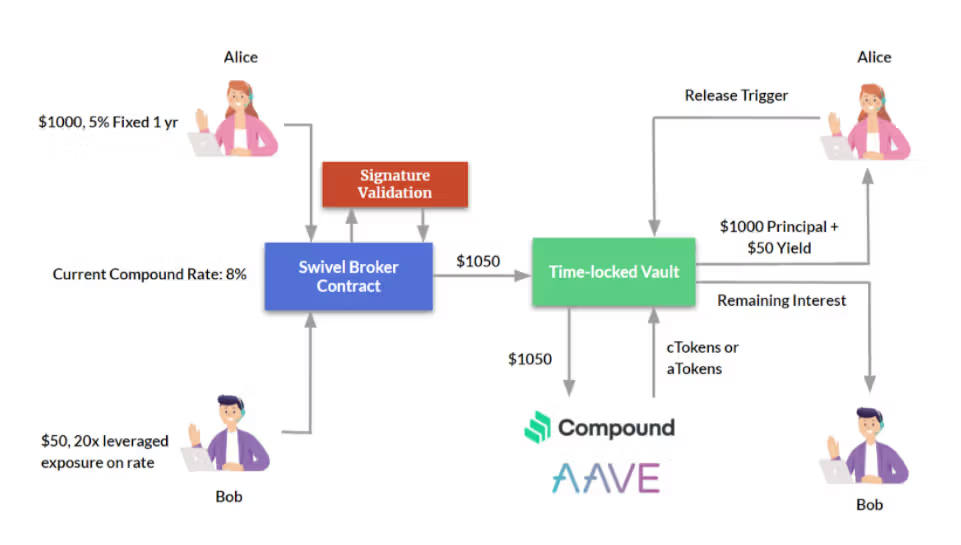
Yield Protocol, Notional V2, and Element launched into a market where nearly all borrowing demand was speculative and short term. Speculators wanted leverage they could open and close instantly, so paying a premium to lock a rate held little value for them. Yield Protocol shut down in 2023 after concluding that demand could not sustain the business.
Fixed term instruments deepened the demand problem by locking lender capital while variable pools such as Aave paid comparable yields with instant withdrawal, so lenders were rarely compensated for going fixed. Liquidity fragmented across every maturity and collateral pair, leaving thin books and wide spreads that pushed users back to floating pools.
Source: Fixed Income Protocols - The Next Wave of DeFi Innovation | Messari by Blockworks
2. What Changed?
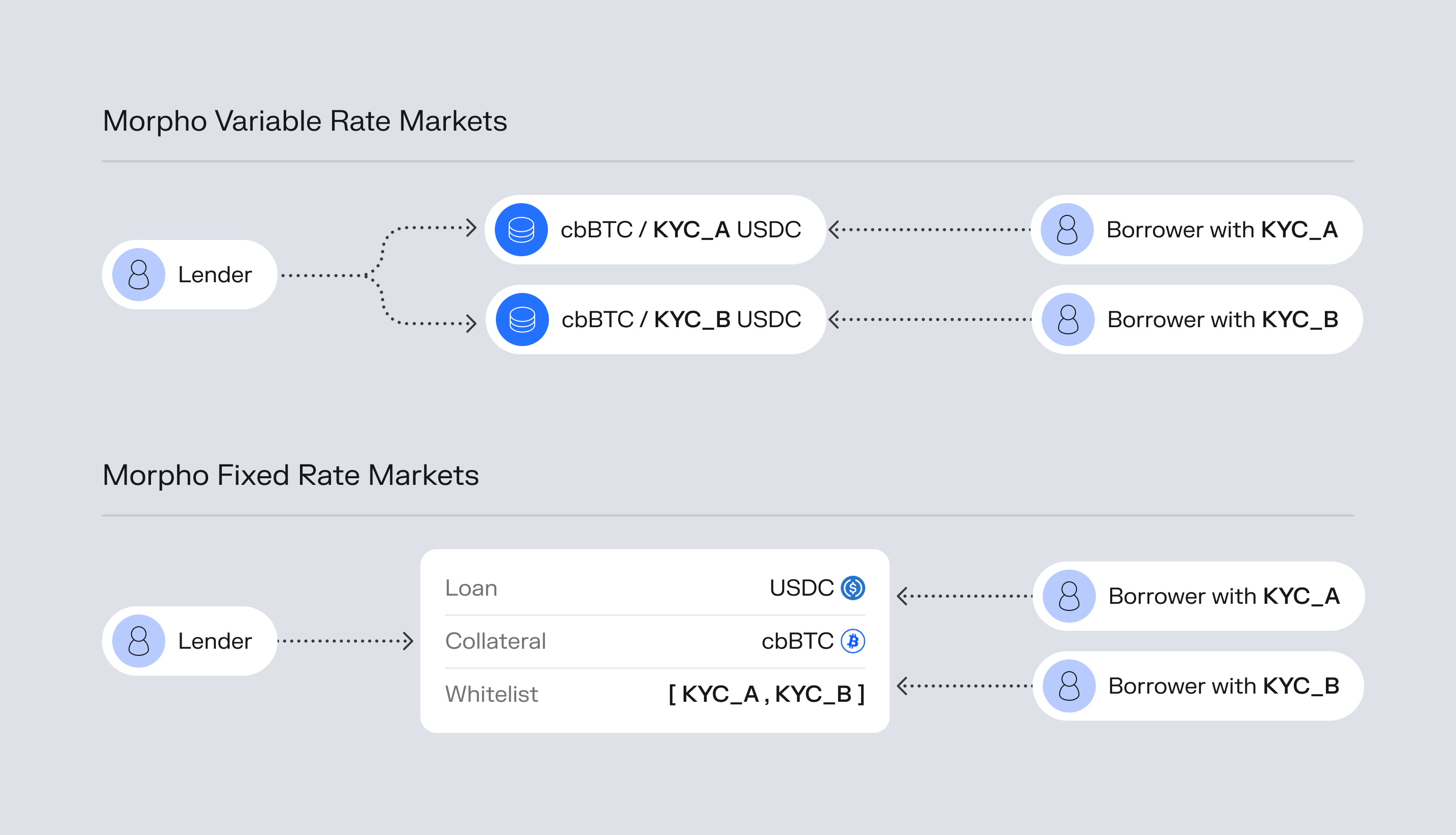
The borrower base changed as institutions, corporate treasuries, and tokenized credit funds entered onchain markets at scale. These actors plan cash flows and require known funding costs. Morpho, the second largest lending protocol with over $7 billion in deposits, judged this demand mature enough to launch Midnight, its fixed rate protocol, on Base in July 2026.
The use cases are concrete, a trading firm financing inventory cannot absorb a funding spike while positions are on the book, and a corporate treasury borrowing dollars against BTC must report a known interest expense. A tokenized private credit fund matches asset yields against liability costs, and a market maker funding a delta neutral book treats the financing rate as the trade itself.
Supply matured alongside demand as vault curation became a professional industry, with firms such as Gauntlet, Steakhouse, and Avantgarde managing rate and duration risk for passive depositors. US regulatory direction, including the CLARITY Act discussions and SEC Commissioner Peirce's framework for vaults and onchain lending, is giving institutional allocators more confidence.
Source: Morpho Fixed Rate Markets: Liberating the Potential of Onchain Loans
3. The Design
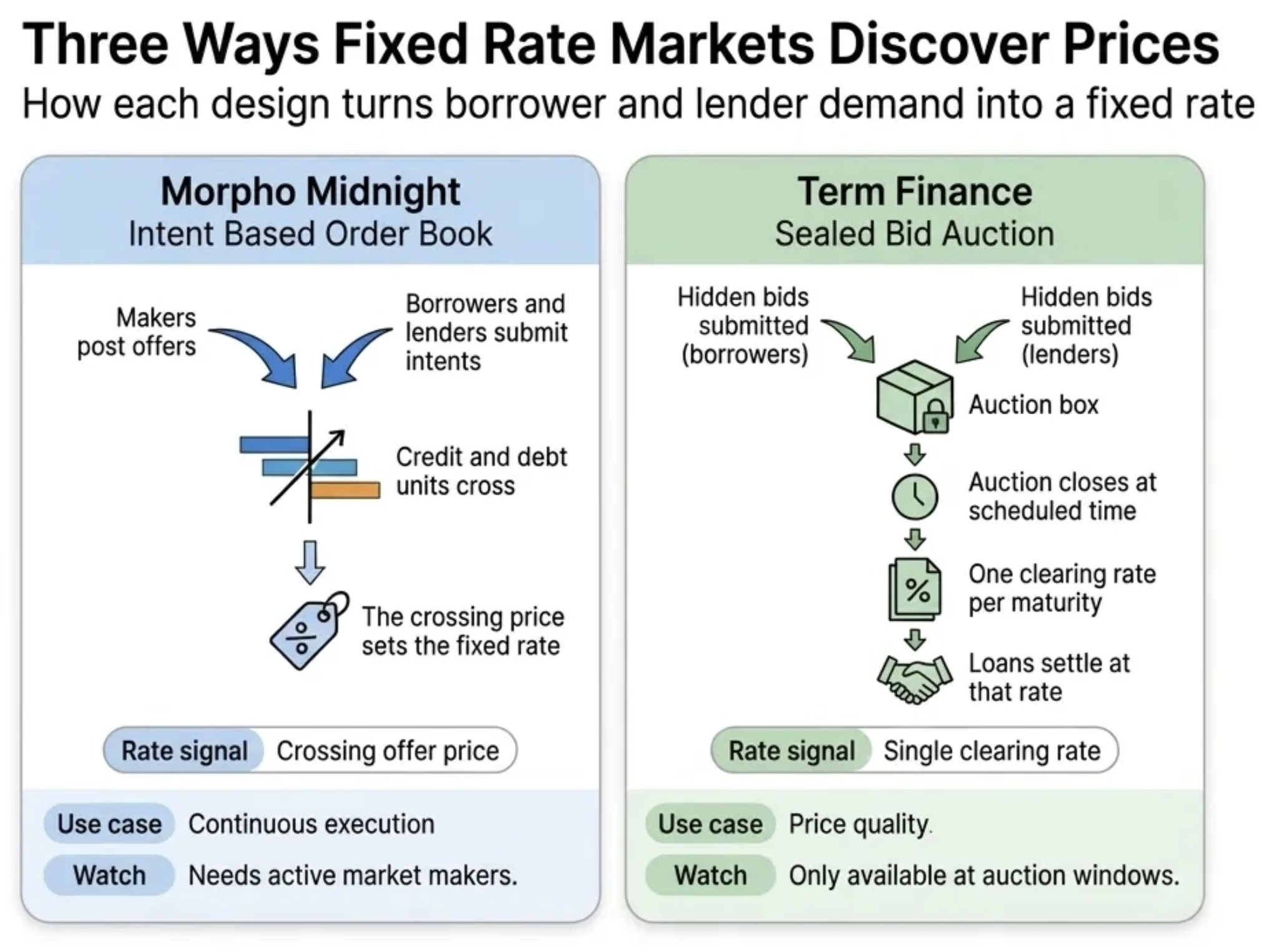
With the demand in place, the design question is how a venue discovers the fixed rate. Morpho Midnight answers with an intent based order book where participants post offers on credit and debt units whose payoff mirrors zero coupon obligations, so the implied rate is set where offers cross. Offers do not lock capital and source liquidity only at settlement, which lets one maker quote across many markets and maturities from a single balance.
Because Morpho exposes this order book as open infrastructure, platforms can specialize on top of it. Tenor builds directly on Morpho and adds a policy layer where participants attach custom terms to the shared liquidity, including whitelisted counterparties, bespoke OTC agreements on collateral and rates, and automatic renewal or fallback to variable rates at maturity. The same layer lets fintechs and exchanges run their own crypto backed loan programs without building a separate venue.
Term Finance answers the same rate discovery question with the opposite choice on timing, concentrating activity into periodic sealed bid auctions in which both sides submit hidden bids and one clearing rate is set per maturity.
The two mechanisms therefore trade rate quality against availability: auctions concentrate liquidity and produce robust clearing prices but only at scheduled moments, while continuous order books execute at any time and depend on active makers to stay liquid.
4. The Demand is Arriving
The collateral base that needs term credit is moving onchain. Tokenized real world assets reached roughly $29 billion in the first quarter of 2026 after growing about 30 percent in a single quarter, and BlackRock's tokenized Treasury fund BUIDL passed $2.8 billion and began trading on Uniswap in February 2026. Tokenized stocks and commodities are scaling behind Treasuries, and the holders of these assets are overwhelmingly institutions that finance positions on fixed terms.
These flows compound into credit demand as fintech rails grow stablecoin float, tokenization moves institutional collateral onchain, and institutions holding that collateral borrow against it at known costs on fixed calendars. Onchain credit at $60 billion remains a small fraction of the roughly $200 trillion in credit originated offchain each year, so the addressable gap is structural.
Speculators drove past cycles were not interested for rate certainty because they could close positions at any time. The capital arriving in this cycle enters through tokenized collateral and fintech distribution, and it belongs to treasuries, funds, and payment companies whose financing needs recur on fixed calendars.
The author of this report may have personal holdings or financial interests in assets or tokens discussed herein. However, the author affirms that no transactions have conducted using material non-public information obtained in the course of research or drafting. This report is intended solely for general information purposes and does not constitute legal, business, investment, or tax advice. It should not be used as a basis for making any investment decisions or as guidance for accounting, legal, or tax matters. Any references to specific assets or securities are made for informational purposes only and should not be construed as an offer, solicitation, or recommendation to invest. The opinions expressed herein are those of the author and may not reflect the views of any affiliated institutions, organizations, or individuals. The opinions and analyses expressed herein are subject to change without prior notice. In addition, beyond the individual disclosures included in each report, Four Pillars, may hold existing or prospective investments in some of the assets or protocols discussed herein. Furthermore, FP Validated, a division of Four Pillars, may already be operating as a node in certain networks or protocols discussed herein or may do so in the future. Please see below links in the footer for FP Validated's participating network disclosures and for broader disclosure details.


