


Table of Contents
Researcher

Related Projects

Changes in the distribution of Aptos validators
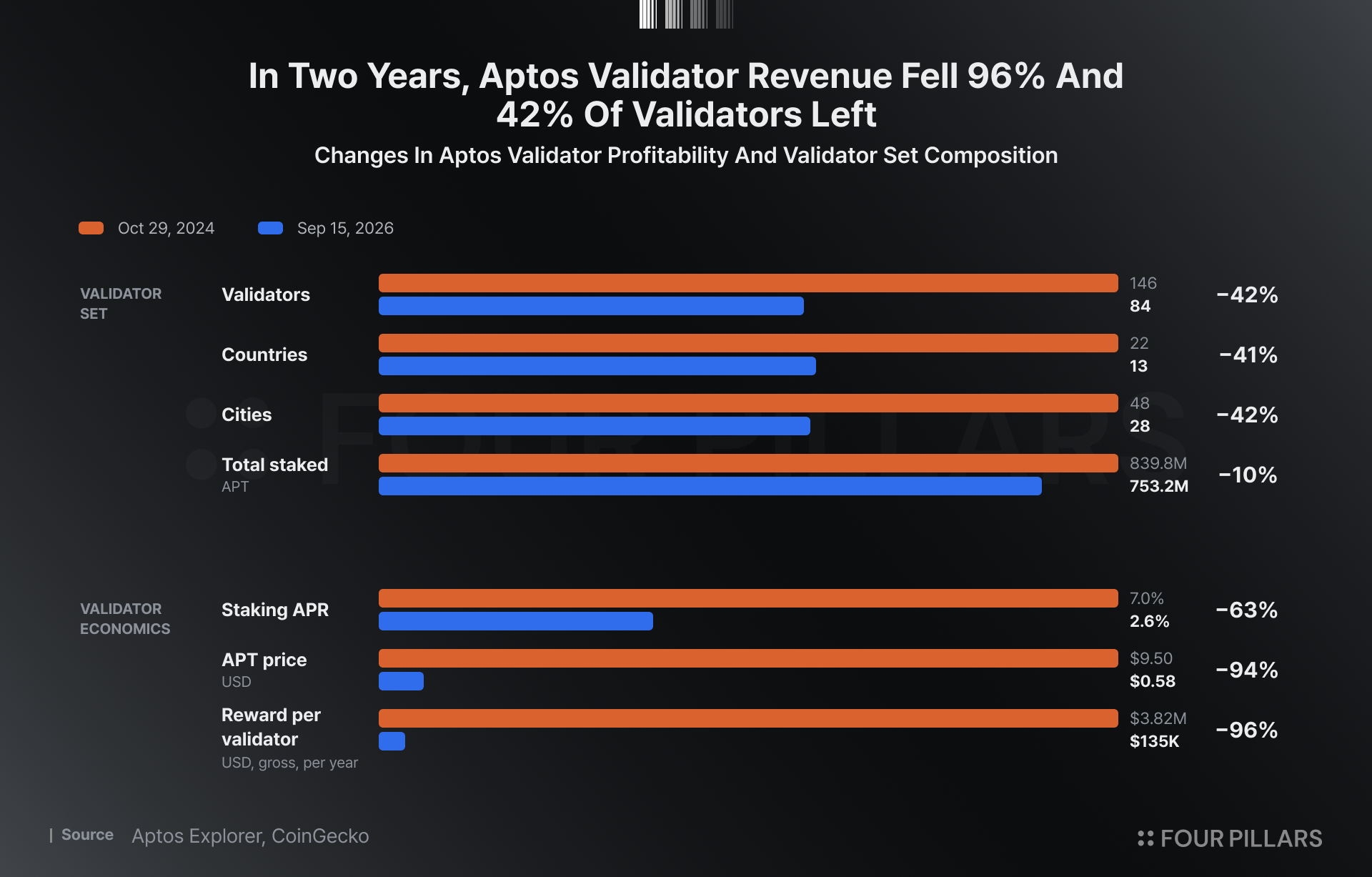
In October 2024, Aptos had 146 validator nodes spread across 48 cities in 22 countries. Beyond Europe and the Americas, there were nodes in Asian cities such as Singapore, Tokyo, Seoul, and Hong Kong, and validators in São Paulo, Johannesburg, and Sydney.
Less than two years later, in September 2026, the count is 84, down 42%. Countries fell to 13 (−41%) and cities to 28 (−42%). Most of the remaining nodes are in the Americas and Europe. Outside those two regions, only one node is left, in Tokyo.
Two causes stand out. Performance upgrades raised what the chain asks of validators, and a lower reward rate combined with a falling token price cut validator revenue sharply.
Performance upgrades changed the operating environment
With the Baby Raptr upgrade in June 2025 and AIP-131 (Velociraptr), Aptos brought block time under 50ms. That is a real gain in performance, but it also made a validator's network conditions and physical location matter more for its results.
Aptos rewards are calculated as stake times the reward rate times the share of a validator's proposals that succeed. A node far from the rest of the set earns less on the same stake. That gave validators spread across continents a reason to shut down or relocate to Europe or the Americas.
Higher chain performance also means higher hardware requirements. Add the surge in memory prices driven by AI demand, and validators' fixed costs rose considerably.
Operating economics
The direct cause of the exits is revenue. A validator business earns in tokens and pays its costs in dollars.
Aptos's annual staking reward rate fell from 7% in October 2024 to 2.6% in September 2026, a 63% cut. AIP-119, proposed in April 2025, lowered the rate from 7% to 5.19% starting in June. The tokenomics overhaul proposed by the foundation in February 2026 then halved it to 2.6%. A validator's income is the commission it takes from rewards on delegated stake, so a lower reward rate reduces delegator and operator income in the same proportion.
The decisive factor was price. APT fell from $9.50 to $0.58 over the same period, down 94%. As nodes left, average stake per node rose 56%, from 5.75M to 8.97M APT. But once the reward cut and the price drop are multiplied together, a validator's annual reward in dollar terms fell 96%.
Market conditions and network distribution
The case shows how a token's market value and changes to its reward structure affect whether network participants can keep operating. Earning in tokens while paying for servers and staff in fiat is a challenge most blockchain networks share.
As market conditions shifted, Aptos adjusted its tokenomics toward lower staking rewards and lower issuance. That choice makes sense for the long-term token economy, but it also reduced validator revenue and created a new challenge for network distribution. Over the same period the validator count fell sharply and the geographic footprint narrowed to Europe and the Americas.
A similar debate has been active on Ethereum. EIP-8363 proposes burning part of new issuance rewards as staking grows. The intent is to curb excessive staking growth and the inflation that comes with it, but the effect on validator economics has to be weighed as well.
Keeping a network running through market swings
Judging decentralization takes more than today's node count and staking ratio. The question is whether a diverse set of operators can keep participating when the token price drops and reward policy changes.
In periods like this, participants who can absorb short-term reward swings and keep operating matter more. Exchanges and institutions, with stable underlying businesses and long-term service demand, can maintain network operations through an extended downturn and support the ecosystem as members of the community. That is why exchange staking services and institutional-grade validator participation are good for a network.
Lowering hardware requirements to reduce the entry barrier for smaller operators also matters. So far, most blockchain networks have pointed their engineering effort at raising performance. The same effort should go into efficiency: delivering the same performance with fewer resources and at lower cost. Such gains help new operators enter and give existing operators more room to keep running at lower reward levels.
In the end, long-term decentralization depends on three things: validators with the capacity to keep operating through a market downturn, lower operating costs, and an entry environment that stays open to new participants.
The author of this report may have personal holdings or financial interests in assets or tokens discussed herein. However, the author affirms that no transactions have conducted using material non-public information obtained in the course of research or drafting. This report is intended solely for general information purposes and does not constitute legal, business, investment, or tax advice. It should not be used as a basis for making any investment decisions or as guidance for accounting, legal, or tax matters. Any references to specific assets or securities are made for informational purposes only and should not be construed as an offer, solicitation, or recommendation to invest. The opinions expressed herein are those of the author and may not reflect the views of any affiliated institutions, organizations, or individuals. The opinions and analyses expressed herein are subject to change without prior notice. In addition, beyond the individual disclosures included in each report, Four Pillars, may hold existing or prospective investments in some of the assets or protocols discussed herein. Furthermore, FP Validated, a division of Four Pillars, may already be operating as a node in certain networks or protocols discussed herein or may do so in the future. Please see below links in the footer for FP Validated's participating network disclosures and for broader disclosure details.


