


Table of Contents
Researcher

A more detailed discussion of x402 and agentic commerce will be included in the forthcoming “All About x402 report”.
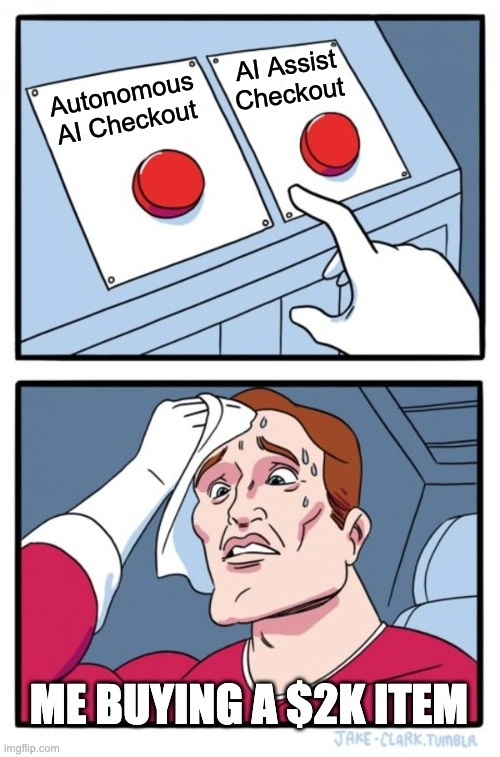
Assume you are about to buy a $1,000 item. You have two checkout options:
- The first is Autonomous AI Checkout, in which AI handles the full process from product recommendations to payment.
- The second is AI Assist Checkout, in which AI supports the steps before purchase, such as product recommendations and information search.
Which would you choose?
I am optimistic about the future of agentic commerce, but for now I would choose the second option without hesitation. I expect most consumers would make the same choice. Why?
This article first defines agentic commerce and the headless merchant endpoint. It then examines the trust cost that makes consumers hesitate before fully autonomous checkout. It also considers where the market may emerge first and how agentic commerce may develop over time.
Defining agentic commerce and the headless merchant endpoint
Agentic commerce is a form of commerce in which an AI agent receives authority from a person or business to search for and compare products and services, then carries out part or all of the order and payment process. Major global consulting firms project that by 2030, transactions in which agents participate directly or indirectly in the purchasing process will reach trillions of dollars.
I divide agentic commerce into three stages based on how much authority is delegated to the AI agent:
- T1. Assist: AI handles search and recommendations, while a person approves each final payment.
- T2. Delegated execution: A person sets the budget and purchase conditions, such as a spending cap, in advance. The agent places orders and makes payments within those limits.
- T3. Autonomous: Software selects and purchases external machine-callable resources, such as APIs, data, and services, without requiring human approval for each transaction.
At T3, a new type of business is emerging: the headless merchant endpoint, which accepts payment through an API endpoint without a website. It is gaining attention as a possible successor to brick-and-mortar retail and e-commerce for small businesses.
A real market is already forming in which AI buys software resources from other software. A new generation of builders, often represented by vibe coders, is also expected to build agentic-native businesses. Stablecoin wallets, blockchain networks, discovery platforms, and facilitators are therefore entering the market to capture value at different layers.
What is trust cost?
Before discussing where agentic commerce may develop, consider how the market is generally expected to progress.
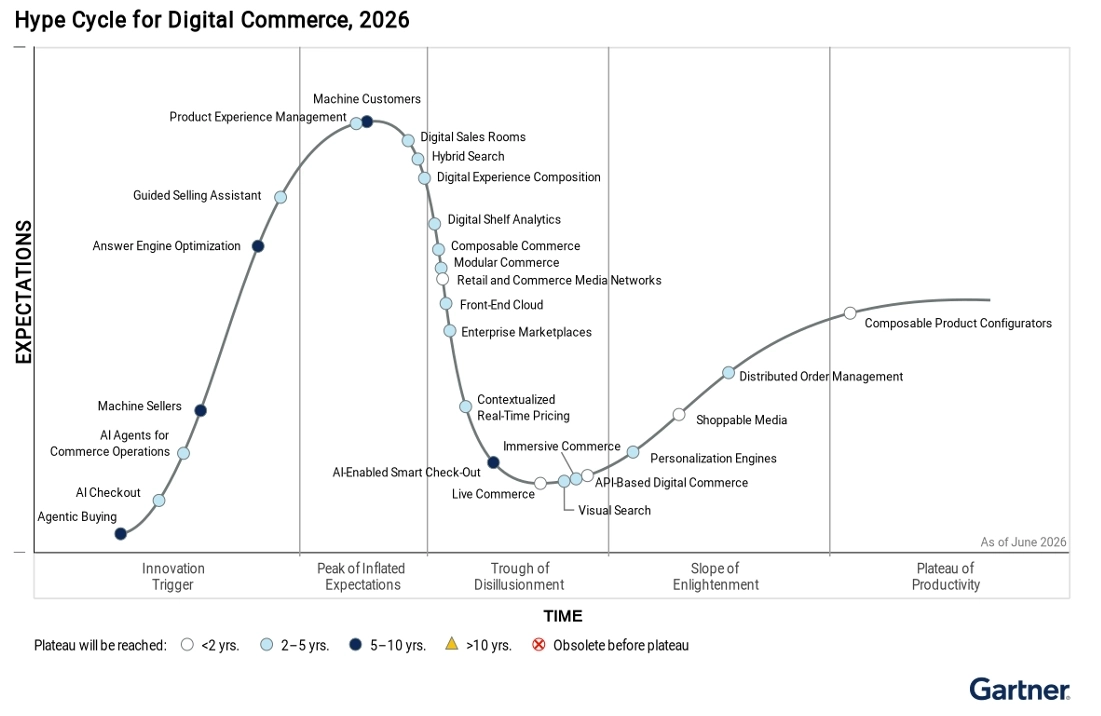
Source: Gartner
The prevailing view is that the adoption of agentic commerce will begin with T1, where delegation is limited, and then move gradually to T2 and T3 as trust accumulates. Many protocols and technologies have followed this path.
I expect the order of market formation to be the reverse. Agentic commerce may first take hold at T3, the stage with the highest level of delegation, and more specifically in the headless merchant endpoint market.
Return to the question at the start. If you need to buy a $1,000 product, would you choose autonomous AI checkout or AI-assisted checkout? If the answer seems obvious, change the scenario. Suppose you need to buy $10 worth of data from an API endpoint. Which option would you choose? If you still prefer assisted checkout, what about $0.10 or $0.01?
Why does the answer change with the transaction value? Every choice involves some risk. We often reject an option when its expected risk is greater than its expected benefit.
Let us call this risk and burden trust cost. Trust cost is the amount of risk and burden a user must accept when adopting a technology or service. It varies with the level of delegation, but it can also differ at the same delegation level depending on transaction value, verifiability, and recoverability.
How will the Delegation Zone expand?
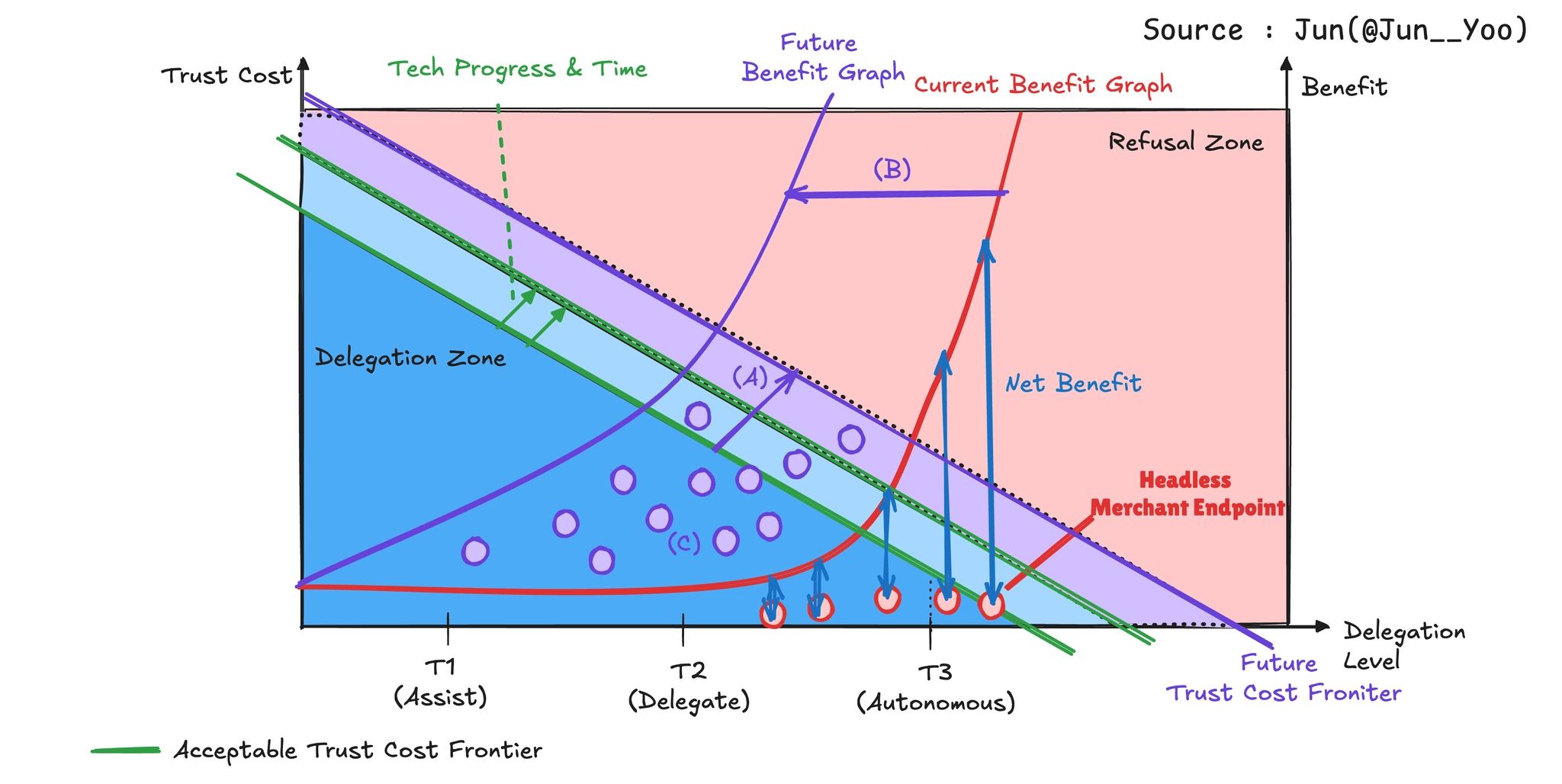
Using trust cost, we can define the Delegation Zone as the range in which people are willing to accept a technology or service at each level of delegation.
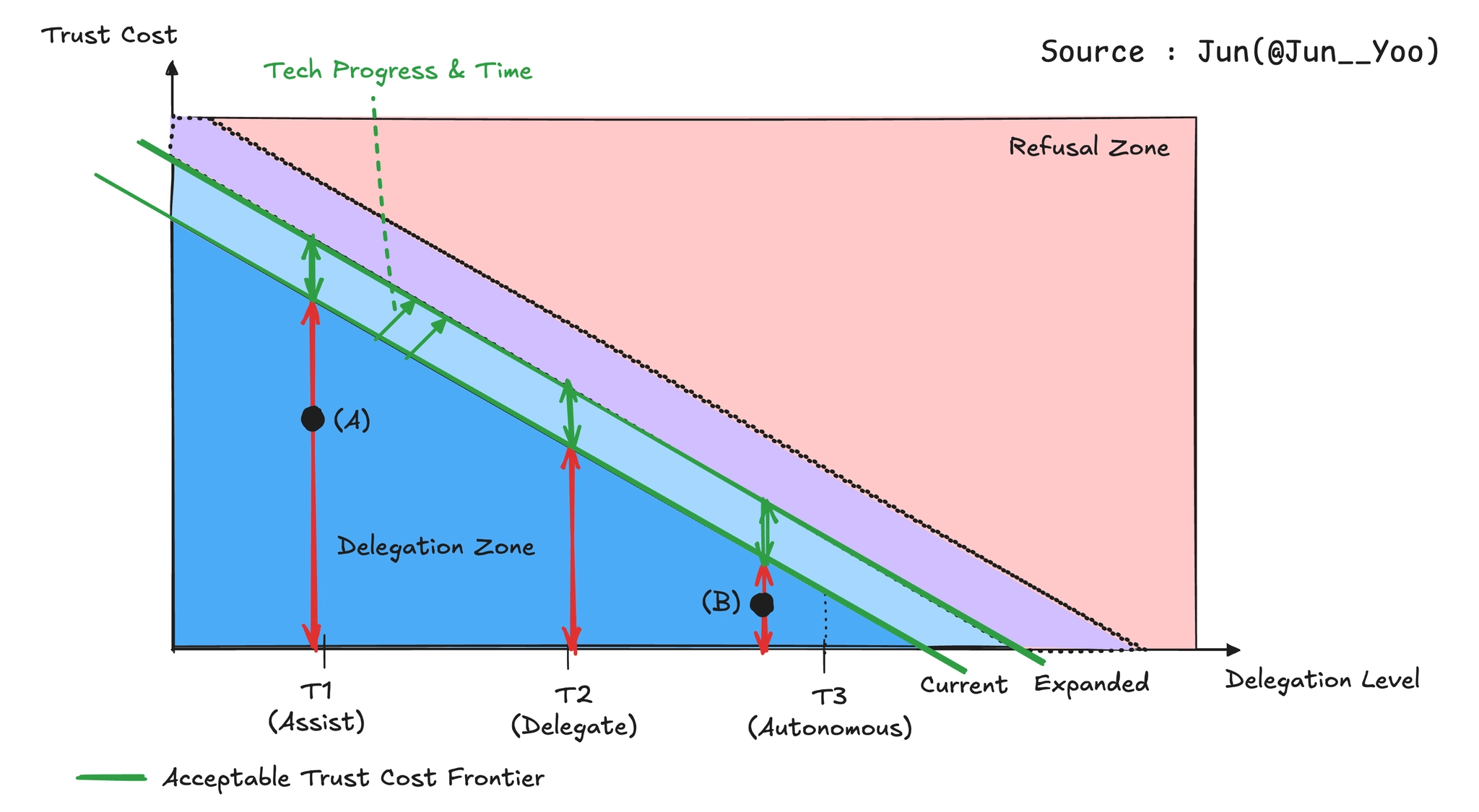
The y-axis in the chart does not represent a fixed trust cost for each delegation stage. It represents the trust cost of an individual service at that delegation level. The diagonal line marks the maximum trust cost that people will accept at each level of delegation. The area below it is the Delegation Zone.
At T1, people retain final approval authority, so they can accept a higher trust cost. This allows them to use services with higher transaction values or greater consequences if something goes wrong. It also permits a wider range of service designs. At T3, people delegate only to services whose trust cost is kept sufficiently low. The current Delegation Zone is therefore widest at T1 and narrows toward T3, as shown by the red arrow.
The Delegation Zone can expand as technology improves and users gain experience. Consider the transition from traditional retail to e-commerce in the late 1990s. Early e-commerce centered on low-value purchases such as books and CDs because consumers had concerns about security. As payment and security systems improved and consumers became familiar with online transactions, they began buying expensive appliances and even cars online, as shown by the green arrow.
A service must first enter the Delegation Zone before users will adopt it. There are two main routes. At T1, represented by point A, low delegation allows a wider range of acceptable trust costs. At T3, represented by point B, delegation is high, but the service can still enter the zone if its trust cost is low enough. The chart shows only whether adoption is acceptable from the perspective of trust cost. Actual adoption occurs only when the service's benefit exceeds that cost.
Net benefit determines adoption
The adoption question is simple: Does the benefit provided by the agent exceed the trust cost, including the cost of concern and supervision? The next chart shows how benefit may change with the level of delegation.
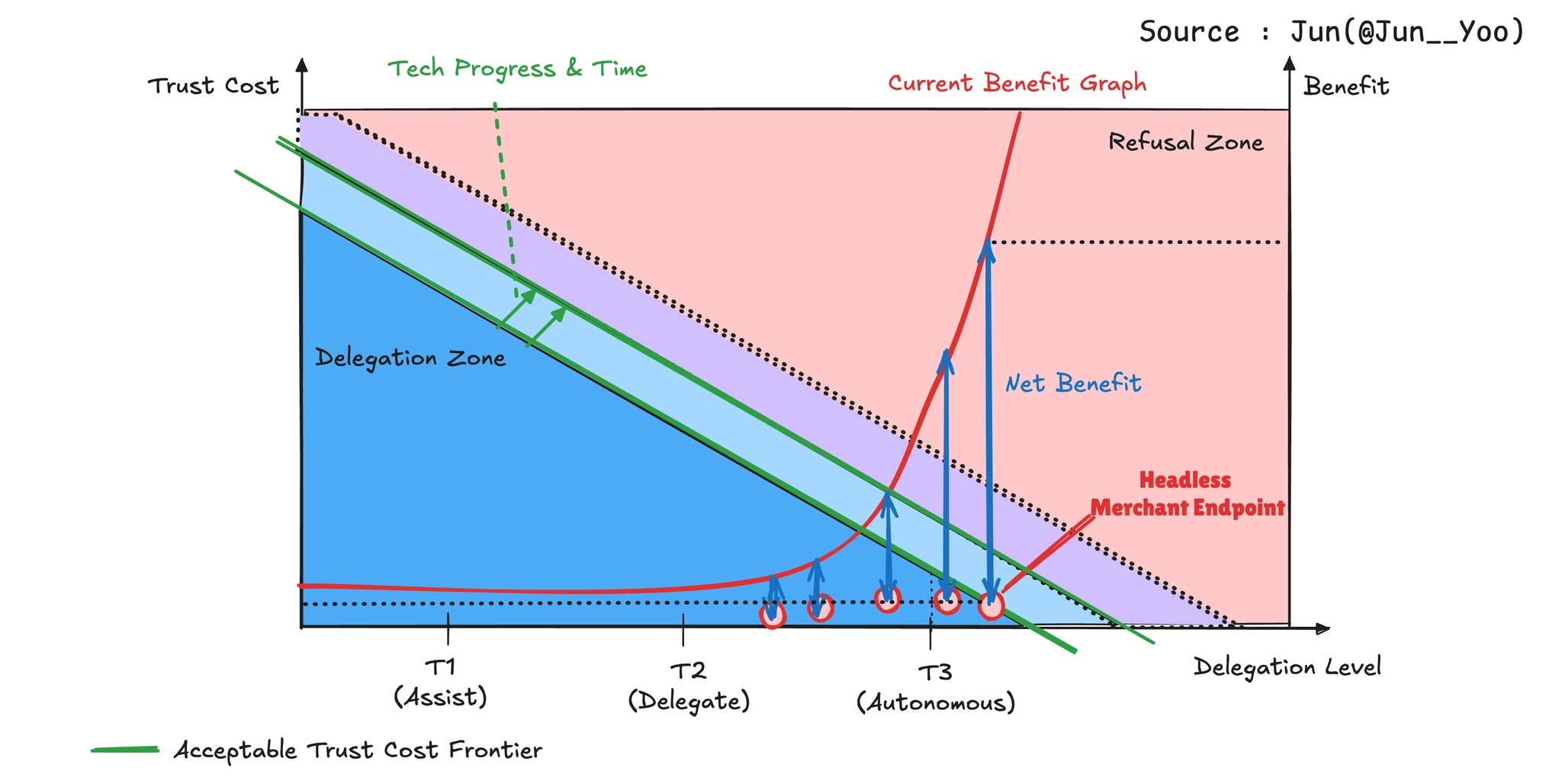
Increasing delegation does not produce a proportional increase in benefit. If a person must check every action taken by the agent, the burden of verification reduces much of the gain. More important, it is almost impossible to reclaim attention only in part. A process handled 90% by an agent and 10% by a person is not simply 10% different from one handled 100% by an agent. The presence of that final 10% changes the structure of attention itself. Delegating 90% of the work does not return 90% of a person's time.
This explains why benefits may rise nonlinearly near T3. The distinction between Level 2 and Level 3 autonomous driving rests on whether the driver must continue monitoring the road, rather than on vehicle performance. The cost of supervision falls to zero only when that duty disappears completely. One person can then manage N agents at the same time, and the realized benefit can rise nonlinearly.
From the chart's perspective, net benefit is the gap between benefit and trust cost at a given level of delegation. As the gap widens, users become more willing to adopt the service. Two conditions must be met for adoption:
- Entry into the Delegation Zone: Is delegation acceptable in the first place?
- Sufficient net benefit: Even if delegation is acceptable, is there a reason to do it?
The market to watch is one where delegation reaches T3 and the benefit still exceeds trust cost by a wide margin. This is where a clear product-market fit can form. The headless merchant endpoint described earlier fits these conditions.
Why focus on headless merchant endpoints?
Why does this market matter? In high-frequency machine-to-machine orders with low values per transaction, the loss from a failed transaction is limited, while the benefit of automation is immediate.
The agent coordinates the purchasing process according to preset policies and user preferences. The user sets the total budget and the conditions for the final output. The agent then buys the external resources it needs within those limits. If the spending cap per transaction is low and the final output is easy to verify, the user's risk remains limited. Headless merchant endpoints are therefore well suited to the early T3 market. They save substantial time and cost through automation, while the loss from any single failed transaction remains small. Users can readily see that the benefit exceeds the trust cost. Consider how readily we disable permission checks or enable Accept edits mode.
Headless merchant endpoints also meet the requirements for standardized product information and discoverability because the underlying products are digital services. Suppose an end user wants an output worth about $10 and the agent must combine several data and computing resources to produce it. Completing one output may require data retrieval, model inference, computing resources, calls to specialist agents, and result verification. If a person had to find each provider, compare prices, and approve each payment, the cost of search and approval would exceed the value of the task itself.
Orchestrator → Purchase data API → Purchase model inference → Purchase compute → Call specialist agent → Verify result
Under this structure, one user request is divided into many external calls. These calls run sequentially or in parallel, and each step may require a payment to a different provider. Even if the number of user requests remains constant, the number of potential payment events rises sharply as each task requires more external calls. In a multilayer structure where one agent calls other agents, additional depth and branching can cause payment events to grow nonlinearly.
Trust mechanisms also mature as payment data and transactions accumulate in this market. As safeguards such as proof of delegation, spending limit enforcement, result verification, and dispute recovery are tested repeatedly in a low-trust-cost market, the maximum acceptable transaction value can rise at the same level of delegation. This can produce the following sequence:
- Expansion of the Delegation Zone (A): The boundary of acceptable trust cost shifts upward and to the right, which expands the range of tasks users are willing to delegate.
- Upward shift in the benefit curve (B): As services and the ecosystem mature, the benefit available to users increases.
- Entry into the adoption zone (C): As both axes change, services that previously fell short enter the range in which users will adopt them.
This creates a self-reinforcing cycle in which the T1, T2, and T3 markets grow together.
Headless merchant endpoints are therefore likely to become the sandbox in which the full commerce process is first tested with low-trust-cost digital resources. Their transaction values may be small, but their high payment frequency allows trust architecture and payment infrastructure to be tested and improved quickly.
Which layers should we watch?
If the headless merchant endpoint market develops as described, which layers should we watch? I would focus on five: stablecoin issuers, blockchains, facilitators, wallets, and discovery. These layers do not always exist as separate entities. One company or protocol may cover several of them. Coinbase's facilitator, for example, can also operate in the discovery layer through Bazaar.
Each layer may have a central role in the headless merchant endpoint market and can generate revenue in the following ways:
- Stablecoin issuers earn reserve income from the portion of payment demand that remains as net new circulating balances.
- Blockchains charge network fees on payment events that settle onchain.
- Facilitators charge per managed payment event for verification and settlement.
- Wallets control budget execution and the flow of assets before and after payment, while offering related financial services.
- Discovery platforms monetize part of the payment volume routed through supplier search and order allocation.
(A detailed analysis of each layer's revenue model will appear in the forthcoming x402 report.)
The headless merchant endpoint market has the potential to grow nonlinearly. It may feel like the most distant market, but it may become the nearest one and the easiest for people to understand and use. It is worth watching.
The author of this report may have personal holdings or financial interests in assets or tokens discussed herein. However, the author affirms that no transactions have conducted using material non-public information obtained in the course of research or drafting. This report is intended solely for general information purposes and does not constitute legal, business, investment, or tax advice. It should not be used as a basis for making any investment decisions or as guidance for accounting, legal, or tax matters. Any references to specific assets or securities are made for informational purposes only and should not be construed as an offer, solicitation, or recommendation to invest. The opinions expressed herein are those of the author and may not reflect the views of any affiliated institutions, organizations, or individuals. The opinions and analyses expressed herein are subject to change without prior notice. In addition, beyond the individual disclosures included in each report, Four Pillars, may hold existing or prospective investments in some of the assets or protocols discussed herein. Furthermore, FP Validated, a division of Four Pillars, may already be operating as a node in certain networks or protocols discussed herein or may do so in the future. Please see below links in the footer for FP Validated's participating network disclosures and for broader disclosure details.


