

![Bitcoin Stalls, Tether Evolves [FP Weekly 34]](/_next/image?url=https%3A%2F%2Fkrotgrfjzckvumudxopj.supabase.co%2Fstorage%2Fv1%2Fobject%2Fpublic%2Fassets%2Fimg%2Fcontent%2Farticle%2Fnotion-import%2F9vm8kmsyf35ai.png&w=3840&q=75)
Table of Contents
- 1. Major News
- [Crypto] BIP-110 Forks From Bitcoin, but Fails to Gain Adoption
- [Institution] Tether Completes Its First Full Financial Audit With KPMG
- Others
- 2. Data Spotlight
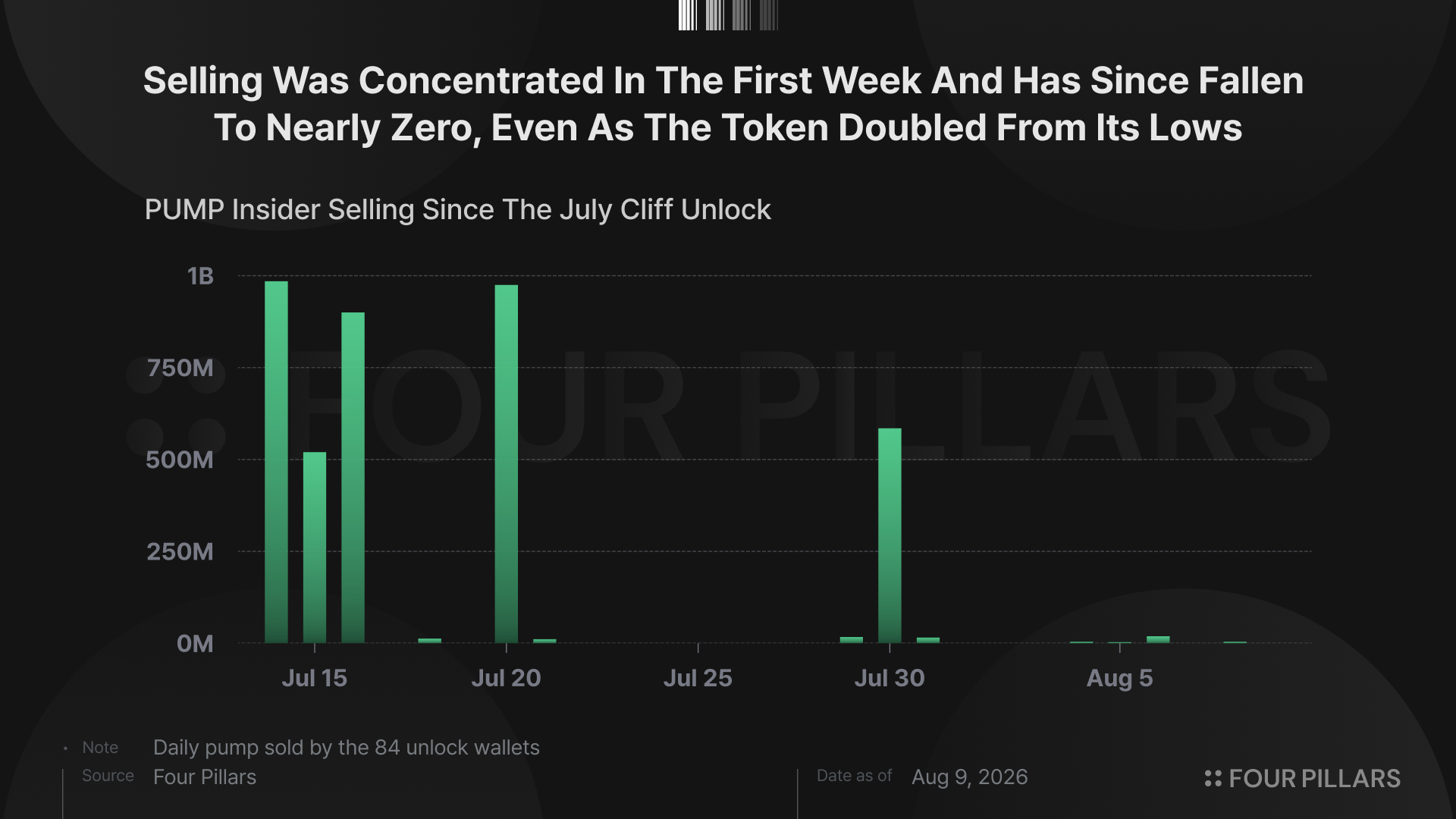
- PUMP Insiders Kept 92% of the July Unlock (Link)
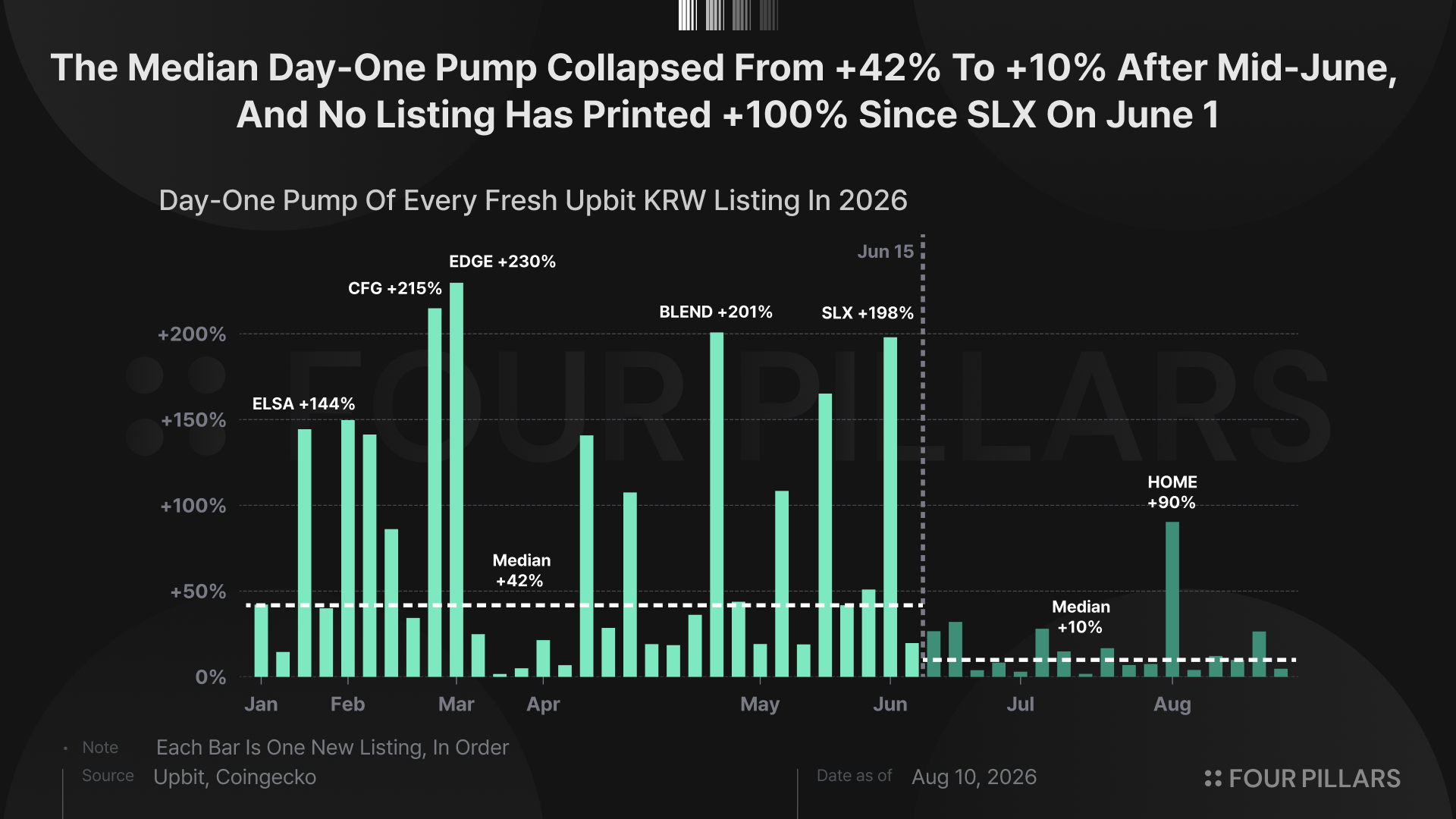
- The Dying Upbit Listing Pump (Link)
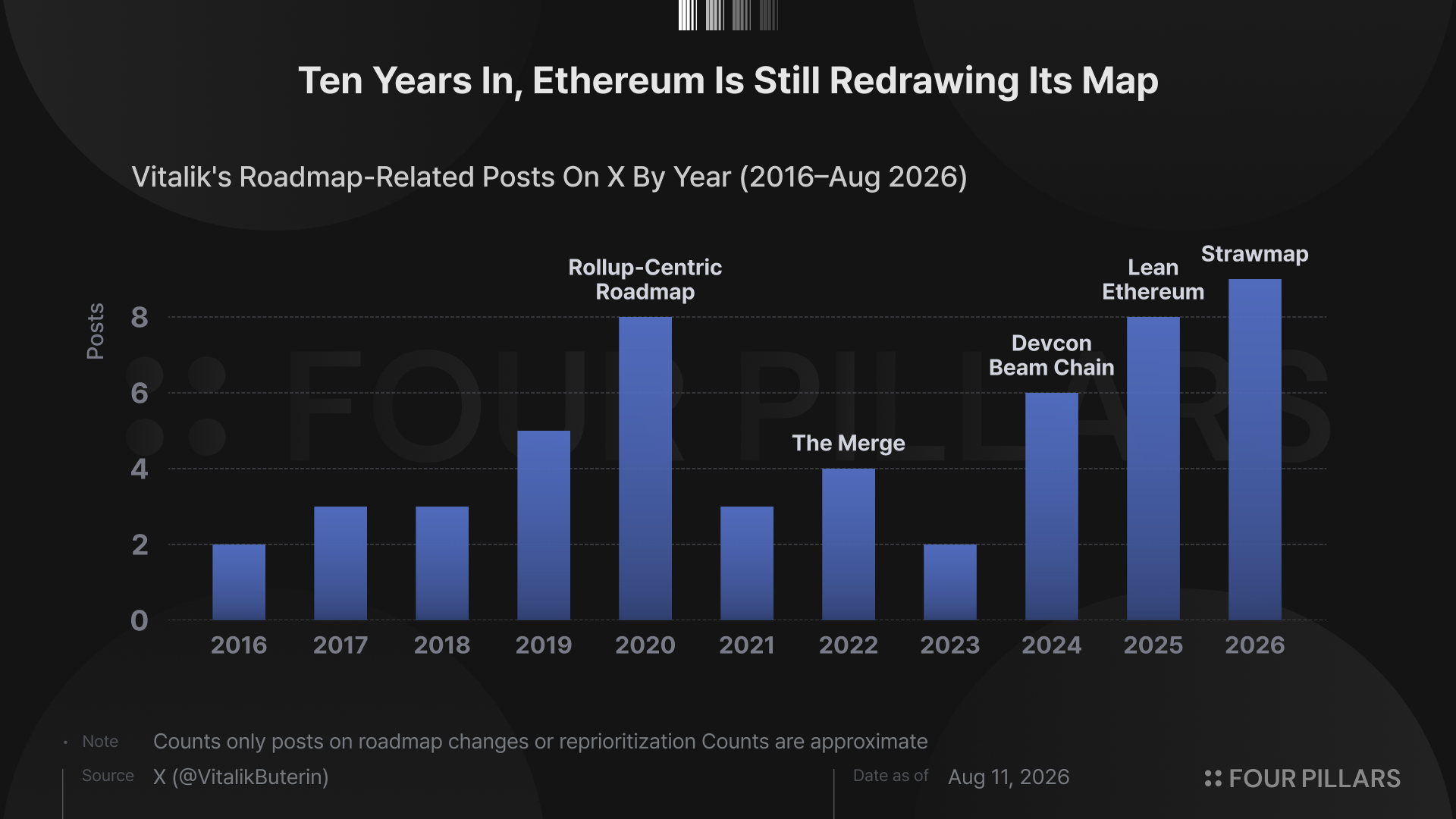
- Is Money That Keeps Changing Its Roadmap Still Money? (Link)
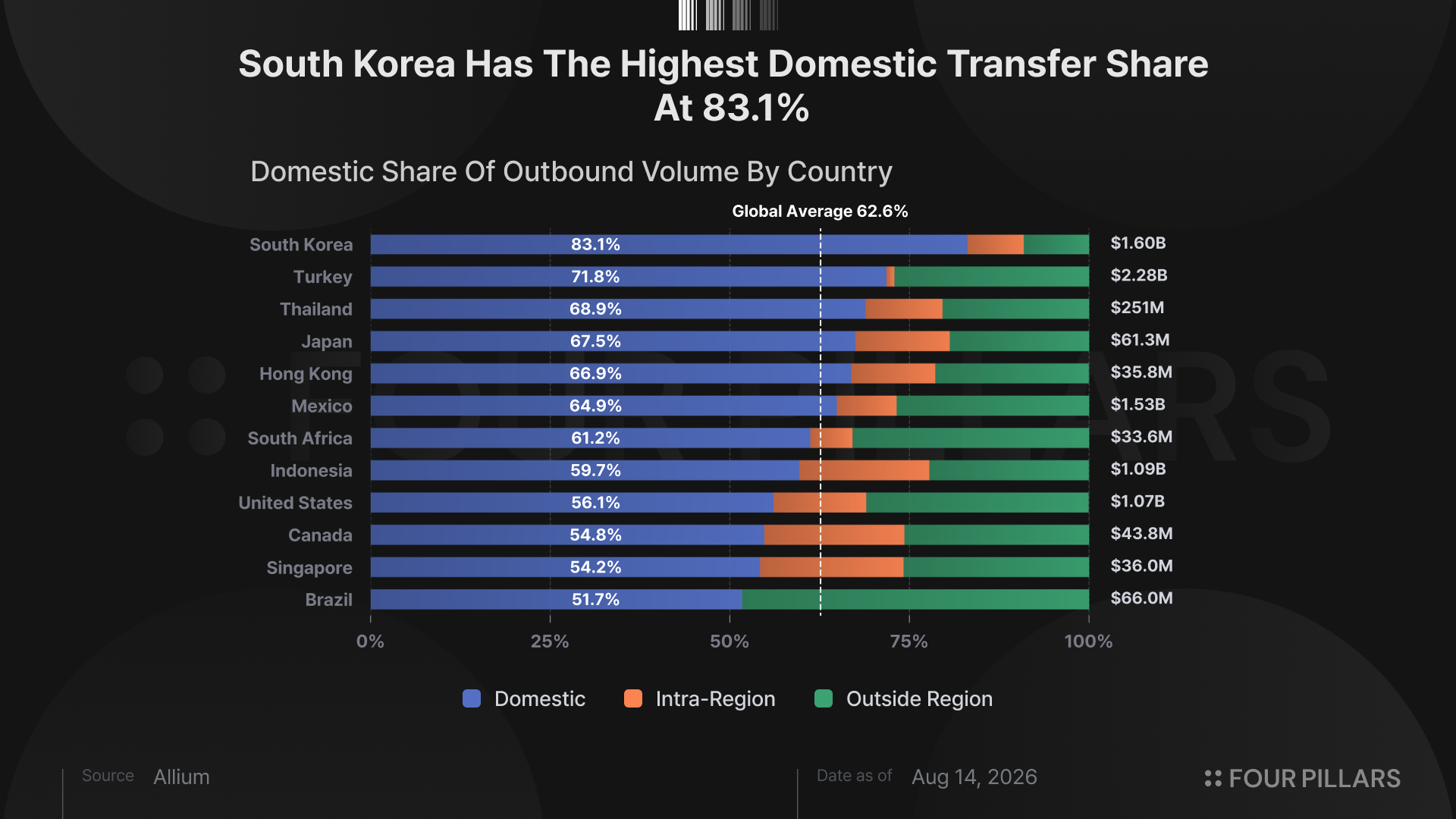
- Stablecoin Payment is Actually Not Moving Cross Border (Link)
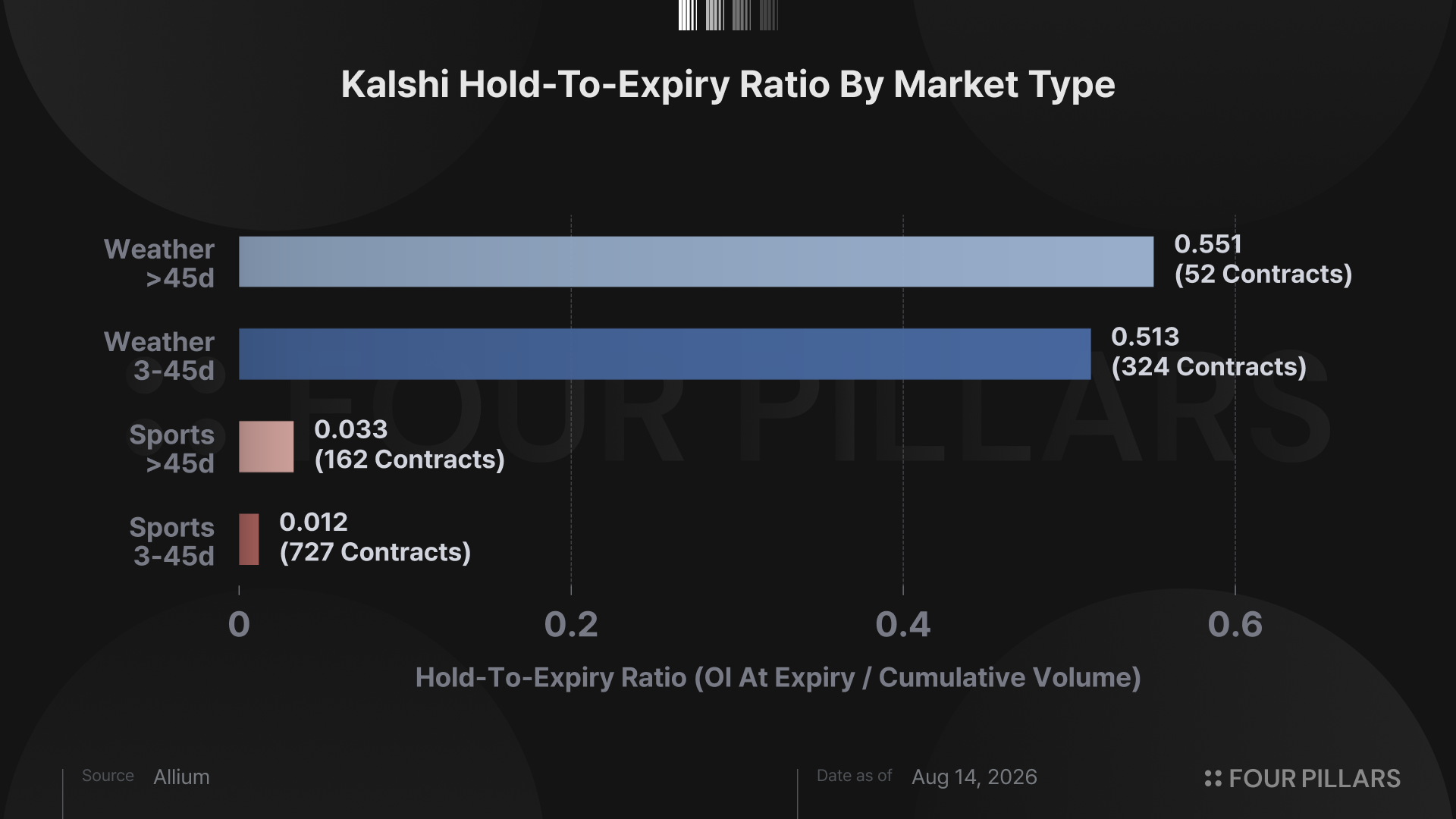
- Do Prediction Markets Work as Hedges? (Link)
- 3. Four Pillars Weekly
- : : Tokenized Stocks: The Next Battleground (Link)
- : : Tokenized Money for Banks (Link)
- : : Korea Needs Tokenized Deposit, and Strategies Beyond (Link)
- : : Monad: The Last General-Purpose L1 (Link)
- Comments
- 4. Macro & Onchain Metrics
Researcher

1. Major News
[Crypto] BIP-110 Forks From Bitcoin, but Fails to Gain Adoption
What Happened?
BIP-110, officially titled the Reduced Data Temporary Softfork, was designed to temporarily restrict arbitrary data storage on Bitcoin at the consensus level. The proposal sought to limit several transaction patterns used for inscriptions and other forms of data embedding, including restricting OP_RETURN outputs to 83 bytes, limiting certain data pushes and witness items to 256 bytes, and introducing additional restrictions around Taproot scripts. The stated goal was to discourage Bitcoin from becoming a generalized data-storage layer and refocus block space on monetary use cases.
The proposal was intentionally temporary, with the new rules designed to remain active for roughly one year if successfully deployed. Unlike a normal policy-level filter, however, BIP-110 attempted to enforce these restrictions through consensus. This meant that nodes enforcing BIP-110 would reject blocks that remained valid under the existing Bitcoin consensus rules if those blocks failed to comply with the new restrictions.
The key moment came in early August. BIP-110 included a mandatory signaling period beginning at block 961,632, during which enforcing nodes would reject blocks that did not signal support using version bit 4. Miner support heading into the period was only around 2.5%, far below the proposal’s earlier 55% activation threshold. Once mandatory signaling began, BIP-110 nodes therefore stopped following the chain supported by the overwhelming majority of Bitcoin’s hash rate and instead followed a minority branch containing signaling blocks.
The outcome was immediate. The BIP-110 branch produced only two blocks while the Bitcoin main chain advanced by more than one hundred blocks. With such a small share of hash rate but the same inherited mining difficulty, block production on the minority chain effectively stalled. One of the miners responsible for the BIP-110 chain tip subsequently stopped mining the branch.
This triggered a debate over whether BIP-110 had technically “activated.” Supporters argued that nodes running the BIP-110 rules had activated exactly as specified and continued to recognize the minority chain as valid. Others argued that the relevant issue was not whether a subset of nodes could enforce the rules, but whether the proposal had achieved meaningful network adoption. The BIP repository has since marked BIP-110 as Closed.
Researcher’s Comment
BIP-110 is less important for the specific restrictions it proposed than for what its failure reveals about Bitcoin governance.
At a technical level, BIP-110 worked largely as designed: nodes enforcing the new rules rejected non-signaling blocks and followed a more restrictive chain. The problem was adoption. A soft fork can be logically valid while still being economically irrelevant if miners, exchanges, wallets, and users continue to coordinate around another chain. BIP-110 demonstrated this distinction in unusually explicit form.
The episode also highlights the limits of node count as a standalone measure of consensus. Running software that enforces a rule is sufficient to determine which blocks an individual node accepts, but it does not ensure that meaningful proof-of-work, liquidity, or economic activity will follow that rule set. In BIP-110’s case, the minority chain inherited Bitcoin’s difficulty without inheriting Bitcoin’s hash rate, making continued block production impractical.
More broadly, the controversy reflects a deeper disagreement over what Bitcoin block space is for. Supporters of BIP-110 view arbitrary data as an externality imposed on node operators and monetary users, while opponents argue that consensus rules should remain neutral toward any transaction that satisfies Bitcoin’s existing validity conditions.
The practical takeaway is that restricting a controversial use case through consensus is substantially harder than restricting it through relay or mempool policy. Once a proposal begins invalidating blocks that the broader network still considers valid, the debate is no longer simply about spam or data storage; it becomes a coordination problem over which set of consensus rules defines Bitcoin itself.
BIP-110 appears to have lost that coordination battle. But the underlying question it raised — whether Bitcoin should remain maximally neutral toward block-space usage or actively protect a narrower monetary use case — remains unresolved.
[Institution] Tether Completes Its First Full Financial Audit With KPMG
What Happened?
Tether has completed its first full financial statement audit by a Big Four accounting firm since the company was founded. On August 13, Tether announced that KPMG U.S. had completed an independent audit of Tether International, S.A. de C.V.’s financial statements for the year ended December 31, 2025 and issued an unqualified opinion. In practical terms, KPMG concluded that the financial statements fairly present, in all material respects, the company’s financial position, results of operations and cash flows in accordance with U.S. GAAP.
The key distinction is the scope of the review. Tether has published independent reserve attestations since 2021, with BDO Italia recently providing assurance over the company’s reserve reports. Those reports primarily assess whether Tether’s stated assets and liabilities are appropriately presented at a given point in time. The KPMG engagement went further, covering Tether’s full financial statements and testing transactions, systems, ownership records, valuations, counterparties and the underlying evidence supporting its balance sheet, income statement, changes in equity and cash flows.
According to Tether, KPMG also physically counted and inspected every individual gold bar held by the company rather than relying solely on reports from custodians or counterparties. Tether’s audited 2025 financial statements showed reserves exceeding the associated liabilities by $6.814 billion, a result the company said was consistent with figures previously disclosed through its reserve attestations.
The audit addresses an issue that has followed Tether for years. The company had repeatedly said it intended to obtain a full audit of the assets and financial structure supporting USDT, but until now had relied on attestations rather than a complete audit of its financial statements. In 2025, Tether appointed Simon McWilliams as CFO with audit readiness as a key priority, and in March 2026 announced a formal engagement with a Big Four firm. KPMG was subsequently identified as the auditor.
The timing is also notable. Tether has been positioning itself for broader U.S. expansion and has explored a significant external fundraising round, both of which increase the importance of institutional-grade financial reporting. A full audit therefore serves not only as a response to longstanding questions around USDT’s reserves, but also as part of Tether’s broader effort to establish credibility with regulators and institutional investors. However, Reuters reported that the underlying audit results have not been made public, meaning outside investors are currently relying primarily on Tether’s disclosure of KPMG’s opinion and the headline figures.
Researcher’s Comment
The significance of the KPMG audit is not simply that Tether received another confirmation that its reserves exceed its liabilities. The more important development is that Tether has, for the first time, moved beyond reserve attestations and subjected its full financial statements to an independent audit.
The distinction between an attestation and a financial statement audit is particularly important for a stablecoin issuer. A reserve attestation can provide useful assurance that reported assets are sufficient to cover issued tokens at a particular point in time, but it does not necessarily provide the same level of scrutiny over internal systems, transaction flows, ownership, valuation methodologies, income, cash flows and the broader financial position of the company. A full financial statement audit is therefore a materially higher standard of financial examination.
This matters more as Tether grows. USDT is no longer simply a crypto-native trading instrument; it has become a large source of dollar liquidity and an increasingly significant link between digital assets and traditional financial markets. Tether holds a substantial amount of its reserves in U.S. Treasuries, meaning the scale of the company increasingly warrants scrutiny not only of whether reserves exist, but also of their composition, valuation, counterparty exposure and the controls surrounding them.
That said, the audit should not be interpreted as resolving every transparency question around Tether. The audit covers Tether International, S.A. de C.V.’s financial statements for the year ended December 31, 2025, and the full audit report itself has not yet been made public. As a result, external observers cannot independently review the detailed disclosures, audit notes, scope limitations or other information that would normally accompany audited financial statements.
More importantly, solvency is only one dimension of stablecoin risk. Tether’s reserves include not only U.S. government securities and cash-equivalent assets but also positions in assets such as gold and bitcoin whose market values can fluctuate. The relevant question during a period of stress is therefore not simply whether assets exceed liabilities at a reporting date, but whether those assets can be liquidated quickly enough, at sufficiently stable values, to meet large-scale redemptions without materially eroding the company’s equity buffer.
Still, the KPMG audit represents a meaningful change in Tether’s transparency trajectory. For years, the central criticism was that Tether had not completed the full audit it repeatedly promised. That question has now shifted. The more relevant issue going forward is whether Tether can institutionalize this level of scrutiny and provide audited financial statements on a recurring basis.
In that sense, the audit does not end the debate around Tether. It raises the standard of that debate. The market will increasingly judge Tether not only on whether USDT is fully backed, but on whether the issuer of the world’s largest stablecoin can sustain the accounting, governance and disclosure standards expected of a systemically important financial institution.
Others
Crypto
- Zama brings its blockchain-privacy token to Revolut's 70 million users
- The Ethereum Foundation is abandoning Poseidon for L1, pivoting to SHA or BLAKE
- Ether.fi adds tokenized stocks, metals and Aave-powered portfolio loans in latest 'neobank' expansion
Institution
- OCC grants conditional approval for Trump-backed World Liberty National Trust bank
- Tether says KPMG issued 'clean' opinion in first full audit of USDT issuer's financials
Tech
- Harmony confirms exploit involving unauthorized minting of 4 billion ONE tokens
- Wallet provider SafePal says data breach exposed personal info of nearly 40,000 customers
Investment
- Bitmine adds 7,391 ether in a week, bringing total Ethereum holdings to 5.81 million ETH
- Michael Saylor's Strategy sells another 1,690 BTC as USD reserve hits $4.65 billion
Asia
- Standard Chartered-backed Anchorpoint begins HKDAP stablecoin rollout
- Mirae Asset to inject additional $35 million into Korbit crypto exchange following July acquisition: report
2. Data Spotlight
PUMP Insiders Kept 92% of the July Unlock (Link)
The Dying Upbit Listing Pump (Link)
Is Money That Keeps Changing Its Roadmap Still Money? (Link)
Stablecoin Payment is Actually Not Moving Cross Border (Link)
Do Prediction Markets Work as Hedges? (Link)
3. Four Pillars Weekly
: : Tokenized Stocks: The Next Battleground (Link)
- Unlike the tokenized U.S. Treasury market, which has recently seen its market size stagnate, the tokenized equity market has been growing rapidly in both qualitative and quantitative terms.
- Players across the board, including traditional equity infrastructure providers, fintech companies, cryptocurrency exchanges, and Web3-native platforms, are looking to tokenized equities as the next major opportunity in the RWA industry. In fact, there are various approaches to tokenizing equities, and understanding their respective strengths, weaknesses, and positioning is key.
- In this article, we analyze the strategies being pursued by industry players with diverse backgrounds, including Securitize, Ondo, xStocks, Robinhood, DTCC, NYSE, Nasdaq, and Coinbase.
: : Tokenized Money for Banks (Link)
- The GENIUS Act, MiCA, and Basel SCO60 give banks a clear regulatory basis for issuing tokenized money on public networks, while venues such as Hyperliquid already show institutional flow that clears around the clock and is margined in stablecoins. Both the regulatory conditions and the client demand are now in place.
- Among the three product families, tokenized deposits keep the claim as a deposit, preserving the deposit franchise, guarantee coverage, and existing capital treatment. The token moves only between counterparties the bank approves, and JPMD on Base is the live example.
- In contrast, a bank issuing its own stablecoin gains a settlement rail it controls around the clock but shifts its funding into the most punitive regulatory categories. A third party stablecoin reaches far wider markets, at the cost of prefunded coins that earn no liquidity recognition or client deposits that leave the books entirely.
- Ultimately, no single product family serves every institutional client need. The same hedge fund may post margin on a tokenized deposit network, hedge weekends with a third party stablecoin, and rebalance through a consortium issued asset, so banks will need all three in their strategy.
: : Korea Needs Tokenized Deposit, and Strategies Beyond (Link)
- Tokenized cash is already settling wholesale markets around the clock, while stablecoin migration could erode the deposit base, so banks must offer money that works on onchain rails.
- Tokenized deposits answer both pressures. The client gains onchain settlement while the claim stays a deposit, preserving insurance, interest, and the lending relationship.
- Korean banks can build this today through Project Hangang, and the JPMD precedent shows deposit tokens can reach public blockchains under whitelisted access ahead of the stablecoin law.
- The law sets the sequence. Build deposit token rails now, prepare won stablecoin issuance for when the Digital Asset Basic Act passes, and move before others capture the flow.
: : Monad: The Last General-Purpose L1 (Link)

- Monad is the last case in which record levels of capital and time were bet on the thesis of a "high-performance general-purpose chain that can hold everything." It is also the final large-scale experiment testing whether integrated production can beat specialization in an era when chains are dividing into purpose-built roles. Its conditions for success come down to three things: 1) proving the composability premium that only integration can create, 2) keeping successful apps from leaving, and 3) monetizing demand that works without incentives.
- Monad's ecosystem is the product of a four-stage funnel: community building designed as a status economy without a token, a founder pipeline represented by Monad Madness, testnet validation backed by 2.6 billion cumulative transactions and the full open-sourcing of its clients, and staged support after mainnet. That process, however, only cleared doubts about the technology. Whether the traffic represents real demand that will remain once costs apply is something only post-mainnet metrics can prove.
- Results in the trading sector split sharply. Kuru overtook Uniswap in volume with a 36.4% share even as chain-wide volume shrank, but its fees remain effectively zero. Perpl is small in scale but has been charging fees and growing from the start. LeverUp records the largest volume and fees with its house model, though its thin user base concentrated in a few wallets remains a caveat. The landscape shifted in July, however. The perps segment led a rebound in chain-wide trading volume, with 30-day perpetual futures volume ($1.6 billion, based on the Foundation's figures) overtaking spot volume ($1.3 billion) for the first time. Perpl recorded $1 billion in cumulative volume and more than $800 million for the month, rising to the top of the ecosystem by weekly trading volume.
- Lending currently contributes the most to Monad's TVL, but much of that capital is mercenary money that follows incentives. Liquid staking shows the widest gap between expectations and results: combined TVL sits at roughly $12 million against more than $46 million raised. Structural factors, namely native staking built into consensus and the absence of slashing, limit the added value liquid staking protocols can offer.
- Stablecoin supply passed an all-time high of $517 million, but the increase was driven by a single asset, AUSD, in tandem with Pendle incentives. Outcomes pointing toward payments, RWA, and institutions, such as MetaMask's Money Account choosing Monad as its sole settlement chain, Aave's official deployment, and joining the x402 Foundation, are only beginning to show up in the data. This trend gained full momentum in July. Aave's total deposits crossed $500 million within a month of deployment, lifting Monad's DeFi TVL to $770 million and placing it in the top 10 across all chains. Stablecoin supply expanded beyond $550 million, and the onboarding of new dollar assets such as Ethena, Maple, and Saturn Credit diversified the sources of inflows. The active market cap of RWAs surpassed $430 million, making Monad the third-largest RWA chain after Ethereum and Solana.
- The nearest variable over the next six months is the TGEs of ecosystem projects. Beyond valuation events for individual projects, the TGE cycle will be the first sector-by-sector measurement of how much demand stays on Monad without incentives.
Comments
4. Macro & Onchain Metrics
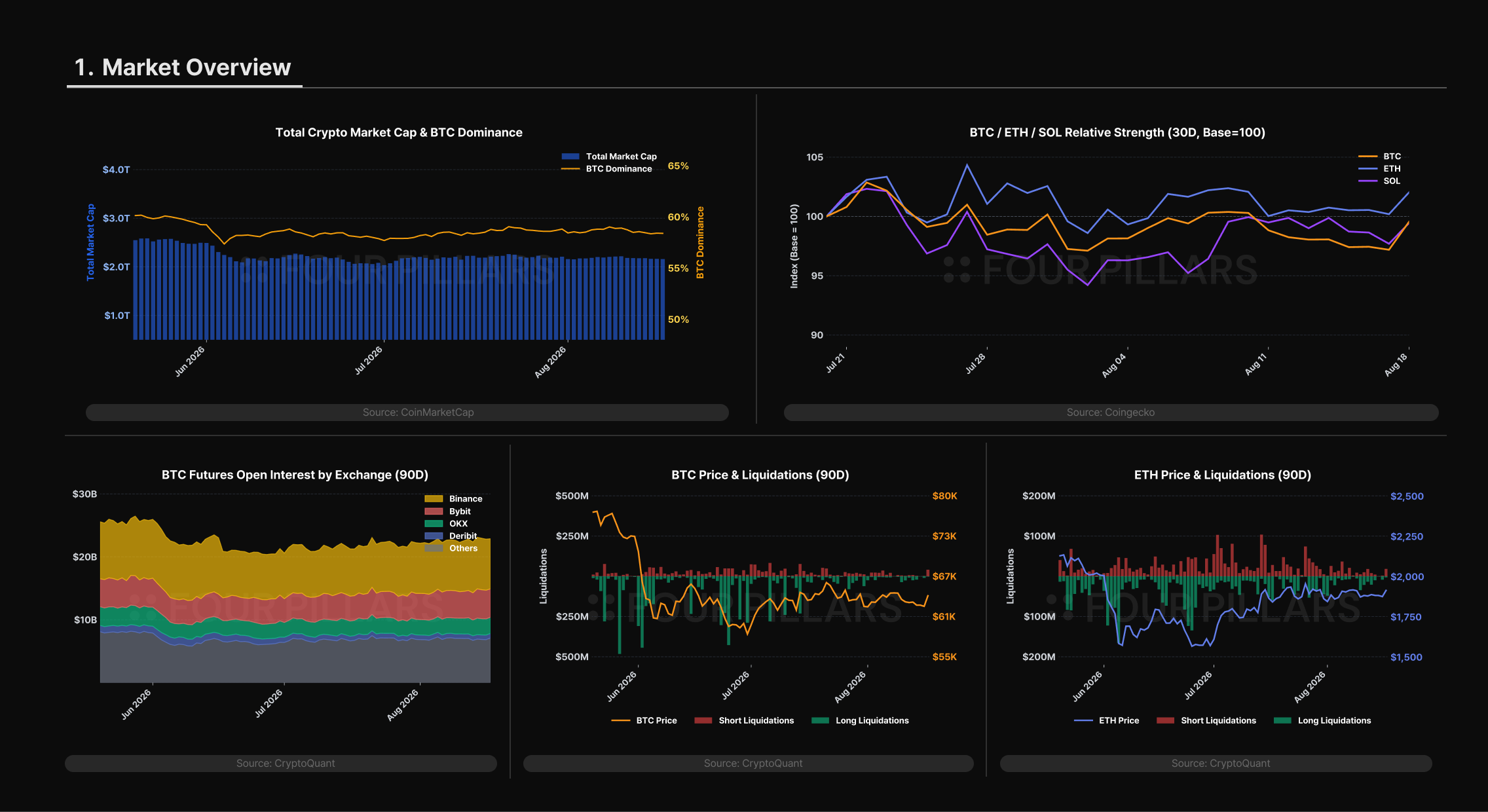
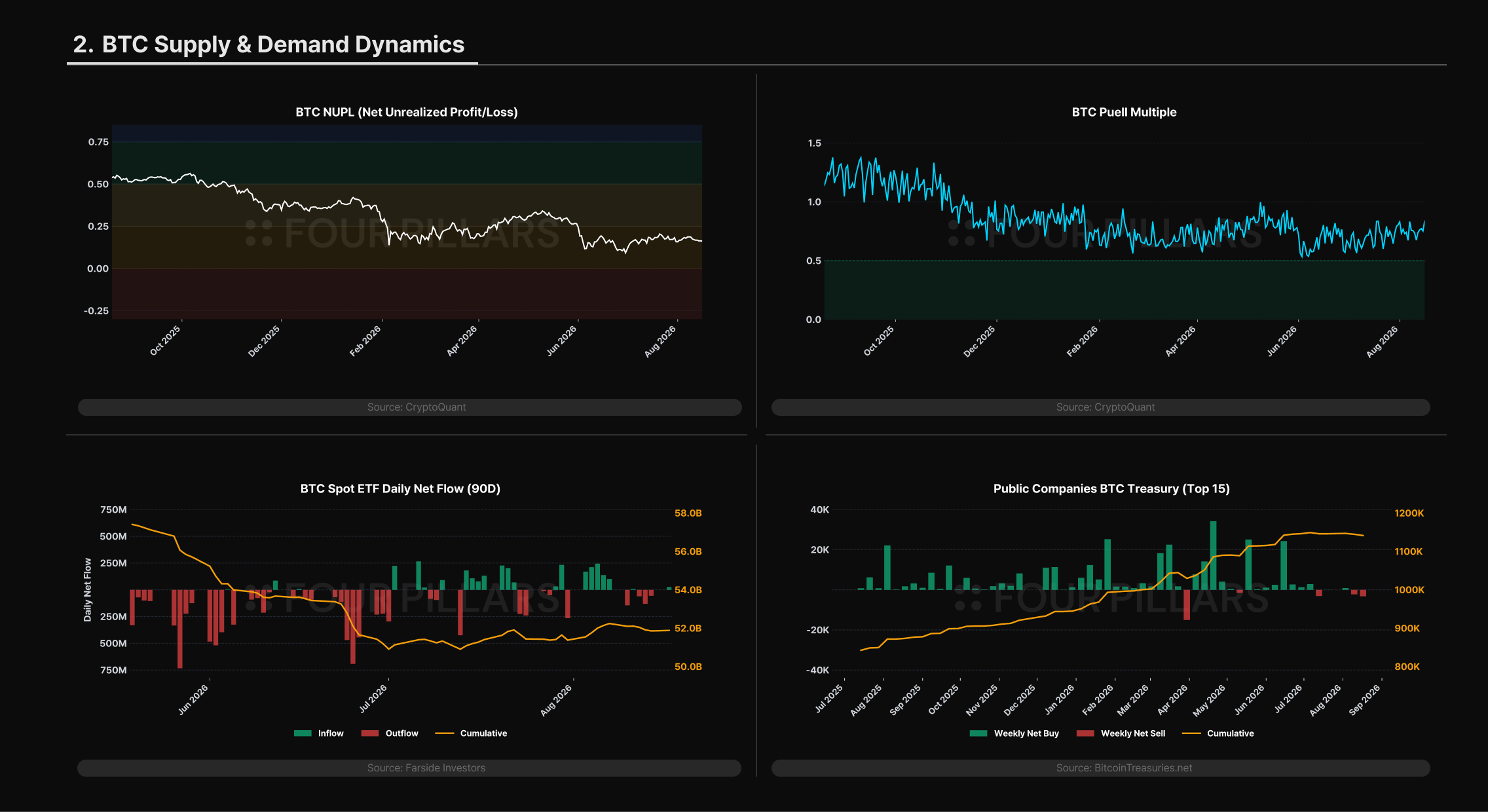
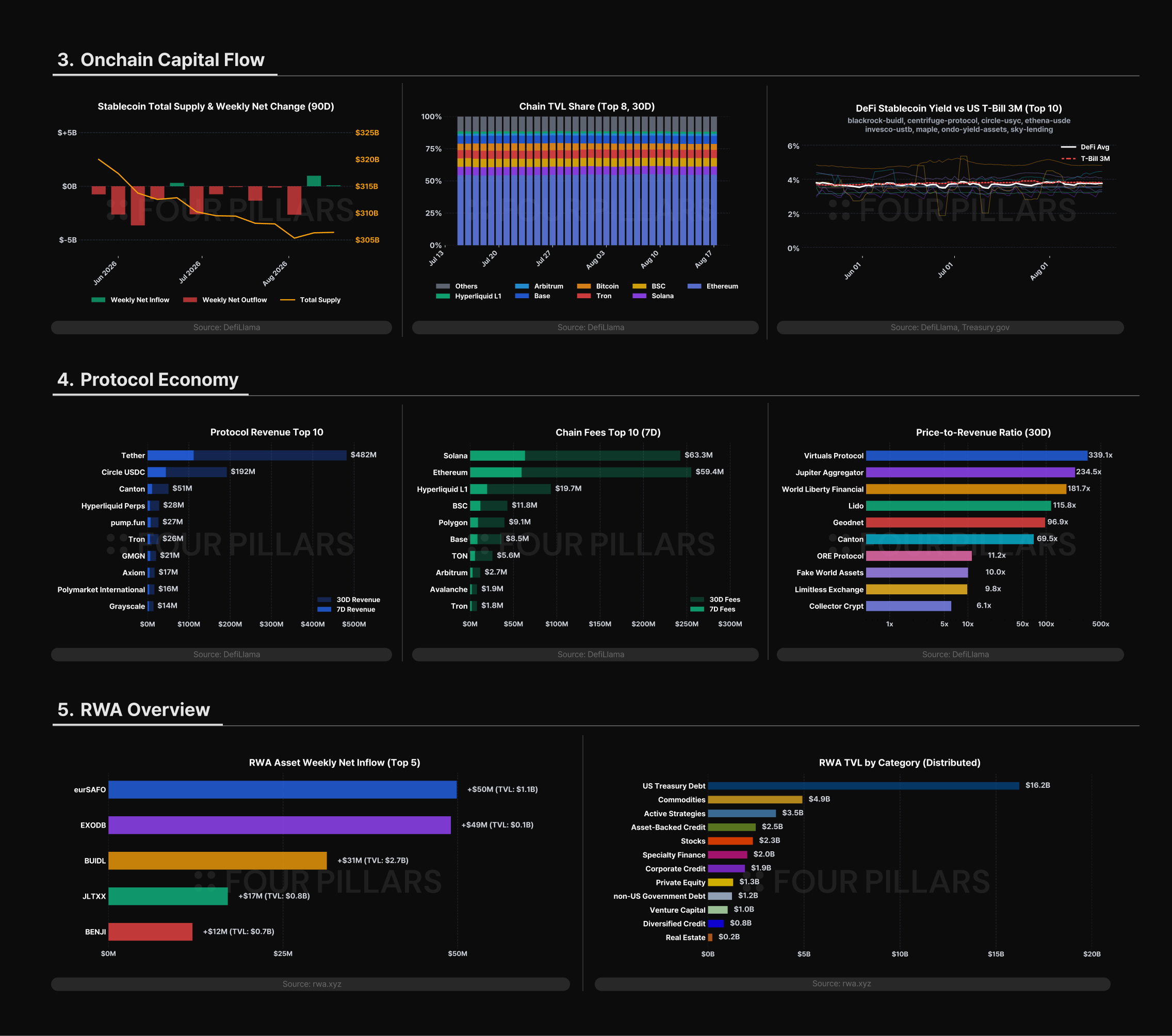
Some of the charts below are powered by CryptoQuant. For those interested in exploring the underlying data in greater detail, CryptoQuant provides access to a comprehensive suite of onchain and market analytics used by institutional participants.
The author of this report may have personal holdings or financial interests in assets or tokens discussed herein. However, the author affirms that no transactions have conducted using material non-public information obtained in the course of research or drafting. This report is intended solely for general information purposes and does not constitute legal, business, investment, or tax advice. It should not be used as a basis for making any investment decisions or as guidance for accounting, legal, or tax matters. Any references to specific assets or securities are made for informational purposes only and should not be construed as an offer, solicitation, or recommendation to invest. The opinions expressed herein are those of the author and may not reflect the views of any affiliated institutions, organizations, or individuals. The opinions and analyses expressed herein are subject to change without prior notice. In addition, beyond the individual disclosures included in each report, Four Pillars, may hold existing or prospective investments in some of the assets or protocols discussed herein. Furthermore, FP Validated, a division of Four Pillars, may already be operating as a node in certain networks or protocols discussed herein or may do so in the future. Please see below links in the footer for FP Validated's participating network disclosures and for broader disclosure details.
![CLARITY Act Fails, the SEC Steps In [FP Weekly 39]](/_next/image?url=https%3A%2F%2Fkrotgrfjzckvumudxopj.supabase.co%2Fstorage%2Fv1%2Fobject%2Fpublic%2Fassets%2Fimg%2Fcontent%2Farticle%2Fnotion-import%2Fmqlpp6muat2oq6.png&w=3840&q=75)

![CLARITY Act Faces the Senate, $LAPTOP Faces Reality [FP Weekly 38]](/_next/image?url=https%3A%2F%2Fkrotgrfjzckvumudxopj.supabase.co%2Fstorage%2Fv1%2Fobject%2Fpublic%2Fassets%2Fimg%2Fcontent%2Farticle%2Fnotion-import%2Fc3ygeemu0lqxb5.png&w=3840&q=75)

![Robinhood Takes Over Onchain
[FP Weekly 37]](/_next/image?url=https%3A%2F%2Fkrotgrfjzckvumudxopj.supabase.co%2Fstorage%2Fv1%2Fobject%2Fpublic%2Fassets%2Fimg%2Fissues%2Frobinhood-takes-over-onchain-fp-weekly-37.png%3Ft%3D1788765790150&w=3840&q=75)