


Table of Contents


1. A New Kind of Insurance, Underwritten by the Market
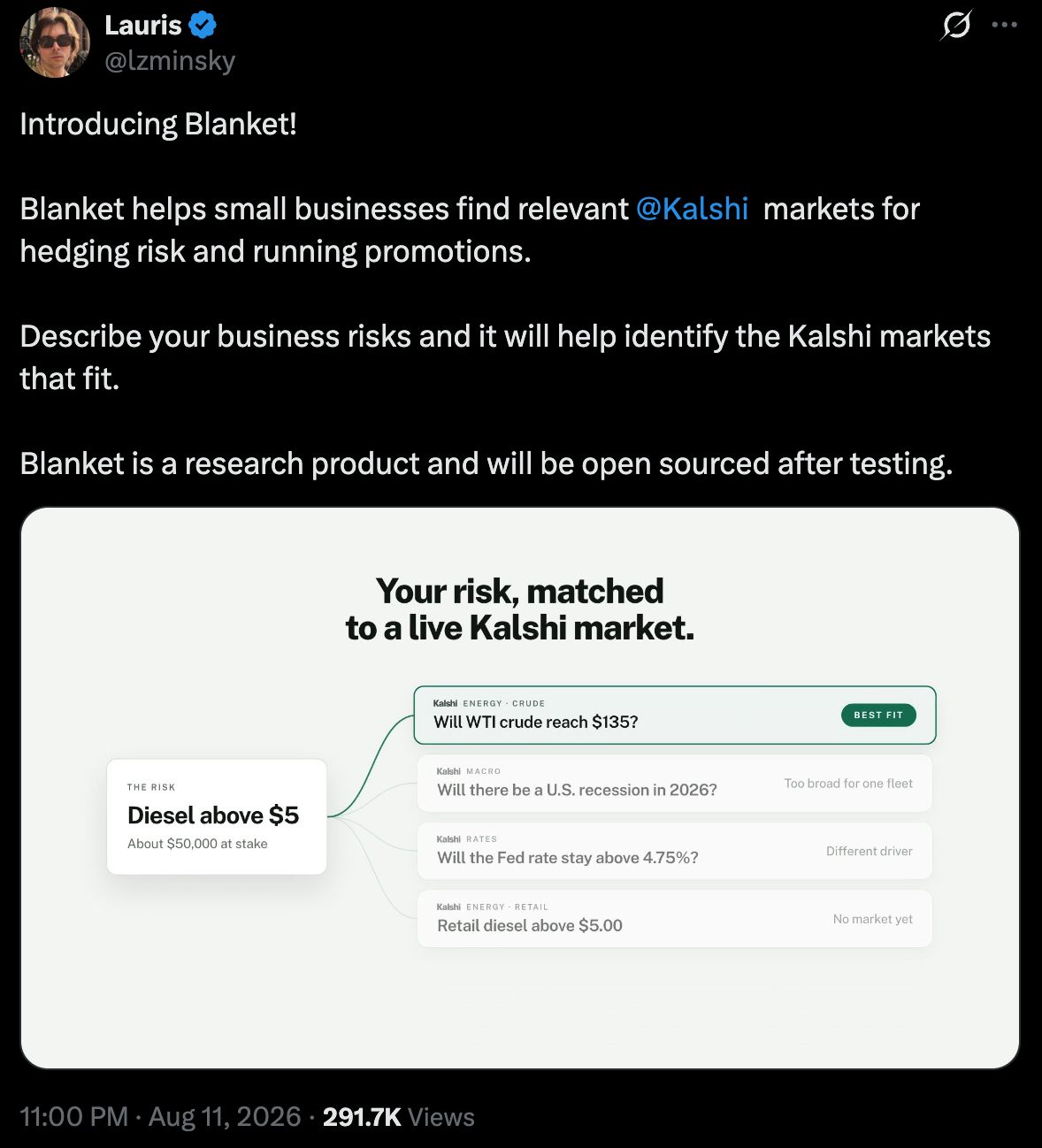
Source: X(@lzminsky)
Blanket, an AI risk management tool, launched recently. Blanket takes business information as input, diagnoses the risk exposure that business carries, and recommends Kalshi event contracts that can offset it.
The mechanics of hedging here are simple. Prediction markets pay $1 per contract if a given event occurs and $0 if it does not. The contract price reflects the probability the market assigns to that event.
This structure allows prediction markets to serve as a hedging instrument for real businesses. Buying contracts on events that affect business performance, such as weather, energy prices, or tariffs, means the payout received when the event actually occurs offsets part of the operating loss.
Consider an ice cream shop that loses $20,000 in revenue during a cool summer.
- The hedge: Buy 20,000 contracts at $0.30 each that pay $1 if the summer average temperature falls below a predetermined threshold. The total cost is $6,000.
- Cool summer: If the temperature falls below the threshold, revenue drops by $20,000, but the contracts pay out $20,000. The final loss is capped at $6,000, the cost of buying the contracts.
- Hot summer: If the temperature exceeds the threshold, there is no revenue loss, but the contracts expire at $0 and the $6,000 purchase cost is lost.
In either case, the final loss is fixed at $6,000. That $6,000 is effectively an insurance premium, and the party setting the rate was simply market quotes rather than an insurance underwriter.
2. Is the Hedging Market Actually Working?
Prediction markets have already secured sufficient speculative demand. After establishing themselves as an election forecasting tool, they expanded into sports and resolved the volume problem as well. What remains is expanding use cases, and hedging demand is cited as the leading candidate.
In theory the utility is high. The territory existing hedging instruments fail to reach is wide. Business interruption coverage in commercial insurance presumes physical damage. No suitable insurance product exists in the first place for the risk of a ski shop losing revenue because it did not snow.
Futures markets do have hedging products, but requirements such as ISDA agreements (International Swaps and Derivatives Association master agreements), futures accounts, margin, and minimum contract sizes make access difficult. Goldman Sachs has a derivatives desk. The corner cafe does not.
The problem is the gap between the rationale and actual use. Prediction markets have carried the gambling label throughout, and whether they function as a hedging market, separate from their utility as a speculative instrument, has never been verified.
Are prediction markets actually functioning as a hedging market? Does hedging demand actually exist? Trading behavior can answer this question. There are three comparison sets.
- CME grain futures: A traditional hedging market used to reduce losses from price volatility in agricultural and livestock products.
- Kalshi sports markets: A market where hedging demand is limited and speculative demand drives trading.
- Kalshi weather markets: These handle weather risk in the same way CME weather futures do, while sharing the same event contract structure and trading environment as Kalshi sports markets. This makes them the test case for determining which side their trading behavior resembles.
Hedging and speculation are likely to show different trading behavior. Hedgers tend to build positions before the risk window arrives and hold them to expiry. Speculators buy and sell frequently in response to price movements, which produces high turnover.
If Kalshi weather sits closer to traditional hedging markets than to sports on both turnover and holding behavior, hedging demand is real.
If it cannot be distinguished from sports, actual use is closer to speculation. In that case, tools like Blanket are responding to a narrative rather than to confirmed demand.
The dataset covers 1,265 Kalshi markets settled between August 2025 and August 2026. Only contracts meeting a threshold of at least 500 contracts in cumulative volume and at least three days of trading duration were included.
3. Data 1: Average Daily Turnover
Start with how frequently positions trade in each market. Turnover is daily volume divided by same-day open interest (OI). Daily turnover was calculated for each contract in each market, and the median across the full trading period was taken.
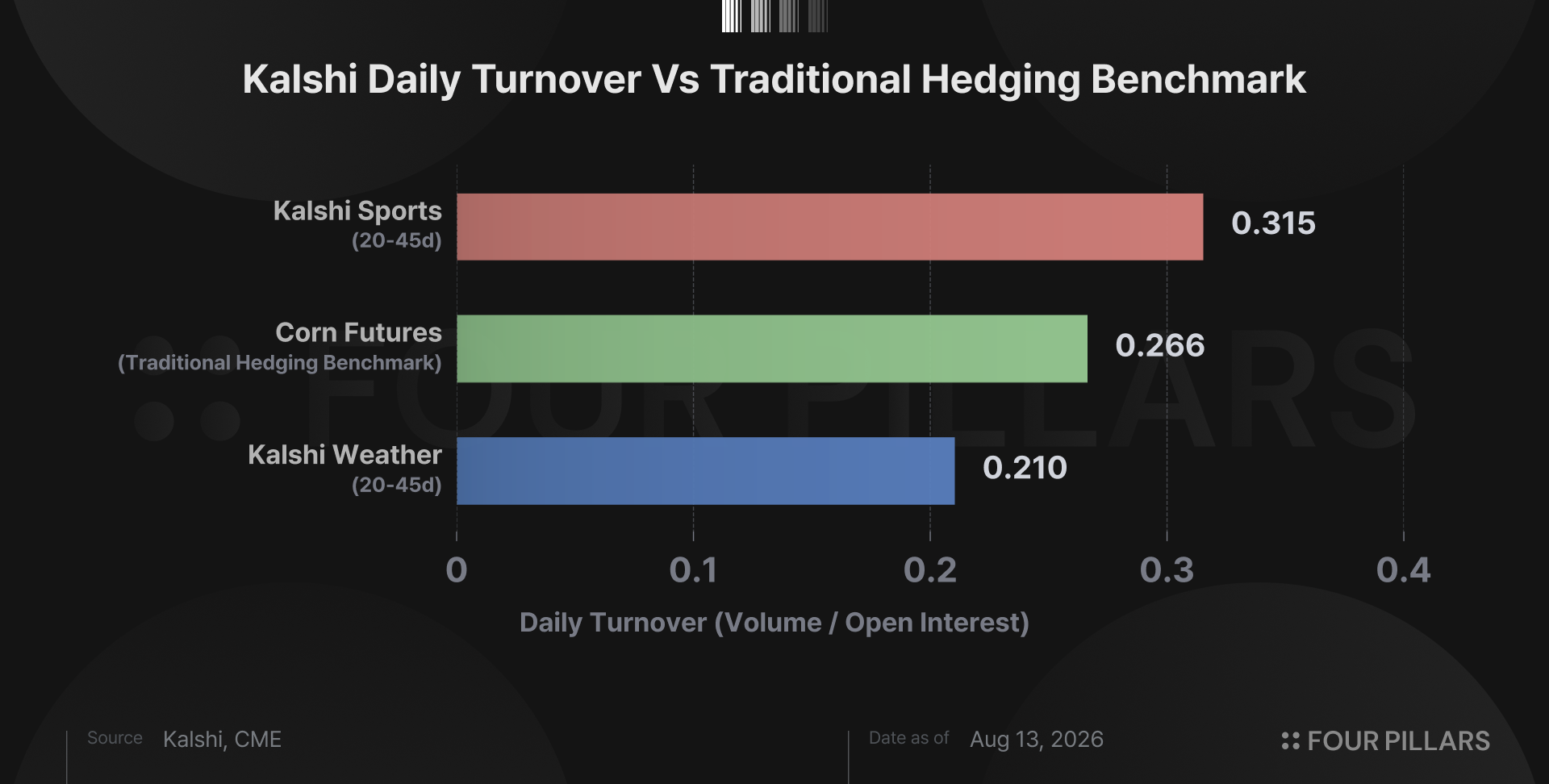
Kalshi weather contracts posted the lowest turnover at 0.210. Corn futures, a traditional hedging product, recorded 0.266, and Kalshi sports contracts recorded 0.315.
Sports contracts turned over 1.5 times faster than weather. This indicates a tendency to hold positions relatively longer in weather contracts, and suggests that actual hedging demand may exist.
However, corn futures turnover sits between the two markets, and the differences are not large. Turnover alone therefore cannot confirm hedging demand in the weather market. What this metric establishes stops at the fact that weather contracts turn over less than sports contracts.
4. Data 2: Hold-to-Expiry Ratio
The second metric is the hold-to-expiry ratio, which shows how much OI remained in the market up to settlement. It was calculated by dividing each contract's final OI by cumulative volume. A higher value means more positions remained to expiry.
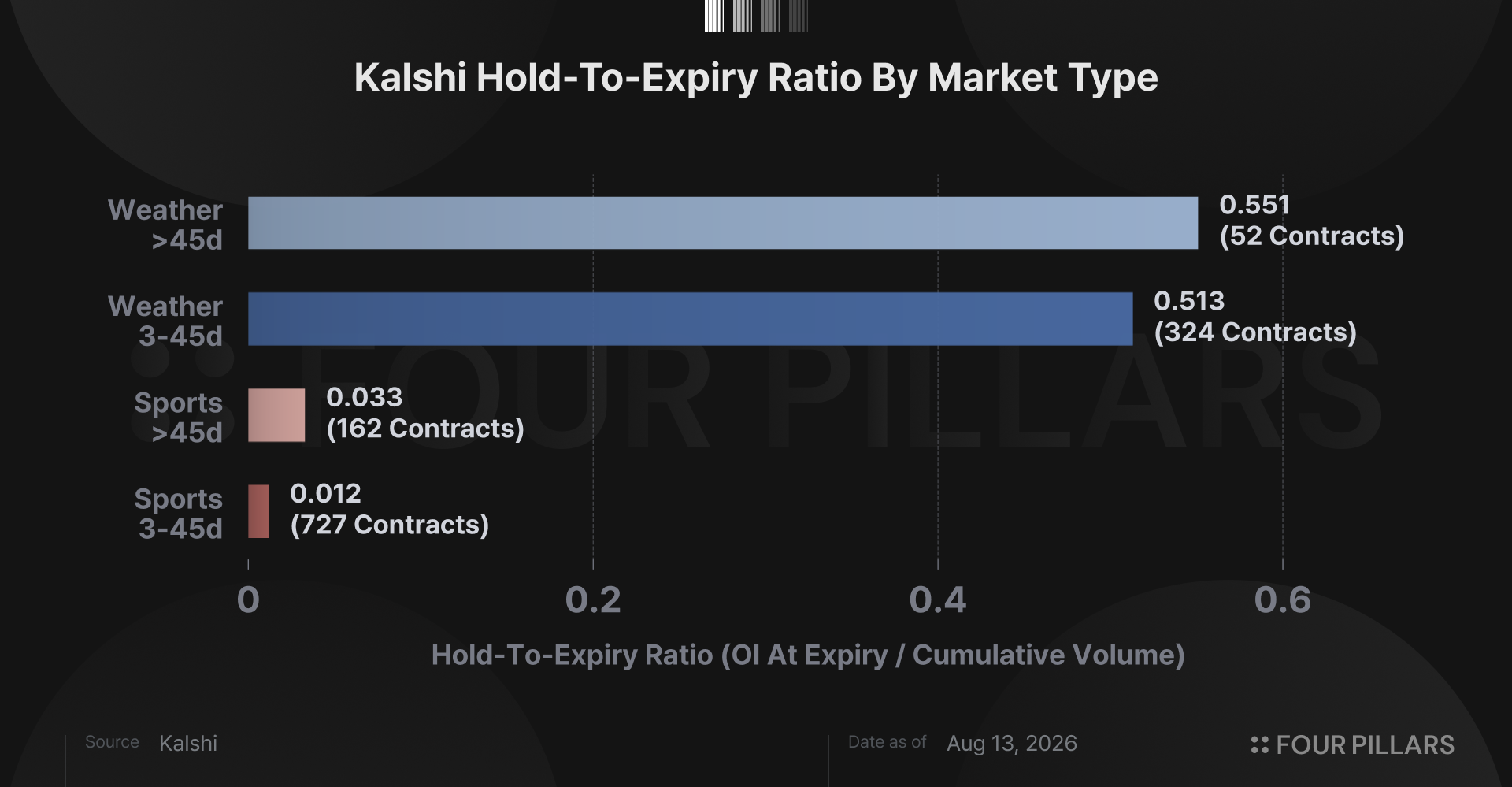
The hold-to-expiry ratio for weather contracts exceeded 0.5 regardless of trading duration. Sports contracts, in contrast, came in at 0.012 and 0.033. The gap between weather and sports reaches 42.8 times in the 3 to 45 day bucket and 16.7 times in the bucket above 45 days.
This shows a clearer tendency to hold to expiry in weather contracts than in sports. Hedgers hold contracts for the payout when risk materializes rather than for short-term price movements. A high hold-to-expiry ratio therefore supports the possibility that actual hedging demand exists in the weather market.
This cannot be taken as proof that the entire weather market is used for hedging. The figure does not track individual positions, so it cannot be read as the share of original buyers who held to expiry. What this metric establishes stops at the fact that weather contracts display holding behavior clearly distinct from sports.
5. Data 3: When Open Interest Builds
The last question is when positions are built. Each contract's daily OI was divided by that contract's peak OI, and the elapsed time from listing to expiry was converted to a 0% to 100% scale. The medians were then plotted as curves.
The criterion is the point at which half of peak OI is reached. Reaching the halfway mark with more time left to expiry means positions were built earlier.
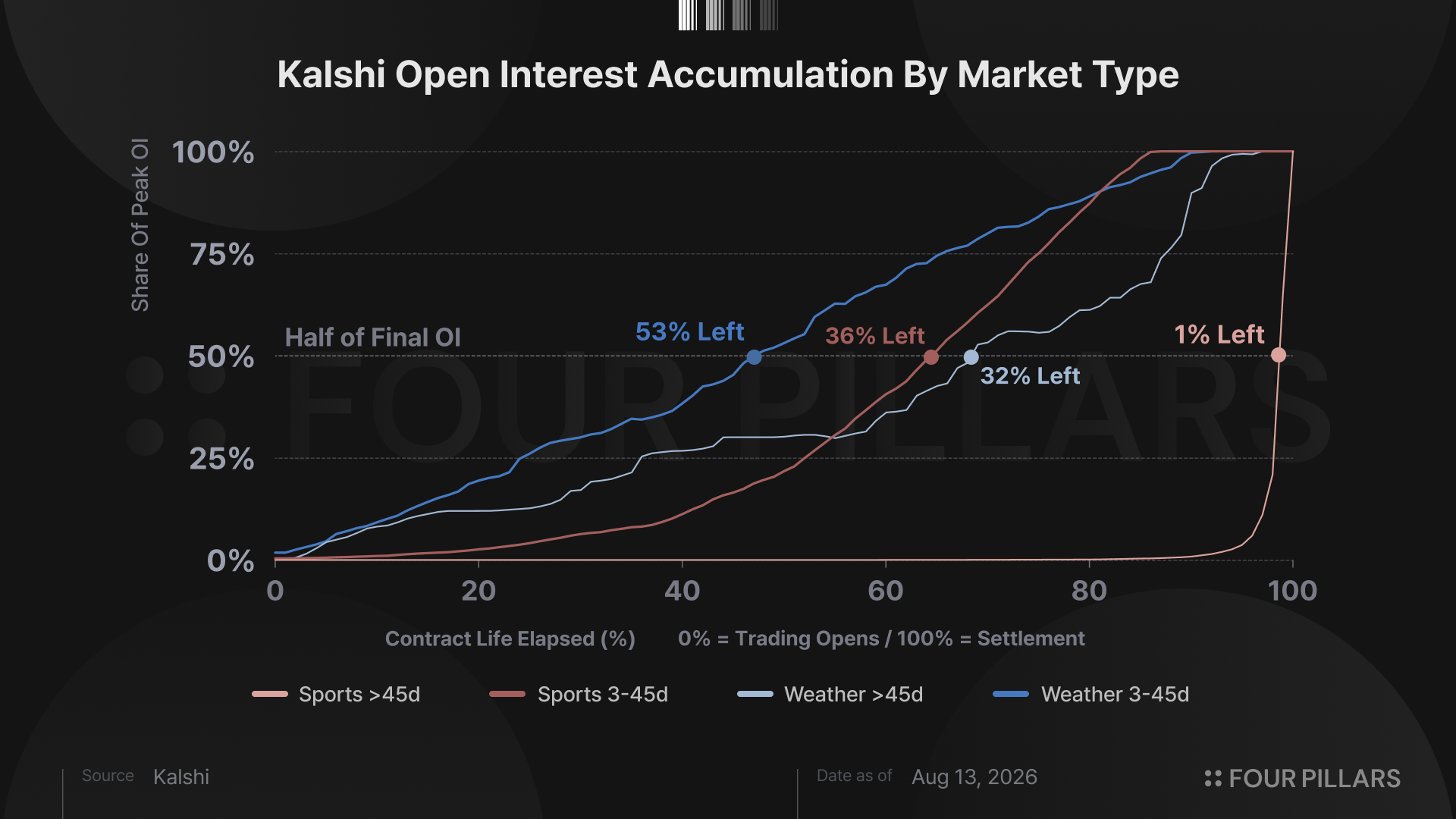
Weather contracts with a 3 to 45 day trading duration reached half of peak open interest at 47% of elapsed life. That leaves 53% of the period remaining to expiry. Sports contracts in the same bucket reached the halfway mark at 65% of elapsed life, with 36% remaining to expiry.
The difference was larger for contracts above 45 days. Weather contracts reached the halfway mark with 32% remaining to expiry, while sports contracts only got there with 1.3% remaining. In both duration buckets, weather positions were built earlier than sports.
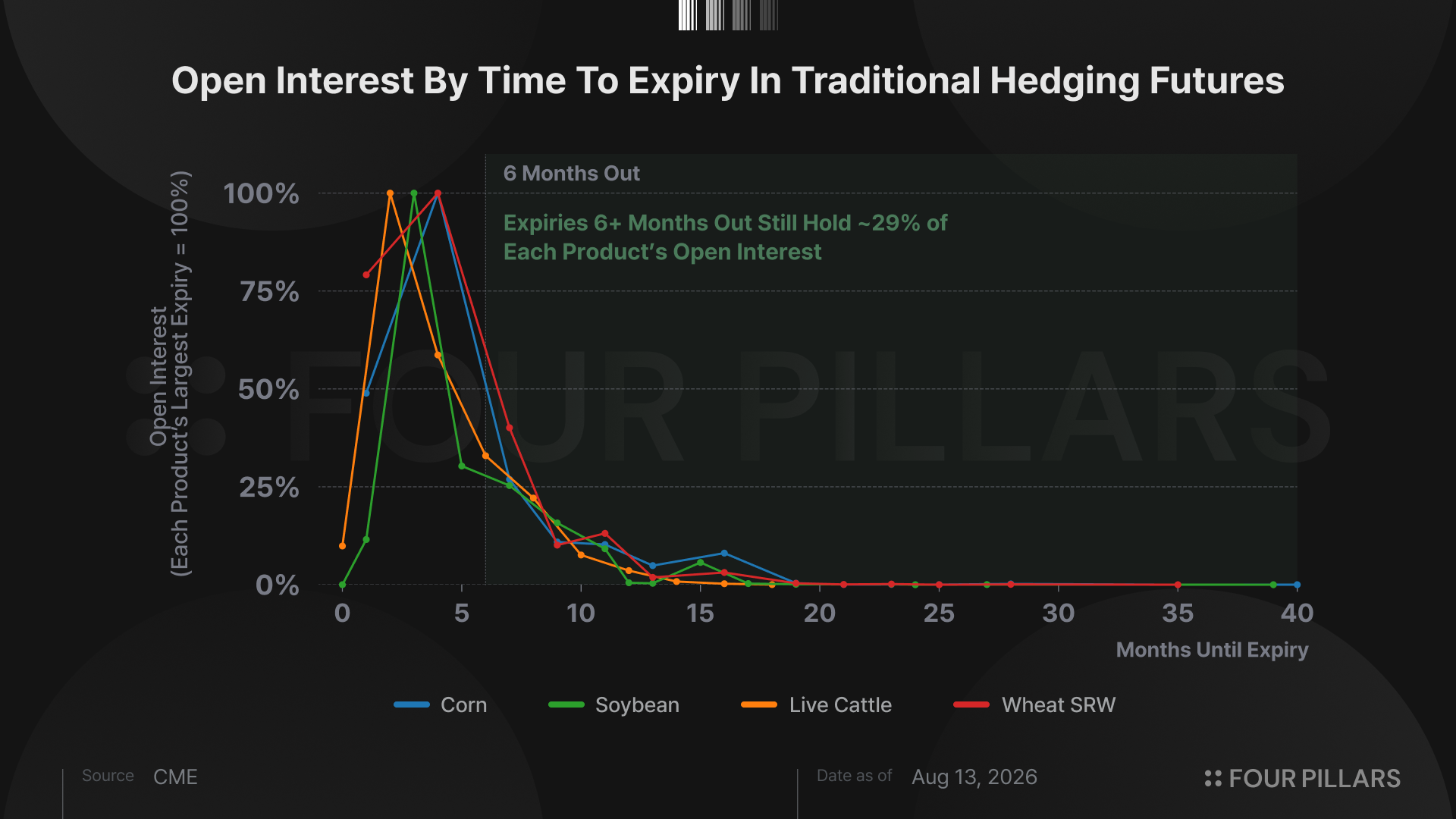
This early position building also shows up in traditional hedging markets. In CME grain and livestock futures as of August 11, 2026, substantial positions have already accumulated in contracts with six months to expiry. Corn futures carried 65,127 contracts of OI even in expiries 16 months out.
This reflects a tendency to build positions well before risk materializes, and Kalshi weather contracts behave closer to traditional hedging markets than to sports.
6. Hedging Rides on Liquidity Built by Speculation
To state the conclusion first, the Kalshi weather market is neither a pure hedging market nor a speculative market like sports. Speculative demand still generates a substantial share of liquidity, but hedging demand also shows up on top of it with relative clarity.
The three metrics point in the same direction. Weather contracts trade less than sports, leave more positions standing at settlement, and build those positions earlier. No single metric can confirm trading intent, but the consistency of this behavior supports the existence of holding demand in the Kalshi weather market that is distinct from sports, and the possibility that part of it is hedging.
Speculative demand is also closer to a precondition for the hedging function than a weakness of prediction markets. A market with only hedgers struggles to secure counterparties and liquidity.
In prediction markets, speculators set prices and supply liquidity, and hedgers transfer the risk they need to offload on that basis. Instead of an insurer underwriting the risk directly, market participants distribute it among themselves through trading.
The next phase of growth for prediction markets does not lie in pushing out speculation and converting to hedging. What matters is how much real business hedging demand can be layered on top of the liquidity that speculation has built.
The author of this report may have personal holdings or financial interests in assets or tokens discussed herein. However, the author affirms that no transactions have conducted using material non-public information obtained in the course of research or drafting. This report is intended solely for general information purposes and does not constitute legal, business, investment, or tax advice. It should not be used as a basis for making any investment decisions or as guidance for accounting, legal, or tax matters. Any references to specific assets or securities are made for informational purposes only and should not be construed as an offer, solicitation, or recommendation to invest. The opinions expressed herein are those of the author and may not reflect the views of any affiliated institutions, organizations, or individuals. The opinions and analyses expressed herein are subject to change without prior notice. In addition, beyond the individual disclosures included in each report, Four Pillars, may hold existing or prospective investments in some of the assets or protocols discussed herein. Furthermore, FP Validated, a division of Four Pillars, may already be operating as a node in certain networks or protocols discussed herein or may do so in the future. Please see below links in the footer for FP Validated's participating network disclosures and for broader disclosure details.


