


Table of Contents
- Key Takeaways
- 1. Everyone Is Looking at Tokenized Equities
- 2. SEC’s Taxonomy for Tokenized Securities
- 3. Analysis of Major Tokenized Equity Platforms
- 3.1 Securitize: Taking the Most Direct Approach
- 3.2 Ondo and xStocks: Expanding the Ecosystem Through Broad Accessibility
- 3.3 Robinhood: Can a Late Entrant Show Its Strength?
- 3.4 DTCC, NYSE, and Nasdaq: Signs of a Reshaping of Financial Infrastructure
- 3.5 Coinbase: What Path Will It Take?
- 4. Competition Toward a Single North Star
Researcher

Key Takeaways
- Unlike the tokenized U.S. Treasury market, which has recently seen its market size stagnate, the tokenized equity market has been growing rapidly in both qualitative and quantitative terms.
- Players across the board, including traditional equity infrastructure providers, fintech companies, cryptocurrency exchanges, and Web3-native platforms, are looking to tokenized equities as the next major opportunity in the RWA industry. In fact, there are various approaches to tokenizing equities, and understanding their respective strengths, weaknesses, and positioning is key.
- In this article, we analyze the strategies being pursued by industry players with diverse backgrounds, including Securitize, Ondo, xStocks, Robinhood, DTCC, NYSE, Nasdaq, and Coinbase.
EastPoint:Seoul is the first private conference to bring together institutional leaders, regulators, and Web3 pioneers to shape the future of digital assets and the AI economy in Korea.
1. Everyone Is Looking at Tokenized Equities
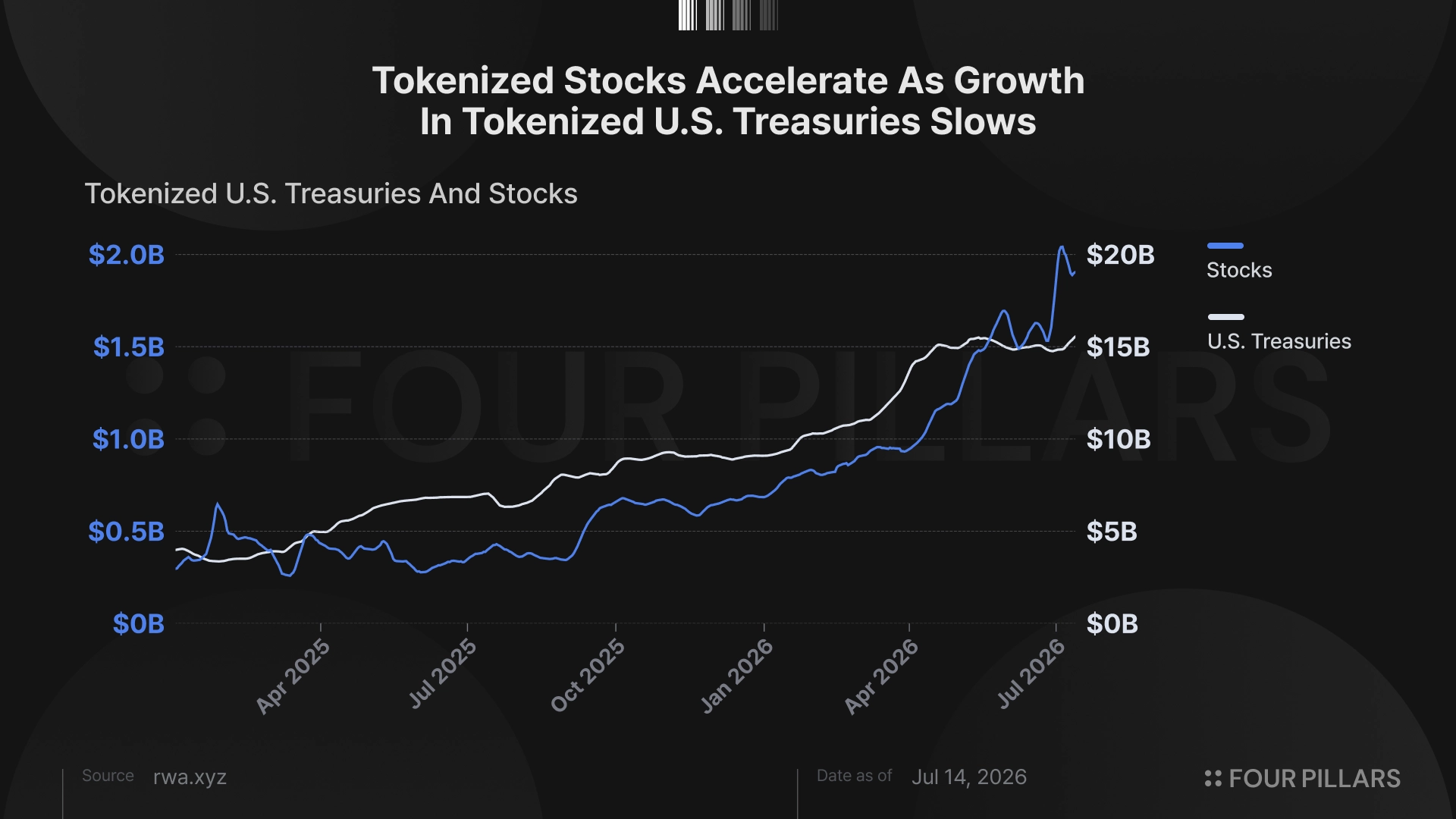
Today, regulators, banks, institutions, fintech companies, and virtually every other major market participant are showing strong interest in tokenization. However, the term "tokenization" itself has only relatively recently come into the spotlight. The asset class that contributed the most to the early growth of the tokenization market was undoubtedly U.S. Treasuries, which were able to grow rapidly due to 1) the safety of U.S. government debt, 2) relatively simple tokenization structures, and 3) comparatively high yields.
The tokenized U.S. Treasury market grew from $701M on January 1, 2024 to $15B for the first time on April 17, 2026, representing an extraordinary average annual growth rate of approximately 3.81x. However, since surpassing $15B, the market has continued to hover around that level, showing signs that growth has slowed to some extent. Considering that much of the demand for tokenized U.S. Treasuries comes from DeFi protocols or exchange margin use cases, it appears that demand has stagnated due to the recent unfavorable market environment.
With the tokenized U.S. Treasury market now losing momentum, another tokenization sector has been growing rapidly both quantitatively and qualitatively: tokenized equities. In terms of market size, the sector has grown 6.5x in just a year and a half, from $291M on January 1, 2025 to approximately $1.9B today. From an industry perspective, everyone from Web3-native players such as Securitize and Ondo Global Markets, to financial companies such as Robinhood and Coinbase, and financial infrastructure providers such as DTCC, NYSE, and Nasdaq, has either already introduced tokenized equities or is preparing to do so.
What advantages do tokenized equities offer over the traditional equity market that have led virtually all major U.S. players to identify them as the next major opportunity? At first glance, tokenized equities may appear very simple. In practice, however, they can take on a wide variety of tokenization structures depending on the regulatory framework being used, and each structure offers a different set of advantages. To understand these differences, it is first essential to understand the SEC's classification framework for tokenized securities.
2. SEC’s Taxonomy for Tokenized Securities
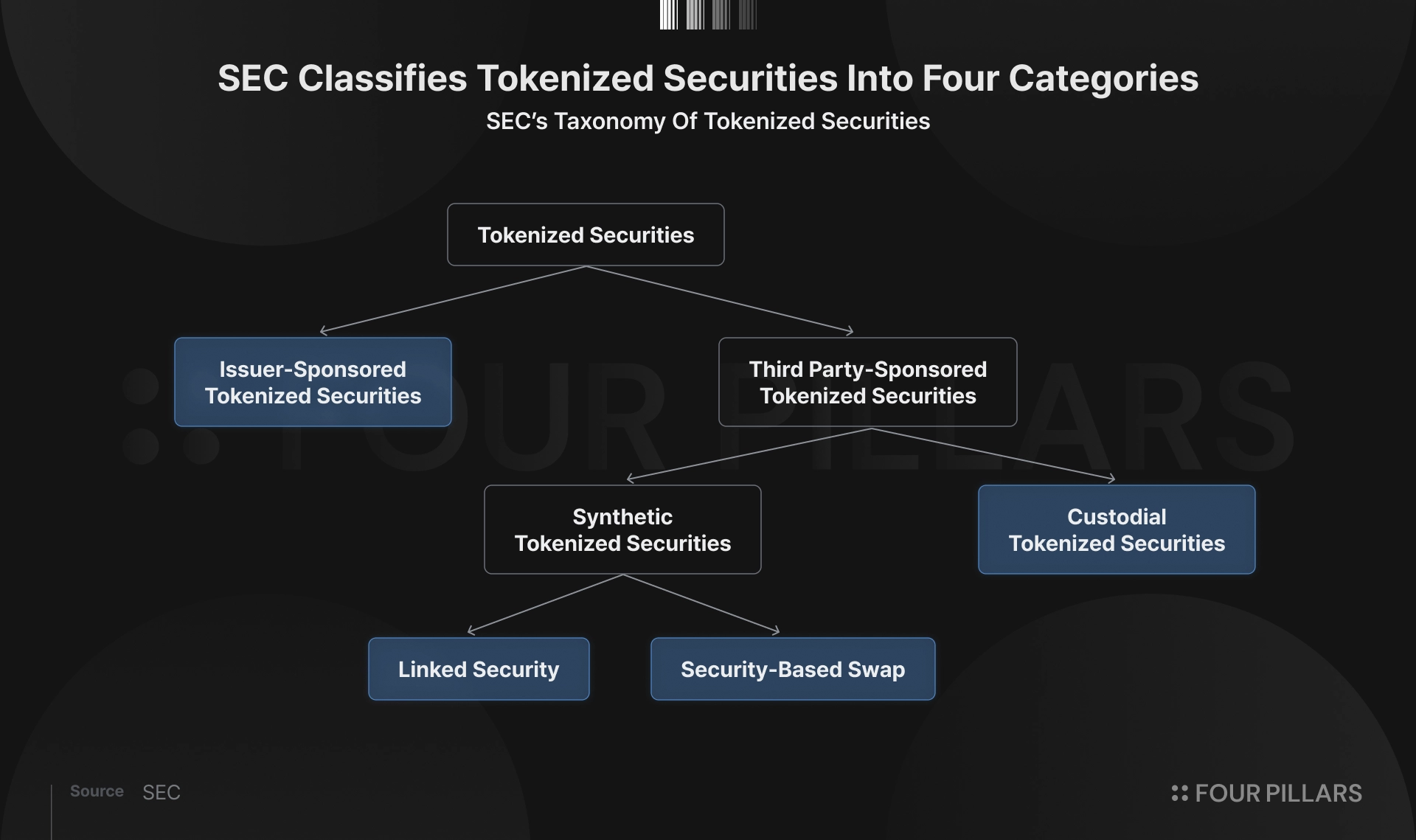
In January of this year, the SEC published a statement introducing a framework for classifying tokenized securities.
- First, tokenized securities are classified according to whether the entity tokenizing the security is the issuer of the security itself or a third party. The former is classified as Issuer-Sponsored Tokenized Securities, while the latter is classified as Third Party-Sponsored Tokenized Securities.
- Third Party-Sponsored Tokenized Securities are then further classified depending on whether the rights associated with the underlying security are themselves tokenized. If a security is used as collateral and the rights associated with that security are tokenized, the structure is classified as Custodial Tokenized Securities. If, instead, a separate tokenized product is issued that is merely linked to the price, return, events, or other characteristics of the underlying security, it is classified as Synthetic Tokenized Securities.
- Finally, Synthetic Tokenized Securities are further classified according to the type of product being tokenized. If a third party issues a separate security, such as a debt security, it is classified as a Linked Security. If the third party enters into a derivatives contract, it is classified as a Security-Based Swap.
As a result, under this classification framework, tokenized securities can be divided into the following four categories. Tokenized equities can likewise be classified into the same four categories:
- Issuer-Sponsored Tokenized Securities: A structure in which the issuer, such as the company whose shares are being tokenized, or an agent designated by the issuer, such as a transfer agent, directly tokenizes and operates the securities. The issuer or its agent integrates a DLT system such as a blockchain into the official shareholder registry and uses it to maintain the shareholder record. This approach complies with existing securities laws without fundamentally changing the legal framework. Its key advantage is that all rights associated with the shares, including ownership rights, are inherited by the token. However, strict compliance requirements limit its usability to some extent. Major examples include Securitize, Superstate, and Figure.
- Custodial Tokenized Securities: A structure in which a third party tokenizes the security entitlement, which represents an indirect right to securities held at a depository institution such as DTCC or at a brokerage. This structure similarly offers the advantage that all associated rights are inherited by the token. However, because it largely relies on the existing equity market infrastructure, ownership remains indirect and the degree of improvement over the traditional system is relatively limited. DTCC is a major example, and Ondo has also recently used this approach to tokenize IVV and MU.
- Linked Security: A structure in which a third party issues and tokenizes a separate security, such as a debt security, that provides synthetic exposure to the underlying security, in this case the stock. Token holders receive exposure only to the price performance of the security and do not inherit other rights associated with the underlying shares. Its key advantage is that it offers a high degree of flexibility for onchain use. Major examples include Ondo, xStocks, and Robinhood Stock Tokens.
- Security-Based Swap: A structure in which a third party issues a derivatives contract that provides synthetic exposure to the underlying security and tokenizes that contract. As with Linked Securities, token holders receive only price-related exposure to the underlying security and do not inherit other associated rights. Robinhood Classic Stock Tokens are virtually the only major example.
3. Analysis of Major Tokenized Equity Platforms
3.1 Securitize: Taking the Most Direct Approach
Securitize is the largest tokenization platform by market share, with $5.1B in tokenized RWAs. Its flagship product is BUIDL, BlackRock's money market fund. Securitize holds SEC registrations and licenses as a broker-dealer, transfer agent, and ATS, and leverages these regulatory strengths to pursue a model in which securities are directly tokenized. Under the SEC's taxonomy for tokenized securities, this falls under "Issuer-Sponsored Tokenized Securities," where the issuer of the security or an agent designated by the issuer tokenizes the security.
More recently, Securitize has also been expanding into tokenized equities, using the same Issuer-Sponsored Tokenized Securities model for stocks. When Securitize listed its own shares, SECZ, through a SPAC, it also used its own service to tokenize and issue $180M worth of SECZ onchain.
The advantage of an Issuer-Sponsored Tokenized Securities platform such as Securitize is clear. It allows existing equities to be tokenized as they are while remaining fully compliant with existing securities laws. Investors directly register ownership of shares previously held through DTCC or a broker via DRS, after which Securitize tokenizes those shares in its capacity as transfer agent. As a result, the stock tokens share the same CUSIP as the existing shares and inherit not only economic rights but also all associated rights, including voting rights and residual claims on assets in the event of bankruptcy.
However, because stocks tokenized through this model are essentially the same shares in a different form, the structure also comes with certain drawbacks. Most importantly, it is subject to strict compliance requirements, which makes onchain use relatively limited. Unlike tokenized equities from Ondo or xStocks, which can be transferred and utilized relatively freely onchain, Securitize's stock tokens can only be transferred between whitelisted wallets that have passed KYC/AML checks. Their onchain use is also highly restricted, as they can interact only with a limited number of smart contracts that have been pre-approved by the team.
Source: Securitize
How, specifically, can Securitize enforce compliance requirements such as KYC/AML even onchain? The answer lies in the DS Protocol. The DS Protocol is a collection of smart contracts developed by Securitize that uses smart contract code to enforce regulatory compliance across the entire lifecycle of tokenized securities, including issuance, transfer, utilization, voting, and dividend payments. Four Pillars previously published an in-depth research report on the DS Protocol, and the research is also available on Securitize's official website. Readers who want to understand in detail how tokenized securities actually operate at the smart contract level may refer to that research.
Other platforms that tokenize equities in a similar way include Superstate and Figure. All of them conduct tokenization in their capacity as transfer agents, but the biggest difference lies in the type of equity they tokenize. Securitize and Superstate use the DRS system to tokenize the exact same shares as existing equities, whereas Figure takes a different approach by separately offering and issuing a blockchain-native class of shares and then tokenizing those shares.
3.2 Ondo and xStocks: Expanding the Ecosystem Through Broad Accessibility
Ondo and xStocks use a structure in which, when a user places an order for a stock token, an offshore SPV acquires the underlying stock and issues a tokenized debt security backed by that stock.
Take xStocks as an example. xStocks has a Jersey-regulated SPV called Backed Assets (JE) Limited. When an xStocks user requests the issuance of a stock token through the platform, Backed Assets (JE) Limited acquires the underlying shares through Alpaca Securities in the United States and holds them in segregated custody with a regulated custodian. The SPV then issues a separate security, specifically a debt security backed by the underlying shares, tokenizes it, and provides the token to the user.
Because this structure involves a third party issuing a separate security that references an underlying security, it falls under the "Linked Security" category in the SEC's taxonomy for tokenized securities.
Source: rwa.xyz
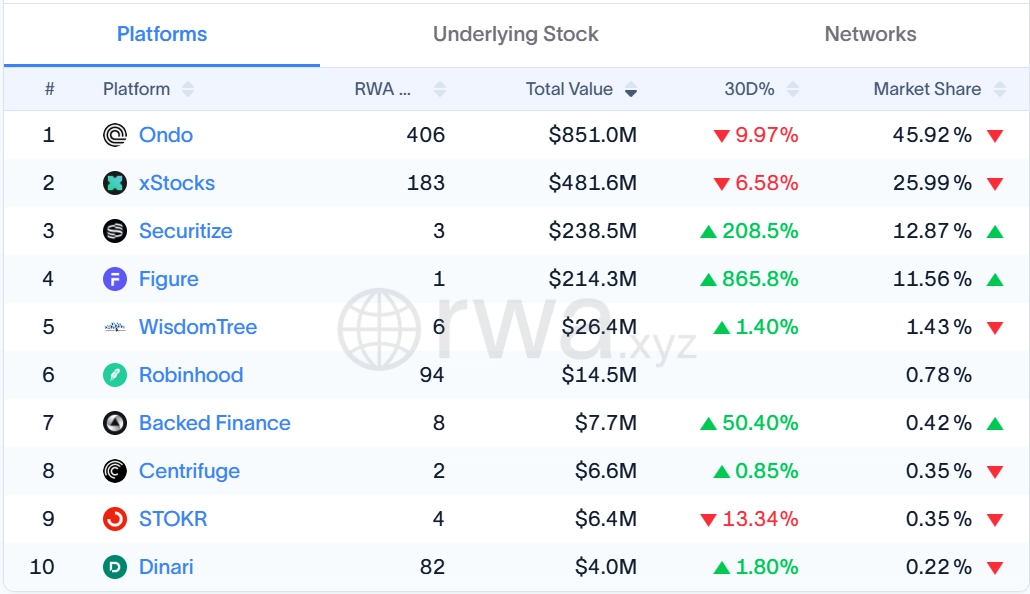
In terms of tokenized asset value, Ondo has tokenized 406 different equities with a total value of approximately $851M, while xStocks has tokenized 183 different equities worth approximately $482M. Their market shares in the tokenized equity sector are 45.9% and 26.0%, respectively, making them the first- and second-largest players in the sector.
The reason they have been able to grow so rapidly lies in the broad accessibility enabled by their tokenization structures. Strictly speaking, they are not tokenizing the stocks themselves. Instead, they are tokenizing debt securities issued by third-party entities and backed by stocks. As a result, compared with the Issuer-Sponsored Tokenized Securities model, which directly tokenizes existing shares, these structures are subject to less stringent compliance requirements for distribution and secondary trading. This gives users the advantage of being able to freely trade and utilize tokenized equities issued by Ondo and xStocks across CEXs and onchain DeFi protocols. In the case of xStocks, for example, anyone can trade them through Jupiter DEX using a Web3 wallet, or deposit them as collateral in lending protocols such as Kamino and borrow stablecoins against them.
However, because these structures tokenize equities indirectly, they create non-interoperable tokens across different platforms even when the underlying asset is the same, resulting in liquidity fragmentation. For example, even though both tokens may be backed by the same Nvidia stock, Ondo issues NVDAon while xStocks issues NVDAx, and the two tokens are not interoperable. In addition, because these platforms rely on Regulation S, they cannot be used by U.S. investors or U.S. persons.
To address these limitations, Ondo recently acquired Oasis Pro, securing broker-dealer, ATS, and transfer agent status and signaling a shift toward more regulation-friendly tokenization models. In fact, Ondo recently demonstrated the possibility of tokenizing equities through multiple structures by using its regulatory status to tokenize IVV ETF shares and MU stock held in brokerage accounts under the "Custodial Tokenized Securities" model.
3.3 Robinhood: Can a Late Entrant Show Its Strength?
A new major contender in the tokenized equity ecosystem is Robinhood. In fact, Robinhood had already been offering tokenized equities to European investors through a service called Classic Stock Tokens. However, under the SEC's taxonomy for tokenized securities, this structure falls under the "Security-Based Swap" category. Robinhood entered into derivatives contracts with users referencing equities as the underlying assets and merely tokenized those contracts in the form of receipt tokens. As a result, the structure was highly closed and could only be offered within the Robinhood app.
On July 1, 2026, Robinhood unveiled a new tokenized equity service called Stock Tokens. Its tokenization structure follows the "Linked Security" model and is almost identical to the structures used by Ondo and xStocks described in the previous section. As a result, it shares largely the same strengths and weaknesses.
Even if the tokenization structure itself is the same, however, what we can expect from Robinhood's Stock Tokens is clear: Robinhood's product DNA and its massive existing user base. Alongside the launch of Stock Tokens, Robinhood also launched the mainnet of Robinhood Chain, which is centered around Stock Tokens. In addition, U.S. users can deposit stablecoins into Morpho on Robinhood Chain through the Robinhood app and earn 7% interest. Although Robinhood's Stock Tokens are a late entrant compared with Ondo or xStocks, this is why they have significant potential for rapid growth in terms of both product development and ecosystem expansion.
3.4 DTCC, NYSE, and Nasdaq: Signs of a Reshaping of Financial Infrastructure
It is not only platforms and individual companies that are considering equity tokenization. Settlement and trading infrastructure providers such as DTCC, NYSE, and Nasdaq, which have traditionally played critical roles in the equity market, are also moving in the direction of tokenizing stocks.
- DTC, a subsidiary of DTCC, received a no-action letter from the SEC allowing it to tokenize certain securities held at DTC on pre-approved blockchains. Through this initiative, DTC expects to achieve benefits such as improved collateral mobility, extended trading hours, greater operational and settlement efficiency, programmability, and real-time auditing. On July 15, DTCC also conducted a limited tokenization of securities such as QQQ and SPY in an environment using actual securities infrastructure and successfully completed trading and collateral transfers using those tokenized assets.
- NYSE filed a proposed rule change with the SEC in April 2026 to support DTC's tokenization pilot, enabling equities to be settled in tokenized form as well. Separately, NYSE is developing a new regulated exchange called the Digital Trading Platform. The platform is intended to enable 24/7 trading of U.S.-listed stocks and ETFs using blockchain infrastructure and allow funding through stablecoins. NYSE also signed an MOU with Securitize in March 2026 and designated Securitize as the first prospective digital transfer agent for the new platform.
- Nasdaq received SEC approval for a rule change in March 2026, allowing equities included in DTC's tokenization pilot to be traded and settled in tokenized form. Nasdaq is also working with Payward, Kraken's parent company, to design a gateway service that would allow issuers and investors to move equities between the regulated Nasdaq market and permissionless blockchain environments.
3.5 Coinbase: What Path Will It Take?
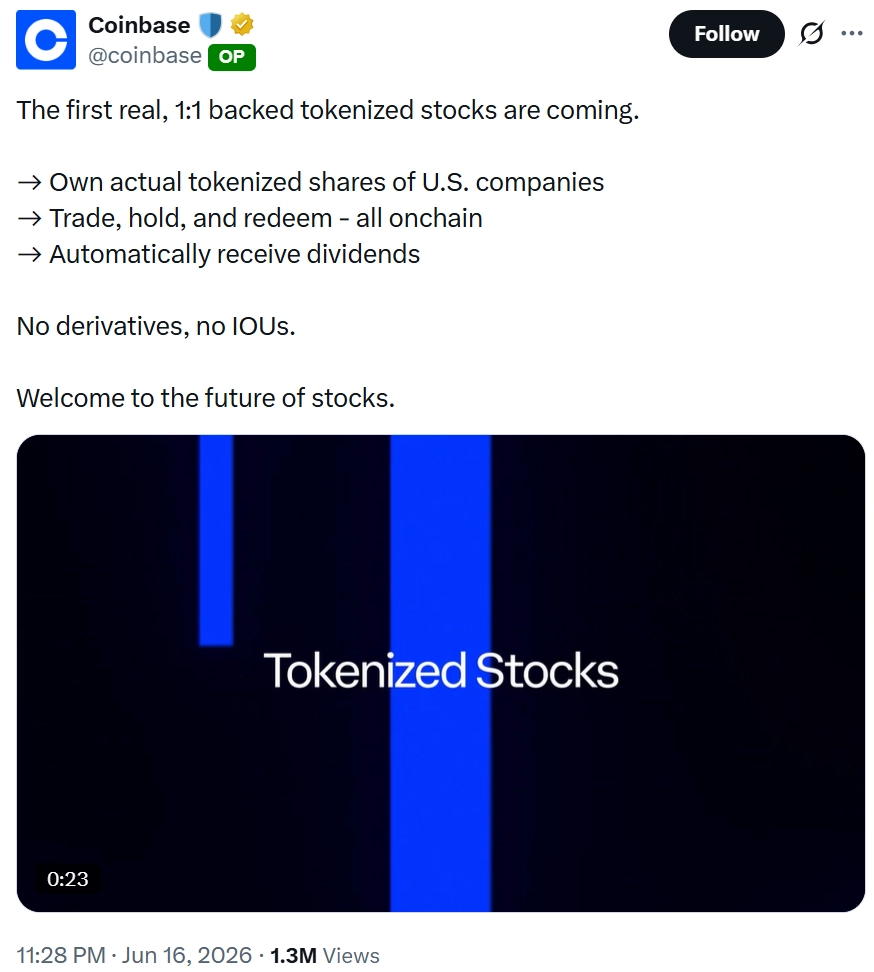
Source: X (@coinbase)
The final player worth watching is Coinbase. Coinbase does not yet offer a tokenized equity service. However, since last year, the company has repeatedly stated its intention to launch such a service. In February this year, Coinbase launched 24/5 trading of traditional equities in the United States, and at an event in June, it announced that it would soon begin offering tokenized equities.
The industry is paying close attention to what structure Coinbase will use to tokenize stocks. Coinbase has stated that its service will not only have tokens backed 1:1 by actual shares but will also be capable of providing shareholder rights, although it has not disclosed the specific structure in detail. More importantly, Coinbase has stated that its stock tokens will be usable onchain while also being unavailable to U.S. customers.
If Coinbase were using an Issuer-Sponsored structure, the tokens would likely inherit all shareholder rights, be available to U.S. customers, and have relatively limited onchain usability. However, the combination of broad onchain usability and the exclusion of U.S. customers instead seems to suggest that Coinbase may be using a Third-Party structure such as a Linked Security. It will be interesting to see what structure Coinbase ultimately uses to tokenize equities and how it plans to expand the tokenized equity ecosystem by leveraging its exchange infrastructure.
4. Competition Toward a Single North Star
The North Star of financial services is clear: enabling anyone, anywhere, at any time, to trade every type of asset through a single backend and frontend. Today's financial services may appear to have already achieved this goal, but in reality, integration has largely occurred only at the frontend, while the backend remains fragmented.
Stocks are no exception among the many asset classes encompassed by this North Star. Robinhood, which began with equity trading, Coinbase, which began with cryptocurrency trading, traditional equity infrastructure providers such as DTCC, NYSE, and Nasdaq, and Web3-native players such as Securitize, Ondo, and xStocks all differ in their tokenization structures and strategic directions. Yet they are all moving toward the same North Star: tokenized equities.
Going forward, the key points to watch will be how the competitive landscape among these players changes depending on how the United States and other jurisdictions view tokenized equities and how their regulatory frameworks are implemented in practice, as well as whether tokenized equities can become the next major catalyst after tokenized U.S. Treasuries to expand the overall RWA sector.
The Korean market is also notable for relatively slow growth in the RWA industry despite its high level of retail trading activity. It will therefore be important to see how the discourse around tokenized equities develops in Korea. We hope that the upcoming EastPoint event will foster active and constructive discussion around these issues.
The author of this report may have personal holdings or financial interests in assets or tokens discussed herein. However, the author affirms that no transactions have conducted using material non-public information obtained in the course of research or drafting. This report is intended solely for general information purposes and does not constitute legal, business, investment, or tax advice. It should not be used as a basis for making any investment decisions or as guidance for accounting, legal, or tax matters. Any references to specific assets or securities are made for informational purposes only and should not be construed as an offer, solicitation, or recommendation to invest. The opinions expressed herein are those of the author and may not reflect the views of any affiliated institutions, organizations, or individuals. The opinions and analyses expressed herein are subject to change without prior notice. In addition, beyond the individual disclosures included in each report, Four Pillars, may hold existing or prospective investments in some of the assets or protocols discussed herein. Furthermore, FP Validated, a division of Four Pillars, may already be operating as a node in certain networks or protocols discussed herein or may do so in the future. Please see below links in the footer for FP Validated's participating network disclosures and for broader disclosure details.
![CLARITY Act Fails, the SEC Steps In [FP Weekly 39]](/_next/image?url=https%3A%2F%2Fkrotgrfjzckvumudxopj.supabase.co%2Fstorage%2Fv1%2Fobject%2Fpublic%2Fassets%2Fimg%2Fcontent%2Farticle%2Fnotion-import%2Fmqlpp6muat2oq6.png&w=3840&q=75)

![CLARITY Act Faces the Senate, $LAPTOP Faces Reality [FP Weekly 38]](/_next/image?url=https%3A%2F%2Fkrotgrfjzckvumudxopj.supabase.co%2Fstorage%2Fv1%2Fobject%2Fpublic%2Fassets%2Fimg%2Fcontent%2Farticle%2Fnotion-import%2Fc3ygeemu0lqxb5.png&w=3840&q=75)

![Robinhood Takes Over Onchain
[FP Weekly 37]](/_next/image?url=https%3A%2F%2Fkrotgrfjzckvumudxopj.supabase.co%2Fstorage%2Fv1%2Fobject%2Fpublic%2Fassets%2Fimg%2Fissues%2Frobinhood-takes-over-onchain-fp-weekly-37.png%3Ft%3D1788765790150&w=3840&q=75)