


Table of Contents

*This analysis uses Allium geo payment corridor data. It covers $15.2B in onchain transfers for which Allium has identified the country of both the sending and receiving wallets. Most onchain volume remains unattributed.
- Domestic transfers account for 62.6% of the $15.2B in attributed stablecoin volume, and 73.0% of all attributed volume settles within the sender’s region, so crossborder remittance represents only one component of observed demand.
- Asia Pacific leads with 41.0% of sent volume, 41.6% of global domestic activity, and positive net inflows led by Indonesia, Singapore, and South Korea.
- For institutions evaluating stablecoin payment demand, domestic settlement services and regional Asia Pacific corridors therefore offer the largest immediate opportunities.
1. Domestic Transfers Lead in Major Countries
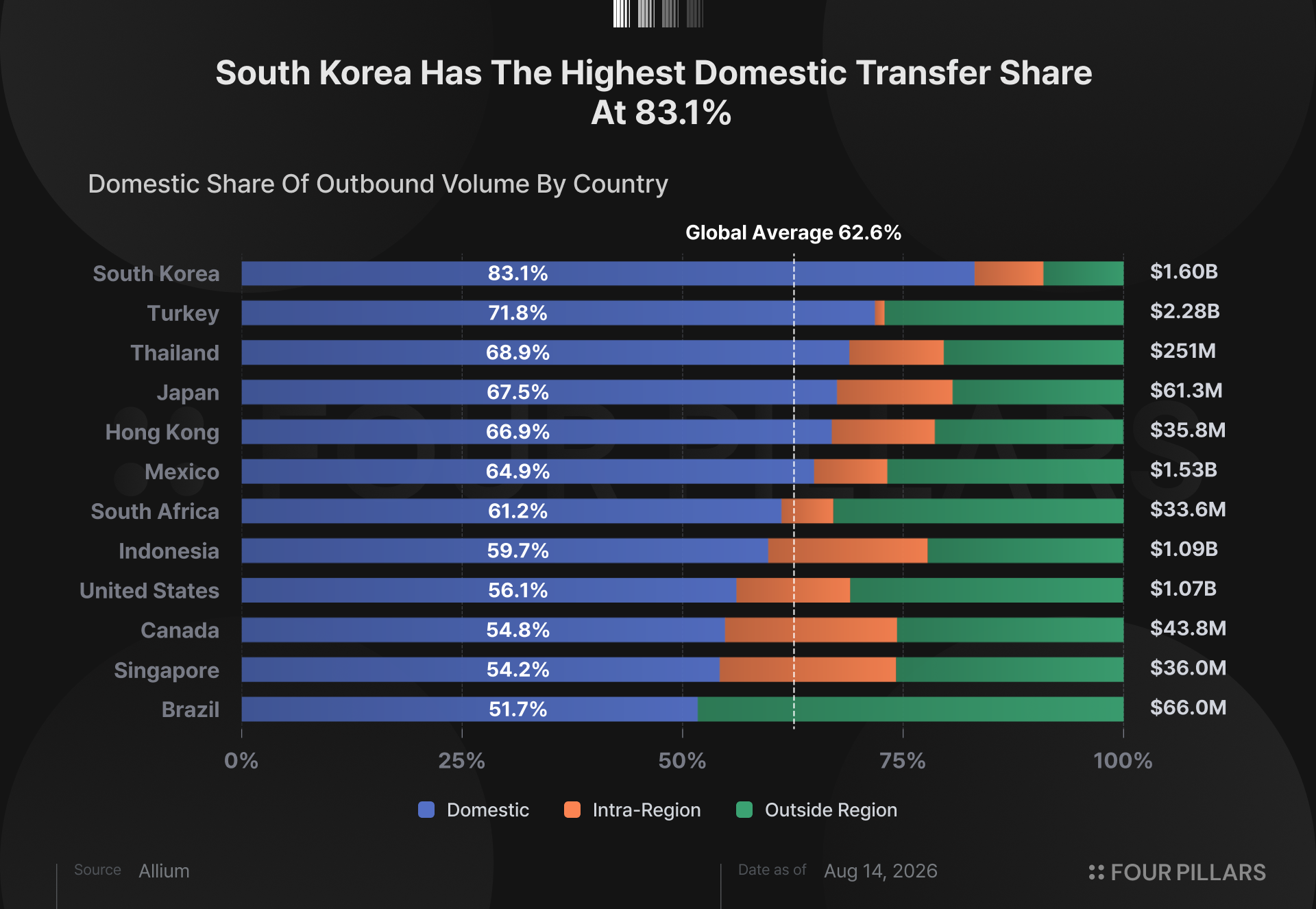
Domestic transfers, meaning transfers between wallets located in the same country, account for $9.5B, or 62.6%, of the $15.2B in attributed volume. The domestic lane is the largest destination in most markets with outbound activity, regardless of region or market size. Turkey ($2.28B), South Korea ($1.60B), Mexico ($1.53B), Indonesia ($1.09B), and the United States ($1.07B) collectively generate 79.5% of global domestic volume.
These transactions settle between wallets on public blockchains without using card networks or bank payment rails. The scale of domestic activity indicates that users employ stablecoins for payments, trading, and dollar denominated savings within their own markets. Crossborder remittances therefore represent only one component of the stablecoin activity.
For institutions designing stablecoin services, domestic payment and settlement use cases address a larger current transaction base than products built only for remittance.
2. Most Attributed Volume Remains Within the Sender's Region
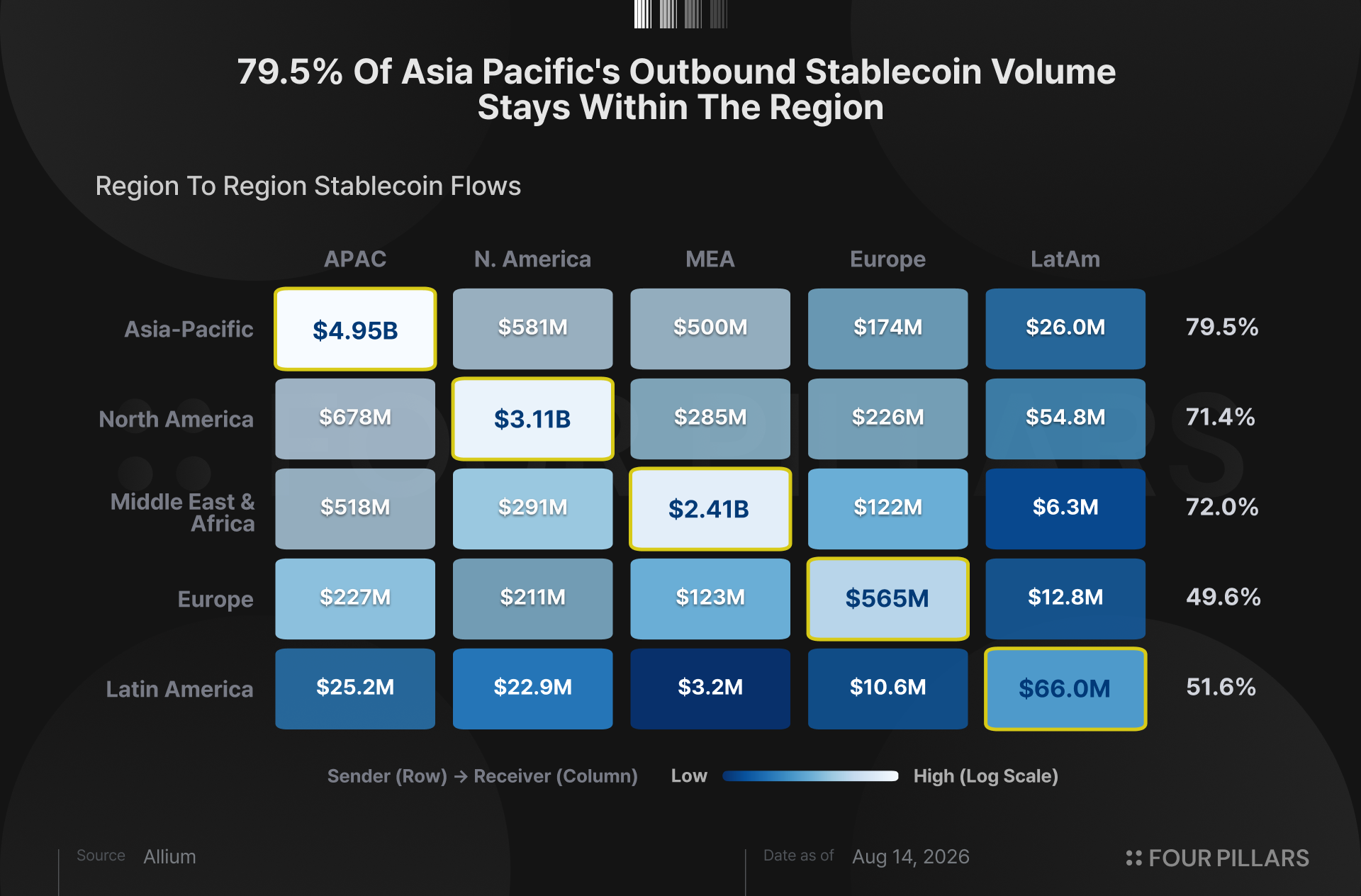
Including domestic transfers 73.0% of volume settles within the sender’s region(continent). Asia Pacific retains 79.5% of the volume sent by its constituent markets, followed by the Middle East & Africa at 72.0%, North America at 71.4%, and Europe at 49.6%. Across regions, the matrix concentrates along the diagonal, indicating that attributed stablecoin volume primarily settles within the sender’s region.
Excluding domestic transfers reduces the regional retention rate to 27.8% of the $5.68B in international volume. Asia Pacific retains 43.7%, equal to $995M of $2.28B, compared with 27.0% in North America and 6.3% in the Middle East and Africa. Turkey, the largest market in the latter region, directs most of its international volume to Asia and the Americas. Within Asia Pacific, Taiwan to Indonesia ($138M), Indonesia to Taiwan ($124M), and Indonesia to South Korea ($89M) are already material corridors.
Existing transaction volumes support the development of regional stablecoin payment infrastructure in Asia Pacific. Indonesia, Taiwan, South Korea, Australia, and Thailand collectively participate in approximately $1B of international volume within the region and $3.96B of domestic activity.
Institutions can use this existing liquidity and bilateral demand to prioritize corridor development. For institutions planning regional payment infrastructure, corridors such as Taiwan to Indonesia and Indonesia to South Korea already carry measurable bilateral demand that supports early investment. Country labeling currently covers only 2.9% of observed volume, so corridor rankings may change as Allium identifies the sending and receiving countries for more of the remaining $505B.
3. Asia Pacific Accounts for 41% of the Total Volume
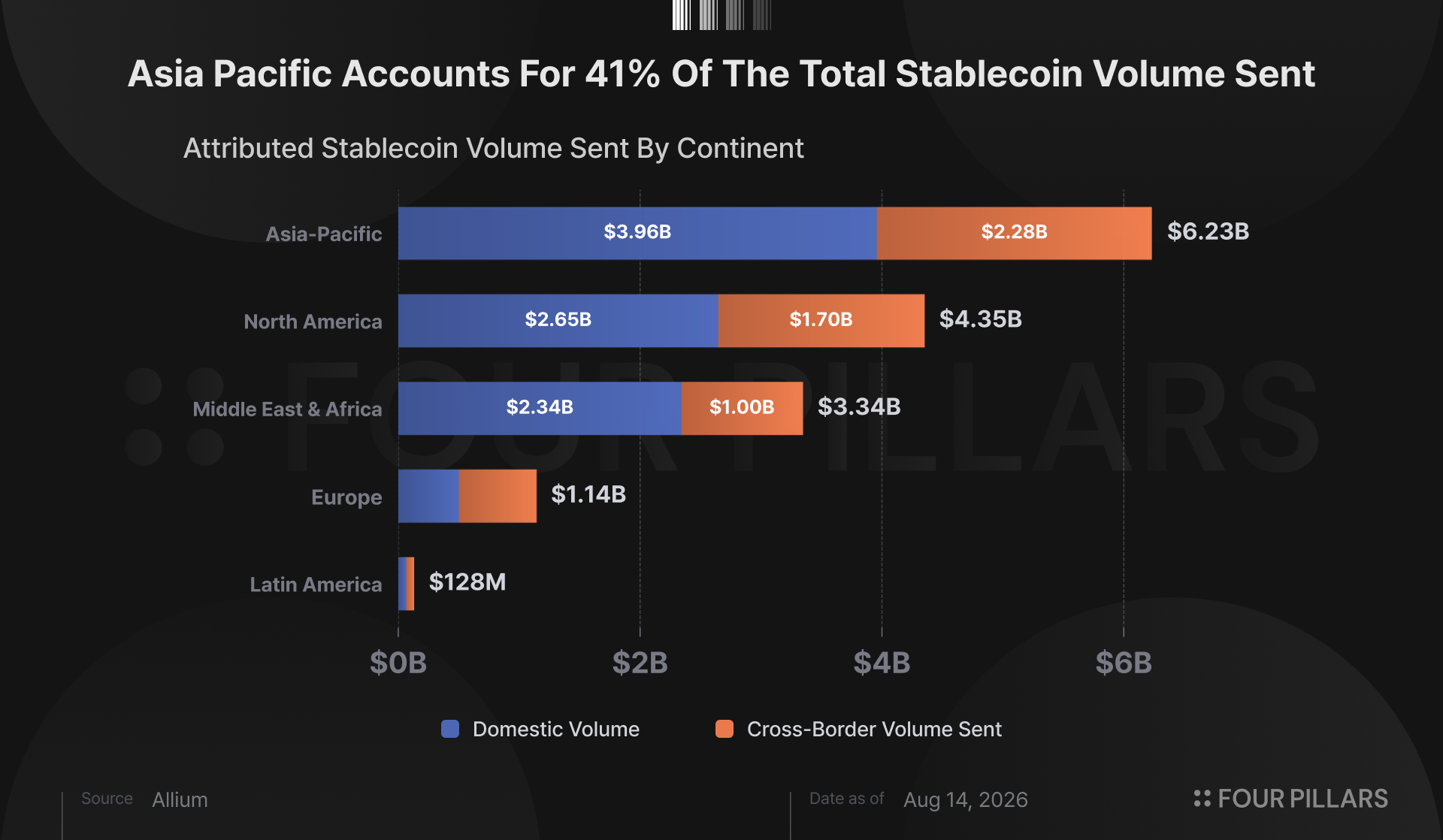
Asia Pacific is the largest region in the data set, sending $6.23B, or 41.0%, of attributed volume and receiving $6.40B, or 42.1%. Its sent share exceeds North America at 28.6%, the Middle East and Africa at 22.0%, Europe at 7.5%, and Latin America at 0.8%. The region also generates $3.96B in domestic activity, equal to 41.6% of the global domestic total.
The same concentration appears in the corridor rankings, where nine of the fifteen largest international corridors involve at least one Asia Pacific market and Indonesia alone is the sender or receiver in six. Turkey to Indonesia ($206M) and the United States to Mexico ($206M) are the two largest individual corridors. On a combined bilateral basis, volume reaches $363M between Indonesia and Turkey, $262M between Indonesia and Taiwan, and $190M between South Korea and Turkey, confirming material links between Asian markets and high adoption markets outside the region.
Net flows reinforce this picture, as Asia Pacific receives $167M more than it sends while the United States records the largest net outflow at $170M. Indonesia (+$111M), Singapore (+$57.9M), and South Korea (+$31.7M) are among the largest net recipients in the sample.
For institutions evaluating current stablecoin payment demand, the region therefore combines the largest attributed transaction base, the highest domestic volume, and positive net inflows.
The author of this report may have personal holdings or financial interests in assets or tokens discussed herein. However, the author affirms that no transactions have conducted using material non-public information obtained in the course of research or drafting. This report is intended solely for general information purposes and does not constitute legal, business, investment, or tax advice. It should not be used as a basis for making any investment decisions or as guidance for accounting, legal, or tax matters. Any references to specific assets or securities are made for informational purposes only and should not be construed as an offer, solicitation, or recommendation to invest. The opinions expressed herein are those of the author and may not reflect the views of any affiliated institutions, organizations, or individuals. The opinions and analyses expressed herein are subject to change without prior notice. In addition, beyond the individual disclosures included in each report, Four Pillars, may hold existing or prospective investments in some of the assets or protocols discussed herein. Furthermore, FP Validated, a division of Four Pillars, may already be operating as a node in certain networks or protocols discussed herein or may do so in the future. Please see below links in the footer for FP Validated's participating network disclosures and for broader disclosure details.


