


Table of Contents

1. 58 KRW Listings in 7 Months
Upbit opened 58 KRW markets in the first seven months of 2026. 42 of them came in the first half, roughly 7 per month, and then the pace doubled. July delivered 10 new markets. The first week of August delivered 6 more, including a stretch from August 4 to August 7 that ran QUID, HOME, GRVT, CAP, KMNO, and BSB back to back, and on August 10 the exchange added six further tokens to its BTC and USDT markets in a single batch notice.
The motive is not mysterious. Upbit's average daily volume has fallen from $1.9 billion in February to $590 million in July and $460 million so far in August, down roughly 70% YTD and 85% from a year ago. Korean retail liquidity has rotated into domestic equities, and a listing is the one lever an exchange controls that used to reliably print volume.
2. Pump Dies in June
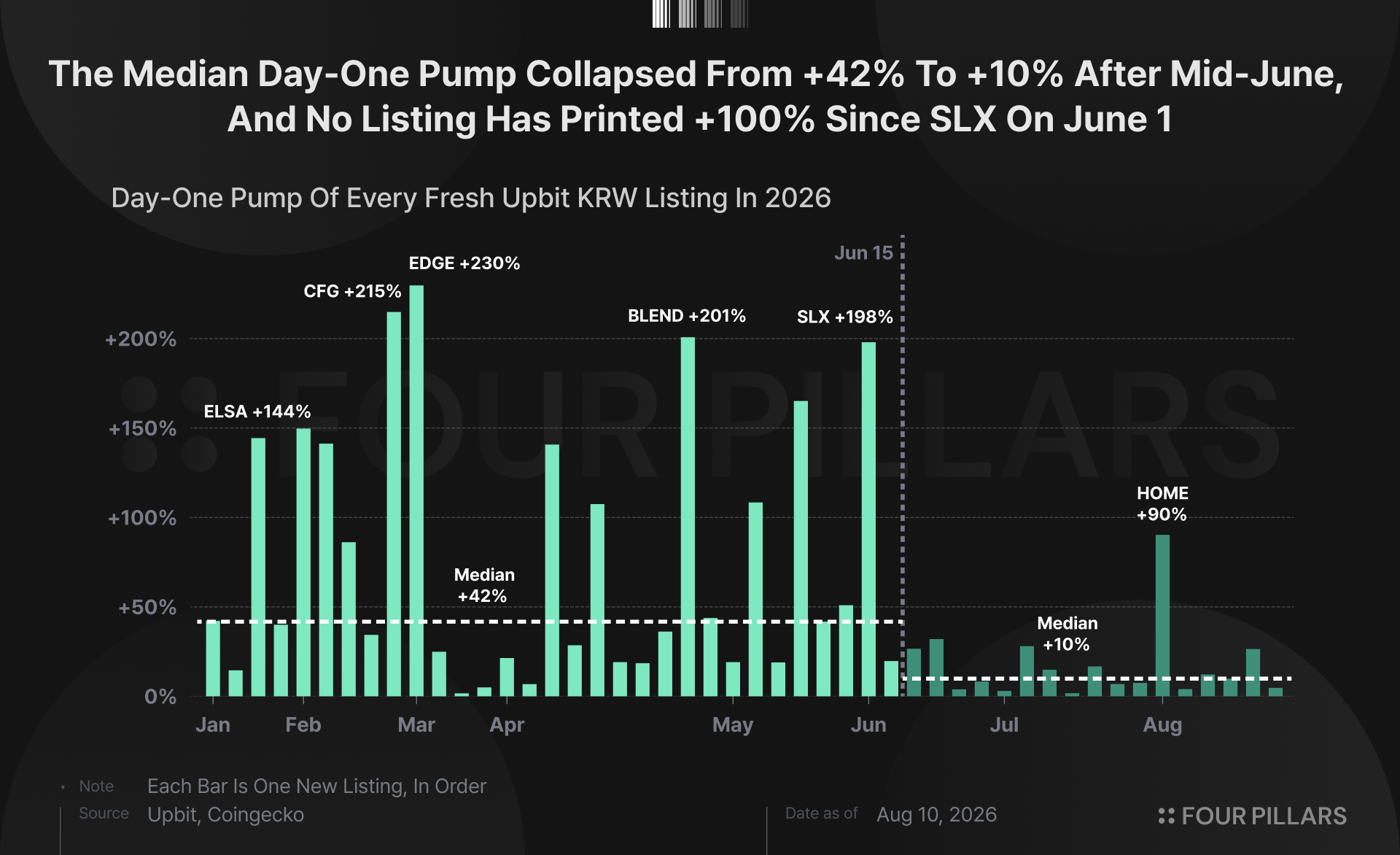
Through June 14 the median fresh listing rose 42% on its first day on median turnover of ₩142 billion, and ten printed triple digits, from ELSA's 144% in January to EDGE's 230% in March and SLX's 198% on June 1.
SLX was the last. The 14 fresh listings since June 15 carry a median first-day gain of 10% on median turnover of ₩54 billion. The best of them, HOME, managed 90%, and 8 of the 14 closed their first day below the open.
Composition does not explain the decay. Tokens that merely received a KRW pair after trading on the BTC market have pumped a median of 19% all year, with MORPHO, KMNO, and OPG barely registering, since surprise is the product and a pre-announced pair has none. But restrict the sample to fresh listings alone and the median still collapsed from 42 to 10%.
Neither is the selling. Among listings that pumped more than 40%, the day-seven close sits 20~65% below the day-one high, median 45, in both regimes. Early holders were always distributing into the print; what changed in June was not the sellers but the bid.
3. Debasement
The obvious explanation is listing fatigue. The pool of capital chasing Korean listings is finite, and six listings in four days split both capital and attention across too many names for any one of them to become an event. Korean retail has always had a strong appetite for short-duration, high-volatility trades, so fresh listings were almost purpose-built for this market. But capital and attention can come back. The harder thing to restore is a signal that has been overused.
For a decade, Upbit was one of the hardest major crypto venues to get listed on, and that difficulty gave a fresh KRW market meaning beyond the trading pair itself. A listing told retail that a token had passed a screen many projects failed. Korean retail then amplified that certification into price action, because traders were buying both Upbit’s endorsement and the expectation that everyone else would trade the same event.
But a screen that passes 58 names in 7 months is no longer selective. Upbit is therefore weakening both ingredients that powered the listing pump: the credibility of the signal and the concentration of demand around it.
For Dunamu, listings were the last discretionary lever for defending volume. An exchange whose volume is down 85%, and whose one reliable volume tool has stopped working, is not spending down a depleting asset. It is discovering it has already been spent.
The author of this report may have personal holdings or financial interests in assets or tokens discussed herein. However, the author affirms that no transactions have conducted using material non-public information obtained in the course of research or drafting. This report is intended solely for general information purposes and does not constitute legal, business, investment, or tax advice. It should not be used as a basis for making any investment decisions or as guidance for accounting, legal, or tax matters. Any references to specific assets or securities are made for informational purposes only and should not be construed as an offer, solicitation, or recommendation to invest. The opinions expressed herein are those of the author and may not reflect the views of any affiliated institutions, organizations, or individuals. The opinions and analyses expressed herein are subject to change without prior notice. In addition, beyond the individual disclosures included in each report, Four Pillars, may hold existing or prospective investments in some of the assets or protocols discussed herein. Furthermore, FP Validated, a division of Four Pillars, may already be operating as a node in certain networks or protocols discussed herein or may do so in the future. Please see below links in the footer for FP Validated's participating network disclosures and for broader disclosure details.


