



Roadmap changes are speeding up
I went through Vitalik Buterin's X (Twitter) account and counted posts about the Ethereum protocol roadmap over the past ten years (2016 through August 2026). Posts that merely mention the word roadmap, opinions on individual EIPs, and takes on specific technologies or ecosystem projects were excluded. The count covers posts that deal directly with roadmap changes or reprioritization.
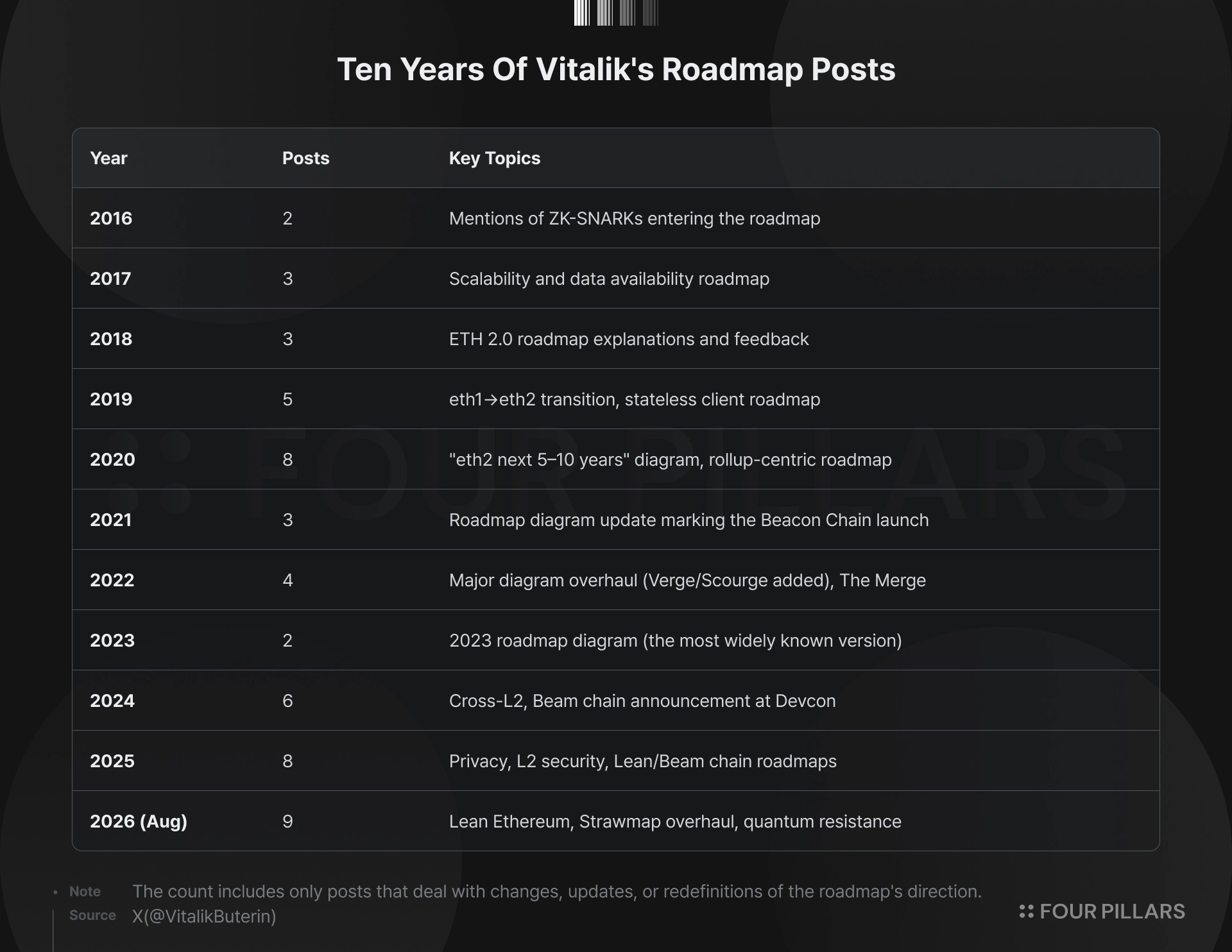
The busiest year on record used to be 2020. That was the year the "eth2 in the next 5 to 10 years" diagram and the rollup-centric roadmap came out, and the direction was set: push execution out to L2s and keep L1 focused on settlement and data availability. Since 2024, when Beam chain, a major overhaul of Ethereum's consensus layer, was announced at Devcon, roadmap posts have been climbing steeply again, through Lean Ethereum and up to this year's Strawmap.
What the rollup-centric roadmap aimed for in 2020 and what Lean Ethereum and Strawmap aim for now are not the same. The rollup-centric roadmap kept L1 minimal and left scaling to the outside. Lean Ethereum and Strawmap, by contrast, put performance improvements and new features on L1 itself: execution-layer performance, ZK-based verification, protocol simplification, privacy, and quantum resistance.
Ethereum keeps a long roadmap that spans four to five years, but the big direction itself changes periodically. And the pace is picking up. Roadmap updates have come faster each of the past three years, and barely past the first half of 2026, the number of Vitalik's posts dealing specifically with the roadmap has already passed 2020, the previous record year.
No money changes its properties this often
Whether Ethereum should be treated as money has long been debated within the Ethereum community itself. Lately, though, positioning ETH as money seems to be emerging as the shared consensus.
But no money changes its properties this often.
The value of money rests largely on the belief that it does not change. Gold's supply is set by geology, and Bitcoin's monetary policy never changes. Ethereum, on the other hand, is an asset whose security model, execution environment, signature algorithms, and even inflation policy keep moving. This is why the market treats ETH less like a monetary asset and more like a Nasdaq tech stock. A tech stock gets re-rated every time its roadmap changes. Money, in the traditional sense, is money precisely because it needs no roadmap.
For Ethereum to become money, it would need a long-term roadmap that is more or less fixed, delivered as planned without frequent changes. Once delivered, the network would have to choose stability over change. Ethereum would need to become something closer to Bitcoin, a network that does not change, before ETH could function as money.
The catch is that the Ethereum network is technology, and technology can always be displaced by something better. It also has to respond to new threats like quantum computing. I doubt there will ever be a point where Vitalik and the Ethereum community no longer need to put out a new roadmap. In the long run, ETH as money in the traditional sense and Ethereum as a trustless network are very hard to reconcile.
It is also entirely possible that the definition of money changes completely in a post-AI world. If it does, ETH, the native currency of a network that keeps evolving, could well function as money. My view is that trying to position ETH as money in the traditional sense right now does more to hold back the network's evolution than to help it, and does little for ETH's valuation either.
The author of this report may have personal holdings or financial interests in assets or tokens discussed herein. However, the author affirms that no transactions have conducted using material non-public information obtained in the course of research or drafting. This report is intended solely for general information purposes and does not constitute legal, business, investment, or tax advice. It should not be used as a basis for making any investment decisions or as guidance for accounting, legal, or tax matters. Any references to specific assets or securities are made for informational purposes only and should not be construed as an offer, solicitation, or recommendation to invest. The opinions expressed herein are those of the author and may not reflect the views of any affiliated institutions, organizations, or individuals. The opinions and analyses expressed herein are subject to change without prior notice. In addition, beyond the individual disclosures included in each report, Four Pillars, may hold existing or prospective investments in some of the assets or protocols discussed herein. Furthermore, FP Validated, a division of Four Pillars, may already be operating as a node in certain networks or protocols discussed herein or may do so in the future. Please see below links in the footer for FP Validated's participating network disclosures and for broader disclosure details.


