


Table of Contents
Researcher

1. Injective's Transfer Agent Registration
Source: Injective
On August 19, Injective Institutional Services' registration as a transfer agent (TA) with the U.S. Securities and Exchange Commission (SEC) became effective. Injective described the registration as a step toward moving regulated finance and tokenized markets onchain, establishing the regulatory foundation needed to support official securities records.
A transfer agent is the entity that maintains the authoritative record of who owns a given security. It reconciles securities issued against securities outstanding, records ownership transfers, and determines who is entitled to dividends, distributions, and voting rights.
So why does tokenization need a transfer agent? Even when the same security is tokenized, some tokens connect directly to the issuer's shareholder register, while others provide only an indirect claim on securities held by a third party, or mere price exposure. For a token holder to be recognized as an official shareholder of the issuer, as in the former case, a transfer agent function that reflects each transfer in the official register is indispensable.
To understand the distinction more precisely, it is worth referring to the classification the SEC set out in January 2026. The SEC divided tokenized securities broadly into issuer-sponsored and third party-sponsored models.
- Issuer-sponsored: The issuer, or an agent acting on its behalf, tokenizes its own securities directly. Where a distributed ledger is integrated into the master securityholder file, a token transfer corresponds to a change of ownership on the official register, and holders exercise their rights directly against the issuer.
- Third party-sponsored: A third party unaffiliated with the issuer custodies the underlying security or issues a token that tracks its price. Holders are not shareholders of the original security; they hold a claim against the third party or a contractual right.
Between the two, the issuer-sponsored model keeps what an investor owns, to whom dividends and voting rights accrue, and which record constitutes the official register within a single recordkeeping system. Existing federal securities laws also apply as they stand. The third party-sponsored model, by contrast, requires an additional determination of whether the token represents ownership of the underlying security, an indirect right to a custodied security, or a separate linked security. Both models carry trade-offs in market access and onchain utility, but ownership and the rights attached to it are clearer under the issuer-sponsored model.
Realizing that advantage requires onchain token holdings to connect directly to the issuer's official ownership records, and the role that turns a token transfer into an official change of record is precisely what a transfer agent performs.
Returning to the announcement, Injective's TA registration matters because it brings the regulatory foundation in-house alongside the tokenization technology. If an issuer designates Injective Institutional Services as its transfer agent and integrates the Injective chain into its official register, onchain issuance and transfer can be handled within the same workflow. Injective is not stopping at technical feasibility here; it is productizing this through Injective Mint.
2. From Issuance to Official Ownership Records
2.1 Injective Mint: An Institutional-Grade Tokenization Platform
Source: Injective
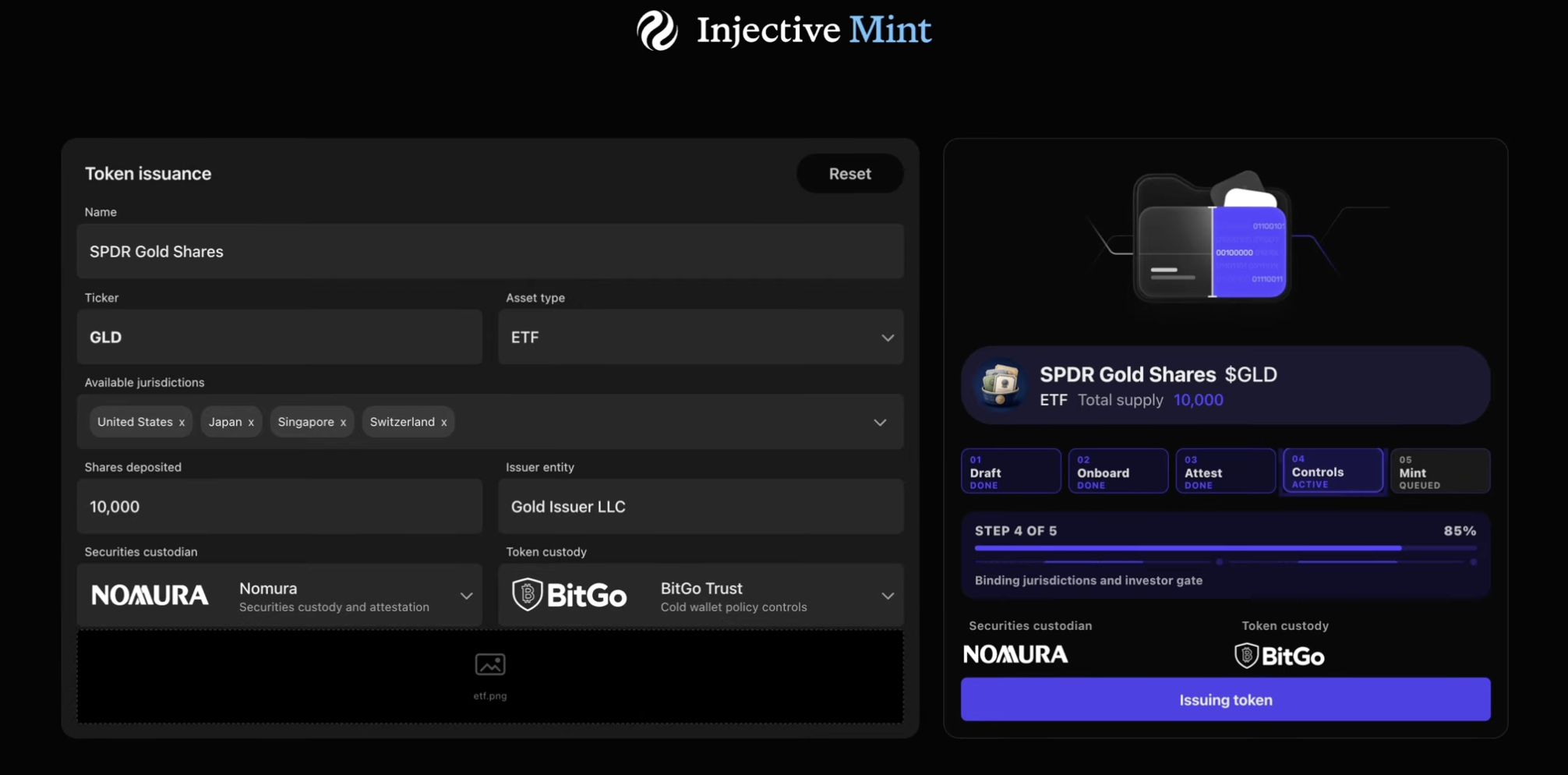
Injective Mint is an issuance platform built so that institutions can create tokenized assets without writing code. Historically, issuing a single token meant handling asset details, investor eligibility checks, jurisdictional restrictions, custodian connections, and issuance authority across separate systems. Injective Mint standardizes that process into one interface.
The values configured there do not remain application-level settings. Through Injective's native Tokenfactory and Permissions modules, holder allowlists, approved jurisdictions, minting and burning authority, and address freezes are enforced at the chain level. Transfers that fall outside the rules are rejected by the chain itself, so no custom smart contract needs to be deployed.
This allows issuers to cut the integration work between institutions and the development costs that come with the issuance process. It also replaces after-the-fact reconciliation of onchain transaction history against investor approval data: holder eligibility and transfer conditions are checked at the moment of transfer, and non-compliant transactions are blocked at the chain level.
2.2 The Missing Piece in Injective Mint: Official Ownership Records
One function, however, remains outside what Injective Mint covers on its own. Mint enforces issuance and transfer rules onchain, but that record does not automatically become the official ownership register. Token balances and transaction history are generated, yet unless the issuer adopts that record as its master securityholder file, token transfers remain separate from official changes of record.
Injective Institutional Services' TA registration adds the official recordkeeping function that Mint lacked to Injective's tokenization stack. Mint is still at the demo stage, so the actual integration cannot be stated with certainty, but the respective roles of Mint and the TA across a single asset lifecycle can be provisionally mapped as follows:
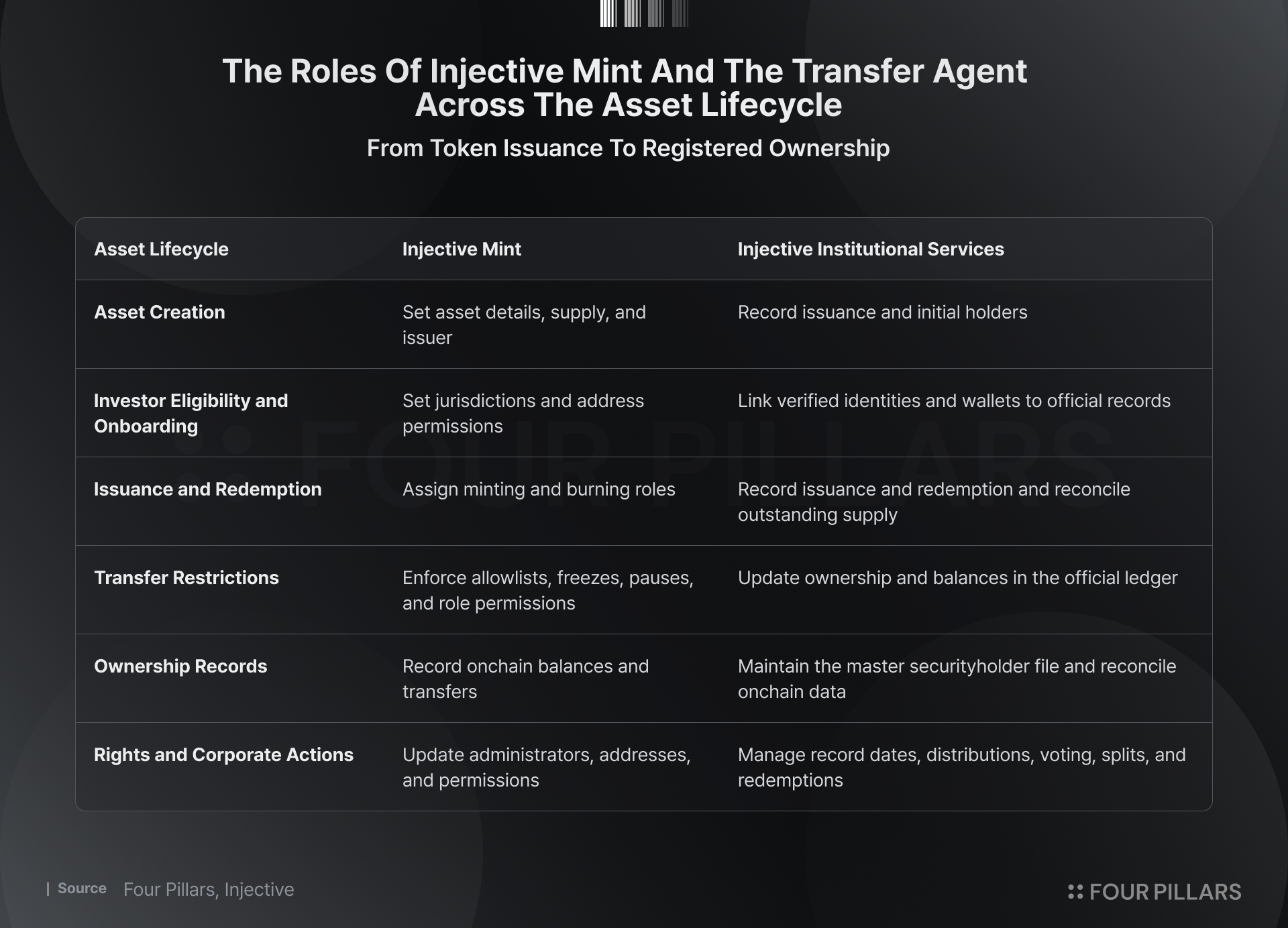
Should an issuer designate Injective Institutional Services as its transfer agent and adopt the Injective ledger as its master securityholder file or a component of it, issuance and transfer records from Mint would connect directly to official ownership records, reducing the cost and risk of separately updating and reconciling onchain balances against a standalone shareholder register.
The announced launch of Injective Mint and this TA registration therefore cannot be read as separate events. Mint supports asset creation through controls that institutions can configure at the protocol level, and the transfer agent supports the official ownership record for those securities. The two form a sequence.
3. From Technology Provider to Regulated Onchain Capital Markets
Since its launch in 2021, Injective has consistently positioned itself as a blockchain built for finance. What mattered early on were the specifications of a finance-specific chain: sub-second block times, an orderbook-based matching engine, and derivatives modules suited to running financial applications. These were the specifications of a technology provider supplying the infrastructure that crypto asset trading required.
The bar for a blockchain built for institutional finance has long since moved past chain performance. Fast execution is a precondition; what counts is whether assets issued on top of it can operate within compliance requirements. In the U.S. market in particular, maintaining securities ownership records on a blockchain requires a registered transfer agent that has filed Form TA-1 with the SEC.
Injective Mint and the TA registration are a response to these institutional requirements. Injective is also assembling components across its ecosystem so that issuance, compliance controls, settlement, and utility operate as connected functions:
- Compliance-ready asset creation and administration through Injective Mint
- Protocol-level permissioning that enforces transfer rules onchain
- Registered transfer agent capability through Injective Institutional Services
- Sub-second settlement infrastructure and financial modules supporting onchain utility across trading, lending, and derivatives
Injective is steadily assembling most of the functions an onchain capital market requires, and it stands as an uncommon case of a chain internalizing everything from asset issuance and transfer controls through to official ownership records.
On that basis, Injective aims to support asset classes spanning institutional funds, listed equities, private securities, and enterprise trade finance, and to extend its reach into U.S. securities markets. Read in that context, this TA registration matters because Injective has moved beyond being a technology provider to secure the transfer agent function that underpins U.S. securities markets.
The author of this report may have personal holdings or financial interests in assets or tokens discussed herein. However, the author affirms that no transactions have conducted using material non-public information obtained in the course of research or drafting. This report is intended solely for general information purposes and does not constitute legal, business, investment, or tax advice. It should not be used as a basis for making any investment decisions or as guidance for accounting, legal, or tax matters. Any references to specific assets or securities are made for informational purposes only and should not be construed as an offer, solicitation, or recommendation to invest. The opinions expressed herein are those of the author and may not reflect the views of any affiliated institutions, organizations, or individuals. The opinions and analyses expressed herein are subject to change without prior notice. In addition, beyond the individual disclosures included in each report, Four Pillars, may hold existing or prospective investments in some of the assets or protocols discussed herein. Furthermore, FP Validated, a division of Four Pillars, may already be operating as a node in certain networks or protocols discussed herein or may do so in the future. Please see below links in the footer for FP Validated's participating network disclosures and for broader disclosure details.


