Table of Contents
Researcher

1. JPMorgan Cuts Earnings Estimates, and the Prisoner's Dilemma Layered on USDC Distribution
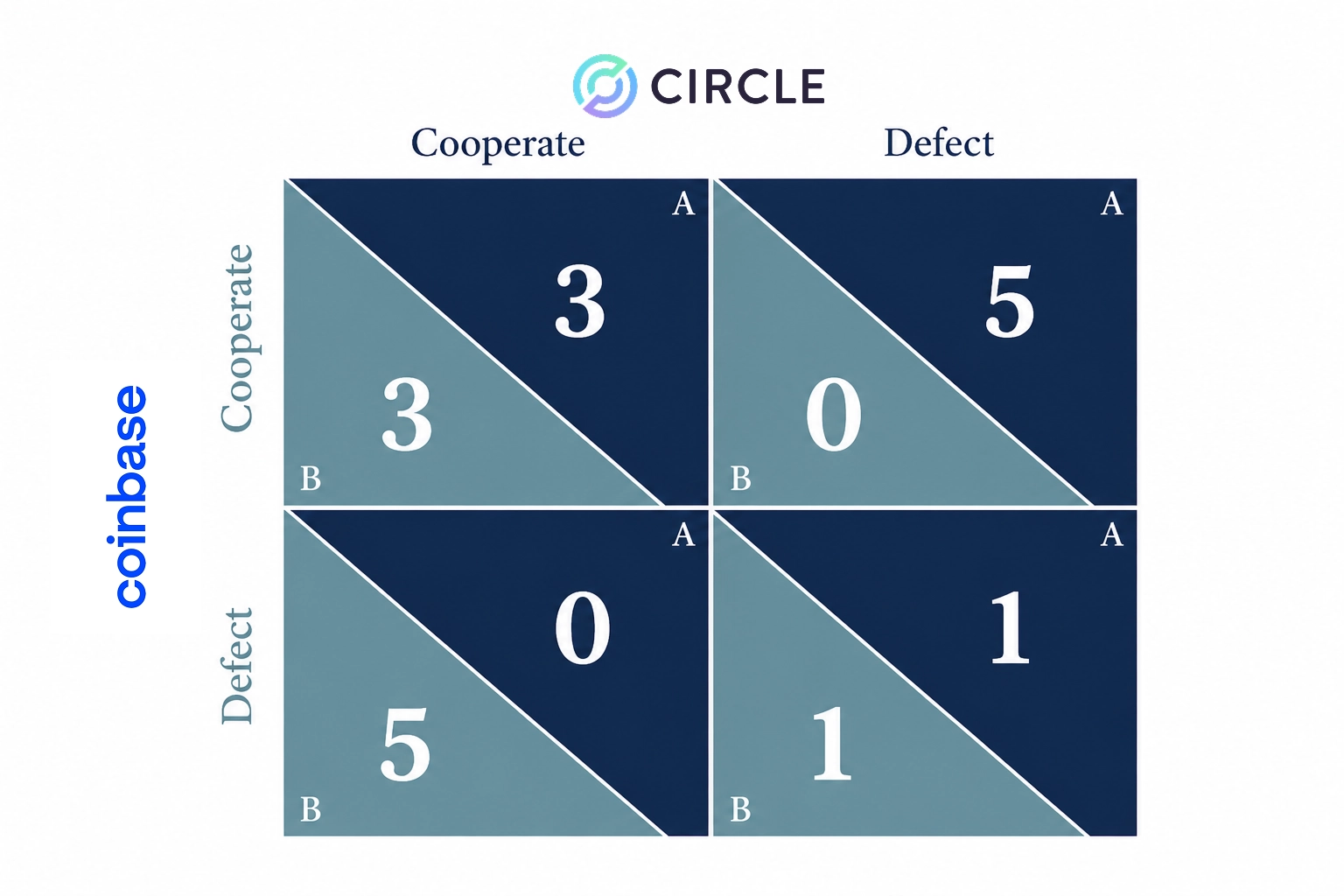
On July 14, JPMorgan cut its earnings estimates for Circle. The assessment is that the deal struck with Hyperliquid this past May weakens USDC's revenue structure and creates a prisoner's dilemma in which Circle and Coinbase compete over USDC distribution.
JPMorgan sees this deal as a larger long-term threat to Circle than to Coinbase. Placing what has happened to Circle over the past two months in order reveals the background:
- 05/14: Hyperliquid discontinued its own stablecoin USDH and adopted USDC as its AQA (Aligned Quote Asset). Coinbase serves as the reserve deployer, and Circle handles cross-chain infrastructure. The two companies each stake 500,000 HYPE and hand about 90% of the reserve income to Hyperliquid.
- 06/30: Open Standard, a consortium of about 140 companies, announced OUSD. There are no fees or limits on minting and redemption, and most of the reserve income is distributed to distribution partners. CRCL fell 13% to 16% on the day of the announcement.
- 07/10: The U.S. Office of the Comptroller of the Currency (OCC) granted final approval for Circle's federally chartered trust bank (Circle National Trust). The stock rebounded 14%.
- 07/14: JPMorgan cut its earnings estimates for Circle and Coinbase. The USDC held by Hyperliquid, cited as the reason, is about $6B, equal to 8% of total circulation.
Over that stretch, CRCL slid from a 52-week high of $263 to the $63 range, closing out the month of June with a 44.6% decline. This reads as the result of OUSD's announcement repricing USDC's long-term profitability while CRCL was dropped from growth indices, triggering mechanical selling by passive funds.
The fundamental cause of CRCL's valuation downgrade comes down to one thing: the issuer's bargaining power has shifted entirely to distribution.
Reserve management is nothing more than standardized short-term Treasury management, stablecoin issuance itself has become a commodity, and maintaining the peg is already a solved problem. The only remaining variable is distribution, and this quarter confirmed that change in the rules.
2. How the Stablecoin Negotiating Table Tilted
It is not that issuance never had a moat. USDC was managed by a consortium co-founded in 2018 by Circle and Coinbase, and when that consortium was dissolved in 2023, Circle paid Coinbase about $200M worth of shares and took issuance entirely for itself. It was a period when the right to issue was worth that much.
Since then, the tilt of the negotiating table has shifted through three stages:
- Stage 1, revenue sharing (2018 to 2024): The issuer shares reserve management income with distribution. In 2024, the distribution cost Circle paid Coinbase was about $900M, amounting to 90% of total distribution costs. In the Binance deal that same year, Circle paid $60M upfront. Distribution costs were already heavy at this point, but at least the structure held in which Circle paid a price and secured distribution.
- Stage 2, commoditization of issuance (2025.9 to 2026.5): Providers offering stablecoin issuance (Paxos USDG, Agora, M0, and others) emerged, and stablecoin issuance became a purchasable service. Substitution did not happen right away. Hyperliquid issued USDH itself, but the gap in liquidity and trading pairs left supply stalled at $100M, while USDC held at $5B. Even so, Hyperliquid later discontinued USDH and extracted about 90% of USDC's reserve income. Its own issuance underperformed, but the distribution terms it secured are better than issuing itself. The implication is that an alternative does not have to succeed. If the distribution is solid, the mere existence of an alternative raises bargaining power. It amounts to both sides admitting that distribution is everything.
- Stage 3, cracks in issuer economics (2026.6): A business that provides stablecoin issuance alone, as a single service, stops holding up. OUSD has no fees or limits on minting and redemption, and returns reserve income to partners. The issuer collects only a small management fee. Where the issuer and distribution once negotiated revenue splits, the structure has now been rebuilt so that there is nothing to split in the first place. Issuance falls from a high-margin business to public infrastructure that distribution maintains jointly.
What matters is that a clear precedent has been set. A distributor holding 8% of circulation extracted 90% of reserve income, and Compass Point estimates that the Hyperliquid deal alone erases $60M to $80M from the combined annual EBITDA of Circle and Coinbase. There is no reason the channels holding the other 92%, CEXs, perp DEXs, lending protocols, wallets, and brokers, will not gradually demand the same terms.
3. The Standalone Issuer Model Ends as a Transitional Phase, and Where the Market Goes Next
If issuance has become a commodity, a business that only issues has to prove its reason for existing all over again. What is happening in the stablecoin market right now is either an attempt at that proof, or a move by the side that no longer needs to prove it.
- A fragmented market with no negotiation: Tether holds 59% of the stablecoin market with $186.7B in USDT supply, but there is no distributor holding that volume in one place. USDT accounts for 88.5% of stablecoin activity in Nigeria and 90.2% of Binance P2P listings in Venezuela, and more than $600B moves monthly across Asia, Africa, and Latin America, mostly in tickets under $1,000. In a market where millions of people each hold less than $1,000, there is no counterparty to sit at the negotiating table.
- The local license moat: Local licensing runs on a different logic from offshore markets by erasing the distribution side's alternatives through law. SBI stacks an exchange, lending, RLUSD distribution, and JPYSC on top of its position as the only operator that can handle USDC in Japan. It is a structure in which issuance and distribution sit inside one group.
- Singapore's StraitsX likewise holds more than 70% of Southeast Asia's non-dollar stablecoin market with XSGD, the only Singapore dollar stablecoin the MAS has acknowledged as compliant. XSGD's market capitalization is $13M, a large gap in scale from USDC. The place local regulation creates is safe but narrow.
- The issuer's move into distribution: Circle is expanding its own distribution channels including Arc, CPN, and the trust bank. Rather than sharing revenue with outside distribution, it is an alternative aimed at securing new revenue sources such as gas and payment fees alongside reserve management income. Circle's CFO citing validator operations on Arc as an alternative revenue source falls in the same context. However, the more it owns distribution directly, the more it faces the dilemma of competing with existing partners.
- Distribution's move into issuance: Distribution operators are building issuance infrastructure jointly, as with OUSD, or going further and putting out their own stablecoins. Western Union connected USDPT to its global remittance network, Fidelity is pursuing FIDD, and U.S. Bancorp is pursuing its own stablecoin. Companies that hold distribution have no reason not to create a stablecoin under their own name.
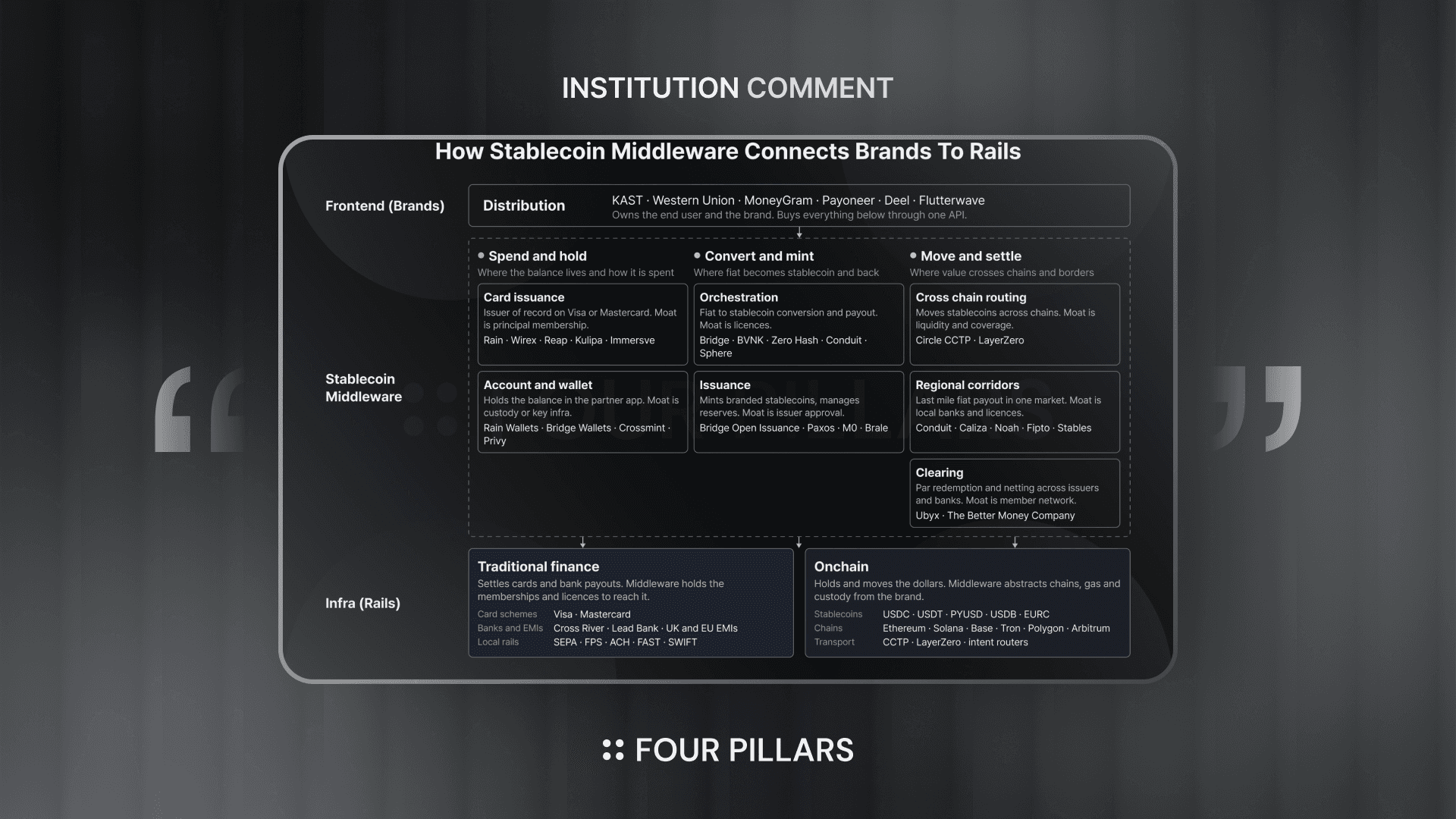
- Outsourced issuance: The entity that actually issues USDPT is not Western Union but Anchorage Digital Bank, a federally chartered bank. Agora, M0, and Bridge run the same business, and Circle also sells a white-label issuance service that lets other distributors issue USDC-backed stablecoins.
Issuance has now been demoted from the whole of the stablecoin business to a single function. As a result, the value the market pays for issuance has fallen, and the odds have risen that the standalone issuer model remains a transitional model. OUSD's early liquidity in the second half, Coinbase and Circle's distribution costs, and local stablecoins expanding their distribution networks will confirm that direction in turn.
The author of this report may have personal holdings or financial interests in assets or tokens discussed herein. However, the author affirms that no transactions have conducted using material non-public information obtained in the course of research or drafting. This report is intended solely for general information purposes and does not constitute legal, business, investment, or tax advice. It should not be used as a basis for making any investment decisions or as guidance for accounting, legal, or tax matters. Any references to specific assets or securities are made for informational purposes only and should not be construed as an offer, solicitation, or recommendation to invest. The opinions expressed herein are those of the author and may not reflect the views of any affiliated institutions, organizations, or individuals. The opinions and analyses expressed herein are subject to change without prior notice. In addition, beyond the individual disclosures included in each report, Four Pillars, may hold existing or prospective investments in some of the assets or protocols discussed herein. Furthermore, FP Validated, a division of Four Pillars, may already be operating as a node in certain networks or protocols discussed herein or may do so in the future. Please see below links in the footer for FP Validated's participating network disclosures and for broader disclosure details.