Key Takeaways
- Gold is a $30T+ asset, but it produces no cash flow. The only ways gold has generated yield were lending it out and selling its volatility (covered calls). Covered calls in particular are well proven, yet the yield was only ever accessible through institutions and asset managers, reachable only after absorbing costs such as management fees, issuer credit, fixed strikes, and opaque pricing.
- Onchain gold, offered as the alternative, is ahead on custody and mobility, but on yield alone it falls short of offchain gold. Lending suffers from thin borrow demand, and AMM LPs erode gold's upside exposure through impermanent loss.
- Enhanced is a general-purpose structured product infrastructure. For volatility yield, it can write covered calls via a competitive RFQ auction among institutional market makers, turning the asset’s own volatility into a recurring premium yield.
- The PAXG Volatility Income Vault is introduced as the first of Enhanced's "Thesis Vaults," a class of strategy vaults the Enhanced team created to express a defined payoff or outcome using options and, in the future, even binary-event positions. Specifically for this Vol Income Vault, that outcome is yield on a typically non-income-generating asset.
- Gold is only the starting point. The same engine will expand to tokenized equities, commodities, and the broader RWA universe, marking the beginning of a new generation of onchain structured products: defined outcomes delivered as single-click vaults.
1. How Has Gold Worked?

Gold has historically been the heaviest, laziest, and most inefficient asset. It is heavy in the literal, physical sense, and equally heavy from a liquidity standpoint, with high storage costs. Gold itself also generates no cash flow the way bonds or equities do. As a result, gold is a $30T+ asset class that has served as a primary store of value for centuries, yet holding it over long periods meant accepting a permanent opportunity cost.
1.1 Two Ways to Make Gold Productive
There was, of course, never a complete absence of options. The honest ways to generate yield from gold developed along two tracks. One is lending it out, the other is selling its price movement. The lending market emerged first, and the market for selling volatility deepened later.
1.1.1 Lease: The Gold Leasing Market
Like the roughly 300-year-old London gold market, gold leasing is one of the oldest practices in finance. Today it works by central banks and large holders lending their gold to bullion banks, which in turn supply that gold to refiners, jewellery manufacturers, miners, and other industrial players with hedging demand.
The logic behind gold lending demand is simple. It is borrowing in gold and repaying in gold to hedge raw-material price risk. A company that uses gold borrows the gold itself instead of buying it with cash, and repays only the same weight of gold plus a lease fee. Because the liability is denominated in gold weight, if the gold price rises the product price rises along with it, easing the repayment burden, and if the gold price falls the company can buy gold more cheaply to repay.
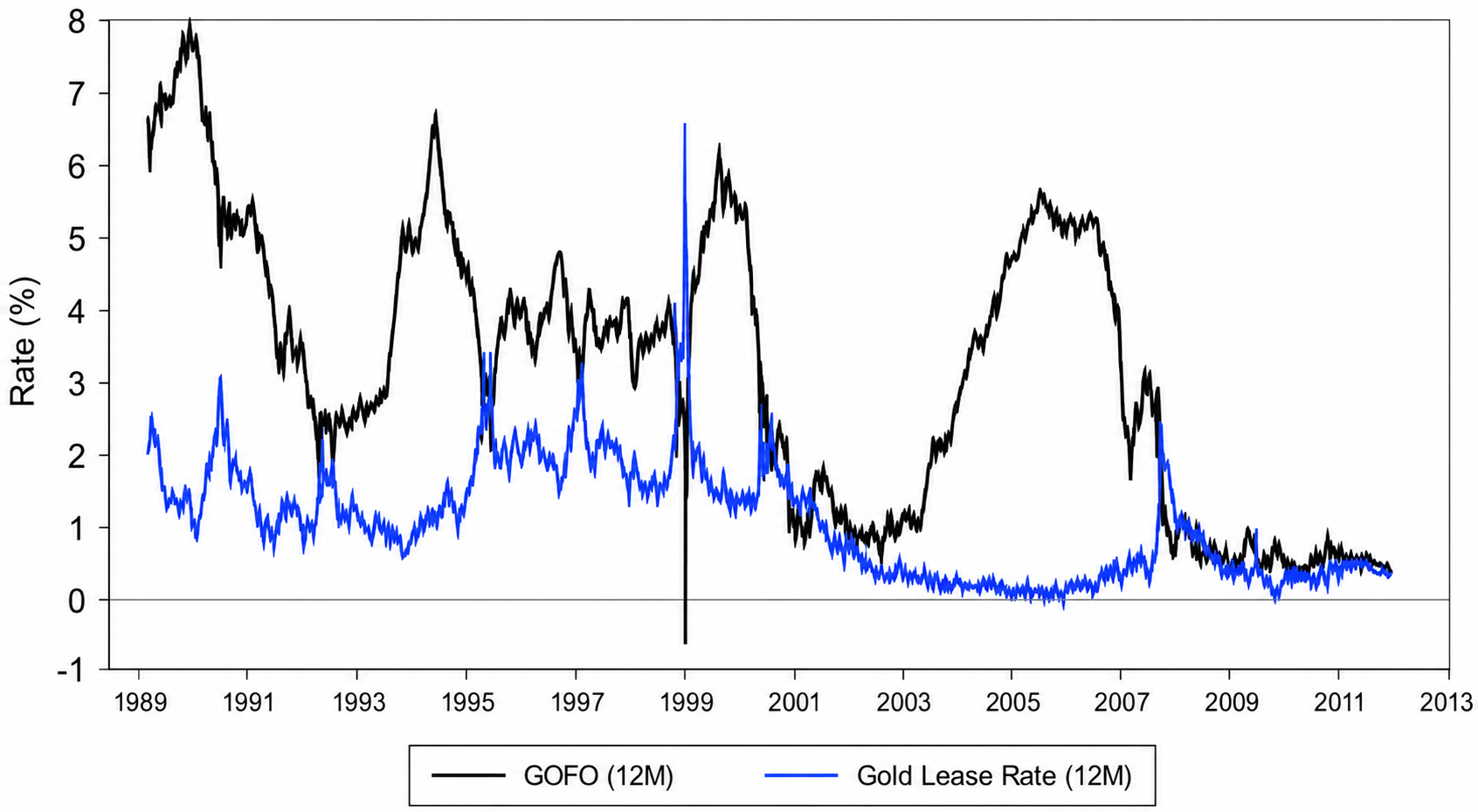
Source: LBMA
This approach, however, has an inherent ceiling from a yield standpoint. Gold lending income depends entirely on borrow demand. Because demand to borrow gold is thin and cyclical, lease rates rarely exceeded 1-2%, and during the zero-rate period of 2009-2011 they even turned negative, to the point where the lender ended up paying to lend.
Moreover, how this yield is priced is hard to observe from outside the market. External observers could only track it indirectly through limited benchmark indicators such as GOFO. After the LBMA discontinued that indicator (GOFO), the public window that tracked gold forwards and lease rates effectively disappeared. In the end, the gold lending market is left with two constraints intact: thin borrow demand and opaque price discovery.
1.1.2 Selling Volatility: From Forward Sales to Covered Calls
Since gold itself has no cash flow, the only material to financialize is its price and volatility. The second approach is selling this price movement. Miners contract to sell their expected production at a fixed future price, defending revenue even if the gold price falls by the time of sale. In exchange, they give up the chance to sell at a higher price if gold rises.
This approach has long been proven, but the problem arose when the trade exceeded holdings or production capacity. If a producer pre-sells more than the gold it can actually secure, it has to bear the difference between the contract price and the market price outright when gold rises.
In 1999, Ashanti Goldfields had built up large forward-sale positions, and when the gold price surged that year on the European central banks' agreement to limit gold sales, it took a hedge-book loss of over $500M and, unable to meet the margin calls, was pushed to the brink of bankruptcy. The gold income strategy that survived and became the standard is the covered call.
1.2 Covered Call, and Its Limits
1.2.1 What Is a Covered Call?
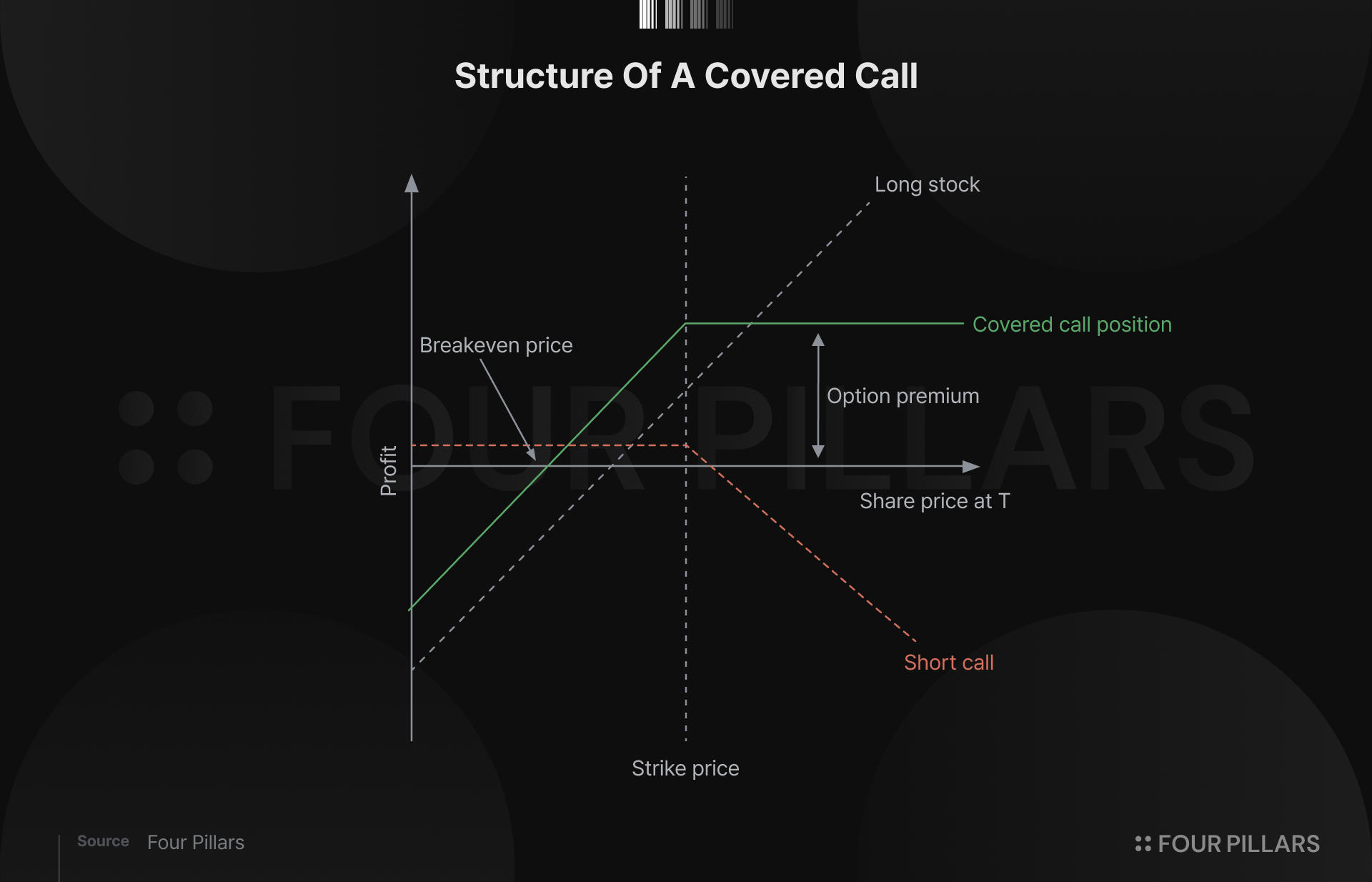
ㅌA covered call is a strategy of handing over part of the upside on an asset you already hold, and receiving a premium in return. The difference from an uncovered forward sale is simple. You only sell as much as you hold. Rather than pre-selling gold you don't have or hedging beyond production capacity, you hand only part of the price ceiling on gold you already own to the market.
For example, a gold holder hands over the right to buy at a given price if gold rises more than 4% above the current level within two weeks, and receives the option premium, the price of that right, in cash. The outcome then splits into two, depending on the gold price:
- Below 4%: If the gold price did not rise more than 4% after two weeks, the right simply expires, and the premium received is entirely yours to keep.
- Above 4%: If it rose more than 4%, you have to hand over the gold at that price as agreed. Even here you keep the premium and the upside up to 4%, and give up only the portion that rose above it.
In either case, you are only selling the price ceiling within the range of gold you hold, so even if gold rises sharply and you give up the excess upside, the loss cannot compound beyond your holdings or spiral into a margin call. If an uncovered forward sale was a bet placed with nothing in hand, a covered call is closer to lending out the price ceiling of an asset you own for a set period and collecting a fee for it.
Traditional finance packaged this safer form into a product. GLDI, listed on the Nasdaq in 2013, was one of the early gold covered-call products, offering a structure that sells monthly call options on a gold ETF and pays the premium as a variable coupon. In its first year, the annualized yield swung between 9% and 26%. Demand is still alive today, and even stronger. IAUI, a gold income ETF listed in 2025, saw its assets under management approach $500M within a year, and in 2025 alone more than 60 new option income ETFs were launched.
1.2.2 The Limits of the Covered Call
The demand and track record for covered calls are well proven. Treasuries holding gold, institutions holding equities, and structured products in which wealth managers layer an option strategy on top of client portfolios all rely on the same principle. Yet the covered call cannot be perfect either, because before an investor reaches the yield of the option premium, they must take on considerable costs and structural constraints:
- Management fees: GLDI's expense ratio is 0.65% annually, deducted before the option premium reaches the investor. On top of this, access costs such as a brokerage account, KYC, custody, and exchange operating hours add up, reducing the yield.
- Issuer credit: GLDI is not strictly an ETF but an unsecured note (ETN) issued by the Swiss financial group UBS. The investor does not hold gold directly, but holds the right to be paid the yield UBS has promised. Even if the gold price and the option strategy work normally, if the issuer's credit runs into trouble the claim itself can be impaired.
- Rigid strategy: Covered-call products sell call options repeatedly on a fixed schedule. This approach produces stable yield, but in phases where the asset price rises quickly the upside is repeatedly cut off. This is made worse because most of these strategies in TradFi are for monthly tenors. This is inflexible and usually results in a serious cut of upside.
- PBP, the most representative equity covered-call ETF, returned 7.2% annually over the past decade, while the S&P 500 returned 15.7% annually over the same period. The gap comes from setting the strike close to the underlying price and fixing the tenor on a monthly basis. Even a small rise cuts off the excess upside, and if a sharp rally occurs in the meantime, the position is hard to adjust midway.
- Opacity of price discovery: Conditions like the strike and tenor are set by the manager, and the investor can hardly verify in which market and at what price the option was actually sold. The investor can see the final distribution, but has little way of knowing how competitively that premium was formed, or how much leaked out as cost during operation.
In short, a path to harvesting gold's volatility clearly existed. But that path only ever opened through institutions and asset managers, and it came bundled with constraints: fees, issuer credit, fixed strikes, and opaque pricing. Yield existed, but the entire route to reaching that yield was intermediated.
Accordingly, finance has naturally developed toward stripping out intermediation. And onchain presented a compelling blueprint at exactly this point. Yet examining the existing onchain yield sources one by one, at least on yield, onchain gold falls short of offchain gold.
2. Onchain Gold Falls Short of Offchain Gold on Yield
2.1 What Onchain Promised, and the Reality
Onchain promised a great deal at the outset. It was the expectation of trading assets without an intermediary layer, verifying every settlement onchain, and above all composability, combining assets like Lego with other financial products. This meant a future that strips out issuer credit, opaque price discovery, and distribution costs. Yet that promise was only half fulfilled.
Consider gold, the representative tokenized asset. The onchain gold market has surpassed $5B, and in Q1 2026 the spot trading volume of tokenized gold surpassed $90B. Gold can now be traded 24/7 with only a wallet, bought in fractions of a dollar, and accessed without a brokerage account. On custody and mobility alone, onchain gold clearly offered a better alternative.
But once you move to the perspective of yield, the story flips. Offchain gold holders can receive double-digit covered-call coupons through products like GLDI. By contrast, the options given to someone holding the same gold onchain are far more limited. Consider lending and AMM LP, the most common onchain yield sources.
2.1.1 Lending
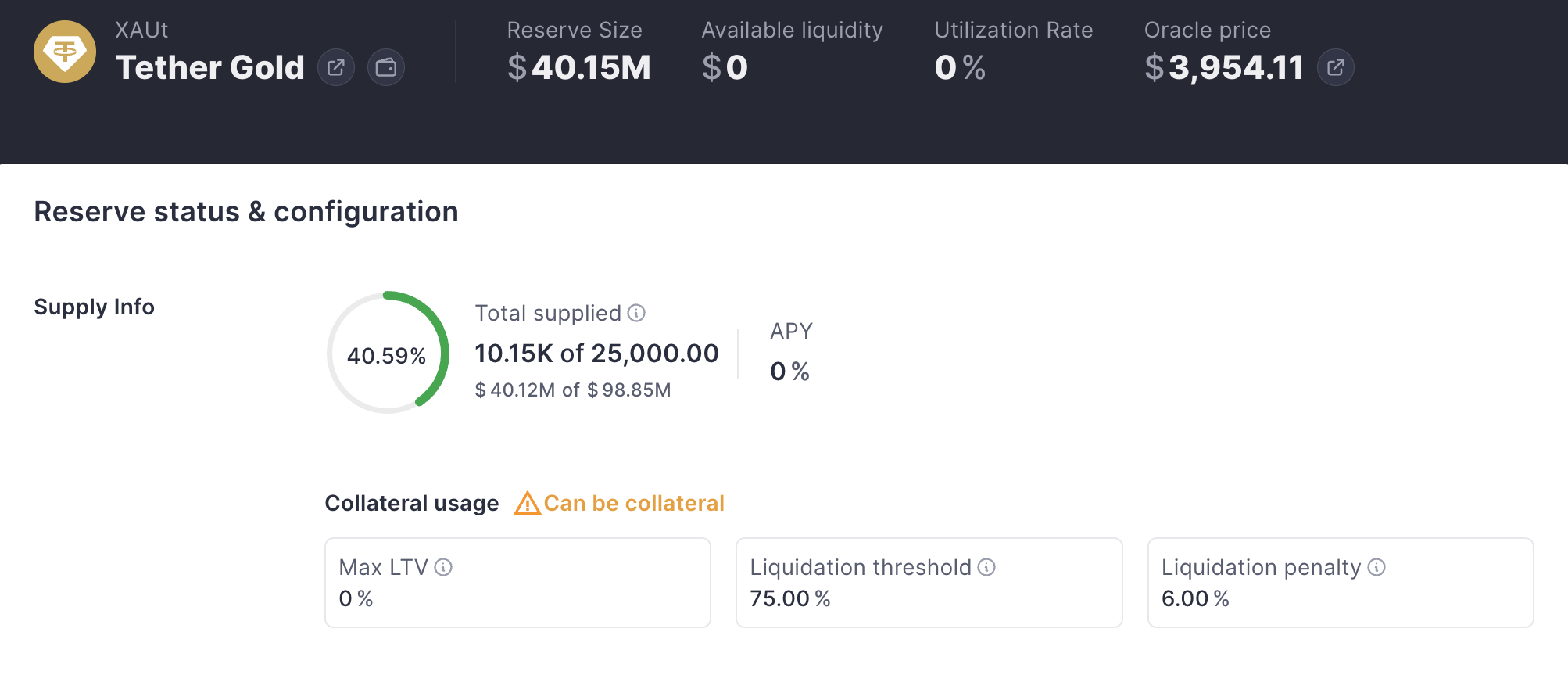
Source: Aave
There is a path to lend tokenized gold and earn yield, but the actual options are very limited. Looking at Aave's XAUt market, the supplied amount reaches about $40M, yet for XAUt the borrowable liquidity is 0 and the Max LTV is also 0%. For risk-management reasons, it is closer to a state where deposits are allowed but borrowing and collateral use are disabled.
The reason lies first in liquidation risk. Tokenized gold has shallower order depth than ETH or USDC and its oracle updates are less frequent, so it is hard to be confident it could be disposed of without slippage in a large liquidation. Aave therefore chose to allow XAUt only as isolated collateral and to accept it only in a limited way under conservative parameters.
More fundamentally, the demand to borrow gold itself is thin. For ETH, staking yield, leverage demand, and its role as base collateral across DeFi overlap, so borrow demand naturally arises. Gold, by contrast, is closer to a hedge and store-of-value asset with annual volatility of around 10%. There is little incentive to pay interest and take on liquidation risk to borrow it. In the end, lending has not yet made tokenized gold a productive asset.
2.1.2 AMM LP
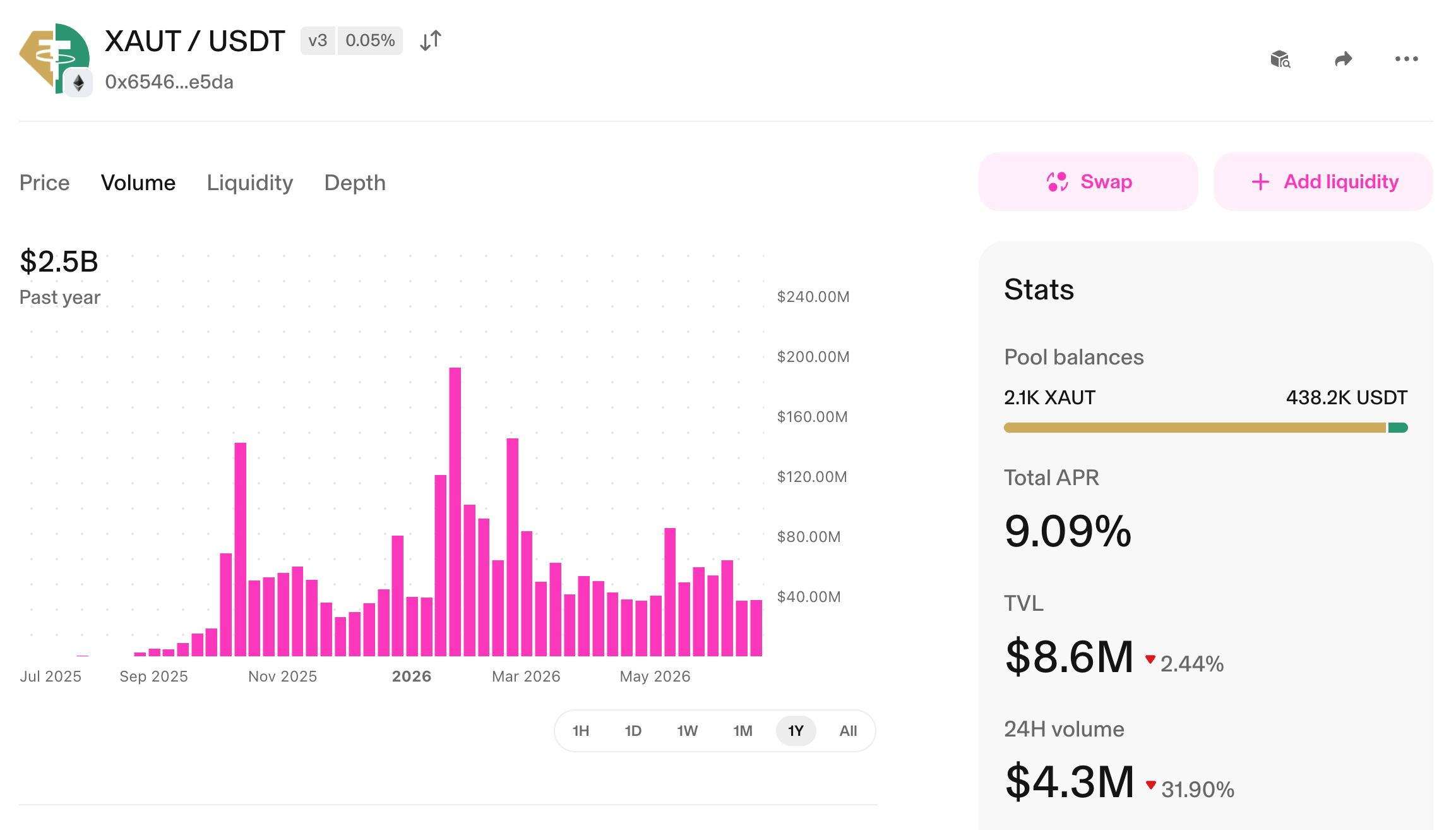
Source: Uniswap
There is also the method of putting tokenized gold into a pool alongside USDT and collecting trading fees. Uniswap's XAUt/USDT pool displays an APR of about 9%. But this number is far from what the LP actually pockets. The displayed APR is merely the recent trading fees annualized, a figure before impermanent loss is deducted.
An LP splits capital between gold and USDT and supplies two-sided liquidity. Here the AMM adjusts the pool's weighting by selling the asset whose price rises and buying the one that rose relatively less. When gold rises, the pool hands the appreciated gold to the market and receives USDT. As a result, part of the upside the holder would have enjoyed simply holding gold is diluted as impermanent loss in the LP position.
The LP's yield therefore cannot be judged by the displayed APR alone. Over the course of 2025, while spot gold rose more than 60%, the XAUt/USDT LP earned around 9% in fees but the holder could hardly capture the price appreciation in full. In the end, the users this fits are very limited. For a holder who wants to carry gold as a store of value, neither impermanent loss nor the burden of managing a range is a fit. The LP is closer to a trade that works only for a subset of investors willing to swap part of their gold upside exposure for fees.
2.2 Reimagining Structured Products Onchain
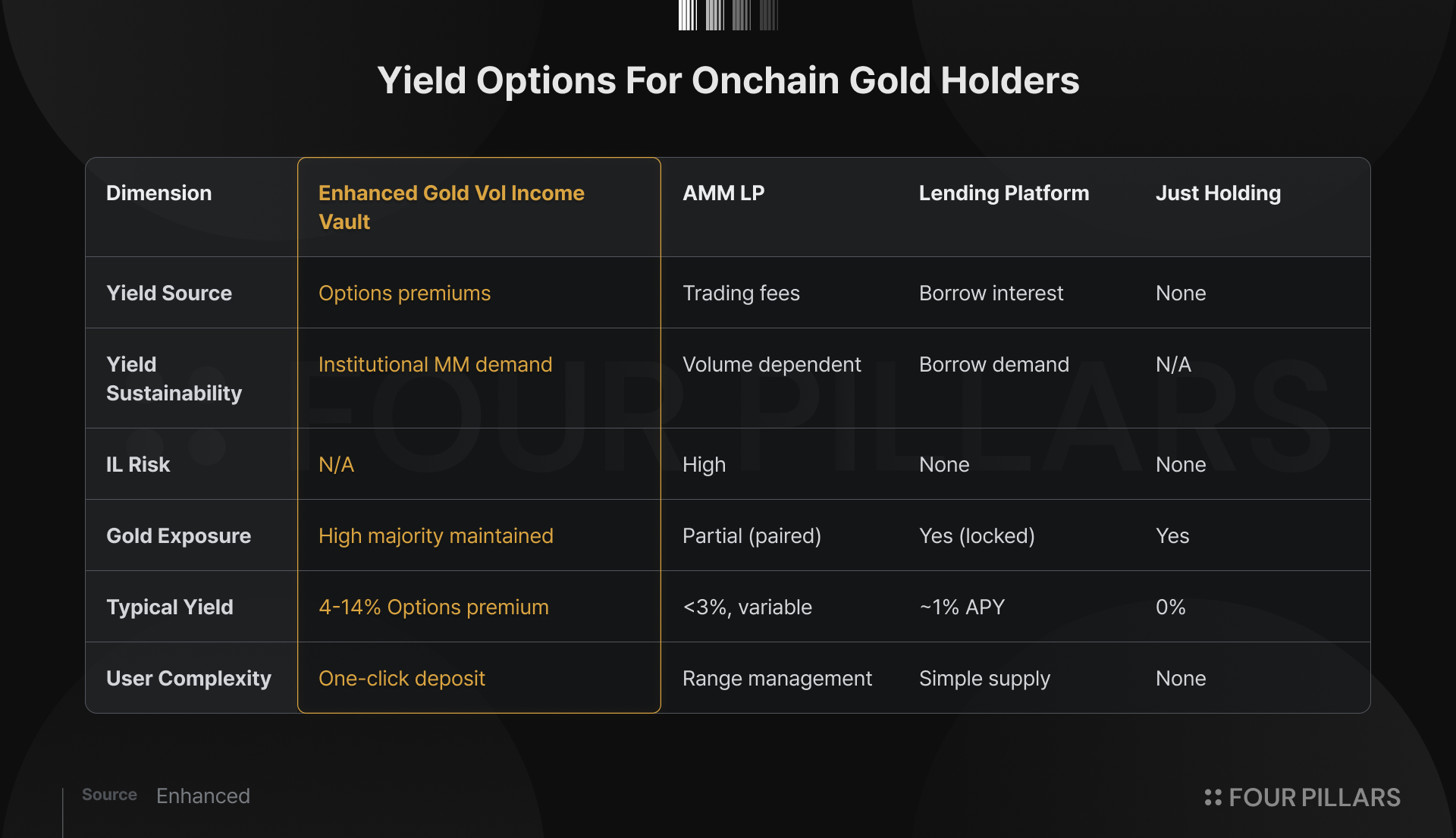
Neither lending nor AMM LP became the answer for tokenized gold. One suffers from thin borrow demand, and the other actually erodes the very exposure gold holders want to protect. If this missing yield layer persists, has tokenization really upgraded the offchain asset?
Putting a real-world asset onchain is not free. Issuance, custody, legal structure, reserve management, and contract risk all carry considerable cost. If what you get for paying that cost is only atomic settlement and 24/7 trading, it is hard to say the benefit outweighs the cost. In other words, yield is not an add-on feature of a tokenized asset, but the minimum condition for the onchain transition to be an upgrade rather than a downgrade. Seen differently, this is really about reimagining structured products onchain - moving the outcomes TradFi packaged behind fees and intermediaries into open, verifiable vaults.
Moreover, the absence of a yield layer does not appear equally across every asset class. Assets that already have cash flow, such as government bonds or private credit, can move their coupons onchain relatively easily. By contrast, assets without native cash flow, such as gold, commodities, and equities, have no coupon to move onchain in the first place, and their existing yield sources, whether lending, trading volume, or staking, are all thin or absent.
Onchain assets therefore need a layer different from the existing yield sources. That layer, however, does not have to be an entirely new invention. The covered call examined earlier is one such alternative. As it coincides with the timing of institutional capital moving onchain, the importance of infrastructure that can execute this strategy, proven in traditional finance, onchain is growing as well. Enhanced’s infrastructure as a yield layer is worth watching at exactly this point.
3. Enhanced: A Structured Products Layer That Can Turn Volatility Into Defined Outcomes
Enhanced is an institutional-grade structured-yield infrastructure for onchain assets. If the early task of onchain finance was issuing and moving assets, the next task shifts to how those assets can be operated productively. Enhanced sets out to fill this empty yield layer with derivatives-based strategies that package defined payouts into single-click vaults.
3.1 The Core Engine: The RFQ Auction Engine
At the center of the yield strategy is the option. When a user deposits an asset, Enhanced creates an option-writing position collateralized by that asset and sends it to an auction where institutional market makers compete. The market maker offering the best terms buys the option, and the premium goes back to the user. It is a structure in which the asset's volatility is converted into recurring yield.
Every option position in Enhanced starts from an RFQ (Request for Quote) auction. The process is as follows:
- Taker (Request): The taker (an institution, a whitelisted holder, or a vault) initiates the RFQ by defining the option it wants to write against its holdings. It specifies the trade terms, the underlying asset, strike, expiry, quantity, direction, and collateral, while leaving the price open.
- Market maker (Quote): A market maker responds by putting a price on that request. It signs a quote that adds the premium it will pay to those terms, and that signature locks in every term.
- Taker (Confirm): The taker compares quotes from several market makers, selects one, and creates a matching confirmation signature.
- Operator (Execute): A backend operator relays both signatures to the onchain gateway, which verifies the signatures, opens an isolated margin vault, writes and sells the option, and then routes the premium back.
For the integrity of the auction, Enhanced runs the RFQ as a permissioned market-maker set. Only identified, vetted top-tier institutional market makers can submit quotes. Each market maker goes through a signed onboarding process and submits quotes under a unique signing key. Through this, every quote is bound by a signature, and each quote is single-use only. On top of this, the active market-maker roster expands gradually as additional partners complete onboarding and risk review.
Seen this way, Enhanced itself is closer to a single option-execution engine than a single product. The engine connects institutional market makers and onchain asset holders through an RFQ (Request for Quote) competitive auction, with two interfaces laid on top. One is the RFQ interface for institutions and large holders, the other is the automated vault interface for general users, and both share the same engine, the same auction, and the same settlement.
3.2 The Manual RFQ Interface
This is the interface through which institutions and large holders access the engine directly. They can sell covered calls directly against their holdings and build custom structures with the tenor, strike, quantity, and direction adjusted as needed. Once a market maker submits a quote and the trading party selects and signs the quote it wants, the trade executes in a single atomic transaction. Because all terms are signed in advance, the operator cannot alter them arbitrarily. Selling puts and buying options will be introduced later.
This manual RFQ interface is built for parties that need latitude in managing their assets. Foundation treasuries, sophisticated investors, and listed-company crypto treasuries that hold large assets have a need to adjust the timing and terms of sale on their own. For a treasury that has stacked substantial assets on its books, like Metaplanet or Sharplink, it becomes a custom option-execution channel to monetize holdings directly.
With this, every term of the trade is fixed by both parties' signatures, and settlement is verified onchain. The operator cannot step in mid-way to change the price or quantity, and the holder's assets are never moved outside the signed terms. It is a structure in which an institution faces the market directly, yet without having to rely on trust in the counterparty or an intermediary.
3.3 The Vault Interface
This is the interface in which the vault calls the same option-execution engine on the depositor's behalf. The vault turns a defined outcome into a single-click product in which the depositor chooses the strategy, and the engine handles the option mechanics underneath.
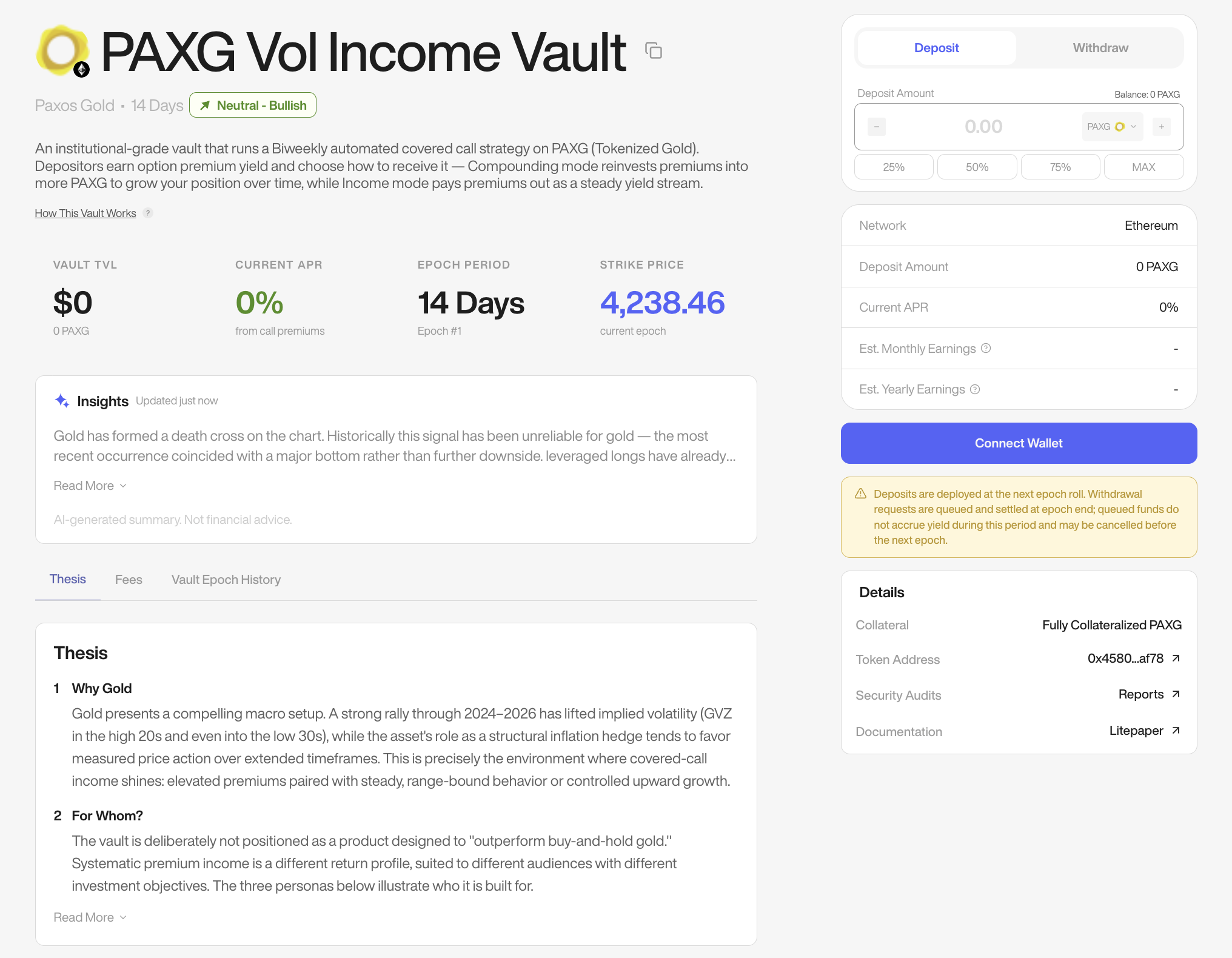
Enhanced calls these strategy vaults Thesis Vaults, a class of vaults created to express a single defined payoff or outcome. Each vault takes a thesis that a sophisticated trading desk would normally structure by hand, such as earning income from volatility or, in the future, paying out if an event resolves in a certain way, and compresses it into a single deposit. The first generation is built on options, with binary-event positions to follow.
For the PAXG Vol Income Vault, it then sells covered calls through the RFQ auction on a fixed schedule and distributes the premium received to depositors each epoch.
Each vault is created with fixed parameters covering the underlying asset, collateral asset, strike-denomination asset, epoch length, deposit cap, minimum deposit, and target-strike conditions. Because the vault ID is determined by the hash of this parameter set, the conditions of a vault, once created, cannot be changed arbitrarily midway. Tokenized gold is queued as the first asset to which this vault mechanism is applied.
4. The PAXG Volatility Income Vault: How Gold's Volatility Becomes Income
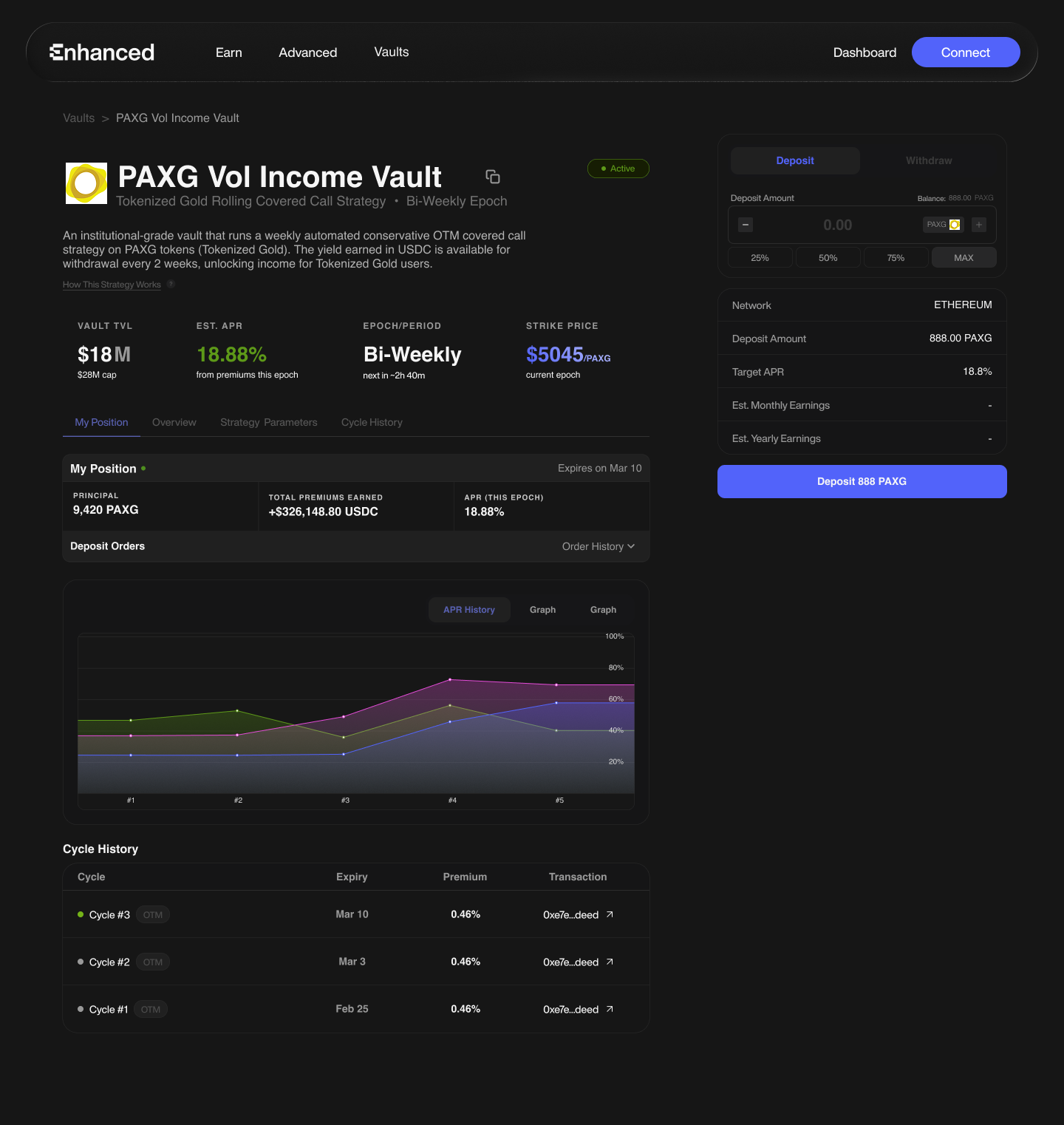
Source: Enhanced
The PAXG Vol Income Vault is the first of Enhanced's Thesis Vaults. Gold, of course, is only the first asset applied; the larger market Enhanced targets is a structured-yield layer across onchain assets as a whole.
Still, there is a clear reason for starting with gold. One is that gold's recent implied volatility fits covered-call income especially well:
- The strong rally through 2024-2026 has lifted gold's implied volatility (GVZ) from the high 20s into the low 30s.
- Because gold is an inflation-hedge asset, it tends to move relatively gently over the long term. This combination of high premiums and controlled price action is the environment where covered-call income works best.
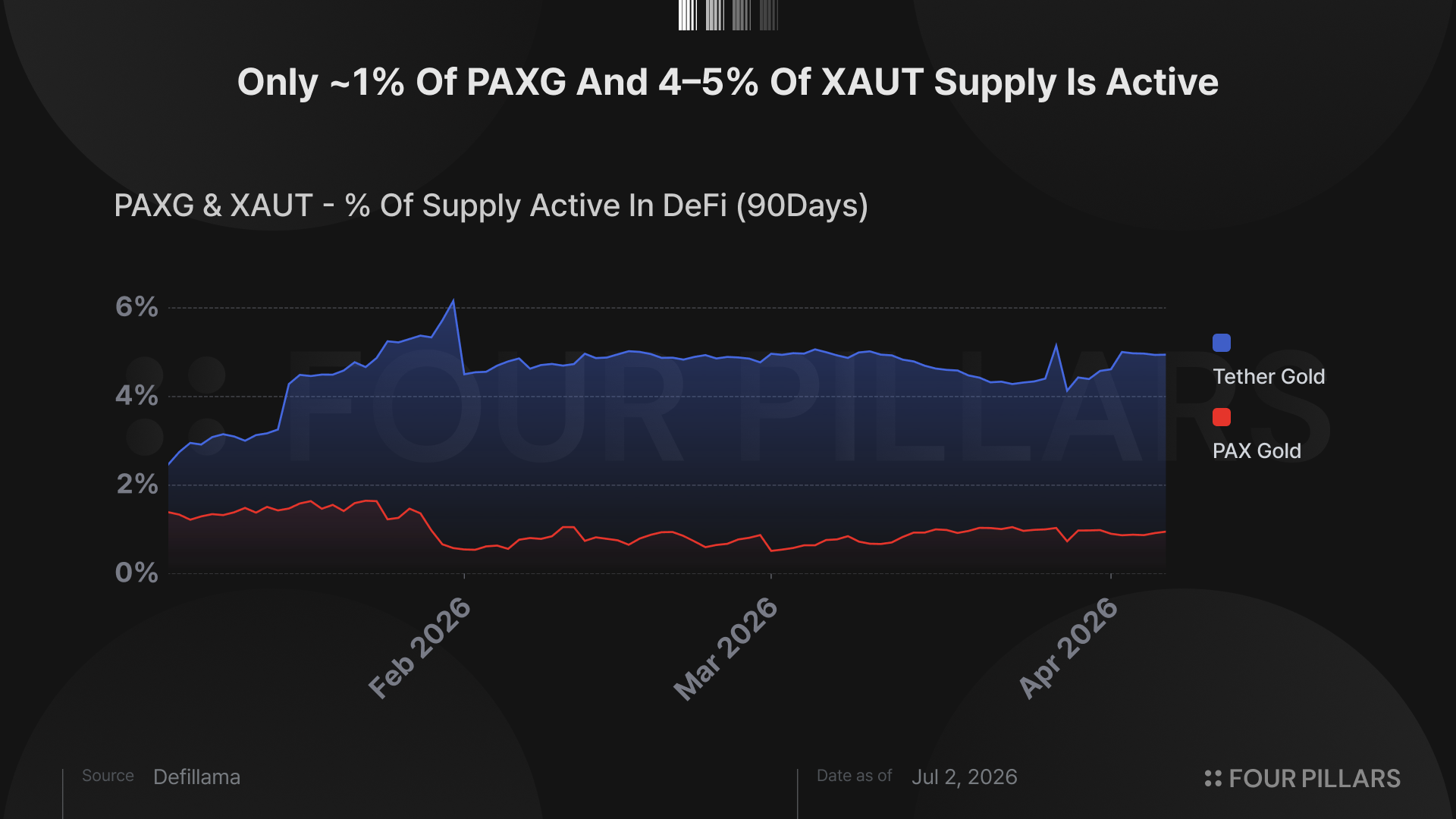
The other is that it is the asset with the largest empty yield surface onchain. According to DeFiLlama, about 96% of PAXG and XAUT sits idle. This means most onchain gold is held passively, without being put into any dedicated yield strategy.
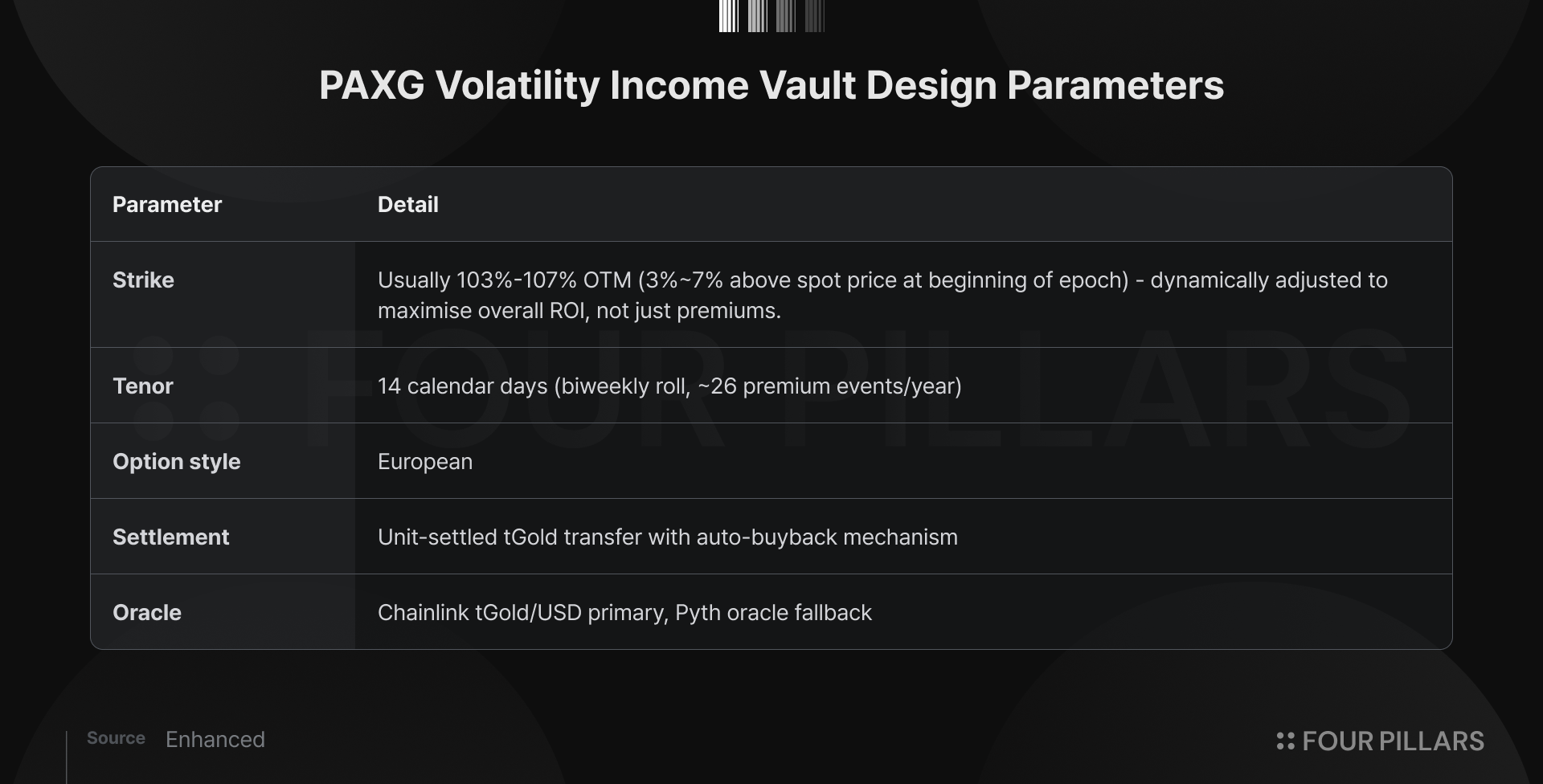
The vault writes European-style covered calls collateralized by deposited PAXG. The strike is usually out-of-the-money (OTM) at 3-7% above spot, and the tenor is two weeks. But the strike and option size are not fixed values. They are dynamically adjusted within the OTM range each cycle, reflecting market signals and price action.
The goal is to dynamically adjust the OTM range so as to retain as much gold exposure as possible while still securing sufficient option premium. This is where it diverges from traditional finance products that fix the strike on the same monthly rule.
More concretely, this yield optimization shifts with market conditions. When gold's implied volatility (GVZ) is elevated, the option premium itself is thicker, so the strike can be pushed farther out (a higher OTM strike) to preserve more upside while still capturing sufficient premium.
Conversely, when volatility is low and prices are stable, premiums are thinner, so the strike is tightened closer to spot to lift the premium collected. In other words, even within the same biweekly tenor, the vault re-finds the balance between premium and upside to match the prevailing volatility environment.
Once these terms are set, the option goes straight to auction. Institutional market makers compete over this option in the auction, and the winning premium is paid to depositors upfront. Since it gets complicated in words, follow it with numbers:
- Deposit: Assume that when spot gold is at $4,000, a user deposits 10 PAXG, worth about $40,000.
- Option writing: Every two weeks the vault sells a covered call collateralized by this PAXG. If this cycle's strike is $4,160, 4% above spot, the vault hands the market maker the right to buy at that price should gold exceed $4,160 within the next two weeks, and receives a premium upfront in return.
- Not exercised: If gold does not exceed $4,160 after two weeks, the call option expires unexercised and disappears. The depositor keeps all 10 PAXG and takes the full premium. Most cycles fall here.
- Exercised: If gold exceeds $4,160, rising to, say, $4,300, the market maker exercises the right. In this case the depositor takes the premium and the upside up to $4,160, and gives up only the $140 of excess upside above that. Because only the difference is settled, the depositor retains the majority of the gold position.
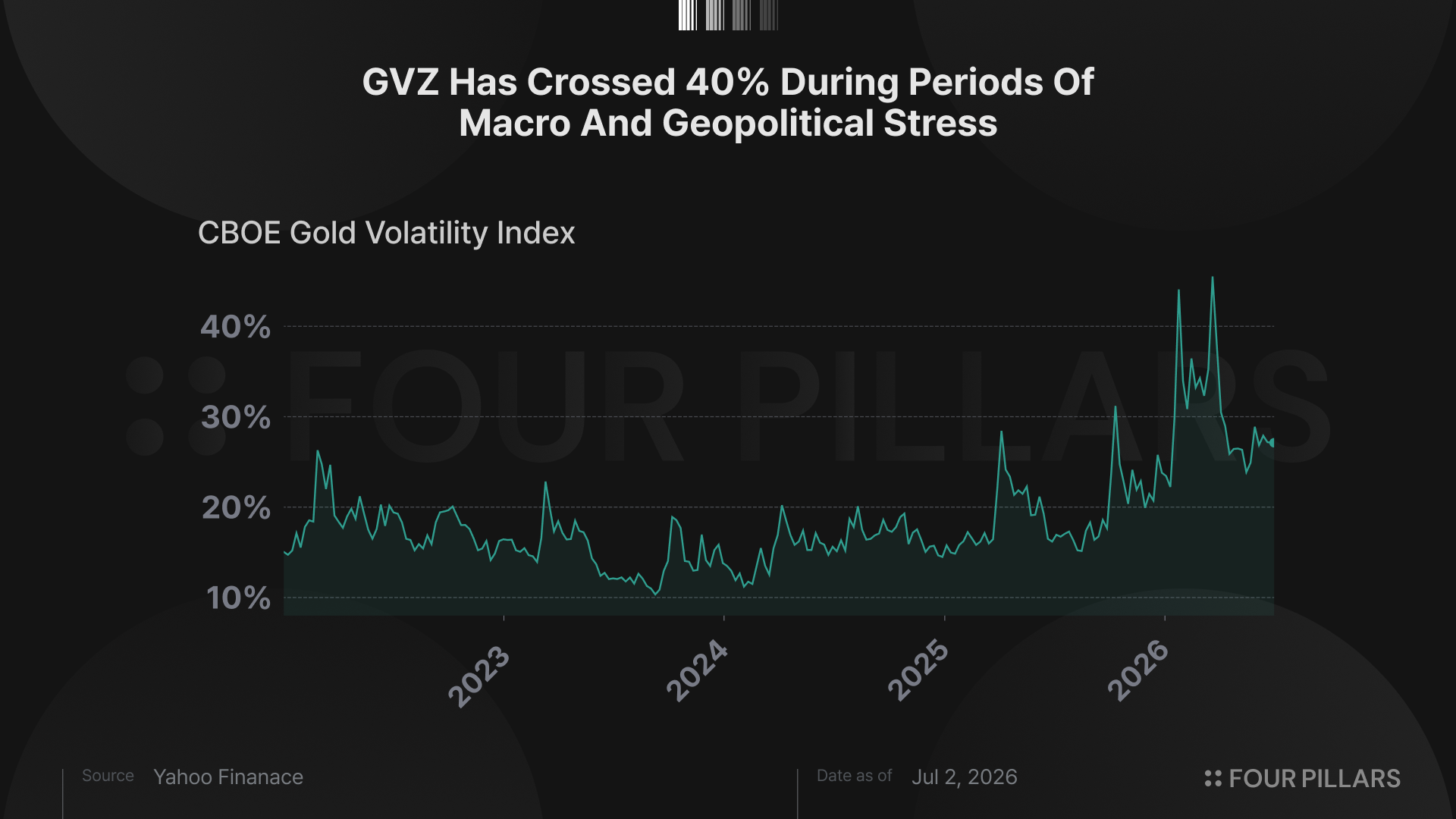
As a result, if a cycle's winning premium is 0.4% of the deposit, that generates about $160 in yield on a $40,000 basis. This cycle repeats about 26 times a year. The premium varies with gold's implied volatility and can be thicker in stretches where implied volatility is elevated at around 30%. In uncertain periods when geopolitical risk flares up, GVZ has even crossed 40%. On an actual operating basis, the premium yield is expected to move in roughly the 4-14% annual range.
- Compounding mode (default): The premium is automatically swapped into PAXG and added to the principal in the next epoch, and if an exercise occurs, the settlement proceeds are used to buy gold back and restore the position. It suits long-term holders who want to carry gold throughout the cycle.
- Income mode (optional): The premium accrues in USDT to a separate balance and can be withdrawn at any time, even during an epoch. It is a mode for those who want to pull cash flow from their holdings without agonizing over exit timing.
The protocol fee is not charged upfront but settled per epoch. The vault charges 0.019% protocol fees every epoch on the capital deposited, which annually turns out to be 0.5%. As a result, users do not have to pay the fee upfront; instead, the fee is settled every epoch the vault operates. There is no separate withdrawal fee, and this rate is fixed at the time of vault creation and can be verified onchain.
5. What Makes Enhanced Different, and What It Accepts
5.1 What Sets It Apart From First-Generation Onchain Vaults
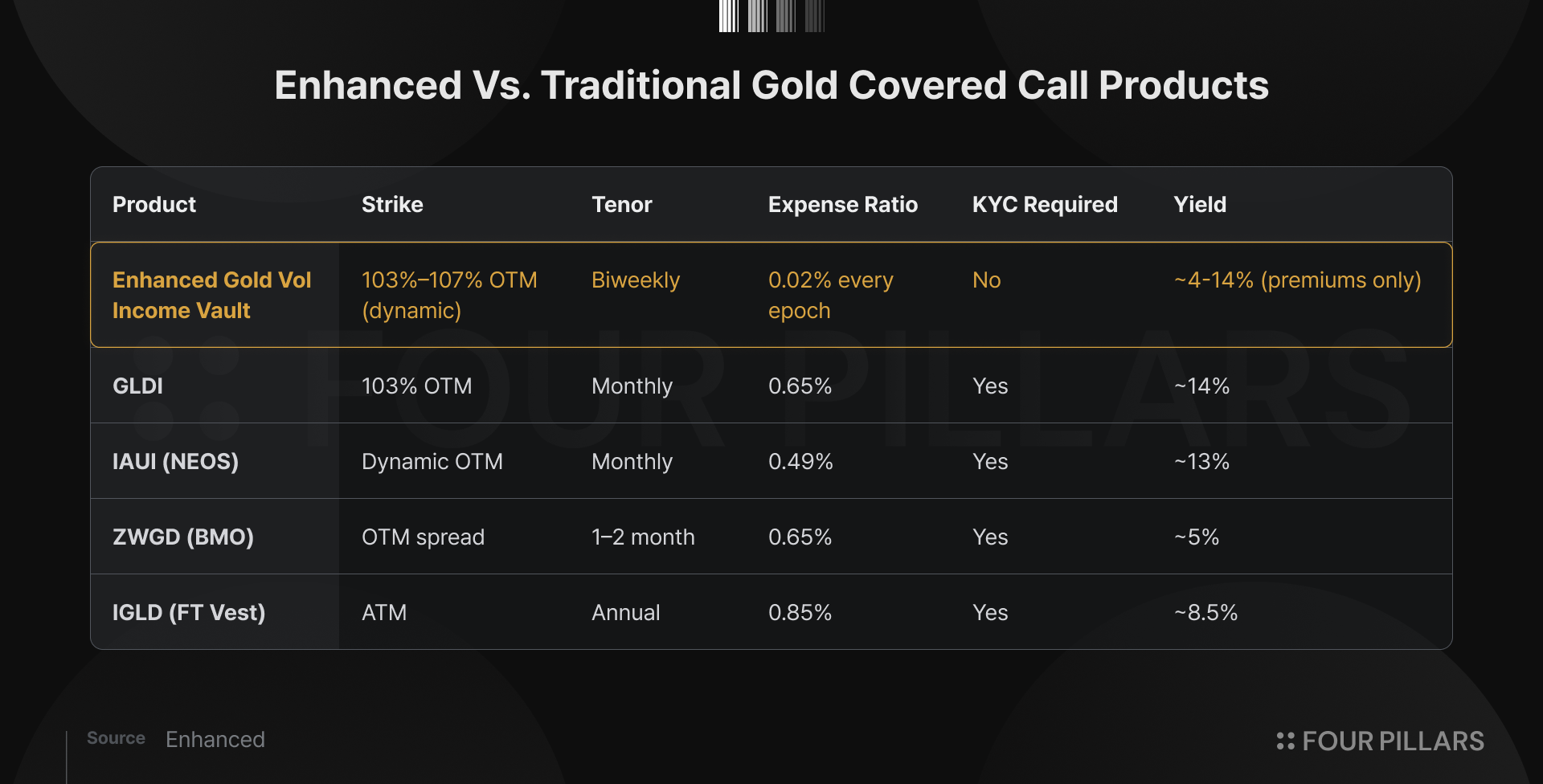
Enhanced's vault was reverse-engineered from every gold covered-call ETF currently operating in traditional finance. Its differentiators can be cited as a management fee comparable to or lower than traditional finance, the absence of an intermediate distribution layer, global access without KYC, 24/7 operation, a biweekly tenor for faster theta capture, and the transparency of every fill, fee, and expiry being recorded onchain.
Taken together, this signals a broader shift: the next wave of onchain structured products won’t resemble traditional finance wrappers or early crypto vaults. Instead, they’ll focus on clear, defined outcomes, hide the underlying complexity, and operate with transparent execution.
Enhanced is not, of course, the first onchain vault to sell volatility. In 2021, Ribbon Finance opened this model with its Theta Vault, and its TVL once reached $170M. First-generation vaults proved that demand for structured yield is real, but they also left clear weaknesses, and Enhanced was designed to address these limits:
- Auction-based price discovery: First-generation vaults sold options repeatedly on a fixed time and rule. Once the flow became predictable, market makers could suppress implied volatility right before the auction and buy the options cheaply. Predictable one-sided supply led to premium compression. Enhanced makes several market makers quote on every trade through a competitive RFQ auction, and turns that competition into depositor premium.
- Holder-aligned strike selection: First-generation vaults were weak in bull markets because of their mechanical strikes. When prices rose quickly the upside was cut off, and holders had to repeatedly give up part of the gains. Enhanced uses a farther OTM strike and a biweekly tenor, and adjusts the strike and option size each cycle to fit market conditions. The goal is to retain as much gold exposure as possible within the strategy.
- An asset with an empty yield surface: First-generation vaults were confined to BTC and ETH. But these assets already had competing yield sources such as staking and lending, and as vaults grew larger their option-writing flow also became predictable. Enhanced, by contrast, starts from RWAs where the yield surface is empty. Gold has neither staking nor a deep lending market, so the option premium becomes the most direct yield source.
5.2 A Covered Call Is Not a Free Lunch
A covered call is not a free lunch. It can generate recurring premiums, but there are risks that must be traded off.
- Capped upside: If gold rises far above the strike within a cycle, the depositor takes the premium and the upside up to the strike, but gives up the excess upside above it. This is a structural cost inherent to every covered call.
- No principal protection: This vault is not a principal-protected product. If the gold price falls, the dollar value of the deposited assets falls with it. Also, if gold rises far above the strike and the option is exercised, the number of PAXG held at the end of the cycle can decrease. Even in this case the dollar value may be higher than at the start, but the token quantity itself varies.
- Volatility dependence: The yield is tied to gold's implied volatility. If a low-volatility regime persists, the option premium compresses and the yield advantage narrows. With GVZ around 30%, the current environment is favorable, but there is no guarantee this condition will continue.
- Counterparty and contract risk: Counterparties are limited to identity-verified institutional market makers, and a proven contract (Opyn Gamma) is used. Still, being onchain, contract risk, oracle risk, and settlement risk remain. Audits and TVL caps are devices to reduce these risks, not to eliminate them.
These characteristics show what this vault is for. Enhanced does not claim that the covered-call strategy always outperforms simply holding spot gold. It is also far from a product for those who want to ride the top of a bull market all the way up. It is focused on turning a 0% gold position that produced no yield at all into an asset that generates recurring income while retaining most of the underlying exposure.
6. In the End, Onchain Capital Needs Wealth Management
Finally, what is the market Enhanced ultimately targets? In crypto, the narrative that "capital is moving onchain" is often lumped together as a single event, but this flow actually has a clear order, and balance size, an important variable for gauging that order, is frequently overlooked. What Enhanced sets out to do is also deeply tied to this flow of capital.
Onchain activity today is mostly concentrated in speculation. Prediction markets, perpetual futures, memecoins, TCG platforms; at their core, all of it is trading. When the unit of onchain balances is small, this is natural. If you hold $100, the incentive is stronger to put that $100 into trading with high volatility and asymmetric upside.
But as the average balance per user grows, people no longer hold all of their assets only in stablecoins, nor do they throw all of it into high-risk buy-and-sell trading. The focus moves from where to make asymmetric excess returns to how to manage the assets one holds, that is, into wealth management. At this stage, demand grows to hold spot assets like gold, equities, and commodities, and to put them to work while keeping the spot exposure.
The next leg of onchain maturity, then, is not simply more trading but innovative structured products. The problem is that this layer barely exists today.
Source: Enhanced
Enhanced aims to establish itself as a general-purpose structured products in this empty market. What follows is a new generation of onchain structured products built around defined outcomes. Each one a Thesis Vault: a single-click expression of one's thesis, leveraging sophisticated, institutional-grade strategies typically unavailable to everyday users.
The first application of this is the recently launched PAXG Volatility Income Vault. Onchain gold is only the beginning, and the same engine is expected to expand into tokenized equities, commodities, and the broader RWA universe. The stage where gold's volatility, which had only ever been endured, starts to work for the first time will be that starting point.




