


Table of Contents


Source: Bloomberg Crypto
‘Visa is not trying to become another stablecoin issuer. It wants to be the procurement gateway that brings banks onchain and the acceptance layer that turns issued stablecoins into actual spending.’
Many expected card networks to lose their place as stablecoins gained influence. Stablecoins allow users to transfer funds directly, around the clock, without intermediaries. Yet the opposite is happening. The “new money” designed to bypass existing payment networks is circulating faster by using those same rails.
On August 4, Visa’s Head of Crypto, Cuy Sheffield, explained this mechanism on Bloomberg Crypto. Visa does not view stablecoins solely as a competitive threat. It sees them as new financial infrastructure that remains difficult for banks to procure on their own and still lacks enough places for actual use. Visa intends to fill both gaps. Sheffield’s remarks show what Visa ultimately plans to sell within the stablecoin ecosystem.
Visa wants to provide banks with one-stop stablecoin infrastructure and consulting
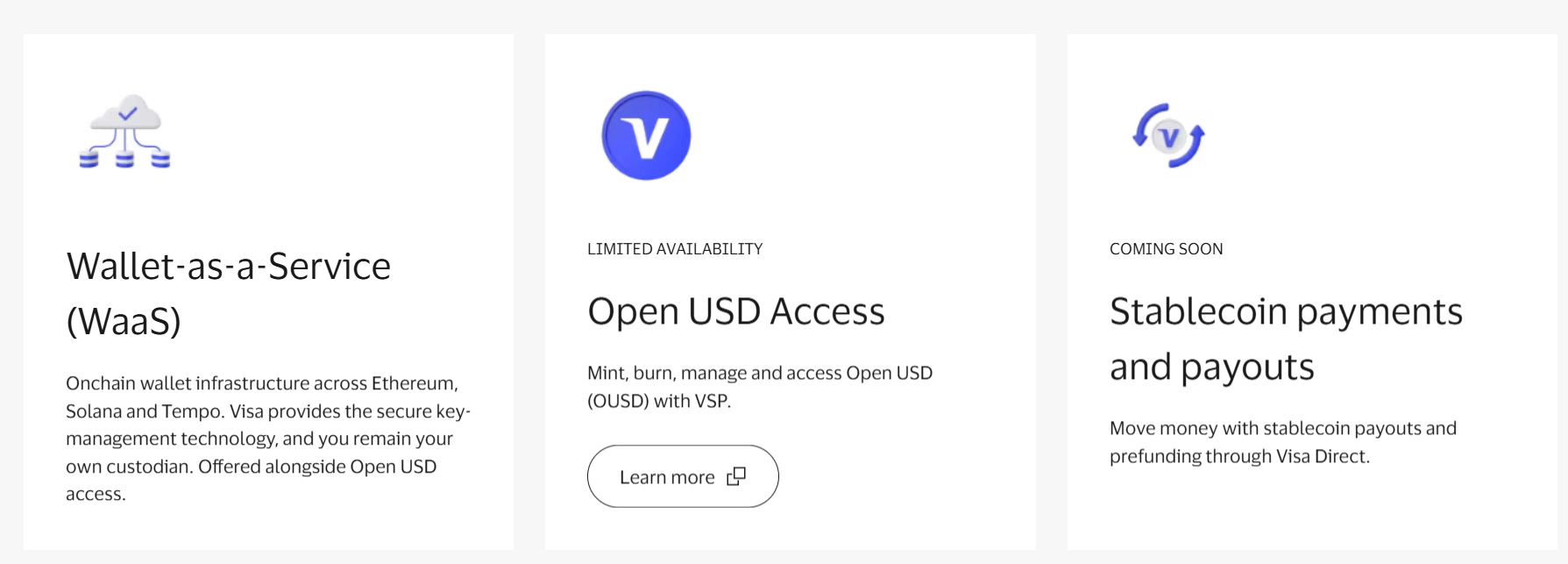
A stablecoin strategy has become necessary for every bank. Yet most traditional financial institutions still lack clear answers about which use cases to target and what infrastructure to build. Visa presents the Visa Stablecoin Platform, or VSP, as a way to address these issues through a single platform.
Source: VSP
VSP supports the full process, including wallet creation, Open USD issuance and redemption, custody, and transfers. Visa Consulting & Analytics, or VCA, adds market analysis, use case selection, economic feasibility reviews, sandbox testing, and launch support. Visa packages the infrastructure and consulting into a single offering. VSP remains in beta, but it clearly shows Visa’s intended direction: an all-in-one onchain package for banks.
Visa already has an advantage in ‘procurement’ and ‘trust’
Banks hesitate to move onchain because they must assess multiple unfamiliar crypto vendors. They must also address regulatory and control requirements before securing approval from internal risk committees.
For a bank, procuring a complete package from a long-standing and trusted partner is simpler and safer than assembling separate wallet, custody, compliance, and settlement providers. From this perspective, VSP offers banks one of the shortest and lowest-risk routes into the onchain ecosystem.
Many companies now propose their own packages. What can Visa place at the center of its pitch? Its position in traditional finance is already well established. The more important task is to demonstrate actual influence and results in the blockchain sector. Visa’s data from the crypto card market gives it a clear way to make that case to banks.
A crypto card connects cryptocurrencies or stablecoins held in a wallet to an existing card network, allowing users to spend those assets in everyday transactions. When a user pays with a card linked to a wallet, the operator checks the balance, locks the required amount, and processes authorization through the existing card network. Merchants can handle the transaction like any other card payment without building a separate crypto system. Users can spend onchain assets through familiar payment channels.
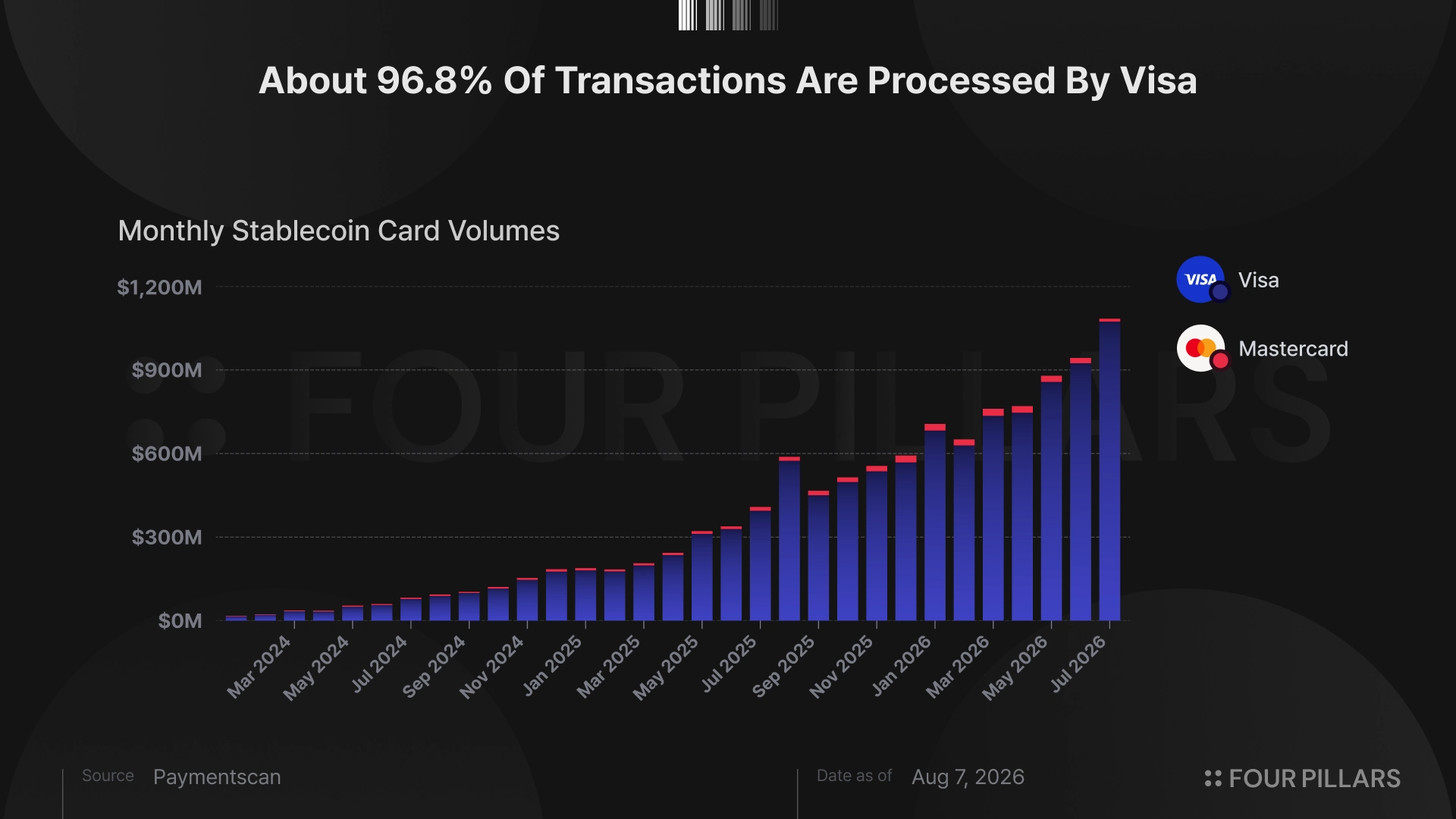
According to Paymentscan, cumulative crypto card transaction volume has exceeded $11 billion. Visa accounts for 96.8% of card network volume in this market, which has established its position as the main distribution network for crypto payments.
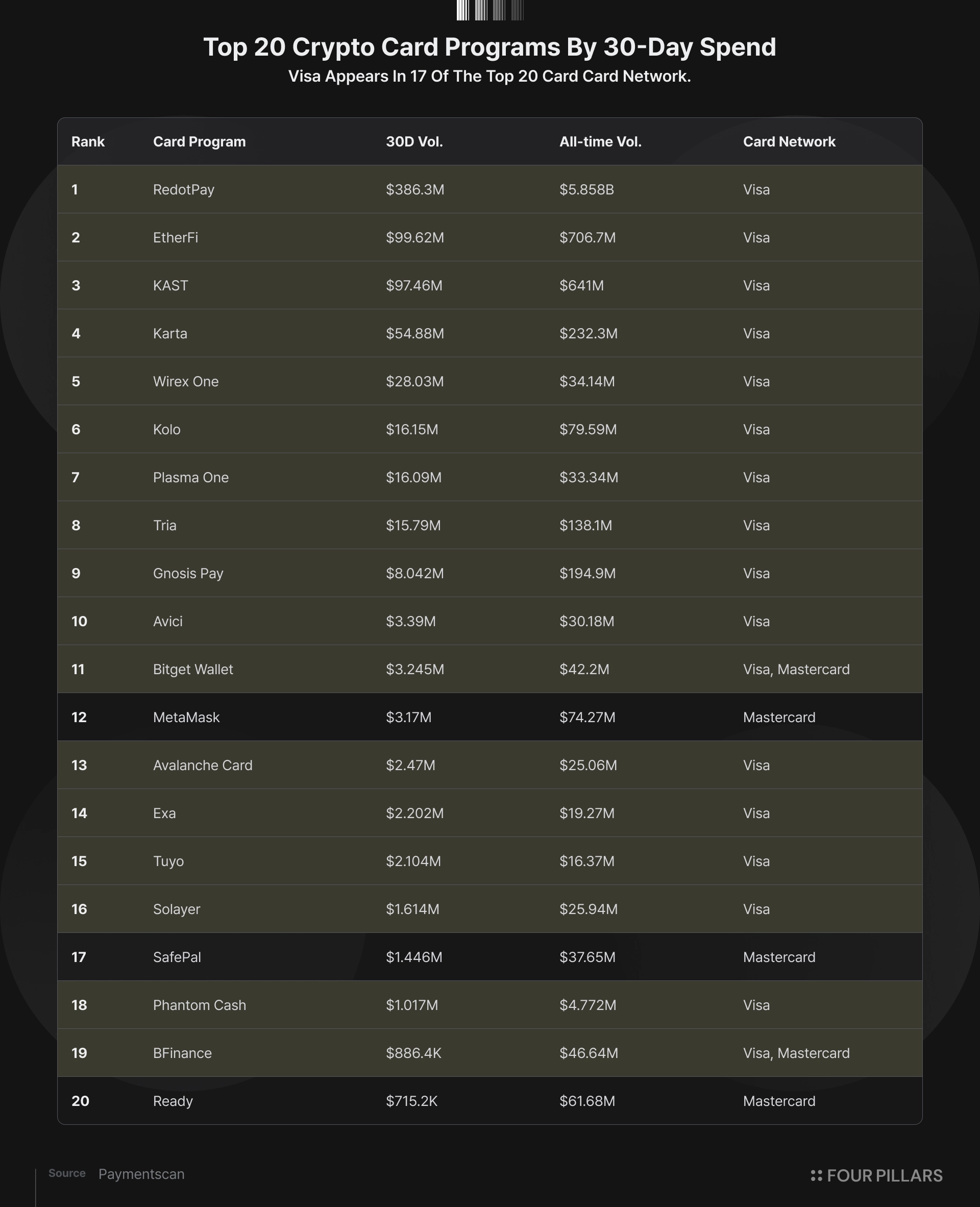
Visa also powers 17 of the 20 largest crypto card issuers by transaction volume over the past 30 days. Its lead in the crypto card market is clear.
This payment structure shows that onchain settlement can work without replacing existing payment rails. For conservative banks, crypto cards provide a clear proof of concept for the stability and scale of onchain infrastructure. They may also help Visa strengthen its position in the stablecoin settlement market.
The stablecoin ecosystem Visa wants to build
Visa’s broader plan can now be reduced to one structure. It provides banks with a single procurement channel and the required regulatory and control modules. For fintech companies, it opens a global card acceptance network built around stablecoin payments.
Visa’s work in agentic commerce also deserves attention. Its Trusted Agent Protocol, or TAP, may connect stablecoins with HTTP 402 based payment protocols such as x402 and MPP. This model is becoming another part of Visa’s future payment strategy.
The market remains at an early stage. Visa already has strong control over existing card networks and a dominant share of the crypto card market. These positions give the company several ways to expand across the stablecoin value chain.
Over the next year, Visa will need to convert growing institutional demand into working products and actual payment flows. Its ability to do so will determine whether it can build another durable competitive moat.
The author of this report may have personal holdings or financial interests in assets or tokens discussed herein. However, the author affirms that no transactions have conducted using material non-public information obtained in the course of research or drafting. This report is intended solely for general information purposes and does not constitute legal, business, investment, or tax advice. It should not be used as a basis for making any investment decisions or as guidance for accounting, legal, or tax matters. Any references to specific assets or securities are made for informational purposes only and should not be construed as an offer, solicitation, or recommendation to invest. The opinions expressed herein are those of the author and may not reflect the views of any affiliated institutions, organizations, or individuals. The opinions and analyses expressed herein are subject to change without prior notice. In addition, beyond the individual disclosures included in each report, Four Pillars, may hold existing or prospective investments in some of the assets or protocols discussed herein. Furthermore, FP Validated, a division of Four Pillars, may already be operating as a node in certain networks or protocols discussed herein or may do so in the future. Please see below links in the footer for FP Validated's participating network disclosures and for broader disclosure details.


