


Table of Contents
- Key Takeaways
- 1. Introduction: an old debate suddenly becomes real
- 2. EIP-8363: Tapered Issuance Burn
- 2.1 Background: ETH issuance without a brake
- 2.2 Mechanism: burn a slice of validator rewards
- 2.3 The case for TIB: less stake might mean more security
- 3. But TIB is too hasty, and not neutral
- 3.1 A premise with a leap in it
- 3.2 The burn is not neutral
- 3.3 An asymmetry in operating income
- 3.4 Effects on the onchain economy
- 3.5 Process problems
- 3.6 Uncertainty and institutional capital
- 4. Ethereum's issuance model must change eventually. Something else has to come first.
Researcher

Related Projects

Key Takeaways
- TIB (EIP-8363, Tapered Issuance Burn) proposes burning a portion of validator rewards so that net staking yield reaches zero once 50% of the ETH supply is staked. It was submitted just two days before the review discussions for Hegotá, the next hard fork, and the community has been critical of both its substance and the way it appeared without prior consultation.
- A burn applies to everyone equally at the protocol level, but it is not neutral in the real validator market. As yield falls, solo stakers and independent operators are pushed out first, the validator set concentrates among a few large players, and the effects reach the entire onchain economy that treats staking yield as its base rate.
- Even so, Ethereum's issuance model must change eventually, because the validator's role and cost structure are being redrawn at the network level. The problem is the order of operations. Agree first on how the validator's role will evolve and how much security budget that role deserves, then design the reward structure to match.
1. Introduction: an old debate suddenly becomes real
The debate over Ethereum's issuance is not new. Since 2024 there have been rounds of discussion about the dilution that staking rewards impose on ETH holders (issuance.wtf collects these debates well). Even the underlying question, whether more staking really makes the network safer, has been asked many times before.
Then on August 4, 2026, just two days before the August 6 ACDC call that reviews candidate items for Hegotá, the next hard fork, a proposal landed that would radically adjust Ethereum's issuance mechanism: TIB (EIP-8363, Tapered Issuance Burn). (It was originally submitted as EIP-8361, but that number was already assigned to another proposal, and a change to 8363 has been suggested.)
Since then the Ethereum community has been flooded with objections. Part of the argument is about the proposal's economic and security effects. But the way it appeared is drawing just as much criticism: a change to the network's monetary policy, submitted without prior consultation, timed to a fork schedule.
This piece walks through why TIB emerged, how it works, and what its authors argue, then lays out our position. In short, we agree that Ethereum's issuance structure has to change in the long run. We disagree with the form and the timeline TIB proposes.
2. EIP-8363: Tapered Issuance Burn
2.1 Background: ETH issuance without a brake
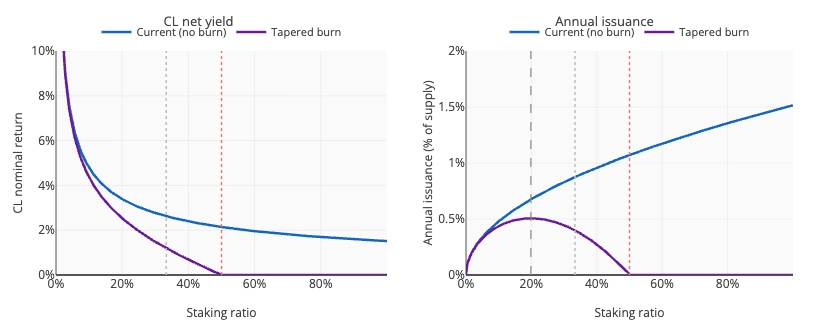
Under the current issuance curve, an individual validator's consensus-layer yield is inversely proportional to the square root of total active stake. As staking grows, each validator earns less, but newly issued ETH, in other words inflation, keeps growing. By the proposers' math, even with every last ETH staked, nominal yield stays around 1.5%. The current curve is effective at attracting a minimum level of staking, but it has no explicit mechanism to stop growth at the top.
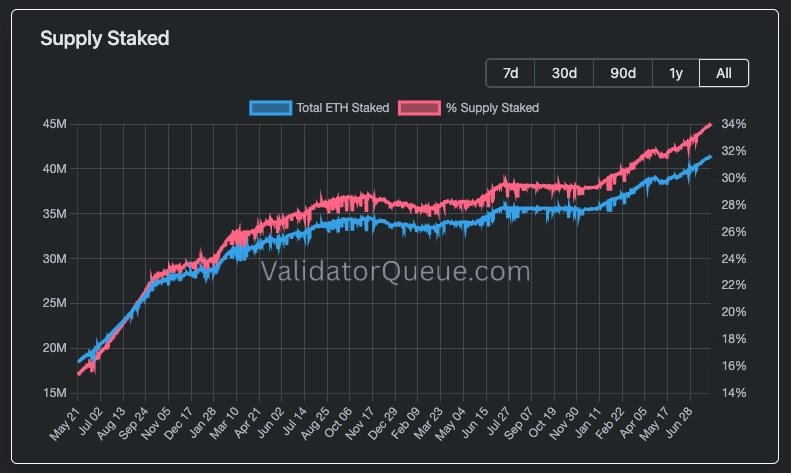
The reason this suddenly became urgent is that staking is growing very fast. In April 2026 the staking ratio passed roughly a third of total supply, and the validator entry queue has been saturated at its maximum limit for months. About 1.75 million ETH is being staked every month, roughly 1.5 percentage points of staking ratio, and even under conservative assumptions the projection reaches 70 million ETH, more than 55% of supply, by January 2028. Institutional entrants like Ethereum DATs and staking ETFs are the main driver, and we expect that flow to grow rather than shrink.
Source: ValidatorQueue
2.2 Mechanism: burn a slice of validator rewards
TIB does not change the reward curve itself. Attestation, block proposal, and sync committee rewards are all computed and paid exactly as they are today. Then, each epoch, a fraction of the idealised rewards for the duties assigned to each validator is deducted from its balance and burned, with the fraction determined by the overall staking ratio.
What matters is that the burn is based on assigned duties, regardless of whether they were performed. Perform your duty, and part of the reward you received is burned. Fail to perform it, and the burn comes on top of the penalty. Because the burn is the same either way, the micro-incentive to keep your node online and vote correctly is preserved. A validator that performs its assigned duties correctly ends up with a net reward of zero at the saturation point. Put differently, once total staking reaches saturation, doing your job well gets you zero, and doing it badly only costs you more.
Source: pintail.xyz
The burn fraction is determined by total active stake D and a saturation balance D_sat.
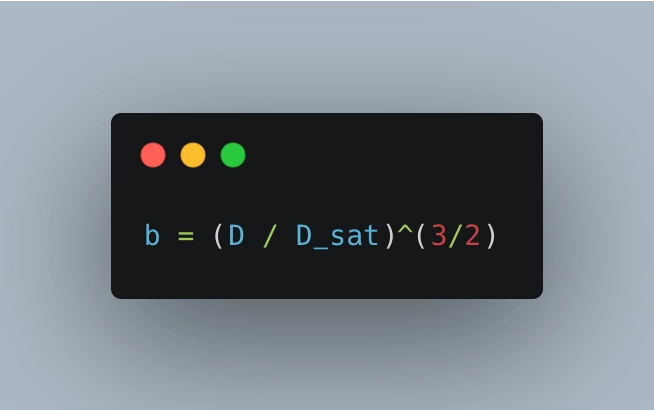
D_sat is about 60.25 million ETH, roughly half of the supply at the time of the proposal. The reason for a fixed balance rather than a dynamic 50% ratio is that the consensus layer does not directly track total ETH supply; the tradeoff is that the effective saturation ratio drifts slowly as supply changes. As staking grows the burn rate climbs, and net yield hits zero at a 50% staking ratio. Total issuance peaks at about 0.5% of supply per year around a 19.8% staking ratio, then declines to zero at 50%. That 50% is not a target; it is simply the saturation point where the incentive to stake switches off entirely. According to the proposal, the actual equilibrium should form somewhere below 50%, where net yield meets the risk premium stakers demand.
The design philosophy resembles EIP-1559. Redirecting the deducted rewards to other validators or to a foundation would create new beneficiaries and a governance contest, so a burn that accrues to no one is the most credibly neutral option.
There is a damping mechanism as well. The burn curve applies from day one, but switching it on at full strength would crater yields, so BASE_REWARD_FACTOR starts at 128 and declines linearly to 64 over 18 months. Rewards, penalties, and the burn all scale with this factor together, so the relative incentives between duties hold through the transition. Counting fork lead time, the market gets about two years to adjust.
2.3 The case for TIB: less stake might mean more security
The proposers' first argument is about security. If tens of millions of ETH already sit as slashable collateral, the marginal security of additional stake is small. The cost, meanwhile, grows: new stake keeps concentrating in exchanges, custodians, and large staking providers. The more ETH and validation power move into large custodial structures, the weaker Ethereum's last-resort defense becomes, namely the social layer's ability to fork out a captured validator set.
The second argument is about ETH as money. Inflation is a dilution cost imposed on every ETH holder who does not stake. In a structure that forces the choice to stake or be diluted, higher staking ratios make it better to hold LSTs (liquid staking tokens) or custodial products than native ETH, and the economy's base asset drifts from the most neutral, trustless asset toward dependence on issuers. If economic security is stake quantity times ETH value, then reducing dilution to protect ETH's monetary premium is itself a security measure.
There is a twist here: the proposers claim solo staker protection as part of their case. The current curve, they argue, is already squeezing solo stakers out through growing dilution, taxes on nominal income, and yields that fall anyway. TIB, by capping dilution, leaving 100% of execution-layer income with the block proposer, and never putting a correct attester in the red, is presented as the thing that actually protects them.
There is a real problem here, and doing nothing about it is not neutral either. Keeping the current issuance structure is an implicit endorsement of ever-growing staking and inflation. The arguments for adjusting Ethereum's issuance deserve to be taken seriously.
3. But TIB is too hasty, and not neutral
Before going further: Four Pillars, where I work, operates Ethereum validators, and we are directly exposed to a cut in validator income. This piece has a stake in the outcome. What follows, though, is not an argument that Ethereum's issuance must never be touched. It is an argument that we should first verify what an issuance change does to the validator market and the economy built on top of it, and that TIB skips that verification.
3.1 A premise with a leap in it
The most basic problem is the premise. The claim that staking will not stop as long as rewards are positive reduces demand to a function of expected return alone. Real staking demand is tangled up with liquidity, taxes, regulation, custody, collateral utility, and risk appetite. As many in the community have pointed out, the existence of a positive-yield asset does not pull every asset into it. Cash and treasury bills coexist.
The 55% staking ratio by 2028 that TIB's proposers describe is one possible scenario, not a settled future. And setting the saturation point at half of supply (60.25 million ETH) is not a law of nature; it is a policy value that people chose. Before locking in a specific policy like TIB, there are questions that need community consensus first. How much economic security does Ethereum actually need? Is a minimum-viable-security approach acceptable for the largest onchain financial network in the world? Those discussions should come before the policy.
3.2 The burn is not neutral
The burn mechanism treats everyone identically at the protocol level, but it is not neutral in the real market, because participants have different cost structures. The costs of running validators are denominated in dollars, not ETH. Speaking as an operator, most of our costs are fixed and monthly, regardless of revenue: servers and data center leases, dedicated lines and bandwidth, monitoring and alerting systems, 24/7 on-call staff, security certifications and audits. Every one of them is billed in dollars (in our case, Korean won), not ETH.
In that world, solo stakers and independent operators are the most sensitive to falling yields. Large custodians, exchanges, ETF issuers, and major LST providers can absorb the hit through economies of scale, cross-subsidies, and a willingness to take strategic losses. Some can treat staking not as a profit business at all but as a cost of acquiring custody, trading, and financial-product customers. So the conclusion that lower yields will stop the growth of large players first does not hold.
The Ethereum Magicians thread discussing TIB is full of the opposite concern: independent operators exit first, and the number of real operating entities, along with the Nakamoto coefficient, deteriorates. There is a balloon effect too, where ETH squeezed out by costs flows into riskier or more centralized custodial yield products. And if a concentrated validator set misbehaves and the only remaining tool is social slashing, a last-resort deterrent turns into a routine instrument for correcting problems the system created for itself. A proposal meant to protect solo stakers should not be structured to push solo stakers and independent operators out of the market first.
3.3 An asymmetry in operating income
TIB only touches consensus-layer rewards. Execution-layer income, the priority fees and MEV that make up validators' real revenue, stays as it is. As consensus rewards shrink, MEV takes up a growing share of total income. Access to MEV is equal under PBS, of course. The problem is that where issuance rewards flow to every validator in a steady, sustainable way, MEV behaves like a lottery concentrated in a handful of high-value blocks.
For large operators and staking pools, that variance averages out. For a solo staker who gets to propose only a few blocks a year, income becomes a matter of luck. And as consensus rewards matter less, validators also become more sensitive to whatever happens to execution-layer income next, including changes already in motion like ePBS and MEV burn.
3.4 Effects on the onchain economy
There are problems outside the protocol too. ETH staking yield is not just an infrastructure operator's concern. Staking APY works as the base rate for the entire onchain economy. Lending market rates, leveraged staking loops, fixed-income protocols, and structured products are all wired to it.
LSTs are also the base of DeFi's money legos. If the yield on LSTs, the largest collateral class in major lending markets, converges to zero, collateral demand, loop strategies, and the liquidity around them get reshuffled in a chain reaction, and near zero yield there is a real possibility of large leveraged staking positions unwinding. Aave founder Stani Kulechov posted a critique arguing that the proposal makes staking yields unpredictable and, in some cases, entirely uneconomical. TIB's field of view stops at validator incentives. The analysis of what happens to the onchain economy built on top of staking yield is missing.
3.5 Process problems
As noted above, this proposal was submitted two days before the August 6 ACDC call, in what amounts to a bid to put it up for Hegotá consideration (PFI) right away. To be fair, PFI is the start of review, not a confirmation of inclusion; being proposed for inclusion does not mean a proposal ships. Still, taking a proposal that touches monetary policy, validator market structure, and the whole of DeFi, and pushing it onto a fork timeline without the underlying research, damages procedural trust all by itself.
3.6 Uncertainty and institutional capital
There is an institutional angle as well. Under the current curve, staking yield moves gently along the square root of total stake. It is a relatively predictable number, and that predictability is part of why institutions that design products around dependable cash flows, staking ETFs and Ethereum DATs among them, entered ETH staking at all.
The burn schedule TIB proposes brings much larger yield swings and much more uncertainty. Your yield comes to depend, far more sensitively than today, on other participants' decisions to enter. For institutional investors who prize predictable cash flows, ETH staking risks becoming an asset whose yield cannot be forecast and which, in some cases, stops making economic sense.
Remember that TIB exists in the first place because of the institution-driven staking surge from DATs and ETFs. The proposal answers that problem by driving away exactly that institutional demand. It might achieve its goal of stopping staking growth, but it should not collide with the ecosystem's broader effort to settle institutional assets and payment rails on Ethereum.
4. Ethereum's issuance model must change eventually. Something else has to come first.
The core complaint, that the current curve has no explicit limit, is valid. Dodging the long-running issuance debate is not an answer, and I believe the issuance model must change at some point. The current curve was designed around the early Beacon Chain validator model: every validator verifying by re-execution, in uniform 32 ETH units, performing roughly the same role.
That premise is crumbling, and within a few years it is likely to be gone entirely. On the lean Ethereum roadmap, the L1 zkEVM converts the validator's job from re-execution to verifying zero-knowledge proofs produced by provers. ePBS will separate block building from proposing, lean consensus simplifies signature aggregation with ZK, and the minimum stake drops from 32 ETH to 1 ETH.
As roles change and split, capital costs, operating costs, security risks, and income sources diverge by role. With consensus and execution being rebuilt this thoroughly, Ethereum cannot stay locked forever into an issuance curve premised on the cost structure of 2020. That is why changing the reward structure calls for a design bigger than TIB, and why the bar must be higher than for ordinary protocol optimization: in a decentralized network, monetary policy and the security budget are nearly irreversible once applied. Cutting issuance first, on its own, sounds like a deeply irresponsible proposal.
The complication is that the interests tied to the Ethereum network, and to ETH as an asset, keep getting more entangled. Left alone, the issuance debate may never resolve, blocked by too many stakeholders, and it will only get harder as institutional entry accelerates. Perhaps the radicalism and the timing of this TIB proposal are a strategy to break that deadlock and force issuance to the center of the debate. It has, in fact, worked: right now the entire Ethereum community is arguing about ETH issuance.
I oppose TIB in its current form and on its Hegotá-targeted schedule. At the same time, I support the effort to redesign the issuance model, and as a validator operator we intend to take an active part in that discussion.
Inflation is, in the end, the price of security. What comes first is agreeing on what role validators will play in the Ethereum network that is coming, and how much security budget that role deserves.
The author of this report may have personal holdings or financial interests in assets or tokens discussed herein. However, the author affirms that no transactions have conducted using material non-public information obtained in the course of research or drafting. This report is intended solely for general information purposes and does not constitute legal, business, investment, or tax advice. It should not be used as a basis for making any investment decisions or as guidance for accounting, legal, or tax matters. Any references to specific assets or securities are made for informational purposes only and should not be construed as an offer, solicitation, or recommendation to invest. The opinions expressed herein are those of the author and may not reflect the views of any affiliated institutions, organizations, or individuals. The opinions and analyses expressed herein are subject to change without prior notice. In addition, beyond the individual disclosures included in each report, Four Pillars, may hold existing or prospective investments in some of the assets or protocols discussed herein. Furthermore, FP Validated, a division of Four Pillars, may already be operating as a node in certain networks or protocols discussed herein or may do so in the future. Please see below links in the footer for FP Validated's participating network disclosures and for broader disclosure details.


