


Table of Contents

Source: Upbit
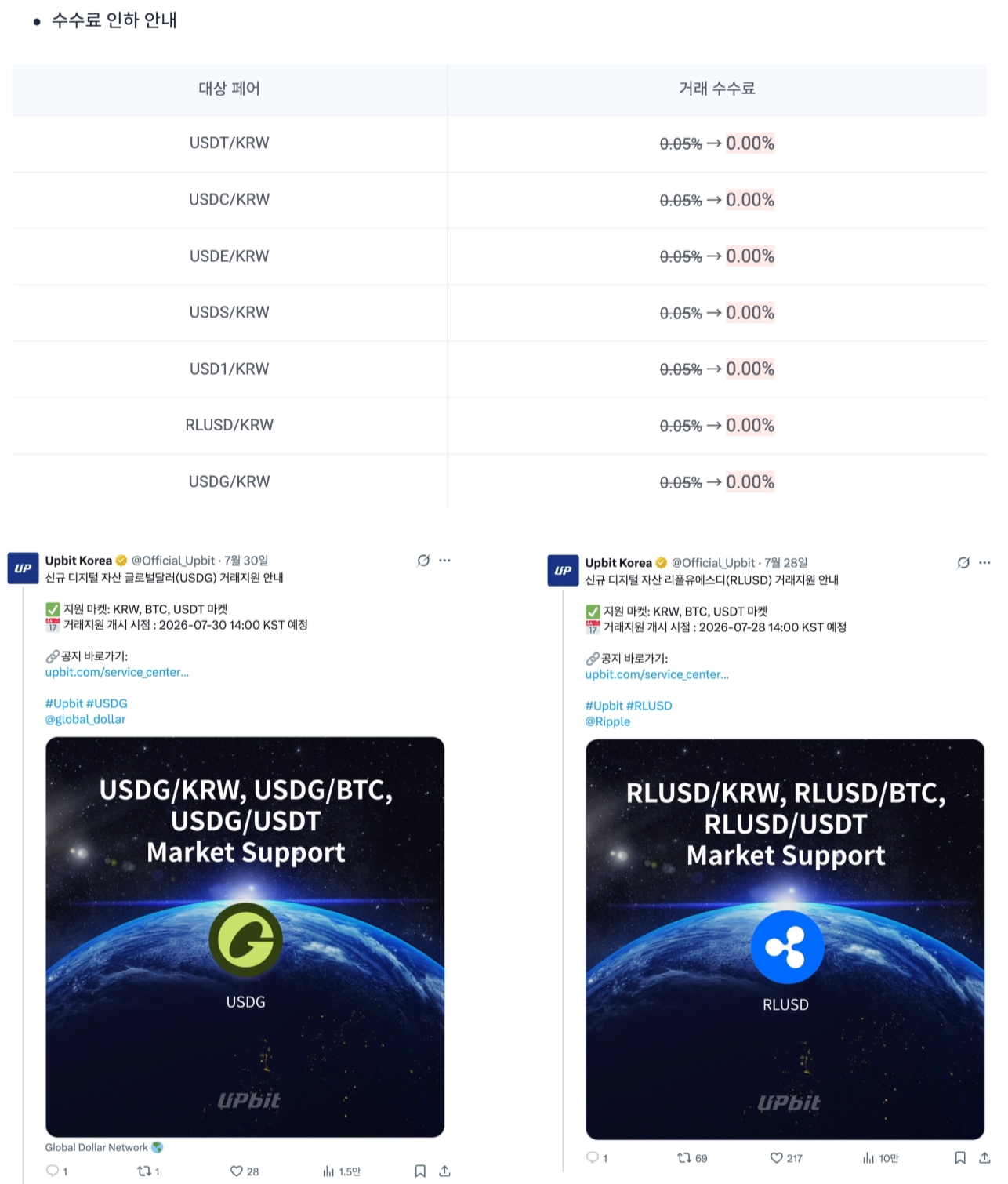
Upbit is running a promotion from July 26 to August 9 that waives the 0.05% trading fee on stablecoins listed on its KRW market. In the same week, it also listed dollar stablecoins such as RLUSD and USDG in quick succession, a series of moves aimed at expanding stablecoin trading volume.
This is not the first time Upbit has listed a stablecoin, but it is the first time stablecoin-related initiatives have been packed into such a short period. This article examines why Upbit is focusing on expanding the stablecoin market now, from three angles: stablecoin market share among Korean exchanges, stablecoin inflow and outflow trends, and the current regulatory environment.
1. The Reshaping of Korea's Exchange Stablecoin Market
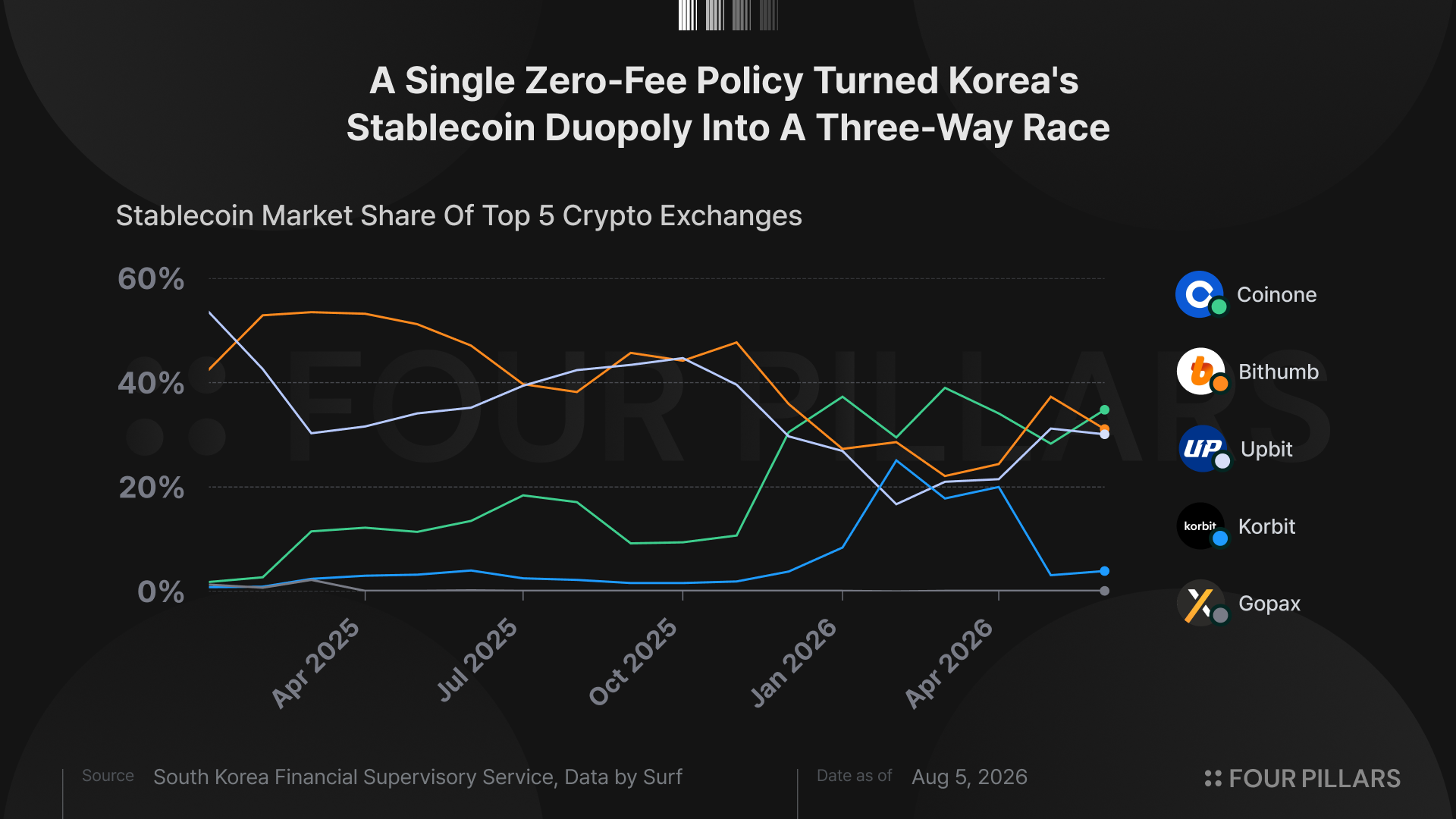
In January 2025, Korea's stablecoin trading market was a two-horse race, with Upbit (53.5%) and Bithumb (42.5%) together holding more than 95%. Within 18 months, that structure changed completely. As of June 2026, Coinone leads in average daily stablecoin trading value with 84.58 billion won (34.8%), followed by Bithumb with 75.57 billion won (31.1%) and Upbit with 73.02 billion won (30.1%), forming a three-way race.
Behind this shift is Coinone's decision to eliminate USDC trading fees entirely from October 2025. While its competitors kept fees of 0.04% to 0.20%, Coinone held on to its free policy. As a result, its market share climbed to 11.5% in March 2025 and reached 30.5% in December, overtaking Upbit (29.7%) for the first time. Fee-sensitive demand moved over, specifically demand for moving funds abroad to trade overseas derivatives and demand seeking gains from the dollar's exchange rate.
What this confirms is how price-elastic stablecoin trading demand is. A stablecoin is the same asset regardless of where it is purchased, and a large share of it is withdrawn to external wallets after purchase, so the factors that differentiate exchanges narrow down to fees and liquidity. In effect, the market is structured so that a fee gap of just around 0.05 percentage points can change who holds the top spot.
What is interesting is that this reshuffling has been confined to stablecoins. In June 2026, Upbit held 60.0% and Bithumb 32.0% of total trading value, with the two together accounting for more than 90%, while Coinone stood at just 6.2%. From Upbit's standpoint, stablecoins are the sector where it lags furthest behind in a market it otherwise dominates.
At the same time, the overall market itself is shrinking fast. In July 2026, average daily trading value across the five major exchanges was 466.69 million dollars, down 80.3% from 2.37 billion dollars in January. Dunamu's revenue for the first quarter of 2026 came to 234.6 billion won, down 55% from a year earlier, while its operating profit fell 78% to 88 billion won. With the entire market shrinking to one fifth of its size in just six months, my view is that a sector where demand holds up regardless of market conditions carries far greater strategic value than it would in normal times.
2. Stablecoins as a Cross-Border Gateway Asset
To understand the nature of stablecoin demand in Korea, we need to look at where purchased stablecoins end up.
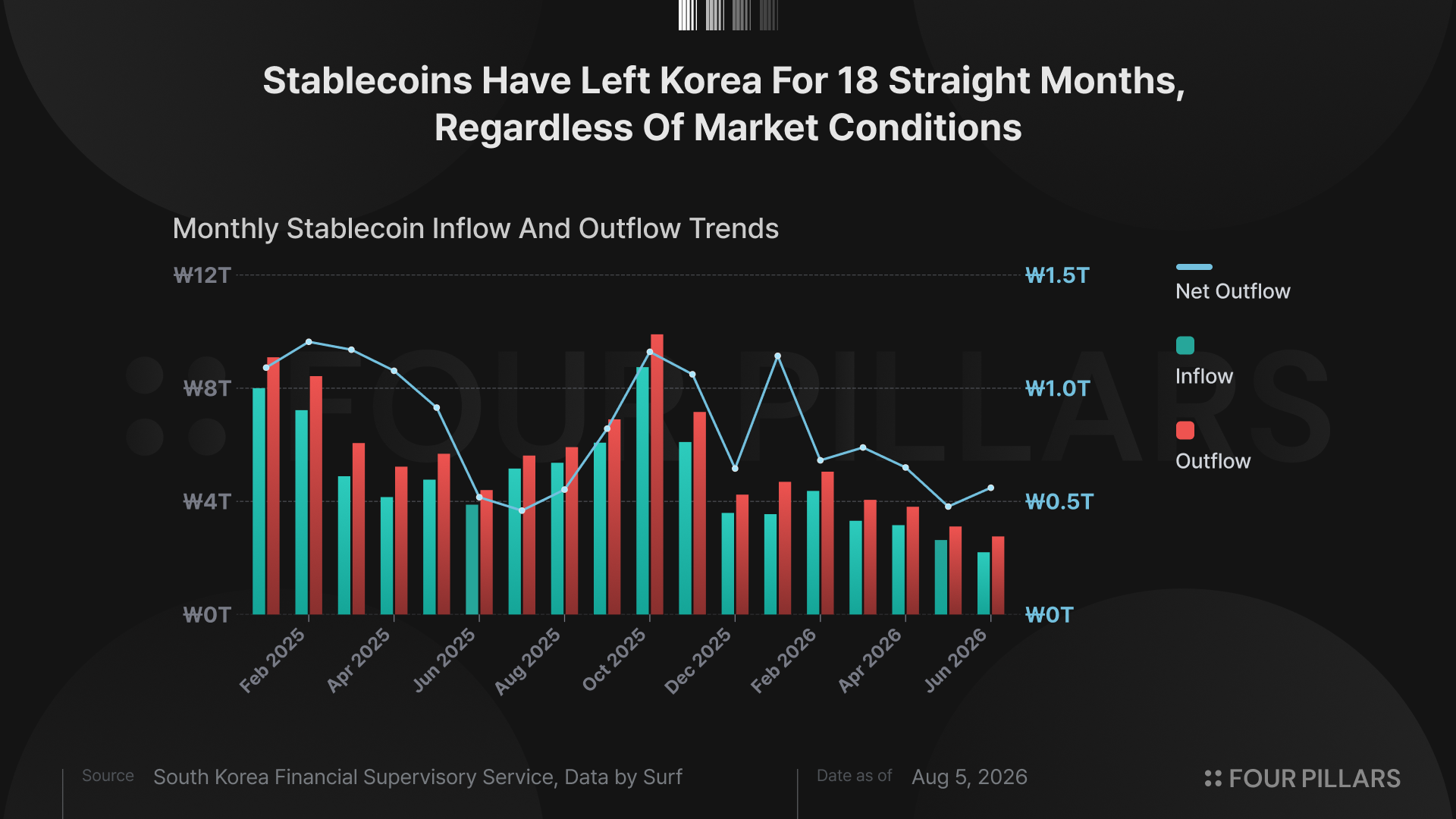
In June 2026 alone, 2.7625 trillion won worth of stablecoins was sent from the five major exchanges to overseas exchanges, while 2.2022 trillion won came in from overseas, leaving a net outflow of 560.3 billion won. The net outflow has continued without a single monthly interruption for 18 months since January 2025, when the statistics were first compiled, and the cumulative net outflow now stands at roughly 14.9 trillion won.
This steady net outflow runs opposite to what we see in equities. In the second quarter of 2026, overseas equities recorded net selling of 1.6185 trillion won while stablecoins saw a net outflow of 1.6872 trillion won. Money in overseas equities often reverses direction and flows back into the domestic market depending on conditions, but stablecoin flows have not changed direction even during downturns, which points to the distinctive position stablecoins hold in the Korean market.
The role stablecoins now play as a channel for moving capital to overseas exchanges and DeFi did not originally belong to them, which makes it all the more meaningful. Stablecoins were listed on Korea's KRW markets only recently, and Upbit was the last of the five major exchanges to open a KRW market for USDT, doing so in 2024. Before that, the only way to move funds to an overseas exchange was to buy and transfer a volatile asset such as Bitcoin or XRP, accepting the risk of price swings during the transfer.
After the KRW market listings, this role quickly passed to stablecoins. The very fact that the Financial Supervisory Service began compiling cross-border transfer statistics on a stablecoin basis in January 2025 shows that regulators have come to see stablecoins as the primary vehicle for cross-border fund movement. Considering that USDT overtook Bitcoin in global trading volume back in 2019, Korea can be seen as a case where this transition happened in compressed form after 2024 because of its delayed KRW market listings.
3. The Actual Effect of the Push to Expand Stablecoin Trading
Now let us return to Upbit's choice. Upbit's promotion is a temporary measure running through August 9, whereas Coinone's free-fee policy, which took the market share, has been in place on a permanent basis since October 2025.
There is a useful precedent for how temporary promotions play out. Korbit ran a zero-fee USDC campaign and a reward promotion from January to April 13, 2026, recording a 3.48% share during the period, but once the campaign ended, the volume was reabsorbed by Upbit and Bithumb. Following this precedent, Upbit's promotion may likewise lose its effect once it ends. Let us use data from the promotion period and from normal times to assess the outlook.
Below is a chart of average daily stablecoin trading value on Upbit during the promotion period and the month before it.
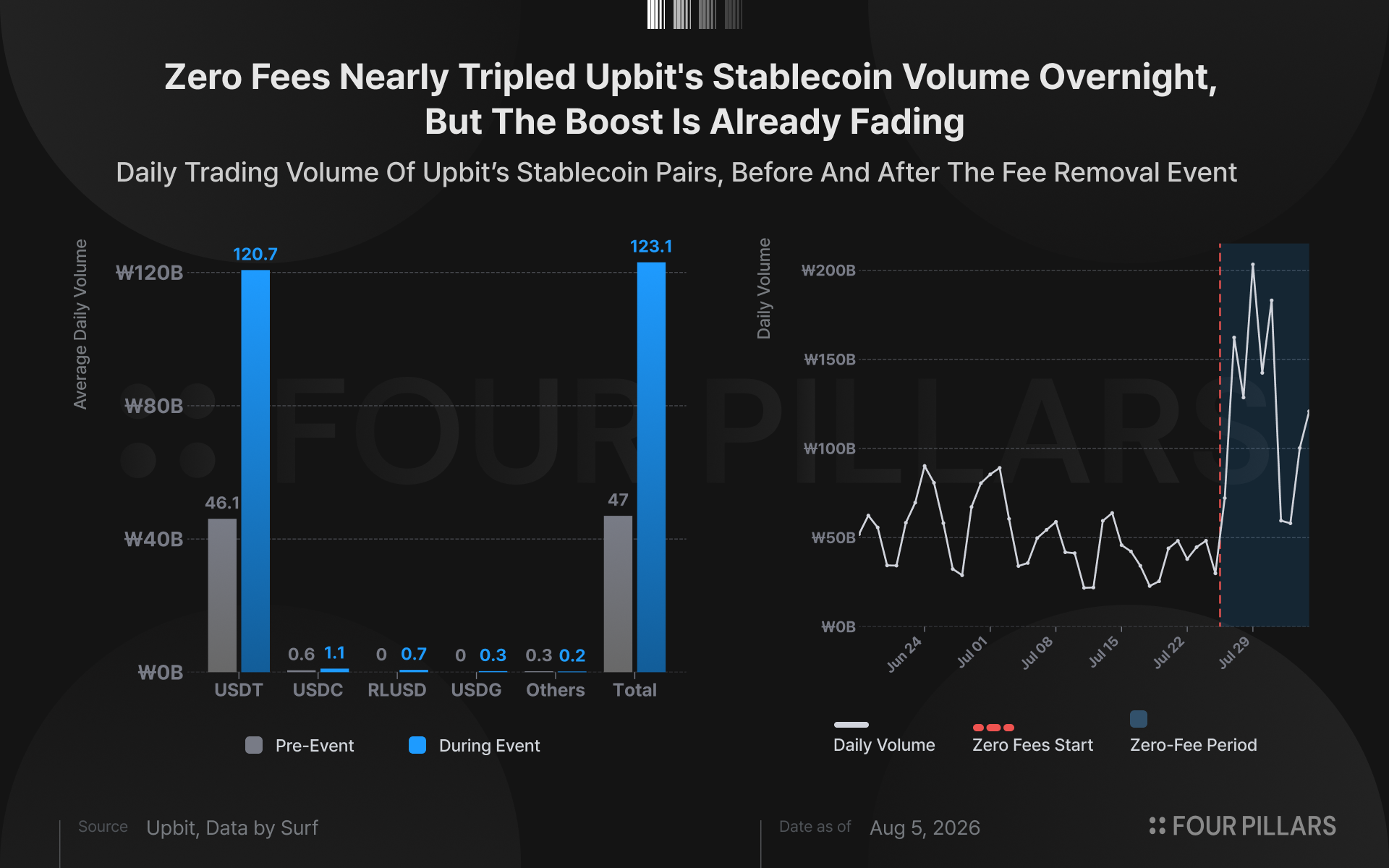
Average daily trading value rose 162.0%, from 46.96 billion won in the 30 days before the promotion to 123.06 billion won during it. On a weekday-only basis, which removes the weekend effect, it grew 170%, from 55.03 billion won to 148.69 billion won.
The immediacy of the effect was also clear. Trading value stood at 29.95 billion won on July 25, the day before the promotion began. On the opening day, a Sunday, it reached 72.19 billion won, more than double the previous weekend's level, then hit 162.27 billion won on the 27th, the first weekday, and peaked at 203.29 billion won on the 29th.
Three additional points stand out in the data.
- USDT accounted for virtually all of the increase in volume. Its average daily trading value rose from 46.06 billion won to 120.71 billion won, and its share of Upbit's stablecoin trading value stayed at 98.1% both before and during the promotion. By contrast, RLUSD (an average of 710 million won a day) and USDG (340 million won), which were listed alongside the promotion, contributed only about 1% of the total increase. Even that did not last. RLUSD posted 5.60 billion won on its listing day and then fell sharply to around 100 million won a day, and USDG followed a similar path after 2.24 billion won on its listing day. In effect, the new listing bump lasted only a single day. Meanwhile, long-tail pairs such as USD1, USDS, and USDE, along with the gold-linked XAUT, saw trading value stay flat or even decline despite the fee waiver. In conclusion, Upbit's stablecoin expansion strategy failed to spread existing USDT trading across other stablecoins.
- The effect began fading even before the promotion ended. Average daily trading value fell from 148.65 billion won in the first week to 84.68 billion won in the second. Even on a weekday-only comparison, which strips out the weekend effect, it dropped 33%, from 163.94 billion won to 110.58 billion won. This reads as the familiar pattern of the initial wave of attention around a new launch wearing off quickly.
- There is a confounding factor. As the won strengthened in July, the USDT price on Upbit fell from 1,517 won on June 26 to 1,423 won on August 4, with the decline steepest in late July, which overlapped with the promotion. Exchange rate moves in themselves stimulate demand for currency gains and bargain buying, so part of the increase may reflect the exchange rate rather than the fee waiver.
Taking all this into account, once the promotion ends and Upbit resumes charging fees, it seems unlikely to hold on to the share it temporarily gained during the event. As long as Coinone keeps its free policy in place permanently, Upbit will then be forced to choose between making free trading permanent and preserving fee revenue.
4. Institutionalization as a Variable
I believe Upbit itself fully expected that the volume boost from the fee waiver would prove very short-lived, and that listing a variety of stablecoins would not meaningfully spread trading away from USDT. (Quite unfortunate if not..)
Calculated from trading volume, Upbit gave up roughly 1 billion won in fee revenue over the past 15 days. Why is Upbit committing resources to a relatively low-margin sector while giving up fees along the way? A clue can be found in the changes underway in Korea's regulatory environment.
The first is that the introduction of a won-based stablecoin is now within sight. In its 2026 economic growth strategy, the Korean government made official its plan to push for the enactment of the Digital Asset Basic Act in the second half of the year. The bill is expected to include a licensing system for issuing won stablecoins, reserve asset requirements, and redemption rights. In the United States, the GENIUS Act is set to take full effect between late 2026 and early 2027, a point at which dollar stablecoins are expected to spread globally.
The second is the change in Dunamu's ownership structure. In November 2025, Naver Financial resolved to make Dunamu a wholly owned subsidiary through a comprehensive stock swap, and the two companies presented a payment ecosystem built around stablecoins and digital wallets as the core synergy. From this perspective, Upbit's stablecoin trading volume, liquidity, and user base are less a source of fee revenue than a distribution network for a future payment business, which makes it worth widening that base as much as possible now.
The third, paradoxically, is that the regulatory environment may keep Dunamu from fully benefiting from a won stablecoin. The current Specified Financial Transaction Information Act and the Virtual Asset User Protection Act prohibit virtual asset service providers from trading assets issued by related parties. If a Naver-led consortium issues a won stablecoin after Dunamu's incorporation into the Naver group, one possible interpretation is that listing the asset on Upbit could be restricted. With it still uncertain whether Upbit will even be able to handle a won stablecoin, a product of the future, the one asset it can secure with certainty today is its position as the distribution hub for dollar stablecoins.
The author of this report may have personal holdings or financial interests in assets or tokens discussed herein. However, the author affirms that no transactions have conducted using material non-public information obtained in the course of research or drafting. This report is intended solely for general information purposes and does not constitute legal, business, investment, or tax advice. It should not be used as a basis for making any investment decisions or as guidance for accounting, legal, or tax matters. Any references to specific assets or securities are made for informational purposes only and should not be construed as an offer, solicitation, or recommendation to invest. The opinions expressed herein are those of the author and may not reflect the views of any affiliated institutions, organizations, or individuals. The opinions and analyses expressed herein are subject to change without prior notice. In addition, beyond the individual disclosures included in each report, Four Pillars, may hold existing or prospective investments in some of the assets or protocols discussed herein. Furthermore, FP Validated, a division of Four Pillars, may already be operating as a node in certain networks or protocols discussed herein or may do so in the future. Please see below links in the footer for FP Validated's participating network disclosures and for broader disclosure details.


