


Table of Contents
- Key Takeaways
- 1. WebX 2026, the Year of Finance
- 2. Regulation: Japan’s Financial Big Bang Now Has a Timetable
- 3. Stablecoins: ¥13 Billion Chasing ¥50 Trillion
- 4. AI Agents: 99.3% of Stablecoin Payments Already Aren’t Human
- 5. RWA: Tokenization Graduates From Fractional Real Estate to JGBs and IPO-Day Stocks
- 6. Market Cycle: Retail Capitulated, Institutions Didn’t
- 7. Prediction Markets: Price Discovery for Some, Laundering for Others
- 8. Security: Quantum Deadlines, DPRK Theft, and Washington’s Kill Switch
- 9. Adoption: Web3 Works Best Where Nobody Says Web3
- 10. Key Insights on the Japanese Market
Researcher

Key Takeaways
- WebX is Asia’s largest Web3 conference, hosted by CoinPost in Tokyo on July 13 and 14 with more than 13,000 attendees, roughly 300 speakers, and over 150 companies across four stages.
- Four Pillars participated as the exclusive research partner, and this article organizes what we heard into the eight themes that dominated the conference.
- The defining event of the conference happened partly off stage. Japan’s FIEA amendment, the bill that moves crypto from the Payment Services Act into securities law, cleared its final Upper House committee while the panels discussing it were still running.
- Across every stage, one demand thesis recurred regardless of the topic. The heaviest users of stablecoins and tokenized assets will not be people. By JPYC’s own count, 99.3% of stablecoin payment volume is already non-human.
1. WebX 2026, the Year of Finance
Every conference eventually becomes a time capsule of its cycle. WebX 2023 was the NFT conference. WebX 2024 was the ETF and investment conference. WebX 2025 was the digital asset treasury conference.
WebX 2026, in the organizers’ words, was the year of finance.
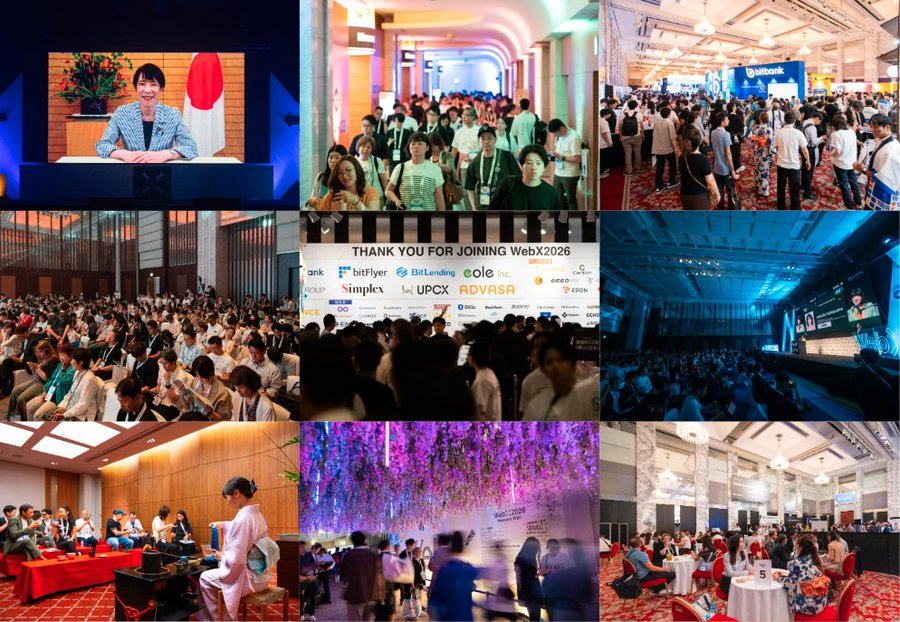
The guest list backed the label. Prime Minister Takaichi Sanae spoke. Finance Minister Katayama Satsuki, who also holds the financial services portfolio, delivered a keynote. The three megabanks, the Tokyo Stock Exchange, the JFSA’s international lead, BlackRock, Franklin Templeton, Fidelity, Mastercard, Visa, SWIFT, the DTCC’s partners, and a former Federal Reserve innovation chief all took stages alongside the exchanges and protocol founders who used to have the industry to themselves. Attendance passed 13,000, and next year’s event moves to Tokyo Big Sight, a venue nearly twice the size.
Four Pillars attended as the exclusive research partner, publishing and distributing proprietary research on site, as we did at MoneyX in February. That earlier piece described a Japanese market where regulatory infrastructure had stopped being the bottleneck. Five months later, WebX showed what gets built once the bottleneck is gone.
With more than 60 sessions across the CRYL, Visionary, Binance, and Limitless stages, we share the eight themes that were most widely discussed during the WebX 2026 conference.
2. Regulation: Japan’s Financial Big Bang Now Has a Timetable
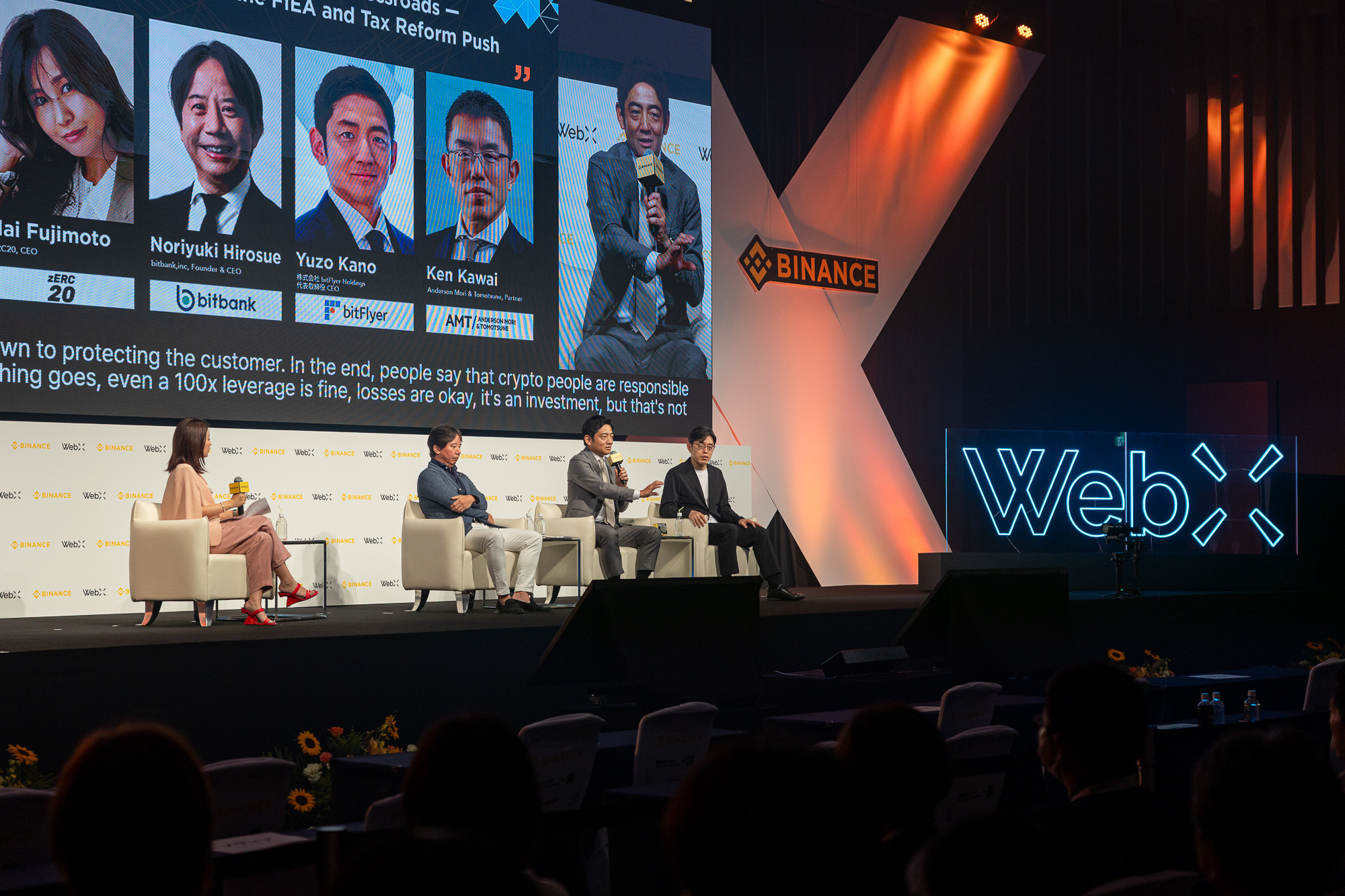
The single most repeated sentence of the conference was some version of “the law is passing this week.” It did. The FIEA amendment passed the Lower House before the conference and cleared the Upper House committee on Day 2, a fact confirmed live on stage during Japan at a Crypto Crossroads — Inside the FIEA and Tax Reform Push by bitFlyer Holdings CEO Yuzo Kano, while over on The Compliant DeFi Stack: Designing On-Chain Products for a Regulated World that same afternoon, the JFSA’s director for international policy Ryosuke Ushida told the room the vote was “happening today.”
The sequence from here is fixed. Speaking on the same Japan at a Crypto Crossroads panel, Anderson Mori & Tomotsune partner Ken Kawai laid out enforcement within one year of promulgation, which puts the new regime around summer 2027, and because the tax reform is legislatively chained to that migration, the move from a maximum 55% aggregate taxation to a flat 20.315% separate taxation lands around January 2028, with ETFs following the tax change on Kano’s prediction of listings in 2028. Kawai was honest about what all this amounts to, since no jurisdiction has ever switched an entire live asset class from one regulatory regime to another mid-stream. In his words, “this is a big experiment.”
Bitbank founder and CEO Noriyuki Hirosue, who chairs the JCBA and spent years making the annual pilgrimage to the LDP’s tax committee, told the story of how Japan got here from the inside on the Japan at a Crypto Crossroads panel, and for years the answer never changed.
Separate taxation for an industry full of scam operators? Don’t be ridiculous. The shift came about two years ago, when the industry accepted that the 20% rate was a privilege that had to be purchased with securities-grade regulation, an internal consensus Hirosue described as agreeing to “eat the poison manju.” Accept disclosure rules, accept the first insider trading regime ever applied to crypto, accept compliance costs that most of the industry cannot afford, and receive legitimacy in return. Those costs are already visible, because by Kano’s count on the same panel only two or three of Japan’s roughly 38 licensed exchanges are profitable, and FIEA-grade obligations will push the burden higher still.
What Japan is buying with that manju was quantified a day earlier on the same stage. On Japan’s Crypto ETF: What It Borrows from the U.S. — and Where It Goes Beyond, BlackRock Japan’s Keisuke Jo walked through the American precedent, where one US spot product reached 80 billion dollars in assets in about two years against the eight years a normal ETF launch would need, 75% of its buyers had never bought an ETF of any kind before, and 27% of those went on to buy other traditional ETFs, meaning crypto was not cannibalizing the ETF market so much as recruiting for it.
SBI Global Asset Management CEO Tomoya Asakura then gave the Japan math, setting the country’s 14 million crypto accounts against 28 million NISA accounts and 2,386 trillion yen of household financial assets, and demanding that crypto ETFs be made eligible for NISA and iDeCo accounts, without which he argued the product stays a fad. His ambition was more vivid, since he wants SBI to list first, “January 2028 at the latest,” and painted a 2028 where a new graduate receives part of her salary in JPYC and buys a crypto ETF while her grandparents buy crypto funds through installment plans at a regional post office.
Backpack co-founder Can Sun, whose company moved its entire headquarters to Tokyo in spring 2023 and is still inside the licensing examination more than three years later, called the process “definitely not for the faint-hearted” on Global Exchanges, Local Trust: Why Global Leaders Are Betting on Japan, and on Will AI Kill DeFi? Japanese DeFi Founders Debate the Future, Secured Finance founder Masa Kikuchi pointed at the gap the amendment does not close. Japanese law still has no definition of what it means to legally own or transfer a token, unlike Switzerland’s DLT Act, where a token transfer is a transfer of title, so FIEA moves crypto into securities law without yet making the token itself a legal object.
The big bang has a timetable, but it is only half built.
3. Stablecoins: ¥13 Billion Chasing ¥50 Trillion
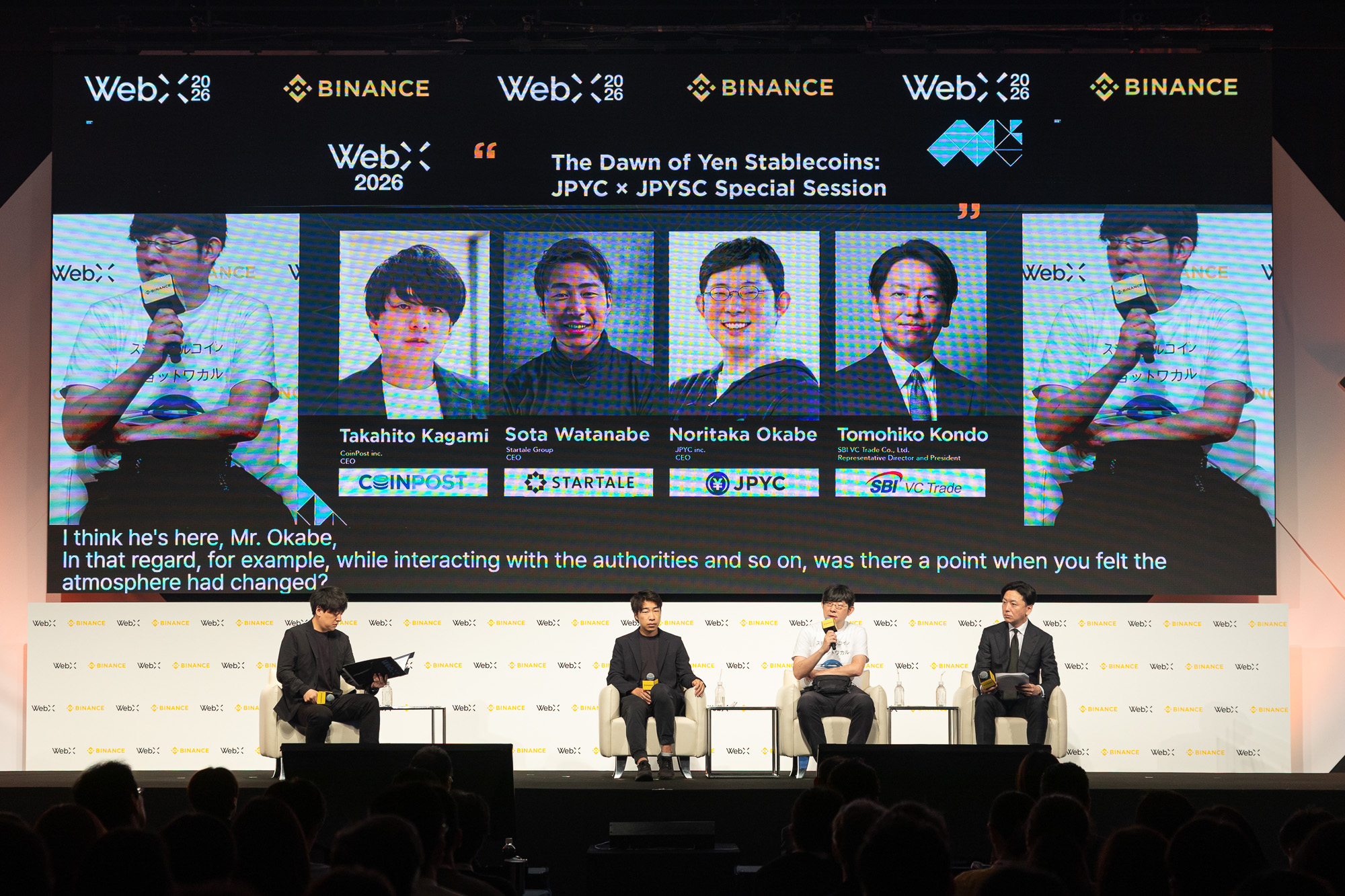
Japan now has two licensed yen stablecoins. JPYC, the funds-transfer type that launched last October, and JPYSC, the trust-type issued through SBI Shinsei Trust Bank that went live on June 24, exempt from the one million yen transfer cap that constrains its rival and barely three weeks old when its issuers took the stage together. The Day 2 session The Dawn of Yen Stablecoins: JPYC × JPYSC Special Session, which brought JPYC CEO Noritaka Okabe, SBI VC Trade president Tomohiko Kondo, and Startale Group CEO Sota Watanabe onto one panel, was the densest 30 minutes of the conference.
The scoreboard is brutal, with the two yen stablecoins having issued roughly 13 billion yen combined against about 50 trillion yen of dollar stablecoins outstanding, so that a currency accounting for nearly a fifth of global FX volume rounds to zero on-chain. Kondo’s response was to reject his own market’s framing of success, saying “a hundred billion yen is too small” and setting one trillion yen within a year as the target that matters, along with a bet that 30% of the audience would be using stablecoins by next year’s WebX, while Watanabe preferred to stop measuring stock and start measuring velocity, arguing Japan should aim to beat the US market’s growth rate rather than its size.
Okabe made the most original argument of the two days, and it starts from the observation that Japanese government bond yields are rising while the Ministry of Finance needs marginal buyers. In the United States, stablecoin issuers quietly became some of the largest holders of Treasury bills because reserve requirements convert stablecoin adoption directly into government debt demand, and Okabe suggested the same logic applies to Japan, positioning yen stablecoin issuers as a new structural buyer of JGBs, something he noted is “not talked about publicly much.” A trillion yen JPYC is not just a payments product; it is a bond desk.
Beneath the issuers, the distribution layer is being assembled with unusual speed, much of it detailed on the Day 1 panel From Hype to Utility — Yen Stablecoins Take Over Payments, Remittance, and Treasury. NETSTARS, Japan’s largest QR payment aggregator, used the conference’s first day to release StablecoinPay to its entire network of 700,000 locations, settling USDC, USDT, and JPYC to merchants in yen at a 0.98% fee against the 3% or so that cards and QR codes charge, while TRADOM launched Japan’s first full cross-border stablecoin remittance service in May, receiving stablecoins from overseas and delivering yen deposits in five to seven minutes with no cap.
HashPort, whose wallet inherited 1.15 million users from the Osaka Expo, announced it will connect the wallet to Claude, ChatGPT, and Gemini in September so that payments can be executed in natural language.
Above them all, the three megabanks confirmed their joint stablecoin consortium during Japan’s Three Megabanks on Tokenization and Crypto: Strategies for the Digital Finance Era on the CRYL Stage, with the FSA’s pilot program behind it, and Circle’s Yam Ki Chan reminded the audience on Next-Gen Payments: Stablecoins & Tokenized Deposits what scale looks like, citing some 26 trillion dollars of USDC settlement in the first quarter alone and pointing out that a Japanese corporate can now move treasury between Tokyo and London within the hour.
The skeptics got the floor too. Former Fed innovation chief Sunayna Tuteja, on The Future of Global Money Movement: Blockchain, Stablecoins, and the New Payments Stack, delivered the line American boosters avoid, that “there is no problem in the US that stablecoins solve,” because the utility lives offshore in exactly the cross-border and settlement niches Japan is targeting.
Gauntlet founder Tarun Chitra, on TradFi Meets DeFi: The Next Generation of Financial Products, performed the autopsy on the euro’s attempt, where on and off ramps cost ten to fifteen times their dollar equivalents and adoption never became organic, leading him to conclude that “the euro won’t be second place.” His conclusion was the one the room wanted but from a source with no reason to flatter it, that trillions of yen in assets are trapped onshore earning 1% and “Japan is clearly the next market.”
The unresolved problem is Washington, because the GENIUS Act recognizes only dollar stablecoins, and the JPYC and JPYSC teams both identified legal recognition of yen stablecoins inside the US framework as the battle that decides whether the yen gets a global rail or a domestic one.
4. AI Agents: 99.3% of Stablecoin Payments Already Aren’t Human

One thesis escaped containment and colonized all four stages, the claim that the natural users of on-chain money are machines, and what made this year different is that it came with a measurement.
On The Day AI Manages Money — Reading the Turbulent Future of the Agent Economy, the Day 1 session pairing JPYC’s Noritaka Okabe with Takafumi Horie, Okabe reported that 99.3% of stablecoin payment volume is already non-human, with in-store payments by people making up the remaining sliver. Global stablecoin volume runs around 20 trillion yen a day, and his projection for 2035 was 23.9 quadrillion yen a day, a number that only parses if machine-to-machine transactions outnumber human ones by four orders of magnitude, which is precisely what he expects once the agent economy matures and the ratio approaches ten thousand to one.
Animoca Brands co-founder Yat Siu built the demographic version of the same argument on Beyond Human: Why Ownership Is the Defining Question of the Agentic AI Era. Ask a normal person how many AI agents they will run in five years and the answer is three to five, but ask in San Francisco and the answer is two or three hundred, which is why he put 50 to 100 billion agents against eight billion people as a conservative estimate of a web where humans are no longer its dominant users.
His stranger observation was that the dependency already runs both ways, since sites now exist where agents pay humans to do physical tasks the agent cannot, and Siu recounted his own research agent instructing him to visit a library to retrieve a book it could not access. Agents need money to be autonomous, banks will not open accounts for software, and stablecoins, he argued, become their natural economic layer, with his own agents executing a thousand micro-transactions in the time a person makes one.
The infrastructure implications ran through half the agenda. On The Autonomous Economy: How Crypto, AI Agents, and Next-Gen Infrastructure Are Converging, Andreessen Horowitz’s head of Asia Pacific Sungmo Park inverted the industry’s usual apology for bad UX, saying “blockchain was used by humans, but I don’t think it was meant to be used by humans,” because wallets with unreadable addresses and programmable money are miserable interfaces for people and perfect ones for software.
Coincheck president and CEO Tomoyuki Isaka, on Beyond Investment: How Blockchain Is Reshaping Everyday Life, extended compliance into the same future, predicting that exchanges built on know-your-customer will need to verify whether an agent genuinely represents its principal, a discipline he called knowing your agent, while Mastercard’s Christian Rau and Visa’s Nischint Sanghavi, on Beyond the Card: How Payment Giants Are Reimagining Retail with Stablecoins and Stablecoins in Action: Reimagining Retail Payments Across Asia Pacific respectively, described agent credential systems already in development. And Horie, back on The Day AI Manages Money, added the competitive threat that makes banks care, pointing to X-Pay’s 6% yield on dollar deposits as the shape of what happens when a platform with hundreds of millions of users bolts stablecoin economics onto consumer money.
Pantera Capital general partner Franklin Bi gave the thesis its investment form in his session Where Crypto Capital Is Flowing Next: Pantera’s View on the New Market Cycle, arguing that tokenization is how institutions make themselves legible to AI agents, and that the moats which protected software businesses for two decades, proprietary data and salespeople and lock-in, mean nothing to a buyer that is itself software, leaving networks and markets as the durable moats, which is the ten-year head start crypto happens to have.
The soberest voice belonged to Audrey Tang, Taiwan’s cyber ambassador, who used the remote Fireside Chat with Audrey Tang to remind the room that delegation without limits is not autonomy but abdication, pointing to agent architectures where spending authority is bounded by mathematical proof, so that without her signature an agent simply cannot spend beyond its mandate. If the agent economy is coming at the scale Okabe measures, that constraint discipline is the difference between an economy and an incident.
5. RWA: Tokenization Graduates From Fractional Real Estate to JGBs and IPO-Day Stocks

Japan’s security token market is five years old, and the panel How Far Can Security Tokens Go? — The Compounding Power of Secondary Trading, New Asset Classes, and Infrastructure graded it with roughly 350 billion yen issued across 86 tokens, about 86% of it backed by real estate per BOOSTRY CEO Kazuma Hirai, and a secondary market on ODX START that lists around 30 billion yen of it while trading a few million yen a day. Fractionalized real estate for retail was a fine first chapter, but as a market structure it churns like the illiquid asset it wraps.
The second chapter is wholesale, and it arrived during the conference. On JGBs on Chain: How Blockchain Is Reshaping Japan’s Financial Infrastructure, the panel confirmed that the DTCC’s tokenized US Treasury trades on Canton would go into production within days, and laid out the plan to put Japanese government bonds on the same protocol, where the prize is the roughly 250 trillion yen JGB repo market, by one panel estimate about a tenth of global repo.
Back on the security token panel, Daiwa Securities Group senior managing director Nobuyuki Sawa explained why treasurers should care in terms any funding desk understands, since on-chain US Treasuries already support repo borrows measured in hours rather than days, with interest computed by the minute, collapsing funding costs and opening a path to real-time gross settlement. Sumitomo Mitsui Trust Bank’s foreign-domiciled tokenized money market fund, billed across several panels as Japan’s answer to BUIDL, extends the same logic to collateral, arriving just as rising JGB volatility inflates margin requirements across the street.
Securitize Japan country head Eiji Kobayashi supplied the number that should hang over every Japanese financial policy meeting, on The Road to a Trillion-Yen Market — Full-Scale Scenarios for RWA, MMF, and Tokenized Securities. Consultancy projections put tokenized real-world assets at roughly 3,000 trillion yen globally by 2033, Japan’s proportional share of global capital markets implies it should hold around 300 trillion yen of that, and his phrasing was that Japan reaches that number “or Japan loses,” even as its current figure on public chains is effectively zero, because the country’s security tokens live on private consortium chains he declined to count.
Franklin Templeton’s Chetan Karkhanis put numbers on the migration’s logic on The On-Chain Bond Market: How Tokenization Is Reshaping Fixed Income, where processing 50,000 fund trades costs about 75,000 dollars through a traditional transfer agent and about one dollar and thirteen cents on a public blockchain.
Then there was SpaceX, the set piece that showed how far the market has moved past Japan’s private chains. When the most anticipated IPO in a decade priced in June, it was tradable on-chain the same day through at least four independent rails, and the people who built them told the story across separate sessions.
Ondo deployed its token a week early, ran a 135-step launch checklist, and had it trading within about five minutes of the NASDAQ open, while Sunrise head of operations Edward Zuo, recounting the launch on Interoperability Beyond Protocols & Markets: Connecting DeFi with Offchain Finance, brought a tokenized version to Solana and watched it do 52 million dollars of spot volume in the first 24 hours, then another 40 million over the weekend while the underlying market slept, and Backpack’s Can Sun, on Asia as a Crypto Powerhouse: Policy, Liquidity and Trust for Robust Growth, laid out the model he considers the endgame, tokenized real shares redeemable one to one and transferable to a conventional brokerage with no taxable event.
Ondo Finance CEO Ian De Bode, in Building the Financial Rails of Tomorrow: A Strategic Vision with Ondo CEO Ian De Bode alongside SBI Onchain director Kefei Lin, explained the market-structure discipline underneath it all, since his firm refuses to seed DEX pools for tokenized stocks because pool prices drift from the primary market, and rivals who launched that way saw buyers pay 20% over the exchange price for Amazon. “Whatever the price is in that DEX pool, that price is wrong.” Prices must be minted and burned at the NASDAQ price or the product deserves to fail, and on the conference’s opening day, Ondo and SBI announced an MOU to bring that machinery to Japanese assets, with the on-chain yen carry trade and tokenized Japanese equities as the stated targets.
The new issuance frontier is Japanese too. Metaplanet, now holding some 43,000 BTC by the count its capital markets lead Shinpei Okuno gave on Metaplanet’s Next Growth Strategy: How Bitcoin Treasury and Digital Credit Are Building a Japan-Born Financial Ecosystem, outlined perpetual preferred shares yielding 4 to 6% against its Bitcoin balance sheet, with tokenized settlement in JPYC to escape Japan’s three-month dividend plumbing.
A law passed this June makes digital municipal bonds possible from next April, a development the panel Tokenizing Municipal Bonds: Can Blockchain Reshape Public Finance? paired with the precedent, a Marui digital bond that drew twenty times its offering in applications. From assets to collateral to funding and now public finance, the wrapper era is ending and the balance-sheet era is starting.
6. Market Cycle: Retail Capitulated, Institutions Didn’t
Bitcoin traded around 62,000 dollars during the event, half off its October 2025 peak, with fresh US strikes on Iran landing the morning of Day 2. The panel Bitcoin Outlook: Top Analysts Break Down Price, Macro, and What Comes Next went straight at the causes, from tariff shocks and a gold unwind that dragged Bitcoin down with it to a drumbeat of exchange hacks and above all the rotation of speculative capital into AI, where the SpaceX IPO alone absorbed roughly two trillion dollars of risk appetite with OpenAI and Anthropic listings looming behind it. Rate expectations flipped from cuts to hikes, and retail, by every on-chain measure the panel cited, has left.
The institutions have not, and one statistic carried the whole argument. BlackRock Japan’s head of ETF product Ken Tojo, on The Institutional Gateway: How Crypto ETFs Are Reshaping Finance, noted that Bitcoin is down about 50% from its highs and Ether roughly 60%, while the units outstanding of BlackRock’s crypto ETFs are down about 9%. Prices halved and the holders barely moved, so whatever the marginal seller has been this year, it is not the allocator who arrived through an ETF.
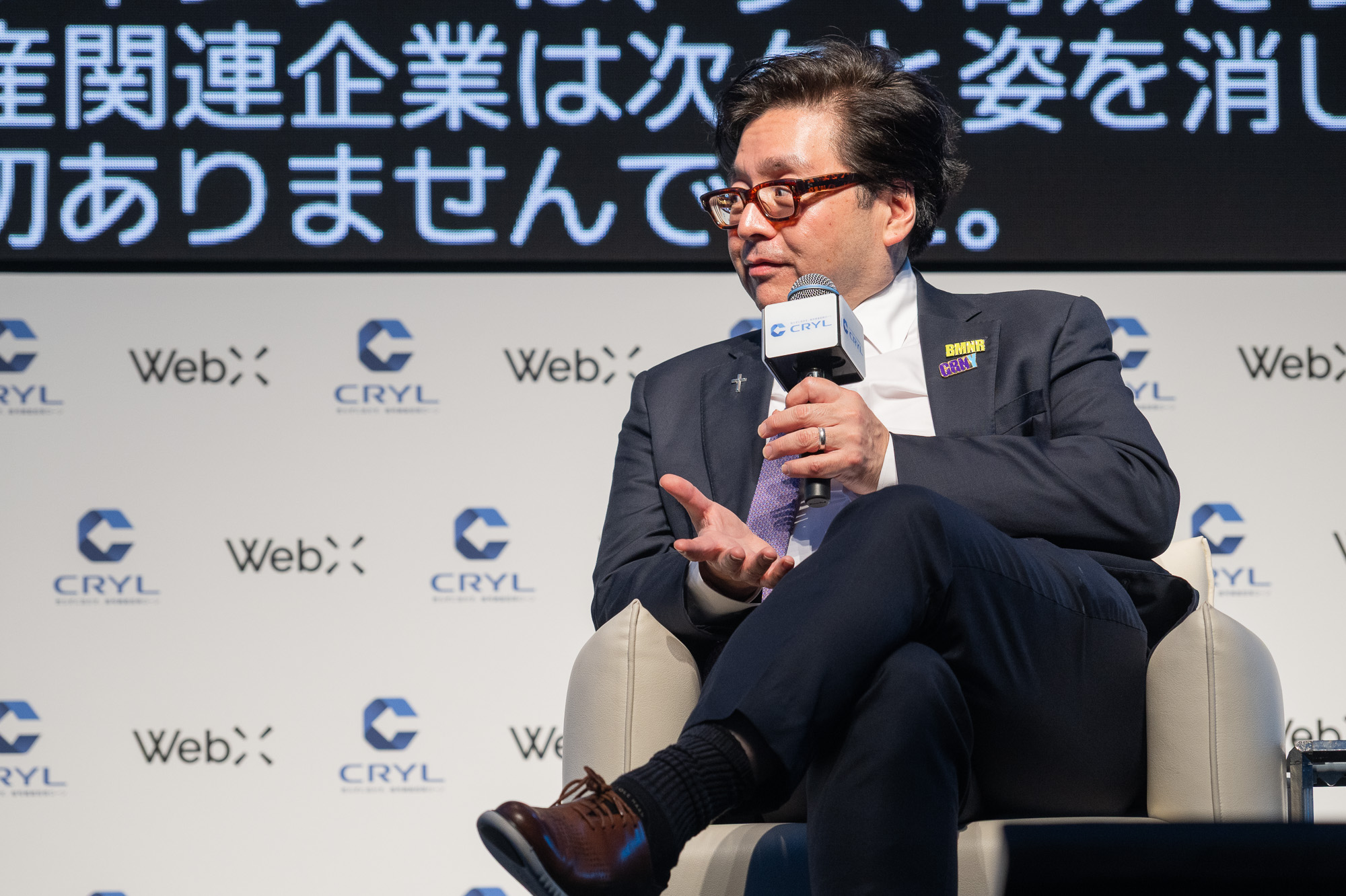
Tom Lee made the same divergence the center of the Tom Lee MAVAN: Made in America VAlidator Network Workshop, pointing to Ethereum posting record monthly transactions in April and staking at an all-time high while sentiment sits at cycle lows, and Pantera’s Franklin Bi, on Where Crypto Capital Is Flowing Next: Pantera’s View on the New Market Cycle, read the tape the way old traders do, observing that headlines about possible world war now fail to move crypto prices at all, which is what seller exhaustion looks like, and noting that the industry produced ten IPOs in the past twelve months where two years ago it had one public proxy.
The purest expression of the divergence was Hyperliquid, which was named in at least eight sessions without having any official presence at the conference. Watanabe returned to it repeatedly, on Why Hasn’t Crypto Changed the World Yet? 〜Reflecting on the Last Decade, Reimagining the Next〜 and again on Digital Finance, Unfiltered: Testa & Sota Watanabe on How Investing Actually Changes, describing an exchange run by 13 people that generates about 150 billion yen in annual revenue, has never raised venture capital, now does on the order of a tenth of NASDAQ’s volume with days that approach parity, and listed Nikkei 225 perpetuals this year.
On The Autonomous Economy: How Crypto, AI Agents, and Next-Gen Infrastructure Are Converging, SPEQETRA Investment Research CEO Tokuyou Li added the detail that institutionalizes the joke, because traditional fund managers now check Hyperliquid on weekends to decide their Monday morning hedges, given that when wars are announced on a Saturday it is the only venue where oil trades.
Watanabe’s larger point was that this is what winning looks like for infrastructure, since nobody announces they are using AWS. “In ten years nobody will raise their hand when asked who uses blockchain,” he told the room. “Everyone will be using it.”
Testa himself embodied the temperament the panelists kept prescribing, disclosing in the same Digital Finance, Unfiltered session that he bought about 100 million yen of Bitcoin as diversification alongside gold and Treasuries, that the position is underwater, and that he is not bothered, offering the old market proverb that the head and the tail belong to the market.
The forward-looking number came from SBI VC Trade’s Tomohiko Kondo, who suggested on Why Hasn’t Crypto Changed the World Yet? that by 2030 crypto, stablecoins, and tokenized assets could plausibly reach a tenth of Japan’s 2,400 trillion yen of household financial assets, and whether that lands at 100 or 200 trillion yen, it is the same trade. The people who need prices to validate them have left, and the people building the pipes did not notice.
7. Prediction Markets: Price Discovery for Some, Laundering for Others
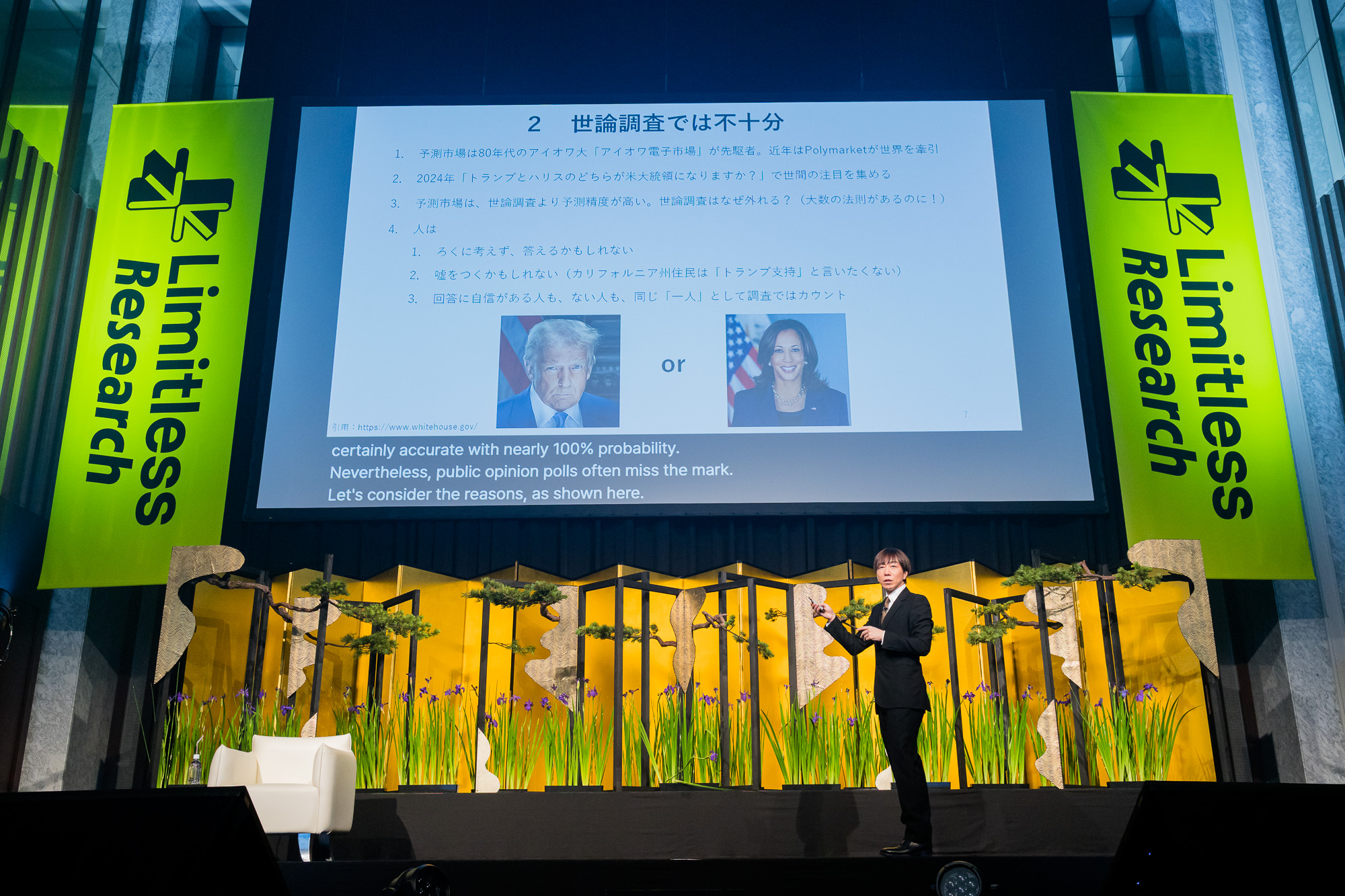
Prediction markets appeared twice at WebX, in two rooms that badly needed to talk to each other.
The first room belonged to Keio University professor Toyotaka Sakai, whose solo keynote, The Age of Prediction Markets: Bringing Collective Intelligence into the Real World, made the largest claim heard on any stage, that prediction markets belong on the short list of great social science inventions alongside representative democracy, the joint-stock company, and fiat money.
The argument underneath it was a demolition of the poll, because survey respondents have no incentive to think, they lie about socially awkward preferences, and a poll counts an expert and someone who has never considered the question as the same one person.
Markets fix all three, and the research he cited, an American Economic Review paper by Ottaviani and Sorensen, shows the price is a geometric mean of participants’ beliefs weighted by risk tolerance, which means informed minorities move prices in a way no survey allows. His practical program was corporate, internal prediction markets built on scoring rules and run on points to stay clear of gambling law, functioning as bad-news alarms in organizations where bad news does not travel upward, since a ticket on whether a project finishes this year trading at 15 cents tells a board what no subordinate will.
He drew the manipulation line just as cleanly, because whoever can change an outcome must not be allowed to bet on it, which is why a market on the Strait of Hormuz cannot admit the man who can close it. The legal footnote was the punchline, since using Polymarket from Japan likely constitutes illegal online gambling, so, as he told the audience, please don’t.
The second room was the panel Preventing Crypto Misuse: Asset Tracing and Confiscation Frameworks, where Elliptic’s APAC head of policy and regulatory affairs June Lau described what prediction markets look like from a financial crime desk, and the typology is already live on-chain. Dirty money buys Bitcoin, Bitcoin becomes USDT, USDT flows into binary contracts, and the proceeds come out the other side as gambling winnings, a clean and plausible source of funds. Her asks were concrete, that regulators decide what these platforms legally are, that exchanges screen prediction-market wallet addresses, that FATF and IOSCO coordinate typologies rather than leaving each country to improvise, and that sandboxes replace prohibition, while Japan’s exchanges, per the Japan at a Crypto Crossroads — Inside the FIEA and Tax Reform Push panel, are already quietly blocking transfers that hop toward prediction markets as de facto industry guidance.
Between the two rooms sits the fact both would accept, which is that the markets work. The clearest evidence offered all week was Watanabe’s observation, on Digital Finance, Unfiltered: Testa & Sota Watanabe on How Investing Actually Changes, that SpaceX’s opening price was discovered on Hyperliquid’s pre-IPO perpetual before NASDAQ ever opened, and the wider context that the United States legalized perpetual futures through the CFTC framework just last month.
Japan now hosts a keynote arguing prediction is a national capability while its regulators treat the instruments as casinos and its criminals treat them as washing machines, and that tension does not resolve itself. Someone will have to write rules that keep the price discovery and kill the laundry, and the country that writes them first gets an information advantage everyone else imports.
8. Security: Quantum Deadlines, DPRK Theft, and Washington’s Kill Switch

The quantum session, honestly titled Quantum Threat or Quantum Hype? The Crypto Industry’s Honest Assessment, refused to comfort anyone. G.U. Technologies CEO Hidekazu Kondo, whose firm runs Japan Open Chain, argued the timelines are compressing, with error-correction advances from IBM and RIKEN cutting the qubit requirements for breaking elliptic curve cryptography and moving his estimate of the crossing point to around 2030 against the consensus 2035.
Meanwhile, Japan Bitcoin Industry researcher Taishi Mikura pushed back on the hardware reality, noting that as of last year quantum machines still struggled to factor the number 21, and anchored the policy timeline instead, with NIST deprecating current cryptography by 2030 and mandating migration by 2035.
What nobody disputed was the exposure and the dilemma, because roughly six million BTC sit in address formats with exposed public keys, post-quantum signatures are so much larger that naive adoption would cut Bitcoin’s throughput from about seven transactions per second to a third of one. When the day comes, dormant coins including Satoshi’s force a choice between freezing user assets, which violates everything Bitcoin claims to be, and letting a state-grade thief drain them. The worst case, as Hidekazu Kondo put it, is not stolen coins but a hundred-trillion-yen asset class repricing all at once, which is not a crypto event but a financial crisis.
North Korea needed no projection, because on The Compliant DeFi Stack: Designing On-Chain Products for a Regulated World, the JFSA’s Ryosuke Ushida said plainly that North Korean actors steal billions of dollars a year from DeFi protocols “to buy missiles, which are then launched toward Japan,” a sentence that explains Japan’s zero-tolerance AML posture better than any consultation paper.
The Preventing Crypto Misuse: Asset Tracing and Confiscation Frameworks panel laid out the plumbing behind it, citing FATF findings that some 84% of illicit digital asset volume now moves in stablecoins while only 76 jurisdictions license virtual asset providers at all. The same week’s absurdity got aired on the Japan at a Crypto Crossroads panel, where Hirosue publicly lobbied Kano to fix the fact that bitFlyer runs the TRUST travel-rule system while bitbank runs Sygna, meaning two of Japan’s largest licensed exchanges cannot send assets to each other domestically.
The third threat came from an ally. The Mythos incident, the US export restriction that denied Japan access to a frontier American AI model, was treated by SBI Holdings chairman Yoshitaka Kitao in his Day 1 keynote as proof that foreign technology dependence is a switch someone else’s government can flip.
Horie, on The Day AI Manages Money, reached for aircraft to make the same point, contrasting the F-15, which Japan license-built and could maintain, with the F-35, a black box Japan merely operates, before arguing the same logic now applies to AI models and, by extension, to dollar-denominated financial rails.
Former White House advisor Carole House, on the Asian regulators roundtable Digital Assets, Updates in Regulatory Regimes and the next growth areas for 2026 Onwards, validated the anxiety from the American side, cataloguing what the GENIUS Act left unresolved and warning that unsupervised dollar stablecoins amount to bottom-up dollarization that drains deposits from smaller economies.
Japan’s sovereignty case for the yen stablecoin, for domestic AI, and for post-quantum planning is usually presented as three policies, but WebX presented them as one instinct.
9. Adoption: Web3 Works Best Where Nobody Says Web3
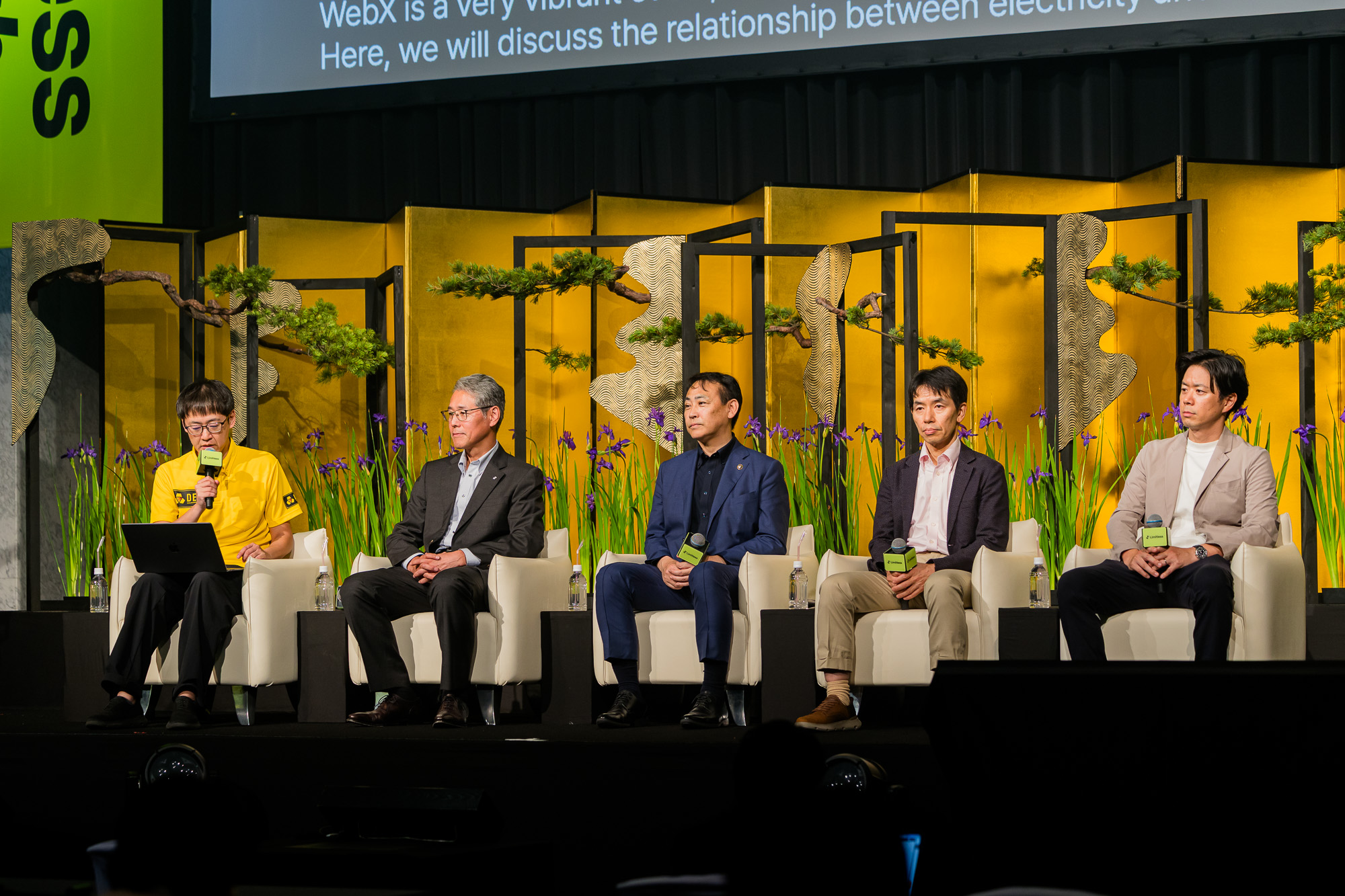
The METI official on the panel Japan’s Social Infrastructure for the Next Decade: Energy Grids and Municipal DX on the Front Lines, Shuichiro Yoshida of the Frontier Promotion Office, defined the end state better than any protocol founder, observing that nobody says they are using the internet because it is simply there, and that the measure of Web3’s success is when its own vocabulary disappears the same way. In Japan, in scattered and very concrete places, it already has.
The strongest data point of the entire conference came from the session Japan’s Tokenized Deposit Moment: From Banking Infrastructure to National Policy. When the Takaichi cabinet’s cost-of-living subsidy was distributed in Ishikawa prefecture, it was paid exclusively through Tochika, Hokkoku Bank’s tokenized deposit, with no application process and no recipient list, because digital identity credentials tied to MyNumber records let the prefecture pay residents the day after they opened an account.
The result, per Digital Platformer CEO Ikkei Matsuda, is some 230,000 accounts, around 30% of the prefecture’s eligible population, spendable at 7-Eleven at a 0.5% merchant fee against the card networks’ 3%, and during the Noto earthquake, evacuees with wallet balances did not return to dangerous homes to retrieve cash. Nobody in Ishikawa asked what chain any of this runs on, because what they received was a subsidy that arrives faster and a payment that costs less.
The same pattern showed up wearing a game. PicTree, the joint venture between TEPCO’s grid subsidiary and DEA presented on the same panel, pays citizens points to photograph utility poles, turning inspection of 6 million poles and 400,000 kilometers of line into a mobile game with 150,000 downloads and over 3 million photos in two years, complete with point values that shift seasonally toward crow nests in spring and vine overgrowth in summer.
Top players have earned over a million yen, for Hakodate mayor Jun Oizumi watching families inspect his city’s infrastructure for fun was something close to a historic moment, and Thailand is next on the expansion list.
At the top of the funnel, back on Beyond Investment: How Blockchain Is Reshaping Everyday Life, Coincheck’s Tomoyuki Isaka revealed the quiet architecture behind Japan’s gentlest on-ramps, with Mercari’s crypto service, Credit Saison’s points-to-Bitcoin conversion, and the KDDI joint venture’s point investing all running on Coincheck’s infrastructure through APIs, because points, he noted, are how Japanese users learn to hold volatile assets without fear. His prediction matched Yoshida’s and Watanabe’s, that the words blockchain and Web3 disappear from consumer language soon. In Ishikawa they already have.
10. Key Insights on the Japanese Market
Several conclusions follow that we believe global readers underweight:
- The bottleneck has moved from law to plumbing. At MoneyX we wrote that regulation was no longer the constraint, and WebX confirmed it while revealing the next ones, from two flagship exchanges that cannot transfer to each other, to a securities regime with no legal definition of token ownership, to security tokens trading millions of yen a day against billions issued. The 2027 and 2028 dates are now fixed, and whether Japan’s market is ready for them is an infrastructure question rather than a legislative one.
- The yen stablecoin question is now distribution and macro. Issuance is legal, rails into 700,000 merchants exist, and the binding constraints are the one million yen cap, recognition inside the US regulatory perimeter, and the arrival of the megabank consortium. Okabe’s framing of stablecoin issuers as structural JGB buyers deserves particular attention, because it aligns the Ministry of Finance’s fiscal interest with the industry’s growth for the first time.
- The agent thesis is consensus, and unusually for consensus, it is measurable. When every stage of a conference agrees on something, the edge is usually gone, but 99.3% of stablecoin payment volume being non-human is not a narrative so much as a reading. Japan is the only market where regulators, megabanks, and issuers are all designing for machine customers at once, and where a politician has already promised agent-era legal reform on a 6 to 12 month clock.
- Institutions decoupled from price this cycle, and Japan is scheduled to arrive at the bottom. Halved prices moved ETF units by single digits, and if that holding behavior survives the year, Japan’s 2028 tax and ETF unlock will land on a market where the sellers are exhausted and the buyers are structural savers with 2,386 trillion yen behind them. The timing mismatch between Japanese demand arriving and Western sentiment recovering is, in our view, the most interesting trade setup discussed at the conference without anyone quite naming it.
- Sovereignty is the engine underneath everything. The Mythos shock, dollar stablecoin encroachment, quantum deadlines, and North Korean theft are a single anxiety wearing four costumes, and Japan’s speed on stablecoins, AI, and financial reform is best understood not as enthusiasm but as a country deciding it will not be dependent on switches it does not control.
Japan is done writing rules. Now it has to fill them.
The author of this report may have personal holdings or financial interests in assets or tokens discussed herein. However, the author affirms that no transactions have conducted using material non-public information obtained in the course of research or drafting. This report is intended solely for general information purposes and does not constitute legal, business, investment, or tax advice. It should not be used as a basis for making any investment decisions or as guidance for accounting, legal, or tax matters. Any references to specific assets or securities are made for informational purposes only and should not be construed as an offer, solicitation, or recommendation to invest. The opinions expressed herein are those of the author and may not reflect the views of any affiliated institutions, organizations, or individuals. The opinions and analyses expressed herein are subject to change without prior notice. In addition, beyond the individual disclosures included in each report, Four Pillars, may hold existing or prospective investments in some of the assets or protocols discussed herein. Furthermore, FP Validated, a division of Four Pillars, may already be operating as a node in certain networks or protocols discussed herein or may do so in the future. Please see below links in the footer for FP Validated's participating network disclosures and for broader disclosure details.


