Key Takeaways
- Q2 2026 was a quarter in which market conditions and regulatory progress diverged in Japan. The Bitcoin price kept falling, while the FIEA amendment bill was submitted to the Diet and the amended Payment Services Act took effect, moving Q1 policy direction into legislation and enforcement.
- Tokenization expanded from the cash leg to the underlying asset. The Progmat working group put forward a micro stock concept and a tokenization law proposal, giving concrete shape to equity tokenization. But stocks await a general law, so a tokenized MMF, issuable through an Investment Trust Act amendment alone, is the more likely first result.
- The amended Payment Services Act widened market entry while strengthening asset safeguarding. It established an intermediary business for operators that connect transactions without holding user assets, allowed up to 50% of trust type stablecoin reserves in government bonds and time deposits, and added a domestic holding order. The intermediary business in particular shifts stablecoin competition from issuance qualifications to the user point of contact.
- Bitcoin treasury companies faced their first stress test, while regulated distribution businesses expanded. Metaplanet recorded a JPY 114.5 billion net loss and saw its mNAV fall to 0.9x, weakening its premium-dependent fundraising cycle. Meanwhile, SBI expanded stablecoin distribution and exchange consolidation, while JPYC surpassed JPY 3 billion in cumulative issuance and broadened real-world use cases.
1. Introduction: Q2 2026, When Market Sentiment and Regulation Diverged
If Q1 2026 was a quarter that set direction through government administrative measures and corporate business announcements, Q2 was the quarter in which that direction began to actually operate in law and in the market. In Q1, the Japanese government moved the division handling crypto assets under the asset management supervision bureau, put separate taxation into law, and laid out a direction to move crypto assets into the Financial Instruments and Exchange Act. In Q2, as the FIEA amendment bill was submitted to the Diet and the amended Payment Services Act took effect, direction began to move into bills, and signals into enforcement.
What stands out is that this progress advanced separately from market conditions. The Bitcoin price continued to fall in Q2, and its impact spread directly to the financials and share prices of companies that had placed their assets in Bitcoin. The regulatory and business areas, however, moved regardless of this decline. Laws took effect on schedule, the target of tokenization broadened from real estate and bonds to stocks, and operators integrated exchanges and increased handled assets on top of the newly opened framework. In other words, it was a quarter in which market sentiment and the regulatory clock turned separately.
2. Three Currents in the Q2 2026 Digital Asset Market
2.1 Tokenization: The Target of Tokenization Broadens to Stocks
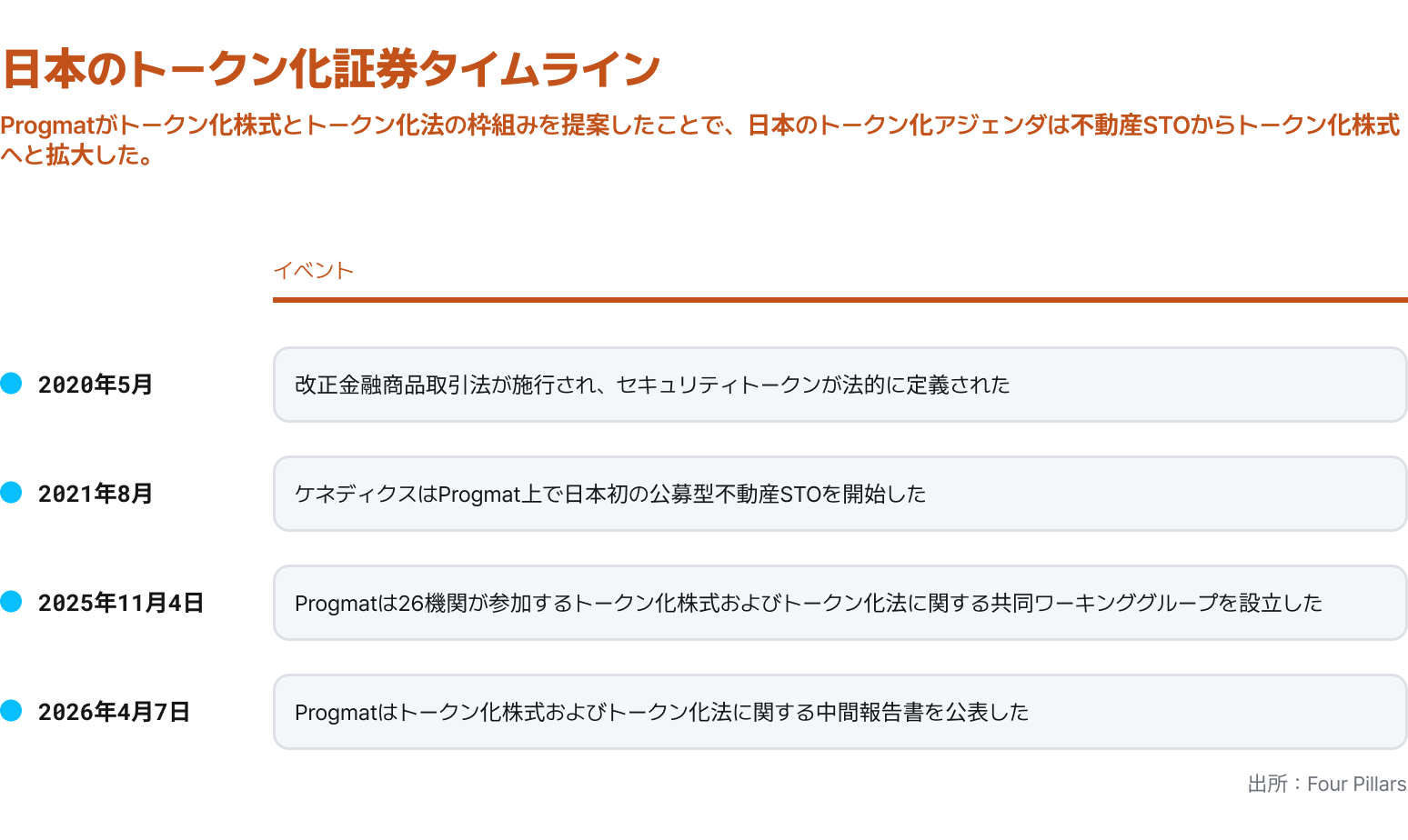
Recently, the digital asset infrastructure company Progmat published a report on tokenized equities. It is a document organizing the review results of a working group in which Nomura, Mitsubishi UFJ Trust Bank, SBI, and others participate, and the report's purpose is to prepare a draft for tokenization law legislation needed to actually issue tokenized equities.
Through this, if Q1 saw an attempt at tokenization in the settlement area of Japan's security token market, in Q2 securities themselves emerged as a target of tokenization. In particular, moving beyond the previously active real estate and bonds, a direction emerged in which the scope of tokenization broadens to stocks as well.
2.1.1 Japan's Security Token Market: Why Real Estate Came First
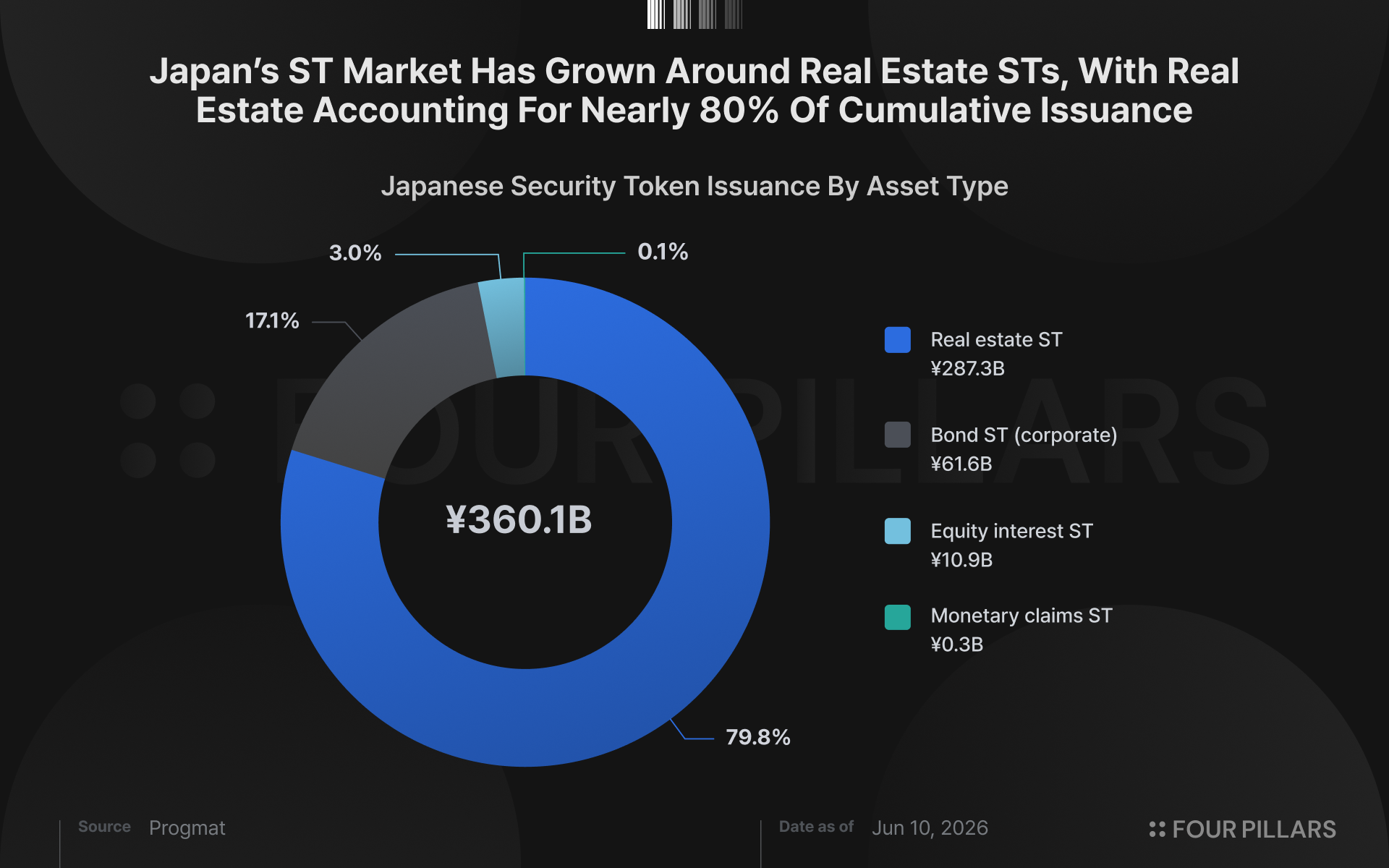
Japan's security token market has grown around real estate since being incorporated into the regulatory framework through two amendments to the Financial Instruments and Exchange Act in 2019 and 2020. The following year, in August 2021, Kenedix launched Japan's first public real estate STO. It was a case that divided a rental condominium in Shibuya into a minimum investment unit of JPY 100,000 so individual investors could buy it, issued on the Progmat platform developed by Mitsubishi UFJ Trust Bank.
The market then grew around real estate beneficiary rights and corporate bonds. As of April, Japan's cumulative ST issuance was about JPY 360 billion, with a balance of about JPY 674.7 billion, and most issues are concentrated in real estate and bonds. There are three reasons behind this concentration.
- It was an empty space with no existing infrastructure to replace: Unlike listed stocks, real estate security tokens had no centralized recording institution such as the Japan Securities Depository Center (JASDEC) from the start.
- The product itself was new: Real estate security tokens combined the liquidity of a REIT with the individual-asset selectivity of crowdfunding. There was room for the market to grow by filling small-scale real estate investment demand that existing products did not meet.
- The framework fit: Real estate security tokens could use the already-recognized beneficiary-securities-issuing trust structure as is, so legal friction was low.
Progmat's interim report presented the area left empty in the existing electronic system as a new market that tokenization can fill. The gist is to divide stocks, which had been bound to trading in 100-share units by the trading-unit (tan'gen) system, down to the JPY 1 unit, and to change trades that had been bound to set hours and settlement cycles into a structure capable of 24-hour instant settlement.
2.1.2 Implementing "Micro Stocks" Through Tokenized Equities
The main product the report presented is "micro stocks." A tokenized equity is a structure in which 100 shares of a listed company's trading unit are entrusted to a trust, and the beneficiary rights are divided down to the JPY 1 unit and issued on a blockchain. It uses the beneficiary-securities-issuing trust that real estate security tokens and JDRs have employed, changing only the underlying asset to stocks. Through this, the investment entry barrier, which had reached several million yen, is lowered to the JPY 1 unit.
The issuing company is directly involved in the tokenization process. Unlike a stock-linked token issued by a third party without the issuer's consent, a tokenized equity connects the listed company and the trust by contract. Investors therefore receive dividends pro rata even while holding finely divided beneficiary rights, and can also enjoy perks as deemed shareholders and exercise voting rights.
The attribution of rights for listed stocks is already fixed by the book-entry transfer system of the Japan Securities Depository Center (JASDEC) as the legal master ledger. If a blockchain is set up separately as a new ledger on top of this, a conflict arises over which record holds legal effect. The approach presented after review is therefore to leave JASDEC's ledger as the legal master and place the blockchain on top of it to synchronize transaction records.
The order of application also starts outside the exchange. Trading on the exchange's main board is left in the existing way, and trades that take place outside the exchange, such as securities firm OTC transactions or proprietary trading systems (PTS), are processed on-chain first. Rather than replacing the existing infrastructure, it chose to connect it in stages.
2.1.3 "Tokenization Law" as a Legal Proposal
Together with the product concept, the interim report also put forward a "tokenization law" proposal. To understand the context of this proposal, one must first look at the character of Japan's current security token regulation. The amended Financial Instruments and Exchange Act of 2020 defined security tokens, but this regulation is closer to business regulation that governs the operators handling tokens from an investor-protection standpoint. It does not give the token itself a new legal nature. Business regulation only determines who can handle tokens under what qualifications, and does not define what rights arise from holding the token or how it transfers when passed to another. Regardless of tokenization, therefore, a product must be structured to fit the existing governing law of the target security, and real estate tokenization has barely been made to work through the detour of a beneficiary-securities-issuing trust.
This detour, however, does not apply to all securities and gets blocked at the certificate-issuance problem. Many Japanese laws still retain provisions premised on issuing paper certificates, so securities grounded in existing law are difficult to tokenize under the current law as is. Investment trust beneficiary rights, municipal bonds, and special purpose company preferred equity securities are representative cases. Real estate sidestepped this using a trust, but tokenized money market funds (MMFs) that manage government bonds and the like run into this problem, since the trust detour is blocked under the Investment Trust Act.
In response, the tokenization law is a proposal to fill this legal gap with a general law. The gist is to give legal effect to the blockchain record itself. At present, even if it is recorded on a blockchain whose token belongs to whom, that record alone makes it hard to assert legal rights. The tokenization law presumes the person registered as the token holder on a distributed ledger to be the rightful holder. The record itself becomes the basis of the right.
A device to reinforce transaction stability is also included. If the person who received a token did not know there was a problem with the transferor's qualification to transfer the right, and acquired it through a normal transaction, that acquisition is protected through good-faith acquisition. Rather than amending an individual law for each type of security, the intent of the tokenization law is to guarantee the effect of the record and the safety of transactions through a single general law applying to tokenized assets broadly.
This is in the same direction as overseas cases that organized the rights relationships of tokenized assets ahead of Japan. Switzerland, Germany, and France govern the rights relationships of tokenized assets based on the holder recorded on the ledger, and the United States handles this through a concept of control with the character of a property right. All these jurisdictions recognize third-party perfection, issuer discharge, and good-faith acquisition based on the ledger record. This differs from Japan's current business-regulation-centered approach.
Organizing such a general law, however, usually takes several years. The interim report therefore also presented a detour possible in the short term. If the Investment Trust Act is amended first to introduce a certificate-non-issuance system, MMFs, which have large tokenization demand, can be issued even within 2026. A phased approach leaves general-law organization as a long-term task while opening areas with clear demand and a limited scope of institutional amendment first through individual-law amendments.
2.1.4 Outlook: From Settlement Tokenization to Asset Tokenization
Viewing Q1 and Q2 together, the focus of tokenization is shifting. The Q1 security token settlement camp, in which Nomura, Daiwa, and the megabanks gathered, was an attempt to tokenize the stage of paying the consideration when buying and selling stocks or bonds, that is, the cash leg. It changes the settlement method to tokens while leaving the trading object as is. The Q2 tokenized equity review is an attempt to make the trading object, the stock itself, into a token. From tokenizing the consideration to tokenizing the asset, the area tokenization addresses has broadened by one step.
In this direction, the first tangible result is more likely to be an MMF than stocks. Organizing a general law such as the tokenization law usually takes several years, but a path is open for MMFs to be issued within 2026 through the limited detour of amending the Investment Trust Act. In fact, in December 2025, three Mitsubishi UFJ companies in asset management, securities, and trust joined hands with Progmat and began organizing the foundation for Japan's first tokenized MMF. They first target providing a yen tokenized MMF for institutional investors in 2026, with expansion to individual investors placed as the next step. The yen MMF is also a product reviving after about ten years, in an environment where rates have returned after recruitment ceased in 2016 due to negative rates.
The report is also still at the proposal stage. The tokenization law, the foundation of stock tokenization, has not yet reached legislation, and practical issues remain, such as micro stocks' tax treatment, suitability for the Nippon Individual Savings Account (NISA), and the method of exercising voting rights. Even the short-term detour, the MMF, must be backed by an Investment Trust Act amendment and tax organization. In the end, what became clear in Q2 is the direction of tokenization broadening from the consideration to the asset, and that its first result is more likely to come from MMFs, which have a lower threshold than stocks. The speed of reaching stocks depends on the longer task of organizing the tokenization law.
2.2 Regulation: Enforcement of the Amended Payment Services Act and the Expansion of Distribution Channels
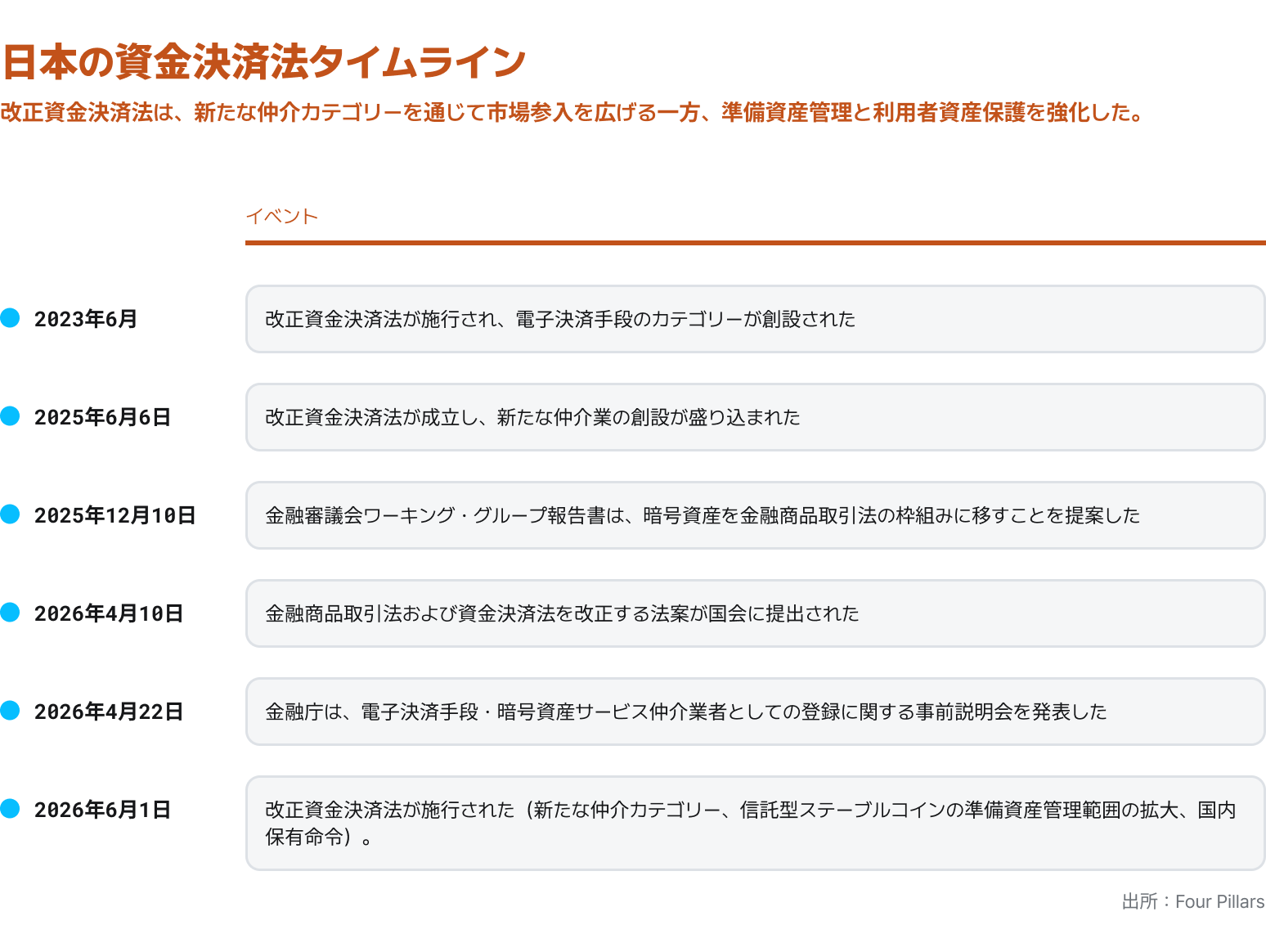
On June 1, the amended Payment Services Act took effect. Enacted in June 2025, this law contains three changes.
- Establishment of the "Electronic Payment Instruments and Crypto Asset Service Intermediary": the creation of an intermediary business for operators that only intermediate, without issuing or exchanging.
- Expansion of the reserve-asset management scope for trust type stablecoins: broadening the reserve assets of trust type stablecoins, which had been managed only in demand deposits, to allow management in government bonds and the like as well.
- Domestic holding order provision for crypto assets: the addition of a domestic holding order that can order an exchange operator's held assets to be kept within Japan.
If the FIEA amendment bill submitted to the Diet on April 10 handles the broad framework of moving crypto assets' legal status from a means of payment to a financial product, the June enforcement of the Payment Services Act amendment defines the framework of distribution and safeguarding needed for that market to actually function.
2.2.1 The Empty Space the Intermediary Business Fills
The part of the amended Payment Services Act that brings the most direct change to Japan's digital asset market is the establishment of the intermediary business. Until now, to connect stablecoins or crypto assets to users in Japan, one had to register directly as an "Electronic Payment Instruments Exchange Service Provider" or a "Crypto Asset Exchange Service Provider." This was because there was no separate registration system for operators that connect users and exchange operators without directly performing the issuance and exchange functions.
As a result, the distribution path that reaches users was bound to a small number of operators that had completed formal exchange or exchange-service registration. This was also part of the backdrop for JPYC becoming a first mover in Q1. JPYC entered the market first in the form of a prepaid payment instrument before the stablecoin framework fully opened, building a user and merchant base, and then obtained registration as a funds transfer service provider to convert to a regulated stablecoin redeemable for cash. Since Japan's first registration as an Electronic Payment Instruments Exchange Service Provider came only about one year and nine months after the law took effect, there was a bottleneck in which the distribution path opened late even with operators qualified to issue.
In response, the "Electronic Payment Instruments and Crypto Asset Service Intermediary" was newly created to resolve this bottleneck. The core of the intermediary business is that it applies lighter regulation, different from exchange operators, to operators that only intermediate. Exchange operators directly take custody of user assets and handle trading and exchange, so they bear financial requirements and anti-money-laundering obligations, but intermediaries are prohibited from receiving custody of user assets in the first place and do not become a party to the transaction. Accordingly, no financial requirement is imposed on the intermediary business, so even an individual can register, and the transaction confirmation (KYC) obligation is fulfilled by the affiliated exchange operator, so it is not imposed redundantly on the intermediary.
Instead, the intermediary must follow an affiliation system in which it intermediates for a specific exchange operator under that operator's commission, and if damage occurs to a user during intermediation, the more solvent affiliated exchange operator is made to bear responsibility. It is a structure that lowers the entry threshold while binding user protection to the affiliated exchange operator. With this, a path opened for Web3 operators such as blockchain games or wallet services to intermediate stablecoin or crypto-asset transactions by connecting users to an exchange operator within their own apps and services, without directly obtaining an exchange operator license.
2.2.2 Expansion of the Trust Type Management Scope and the Domestic Holding Order
The same enforcement contained two more changes affecting the stablecoin market. One is the expansion of the reserve-asset management scope for trust type stablecoins. Until now, the trust type had to manage all reserve assets only in yen demand deposits, but this amendment allows management in government bonds and time deposits as well, capped at 50% of the issuance amount.
This change starts from the fact that Japan organized stablecoin regulation first, but as time passed, this brought a result that limited issuers' profitability. Japan was a first mover that introduced stablecoin regulation early compared with major global economies in 2022. Tying all reserve assets to demand deposits at that time came from a cautious design to minimize credit, interest-rate, liquidity, and currency risk.
But as other regions, such as the United States, which made regulation afterward, allowed management means beyond deposits including government bonds, Japan's conservative regulation came to act as a model less competitive in terms of issuer profitability. Issuer revenue comes from the management yield of reserve assets, and demand deposits alone make it hard to find a meaningful revenue source compared with government bonds. This expansion of the management scope is therefore an adjustment to recover domestic issuers' competitiveness by matching conditions with other regions.
The other provision is the domestic holding order. When a crypto asset exchange service provider or an Electronic Payment Instruments Exchange Service Provider holds user assets, it adds a basis for the FSA to order those assets to be kept within Japan. This is a device to prevent a situation in which, when an exchange falls into crisis, user assets are tied up in an overseas corporation or overseas custodian and become difficult to recover.
The background to this provision is overseas exchange bankruptcy cases. Financial instruments business operators handling derivatives already had a similar domestic holding order provision, but spot crypto asset exchange operators did not have the same device sufficiently. As a result, if an overseas exchange or related operator went bankrupt, a problem could arise in which Japanese users' assets were tied up in overseas bankruptcy proceedings and hard to enforce for immediate return domestically. The domestic holding order is a system that, in preparation for such situations, requires authorities to keep user assets safeguarded within Japan and raises the possibility of return.
2.2.3 Implications: Widening Entry While Strengthening Asset Safeguarding
The three changes in the June Payment Services Act enforcement are not skewed to one side. The establishment of the intermediary business widens the door to market entry, the trust type management expansion grows issuers' profitability, and the domestic holding order strengthens user protection. That is, it is institutional organization that includes both easing measures that open the market and protective measures that strengthen asset safeguarding.
Among these, the provision most likely to change the market structure is the establishment of the intermediary business. Until now, competition in the stablecoin market was closer to who possesses issuance qualifications and who obtains Electronic Payment Instruments Exchange Service Provider registration first. But once the intermediary business opens, the focus of competition can shift from issuance itself to the user point of contact. This is because payment gateways, wallets, point operators, securities firm apps, bank subsidiaries, and fintech companies can connect stablecoins and crypto assets to users as registered intermediaries without becoming issuers themselves.
Whether the intermediary business actually changes the market, however, depends on which players enter the market. Operators that only intermediate are not subject to financial regulation but bear explanation obligations toward users and advertising regulation. Since the registration pre-briefing session was announced only in April, the specific rules must be gauged through the operating process, and whether payment operators or fintech companies actually jump into stablecoin distribution through this path has not yet emerged. The framework has opened a path, but the appearance of operators entering that business route is likely a matter of the next quarter or later.
2.3 Business: The First Stress Test of Bitcoin Treasuries
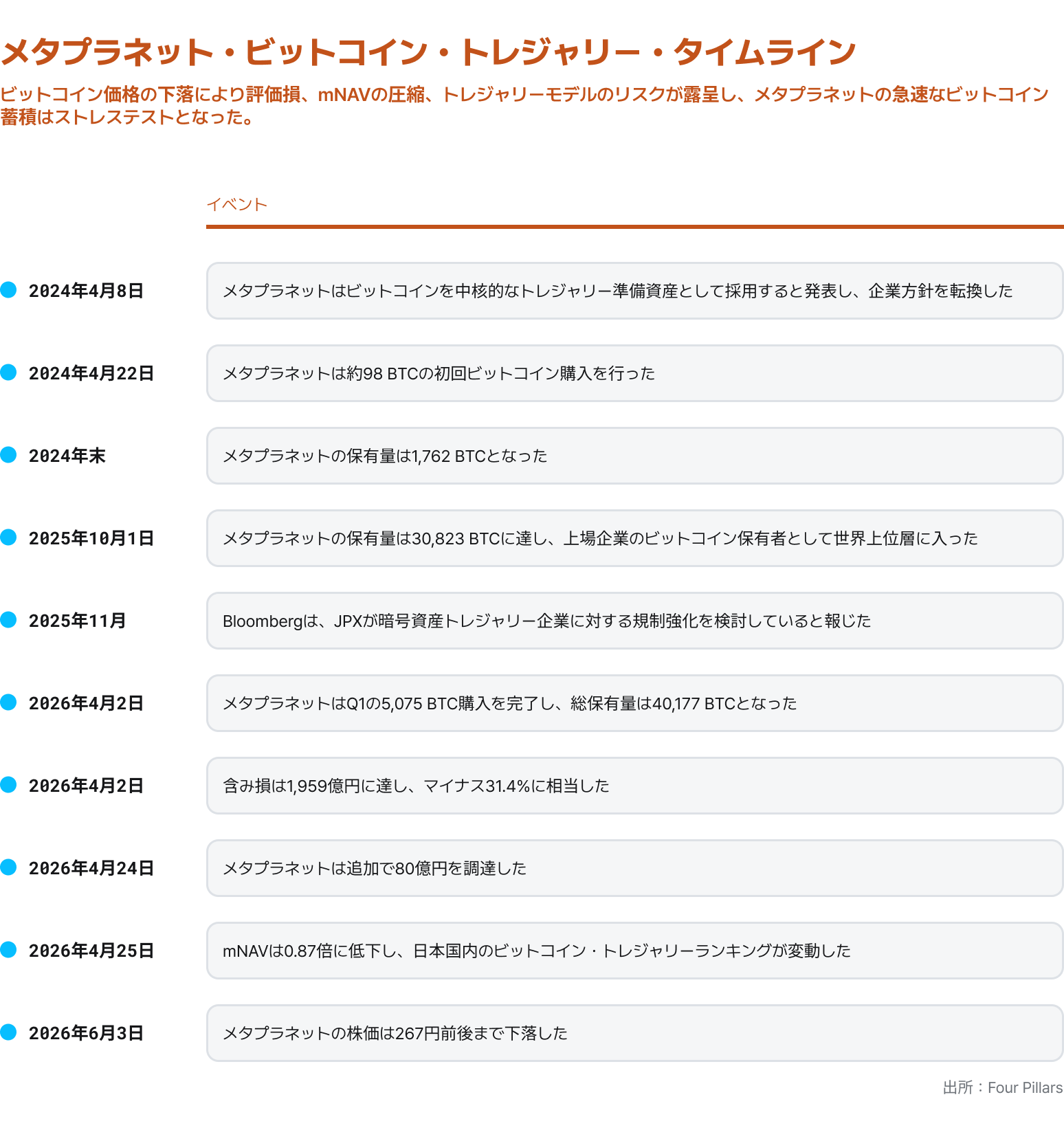
Until Q1, Japan's Bitcoin treasury companies were a growth story of rapidly building up assets. Metaplanet, listed on the Tokyo Stock Exchange Standard market, started with about 98 BTC in April 2024 and increased its holdings to a cumulative 40,177 BTC by April 2026, rising into the global upper tier of public Bitcoin holders. In Q2, however, the other side of this growth story emerged. As the Bitcoin price decline shook treasury companies' financials and share prices at the same time, it was confirmed that vulnerability had grown alongside the pace of asset accumulation.
2.3.1 The Two Faces of Valuation Losses and Q1 Earnings
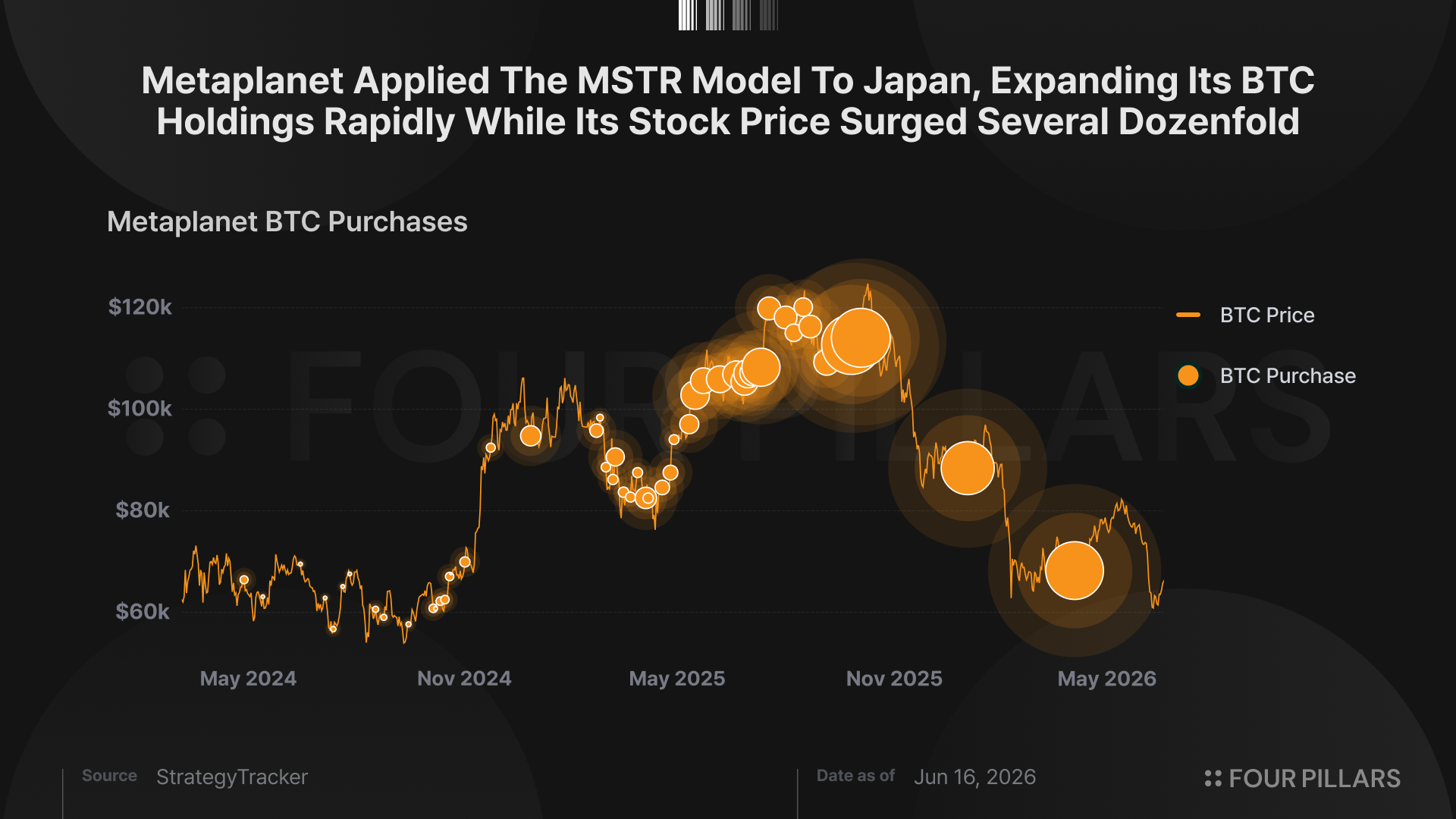
Metaplanet, which had originally operated existing businesses such as hotels, announced in April 2024 that it would adopt Bitcoin as a core reserve asset and made its first purchase of about 98 BTC. From this point, Metaplanet began converting into a digital asset treasury (DAT) company, referencing the model of the US firm Strategy. It is the cyclical structure of raising funds through stock and stock acquisition rights, putting most of it into Bitcoin purchases, and then raising funds again when the increase in holdings leads to a share-price rise. Metaplanet applied this model to the Japanese market and rapidly increased its holdings to 1,762 BTC at the end of 2024 and 30,823 BTC in October 2025, with its share price also rising several dozenfold within a year.
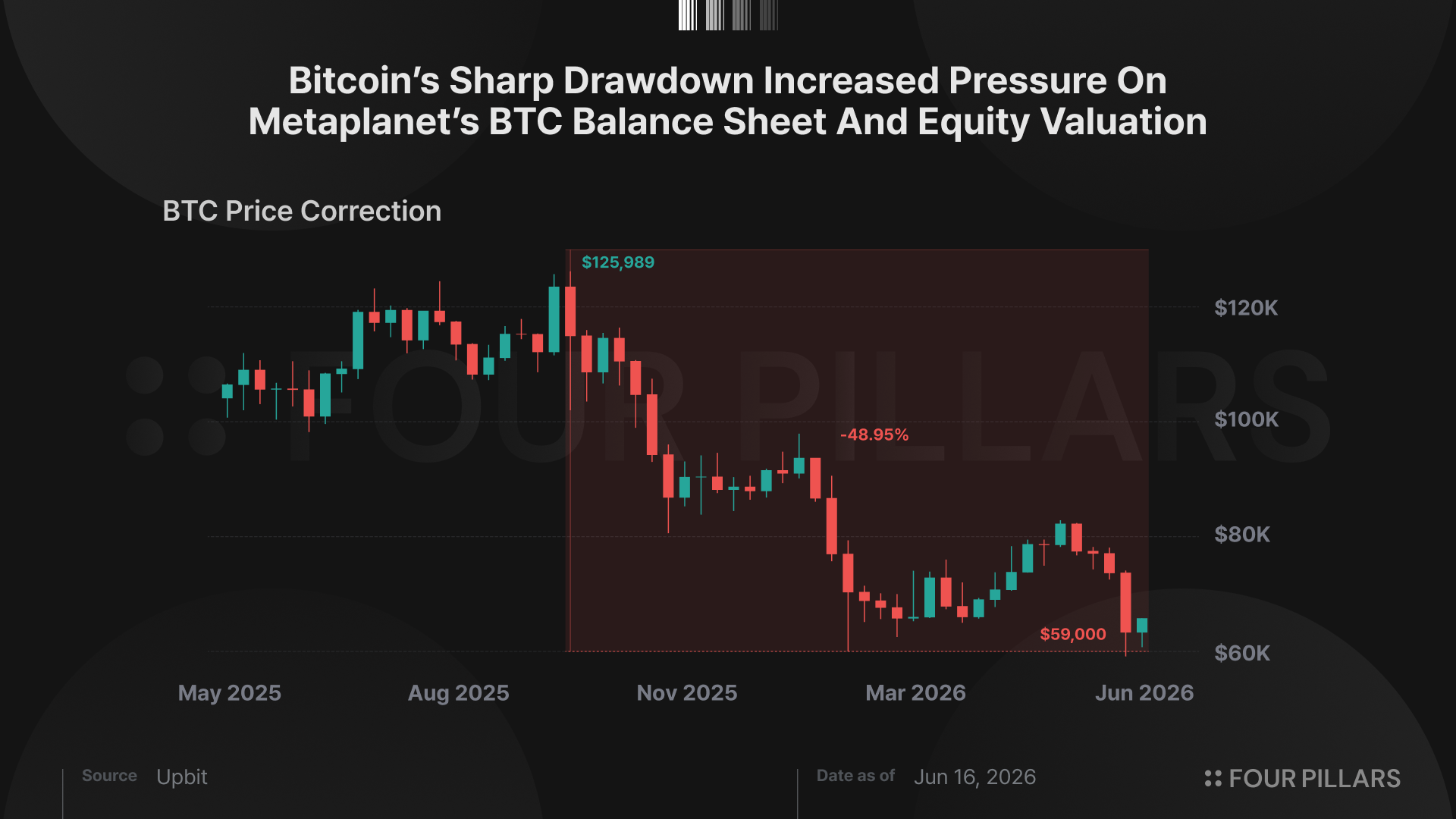
The other side of that growth emerged in Q2. Metaplanet announced the completion of its Q1 Bitcoin acquisition activity on April 2. In Q1 alone it purchased an additional 5,075 BTC, bringing cumulative holdings to 40,177 BTC, with a cumulative acquisition cost of about JPY 623.4 billion and an average acquisition unit price of about JPY 15.52 million. But as the Bitcoin price fell sharply from its October 2025 high, the valuation loss on its held assets expanded. As of April 2, the valuation result was a loss of about JPY 195.9 billion, with a return of minus 31.4%. Compared with once recording a valuation gain of nearly JPY 90 billion, it is a sharp reversal.
The Q1 earnings announced on May 13 showed this business model's profitability and vulnerability at the same time. Revenue was about JPY 3.08 billion and operating profit about JPY 2.27 billion, up sharply year over year, but the ordinary loss reached about JPY 114.9 billion and the net loss about JPY 114.5 billion. It grew its surplus at the operating stage, but due to the Bitcoin valuation loss, it ultimately recorded a large deficit. What lifted operating profit is the Bitcoin income business. Using its held Bitcoin to sell put options, it earned over JPY 2.9 billion during the quarter, and used this revenue to offset acquisition costs, lowering the effective acquisition unit price to the market-average level. Moving beyond merely stacking Bitcoin, it broadened the business to a stage of generating cash revenue from its holdings.
The problem is that this revenue does not fully offset the valuation-loss risk. Metaplanet did take the position that the valuation loss is only an accounting treatment and that its direct effect on business operations or cash flow is limited. The explanation is that as long as Bitcoin is not sold, the valuation loss remains a number on the income statement, and operating cash comes in from the income business.
The share price, however, moved differently from the company's explanation. The share price, which had risen on the back of increasing Bitcoin holdings, fell quickly in the price-decline phase, coming down to the JPY 267 range in early June. Compared with once rising to JPY 1,930 in 2025, it is a large correction. Since a considerable part of corporate value is composed of Bitcoin holdings, the structure in which the share price reacts sensitively to the Bitcoin price, regardless of an accounting valuation loss or an operating surplus, was exposed directly in the down market.
2.3.2 The Collapse of mNAV at 1x
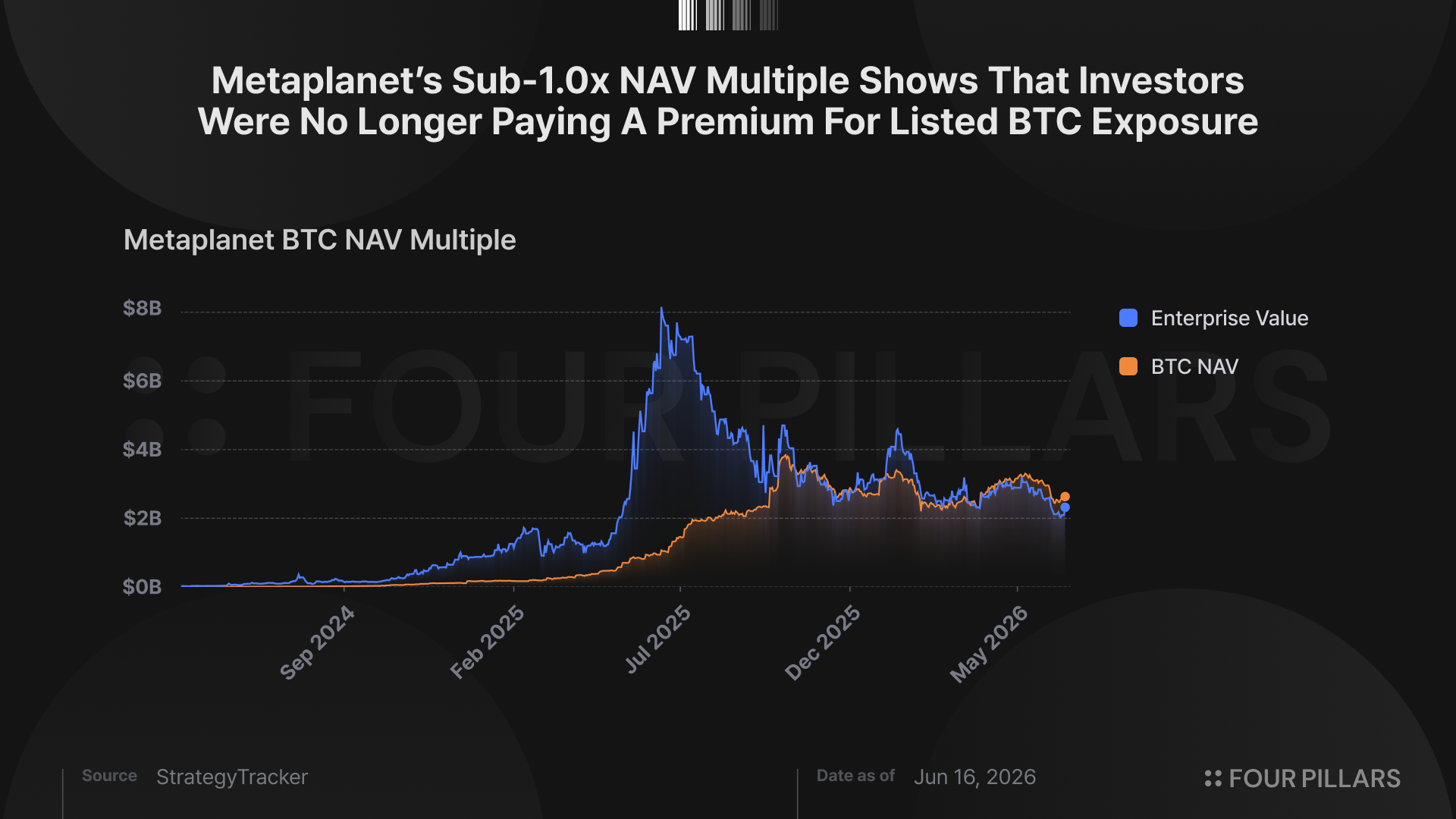
A treasury company's vulnerability shows most clearly in the mNAV indicator. mNAV is the value of a company's market capitalization divided by the valuation of its held Bitcoin. Above 1x means the market assigns the company a premium beyond the Bitcoin value, and below 1x means it receives a valuation worth less than the held assets alone. Metaplanet's mNAV reached about 5x at its 2025 peak but came down to 0.9x as of June 8. It became a state in which buying Metaplanet stock is, in theory, no more expensive than buying Bitcoin directly.
The collapse of mNAV at 1x changes the operating conditions of the treasury model itself. A treasury company grows through a cycle of using its share-price premium to raise funds through capital increases or stock acquisition rights, and using those funds to buy Bitcoin again. On April 24, Metaplanet also stated it would raise JPY 8 billion and use all of it for additional Bitcoin purchases. But once mNAV falls below 1x, the premium that is the premise of this cycle disappears. Raising funds without a premium only dilutes existing shareholders' stakes without increasing the per-share Bitcoin value. The model that was powerful in the price-rise period works in the exact opposite way in the decline period.
The Q2 trajectory of Strategy, the original Metaplanet modeled itself on, shows that the DAT model has entered a stage no longer explained solely by how much Bitcoin one buys. Strategy stated in a June 1 SEC filing that it had sold 32 BTC, effectively its first sale since 2022. The market took this as a shock, but the sale is closer to a choice to manage Bitcoin per share (BPS) than to financial deterioration. In a situation where mNAV has fallen, selling some Bitcoin can reduce per-share value impairment more than raising funds by newly issuing common stock.
The contrast between the two companies reveals a difference in the stages of the treasury model. Strategy has entered a stage of weathering the down market through means such as Bitcoin income or adjusting sales, whereas Metaplanet, even though it is also growing its income business, still maintains a 555 Million Plan of issuing stock acquisition rights and accumulating Bitcoin on a scale of 555 million shares, putting holdings expansion front and center. Whether to continue expanding holdings in a phase where mNAV has fallen below 1x, or to shift weight to capital-structure management like Strategy, is the fork in the road before Metaplanet.
2.3.3 Outlook: The Dual Pressure of Regulation and the Market
In Q2, Japan's Bitcoin treasury companies were under pressure from both the market and regulation. In the market, the Bitcoin price decline led to valuation losses and a fall in mNAV. The regulatory-side pressure came from reports that Japan Exchange Group (JPX), which operates the Tokyo Stock Exchange, is reviewing measures to strengthen regulation on crypto-asset treasury companies. JPX, however, drew a line immediately after the reports, saying no specific policy had been decided. It is therefore hard to view this as a confirmed regulatory change, but it is clear that how the exchange should treat listed companies that make Bitcoin purchases their main business has emerged as a market issue.
Moreover, the variable of taxation also overlaps. Under the current Japanese system, Bitcoin held by a corporation is valued at the market price as of the last day of the fiscal year. That is, even if a company has not sold its Bitcoin, if the price at fiscal year-end is higher than the acquisition cost, that difference is booked as a valuation gain on the books and can become subject to taxation. Conversely, if the price falls, the valuation loss is reflected in profit and loss. Unlike individual investors, who are taxed at the point of sale, corporations have a structure in which the price fluctuation of held crypto assets enters accounting and taxes directly.
For this reason, taxation is not a simple side variable for Bitcoin treasury companies. In Japan, discussion is underway to move individual crypto-asset investment income to separate taxation at 20.315%, similar to stocks, but how to treat the fiscal-year-end mark-to-market taxation of crypto assets held by corporations is a separate matter. If valuation taxation on corporate holdings is maintained, treasury companies could bear a tax burden in a price-rise period even without selling Bitcoin, and continue to carry the volatility of large valuation losses being reflected on the income statement in a price-decline period. In the end, Japan's BTC treasury companies stand on three branches of uncertainty: Bitcoin price fluctuation, the exchange's listing and disclosure standards, and taxation on crypto assets held by corporations.
The position the Bitcoin treasury occupies contrasts with the other currents of Japan's Q2 digital asset market. If regulation, stablecoins, and tokenization are areas being organized steadily under government leadership, the Bitcoin treasury is an area where private companies are directly exposed to market fluctuation. This current is, of course, not a Japan-only phenomenon. Just as the US firm Strategy shook the market with its first Bitcoin sale in the same quarter, the treasury model revealed the same structure, powerful when the Bitcoin price rises and vulnerable when it falls, in both the US and Japan. Metaplanet's slump is therefore more accurately seen as a phase in which the inherent vulnerability that a business model directly linked to the Bitcoin price experiences in a down market appeared together at the global level, rather than a slump of Japan's digital asset market as a whole.
3. Other Major Events
3.1 FIEA Amendment Bill Submitted to the Diet and Shifts in the Exchange Landscape (4/10)
What Happened?
On April 10, the FSA submitted a bill amending parts of the Financial Instruments and Exchange Act and the Payment Services Act to the Diet. The direction of moving crypto assets into the FIEA, which the Q1 Financial System Council report had laid out, came up as an actual bill. The core of the bill is to not leave crypto assets confined to a means of payment under the Payment Services Act, but to move them into a separate financial-product category under the FIEA and attach disclosure and unfair-trading regulation.
The bill, however, does not treat crypto assets exactly the same as securities such as stocks or bonds. It places crypto assets in a separate category under the FIEA and attaches capital-market-style regulation on top. Accordingly, information disclosure at issuance, regulation on trading using undisclosed information, and operators' capital-related obligations are newly added. That is, rather than turning crypto assets into securities, it is a structure that layers on the disclosure and market-surveillance devices needed so they can be treated as investment products.
From the exchange's standpoint, the change is more direct. The existing crypto asset exchange business is reorganized into a crypto asset trading business under the FIEA. Until now, exchanges were closer to payment-instrument-related operators that hold user assets and intermediate trades under the Payment Services Act. But after the bill takes effect, they are treated as a separate business type placed alongside the Type 1 Financial Instruments Business that handles securities, and come under regulation equivalent to capital-market operators. Enforcement is targeted for 2027, and separate taxation is expected to take effect on January 1, 2028, the following year.
Comment
The broad outline of the bill had already emerged in Q1, so the content itself is not new. But in that the direction was submitted to the Diet as an actual bill, the stage advanced one step. If the Q1 reorganization was an administrative measure placing crypto assets in the asset management supervision domain, this bill submission put the rules to apply to that domain onto the legislative process.
The important change in this bill is that the character of the operators running the market, especially exchanges, changes. Until now, crypto asset exchanges were treated as operators that hold user assets and connect trades under the Payment Services Act. After the bill takes effect, they become closer to capital-market-style operators bearing obligations of disclosure, unfair-trading response, and financial soundness. This is the work of bringing the operators of the market where the product is traded into capital-market regulation first, before treating crypto assets as investment products.
The change in exchange status appears likely to raise market entry costs significantly. Statutory reserves and the capital adequacy ratio thicken investor protection, so they are a burden for small exchanges with weak regulatory-response capacity. For reference, Korea set high entry requirements such as information-security certification and real-name account issuance from the start, effectively solidifying into a system of a small number of exchanges, becoming a market closer to consolidation than new entry. Japan started with lighter payment-instrument regulation and is now moving to capital-market-style regulation.
Conversely, for securities firms, large financial groups, and operators already holding multiple licenses, these are relatively familiar rules. This is why the exchange-business entry reviews of securities firms such as Nomura and Daiwa, and SBI's exchange integration, read in the same direction. The more regulation rises to the capital-market level, the more likely the crypto asset exchange market is to reshape around operators with regulatory-response capacity and capital strength, not just trading-fee competition.
3.2 SBI's Foreign-Issued Stablecoin and Exchange Integration (During the Quarter)
What Happened?
SBI broadened both its handled stablecoins and its exchange base during the quarter. On the stablecoin side, the group's crypto asset exchange operator SBI VC Trade continued preparing to handle RLUSD, a dollar stablecoin, under a basic agreement on its Japan issuance and distribution made with a Ripple subsidiary. RLUSD is a stablecoin 100% backed by dollar deposits, US short-term government bonds, and the like, with monthly verification by a third-party accounting firm, and it is the second foreign-currency stablecoin distributed in Japan after USDC.
On the exchange side, integration proceeded in two stages. SBI VC Trade absorbed the exchange BITPoint Japan on April 1, and on May 1, SBI Holdings submitted a letter of intent to another exchange, bitbank, and entered capital and business alliance talks. On June 25, the two signed a definitive agreement for SBI Holdings to fully acquire bitbank for ¥46.7 billion (about US$289 million), with closing expected around October 2026, making bitbank a consolidated subsidiary and solidifying SBI's position in Japan's crypto asset industry.
Comment
SBI's Q2 trajectory reads as a strategy to gather the distribution gateway of Japan's digital asset market within the group. Broadening foreign-currency stablecoin handling from USDC to RLUSD is about increasing handled assets, and integrating exchanges one after another is about gathering users and trading volume. In Q1, SBI was the only domestic handler of USDC and prepared to issue the trust type yen stablecoin JPYSC, and in Q2 it seeks to add a second foreign-currency stablecoin and two exchanges on top.
The intent of this integration becomes clearer when looking at the fragmented structure of Japan's exchange market. Japan's exchanges are divided among several operators of similar weight, such as GMO Coin, bitFlyer, Coincheck, and bitbank, with no single one dominating the market. There are also exchanges under large groups, such as Coincheck and Rakuten Wallet, but cases of operating multiple exchanges are rare.
SBI, by contrast, is growing scale by integrating exchanges. In April it absorbed BITPoint Japan, unifying it into SBI VC Trade, and in May it entered talks to acquire bitbank. Once bitbank's incorporation is completed, SBI becomes a rare large operator that has gathered the customer base and liquidity of multiple exchanges within a single group.
This trajectory is interesting when viewed in the competitive structure with the megabank camp. The three megabanks, including Mitsubishi UFJ, do not currently operate crypto asset exchange businesses directly. Operating a retail exchange carries a heavy regulatory and risk-management burden for a banking group, and their strengths also lie in corporate clients, trusts, and payment networks rather than in intermediating individual investor trades. Instead, the megabank camp targets interbank high-value payments and the issuance and settlement of tokenized assets through the issuance infrastructure Progmat and trust type stablecoins. If SBI takes the individual investor segment with exchanges and foreign-currency stablecoins, the banks take the corporate segment with their existing corporate clients and payment networks as strengths.
3.3 JPYC's Expansion of Real-Use Cases and JPY 3 Billion in Cumulative Issuance (6/2)
What Happened?
Source: Line
JPYC surpassed JPY 3 billion in cumulative issuance on June 2, and raised an additional JPY 2.8 billion through the second close of its Series B round on April 20, securing about JPY 5 billion in cumulative capital. It also broadened its use cases, pursuing the construction of a tax-refund inbound payment network together with Japan Tax-Free, while being adopted into LINE NEXT's Web3 wallet Unifi.
JPYC has rapidly increased its issuance since starting issuance of a funds transfer type yen stablecoin in October 2025. It surpassed JPY 1.3 billion in cumulative issuance in Q1 and reached JPY 3 billion in Q2. The issuance itself increased, but what stood out in Q2 is that fundraising and use-case acquisition proceeded together. The capital secured through Series B became the foundation for use-case expansion.
Comment
If in Q1 JPYC was a first mover that rapidly increased issuance as a funds transfer type yen stablecoin, in Q2 it shifted weight toward securing actual use cases beyond expanding issuance. The tax-refund inbound payment network and the large-platform wallet adoption are representative. Tax refunds are an attempt to connect a stablecoin to the process by which inbound foreign visitors take their refunded yen back to their home country, and the adoption of LINE NEXT's Unifi is a move to place JPYC in advance as a payment method in a wallet environment where users have already gathered.
The effect of this strategy is being confirmed through a transaction turnover indicator. JPYC Inc. stated that there are days when daily trading volume exceeds 100% compared with the issuance balance. It means the issued coins are moving repeatedly in the payment and remittance process rather than stacking up like deposits. A stablecoin's important market competitiveness shows as much in how often it turns over as in its issuance amount. JPYC shows it is ahead in the competition to preempt an actually used payment method, not the competition for issuance scale.
This direction also reflects an institutional character. JPYC's legal basis, the funds transfer type, lets the issuer take the reserve-asset management yield but limits one remittance to JPY 1 million, fitting individual and small payments rather than interbank high-value payments. Compared with SBI, which grows scale with exchanges and foreign-currency stablecoins, and the megabanks, which prepare a trust type for high-value corporate payments, JPYC digs into a different layer of small-value real use. This leaves the implication that the differentiation of Japan's stablecoin market is taking place according to differences in issuance form and legal structure.
3.4 Japan Exchange Group Signals Review of Crypto-Asset ETF Listing (4/30)
What Happened?
On April 30, Hiromi Yamaji, CEO of Japan Exchange Group (JPX), mentioned the possibility of listing crypto-asset ETFs in a Bloomberg interview. He said many asset managers are showing interest in creating crypto-asset ETFs, and stated that they can be listed at any time once legal organization is finished and the tax treatment becomes clear. The explanation is that, depending on the progress of related legal amendments, it could be possible as early as 2027 and as late as 2028.
There are two premises: the legal amendment that establishes crypto assets as financial products under the FIEA, and tax organization including separate taxation. Both took shape in Q2 through the bill submission and the tax reform direction. JPX, in its medium-term management plan, has set out entry into a new asset class and has a policy of expanding its ETF product lineup and investor base, and it has placed crypto-asset ETFs on the review agenda as an extension of this.
Comment
ETFs let institutions and individuals who already have securities accounts enter the market in a familiar way, without needing to open a separate crypto asset exchange account and manage a wallet. The reason the US rapidly absorbed funds after approving spot Bitcoin ETFs in 2024 was also this accessibility. A Japanese exchange leaning into ETFs means it intends to bring the channel for buying and selling crypto assets into the existing securities market.
This current meshes with three movements: crypto assets being reorganized into financial products, exchanges preparing ETF listings, and securities firms building handling channels. Which tokens to make ETF targets, however, and by what standards the exchange will review crypto-asset-related products, remain tasks to be solved together with institutional organization.
3.5 The FSA's Interbank Tokenized Deposit Transfer Pilot (Support Decided 4/3)
What Happened?
On April 3, the FSA decided to make a pilot project verifying the interbank transfer of tokenized deposits a support target of its FinTech Proof-of-Concept Hub. The FSA launched a payment sophistication project using stablecoins and tokenized deposits in November 2025, and this project is its third item. The policy is to verify a structure for moving tokenized deposits between different banks, and to link this with the Bank of Japan's current-account tokenization sandbox.
Comment
The core of this pilot lies in the stage after issuance, namely interbank transfer. Moving a tokenized deposit within the same bank ends with the blockchain record alone, but interbank transfer requires the central bank to intermediate the settlement of the two accounts. To complete this on a blockchain, the central bank account that intermediates that settlement must also operate on the same chain. This is why this pilot is linked with the Bank of Japan's current-account tokenization sandbox.
This pilot shows the position of tokenized deposits in Japan's digital money landscape. On-chain money is divided into three layers: stablecoins issued by non-banks, tokenized deposits in which a bank tokenizes its own deposits, and CBDCs issued by a central bank, and tokenized deposits sit in the middle layer. They have the programmability of a stablecoin while remaining, as a regulatorily clear deposit, within the credit of the banking system and the existing regulatory framework.
This difference is directly tied to banks' interests. While there was a concern that stablecoins could pull deposits outside the bank, tokenized deposits are a path that takes only the advantages of instant settlement and 24-hour trading while keeping deposits on the bank's books. It is an option that rides the wave of payment innovation while protecting the deposit base. Japan Post Bank seeking to connect its retail base of 120 million accounts to tokenized deposits also reads as a move to digitize that base within the bank rather than cede it to stablecoins.
4. Conclusion: Supply Is in Place, What Remains Is Demand
Q2 2026 was a quarter in which price weakness and regulatory progress diverged in Japan's digital asset market. Even as mNAV fell below 1x, the FIEA amendment bill was submitted to the Diet and the amended Payment Services Act took effect on schedule. Tokenization and institutional organization advanced regardless of market conditions, whereas the area directly exposed to market fluctuation faced its first test.
- Tokenization: Its target broadened from real estate and bonds to stocks, and Progmat's tokenized equity report, the micro stock concept, and the tokenization law proposal emerged.
- Regulation: The amended Payment Services Act took effect, an intermediary business for operators that only intermediate was newly established, the reserve-asset management scope for trust type stablecoins broadened, and a domestic holding order requiring user assets to be kept within Japan was added.
- Business: the Bitcoin price decline shook treasury companies' financials and share prices together, exposing the vulnerability that lay behind rapid asset accumulation.
Beyond these, Q2 saw a series of business and institutional movements that change the market landscape. The FIEA amendment bill was submitted to the Diet, opening a path for exchanges to be reorganized into capital-market-style operators, and SBI gathered the distribution gateway within the group through RLUSD handling and the definitive agreement to acquire bitbank. JPYC surpassed JPY 3 billion in cumulative issuance and broadened its real-use cases, Japan Exchange Group disclosed its review of crypto-asset ETF listing, and the FSA adopted the interbank tokenized deposit transfer pilot as a support target. With this, exchanges' legal status, stablecoin distribution, ETFs, and tokenized deposits were all worked on side by side in a single quarter, and the direction aligned in Q1 began to move into bill submission, law enforcement, and business expansion.
What Q2 confirmed is that Japan's institutional organization is not shaken by price weakness. But running separately from the market also means that supply-side organization runs ahead before market demand pulls the framework along. The key to the next phase therefore shifts to whether actual use follows on top of the path the government and financial groups have laid.
In tokenization, whether MMFs, which have a lower threshold than stocks, actually draw out institutional demand, and whether the tokenization law organization continues and reaches stocks, divides the pace of adoption. In stablecoins, whether JPYC's payment turnover solidifies into real use beyond issuance scale, and whether payment operators and fintech companies actually enter through the new path of the intermediary business, is the first signal of demand formation.
The Bitcoin treasury is on the opposite side. Whether this model, directly exposed to the market, moves to a stage of weathering the down market is the key, and on top of whether Metaplanet continues expanding its holdings, Japan Exchange Group's regulatory review and taxation on corporate-held crypto assets overlap as variables. In the end, if Q2 was the quarter that confirmed regulation can withstand the market, the following quarters ask whether that regulation can create a market. Supply is in place, and what remains is demand.




