Key Takeaways
- Q1 2026 in Japan was a quarter in which the "Digital Year One" declaration carried through into actual administrative measures and business announcements. The directions set out in 2025, including the JPYC issuance, the transfer of crypto assets to the FIEA, and the separate taxation discussion, moved into concrete implementation across stablecoins, regulation, and the exchange business.
- Tokenization broadened from competition over yen stablecoin issuance to capital-market settlement infrastructure. SBI and Startale announced plans to issue the trust type yen stablecoin JPYSC, and the three megabanks reviewed a joint issuance. Securities firms and megabanks also launched a joint proof of concept settling security tokens with stablecoins, testing a structure that tokenizes the security and the cash leg together.
- Regulation moved crypto assets from a means of payment toward an object of asset management. The FSA announced a reorganization establishing a Crypto Asset and Stablecoin Division under asset management supervision, and brought transaction information into the tax framework through CARF. In March, separate taxation was put into law, giving shape to a phased path from information management to legal reclassification to tax reform.
- In business, a fragmented exchange market began reorganizing around financial groups. SBI decided on the merger of SBI VC Trade and BITPoint, strengthening a vertical integration binding stablecoins, a trust bank, and chain infrastructure. GMO Coin prepared for a listing, and Nomura, Daiwa, and SMBC Nikko reviewed entry into the crypto asset trading business on the strength of their institutional client bases.
1. Introduction: A First Quarter That Declared the Dawn of the Digital Era
The start of the year is when government, financial institutions, and capital markets publicly align on the direction for the year ahead. As in any other year, 2026 began with the New Year opening ceremony (Daihakkai) at the Tokyo Stock Exchange. This time, however, a different theme took the stage. Satsuki Katayama, Minister of Finance and Financial Services, declared 2026 the first year of the digital era.
Minister Katayama stressed that for blockchain-based digital assets to spread, the role of market infrastructure such as commodity exchanges and securities exchanges is important, and she also noted that in the United States, crypto-asset ETFs are spreading as an inflation hedge. On the official stage of Japan's capital markets at the start of the year, crypto assets, stablecoins, and tokenized securities were discussed side by side with exchange infrastructure.
This is not a change formed over a short period. Since 2025, Japan's digital asset market had already shown signs of change across three fronts: policy, industry, and the market. JPYC Inc. launched a funds transfer type JPYC, presenting Japan's first privately issued funds transfer type yen stablecoin. Meanwhile, the Financial System Council laid out a direction for moving crypto assets into the Financial Instruments and Exchange Act (hereafter FIEA) framework, putting into a report its intent to shift the legal position of crypto assets from "means of payment" to "financial product." In December, a plan to apply the same taxation as stocks to crypto-asset investors, who had been bound by comprehensive taxation of up to 55%, also took concrete shape through separate taxation.
The first quarter of 2026 was when these early signals took full form through actual administrative measures and business announcements. This chapter examines what happened across three areas: stablecoins and tokenization, regulation, and business. Through this, it gauges where Japan's digital asset market now stands in 2026 and where it is headed.
2. Three Currents in the Q1 2026 Digital Asset Market
2.1 Stablecoins: SBI's JPYSC Announcement and the Yen Stablecoin Competition
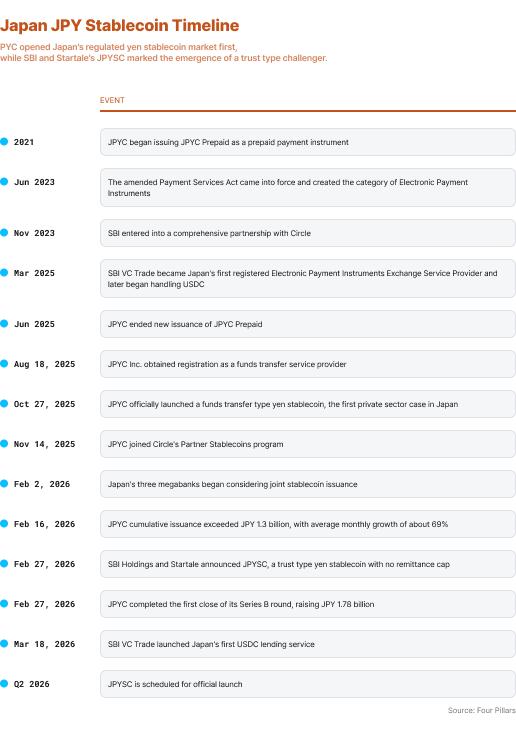
On February 27, 2026, SBI Holdings and Startale officially announced a plan to issue a trust type yen stablecoin, "JPYSC." The issuer is SBI Shinsei Trust Bank, with sales handled by SBI VC Trade, targeting an official launch in Q2 2026. The announcement was a signal that a full competitive structure was forming in Japan's yen stablecoin market, which until then had been driven by a small number of first movers.
2.1.1 JPYC's Origins: How the First Mover Opened the Market
The single first mover in Japan's stablecoin market was originally JPYC. This was because it entered the market first through a lightly regulated detour while other operators were blocked at the regulatory threshold. To understand this, it helps to go back to the starting point of Japan's yen stablecoins, the amended Payment Services Act of June 2023. The Act created a new legal category called "Electronic Payment Instruments." With it, Japan became one of the few countries in the world that can officially issue fiat-pegged stablecoins, and issuance was limited to three types of entities: banks, trust companies, and funds transfer service providers.
But the existence of a law did not immediately open the market. The amended Payment Services Act adopted a structure that separates the issuance and distribution of stablecoins. Issuance is handled by banks, trust companies, or funds transfer service providers, but the distribution stage, where stablecoins are actually traded, exchanged, and managed for users, was assigned to intermediaries holding a separate license called an "Electronic Payment Instruments Exchange Service Provider."
The problem was that screening for this intermediary license took a long time. Japan's first registration as an Electronic Payment Instruments Exchange Service Provider came only in March 2025, about one year and nine months after the law took effect (SBI VC Trade). Even with operators qualified to issue, the distribution path that reaches users opened late, creating a gap between the law's enforcement and actual stablecoin distribution.
JPYC was able to enter the market by filling this gap first. The issuer, JPYC Inc., had been issuing yen-pegged tokens since 2021, but at the time these were not stablecoins (Electronic Payment Instruments) but a "prepaid payment instrument." A prepaid payment instrument, like a gift certificate or prepaid card, is charged in advance and used for payment. It belongs to a different legal category from stablecoins and could be issued without an intermediary license. The tradeoff was that it could not be redeemed for cash and had limited places of use.
Even so, while the stablecoin track under intermediary regulation was delayed by the license bottleneck, JPYC came to market first through the prepaid track, which required no regulation, and was able to accumulate a user and merchant base.
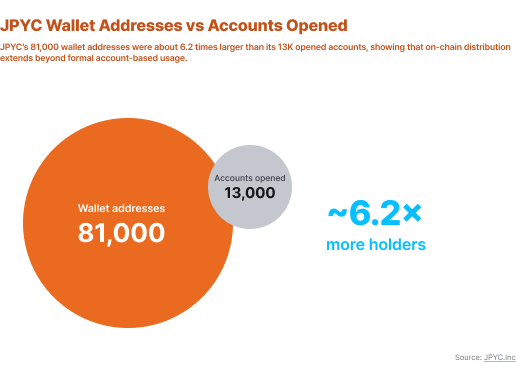
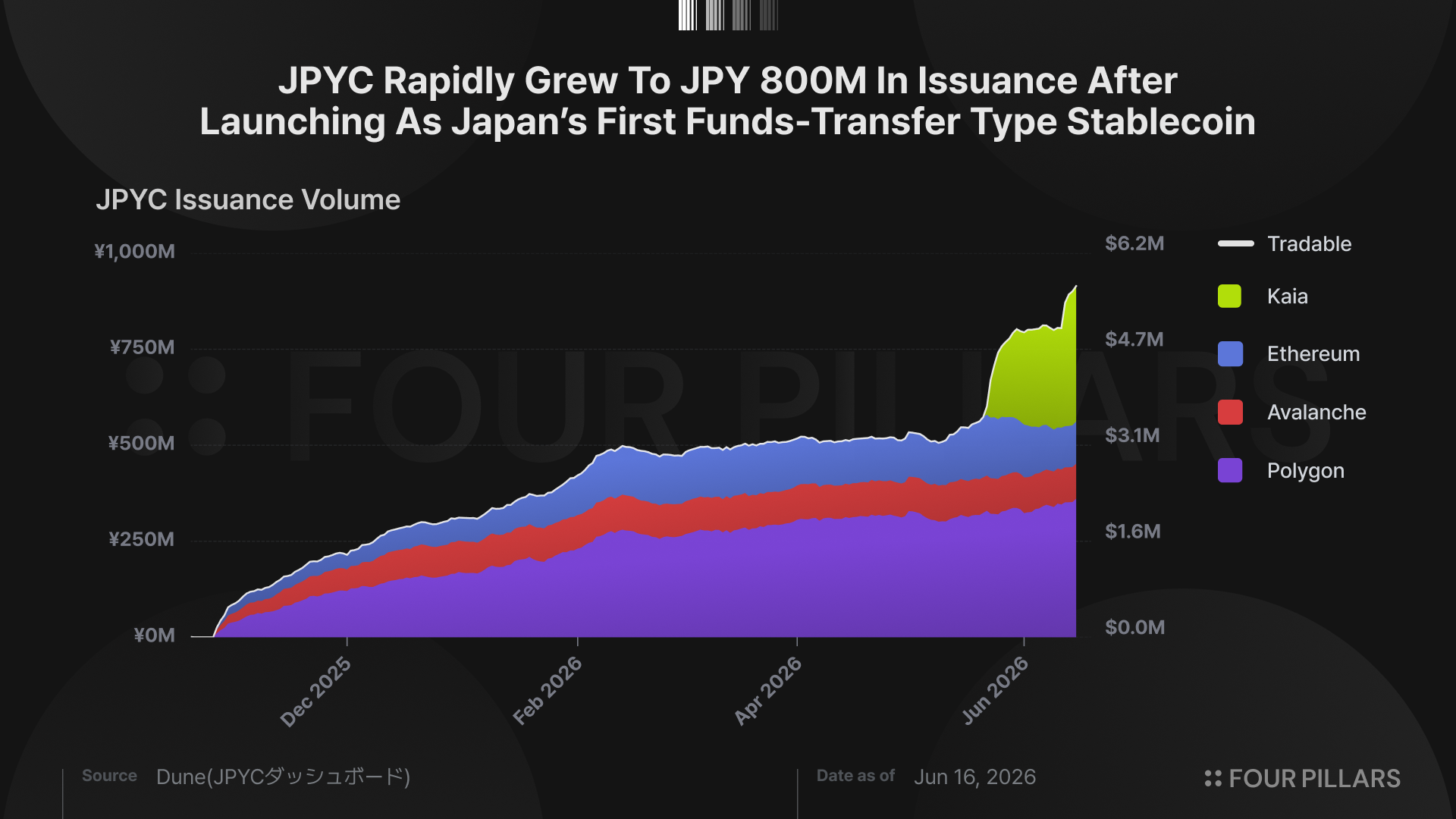
JPYC ended this prepaid issuance in June 2025, obtained registration as a funds transfer service provider in August, and then launched a funds transfer type JPYC redeemable 1:1 for cash, converting to a regulated stablecoin. It was Japan's first privately issued funds transfer type yen stablecoin. About four months after launch, in February 2026, JPYC surpassed JPY 1.3 billion in cumulative issuance, recording average monthly growth of about 69%. Direct account openings numbered about 13,000, but the wallet addresses holding JPYC reached about six times that, 80,000, showing that distribution was taking place on-chain outside exchange accounts. Having secured its position in advance through the prepaid track is the backdrop for the steep growth curve JPYC drew the moment it converted to a stablecoin.
2.1.2 The Arrival of JPYSC: A Trust Type Stablecoin and SBI’s Vertical Integration
Source: Startale
Into the market JPYC had taken first, later entrants arrived one after another in Q1 2026. One of them is "JPYSC," the trust type yen stablecoin announced on February 27 by SBI Holdings and Startale. The issuer is SBI Shinsei Trust Bank, with sales handled by SBI VC Trade, targeting an official launch in Q2 2026.
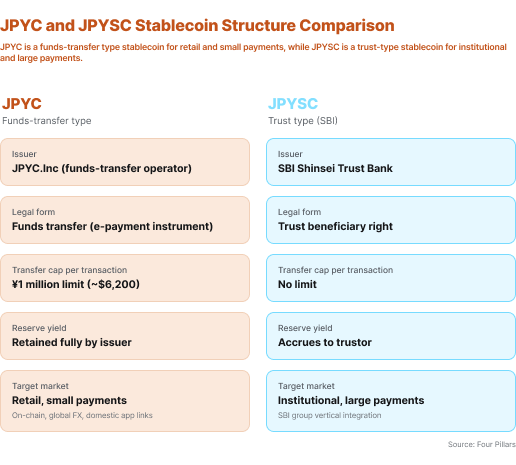
JPYSC's first distinguishing feature lies in its legal form. In Japan, the revenue structure and transaction limits of a stablecoin differ by issuance type. A funds transfer type such as JPYC lets the issuer retain all of the reserve management yield but carries a JPY 1 million cap per remittance. A trust type such as JPYSC has its management yield accrue to the trustor, so the issuer's direct revenue incentive is weaker, but there is no remittance cap. JPYC's JPY 1 million cap is no problem for retail payments and small remittances, but it is unsuitable for areas exceeding JPY 1 million, such as interbank transactions, large payments, and corporate fund movements. JPYSC aims to occupy precisely this uncapped area.
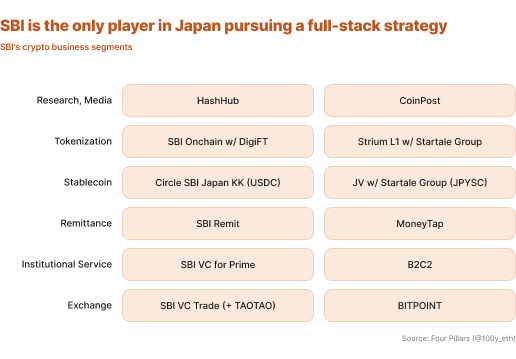
JPYSC's second distinguishing feature is that it starts on infrastructure SBI has already operated. SBI distributed not a yen stablecoin but the dollar stablecoin USDC first. After signing a comprehensive business partnership with Circle in 2023 and completing the first registration as an Electronic Payment Instruments Exchange Service Provider in March 2025, it became the only operator handling USDC in Japan. The entity that took on the role of safeguarding USDC's reserve asset, US dollars, was SBI Shinsei Trust Bank. JPYSC likewise sets up this trust bank as its issuer. It is a structure that places yen issuance on top of the trust safeguarding infrastructure built while operating a dollar stablecoin.
In effect, SBI's experience distributing USDC directly led to the incentive for yen issuance. To distribute a stablecoin issued abroad within Japan, the Japanese handling operator must separately safeguard an equal amount of dollars, apart from the reserve assets the issuer (Circle) manages in its home country. This so-called double reserve burden has been pointed out as a constraint on business expansion. A yen trust type stablecoin issued directly at home is free of this burden. In short, for SBI, JPYSC is both a way to bypass the constraint of USDC distribution and a step toward extending its already-built stablecoin distribution infrastructure into yen issuance.
2.1.3 The Competitive Structure: JPYC and JPYSC, Same Yen but Different Markets
JPYC and JPYSC are both yen stablecoins, but their legal forms differ, as do the market entry strategies of the issuers behind them. Their competition therefore takes on a different character from a chase in which a latecomer catches up to a first mover. JPYSC's competitive elements against JPYC fall into two branches:
- Market segment: JPYC, due to its JPY 1 million cap, has difficulty entering the institutional and high-value segment, which JPYSC can occupy through uncapped remittances. In the large-transaction segment, the trust type is structurally bound to lead.
- Distribution channel: JPYC, as an independent issuer, expands external distribution channels, whereas SBI moves through vertical integration that binds an exchange (SBI VC Trade), an issuer (SBI Shinsei Trust), a chain (Startale's Strium), and foreign-currency management (USDC lending) within one group.
JPYC also has the strengths of a first mover. It has the real-use base built by surpassing JPY 1.3 billion in cumulative issuance about four months after launch, and the ecosystem it expanded quickly over six months. In particular, by joining Circle's Partner Stablecoins program in November 2025, it also secured a channel connecting to global stablecoin infrastructure. This is a network in which each country's currency stablecoins exchange and settle with one another on-chain via USDC, and JPYC participates as the only stablecoin holding the yen position within it.
While the trust type camp targets the institutional and high-value segment, JPYC is staking out its own position on a different axis: a retail payment standard and connection to global FX infrastructure. In this context, JPYC's next battleground is more likely to be connection to global stablecoin infrastructure than domestic Japanese market share.
2.1.4 Outlook: Four Camps at the Same Starting Line
Beyond the competitive structure so far, three currents can be identified that gauge the direction of Japan's yen stablecoin market as of Q1 2026.
- Trust type regulatory change: Trust type stablecoins were originally required to manage reserve assets only in bank demand deposits, and their low profitability was pointed out as a limit. An additional amendment to the Payment Services Act that broadens the management scope to government bonds and the like is set to take effect in June 2026, and once enforced, it reinforces the issuer's revenue incentive for the trust type. This regulatory change is also part of the backdrop for SBI and the megabank camp leaning into the trust type.
- Megabank joint issuance: The three megabanks (Mitsubishi UFJ, Sumitomo Mitsui, Mizuho) are considering jointly issuing a single-brand trust type stablecoin on the Progmat platform, with Mitsubishi UFJ Trust Bank as the sole trustee. The megabanks likewise target uncapped interbank high-value payments, and they were adopted as the first support target of the FSA's payment sophistication project. This sets up direct competition with the SBI camp in the trust type market.
- Entry of foreign-issued stablecoins: SBI VC Trade launched USDC lending in March, and in June a cabinet office ordinance formally recognizing foreign-issued stablecoins is set to take effect. This ordinance organizes the domestic handling conditions for foreign-issued stablecoins (such as USDC), which had been unclear, and once enforced, it creates a legal basis for Japanese operators to handle foreign-issued stablecoins more broadly.
With this, in Q1 Japan's yen stablecoin market had four branches at the same starting line at once: the funds transfer type JPYC, the trust type SBI camp (JPYSC), the trust type megabank camp, and foreign-issued stablecoins (USDC). The funds transfer type JPYC has global infrastructure connection as its competitive element, while the trust type SBI and megabank camps have group infrastructure in uncapped high-value and institutional payments, each with a different segment in mind. At the same time, after Q2, when the issuance models and timing of the two trust type camps are confirmed, the first clash between SBI and the megabanks within the trust type market is expected.
2.2 Regulation: The FSA's New "Crypto Assets and Stablecoins Division," From Means of Payment to Asset Management Target
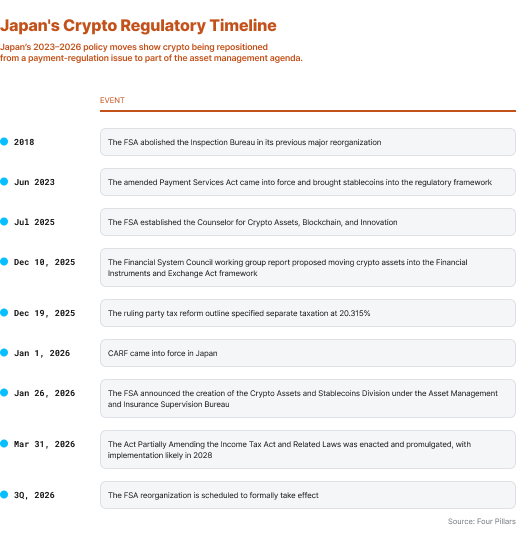
On January 26, 2026, the FSA announced its plan for a summer 2026 reorganization. The core is that the newly established "Crypto Assets and Stablecoins Division" will be placed under the "Asset Management and Insurance Supervision Bureau." It is the largest reorganization in the eight years since the abolition of the Inspection Bureau in 2018, and the FSA stated its purpose as "realizing an asset management nation." On its face this looks like a change of administrative title, but it shows where the Japanese government intends to place digital assets within the financial system as a whole.
2.2.1 The Policy Significance of the FSA Reorganization
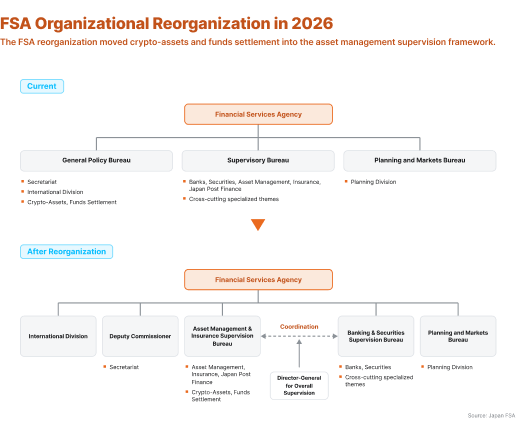
In Japan, crypto assets were long treated effectively as a "means of payment" within the Payment Services Act framework. Within a framework governing payment and remittance, investor protection and anti-money-laundering were the main concerns, and the character of crypto assets as an investment asset was secondary. This reorganization moves the division handling crypto assets into the asset management supervision domain. In administrative terms, the position of crypto assets shifts from "means of payment" to "asset management target."
The location of a division also points to the center of gravity of policy. The Japanese government has pursued a national strategy, "asset management nation," to move household assets from deposits to investment and grow Japan into an asset management hub. The expansion of the new NISA (Nippon Individual Savings Account) and the Tokyo Stock Exchange's demand that listed companies improve capital efficiency were carried out as part of it.
Going a step further, the reorganization that places the division managing crypto assets under the asset management supervision bureau means that digital assets have entered the category of this national strategy. The FSA stating the purpose of the reorganization as realizing an asset management nation also reads in this context.
2.2.2 The Accumulation of Institutional Groundwork From 2023 to 2026
This reorganization is the result of two streams, institutional and policy, accumulating in turn. First came the institutional accumulation. Starting with the amended Payment Services Act of June 2023, defining fiat-pegged stablecoins as "Electronic Payment Instruments" brought stablecoins, which until then had no clear legal status, into the regulatory framework.
Once a new asset category was created, a dedicated organization to supervise it became necessary, and rather than immediately establishing a division, the FSA first placed a counselor dedicated to crypto assets and blockchain in July 2025 to test its supervisory capacity. In this reorganization, it elevated that counselor to a division level, establishing the "Crypto Assets and Stablecoins Division." That is, from defining the asset category, through setting up a dedicated post, to elevation into a formal division, the organizational groundwork proceeded step by step.
Next came the accumulation of policy direction. In December 2025, the Financial System Council laid out a direction to move crypto assets from the Payment Services Act framework to the FIEA framework. The premise of viewing crypto assets as investment products rather than a means of payment was set at this point. Soon after, the ruling party's tax reform outline specified the introduction of separate taxation at 20.315%, signaling tax reform as well. The intent to shift the legal position and the intent to revise the tax system were placed side by side just before the quarter.
The January 26 reorganization was the step of equipping the administrative organization to execute these directions. And at the end of the quarter, on March 31, the "Act Partially Amending the Income Tax Act and Related Laws" was promulgated, putting separate taxation into law. Enforcement is likely on January 1, 2028, the year after the amended FIEA takes effect. A direction is laid out, the organization to execute it is prepared, and legislation completes it. This flow proceeded one step at a time within a single quarter.
2.2.3 Japan's Phased Path to Crypto Regulation
Connecting the regulatory changes so far in chronological order reveals how the Japanese government builds its framework. The plan is to first organize the crypto-asset market's information management system and legislation from 2026 to 2028, then layer investment systems such as separate taxation and ETFs on top to open market expansion in phases.
- 2026, building the tax information system: In January 2026, Japan enforced CARF (Crypto-Asset Reporting Framework), an automatic exchange system for crypto-asset transaction information. CARF is an international reporting framework in which crypto-asset operators such as exchanges report users' transaction information to tax authorities, and each country's tax authority automatically exchanges it. Through this, Japan seeks to bring not only domestic exchanges but also the transactions of Japanese residents using overseas exchanges into the tax information net.
- 2027, redefining the legal status: Enforcement of the amended FIEA is the step that moves crypto assets from the payment-centered Payment Services Act framework to capital-market regulation centered on investment products. A legal basis is created for disclosure, investor protection, unfair-trading regulation, and intermediary regulation to apply to the crypto-asset market.
- 2028, expanding investment access: This is the step of layering investment incentives on top of the market prepared through separate taxation and ETF approval. Separate taxation lowers individual investors' tax burden to a level similar to stocks, and ETFs open a channel through which institutions and retail can access crypto assets via securities accounts.
With this, Japan's Q1 2026 crypto regulatory reform settles into a single direction. The Japanese government seeks to incorporate crypto assets as a regular asset class handled within asset management policy, and it is moving through the sequence of building a tax information system, legal reclassification, and opening up taxation and products. The January 26 FSA reorganization is interpreted as an event that confirmed, at the administrative-organization level, that the center of gravity of crypto-asset policy is shifting from payment supervision to asset management supervision within this flow.
2.3 Business: The Reshaping of Japan's Fragmented Exchange Landscape
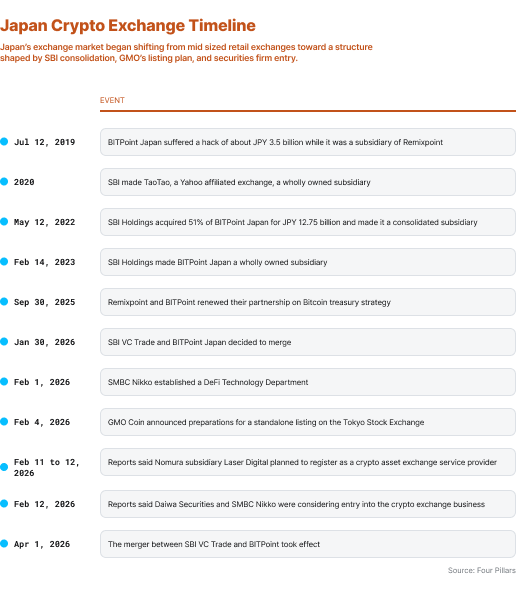
In the business area, exchange reshaping showed the market's larger current. On January 30, 2026, SBI VC Trade and BITPoint Japan, crypto-asset exchanges under the SBI Group, decided to merge. The merger takes effect on April 1 as an absorption merger with SBI VC Trade as the surviving company. On the surface it is a business reorganization combining one group exchange into another, but within it lies the current of Japan's long-fragmented exchange market beginning to reshape at the level of financial groups.
2.3.1 Origins of the Merger: Six Years to Group Integration
This merger is the result of six years of business reorganization. It began with the roughly JPY 3.5 billion hack of BITPoint Japan in July 2019. BITPoint was then a subsidiary of the listed company Remixpoint, and after five types of crypto assets, including Bitcoin, leaked from its hot wallet, it suspended all services. The one that took on the exchange whose trust had been shaken was SBI Holdings.
SBI's acquisition was not made at once but in stages. In May 2022 it acquired 51% of BITPoint Japan shares for JPY 12.75 billion, bringing it in as a consolidated subsidiary, and in February 2023 it secured 100% to make it a wholly owned subsidiary. Since SBI had already made TaoTao, a Yahoo-affiliated exchange, a wholly owned subsidiary in 2020, the BITPoint acquisition was also an extension of absorbing the exchange business into the group.
But even after the acquisition, SBI VC Trade and BITPoint operated separately for a while. The decision to combine the two exchanges came after Remixpoint and BITPoint renewed their relationship in September 2025 by cooperating again on Bitcoin treasury strategy, leading to the January 2026 merger decision. As a result, BITPoint traveled a path from an exchange that lost trust in the 2019 hack, through a staged acquisition, to integration as the SBI Group's flagship exchange.
The merger's implications emerge only when SBI Group's entire Q1 trajectory is viewed together. Within one quarter, SBI Group carried out an exchange integration (1/30), an expansion of new listings (about 40 tokens including TON and SUI, 3/11), the launch of USDC lending (3/18), an additional JPY 8 billion investment in Startale (3/25), and the announcement of the trust type stablecoin JPYSC (2/27). This was a vertical integration that binds the issuer, foreign-currency management, and chain infrastructure within one group, with the exchange at the center. In this vertical integration, the BITPoint merger corresponds to the step of growing the scale and customer base of the exchange segment.
2.3.2 Reshaping of the Exchange Camps: SBI Integration, GMO Listing, Securities Firm Entry
SBI's integration shows that Japan's exchange market is reshaping at the level of camps. Japan's crypto-asset exchange market had long been fragmented. JVCEA member operators (registered crypto-asset exchange operators) alone numbered about 30, and the major exchanges were also divided among bitFlyer, Coincheck, bitbank, GMO Coin, SBI VC Trade, BITPoint, and others.
Unlike the global market, where trading volume and liquidity concentrate in large exchanges such as Binance and Coinbase, and unlike the Korean market, where Upbit and Bithumb account for over 90% of trading value, Japan had a structure in which several mid-sized exchanges divided the market with no single dominant exchange. As SBI integrated exchanges in this market and pushed the entire group toward vertical integration, other operators also moved to respond, each in their own way.
The first to move was GMO Coin. On February 4, GMO Coin announced preparations for a standalone listing on the Tokyo Stock Exchange. If SBI is building competitiveness by binding an exchange, a trust bank, a stablecoin, and chain infrastructure within the group, GMO Coin chose the direction of securing the trust and capital-market access of a listed company through a public listing.
The next axis is the new entry of securities firms. On February 11, reports said Laser Digital, a subsidiary of Nomura Holdings, intended to apply for registration as a crypto-asset exchange service provider within 2026. Its main clients are institutional investors and corporations, and it was reported to be considering a market-maker role as well.
Moreover, on February 12, reports followed that Daiwa Securities Group and SMBC Nikko were also considering entry into the exchange business, and SMBC Nikko established a "DeFi Technology Department." If existing exchanges are reinforcing their scale and trust base through mergers and listing preparations, securities firms are a current seeking to newly enter as regulated exchange operators, leading with their institutional client base.
2.3.3 Outlook: From Mid-Sized Exchange Competition to Regulated Financial Institution Competition
The entry of securities firms shows an important change in Japan's exchange market. Japan's crypto-asset exchanges had largely grown retail-centered. SBI VC Trade, GMO Coin, and bitFlyer all have an individual customer base as their mainstay. Nomura and Daiwa, by contrast, are securities firms with long trading relationships with Japanese institutional investors. When securities firms enter as regulated exchange operators, a path is created for institutional money to access digital assets through domestic regulated exchanges. This is also interpreted as a move to prepare in advance the entry path for institutional money ahead of crypto-asset ETF approval in 2028.
Some scheduling variables remain. Nomura Holdings is estimated to have booked a loss exceeding JPY 10 billion on Laser Digital-related transactions in the previous quarter. If this profit-and-loss situation affects the exchange registration schedule, the possibility that the 2026 application is delayed cannot be ruled out. Ultimately, which securities firm completes registration first, and with which client and product segments it enters, becomes the point to watch next quarter.
Even so, through Q1 2026 the direction of the Japanese exchange market's reshaping became clear. SBI is growing exchange scale through the BITPoint merger and pursuing vertical integration that binds a stablecoin, a trust bank, and chain infrastructure within the group. GMO Coin seeks to strengthen the exchange's capital-market trust through standalone listing preparations.
To this, securities firms such as Nomura, Daiwa, and SMBC Nikko are newly entering the market, leading with their institutional client base. With this, the Japanese exchange market has entered a phase in which, on top of the existing structure where several mid-sized retail exchanges competed in division, new axes are added: the integration strategy of financial groups and the entry of traditional securities firms.
3. Other Major Events
3.1 CARF Enforcement in Japan (1/1)
What Happened?
CARF (Crypto-Asset Reporting Framework) was formally enforced in Japan as of January 1, 2026. CARF is an international reporting framework in which related operators such as crypto-asset exchanges report users' transaction information to the tax authority of the country where they are located, and each country's tax authority automatically exchanges it with the user's country of residence.
CARF's reporting scope covers four areas: trades between fiat and crypto assets, exchanges between crypto assets (swaps), retail payments, and transfers to wallets outside the exchange. Reportable assets include not only ordinary crypto assets but also stablecoins, NFTs, and security tokens, while CBDCs are excluded. Users must declare their country of tax residence to the exchange, and the first practical response in Japan began on January 6 when Coincheck sent guidance to all its users.
Comment
CARF is closer to the starting point of the phased regulation Japan's government is pursuing from 2026 to 2028. CARF brings even crypto-to-crypto exchanges and transfers to wallets outside the exchange into its reporting scope, and it mandates a structure in which, if the user's country of tax residence is Japan, the relevant transaction information is automatically exchanged to Japan's National Tax Agency. Since transaction information must enter the system before tax and institutional products can be layered on top, CARF was placed at the very front of Japan's phased regulation.
Market changes following CARF enforcement have also begun to appear. In December 2025, Bybit announced the termination of services for Japanese residents. This decision is hard to explain by CARF alone, but its overlap with the timing when a reporting burden on Japanese resident transaction information arises is an important signal. Even if the Japanese government does not directly block overseas exchanges, CARF in effect raises the cost of Japanese residents using overseas exchanges and creates pressure to return to domestically registered exchanges.
This change is also connected to the securities firms' exchange-business entry that appeared in the same quarter. As transaction information enters the tax system and the domestic regulated user base expands, the business rationale and legal foundation for traditional financial institutions to enter the crypto-asset market also strengthen.
3.2 Haneda Airport USDC Offline Store Payment Pilot (1/26)
What Happened?
Source: Coinpost
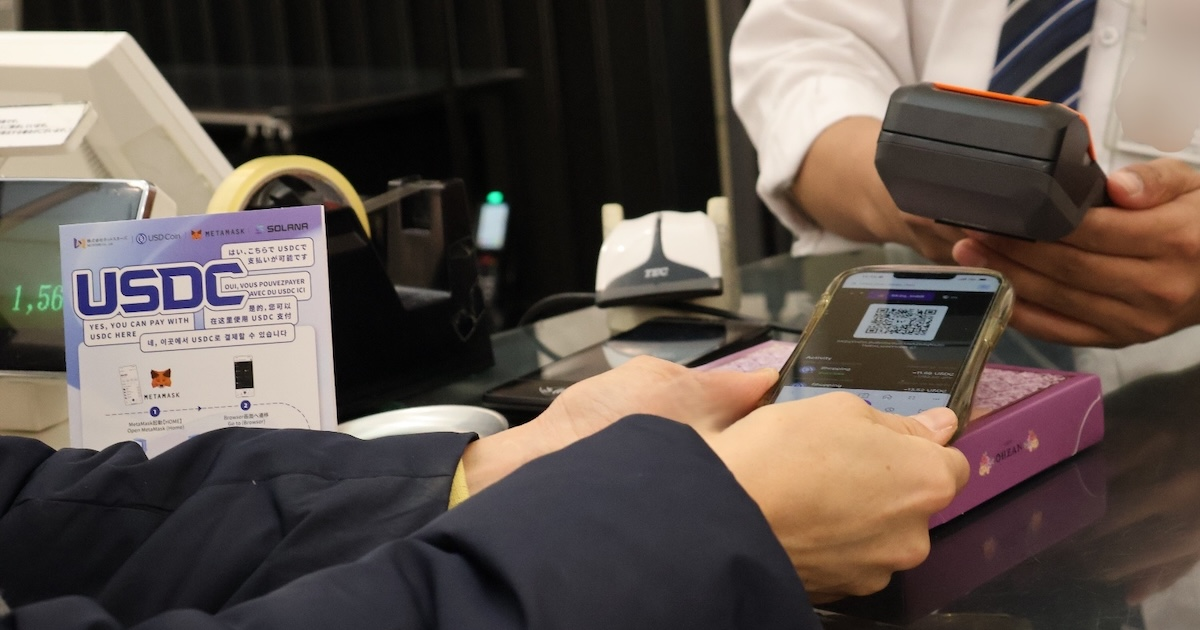
From January 26 to February 28, NetStars and Japan Airport Terminal conducted a USDC payment pilot at Haneda Airport Terminal 3. The target stores were two locations, Edo Food Hall Jidaikan and Edo Event Hall, marking the first case of USDC used for offline store payments in Japan.
NetStars is a QR code payment integration operator, and it implemented this by layering USDC payments on top of the existing merchant payment network. The choice of Haneda Airport is a placement that considers the payment demand of inbound foreign visitors. Japan recorded a record high of about 36.87 million foreign visitors in 2024 and targets 60 million by 2030, but its cashless payment ratio remains at about 39%, and the payment inconvenience of foreign tourists has often been pointed out.
Comment
What stands out is that while Japan is putting effort into organizing its own yen stablecoins, the first case of actual offline payment was taken by the foreign-issued stablecoin USDC. While JPYC was rapidly increasing issuance and JPYSC and the megabank stablecoin were preparing to launch, what first appeared on a payment terminal at an airport store was a dollar stablecoin.
This is a reminder that the adoption of a payment method happens first in areas where demand is clear, not where policy weight lies. Haneda Airport is a place where inbound foreign visitors with clear currency-exchange demand gather, and USDC is a dollar-denominated asset familiar to them. Unlike a domestic-currency stablecoin facing the broad but weakly motivated market of domestic daily payments, USDC is a narrow but clearly motivated market.
The way the payment infrastructure enters also shows this difference. NetStars did not separately create new payment terminals or merchant contracts but layered USDC on top of the existing QR payment network. Because it used an already-installed collection path, the threshold for the pilot was relatively low. This contrasts with the burden on a domestic-currency stablecoin to secure a separate collection path and merchant base among cards and QR payment networks.
Ultimately, the Haneda Airport case shows that the point where stablecoin payments can spread first is not necessarily domestic daily payments. For the time being, offline stablecoin payments are likely to be tested first in areas where the motive for foreign-currency payment is clear, such as tourist payments or cross-border consumption, and where it is easy to layer on top of existing payment infrastructure.
What Happened?
From February 3 to March 5, the FSA conducted public comment on a draft amendment to a cabinet office ordinance to formally recognize stablecoins issued abroad as Electronic Payment Instruments. With enforcement scheduled for June 1, once this ordinance takes effect, the legal basis broadens for foreign-issued stablecoins including USDC to be formally distributed within Japan.
The background is the Electronic Payment Instruments category created by the amended Payment Services Act of June 2023. The law at the time set up the framework for domestically issued stablecoins, but the domestic handling conditions for foreign-issued stablecoins were not sufficiently organized. As SBI VC Trade increased its USDC handling in Q1 and the Haneda Airport USDC payment pilot proceeded, the need to clarify the domestic entry path for foreign stablecoins institutionally grew. This ordinance corresponds to the next step of that organization.
Comment
This ordinance shows how Japan intends to treat foreign stablecoins. The difference becomes clear when compared with other Asian countries. Hong Kong passed a stablecoin ordinance in December 2024 but made clear a priority track for Hong Kong dollar stablecoins and placed restrictions on the retail sale of foreign stablecoins. China blocked foreign stablecoins entirely through a single e-CNY track. Korea is wary of dollar stablecoin penetration in its won stablecoin discussion. By contrast, Japan broadens the legal entry path for foreign-issued stablecoins together with its own stablecoins.
The background is the yen's international position. The yen is a global reserve currency (fifth in the SDR basket), and Japanese financial institutions have a global investment bank network. The non-dollar economic zones where currency sovereignty does not waver even if a domestic-currency stablecoin is partly eroded by foreign stablecoins are, besides Japan, only about the eurozone and the UK. A market with a weak domestic-currency foundation has no choice but to be wary of dollar stablecoin inflows, but for Japan that burden is relatively small.
Whether this ordinance is an intended opening strategy or a natural consequence of institutional organization is hard to determine. What is clear is that as a result, Japan becomes a market equipped with both a domestic-currency payment network and a dollar payment network at the same time. And the SBI camp, the only handler of USDC within Japan, is positioned to benefit most from this opening.
3.4 The Securities Token Settlement Camp of Nomura, Daiwa, and the Three Megabanks (2/10)
What Happened?
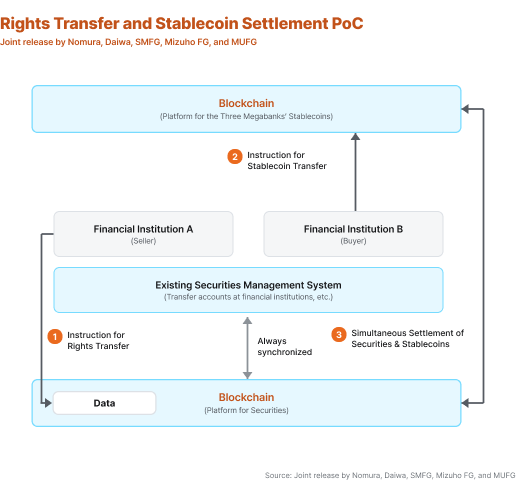
On February 10, it was reported that Nomura Holdings, Daiwa Securities Group, and the three megabanks would jointly conduct a pilot to settle stocks, bonds, and investment trusts on a blockchain. The settlement instrument is a fiat-pegged stablecoin, and the plan is to enter the pilot after an FSA filing during February, targeting practical use within a few years. The government's response was quick as well. Three days later, on February 13, Minister Katayama, in a post-cabinet-meeting press conference, called the pilot groundbreaking, recognized it as an FSA support project, and stated she would support it on the side of legal interpretation.
Comment
A securities transaction consists of two legs. One is the securities leg that transfers ownership of the security, and the other is the cash leg that pays the consideration. In Japan, the securities leg has been handled by the Japan Securities Depository Center (JASDEC), and the cash leg by the Bank of Japan's payment network and the banking system. It usually takes two days after the trade for the two legs to finally align.
Until now, Japan's security tokens were close to a structure in which only the securities leg was placed on a blockchain, while the cash leg was handled separately in the existing banking system. Because only half of settlement was tokenized, instant settlement in which the security and the consideration are settled simultaneously on the same ledger was difficult. This pilot tokenizes the cash leg too with a stablecoin, testing a structure in which the security token and the consideration move simultaneously within the same settlement environment.
What stands out is the composition of participants. Nomura and Daiwa are the first and second players in Japan's securities industry, and the three megabanks are also competitors each holding their own payment and trust infrastructure. Capital-market core institutions that normally stand in different camps gathered in a single pilot under the goal of security token settlement. With the FSA recognizing it as a support project, private consortium formation and government institutional backing meshed within the same quarter. That is, the work of redesigning capital-market settlement infrastructure to fit tokenization has been elevated from an individual institution's attempt to a shared industry task.
3.5 SBI VC Trade Launches USDC Lending (3/18)
What Happened?
Source: SBI VC Trade
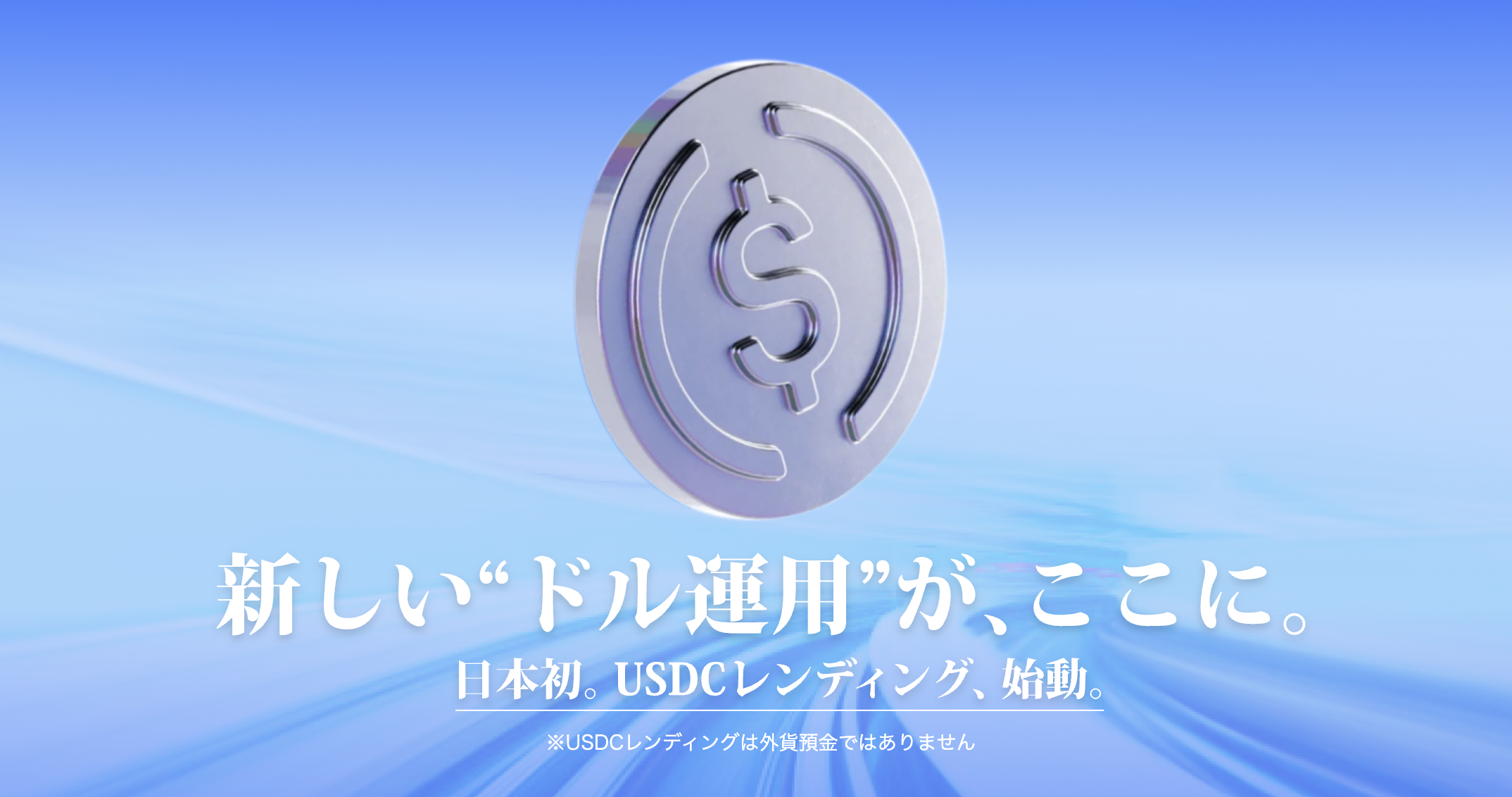
On March 18, SBI VC Trade announced a USDC lending service, the first among domestically licensed operators. It launches on March 19 with a 12-week term, an initial annual rate of 10%, a normal rate planned at 5% per year, and a cap of 5,000 USDC per account. On the maturity date, the principal is returned in USDC plus a usage fee, and early cancellation is in principle not possible.
USDC began to be formally handled in Japan through SBI VC Trade in March 2025. On March 4 of that year, when SBI VC Trade obtained Japan's first Electronic Payment Instruments Exchange Service Provider license, SBI became the only operator that can handle USDC within Japan. Until now, however, USDC use was limited to trading and remittance, and management products such as lending were not offered. SBI put out the first such product.
Comment
The significance of launching the USDC lending service emerges only when viewed together with Japan's foreign-currency management environment. Japan's foreign-currency time deposit rates are normally around 0.01% to 4%, reaching only 3% to 5% even with preferential rates. It is a structure that cannot keep up with US short-term rates (about 4% to 4.5% as of Q1 2026). Even so, the environment was one in which Japanese investors, to manage dollar assets, could not earn sufficient returns even while bearing currency risk. The arrival of USDC lending means that, for the first time, a digital alternative to foreign-currency time deposits exists for Japanese investors. A USD-denominated management product at 10% per year (initial) or 5% per year (normal) far exceeds foreign-currency time deposits.
What this product targets is Japanese households' demand for dollar asset management. With 30 years of deflation ending and a weak yen and rising prices continuing, demand to hold part of one's assets in dollars grew, but there was no suitable high-yield outlet. Bank foreign-currency deposits offer low rates, and direct US securities investment has thresholds of account opening and product selection. USDC lending becomes a fitting alternative for this gap. It provides, through an exchange account alone, an option to hold dollar-denominated assets while receiving higher interest than foreign-currency deposits.
The backdrop that let SBI fill this gap first is a group-level head start in infrastructure. SBI layered a lending product on top of its position as the only operator that can handle USDC in Japan. With the yen stablecoin JPYSC and the Strium chain within the same group, it has secured dollar management, yen settlement, and chain infrastructure all at once. While competing operators must first secure a separate license to handle USDC, SBI placed a management product directly on top of the distribution base it had already laid.
Whether this advantage continues is a separate matter. The initial 10% per year is a temporary rate to secure early demand, and whether it can maintain its appeal against foreign-currency time deposits even after dropping to the normal 5% per year determines the product's durability. At the same time, since household money may move from yen deposits to dollar-denominated management products, a degree of tension also remains with the Japanese government's asset-management-nation stance of steering funds into its own capital markets.
3.6 Zengin-Net Presents a Next-Generation Payment System Concept (3/19)
What Happened?
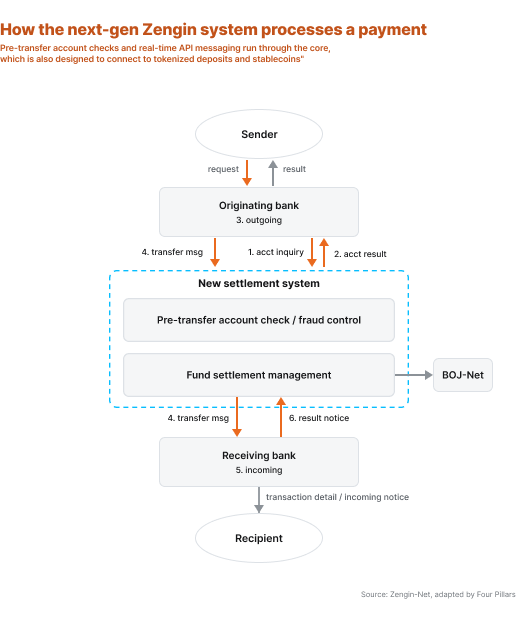
On March 19, the Japanese Banks' Payment Clearing Network (Zengin-Net) published a report on its policy to build a next-generation payment system to replace the current Zengin System. It plans to make a final decision on whether to build it during fiscal 2026, targeting operation in 2030. If realized, it becomes the first large-scale project to convert the current Zengin System, in operation since 1973, into a next-generation system.
The part of the next-generation system's direction that connects directly with digital assets is the connection with new payment instruments such as tokenized deposits and stablecoins. The report states that it will not, at this point, place the issuance, exchange, and redemption functions of stablecoins and tokenized deposits in the next-generation system core.
Stablecoins will have their issuance and redemption requests processed in linkage with external issuer systems, and tokenized deposits will secure extensibility through a system design flexible to message development and content changes, so as to handle transfers between different banks. In other words, rather than the next-generation system issuing or taking on tokenized money directly, it leaves open a path through which tokenized money can connect, on top of a backbone equipped with 24/365 operation, the ISO20022 international standard, and real-time processing.
Comment
The Zengin System is the backbone of interbank remittance in which nearly every bank in Japan participates, and it has functioned as the central infrastructure of Japan's fund settlement for over 50 years since 1973. Until now, stablecoins and tokenized deposits were closer to alternative payment instruments discussed outside this backbone. But that Zengin-Net, in designing the next-generation system, included stablecoin and tokenized deposit connection as an extensibility requirement carries significance. It is a signal that tokenized payment is no longer a peripheral experiment but has entered the realm Japan's interbank payment infrastructure must address.
The fact that the time axes of the private sector and Zengin-Net differ, however, creates another tension. Private tokenized payment has already begun to move. JPYC has started issuance, and security token settlement pilots and stablecoin projects continue to increase. By contrast, the next-generation Zengin System that would receive this at the interbank-network level decides whether to build it during fiscal 2026 and targets an operation date of 2030. During this time lag, depending on how much tokenized payment forms a standard, the 2030 next-generation system could become infrastructure that accommodates payment practices the private sector has already created, or it could become an occasion for the banking industry to reset a new standard.
4. Conclusion: Crypto Assets as a Regular Asset Class, From Three Directions
Q1 2026 was a quarter in which stablecoins, regulation, and business moved side by side in Japan's digital asset market. Rather than separate events, the three currents are interpreted as three facets of the same movement to absorb crypto assets as a regular asset class.
- Stabelcoin: Into the market JPYC had opened alone, SBI's JPYSC and the megabanks' joint issuance review were added, and the funds transfer type, the trust type, and foreign-issued stablecoins all stood at the same starting line.
- Regulation: As the FSA moved the division in charge of crypto assets under the asset management supervision bureau and put separate taxation into law, the position of crypto assets shifted from a means of payment to an asset management target.
- Business: SBI's BITPoint merger, GMO Coin's listing preparations, and Nomura's and Daiwa's exchange-business entry reviews followed in turn, and the fragmented exchange market began to reshape at the level of financial groups.
Beyond these, Q1 saw a series of regulatory and infrastructure preparations. CARF enforcement brought overseas exchanges' transaction information into the tax net, the three megabanks took on a joint pilot settling security tokens with stablecoins, and Zengin-Net included stablecoin and tokenized deposit connection as an extensibility requirement in its next-generation system. At Haneda Airport, Japan's first USDC offline payment appeared, and at SBI VC Trade, the country's first USDC lending appeared.
These too look like scattered events, but in that the tax information system, payment infrastructure, the interbank backbone, and foreign-currency management were all worked on side by side in a single quarter, the direction is one. Rather than writing new rules for crypto assets, it is the work of opening, in phases, a path through which digital assets can connect to the already-functioning Japanese financial infrastructure.
What remains are several observation points to gauge how the institutional and business foundation laid in Q1 carries forward into an actual market. The first signal is whether JPYC's issuance and real use expand and whether SBI's JPYSC and the megabanks' trust type reach issuance as foreshadowed. In exchanges, whether Nomura's and Daiwa's exchange registrations lead to actual applications and approvals shows the pace of reshaping, and since Nomura booked Laser Digital's loss in the previous quarter, whether the registration schedule is kept is also a variable.
On the regulatory side, whether the amended FIEA's 2027 enforcement and the 2028 separate taxation and ETF introduction proceed on schedule determines the execution of the phased path Japan has laid out, and how the dual structure of operating its own currency and dollar stablecoins at the same time balances with the asset-management-nation stance becomes the point that tests the Japanese model. If Q1 was the quarter that aligned the direction, how that direction rolls forward in reality is what this unfolding has yet to answer.




