


Table of Contents
- Key Takeaways
- Part I. The Market: Components Driving the Market
- 1. How Japan Built Its Crypto Market
- 1.1 From Mt. Gox to Maturity: A Regulatory Timeline
- 1.2 The Two Regulatory Foundations: PSA and FIEA
- 2. Exchanges as the Foundation
- 2.1 The Licensed Exchanges
- 2.2 The Self Regulatory Watchtower: JVCEA
- 2.3 The Coming Consolidation
- 2.4 The Offshore Access Question: More Tokens and Leverage
- 3. Participates in this Foundation
- 3.1 The Retail Investor Pyramid
- 3.2 What Institutions Actually Want: The Nomura 2026 Survey
- 3.3 Why Institutional Entry Points Stay Constrained
- 3.4 Corporate Treasury as an Access Vehicle
- Part II. The Rail: Regulation
- 1. Who Regulates Crypto in Japan
- 1.1 Exchanges and Market Conduct
- 1.2 Stablecoins, Payments, and AML
- 1.3 Security Tokens and STOs
- 2. Why 2026 Is the Pivotal Year
- 2.1 The Headline: Reclassification Under the FIEA
- 2.2 The 105-Token Whitelist and SESC's New Powers
- 2.3 The "Too Heavy-Handed" Debate
- 2.4 Open Questions and Timeline
- Part III. The Migration: Digital Money & Tokenization
- 1. Japan's Stablecoin Ecosystem
- 1.1 The Funds Transfer Issuer, JPYC
- 1.2 The Megabank Issuers, and Project Pax
- 1.3 The Trust Bank Issuer, and JPYSC by SBI
- 1.4 Foreign Stablecoins, and USDC
- 1.5 Comparing the Four Issuers
- 2. Beyond Stablecoins: Tokenized Deposits and CBDC
- 2.1 Tokenized Bank Deposit and DCJPY
- 2.2 The Bank of Japan's Digital Yen Phase 3 Pilot
- 3. The Great Onchain Migration: Tokenization
- 3.1 The JASDEC Carve-Out: Why Japan Can Build a Proprietary Stack
- 3.2 The Proprietary Stack: What Vertical Integration Really Means
- 3.3 The Neutral Utility Model: Progmat and BOOSTRY
- 3.4 The Tokenized Asset Universe Widens
- Part IV: The Outlook
Researcher

Key Takeaways
- Japan's crypto market matured through a pattern of crisis followed by framework followed by adoption. Mt. Gox, Coincheck, and DMM Bitcoin each expanded the regulated perimeter, culminating in the April 2026 FIEA amendment that reclassifies 105 approved tokens as financial instruments.
- The 2026 package is a simultaneous overhaul of seven reforms in one vehicle. It brings a flat 20.315% tax from 2028 (down from up to 55%), insider trading bans, issuer disclosure duties, SESC surveillance, and an LPS Act change letting Japanese VC funds hold crypto directly.
- Exchange consolidation is the near term structural story. Roughly 90% of Japan's 27 licensed exchanges operate at a loss, and rising FIEA compliance costs should concentrate volume into a few scale players, with SBI's bitbank acquisition as the clearest signal.
- Japan now runs a full digital yen and tokenization stack. Four complementary stablecoin tracks (JPYC for retail, Project Pax for B2B, JPYSC for tokenized assets, USDC for trading) plus the FIEA security token framework set up institutional adoption, with the 2028 spot ETF window as the largest flow catalyst.
Part I. The Market: Components Driving the Market
1. How Japan Built Its Crypto Market
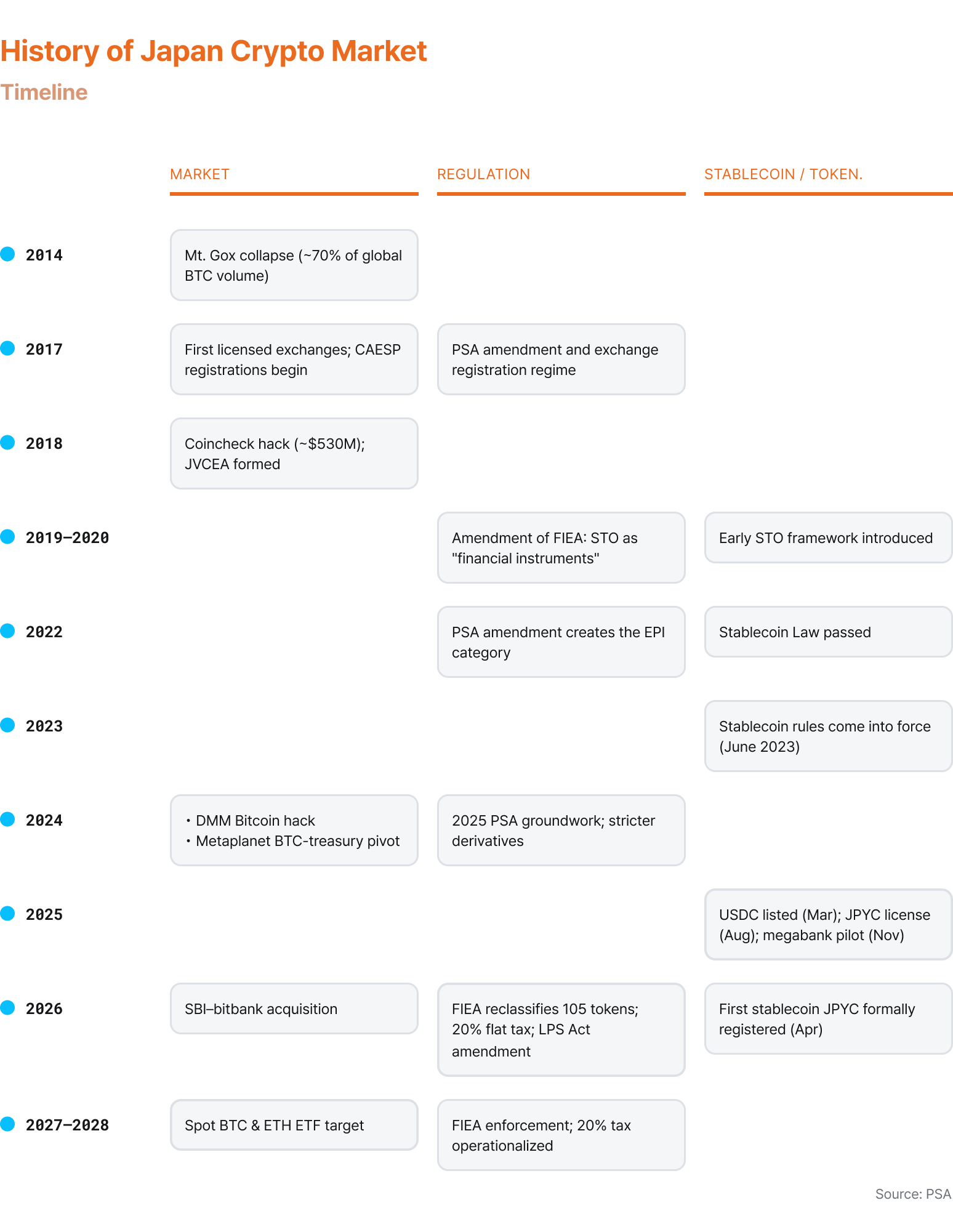
Japan's crypto market did not arrive at its 2026 inflection by accident. It is the product of more than a decade of regulatory iteration, much of it forced by crisis.
- The Mt. Gox collapse of 2014, at the time the world's largest Bitcoin exchange, headquartered in Tokyo, turned Japan into the first major jurisdiction to grapple seriously with custodial risk, and the resulting 2017 PSA amendment made Japan the first G20 economy to formally license crypto exchanges.
- The Coincheck hack of 2018 (~$530M stolen, then a record) led directly to the Japan Virtual Currency Exchange Association (JVCEA) self-regulatory framework.
- The DMM Bitcoin hack of 2024 in turn drove the 2025 PSA amendment that introduced asset-retention orders and a new crypto-intermediary licensing tier.
This pattern, incident → framework → institutional adoption, is unusual globally. In most jurisdictions, the response to a major hack has been a catalyst, but in Japan, each crisis has been used as a forcing function to expand the regulatory perimeter and bring more market activity into supervised channels.
The FSA today directly registers exchanges (CAESPs), stablecoin issuers (EPISPs), and now crypto intermediaries (ECISBs under the 2025 PSA amendment), with the JVCEA and JSTOA operating as delegated self-regulatory bodies. This stacked structure is dense, but it gives the FSA a level of granular visibility into the market that few peer regulators can match.
1.1 From Mt. Gox to Maturity: A Regulatory Timeline
What stands out is not the bunch of new rules but the consistency of direction: every change has expanded the licensed perimeter without rolling back established protections. The 2017 PSA registration regime survived Coincheck. The 2022-2023 stablecoin framework survived USDC's contested approval. The 2024 DMM Bitcoin hack accelerated rather than slowed the FIEA reclassification debate.
The pre-2017 era is best understood as Japan's "discovery" phase. Bitcoin was traded primarily through Mt. Gox and a handful of OTC desks, with no specialized legal status, transactions defaulted into general civil and tax law, which treated crypto gains as miscellaneous income (the seed of today's 55% problem). The Mt. Gox once handled an estimated 70%+ of global Bitcoin trading volume by 2013. In February 2014, Mt. Gox abruptly halted withdrawals, and disclosed that approximately 850,000 BTC of customer and house coins had gone missing.
The failure exposed the absence of segregated-custody and proof-of-reserves standards; the legislative response, the 2017 PSA amendment, imported the same registration philosophy Japan had long applied to payment-services providers, treating crypto exchanges as a new species of regulated payment intermediary rather than as securities venues.
The 2018-2022 "institutionalization" phase added the missing layers: the JVCEA as a self-regulatory body for CAESPs (post-Coincheck), the 2019-2020 amendments tightening custody-of-customer-assets rules and bringing derivatives onto regulated venues, and the 2022 PSA amendment creating Japan's stablecoin framework as a new electronic-payment-instrument (EPI) category. Notably, the 2022 stablecoin law was passed before any issuer was ready to launch under it, a deliberately forward-leaning move that gave the industry time to architect EPI-compliant products. JPYC's eventual 2025 approval is the direct downstream consequence.
The 2023-2026 "convergence" phase is the most rapid and is still unfolding. Stablecoin rules came into force in June 2023; the first foreign stablecoin (USDC) was listed via SBI VC Trade in March 2025; JPYC received its money-transfer license in August 2025 and was formally registered in April 2026; the megabanks' joint stablecoin pilot was FSA-blessed in November 2025; and the FIEA crypto bill which reclassifyed 105 crypto-assets as financial instruments was approved by cabinet on April 10, 2026.
The 2027-2028 horizon brings FIEA enforcement in 2027, the 20.315% separate-taxation regime applying to transactions from January 1, 2028, and the FSA's targeted 2028 window for spot Bitcoin and Ether ETF approvals. Each of these is a discrete event, but together they constitute a coherent multi-year program.
1.2 The Two Regulatory Foundations: PSA and FIEA
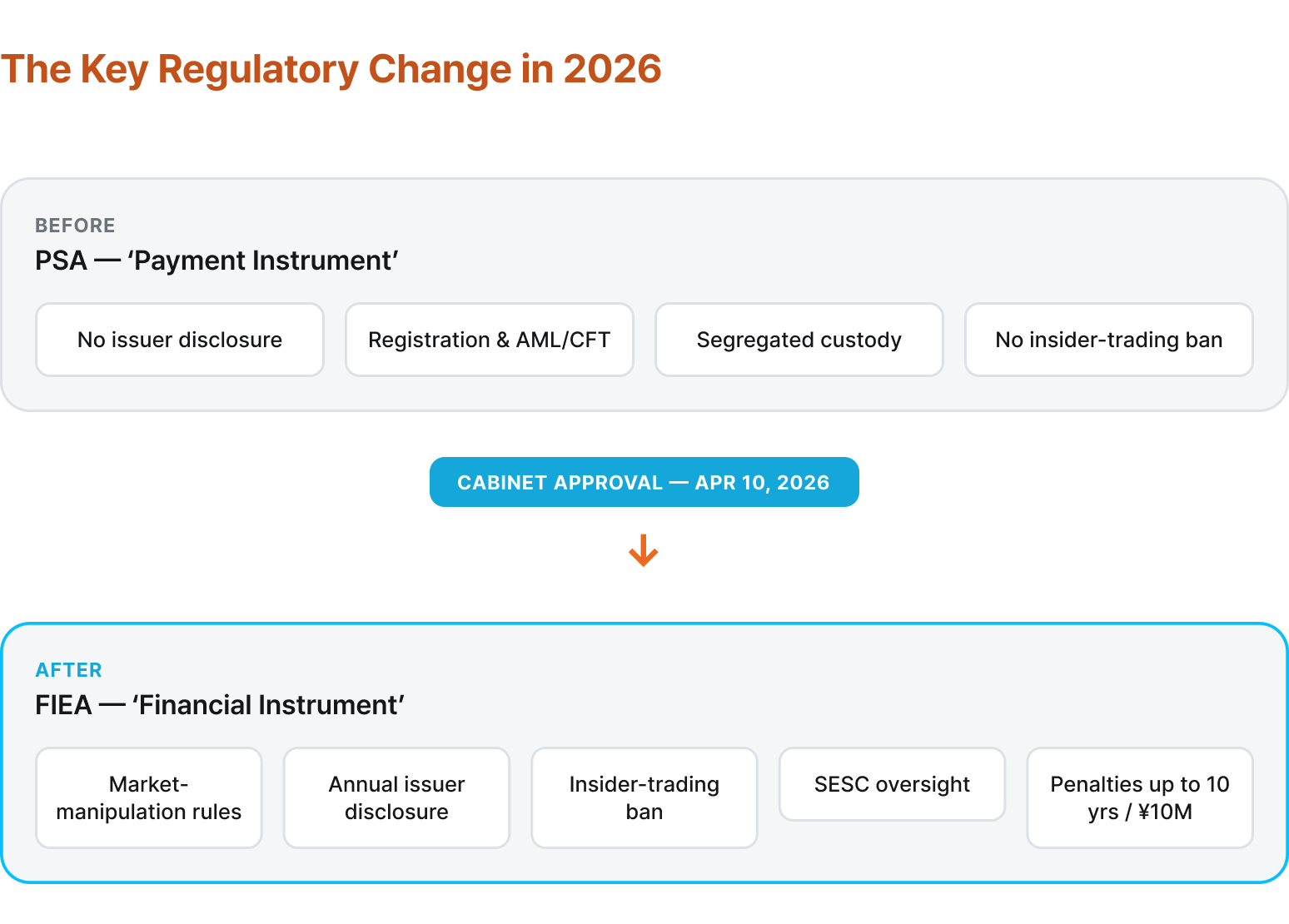
Understanding Japan's regulatory geometry requires holding two laws in mind simultaneously. The Payment Services Act (PSA) has, since 2017, defined crypto-assets as payment instruments and required exchange operators to register with the FSA; it is also the legal home of the stablecoin (EPI) regime since 2022.
The Financial Instruments and Exchange Act (FIEA) has historically governed securities, derivatives, security tokens (STOs), and the conduct of registered financial-instruments business operators. Until 2026, crypto sat almost entirely on the PSA side of the line, with FIEA touching it only for crypto-related derivatives and security tokens.
The April 2026 FIEA amendment changes this fundamentally.
It does not abolish the PSA regime, stablecoins remain EPIs under the PSA, and exchange custody remains a PSA-registered activity, but it moves the 105 approved spot tokens themselves into FIEA, importing securities-grade tools wholesale: continuous disclosure obligations, insider-trading prohibitions, market-manipulation rules, and SESC supervisory authority. The architectural metaphor is that crypto now sits at the intersection of two laws rather than under just one, gaining the legitimacy and surveillance powers of FIEA while retaining the payment-rail flexibility of PSA.
For market participants, the practical consequence is a doubling of compliance surfaces. A licensed CAESP(Crypto Asset Exchange Services Providers) from May 2027 onward will need to satisfy both its PSA registration conditions (custody, AML, Travel Rule) and a new FIEA-aligned suite of obligations (insider-trading surveillance, disclosure-handling, market-conduct rules). Token issuers, whose tokens are on the 105-token list, acquire continuous disclosure obligations comparable to listed equity issuers; they must publish annual reports and material-event disclosures, and failure to do so triggers SESC referral.
For Japanese crypto, it is a normalization moment.
2. Exchanges as the Foundation
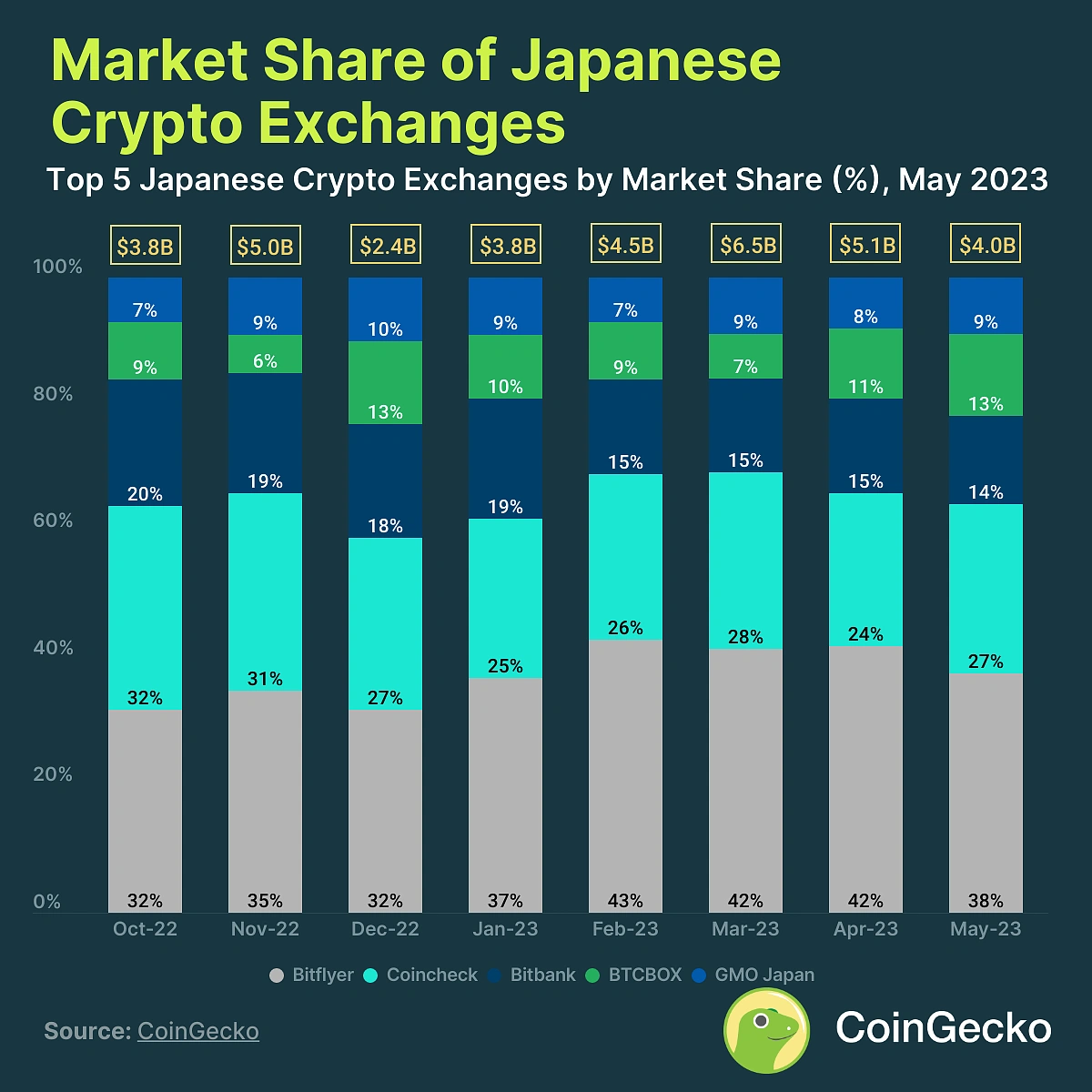
Source: Top Japanese Crypto Exchanges, by Market Share & Trading Volume | CoinGecko
Japan's licensed exchange landscape is simultaneously one of the deepest in the world by registration count and one of the least concentrated by volume share. As of February 2026, the FSA's official registry lists around 27 Crypto-asset Exchange Service Providers (CAESPs), a count that exceeds Hong Kong's, Singapore's, and Korea's combined licensed venues. Yet volume is concentrated in a small handful of platforms: bitFlyer, Coincheck, SBI VC Trade, and bitbank together account for the dominant share of domestic spot trading. (SBI Holdings has now agreed to fully acquire bitbank)
The operating economics of Japanese CAESPs have been chronically challenging since the 2017 PSA registration regime took effect. The FSA itself has publicly noted that roughly 90% of Japanese crypto exchanges operate at a loss under current compliance costs, a structural problem that the 2026 FIEA package will exacerbate before it improves. The cost stack runs through registration fees, AML/CFT compliance, JVCEA membership dues, cybersecurity infrastructure, segregated custody arrangements, and now (from 2026), FIEA disclosure handling, and insider-trading surveillance. Against this cost base, only the highest-volume venues earn sustainable margins.
The likely 2026-2028 path is therefore a structural consolidation, not a wave of failures, but a gradual concentration of volume and licenses into a smaller set of big players. The most credible end-state has three tiers: 3-4 scale players (bitFlyer, Coincheck, SBI VC Trade, plus one of bitbank or GMO Coin), 4-6 specialized mid-tier players (alt-focused, derivatives-focused, or institution-focused), and a long tail of niche or M&A-target venues.
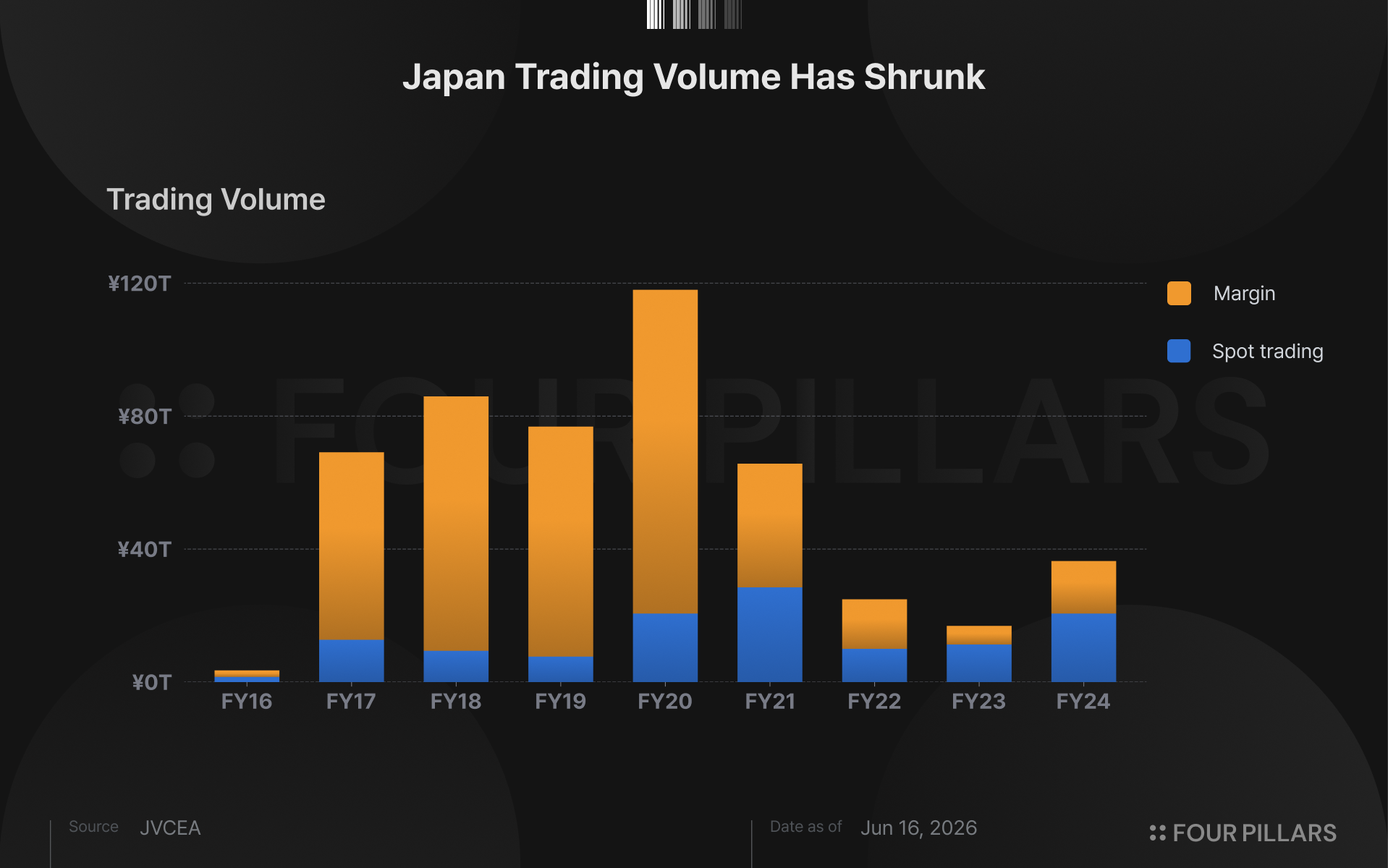
2.1 The Licensed Exchanges
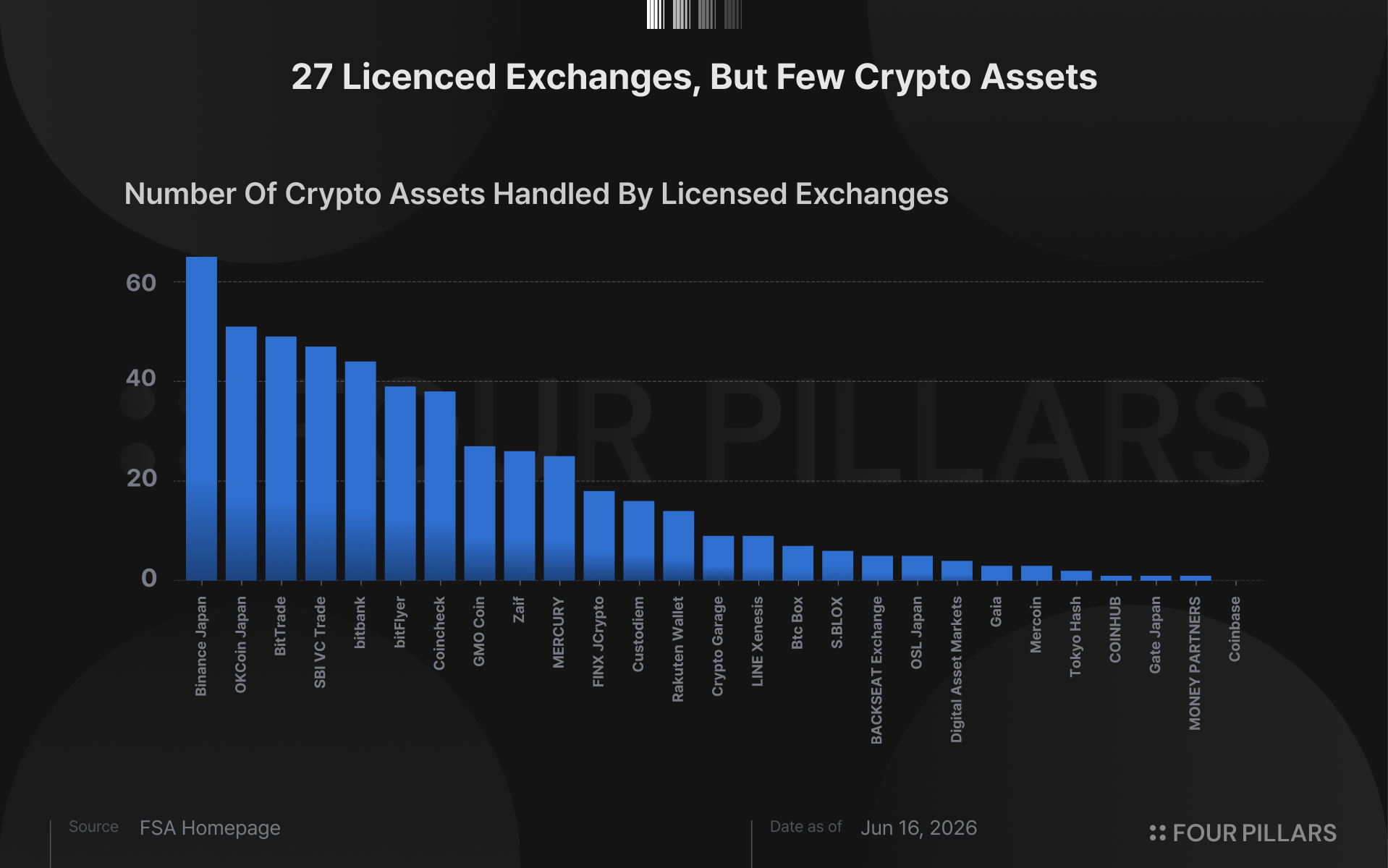
Source: FSA
The top tier of Japanese CAESPs is small but well-differentiated. bitFlyer, Japan's longest-running and largest-volume exchange by spot BTC/JPY turnover dominates institutional and HFT flow with the market's deepest order book. Reportedly preparing for a potential future listing on the Tokyo Stock Exchange (it has not completed an IPO), it owns the BTC-focused trader segment and is the natural beneficiary of FIEA-driven repatriation of offshore volume.
Coincheck, owned by Monex Group since its post-hack acquisition in 2018, has rebuilt into Japan's strongest retail-brand exchange. Its mobile app tops App Store finance charts during retail rallies, anchored by friendly UX, broad alt listings (within the 105 universe), and a strong NFT marketplace.
SBI VC Trade, owned by SBI Holdings, occupies the institutional and integrated-finance segment as the core node of SBI's full-stack digital-asset strategy (first to list USDC in March 2025, plus JPYSC, Strium Network, and tokenized RWA). Its client mix of institutions integrating crypto execution with traditional securities and FX is smaller-volume but higher-margin than bitFlyer's HFT-and-retail flow.
The most consequential 2026 event was SBI Holdings' June 25, 2026 definitive agreement to fully acquire bitbank for ¥46.7 billion (about US$289 million), with closing expected around October 2026, which would make SBI Group Japan's largest crypto-exchange operator by combined volume. The acquisition consolidates the SBI Group's “full-stack” digital-asset strategy: stablecoin issuance (JPYSC), exchange (SBI VC Trade + bitbank), STO (via SBI Securities and ODX), L1 infrastructure (Strium), and custody partnerships. No other Japanese institution operates at this breadth. Expected 2026-2028 follow-on transactions include potential Coincheck and GMO Coin consolidations, with Binance Japan and Mercoin remaining as standalone strategic players.
Rakuten Wallet, and GMO Coin form the second tier of scale players, each with strong parent-company distribution channels (Rakuten Group, GMO Internet) but smaller spot-volume share than the top four.
Beyond this second tier sits a long tail of smaller CAESPs whose volume share is mostly low single-digit percentages and whose path forward likely involves either specialization (e.g., institutional custody, derivatives, OTC) or M&A consolidation into the top tier.
2.2 The Self Regulatory Watchtower: JVCEA
The Japan Virtual Currency Exchange Association (JVCEA) has been the FSA-certified self-regulatory body for crypto-asset exchanges since 2018, in the aftermath of the Coincheck hack. JVCEA's primary functions have included token-listing screening (the gatekeeping process that determined which tokens could be listed on member exchanges), member supervision, and FSA liaison. Until 2026, JVCEA's listing screen was the de facto national whitelist mechanism for Japan, and the JVCEA-screened token set served as the precursor to today's 105-token FIEA list.
The FIEA package fundamentally reorganizes JVCEA's role rather than eliminating it. JVCEA's listing-screening function is largely superseded by the FSA's direct administration of the 105-token whitelist and the disclosure-filing process under FIEA, going forward, token listings will depend on FSA approval rather than JVCEA screening. However, JVCEA retains essential authority over member-conduct rules, dispute resolution, market-conduct enforcement, and shared infrastructure like the Travel Rule reference data exchange and the cross-exchange Suspicious Transaction Reporting standards.
A related expansion is JVCEA's 2024 certification by the FSA as a self-regulatory body for EPISPs (stablecoin distributors). This made JVCEA the unified SRO for both CAESPs and EPISPs, simplifying the regulatory architecture and giving the FSA a single industry counterparty across the crypto-trading-and-stablecoin perimeter. JVCEA's expanded membership now includes traditional CAESPs, foreign-stablecoin distributors (SBI VC Trade for USDC), and prospective domestic stablecoin issuers.
The strategic question for JVCEA over 2026-2028 is whether it can position itself as a value-adding SRO in a world where the FSA holds primary listing authority. The most credible path is for JVCEA to evolve into the operational standards body for the industry, setting CSSA scoring methodologies, Travel Rule data formats, surveillance benchmarks, and dispute-resolution protocols that members must implement.
JVCEA appears to be moving in this direction, though the transition is incomplete and will likely play out fully over 2026-2027.
2.3 The Coming Consolidation
The consolidation thesis for Japanese CAESPs rests on three observable pressures. First, operating losses are widespread: the FSA's ~90% loss figure implies most CAESPs cannot fund their existing compliance stack from current revenues. Second, cost intensification under FIEA: insider-trading surveillance, and disclosure handling will add measurable operating costs from 2026-2027. Third, volume concentration tendency: trading liquidity attracts trading liquidity, so the largest venues organically gain share over time even without M&A.
The likely 2026-2028 path runs roughly as follows.
- Tier 1 (2-4 scale players), bitFlyer, Coincheck, SBI VC Trade, and possibly bitbank, capture the bulk of new volume from FIEA-driven retail and institutional flows. These platforms generate enough revenue to fund FIEA compliance and earn sustainable margins.
- Tier 2 (4-6 specialized players), GMO, Rakuten Wallet, DMM Bitcoin, plus possibly an alt-specialist and an institutional-custody specialist, survive on focused positioning, often supported by parent-company distribution.
- Tier 3 (long tail), the remaining 15+ CAESPs, face acute decisions: specialize, merge, exit, or sell.
The M&A vector is the most likely consolidation mechanism. Acquiring an existing CAESP registration is faster and cheaper for a Tier 1 player than launching a new product line, and the long tail of Tier 3 venues offers attractive bolt-on targets at modest enterprise values. Expect 3-6 visible CAESP acquisitions or wind-downs through 2027-2028, with SBI, Monex, and Rakuten as the most active consolidators given their parent-group balance sheets and existing crypto integration.
The strategic implication for industry participants is that operational scale is becoming the most important determinant of survival. For new entrants, whether foreign exchanges seeking CAESP licenses or domestic fintechs exploring crypto, the calculus increasingly favors partnership with an existing Tier 1 or Tier 2 venue over independent registration.
2.4 The Offshore Access Question: More Tokens and Leverage
One of the most empirically interesting questions for 2026-2028 is how much offshore Japanese trading volume returns home once the tax differential collapses. Offshore participation is widely believed to be substantial (often cited in the tens of percent) of total Japanese crypto volume, concentrated on Bybit and Binance, with smaller tails on Coinbase International and Kraken Pro. Under the legacy 55% regime, the after-tax math overwhelmingly favored offshore execution.
In 2026, two forces now push in the opposite direction:
- The 20% domestic tax rate removes the dominant rationale for trading the 105-token list offshore, which was 55%.
- The FSA and JVCEA are tightening enforcement against venues soliciting Japanese residents. Bybit reportedly halted new Japanese-resident onboarding in late 2025.
Together, these should drive meaningful retail repatriation to JP-licensed CAESPs through 2027. But, two structural gaps remain:
- Leverage. Japan's 2× retail leverage cap (a post-2017 consumer-protection measure that has not been revisited) sits far below the 20-100× routinely offered offshore.
- Alt-listings. The 105-token whitelist is an order of magnitude narrower than a typical global spot menu.
Active derivatives traders and long-tail alt hunters will therefore continue to route offshore. This residual segment is plausibly 10-20% of pre-reform Japanese offshore volume, concentrated in pro-trader cohorts.
Institutions move the other way. Japanese institutions have historically avoided direct offshore exposure for compliance reasons. The FIEA framework with FSA disclosure-handling and SESC surveillance providing documentary support for fiduciary compliance makes "FSA-list menu via Tokyo CAESP" the default, while "global menu" execution becomes a compliance liability. Residual institutional offshore activity should approach zero by 2028.
On derivatives specifically, the FIEA reform opens a narrower path: it leaves the 2× retail cap untouched but brings derivatives on the 105 approved tokens under FIEA margin rules, letting institutional leverage (potentially 10–20×) repatriate onshore while retail stays capped.
3. Participates in this Foundation
3.1 The Retail Investor Pyramid
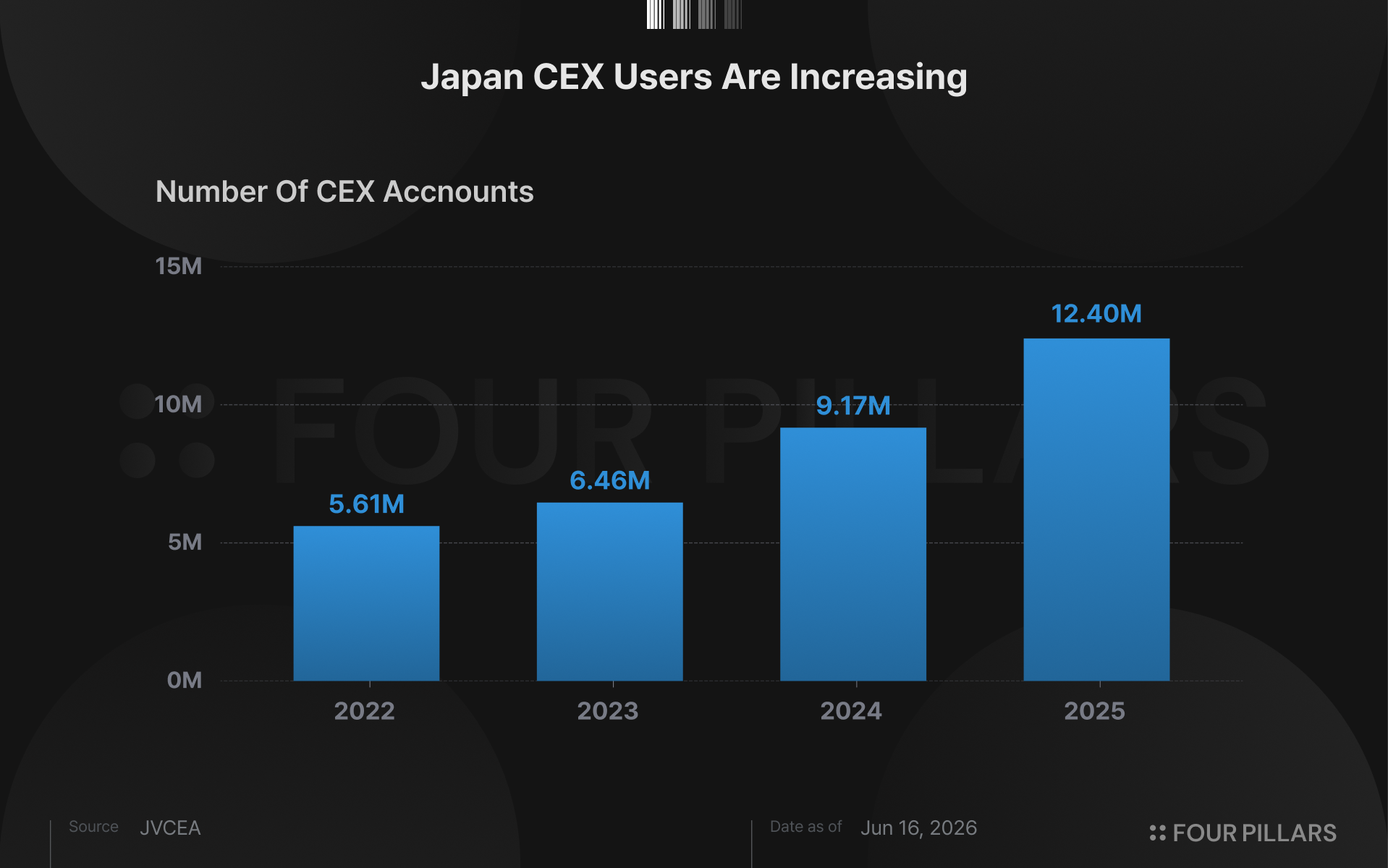
Japan has roughly 12.4 million active crypto users (≈12% of adults) as of mid-2025 similar penetration to the US (~10–12%), but with materially smaller per-user position sizes. The core demographic skews 30~40 years old, earns under ¥7M household income, and trades almost entirely through exchange mobile apps rather than DeFi wallets.
Behaviorally, Japanese retail is the structural opposite of Korean retail: low frequency, BTC/ETH-dominated, accumulation-oriented, with most users transacting only a few times per quarter.
The 2026 tax reform affects this base unevenly. Active traders benefit directly from lower realization friction, but the mainstream accumulation cohort is influenced less by the rate cut itself than by the legitimacy effect of FIEA reclassification, which reframes crypto as a regulated financial-product category alongside listed equities.
Capturing these users through the 2027–2028 transition is the single most important commercial priority for Tier 1 CAESPs.
3.2 What Institutions Actually Want: The Nomura 2026 Survey
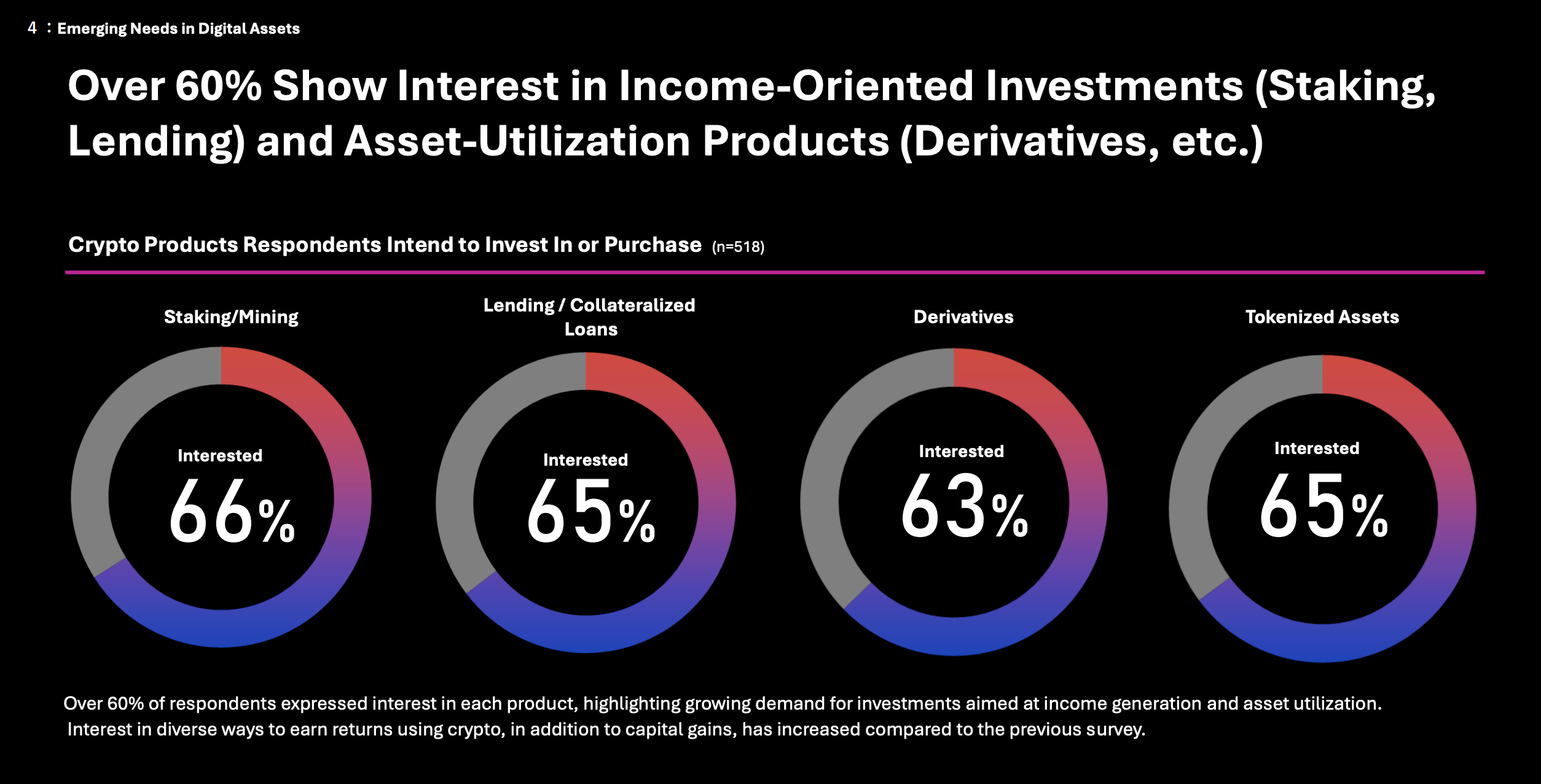
Source: Nomura & Laser Digital 2026 Institutional Investor Survey
Nomura's 2026 Digital Asset Institutional Investor Survey has informative published data point on Japanese institutional intent heading into the FIEA reform. The headline finding is that 79% of Japanese institutional investors considering crypto plan to allocate within three years, with the modal allocation in the 2-5% of AUM band.
- Intent to allocate: Among respondents considering crypto exposure over the next three years, 79% plan to invest, and 60% of those expect a 2% to <5% portfolio allocation.
- Diversification thesis: 65% now view crypto as a portfolio-diversification tool, citing low correlation with other asset classes as the primary rationale.
- Broad product interest: staking/mining 66%, lending & collateralized loans 65%, tokenized assets 65%, derivatives 63%; yield and utilization, not pure beta.
- Stablecoins: 63% identify concrete use cases (treasury management, cross-border payments/FX, crypto-asset investment, tokenized-securities settlement). Across JPY, USD, and EUR, stablecoins issued by major financial institutions receive the highest level of trust a direct tailwind for Project Pax and JPYSC over JPYC for institutional flow.
- Remaining barriers: weak fundamental-analysis frameworks, counterparty risk (default, fraud, asset loss), high volatility, and residual regulatory uncertainty concerns that have shifted from existential to operational.
3.3 Why Institutional Entry Points Stay Constrained
Institutional crypto adoption in Japan has been structurally constrained by four interconnected barriers, each of which the 2026 reform package addresses directly. Understanding these barriers in turn is the cleanest way to think about how institutional flows will sequence over 2026-2028.
- Barrier 1: Tax treatment. Until the 2028 tax change, crypto gains for corporates were taxed at the corporate rate (~30% effective including local) while crypto gains for individuals were taxed at up to 55% as miscellaneous income. The corporate rate was manageable but still higher than the 20.315% capital-gains rate on listed equities; this created a structural disincentive for asset managers to add crypto to portfolios on a like-for-like basis. The 20.315% separate taxation effective January 1, 2028 aligns crypto with equities on the personal side, and the FIEA reclassification clarifies corporate treatment, removing this barrier for retail-product-oriented institutions like asset managers.
- Barrier 2: No spot ETF. The single biggest institutional access channel, the spot Bitcoin ETF, does not exist in Japan and is targeted for 2028. Until then, institutional Bitcoin exposure must be routed through Metaplanet equity, offshore ETF products (with attendant currency and tax complications), or direct CAESP execution. Each of these has structural disadvantages versus a domestic spot ETF, and the 2028 catalyst is the single biggest unlock for institutional flows once delivered.
- Barrier 3: Accounting and audit ambiguity. Japanese GAAP treatment of corporate crypto holdings has been ambiguous on impairment, fair-value vs cost accounting, and disclosure requirements. The 2024-2025 ASBJ (Accounting Standards Board of Japan) guidance has clarified that corporate crypto holdings can be marked to fair value for accounting purposes, removing one of the larger barriers to corporate-treasury adoption. Combined with the FIEA framework's clearer legal classification, the accounting picture is now substantially cleaner than 18 months ago.
- Barrier 4: LPS Act restriction on VC funds. Japanese LPs could not directly hold crypto until the 2026 LPS Act amendment, which forced Japanese VC funds investing in Web3 to use Singapore or Cayman feeder structures. The 2026 amendment permits direct holdings, which is expected to bring a meaningful share of Japan-focused Web3 VC activity back onshore from 2027 onward and to make domestic VC funds viable channels for institutional crypto exposure.
3.4 Corporate Treasury as an Access Vehicle
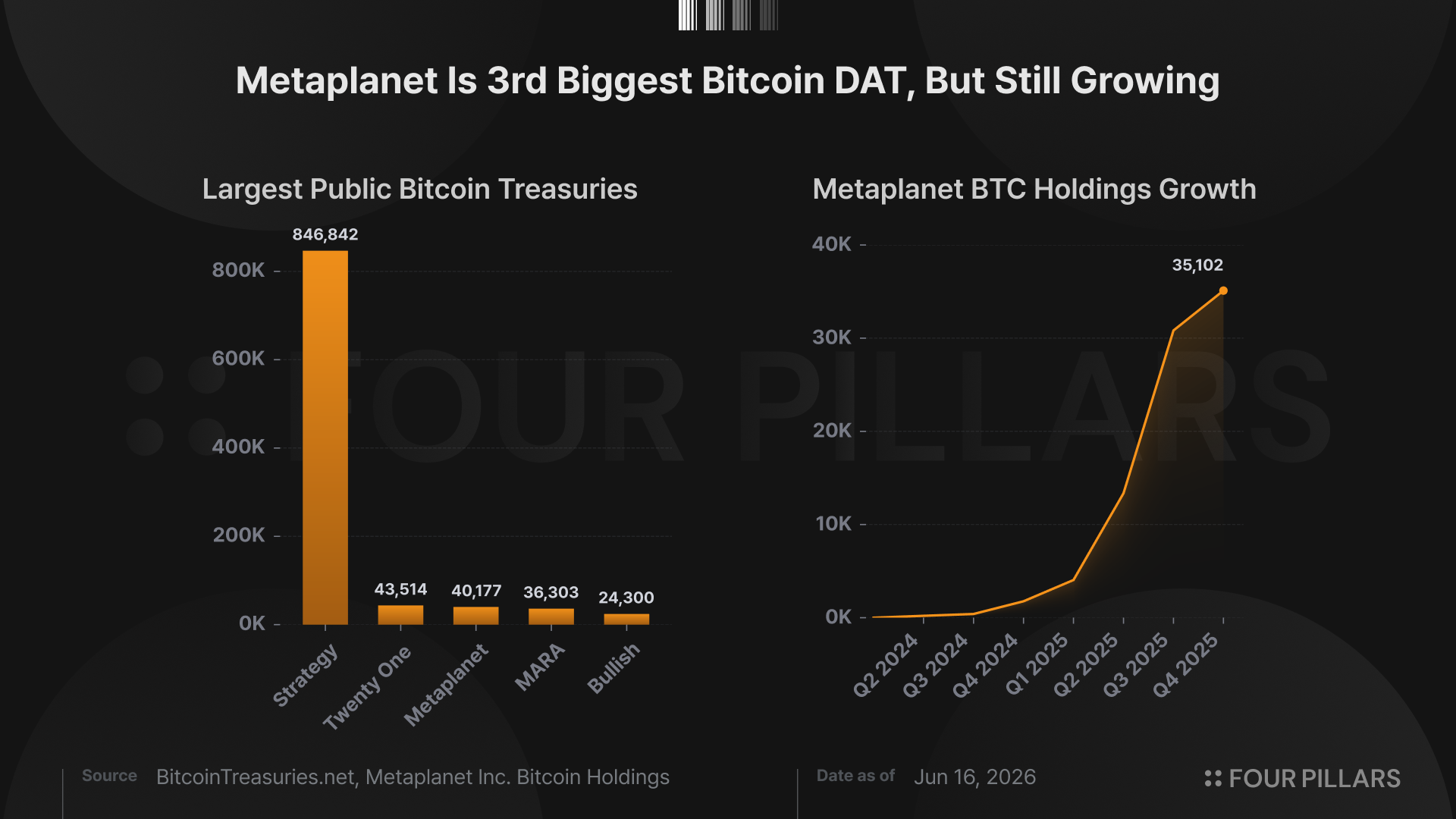
Corporate Bitcoin treasury adoption in Japan emerged from 2024 to 2026 almost entirely through one listed company, Metaplanet Inc., now the third largest publicly disclosed corporate Bitcoin treasury globally.
Metaplanet's pivot from an unprofitable hospitality holding company into a Bitcoin treasury specialist (under CEO Simon Gerovich from early 2024) is one of Asia's most successful corporate reinventions. Funding accumulation through equity placements, convertible bonds, and warrants, its holdings rose roughly twentyfold from 1,762 BTC at the end of 2024 to 35,102 BTC by December 30, 2025.
The vehicle worked because it filled three gaps in the Japanese market: retail crypto gains were taxed at up to 55% until the separate-taxation change effective January 1, 2028, no NISA-eligible Bitcoin wrapper existed, and no spot Bitcoin ETF was available (nor will one be until 2028). A listed holder resolved all three at once, giving retail investors regulated, NISA-eligible, equity-wrapped Bitcoin exposure taxed at corporate rates rather than 55%.
Three structural advantages underpinned that proposition:
- NISA eligibility: Metaplanet is a listed Japanese stock, so it can be held inside NISA and iDeCo, the country's tax advantaged accounts, while directly held Bitcoin cannot. This lets retail investors hold Bitcoin exposure tax free up to their annual contribution limits, an advantage that survives the 2028 tax change.
- Capital markets leverage: As a public company, Metaplanet can issue equity, convertible bonds, and warrants to fund Bitcoin purchases, scaling its holdings in ways an individual investor cannot. This funding playbook drove its roughly twentyfold accumulation during 2025 and lets it raise fresh capital whenever market conditions are favorable.
- BTC income business: Rather than passively holding coins, Metaplanet runs a Bitcoin options and derivatives operation that generated about $55M of revenue in 2025. This produces recurring operating cash flow to cover costs and fund further buying, which pure accumulators lack.
The 2026 tax reform narrows, but does not erase, this edge. The tax advantage once the biggest draw, at 55% retail versus roughly 20% corporate mostly disappears as retail gains on the 105-token list move to 20%. The remaining advantages prove more durable: directly held Bitcoin stays ineligible for NISA or iDeCo while Metaplanet's listed equity qualifies, and capital-markets access plus the BTC income business have no retail equivalent. NISA and iDeCo eligibility is therefore likely to become the dominant marketing message after 2028.
Metaplanet is now the template for Japan's emerging "Digital Asset Treasury" (DAT) cohort, listed small and mid caps that adopt crypto first balance sheets funded through capital markets. As of May 2026, 14 listed Japanese companies hold roughly 46,245 BTC (about $3.6B), leading Asia in count although about 87% sits with Metaplanet alone.
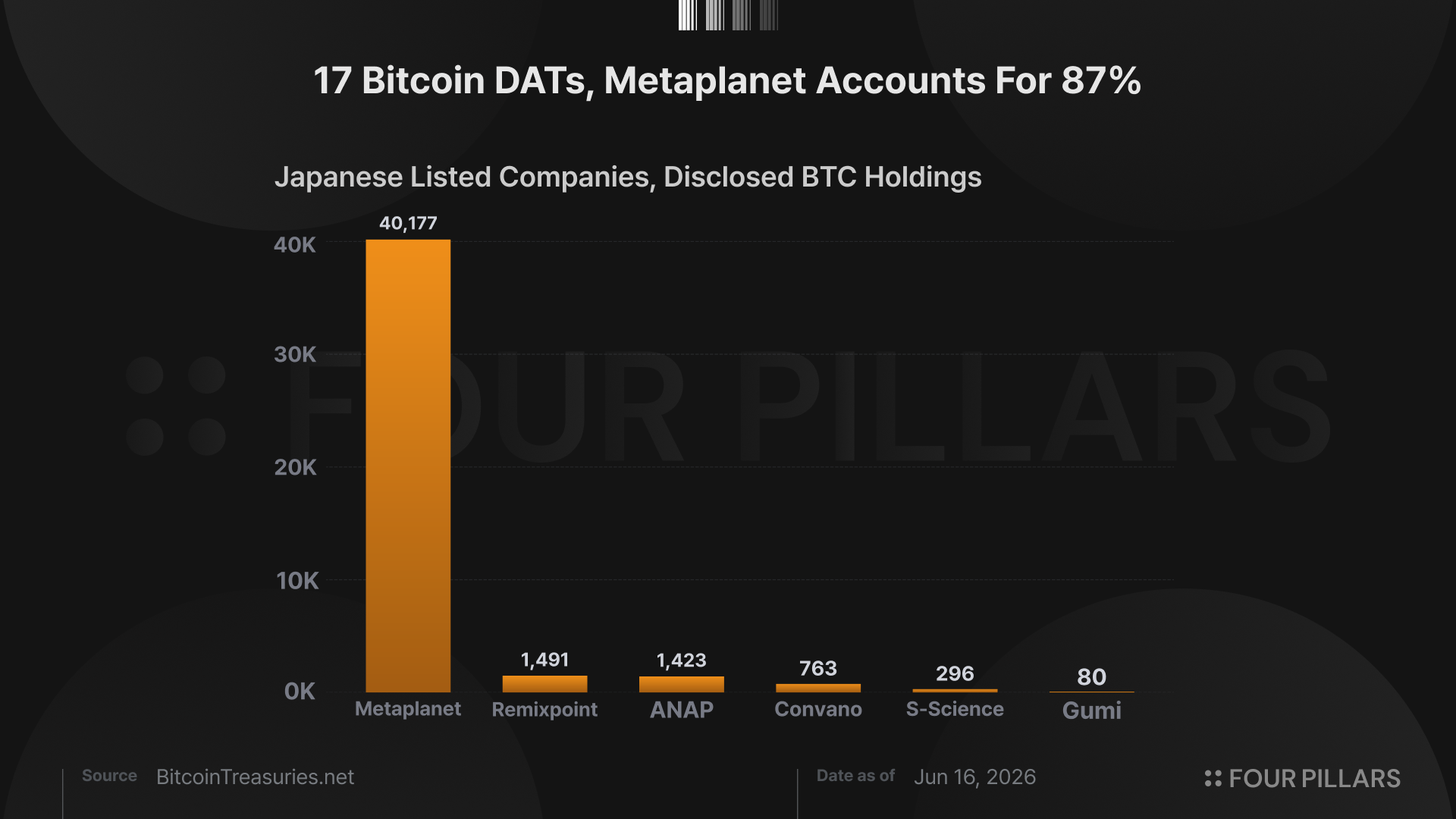
The key risk to the cohort is the 2028 spot ETF approval, which could pull flows toward lower-cost ETF exposure and compress today's 50%–150% DAT premiums toward 10%–30%, though names with real operating businesses should weather it best.
Beyond DATs, SBI, Nomura, Daiwa, and large asset managers are building digital-asset funds, and private banks are issuing HNW allocation guidance for the first time — so FIEA legitimacy, 20% tax parity, and the LPS Act amendment together create an institutional channel that did not exist 24 months ago.
Part II. The Rail: Regulation
1. Who Regulates Crypto in Japan
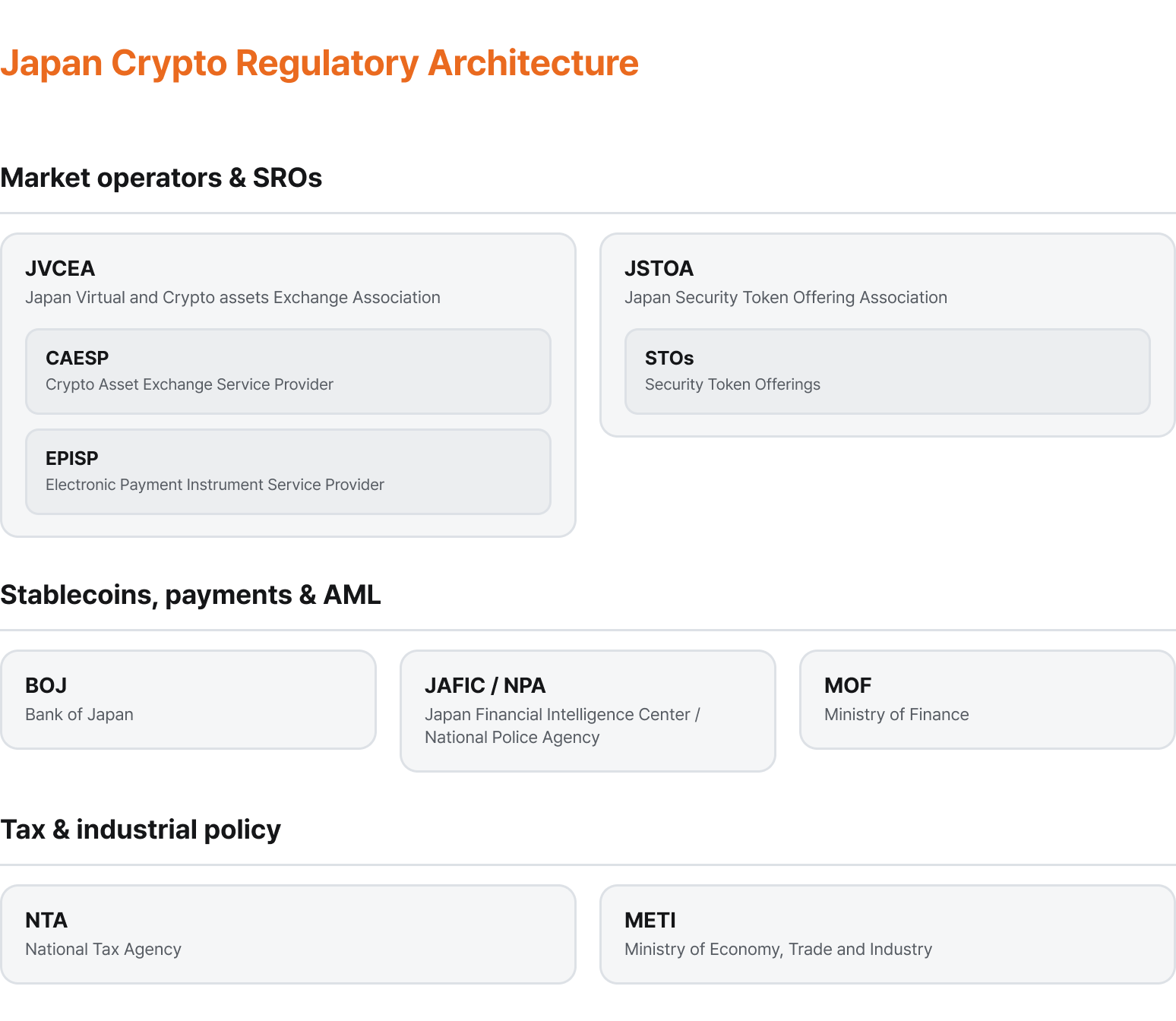
The market these bodies oversee has scaled quickly: active crypto users roughly doubled in three years to over 12 million (~12% of Japanese adults), with user deposits surpassing ¥5 trillion by early 2025.
Japan's crypto regulation involves a lot of bodies, but they sort into a few clear groups.
- Lead regulator: the Financial Services Agency (FSA), plus its market-conduct arm, the Securities and Exchange Surveillance Commission (SESC).
- Macro and anti-money-laundering bodies: the Bank of Japan (BOJ), the Ministry of Finance (MOF), the Ministry of Economy, Trade and Industry (METI), and the Japan Financial Intelligence Center (JAFIC), the financial intelligence unit (FIU) that sits under the National Police Agency (NPA).
- Industry self-regulators (SROs): the Japan Virtual Currency Exchange Association (JVCEA) and the Japan Security Token Offering Association (JSTOA).
Rather than cover each body on its own, it helps to group them by what they actually regulate.
1.1 Exchanges and Market Conduct
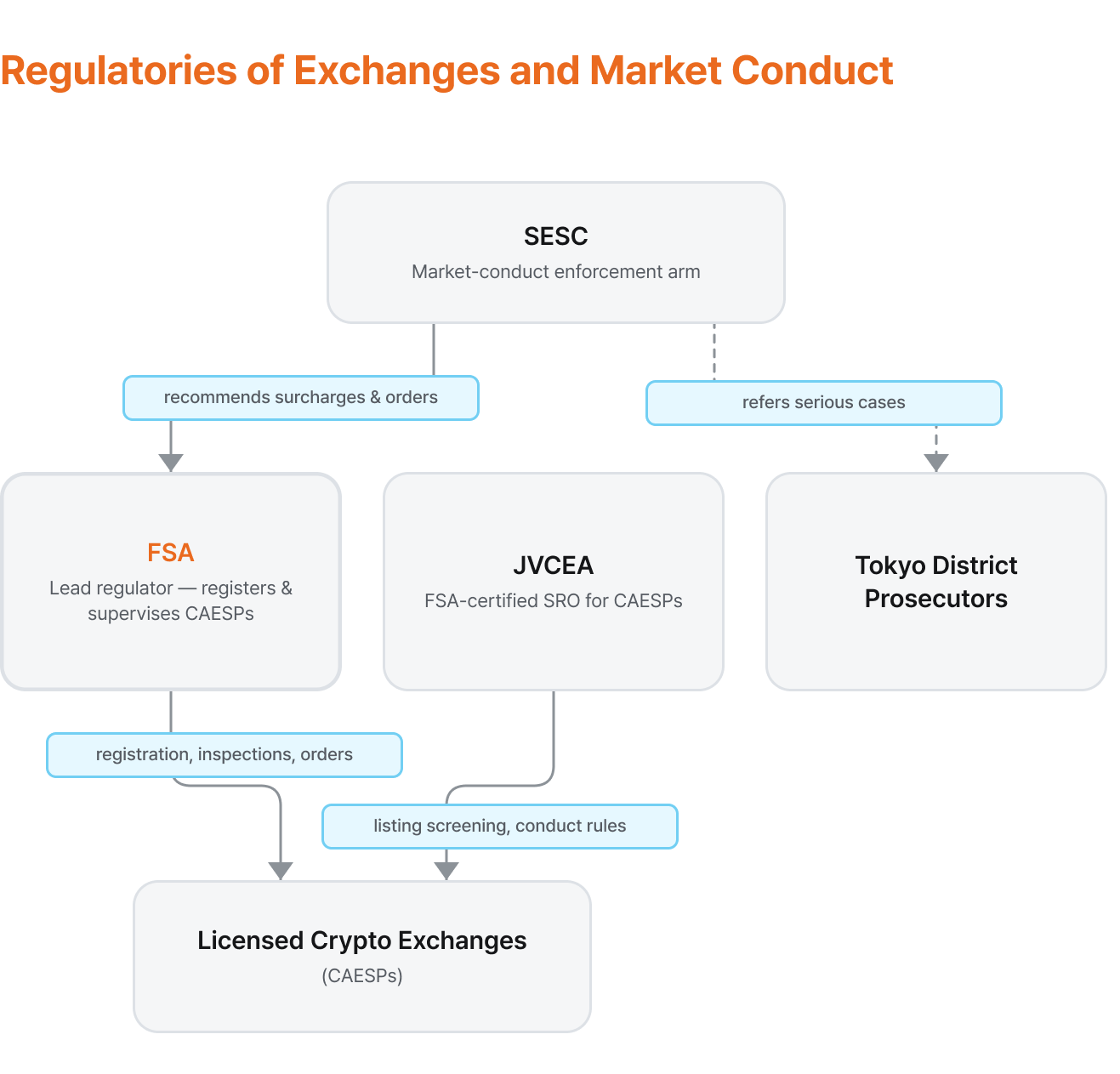
Three bodies oversee licensed crypto exchanges, and the bigger story is who is gaining power. In 2026, authority is shifting toward the FSA and away from the industry's self-regulators. It helps to start with what is being regulated, then take the three bodies in turn.
The regulated entity: CAESPs. A licensed Japanese crypto exchange is formally a Crypto-Asset Exchange Service Provider (CAESP), and any firm serving Japanese users must register with the FSA under the Payment Services Act. The bar is high: segregated custody, AML/CFT systems, Travel Rule compliance, and strong internal controls before opening, plus ongoing inspections and the risk of suspension or revocation.
- The FSA: who may operate. The FSA is the clear lead, and it vets firms heavily before they can operate, rather than punishing bad actors later (the US approach). The trade-off is simple: slower growth for fewer blow-ups. The payoff is that an FSA license actually means something to large investors, a quiet reason they treat Japan as safer than faster-moving markets.
- The SESC: how they behave. If the FSA decides who may operate, the SESC polices how they act, extending its equities-market toolkit to spot crypto for the first time in 2026. One quirk: it does not fine directly, but investigates, recommends penalties to the FSA, and refers serious cases to the Tokyo prosecutors. The upshot is that manipulation and insider trading on crypto exchanges now sit inside the same machinery that polices the stock market.
- JVCEA: the self-regulator. JVCEA is the FSA-certified self-regulatory body for CAESPs (licensed crypto exchanges) formed in 2018 after the Coincheck hack. The key point: it does not license exchanges that is the FSA's power but every CAESP joins it in practice. So the FSA grants the license, while JVCEA is the day-to-day gatekeeper and rule-writer underneath.
1.2 Stablecoins, Payments, and AML
Stablecoins fall under the same FSA but a separate licensing track: EPISP (Electronic Payment Instrument Service Provider) registration under the 2023 stablecoin regime. JVCEA has served as the FSA-certified organization for EPISPs since October 2024. Folding CAESP and EPISP self-regulation under one counterparty was deliberate, letting the FSA delegate operational-standards work to a single body.
The Bank of Japan is not a licensing regulator, but it shapes the environment through three channels: a multi-year CBDC pilot now in its third phase, macro commentary in the Financial System Report, and payment-system oversight via BOJ-Net. Its 2025 Financial System Report flagged stablecoin growth as a future watchpoint but stopped short of restrictive action. The signal is that the BOJ is tracking the megabank pilot and JPYC closely.
JAFIC (Japan Financial Intelligence Center), housed within the National Police Agency, is Japan's FIU. It receives suspicious transaction reports from CAESPs, EPISPs, and banks, publishes AML/CFT typologies, and represents Japan at FATF (the Financial Action Task Force). FATF gave Japan a substantially compliant rating on virtual-asset AML in its 2023 review, making AML one of the few areas already fully built-out and globally aligned. Finally, the Ministry of Finance enforces FEFTA (the Foreign Exchange and Foreign Trade Act) reporting on cross-border crypto transfers above threshold and co-drafts tax policy with the FSA.
The yen's footprint here is still tiny. Dollar-pegged tokens make up roughly 99% of global stablecoin supply, the gap Japan's EPISP regime and JPYC are designed to close.
1.3 Security Tokens and STOs
Tokenized securities sit on a third track, separate from spot crypto and stablecoins. These are security token offerings (STOs): digital representations of regulated financial products such as equity, bonds, and real-estate interests, issued under the FIEA rather than the PSA. Because they are securities from the outset, STOs have always carried full disclosure, suitability, and custody obligations, unlike spot crypto, which only acquired them with the 2026 reform. The relevant self-regulatory body is JSTOA.
The JSTOA is the FSA-certified self-regulatory organization for security-token offerings, established in 2019 as the STO market began to form. Its scope is narrower than JVCEA's: it covers only entities that issue, distribute, or trade tokenized securities under the FIEA Type-1 and Type-2 frameworks. Its membership reflects this, drawing primarily from the major securities houses such as Nomura, Daiwa, SBI, and Mitsubishi UFJ Morgan Stanley, plus a handful of specialized issuance platforms. In practice, JSTOA is the securities industry's counterpart to JVCEA's exchange-focused role.
JSTOA's toolkit mirrors JVCEA's but is tuned for securities. It writes member conduct rules for STO platforms, issues disclosure-handling guidance for issuers, sets investor-suitability standards for token offerings, and acts as the industry's liaison to the FSA on STO-specific questions. The body spent 2024-2025 refining offering-disclosure templates, which supported the growth of tokenized real estate (for example, Kenedix and Digital Securities) and tokenized corporate bonds (Daiwa, Nomura, and Mitsubishi UFJ pilots). Cumulative STO issuance approached several hundred billion yen by 2025, a small but fast-growing segment.
The FIEA reform now imposes disclosure obligations on the 105 whitelisted spot tokens that look much like the rules security tokens already follow, blurring the line between the two categories.
The base case is a clean division of labor: JVCEA leads rulemaking for spot tokens, JSTOA leads STO-specific issuance, and any overlap zones get resolved by issuer choice and platform structure. For issuers, the practical takeaway is that the STO and spot tracks are converging on disclosure, even as they keep separate gatekeepers.
2. Why 2026 Is the Pivotal Year
The 2026 regulatory overhaul is the central event of the year and the cause of nearly every downstream market shift. It is best read not as a single bill but as a package of seven interlocking reforms: FIEA reclassification, a tax shift, an insider-trading ban, a disclosure regime, new exchange obligations, SESC empowerment, and the LPS Act amendment.
All seven share one FSA drafting team and one policy logic. What sets 2026 apart is its simultaneity. Earlier waves (2017, 2019-2020, 2022-2023) tackled one or two issues at a time across multiple Diet sessions, while 2026 compresses tax, market-conduct, disclosure, and intermediary-licensing reforms into a single vehicle.
2.1 The Headline: Reclassification Under the FIEA
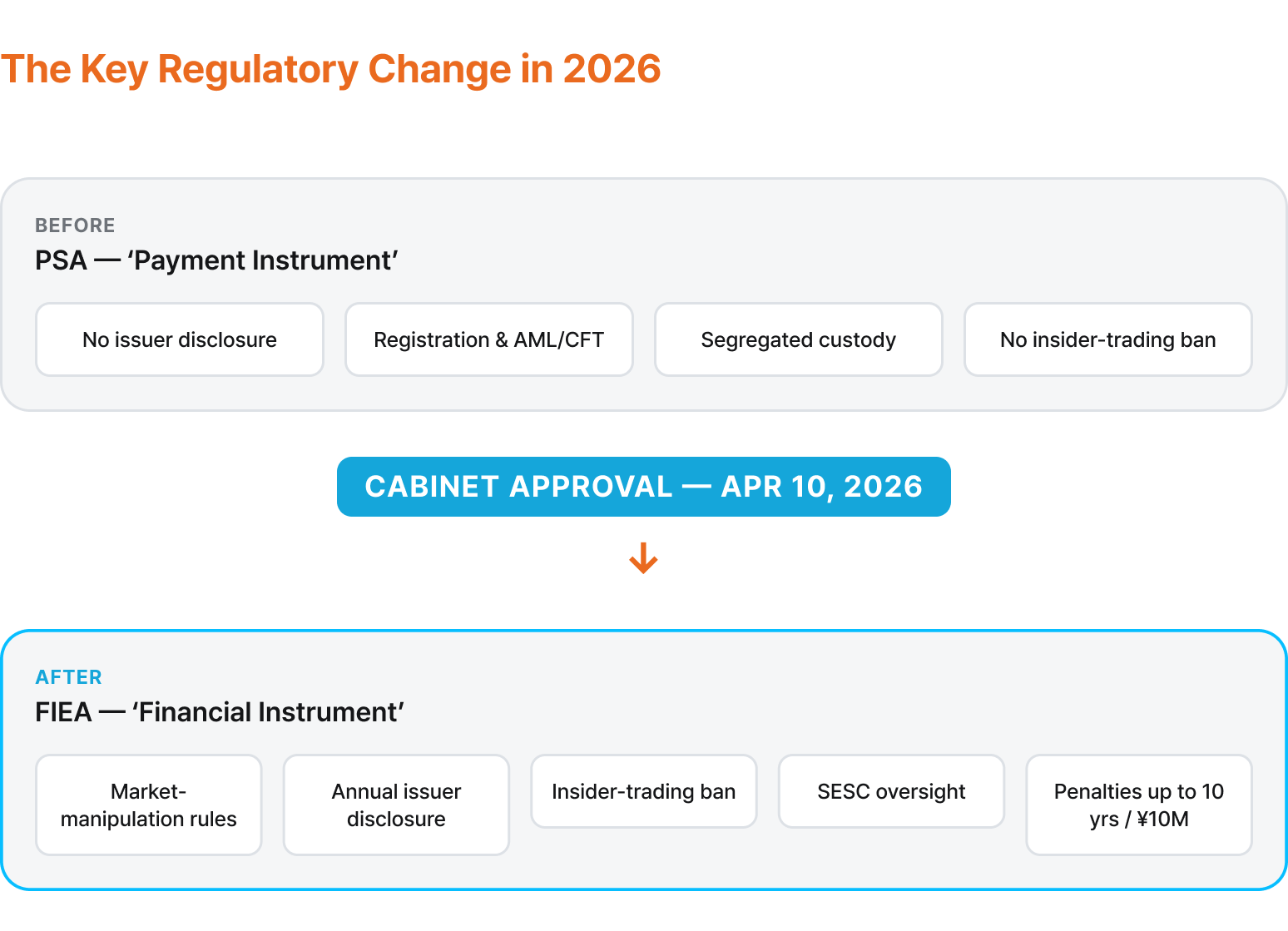
The headline reform reclassifies crypto-assets from "payment instruments" under the PSA to "financial instruments" under the FIEA. This is far more than a label change. Financial instruments carry a stack of obligations built up over 70 years of Japanese securities law: continuous issuer disclosure, market-manipulation bans, insider-trading rules, segregated custody, prospectus liability, and SESC oversight.
On April 10, 2026, the cabinet approved the amendment. It reclassifies 105 crypto-assets, including Bitcoin (BTC) and Ether (ETH), as financial instruments, bans insider trading on material non-public information, and requires annual disclosures from token issuers. It also raises unregistered-seller penalties to ten years' imprisonment and ¥10M fines, and amends the LPS Act so Japanese VC (venture capital) funds can hold crypto directly. The law could take effect in fiscal 2027.
For token issuers, the disclosure regime matters most. Issuers of approved tokens must publish annual reports on par with listed-equity issuers, covering financial position, token-supply mechanics, key personnel, material risks, and material changes. Failing to file, or filing false statements, triggers SESC referral and possible criminal liability.
For venture capital, the LPS Act amendment removes the barrier that pushed much of Japan's Web3 funding offshore through Singapore or Cayman feeders, so Japan-focused activity should meaningfully repatriate from 2027. Backing all of this is the penalty escalation: prison terms rising from three to ten years and fines from ¥3M to ¥10M.
2.2 The 105-Token Whitelist and SESC's New Powers
The FSA keeps a finite whitelist of tokens that qualify for both the FIEA disclosure regime and the 20% tax rate. It starts with 105 tokens, anchored by BTC and ETH and including the major large-cap L1s (layer-1 blockchains). Japan chose a list-based approach: only FSA-approved tokens get the favorable tax and disclosure treatment, which is cleaner to administer but more conservative and concentrates gatekeeping power in the FSA.
For investors, the reward for making the whitelist is tax treatment: gains on approved tokens move from miscellaneous income (taxed up to ~55%) to a flat 20.315% separate rate with a three-year loss carry-forward, matching listed equities.
Adding tokens shifts from the old JVCEA-led screening to a disclosure-filing process under FIEA. Issuers (or, for permissionless protocols, the listing exchange acting as sponsor) file a document describing economics, governance, and risk. The FSA's review focuses on investor protection rather than market-quality judgments, which should meaningfully expand the list over time.
Alongside the whitelist, the SESC gains its full traditional toolbox over crypto for the first time. That includes subpoenaing exchange trading records and on-chain data, recommending surcharge orders on illicit gains, referring serious matters for criminal prosecution, and bringing market-manipulation cases like those in listed equities.
The SESC's March 2026 Strategy & Policy 2026-2028 names crypto market surveillance as a priority. The same apparatus behind the 2024 Sigmago Co. manipulation case in ANYCOLOR shares now targets undisclosed token listings, listing-window pump-and-dumps, and material-event-driven positioning. Observers call the result potentially the most explicit insider-trading regime for crypto in any major jurisdiction.
2.3 The "Too Heavy-Handed" Debate
Licensed CAESPs face a much larger compliance perimeter from 2026-2027. The new duties stack on top of existing PSA conditions (segregated custody, AML/CFT, Travel Rule, JVCEA conduct rules) and bring exchanges closer to FIEA-registered financial-instruments operators. Five requirements are new or upgraded:
- A Cybersecurity Self-Assessment (CSSA) filed annually against an FSA reference framework;
- Liability reserves sized to user-asset balances, like securities-firm net-capital rules;
- Asset-retention orders carried over from the 2025 PSA amendment;
- Tighter Travel Rule compliance on outbound transfers;
- New insider-trading surveillance that flags suspicious patterns around material events.
The FSA itself admits that roughly 90% of Japanese exchanges operate at a loss under current compliance costs. Adding FIEA disclosure handling, CSSA assessments, liability reserves, and surveillance will squeeze margins further and speed up consolidation. Critics, including senior JVCEA members, warn this could leave Japan with a few survivor exchanges and less competitive pressure on listing standards.
The counter-argument is that Japan's 2017-2024 history shows lighter regimes do not actually drive more growth where consumer-protection norms are strong. The Coincheck, DMM Bitcoin, and offshore FTX losses borne by Japanese consumers far outweighed the cost of the FIEA framework now being imposed. On this view, the 2026 package is the price of a market that institutional capital will commit to at scale. Both sides have a point, and the test comes in 2027-2028 as CAESP consolidation and 105-list expansion either validate or undermine the FSA's calibration.
2.4 Open Questions and Timeline
The biggest unresolved question is DeFi, which fits the new framework awkwardly: FIEA targets issuers and registered intermediaries, and the FSA has signaled no immediate plan to regulate DeFi front-ends or smart-contract deployers. The practical result is a grey zone: DeFi is not banned, but it lacks the consumer-protection and tax clarity that 105-list spot trading enjoys.
The bull case rests on three catalysts: JPYC integration with major protocols creating native yen yield, Japanese asset managers wrapping DeFi exposure in regulated products, and tax guidance treating DeFi yield from 105-list positions as capital-gains-equivalent. None is certain by 2028, but together they would move Japanese DeFi from niche to a real product category.
Timing matters because each downstream shift, whether retail repatriation, ETF (exchange-traded fund) approval, or megabank stablecoin go-live, keys off specific milestones. The package runs on three tracks:
- Legislation (April to July 2026), the most predictable: such bills usually pass the Diet on schedule, the tax cut has broad support, and the LDP-Komeito coalition controls both chambers. Base case is enactment by mid-2026, effective FY2027.
- Implementation (H2 2026 to 2027), where execution risk concentrates, as the FSA drafts sub-rules on disclosure templates, insider-trading guidance, CSSA scoring, liability reserves, and listing procedures, each with a 30-day consultation. A 3-6 month slip into Q1 2027 would not surprise.
- Adjacent: the 20.315% separate-taxation effective date (January 1, 2028) and the FSA's targeted 2028 window for spot Bitcoin and Ether ETF approvals, both dependent on the FIEA package taking effect.
Part III. The Migration: Digital Money & Tokenization
1. Japan's Stablecoin Ecosystem
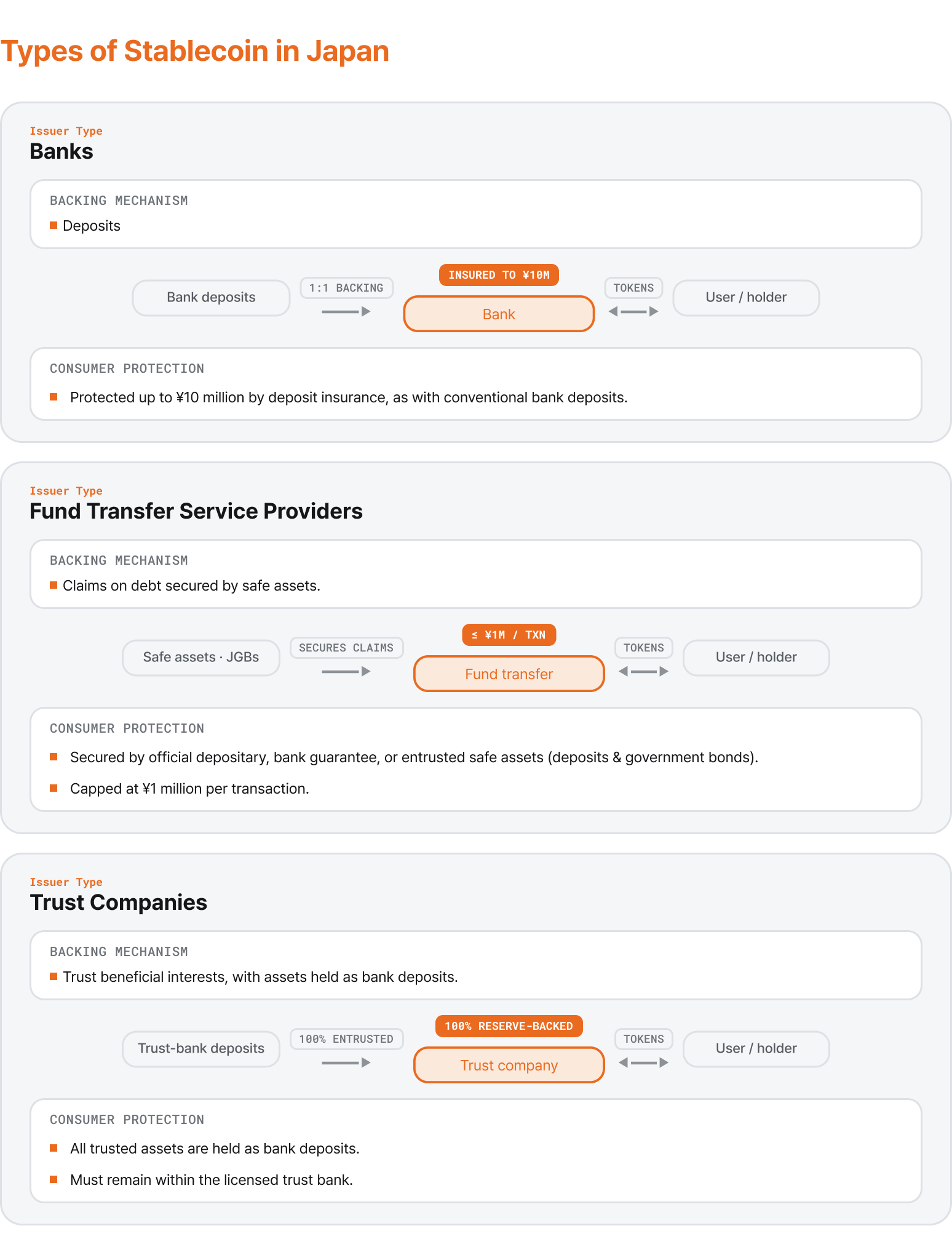
Japan's stablecoin story is the cleanest example of the country's regulatory philosophy. The approach is simple: legislate the framework first, let the industry build products against it, then approve issuers one at a time with the substantive review done upfront. Rather than treating stablecoins as ordinary crypto-assets, the framework carves out a distinct Electronic Payment Instrument (EPI) category under the PSA and deliberately separates two regulated roles:
- Issuers: restricted to three trusted entity types: licensed banks, trust companies, and registered fund-transfer (money-transfer) operators. Each must guarantee redemption at par and hold fully segregated, low-risk backing assets (so a Japanese stablecoin is closer to e-money than to an algorithmic token).
- Distributors (EPISPs): the exchanges and intermediaries that actually handle stablecoins for end users. The FSA certified the JVCEA as their self-regulatory body in 2024, unifying oversight of trading venues and stablecoin distribution under one organization.
The PSA amendment that created the EPI (Electronic Payment Instrument) category passed in 2022 and took effect in June 2023. That was a full two years before any issuer was ready to launch. JPYC's approval in August 2025 and registration in April 2026 are the first products of that pipeline. The megabank pilot is the second.
What sets Japan apart globally is the density of institutional participation. In the United States, the leading issuers like Circle and Tether are crypto native fintechs working against an evolving regulatory backdrop. In Europe, MiCA's electronic money token regime has produced a few new issuers but little participation from traditional finance.
Japan's first three credible issuer tracks tell a different story. They are JPYC, the MUFG, SMBC and Mizuho megabank pilot, and the SBI and Shinsei Trust JPYSC. These represent a fintech, three megabanks, and a trust bank consortium. No other major market has this breadth.
The 2023 EPI framework permits three domestic issuer structures: funds transfer, bank, and trust bank. It also allows a fourth distribution only route for approved foreign tokens. Each structure has different reserve and operational rules, yet the three domestic ones converge on the same end product. That product is a fully backed, redeemable, onchain yen token.
The rest of this section walks through each track in the order it launched.
1.1 The Funds Transfer Issuer, JPYC
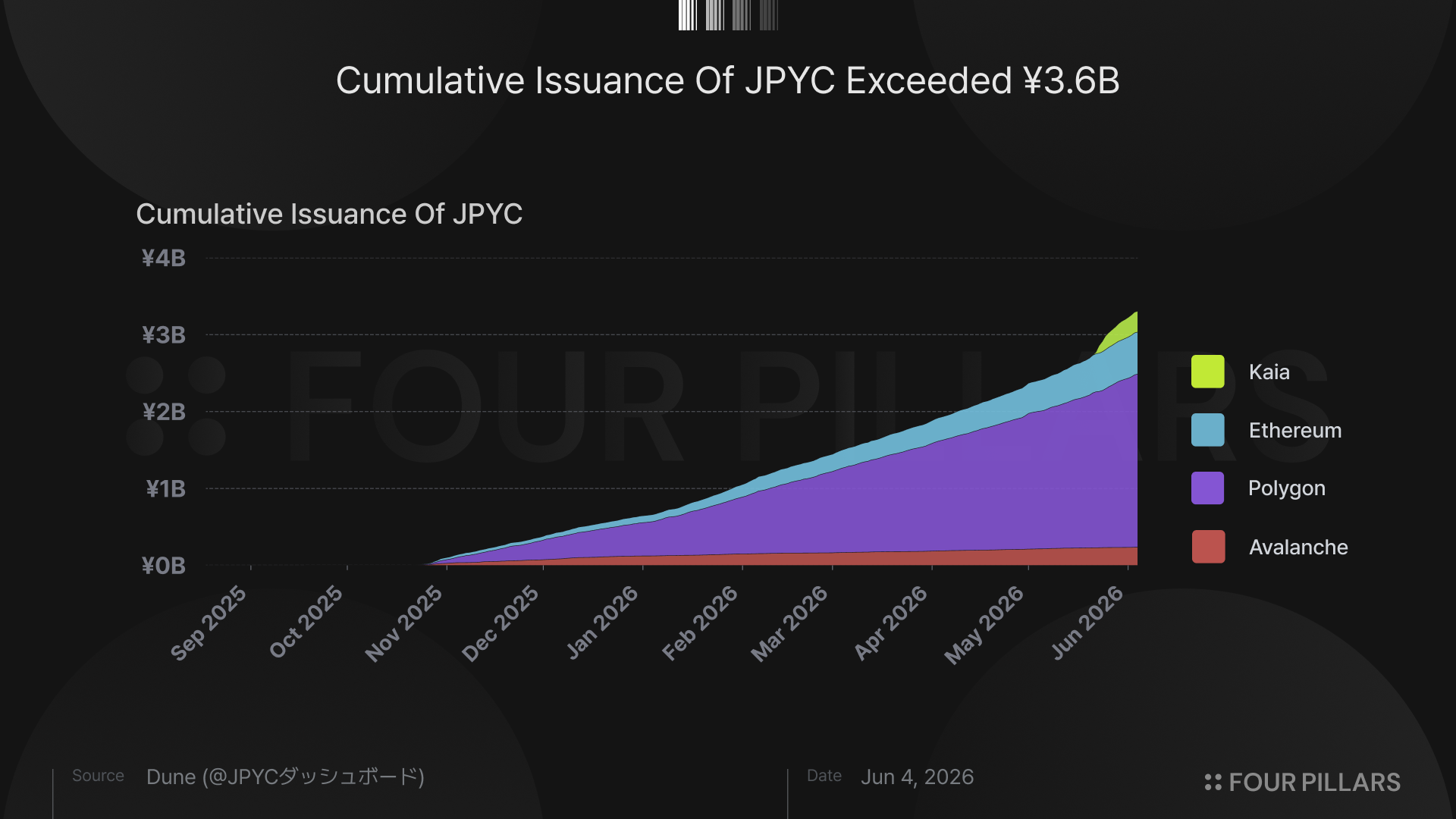
The funds transfer provider license is the lightest of the three domestic EPI structures. Issuers hold reserves fully in bank deposits and short dated JGBs, redeem tokens at par, and answer to the FSA under the PSA. Capital requirements and time to market are both lower than the bank or trust bank routes. The trade off is a cap on each transaction, which suits a fintech led yen stablecoin aimed at retail and small business users.
JPYC is the first product to come through this route. JPYC Inc., founded in 2019, ran a prepaid payment predecessor before the EPI framework existed, issuing roughly ¥30B and integrating with Visa prepaid, Gifty Box, and regional bank rails. That history gave it a credible operating record by the time the FSA opened EPI reviews. The FSA signaled approval in August 2025 and formally registered JPYC on April 28, 2026, making it Japan's first FSA approved yen stablecoin in commercial operation.
Distribution leans on Sony Bank, regional bank partners, and fintech wallets. The competitive position holds as long as the megabank track stays B2B only. A future retail megabank token would compress JPYC's runway in brand and distribution, but not its first mover hold on the fintech wallet layer.
1.2 The Megabank Issuers, and Project Pax
Source: Datachain
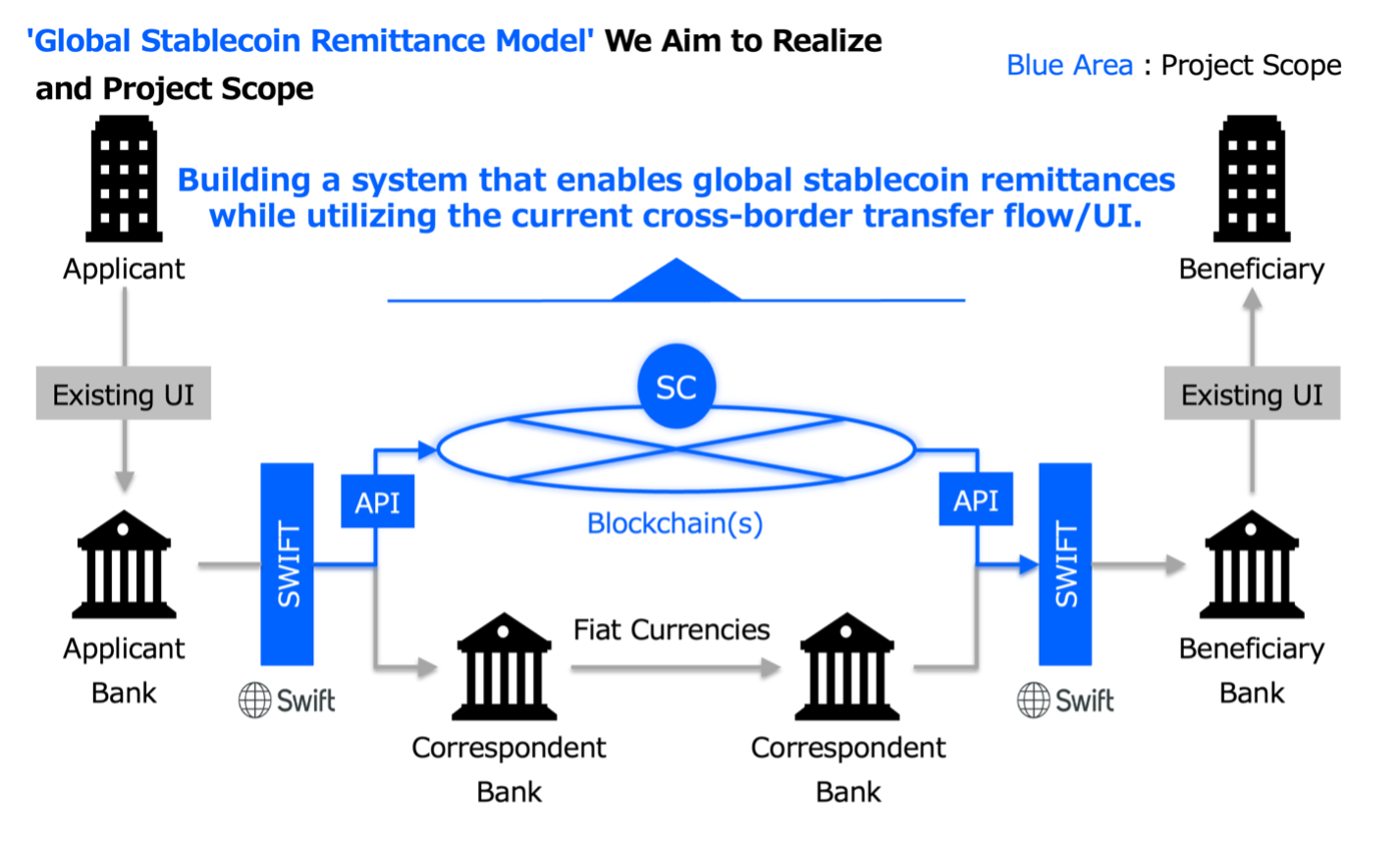
A bank issued EPI is a stablecoin minted directly off a licensed Japanese bank's balance sheet. It carries deposit equivalent legal treatment, and the bank's own prudential capital backs the token. This structure offers the highest trust profile and the largest per transaction ceiling of the EPI options, but it is operationally heavy. Only banks already running global correspondent networks can realistically stand one up, which is why the rail targets B2B and interbank settlement rather than retail.
Project Pax is the first concrete instance of this structure. It is led by MUFG, SMBC, and Mizuho, with technical work from Progmat (incubated by MUFG), Datachain, and TOKI, and the FSA backed it in November 2025. The design keeps SWIFT messaging on the corporate client front end while replacing correspondent bank settlement with onchain stablecoin transfers across Ethereum, Polygon, Avalanche, and Cosmos. This compresses settlement from days to minutes and removes multi hop FX.
The scope is structurally large. MUFG alone has more than 240 international subsidiaries, and SMBC and Mizuho run comparable networks. The first use cases are intra group flows such as dividends, intercompany transfers, and M&A consideration, with corporate trade finance as the natural extension.
1.3 The Trust Bank Issuer, and JPYSC by SBI
The Specified Trust Beneficiary Interest (Specified TBI) is a trust bank instrument. Reserves sit in a regulated trust, and the tokens represent beneficial interests in that trust. The 2022 PSA amendment deliberately carved Specified TBIs out of the FIEA "securities" definition, which avoids security token disclosure overhead while keeping trust grade segregation of customer assets.
The important architectural feature is that trust tokens can move across many banks and intermediaries rather than being tied to a single balance sheet. That is the right shape for an asset meant to settle trades between counterparties on tokenized securities and RWA platforms.
JPYSC is the first issuer to use this structure. It is issued through Shinsei Trust Bank inside the SBI and Startale consortium. JPYSC is built as the settlement asset for tokenized stocks, tokenized RWAs, and DeFi on the Strium Network, the L1 that SBI and Startale built for this purpose.
The competitive bet is vertical integration. SBI owns the stablecoin (JPYSC), the L1 (Strium), the exchange layer (SBI VC Trade plus the pending bitbank acquisition), and the STO venue (SBI Securities and ODX).
Capital commitment matches the ambition. Startale closed a $63M Series A from SBI Group and Sony Innovation Fund in early 2026. SBI then made a ¥8B (about $50M) direct investment in March 2026, a tokenization spend that exceeds any other single Japanese institution
1.4 Foreign Stablecoins, and USDC
The USDC story is the first practical test of whether the EPI framework can accommodate foreign issued stablecoins. USDC became the first foreign stablecoin approved for distribution in Japan when SBI VC Trade listed it on March 26, 2025. Binance Japan, bitbank, and bitFlyer were expected to follow in the months after.
The mechanism is a distributor model. An EPISP (Electronic Payment Instrument Service Provider) acts as the regulated Japanese intermediary instead of Circle distributing directly. Circle remains the foreign issuer, while the Japanese EPISP carries responsibility for AML and consumer protection compliance.
The January 2026 FSA rules on foreign trust type stablecoins then opened the door wider, but with strict collateral standards. The rules require that any foreign bonds used as reserves carry top tier credit ratings and come from issuers from country that has at least ¥100 trillion (about $650B) in outstanding debt. That threshold effectively limits eligible foreign bond reserves to top tier sovereigns such as US Treasuries, German Bunds, and JGBs. This bar is conservative even by global stablecoin standards.
The practical effect of the ¥100T debt threshold is to lock most issuers outside the US and Japan out of using non yen collateral at scale. A UK based GBP stablecoin would struggle to meet the threshold alone, and a Brazilian or Mexican stablecoin would be effectively excluded. The framework therefore favors dollar collateralized stablecoins such as USDC, and yen collateralized stablecoins such as JPYC, JPYSC, and the megabank tokens. It creates high barriers for everyone else.
The strategic reading is that Japan welcomes USDC and similar high grade foreign stablecoins but will not be a permissive harbor for weakly collateralized issuers. This fits the FSA's broader posture: low tolerance for rate arbitrage, a high bar on reserve quality, and a strong preference for transparent, supervisable counterparts.
1.5 Comparing the Four Issuers
The comparison table makes one point clear. Japan's stablecoin ecosystem is deliberately segmented by use case rather than competing for the same pie. JPYC owns retail and fintech distribution, the megabank pilot owns B2B cross border flows, SBI and Shinsei Trust own RWA and tokenized securities settlement, and USDC serves crypto trading and DeFi. Each issuer faces structural constraints in license type, reserve composition, and distribution channels that steer it toward its own niche.
The key uncertainty through 2026 to 2028 is whether the megabank pilot expands from B2B cross border flows into retail tokens, which would directly threaten JPYC's segment. Current statements from MUFG, SMBC, and Mizuho keep retail tokens out of scope. Still, the bank issued EPI structure technically permits it, and competition could push at least one megabank into retail issuance over time. JPYC's defense is to lock in fintech, regional bank, and Sony Bank distribution before any megabank retail entry arrives, a race against the clock that should play out visibly through 2027.
For an outside participant choosing where to integrate, the practical reading is simple. Use JPYC for consumer or fintech products, the megabank rail for institutional B2B settlement, the SBI and Startale stack for RWA and tokenized equity, and USDC for crypto trading. There is no single "Japanese stablecoin." There are four, each tuned for different needs, which is unusual globally and one of Japan's structural advantages.
2. Beyond Stablecoins: Tokenized Deposits and CBDC
Source: TOKENIZED DEPOSITS AND DCJPY -PART1- | デジタル通貨フォーラム
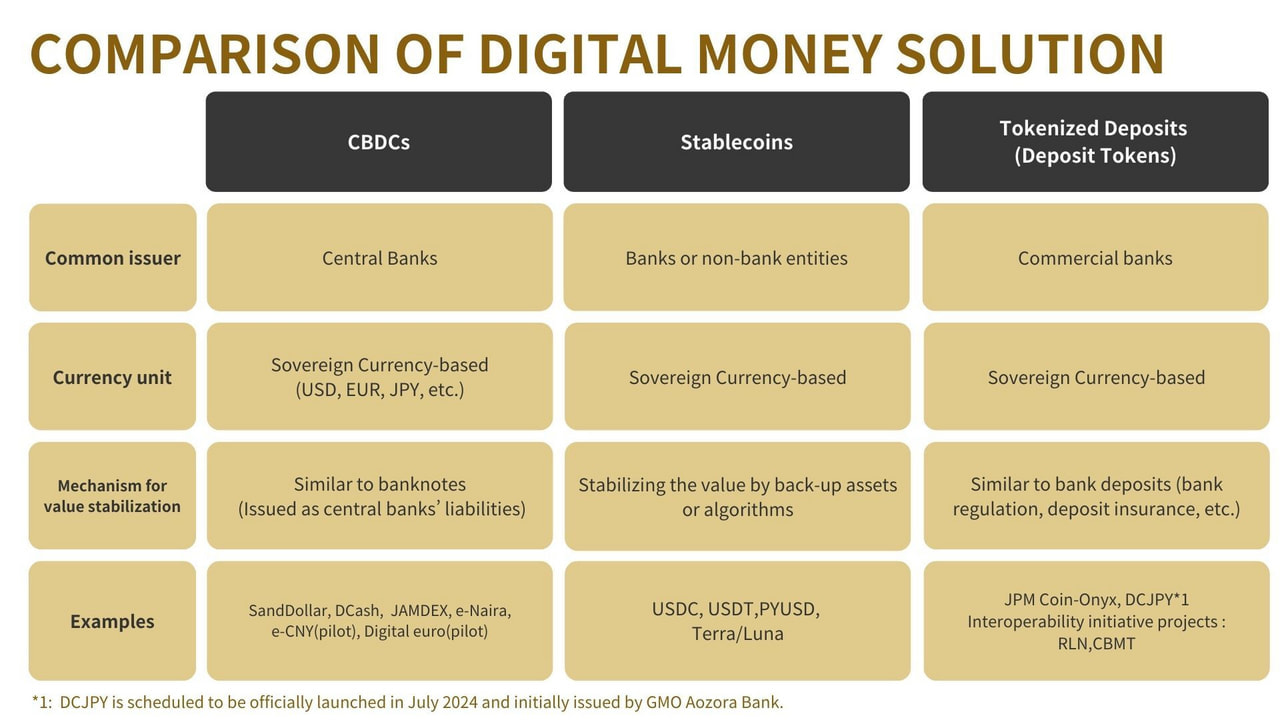
The section above covered the three EPI based stablecoin tracks, however, there are two more digital money structures that run alongside the EPI regime and matter for the institutional cross border story. These are tokenized bank deposits, the BOJ's CBDC based digital yen pilot. Each is a different type of digital money, with its own issuer, legal basis, and purpose.
2.1 Tokenized Bank Deposit and DCJPY
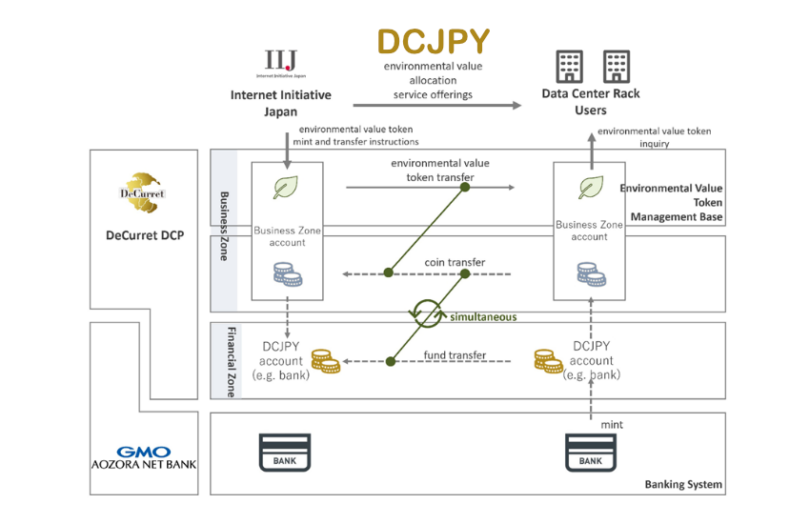
Tokenized bank deposit is a token that represents a direct claim on a regulated bank's deposit liability. It differs from an EPI stablecoin, which is a redeemable payment instrument issued against segregated reserves, and from a CBDC, which is central bank money. The defining feature is that the underlying asset is a commercial bank deposit. The token therefore carries that bank's credit and sits inside the banking system rather than alongside it.
DCJPY, DeCurret Holdings' digital yen deposit token, is Japan's tokenized bank deposit standard. It runs parallel to JPYC but rests on a very different legal structure. Where JPYC is a funds transfer EPI, DCJPY is a tokenized claim on a regulated Japanese bank's deposit liability, built as a Bank of Japan supervised deposit token rather than a PSA regulated EPI.
DCJPY is oriented toward B2B and institutional settlement. It is not available to retail and integrates directly with bank core systems through the DeCurret consortium, which includes Internet Initiative Japan, MUFG, SMBC, Mizuho, Resona, and several regional banks. It is designed for delivery versus payment settlement against tokenized securities. DCJPY has run in several SBI Securities DvP demonstrations for STO settlement, and it forms another Japan's digital money stack alongside JPYC for retail and the Project Pax bank tokens for cross border B2B.
2.2 The Bank of Japan's Digital Yen Phase 3 Pilot
The digital yen is a central bank digital currency (CBDC). It is digital money issued directly by the Bank of Japan as a liability of the central bank, not of a commercial bank like DCJPY or a private issuer like the EPI stablecoins. As sovereign money, it would be the risk free settlement asset at the base of the stack. That is why its design choices set the standard the private sector tokens build toward.
The Bank of Japan's digital yen pilot entered its Phase 3 across 2024 to 2026. The focus is technical integration with private sector payment systems, not retail issuance. The BOJ's repeated posture is that no decision has been made on retail CBDC issuance, and Phase 3 is technology readiness work rather than a launch program.
The pilot matters less for the digital yen itself and more for the standardization signal it sends to private stablecoin and deposit token issuers about acceptable architectures. The BOJ has publicly described JPYC, Project Pax, and JPYSC as private experiments that the central bank tracks but does not lead, so the two regimes are deliberately complementary.
If the digital yen ever launches commercially, an unlikely event before 2028, it would coexist with the EPI stack rather than replace it. That stance mirrors the ECB's digital euro approach and differs from China's e CNY, which is positioned to displace private payment alternatives.
3. The Great Onchain Migration: Tokenization
Tokenization is the issuance and trading of traditional financial assets on public blockchains. Between 2024 and 2026, Japan quietly assembled every layer of this market: the legal status of the asset, the chain it lives on, and the money that settles it. The asset side runs on the FIEA security-token framework, the settlement side on JPYSC and tokenized deposits, and the infrastructure side on both proprietary and shared chains.
Its distinctive edge comes from one quirk of securities law. The JASDEC carve-out removes the central securities depository from the security-token path and lets the ledger itself serve as the legal record of ownership. That single fact allows two opposite architectures to run in production at once: a proprietary stack where one group owns every layer (led by SBI), and a neutral utility jointly owned by competitors (led by Progmat and BOOSTRY). Both ultimately rest on a settlement-money floor that no firm can own.
The window from 2026 to 2028 is when these pieces turn from announcements into production. The SBI and Startale tokenized-stock platform targets a 2027 launch on the Strium Network, and tokenized-bond pilots from Daiwa, Nomura, and MUFG are moving from sandbox to limited production through 2026.
3.1 The JASDEC Carve-Out: Why Japan Can Build a Proprietary Stack
This is the crux, and it is a feature of Japanese market structure that is easy to miss. Under the FIEA, security tokens are treated as "electronically recorded transferable rights" (ERTRs), and crucially, they are not routed through JASDEC, Japan's central securities depository.
JASDEC is the only company in Japan providing comprehensive securities settlement infrastructure, government bonds aside, as a Central Securities Depository (CSD). For tokenized securities, the onchain token itself becomes the legal record of the right and its transfer.
To see why that matters, it helps to unpack what an ERTR actually is. The 2019 FIEA amendment, effective May 2020, created the category to capture tokenized securities.
The legal twist is classification. The underlying rights are normally low-liquidity "Type II" deemed securities, but once tokenized and freely transferable they are promoted to Type I Securities (the same high-disclosure bucket as listed shares and bonds ). It is precisely because a ledger makes them easy to distribute widely. Anyone offering or intermediating them must register as a Type I Financial Instruments Business Operator, and ERTRs are explicitly carved out of the "crypto asset" definition under the Payment Services Act, placing them cleanly under securities law rather than the crypto regime.
Two nuances are worth keeping straight.
- The carve-out applies to the record and transfer layer, not to securities regulation as a whole. ERTRs still carry full Type I disclosure and licensing, arguably heavier than the Type II treatment the underlying rights would otherwise receive, so the deregulation is structural rather than lighter-touch
- Only the securities record escapes JASDEC; the cash settlement leg still runs through shared utilities such as BOJ-NET and tokenized deposits
When SBI issued its ¥10B "SBI START Bonds" in March 2026, they were recorded on the ibet for Fin blockchain instead of the conventional JASDEC system, fully electronic from issuance through redemption.
This is the structural fact that makes a proprietary stack legally possible. The law leaves the transfer-agent and CSD function to the ledger rather than vesting it in one mandated utility, so a private group like SBI can own that function end to end.
3.2 The Proprietary Stack: What Vertical Integration Really Means
With the ledger itself acting as the system of record, one corporate group can own every layer of the tokenization chain at once: the asset issuer, the settlement asset, the blockchain, the brokerage, and the trading venue.
In the Western model each of these usually sits in a separate, often jointly owned, institution. The SBI and Startale partnership, announced in August 2025, is Asia's clearest attempt to own all of them in an all-in-one onchain venue for tokenized stocks and RWAs built on the Strium Network. Strium is SBI's purpose-built L1, bundling tokenized equity trading, JPYSC settlement, DeFi composability, and bridges to Ethereum.
Stacked together, a single group touches the entire chain. That concentration is both the whole point and the whole controversy.
3.3 The Neutral Utility Model: Progmat and BOOSTRY
The second architecture is the neutral utility model, and it is arguably the more consequential of the two. Where the proprietary stack concentrates ownership in one group, this model deliberately mutualizes it across rivals.
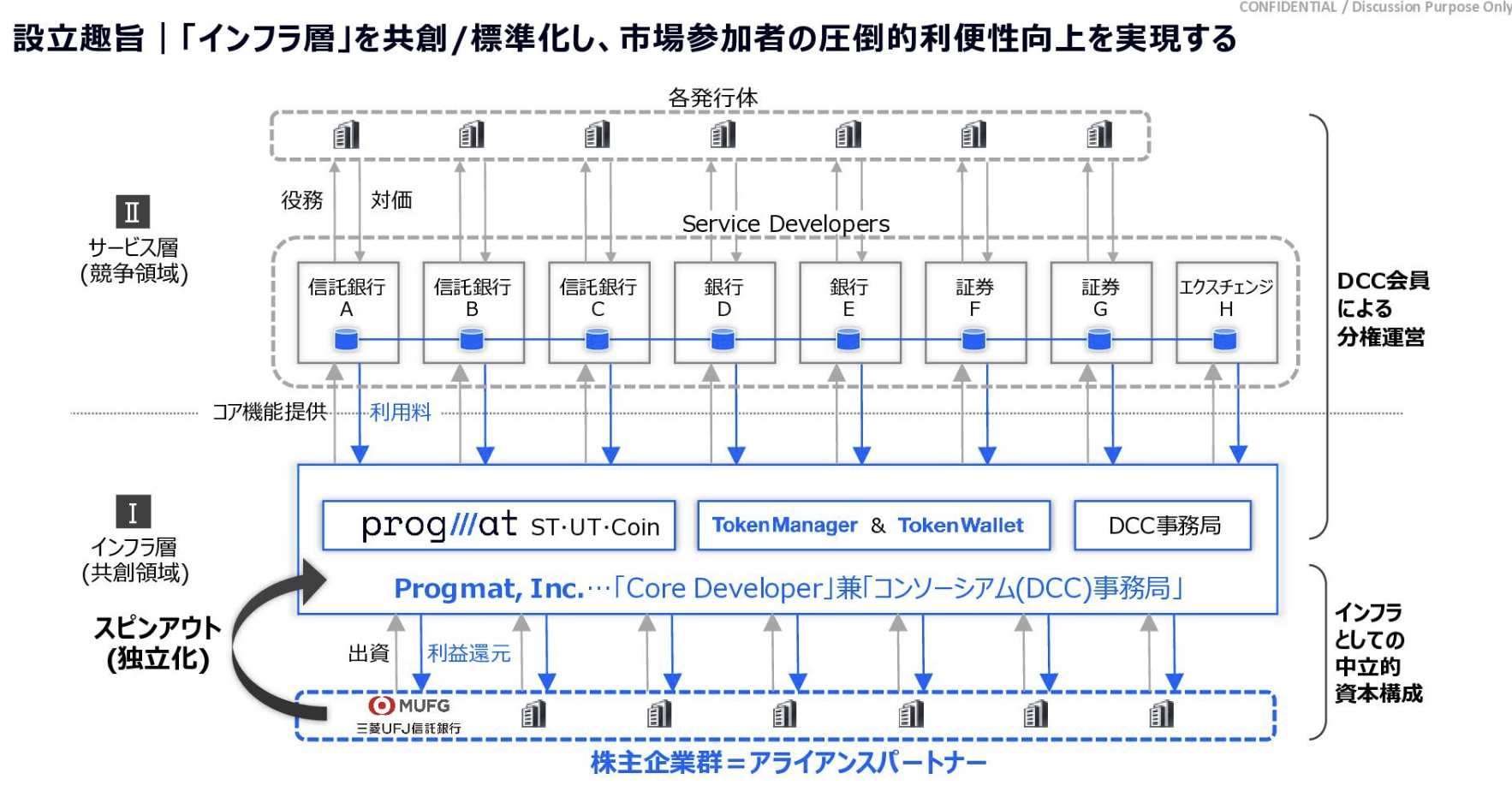
The closest Japanese one is Progmat, which MUFG deliberately spun out as a neutral national infrastructure entity rather than a trust bank subsidiary. The whole intent was for competitors to jointly own it and build on it. Its cap table reads like a mutualized market utility. Mitsubishi UFJ Trust holds 49%, NTT Data 13.5%, while Mizuho Trust, SMBC Trust, and SMFG hold 7.5% each. Also, both SBI and JPX, the Tokyo Stock Exchange operator, hold 5% each, alongside Datachain.
In early 2026 Progmat migrated more than $2B of tokenized real estate and bonds onto a dedicated Avalanche L1 with cross chain DvP. Nomura's BOOSTRY, operator of the ibet for Fin chain, is the second neutral platform and leads public STO issuance. ODX's "START" PTS, Japan's first ST secondary market, is owned by SBI at 70%, SMBC at 20%, and Nomura and Daiwa at 5% each
Source: About Us|【Progmat】デジタルアセットプラットフォーム
3.4 The Tokenized Asset Universe Widens
Source: BOOSTRY / Nomura, Japan Security Token Market Report (FY2025).
With the asset, chain, and settlement layers now in place, the question becomes what is actually being tokenized. The clearest way to read the market today is asset class by asset class, ranked by how much has genuinely been issued.
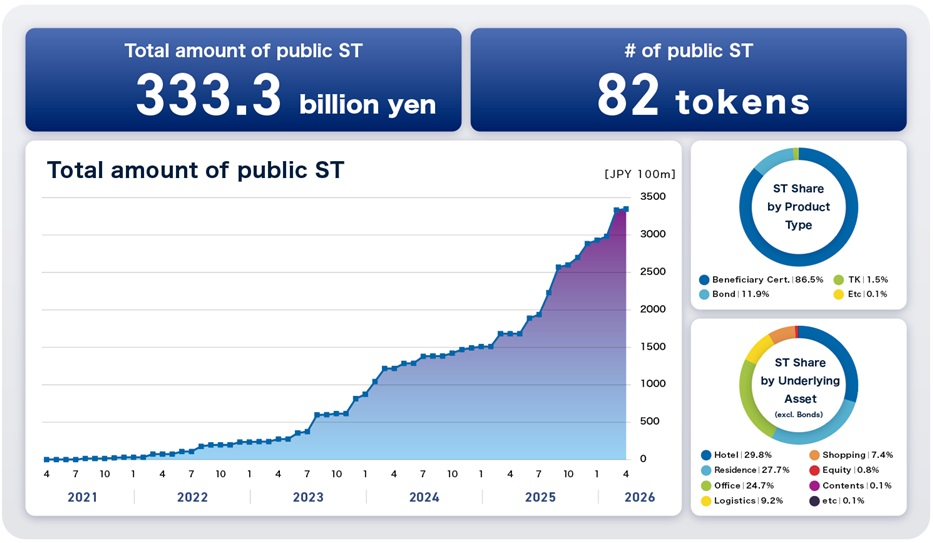
Security Token Offerings under the FIEA have been a slow burn since the first issuance in 2020, when SBI e-Sports registered the first FIEA STO. But 2025 marked the inflection: ¥165B of new issuance lifted the cumulative total to ¥333.3B across 82 tokens, roughly double the prior year.
That growth is highly concentrated. Real estate is about 85% of all issuance, corporate bonds are a distant second, and everything else is still at pilot scale. The walkthrough below takes each asset class in order of current size, then sizes the longer-term opportunity.
3.4.1 Real estate: the anchor (¥140.8B in 2025)
Tokenized real estate is the only segment operating at real scale, and it accounts for the overwhelming majority of Japanese issuance.
The segment has been led by Digital Securities, an SBI affiliated issuer, alongside Kenedix, which ran Japan's first real estate STO in August 2021 and has since issued roughly ¥250B across sixteen offerings. Both issue tokenized fractional ownership in Japanese commercial real estate.
The mechanism works because tokenization lowers the minimum ticket on otherwise illiquid property, opening institutional-grade real estate to retail buyers. SBI took a 20% stake in Digital Securities in early 2026, signaling its intent to consolidate the segment and fold tokenized real estate into the broader Strium ecosystem.
3.4.2 Corporate bonds: the fast follower (¥20.4B in 2025)
The tokenized bond segment is an order of magnitude smaller than real estate but growing quickly, and it carries the deepest institutional backing.
Pilots have come from all three of Japan's leading securities firms. Daiwa partnered with MUFG's Progmat for tokenized bonds in 2023, Nomura's Komainu custody arm supports institutional digital-asset settlement, and MUFG issued its first publicly offered security token bond via Progmat in late 2025.
SBI's ¥10B "SBI START Bonds" in March 2026 pushed retail tokenized bonds into production. The segment should inflect once FIEA's expanded tokenization framework comes fully online in 2027 and 2028.
3.4.3 Private equity and fund interests: early pilots (¥2.4B in 2025)
Tokenized private equity and collective investment scheme interests remain at pilot scale, but they map naturally onto the ERTR structure, which was written around trust beneficial interests and fund interests.
This is the segment most likely to benefit as the security-token framework matures, since tokenization directly solves the transfer and record-keeping friction that has historically kept these assets illiquid.
3.4.4 REITs and other assets: the next frontier (¥1.4B in 2025)
Tokenized REITs, the onchain equivalent of J REITs, have not yet launched but are expected to follow once the regulatory framework matures.
Together with other niche real-estate structures, they represent the widening edge of the universe. What arrives in 2027 and 2028 is a tokenized asset universe rather than a single product line.
3.4.5 The opportunity
The total addressable market for tokenization is enormous even on conservative estimates. BCG and Ripple's 2025 joint research projects a $18.9T global tokenized asset market by 2033, with Asia expected to account for a meaningful share of growth.
Japan's ability to capture a large share of that growth rests on the regulatory and infrastructure foundation now in place, and the real test will be the pace of issuance and trading volume through 2027 and 2028.
Part IV: The Outlook
The most consequential single variable for the overall outlook is the FIEA package's effective date. Slippage by 6 months pushes every other catalyst back by a similar amount, while acceleration would compress the entire downstream timeline. This makes monitoring the FSA's sub-rule consultation pace through H2 2026 the single highest-leverage activity for any participant tracking the thesis.
The tactical calendar of catalysts and dates worth monitoring through 2027 includes the following events. Each represents either a regulatory milestone, a corporate execution milestone, or a market-flow inflection. Tracking these in sequence provides early signals on whether the bear, base, or bull scenario is materializing.
- First, the Diet session running through June 2026 is the immediate hurdle for the FIEA amendment. The bill's progress through the financial-services committee, opposition-party engagement, and any amendments adopted will signal political support and execution pace.
- Second, the FSA sub-rule consultation track through H2 2026 is where execution risk concentrates. The FSA is expected to publish draft sub-rules covering disclosure templates, insider-trading guidance, CSSA scoring methodology, liability-reserve calibration, and listing-application procedures. Each draft is followed by a 30-day public consultation; tracking the publication schedule and the breadth of industry response provides early signals on FIEA effective date.
- Third, the JPYC commercial scale-up during 2026-2027 is the most observable stablecoin metric. Watch for partnership announcements with regional banks, Sony Bank integration, and B2B corporate-treasury pilots.
- Fourth, the Project Pax production launch target of 2027 is the megabank execution test. Watch for the MUFG/SMBC/Mizuho joint statement transitioning Pax from pilot to limited-production B2B settlement, the first published transaction volumes, and the SWIFT-integration milestones. Pax production launch is highly correlated with broader institutional adoption of yen stablecoin rails.
- Fifth, the Strium Network mainnet launch in 2026-2027 is the tokenization-infrastructure test. Watch for testnet-to-mainnet transition, validator set launch, the first tokenized-stock issuance, and JPYSC integration.
- Sixth, the 2028 spot BTC ETF approval window is the largest single flow catalyst on the horizon. The FSA has signaled intent but not committed to specific approval timing; watch for FSA consultation papers on spot crypto ETF frameworks in 2027, applications from major Japanese asset managers (Nomura, Daiwa, SBI Securities), and any public commentary on timing from FSA leadership.
Step back and the parts tell one story. Japan is not chasing fastest or freest. It is patiently building the most trustworthy crypto market.
So the likeliest outcome is not a boom but a quiet settling into normal. Money comes home, institutions invest properly for the first time, leaner exchanges turn a profit, and tokenization grows into everyday infrastructure. Looking back, 2026 may be remembered not as the year crypto arrived in Japan, but as the year it became part of the plumbing.
The author of this report may have personal holdings or financial interests in assets or tokens discussed herein. However, the author affirms that no transactions have conducted using material non-public information obtained in the course of research or drafting. This report is intended solely for general information purposes and does not constitute legal, business, investment, or tax advice. It should not be used as a basis for making any investment decisions or as guidance for accounting, legal, or tax matters. Any references to specific assets or securities are made for informational purposes only and should not be construed as an offer, solicitation, or recommendation to invest. The opinions expressed herein are those of the author and may not reflect the views of any affiliated institutions, organizations, or individuals. The opinions and analyses expressed herein are subject to change without prior notice. In addition, beyond the individual disclosures included in each report, Four Pillars, may hold existing or prospective investments in some of the assets or protocols discussed herein. Furthermore, FP Validated, a division of Four Pillars, may already be operating as a node in certain networks or protocols discussed herein or may do so in the future. Please see below links in the footer for FP Validated's participating network disclosures and for broader disclosure details.


