

![Onchain Vaults Head to the Regulator's Desk [FP Weekly 31]](/_next/image?url=https%3A%2F%2Fkrotgrfjzckvumudxopj.supabase.co%2Fstorage%2Fv1%2Fobject%2Fpublic%2Fassets%2Fimg%2Fcontent%2Farticle%2Fnotion-import%2Fewmxa9ms2zo6jb.png&w=3840&q=75)
Table of Contents
- 1. Major News
- [Asia] Bank of Korea Prepares Phase 2 of Deposit Token Commercialization Trial with Nine Banks
- [Institution] SEC Commissioner Peirce Warns "Onchain Vaults May Be Securities Depending on Structure"
- Others
- 2. Data Spotlight
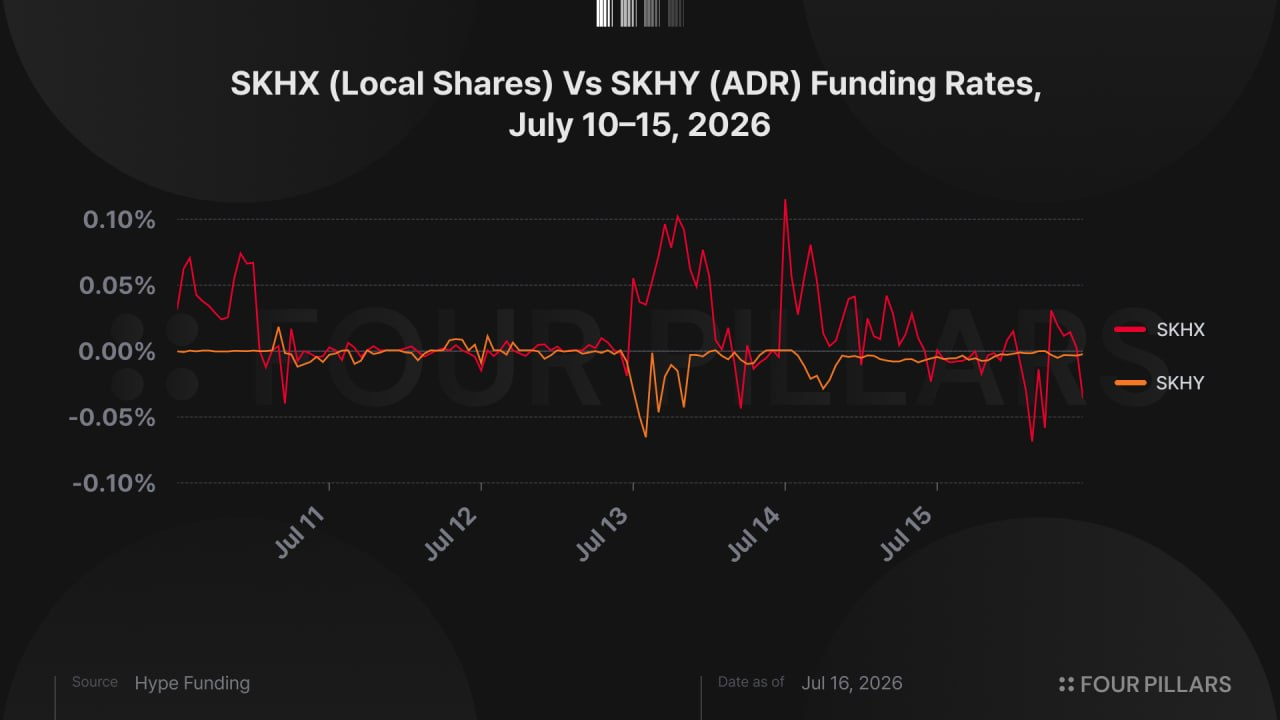
- SKHX & SKHY: Trading the Premium on HIP-3 (Link)
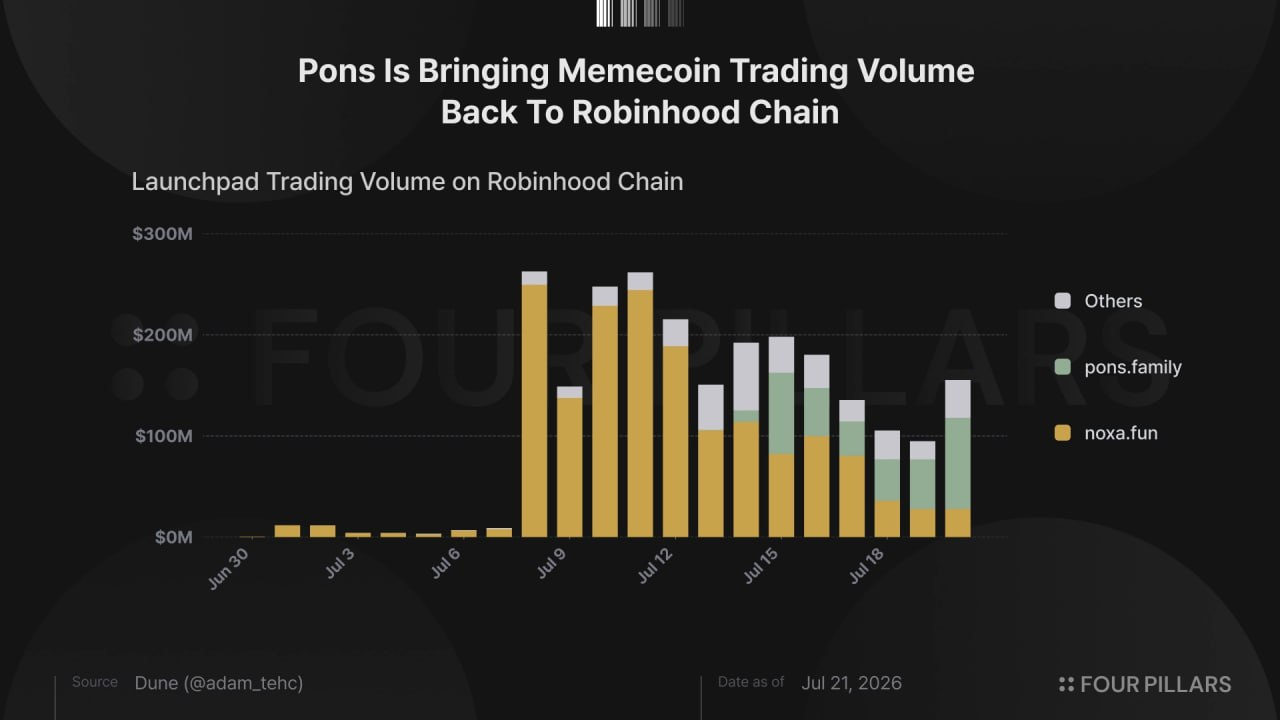
- Noxa’s Failure Marks a New Beginning for Robinhood Chain (Link)
- 3. Four Pillars Weekly
- : : The Tale of the Tail in the Korea CEX (Link)
- : : Japan Crypto Market 2026 (Link)
- : : Three Layers to Understand the Japan Crypto Market (Link)
- : : Securitize, Inc. (SECZ) — Initiating Coverage (Link)
- : : Japan Crypto Market Report, Q2 2026: When Market Sentiment and Regulation Diverged (Link)
- : : Monthly EIP - Jun 2026 (ft. Ethereum at a Multipolar Turning Point) (Link)
- Comments
- 4. Macro & Onchain Metrics
Researcher

1. Major News
[Asia] Bank of Korea Prepares Phase 2 of Deposit Token Commercialization Trial with Nine Banks
What Happened?
The Bank of Korea and nine domestic banks will begin Phase 2 of Project Hangang's live deposit token trial as early as this September. Project Hangang is an initiative that tests a structure in which the Bank of Korea provides blockchain-based wholesale CBDC infrastructure and commercial banks tokenize customer deposits on top of it to use in payments. Unlike a retail CBDC model where ordinary users hold the CBDC directly, the Bank of Korea's wholesale CBDC serves as the final settlement asset between financial institutions, while users transact with deposit tokens issued by their own bank.
In Phase 1, conducted from April to June 2025, 114,880 deposit token payments were made through about 81,000 electronic wallets. The focus was on checking whether basic systems worked, including issuance and redemption, wallet creation, and payments at designated merchants.
In Phase 2, Kyongnam Bank and iM Bank newly join, bringing the number of participating banks to nine alongside the existing KB Kookmin, Shinhan, Hana, Woori, NH Nonghyup, IBK, and Busan Bank. Issuable wallets expand from up to 100,000 to 500,000, and the holding limit per wallet rises from a cumulative 5 million won to a cumulative 100 million won. On top of existing payments, person-to-person transfers and transfers between corporate wallets are added, along with commercial features such as biometric authentication, automatic conversion of account balances into deposit tokens, non-face-to-face wallet opening for businesses, and cash receipt issuance. If Phase 1 was a three-month limited pilot, Phase 2 runs within the regulatory sandbox designation period without a set end date.
Government fiscal execution also enters the scope of the trial. The Ministry of Climate, Energy and Environment is reviewing a plan to pay part of the electric vehicle charging facility subsidy in deposit tokens, along with a pilot to execute public institution operating expenses in deposit tokens. The idea is to set the permitted use and expiration on the deposit tokens in advance to prevent off-purpose use and fraudulent claims. The government plans to later pursue the issuance and settlement proof-of-concept for tokenized government bonds linked to the wholesale CBDC.
Researcher's Comment
Phase 2 of Project Hangang shows that deposit tokens have moved beyond technical validation into the commercial stage. The basis for adopting deposit tokens comes from trust in their institutional foundation. Because they are a claim on bank deposits, the issuer and the redemption are clear, interbank settlement is completed with the wholesale CBDC, and they are also well suited to attaching programmable functions to funds whose use must be restricted, such as government subsidies.
That Phase 2 sets the pilot for executing 110 trillion won in government funds as a main task is also a choice mindful of this strength. In Korea, where simple payments are already highly advanced, retail convenience alone cannot generate adoption, and public finance, where the benefit of conditional payments and usage tracking is clear, is a realistic starting point.
However, the same institutional foundation also defines the limits. The number of participating banks, wallets, and holding limits open only within the range set by the authorities, and the range of movement is confined to the domestic banking network. Above all, deposit tokens are closer to a payment infrastructure improvement that moves existing deposits into token form, and they do not lead directly to a new revenue source or an expansion of the deposit-loan margin. This is why Korean commercial banks find it hard to have a strong incentive to issue, and it is also where the mood comes from in which the banking sector accepts deposit tokens as a policy demonstration led by the Bank of Korea rather than as a business opportunity.
Accordingly, the space for external liquidity connection and revenue business that deposit tokens leave empty is one that fintechs and commercial banks are moving to fill directly. In fact, Circle's entry into Korea became visible the same week. On July 23, Circle signed memorandums of understanding with Kakao Group, Viva Republica (the operator of Toss), and Toss Bank to explore a won stablecoin and payment infrastructure. Following its April partnerships with Upbit and Bithumb, it has now secured the country's largest messenger and largest internet bank.
Of course, the full launch of the won stablecoin business hinges on the Digital Asset Basic Act (DABA), and detailed provisions such as the issuer eligibility requirement remain key points of contention. The Bank of Korea holds that only a consortium in which banks hold at least a 51% stake should be able to issue, while the Financial Services Commission counters that this requirement blocks fintech participation. If the 51% rule is formalized, the won stablecoin also comes close to a quasi-deposit token effectively operated by a bank consortium. Conversely, under the FSC model, an open market led by platforms such as Kakao and Toss opens up.
Even so, the likelihood that Korea follows a single track converging on one digital won, as China or India do, is low, and it appears headed toward forming a differentiated market. Deposit tokens and the wholesale CBDC settle into areas where regulatory trust matters, such as interbank settlement, government fund execution, and tokenized government bond settlement. Conversely, the won stablecoin is likely to be used in crypto trading, overseas remittances, onchain payments, and some retail payments, where cost efficiency and interoperability matter.
[Institution] SEC Commissioner Peirce Warns "Onchain Vaults May Be Securities Depending on Structure"
What Happened?
On July 22, U.S. Securities and Exchange Commission (SEC) Commissioner Hester Peirce issued a statement that DeFi vaults and onchain lending strategies may fall under federal securities laws depending on how they are designed. Although it is a commissioner's personal position rather than an SEC rule or an enforcement decision, it drew significant attention in that it directly rebutted the notion that being onchain alone places something outside securities laws. Because Peirce leads the Crypto Task Force and has been regarded as friendly to the industry, this warning carried added weight.
Vaults pool user assets through smart contracts and allocate them to yield-generating activities such as staking and lending. Peirce explained that a vault is not a single structure. The spectrum is wide, ranging from a form where a smart contract automatically allocates by set rules to a form where a specific individual or group decides investment targets and weights at their discretion. The criterion that separates regulation is where the discretion sits on that spectrum.
Peirce said that if there is a party that selects yield activities, reallocates assets, or appoints a curator to make those decisions, the application of securities laws must be examined. If users expect profit from the managerial efforts of the vault deployer or curator, a vault interest may be interpreted as an investment contract, and if a vault holds or invests in securities, it may be interpreted as subject to investment company regulation. The operator's role in setting interest rates, loan-to-value ratios (LTV), and liquidation thresholds in onchain lending is subject to the same examination.
As of the time of the statement, the vault market holds about $8.6B across 788 curated vaults, with users reaching about 1.4 million. Vaults are also used beyond DeFi as a channel through which Coinbase and Robinhood attach yield to stablecoin balances. Right after the statement, the MORPHO token of the representative vault protocol Morpho fell about 7% at one point before recovering. The independent vault curator Steakhouse Financial said it would take part in the regulatory discussion, presenting an independently verified onchain net asset value (NAV), automated and transparent strategies, and strict non-custody as its design standards.
Researcher's Comment
The core of the statement is that a vault is not separated from securities regulation merely by the fact that it operates onchain in a non-custodial form. This is the same context as the standard the SEC has repeated regarding staking, securities tokenization, and token issuance. The principle is that what separates regulation is not the technical form but the economic function. Who selects the investment targets and changes the risk standards, and whose judgment the user trusts in handing over assets, become the classification criteria.
Specifically, the point Peirce takes issue with is that even if a smart contract holds the assets and users can withdraw at any time, if an identifiable curator selects markets, reallocates assets, and adjusts risk parameters, that role can come closer to an asset manager or an investment adviser. The more users deposit assets by trusting the curator's expertise and judgment rather than the rules set in the code, the stronger this interpretation becomes.
At Aave, risk management firms such as Gauntlet proposed parameter adjustments and governance adopted them by vote. In Morpho Vaults, by contrast, the curator exercises more direct authority over market selection and asset allocation. The problem awareness read from this statement is that the investment judgment that a traditional finance asset manager performed has merely shifted to the onchain curator, while the economic function may not be much different.
In response, the approach Steakhouse presents is one that seeks to prove regulatory compliance through code rather than the operator's promise. An independently verified onchain NAV, pre-disclosed permitted assets and allocation standards, an enforced time delay when strategies change, and a non-custodial structure that cannot block withdrawals bind the curator's discretion to a measurable range. The intent is to make users directly verify the parameters recorded in the code instead of trusting the operator.
However, design alone does not remove the possibility that securities laws apply. If a curator designs the initial strategy and selects markets, the economic judgment still comes from a specific party even when execution is automated. Transparency and non-custody are devices that make the operator's authority and asset flows easier to verify, but they are not an exemption that denies whether something is an investment contract or investment advisory business.
In the end, the vault industry is likely to diverge in two directions. One is a vault that deals in immutable rules and a limited asset set, lowering the possibility that regulation applies. It is a path that gives up some discretion in asset management in exchange for reducing the room to be interpreted as an investment advisory or collective investment structure. The other is a vault type that, as now, actively adjusts assets and risk parameters according to the market. The profit opportunity is relatively large, but it must comply with regulation on par with a registered fund or investment advisory business. The curator that takes this path is effectively incorporated into the regulated sphere as an onchain asset manager, so the market may end up split between offshore distribution channels and regulated active management.
This kind of divergence has repeated similarly not only for vaults but whenever crypto moves closer to institutional finance. Just as onchain securities diverged into direct issuance types and derivative or perpetual futures types, and staking split into self-operated and delegated types, the more the warning about the securities nature of vaults develops into a standardized regulatory criterion, the more clearly the vault market too will divide into a type that circumvents regulation and a type that adapts to it.
Others
Crypto
- Movement Labs files for Chapter 11 bankruptcy protection following controversy over its token market-making arrangements
- Uniswap launches Permissioned Pools, allowing issuers of regulated assets such as tokenized funds and equities to restrict investor access
- Telegram announces plans to roll out the non-custodial GRAM Wallet to nearly 1 billion users
- Robinhood Chain’s RWA value grows fivefold to approximately $70 million as tokenized stock trading expands
- AFX Trade suffers an approximately $24.15 million exploit following the theft of a bridge validator signing key
- Hyperliquid previews a feature allowing users to launch HIP-4 Outcome Markets using validator-approved templates
Institution
- U.S. Senate releases the latest draft of the CLARITY Act, including protections for software developers and ethics provisions for public officials
- Bipartisan U.K. parliamentary group launches an inquiry into banking restrictions and payment blocks affecting crypto firms
- European Union adds HTX to its transaction ban list over alleged involvement in evading sanctions on Russia
- Russian State Duma passes comprehensive crypto legislation introducing registration requirements for exchanges and custodians and annual purchase limits for retail investors
- The Digital Chamber files a lawsuit seeking to block the implementation of Illinois’ digital asset tax
Tech
- Strategy, BlackRock, Coinbase, and six other institutions launch the Bitcoin Security Consortium to support post-quantum security research for Bitcoin
- Coinbase adds x402-based USDC payment acceptance for AI agents to its enterprise platform, Coinbase Business
- LayerZero and Keeta build infrastructure for transferring tokenized commercial bank deposits across Ethereum, Solana, and Base
Investment
- Augustus raises $180 million to build a clearing bank for the AI and stablecoin era
- World Foundation raises $52.5 million through a strategic WLD token sale to expand identity infrastructure designed to combat AI deepfakes
- Digital Asset, developer of the Canton Network, raises an additional $10 million from Shinhan Financial Group and SC Ventures
Asia
- Circle pursues separate partnerships with Kakao Group and Toss Bank to develop stablecoin payment infrastructure in South Korea
- Bank of Korea prepares a second-phase pilot for live tokenized deposit transactions with nine banks in September
- Japanese logistics firm AZ-COM Maruwa plans to introduce the yen-denominated stablecoin JPYC for fee and payment settlements with approximately 2,300 partner companies
- Indian authorities order GitHub to block access to the repository for Bitchat, Jack Dorsey’s offline messaging app
2. Data Spotlight
SKHX & SKHY: Trading the Premium on HIP-3 (Link)
Noxa’s Failure Marks a New Beginning for Robinhood Chain (Link)
3. Four Pillars Weekly
: : The Tale of the Tail in the Korea CEX (Link)
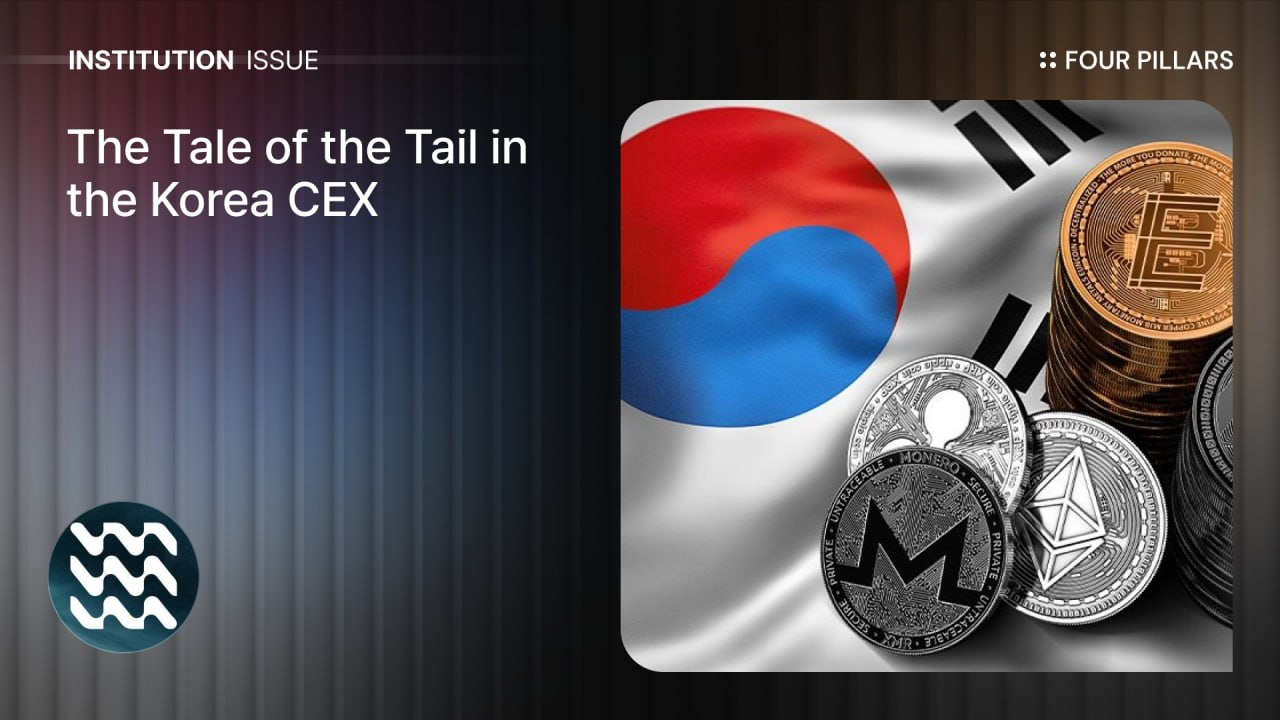
- Korea inverts the global norm tail assets(excluding top 30 crypto assets) carry 58% of Upbit volume and 52% of Bithumb volume, versus 23% on Binance and 19% on Coinbase, while BTC takes just 9% of Korean flow even though KRW pairs represent roughly 30% of global spot volume.
- The tilt is structural due to no legal domestic derivatives, capital controls that keep foreign market makers out, a narrow listing shelf, and a nearly 100% retail base make KRW listings among the most reliable liquidity events in crypto.
- The hype is front loaded but not empty: the median Upbit listing sheds most debut liquidity within 10 to 15 weeks, and only ~43% still trade above 10% of debut liquidity at week 51, yet survivors keep a durable $11.3M median weekly liquidity floor.
: : Japan Crypto Market 2026 (Link)
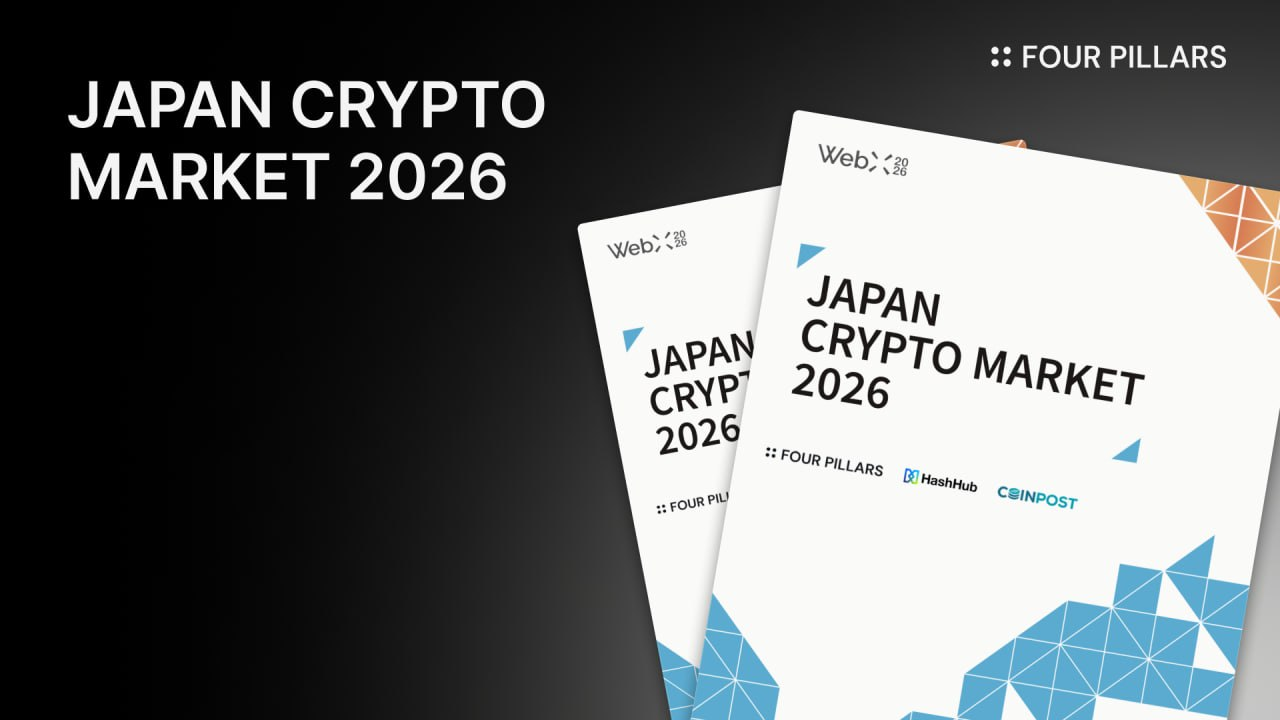
- To understand the future of Web3 in Asia, you have to understand Japan. Japan's crypto market did not arrive at this moment by accident. It is the product of more than a decade of regulatory iteration, much of it forced by crisis.
- From the Mt. Gox collapse to the Coincheck and DMM Bitcoin hacks, each incident became a forcing function that expanded the licensed perimeter and brought more activity into supervised channels.
- The report walks through the pieces that make 2026 a pivotal year: the reclassification of crypto assets under the FIEA and the shift toward separate taxation, the emergence of a genuine yen stablecoin, and the steady widening of tokenization from real estate into bonds, funds, and REITs.
- Japan is not chasing the fastest or the freest market. It is patiently building the most trustworthy one. 2026 will be remembered not as the year crypto arrived in Japan, but as the year it became part of the country's financial plumbing.
: : Three Layers to Understand the Japan Crypto Market (Link)
- Japan's crypto market matured through a pattern of crisis followed by framework followed by adoption. Mt. Gox, Coincheck, and DMM Bitcoin each expanded the regulated perimeter, culminating in the April 2026 FIEA amendment that reclassifies 105 approved tokens as financial instruments.
- The 2026 package is a simultaneous overhaul of seven reforms in one vehicle. It brings a flat 20.315% tax from 2028 (down from up to 55%), insider trading bans, issuer disclosure duties, SESC surveillance, and an LPS Act change letting Japanese VC funds hold crypto directly.
- Exchange consolidation is the near term structural story. Roughly 90% of Japan's 27 licensed exchanges operate at a loss, and rising FIEA compliance costs should concentrate volume into a few scale players, with SBI's bitbank acquisition as the clearest signal.
- Japan now runs a full digital yen and tokenization stack. Four complementary stablecoin tracks (JPYC for retail, Project Pax for B2B, JPYSC for tokenized assets, USDC for trading) plus the FIEA security token framework set up institutional adoption, with the 2028 spot ETF window as the largest flow catalyst.
: : Securitize, Inc. (SECZ) — Initiating Coverage (Link)
- We initiate coverage of Securitize Corp. with an Outperform (Speculative) rating and a price target of $14.50, the probability-weighted intrinsic value of our scenario DCFs, approximately 96% above the $7.41 close of July 8, 2026. The target weights bear, base, and bull intrinsic values of $3.93, $13.04, and $28.16 at 25/50/25. The catalysts that force price discovery are the Q2 2026 print and the first equity-tokenization revenue. The shares have fallen approximately 40% since the July 2 debut on no company-specific news, a move we and press coverage attribute to post-SPAC investor rotation through a thin float. At $7.41 the market pays 0.51x our weighted value and 0.57x our base-case DCF value, with the equity-tokenization option priced at zero. Prices are as of the July 8 close; the stock has since held near that level, closing July 21 at $7.54.
: : Japan Crypto Market Report, Q2 2026: When Market Sentiment and Regulation Diverged (Link)
- Q2 2026 was a quarter in which market conditions and regulatory progress diverged in Japan. The Bitcoin price kept falling, while the FIEA amendment bill was submitted to the Diet and the amended Payment Services Act took effect, moving Q1 policy direction into legislation and enforcement.
- Tokenization expanded from the cash leg to the underlying asset. The Progmat working group put forward a micro stock concept and a tokenization law proposal, giving concrete shape to equity tokenization. But stocks await a general law, so a tokenized MMF, issuable through an Investment Trust Act amendment alone, is the more likely first result.
- The amended Payment Services Act widened market entry while strengthening asset safeguarding. It established an intermediary business for operators that connect transactions without holding user assets, allowed up to 50% of trust type stablecoin reserves in government bonds and time deposits, and added a domestic holding order. The intermediary business in particular shifts stablecoin competition from issuance qualifications to the user point of contact.
- Bitcoin treasury companies faced their first stress test, while regulated distribution businesses expanded. Metaplanet recorded a JPY 114.5 billion net loss and saw its mNAV fall to 0.9x, weakening its premium-dependent fundraising cycle. Meanwhile, SBI expanded stablecoin distribution and exchange consolidation, while JPYC surpassed JPY 3 billion in cumulative issuance and broadened real-world use cases.
: : Monthly EIP - Jun 2026 (ft. Ethereum at a Multipolar Turning Point) (Link)

- In June, ERC proposals continued to expand their scope, addressing regulatory compliance, asset transfers between privacy pools, and mechanisms for carrying token balances at a specific snapshot into a newly issued token. At the core layer, meanwhile, discussions explored separate design paths for more specialized requirements, including staking privacy, pre-distribution of blob data, and account validation based on shared state.
- At the same time, the Ethereum Foundation’s workforce and budget cuts, its broader organizational restructuring, and the launch of Ethlabs began to reveal a more distinct division of roles: the EF would focus on preserving Ethereum’s neutrality and self-sovereign properties, while external organizations would work to accelerate institutional adoption and broaden the utility of ETH.
- The shift from an EF-centered model toward a more multipolar development ecosystem may therefore become a new experiment in decentralization: one that tests whether multiple organizations can balance the interests of their backers with the independence of their research, while maintaining a shared sense of direction and responsibility without a single center.
Comments
- An Era Without a Shared Market
- TradFi Is Swallowing the Korea CEX
- Kaito's Comeback? Can InfoFi Lead the Market Again?
4. Macro & Onchain Metrics
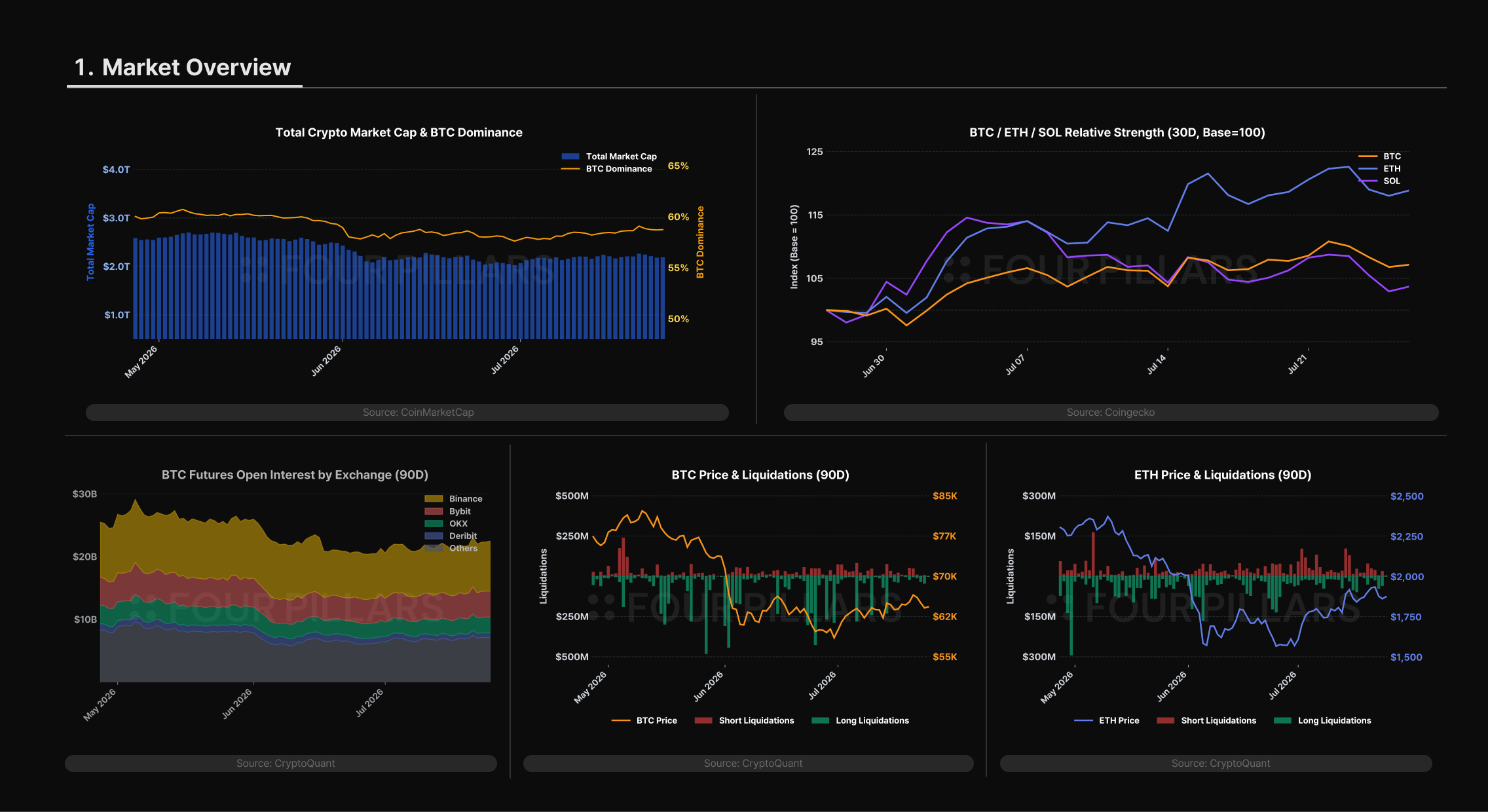
Some of the charts below are powered by CryptoQuant. For those interested in exploring the underlying data in greater detail, CryptoQuant provides access to a comprehensive suite of onchain and market analytics used by institutional participants.
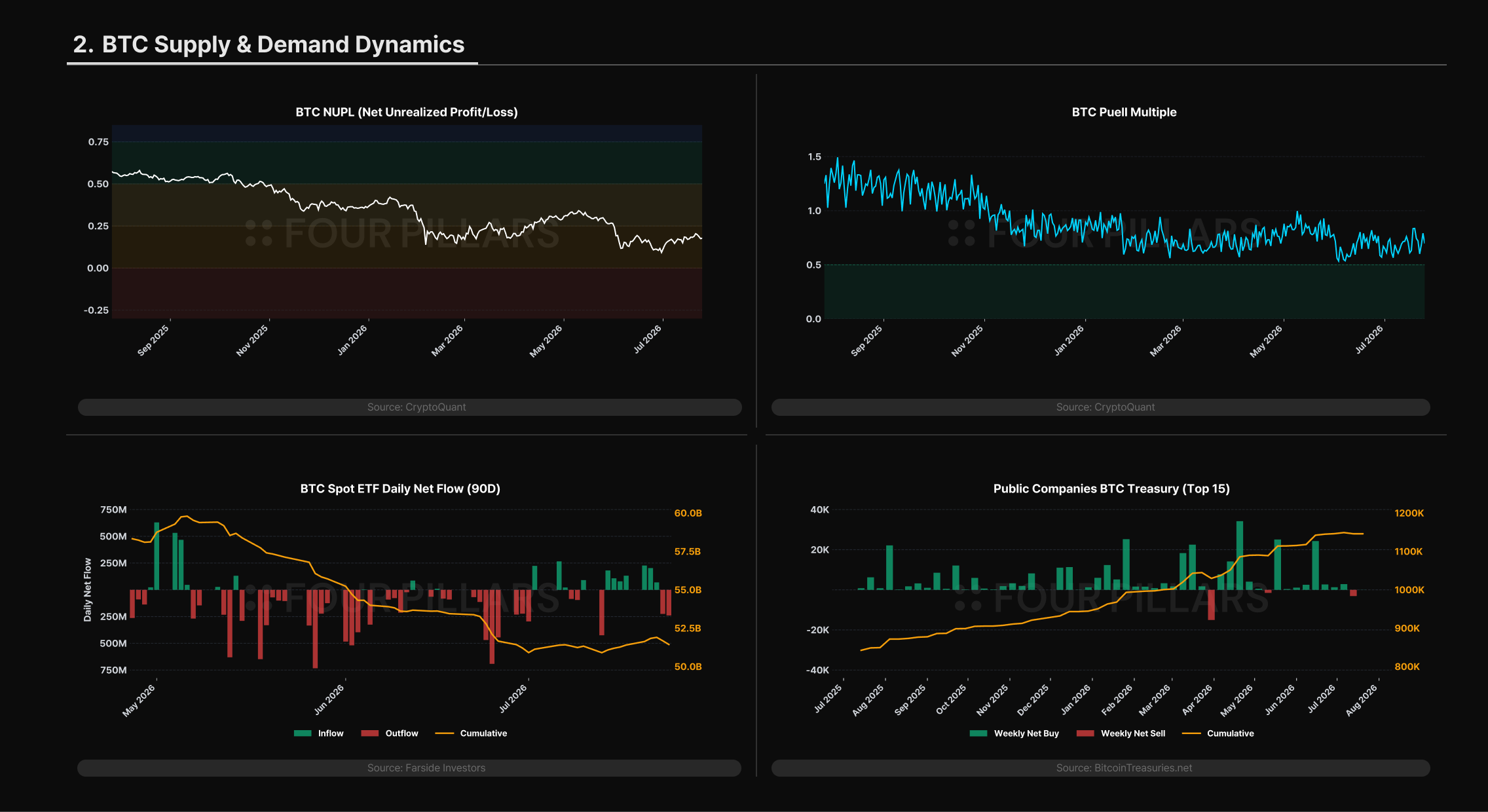
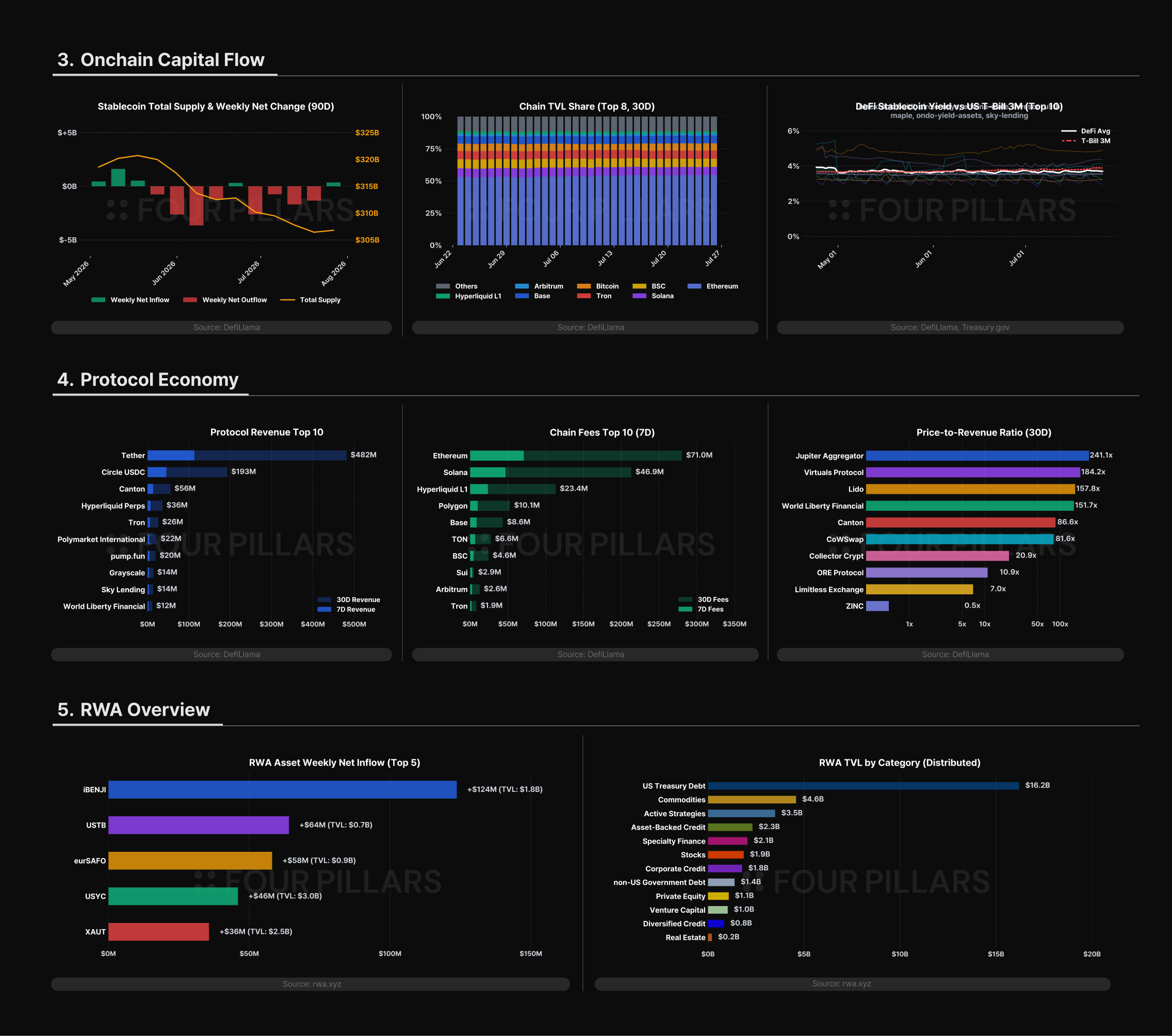
The author of this report may have personal holdings or financial interests in assets or tokens discussed herein. However, the author affirms that no transactions have conducted using material non-public information obtained in the course of research or drafting. This report is intended solely for general information purposes and does not constitute legal, business, investment, or tax advice. It should not be used as a basis for making any investment decisions or as guidance for accounting, legal, or tax matters. Any references to specific assets or securities are made for informational purposes only and should not be construed as an offer, solicitation, or recommendation to invest. The opinions expressed herein are those of the author and may not reflect the views of any affiliated institutions, organizations, or individuals. The opinions and analyses expressed herein are subject to change without prior notice. In addition, beyond the individual disclosures included in each report, Four Pillars, may hold existing or prospective investments in some of the assets or protocols discussed herein. Furthermore, FP Validated, a division of Four Pillars, may already be operating as a node in certain networks or protocols discussed herein or may do so in the future. Please see below links in the footer for FP Validated's participating network disclosures and for broader disclosure details.
![Robinhood Takes Over Onchain
[FP Weekly 37]](/_next/image?url=https%3A%2F%2Fkrotgrfjzckvumudxopj.supabase.co%2Fstorage%2Fv1%2Fobject%2Fpublic%2Fassets%2Fimg%2Fissues%2Frobinhood-takes-over-onchain-fp-weekly-37.png%3Ft%3D1788765790150&w=3840&q=75)

![ATLAS & Entropy [FP Weekly 36]](/_next/image?url=https%3A%2F%2Fkrotgrfjzckvumudxopj.supabase.co%2Fstorage%2Fv1%2Fobject%2Fpublic%2Fassets%2Fimg%2Fissues%2Fatlas-entropy-fp-weekly-36.png%3Ft%3D1788163807734&w=3840&q=75)

![Crypto Rebounds: Is Spring Finally Here? [FP Weekly 35]](/_next/image?url=https%3A%2F%2Fkrotgrfjzckvumudxopj.supabase.co%2Fstorage%2Fv1%2Fobject%2Fpublic%2Fassets%2Fimg%2Fcontent%2Farticle%2Fnotion-import%2Ftcohxdmt6wn2o2.png&w=3840&q=75)