


Table of Contents
Researcher

*This is a joint research initiative on “Asia CEX Research” with SurfAI.
Key Takeaways
- Korea inverts the global norm tail assets(excluding top 30 crypto assets) carry 58% of Upbit volume and 52% of Bithumb volume, versus 23% on Binance and 19% on Coinbase, while BTC takes just 9% of Korean flow even though KRW pairs represent roughly 30% of global spot volume.
- The tilt is structural due to no legal domestic derivatives, capital controls that keep foreign market makers out, a narrow listing shelf, and a nearly 100% retail base make KRW listings among the most reliable liquidity events in crypto.
- The hype is front loaded but not empty: the median Upbit listing sheds most debut liquidity within 10 to 15 weeks, and only ~43% still trade above 10% of debut liquidity at week 51, yet survivors keep a durable $11.3M median weekly liquidity floor.
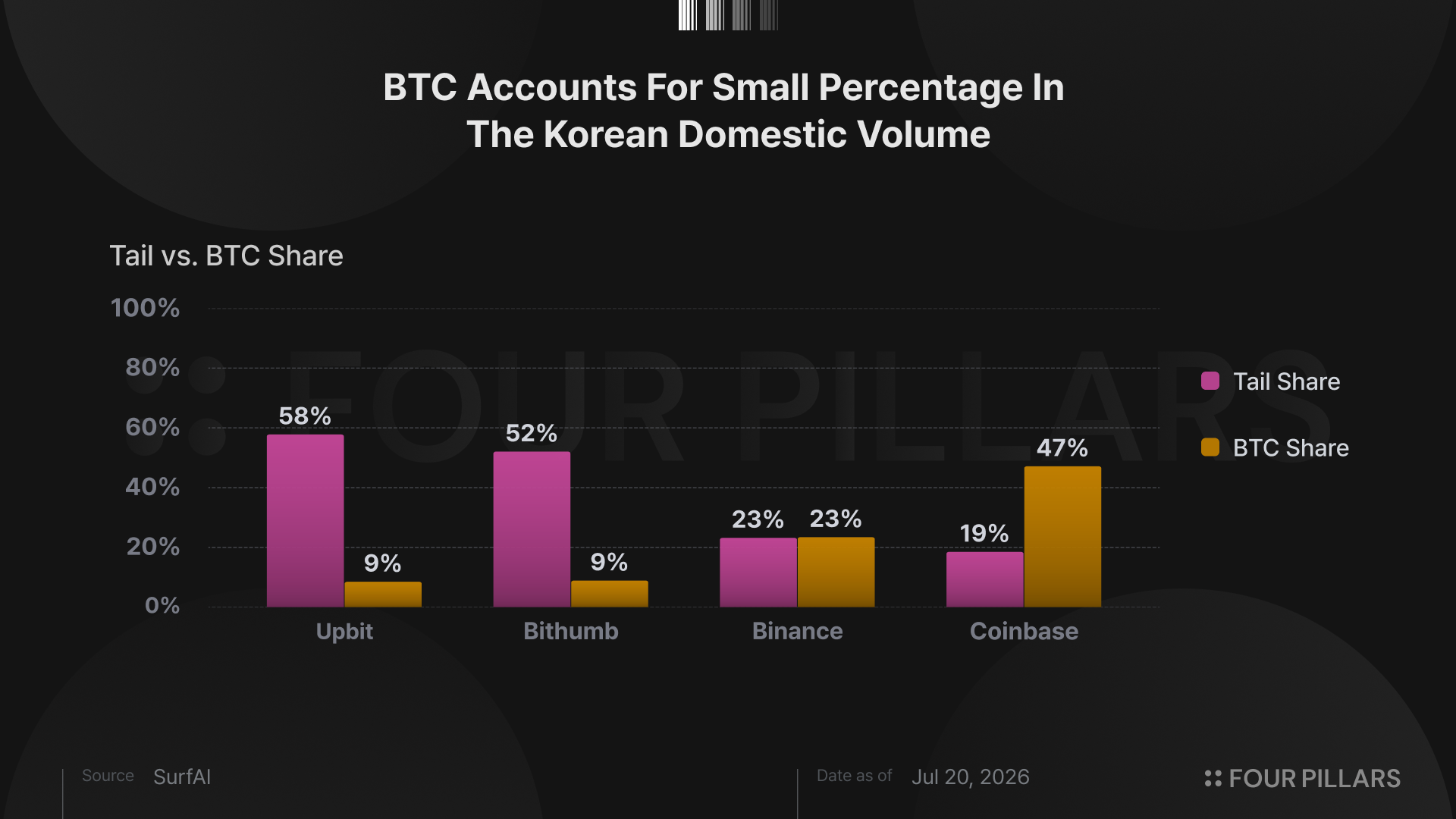
The chart above captures the anomaly this analysis unpacks. In the recent month window, tail assets carried 58% of Upbit volume and 52% of Bithumb volume, versus 23% on Binance and just 19% on Coinbase, while BTC took about 9% of Korean flow against 23% on Binance and 47% on Coinbase. That inversion would be a curiosity in a small market in Korea it sits inside one of the largest pools of spot trading volume in the world.
Korean won pairs represent about 30% of global spot crypto trading volume in 2026, second only to the US dollar, with roughly $26B in weekly turnover. This is not new. In Q1 2024, $456B of crypto traded against KRW on centralized exchanges, briefly making the won the most traded fiat currency in crypto, ahead of even USD.
Yet only about 15% of that flow goes to BTC and ETH. The remaining ~85% chases altcoins and newly listed tokens, which makes a KRW listing one of the most reliable liquidity events in crypto.
That concentrated demand also built the venues themselves into giants. Upbit rode this boom to become a top five global exchange by volume with an over 80% domestic share. Later data put Upbit at ~72% of Korean volume, and Upbit plus Bithumb together at nearly 96%.
That duopoly serves a user base that is genuinely mass market. Exchange registered users passed 16.2M in early 2025, more than the roughly 14.5M Koreans who own stocks. Regulator data showed 9.7M verified traders at end 2024, up 25% in six months, with holdings doubling to $77.5B. The investors in their 30s are 29% of the market and 40s are 27%, while 66% of users hold under ₩500,000. That profile of many small, active retail accounts is the profile that trades the long tail.
1. Retail Trades ~85% Altcoins
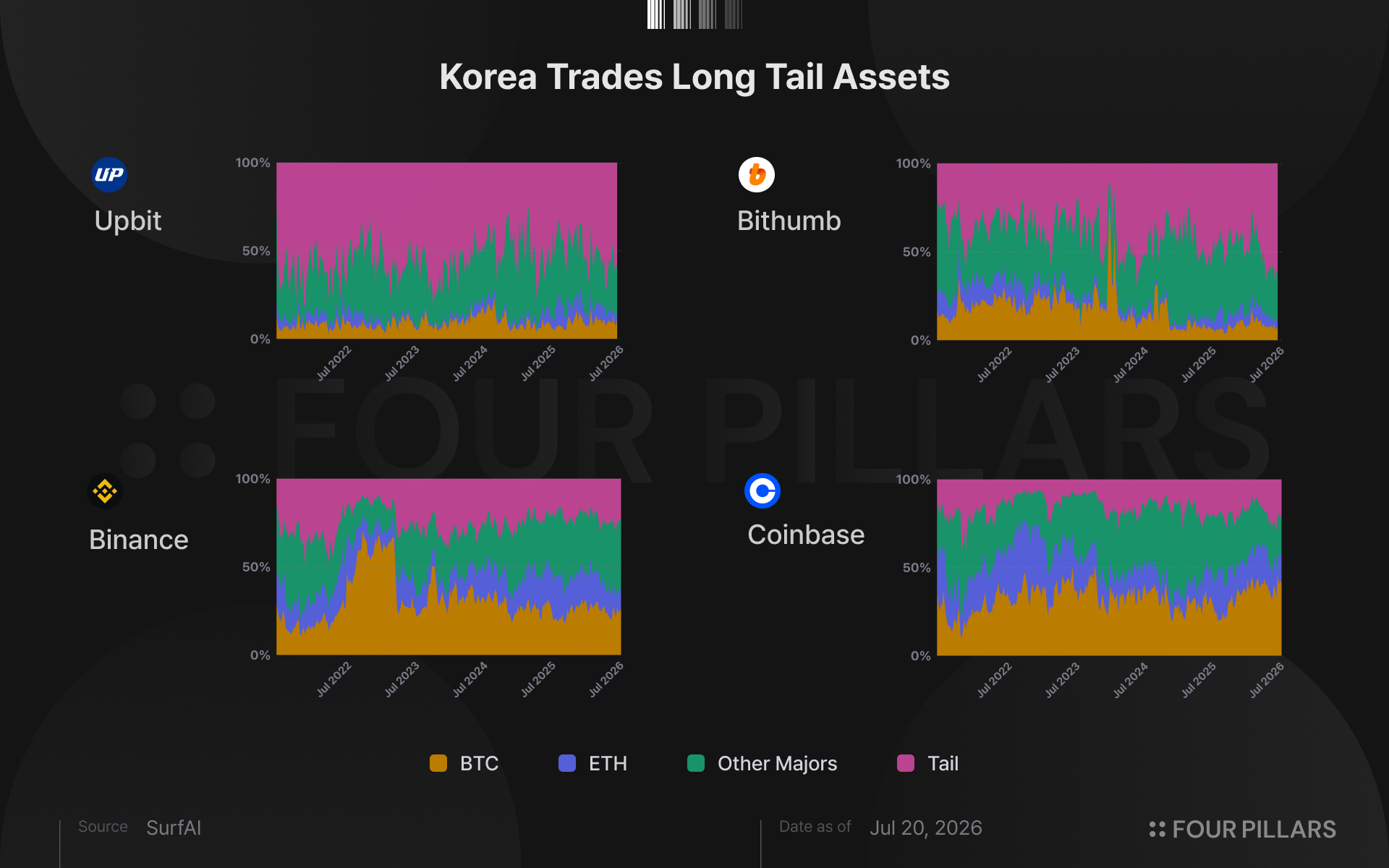
In Korea altcoins take 85% of Korean domestic volume, while Bitcoin takes just 9% and Ethereum 6%. Most Western venues show roughly the mirror image, with BTC and ETH dominating spot flow. This has been produced by the structural constraints on where Korean risk capital can legally go.
The first constraint is the product menu. Korea offers no legal domestic crypto futures, options, or margin products, so traders seeking convexity have to manufacture it through volatile spot assets. The appetite that perps and options absorb elsewhere flows into small cap altcoins instead, which function as the market's de facto leverage.
Capital controls deepen the isolation. Mandatory real name local bank accounts and won only rails keep foreign market makers and arbitrage desks out, which leaves domestic retail setting prices alone. Prices detach from global levels, and momentum compounds because there is no professional bid to fade it.
The shelf itself is narrow. Upbit lists roughly 324 coins and supports only KRW fiat, compared with more than 700 coins on Binance or Bitget. The same national demand is funneled into fewer names, so each listed token receives far more flow than it would on a global venue.
Culture then accelerates everything. The market is nearly 100% retail, technology adoption is fast, and trends diffuse through society very quickly. Attention converges on the same new names at the same time, so any listing or narrative becomes a coordinated wave of flow. Institutions were long barred from the market, so there is no steady allocator bid anchoring volume in BTC and ETH the way ETF and corporate treasury flows do in the US.
2. Listing Pumps and Isolated Liquidity
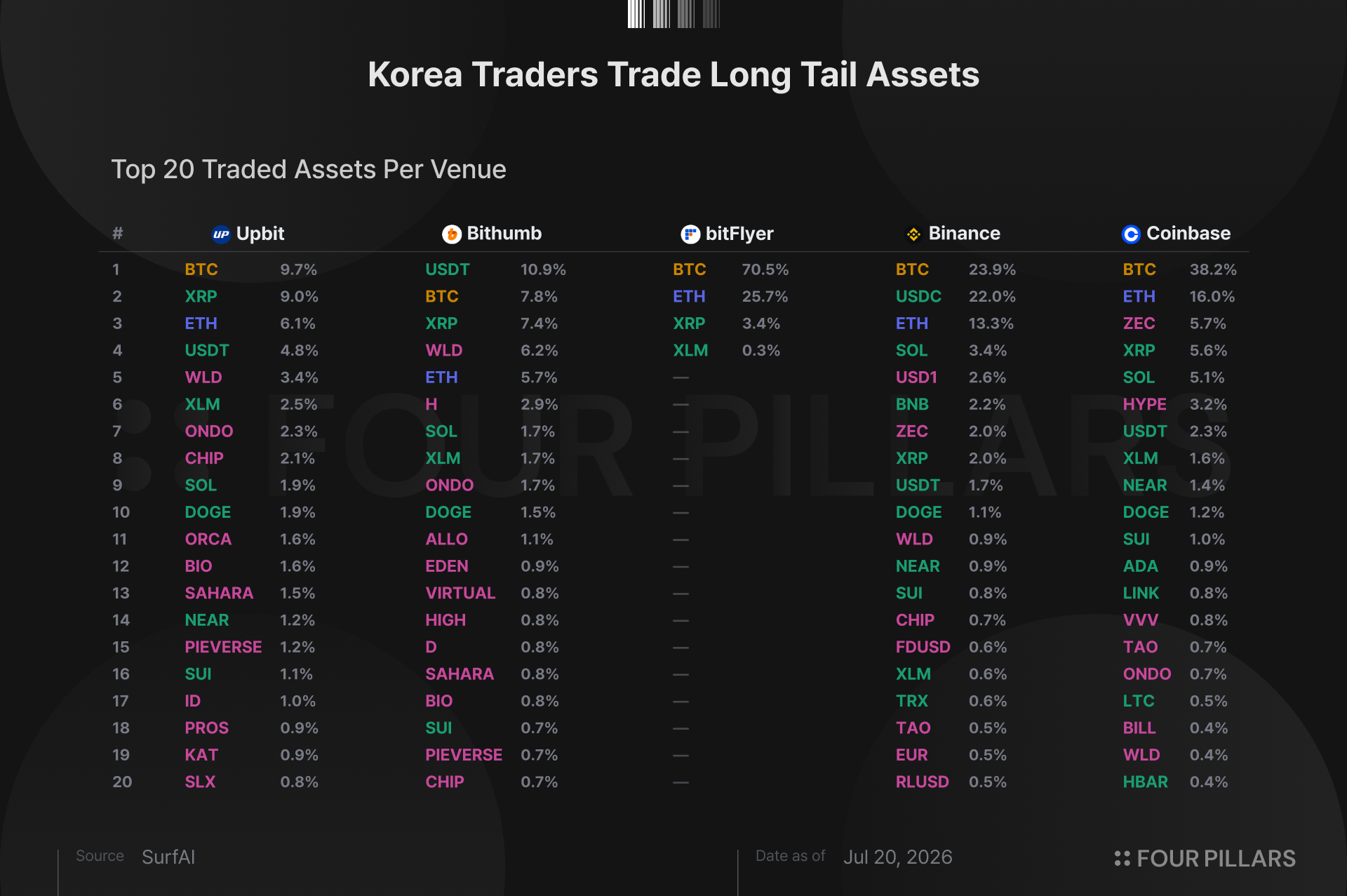
Every new Upbit or Bithumb listing triggers the same pattern: PRL's 24 hour volume jumped 5,500%, SLX doubled on debut, HYPER gained more than 100%, AZTEC rose 82%, and SKR climbed 62% on a 700% volume spike. Listings are also a competitive weapon: when Bithumb's market share climbed to 46% in September 2025, Upbit responded by listing 7 tokens in 10 days.
The same appetite shows up intraday. In Upbit's "promised 9 a.m." phenomenon, a seemingly random altcoin spikes as the daily candle opens at 9 a.m. KST, and traders bet daily on which coin is next. The trigger is the clock rather than news, a pure retail coordination game.
The appetite even survives frozen rails. When a November 2025 hack forced Upbit to suspend deposits and withdrawals, trapped liquidity chased suspended tokens like ORCA and RAY higher in what traders call Gaduri, or fishing net pumping, earning Upbit about $340,650 in fees in a single day. The same closed loop reappeared when ZKsync spiked nearly 970% around a maintenance window in February 2026, prompting a regulatory probe.
Isolated liquidity is what lets these pumps run so far. Capital controls keep foreign arbitrageurs and market makers out, so domestic retail sets prices alone, and the visible symptom is the kimchi premium, averaging 2 to 3% and peaking at 10.88% in March 2024. Isolation cuts both ways by late 2025 the premium had turned negative and the listing premium effect was weakening even as Upbit volume ran above $18B.
3. When the Hype Passes
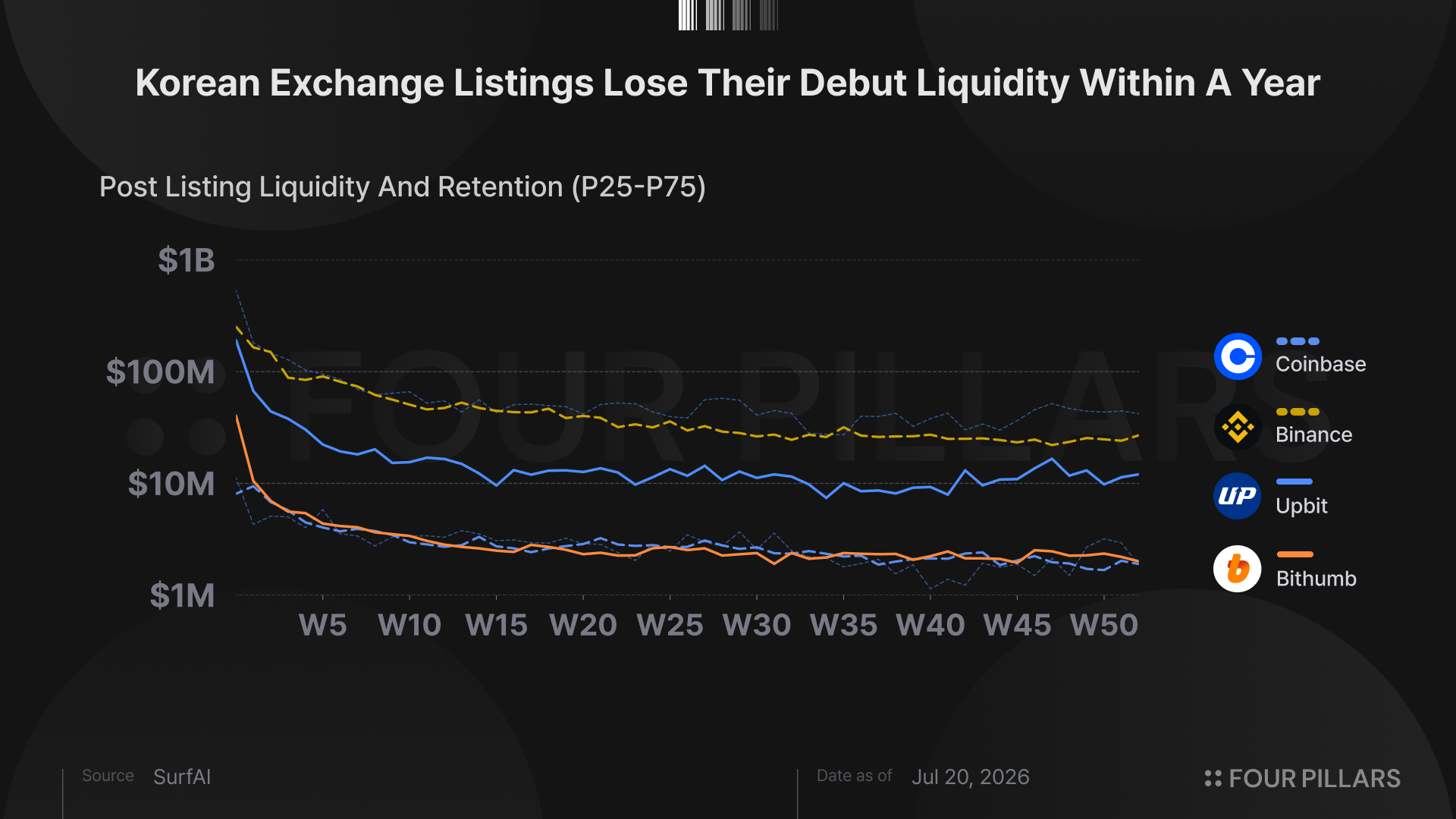
The two charts above quantify what actually survives the hype. The post listing liquidity curve is heavily front loaded the median Upbit listing sheds most of its debut liquidity within the first 10 to 15 weeks, then settles onto a durable floor rather than bleeding to zero. By week 51 that floor still clears $11.3M in median weekly liquidity, second only to Binance's $25.6M and roughly five times Coinbase's $2.3M and Bithumb's $2.2M.
The survival chart is where the picture dims. Only 42.7% of Upbit listings and 40.5% of Bithumb listings still trade above 10% of their debut liquidity at week 51, roughly matching Binance's 43.6% but well below Coinbase's 63.8%. Coinbase debuts start small and steady, so clearing the 10% bar is easier there, while Korean debuts start from enormous spikes, which means keeping 10% still leaves a large absolute number. Even so, nearly six in ten Korean listings lose the bulk of their initial market within a year.
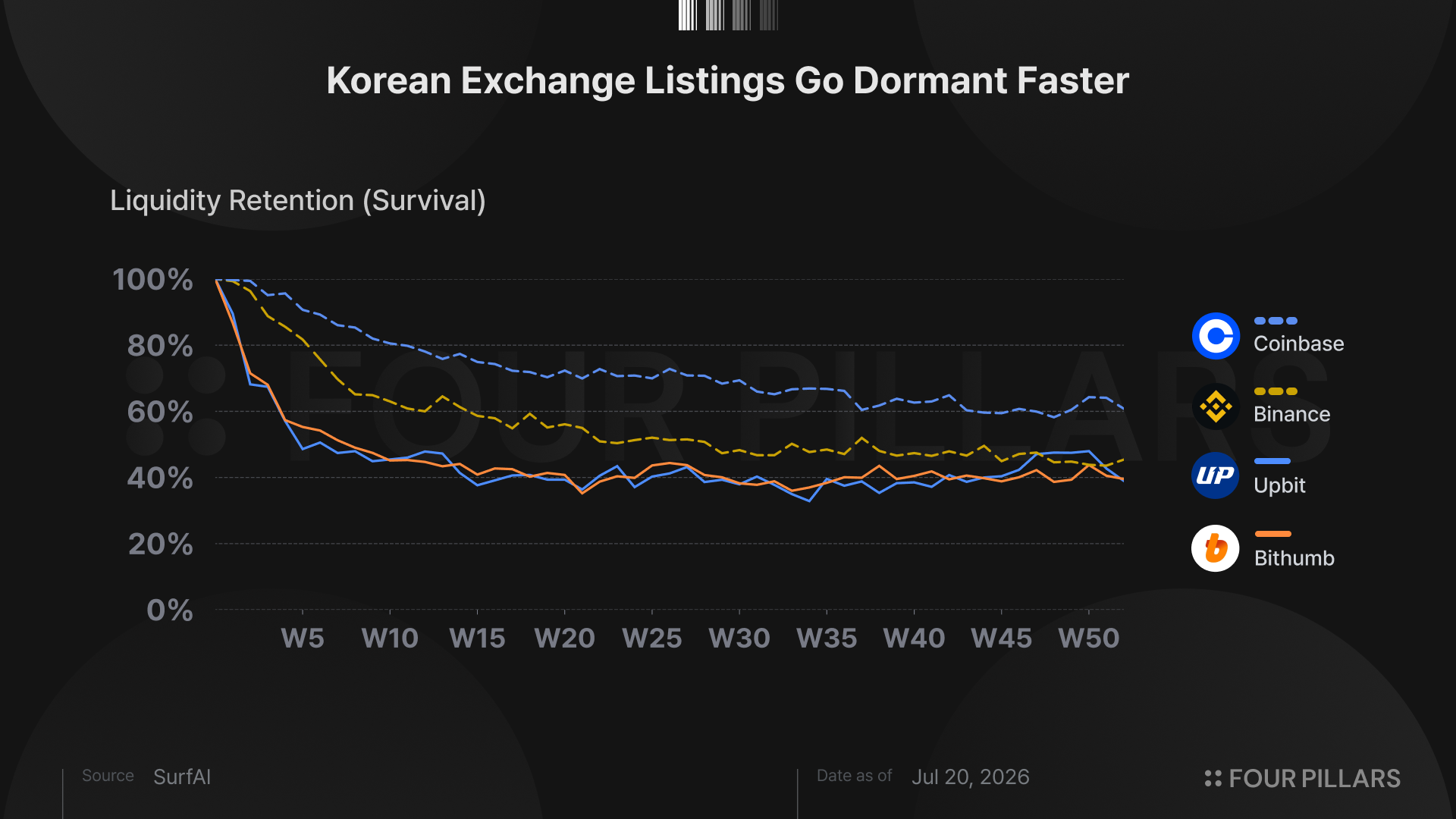
The honest read is a market with deep but selective memory. Korea filters aggressively in the first few months after listing, then concentrates deep liquidity in the survivors. A KRW listing is not a guaranteed annuity; it is a year long audition in which roughly four of ten tokens earn a durable eight figure liquidity floor.
*Above two charts are built from the same listing panel of 605 qualifying listings since June 2021. Week 0 is anchored to each token's first observed trading week rather than the exchange reported listing date. Tokens already trading at the start of the data window are dropped, since their true debut is not visible.
The author of this report may have personal holdings or financial interests in assets or tokens discussed herein. However, the author affirms that no transactions have conducted using material non-public information obtained in the course of research or drafting. This report is intended solely for general information purposes and does not constitute legal, business, investment, or tax advice. It should not be used as a basis for making any investment decisions or as guidance for accounting, legal, or tax matters. Any references to specific assets or securities are made for informational purposes only and should not be construed as an offer, solicitation, or recommendation to invest. The opinions expressed herein are those of the author and may not reflect the views of any affiliated institutions, organizations, or individuals. The opinions and analyses expressed herein are subject to change without prior notice. In addition, beyond the individual disclosures included in each report, Four Pillars, may hold existing or prospective investments in some of the assets or protocols discussed herein. Furthermore, FP Validated, a division of Four Pillars, may already be operating as a node in certain networks or protocols discussed herein or may do so in the future. Please see below links in the footer for FP Validated's participating network disclosures and for broader disclosure details.


