


Table of Contents
- 1. Korea Expands Token Securities from Fractional Investments to Stocks, Bonds, and Funds
- Key Update
- Commentary: Korea Builds an Integrated Ledger Around the Exchange and the Depository
- 2. Singapore Extends Stablecoin Regulation to Joint Issuance and Recognition of Foreign Issuance
- Key Update
- Commentary: Singapore Fixes the Structure Before the Issuer
- 3. Japan's MUFG Joins 21 Global Financial Institutions to Establish a Bank Type Stablecoin Company
- Key Update
- Commentary: Bank Consortium Infrastructure Enters the Stablecoin Market
- 4. Other News
- 4.1 Theme 1. Tokenized Asset Infrastructure Moves into Live Operation
- 4.2 Theme 2. Competition over Detailed Rules for Stablecoin Institutionalization
- 4.3 Theme 3. Digital Asset Market Supervision, Taxation, and Custody Are Being Refined


Korea's expansion of token securities into stocks, bonds, and funds leads this week's ASA News, alongside Singapore's move to legislate its stablecoin framework and a new bank consortium stablecoin company joined by MUFG.
1. Korea Expands Token Securities from Fractional Investments to Stocks, Bonds, and Funds

Key Update
- On September 4, the Financial Services Commission (FSC) announced that token securities issuance will expand from fractional investment securities to stocks, bonds, and funds, with a phased rollout from next February starting with private money market funds for institutional investors, privately placed bonds, and unlisted shares.
- The FSC will run model validation and pilot projects for listed stock tokenization centered on the Korea Exchange (KRX), and the Korea Securities Depository released distributed ledger standards that require at least three independent institutions in consensus and prohibit any single institution from holding 50% or more of node ownership.
- Residential housing tokenization was excluded in principle from eligible underlying assets for fractional investment securities, together with assets related to gambling industries and assets with significant social externalities.
Commentary: Korea Builds an Integrated Ledger Around the Exchange and the Depository
The announcement shifts Korea's token securities policy from fractional investment experiments toward the digital transformation of existing capital market infrastructure, and the KRX centered model validation signals regulated tokenization built around the exchange. The node ownership rules point to a permissioned shared ledger involving the Korea Securities Depository and the exchange, with minimum governance requirements that keep any single operator from controlling verification rights.
The sequence differs across the region, since Japan pushes investment trusts and stablecoins into live operation through Progmat, Hong Kong expands distribution through licensed stablecoins, and Singapore refines issuance rules first. Korea remains late on stablecoin legislation but is solidifying an integrated ledger structure for securities tokenization centered on the exchange and the depository. The key point to watch is how far the KRX centered validation connects to actual settlement, custody, and investor rights exercise.
2. Singapore Extends Stablecoin Regulation to Joint Issuance and Recognition of Foreign Issuance
Source: Singapore Considers Recognizing Stablecoin Co-Issuance
Key Update
- The Monetary Authority of Singapore (MAS) began legislating its single currency stablecoin framework through amendments to the Payment Services Act, with a public consultation running until October 16 and coverage of stablecoins issued in Singapore and pegged to the Singapore dollar or a G10 currency.
- Key issues include whether multiple issuers can jointly issue a single stablecoin and whether stablecoins issued overseas can be recognized within Singapore's regime, while the existing "MAS regulated stablecoin" label is expected to be maintained.
- The proposal bans interest payments to holders and introduces powers to trace, freeze, and burn stablecoins used for illicit activity.
Commentary: Singapore Fixes the Structure Before the Issuer
MAS is institutionalizing the definition of single currency stablecoins, labeling requirements, the interest ban, freeze and burn powers, and joint issuance all at once, deciding what qualifies as a payment instrument before competition among issuers begins. The interest ban keeps stablecoins from morphing into yield products that compete directly with bank deposits.
For issuers, the implication is that reserve assets, redemption rights, and sanctions response frameworks must be proven before anything else. If recognition of foreign issued stablecoins becomes possible, global issuers could use Singapore as an Asian regulatory hub, while strict joint issuance conditions would force bank consortium models to absorb governance costs before speed.
3. Japan's MUFG Joins 21 Global Financial Institutions to Establish a Bank Type Stablecoin Company
Key Update
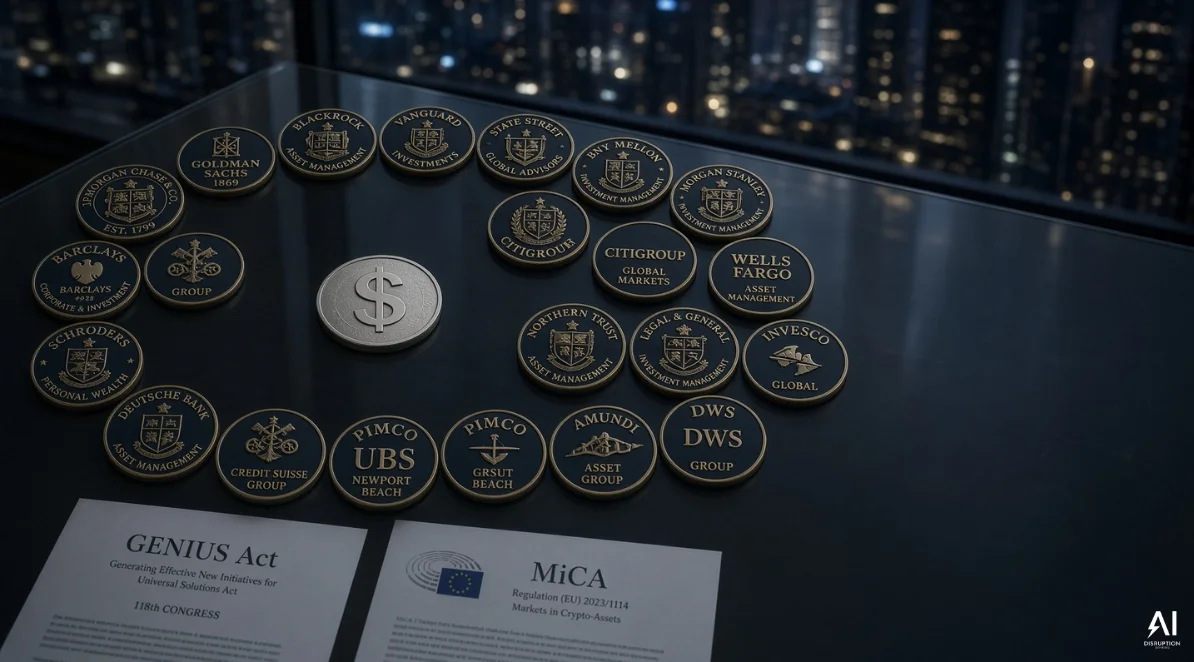
- Twenty one financial institutions worldwide, including Goldman Sachs, Citi, and Mitsubishi UFJ Bank, will establish a new company in the second half of 2026 to support stablecoin issuance, starting with US dollar stablecoins and targeting service launch in the first half of 2027.
- Issuance is expected to expand to the euro and later to other G7 currencies, with an operating framework designed in line with the US GENIUS Act and Europe's MiCA regulation.
- MUFG Group already operates tokenized securities and stablecoin infrastructure through Progmat, and on September 3 it validated a tokenized domestically registered investment trust in a live operating environment.
Commentary: Bank Consortium Infrastructure Enters the Stablecoin Market
The new company puts bank level compliance, governance, and institutional risk management at the forefront, signaling that leadership in the stablecoin market is moving toward the banking sector and that stablecoins are shifting from exchange liquidity tools to institutional settlement rails. MUFG's participation connects Japan's domestic tokenization infrastructure and a global bank issued settlement token at the same time.
The consortium model must align regulations across multiple jurisdictions and will need interpretations from each central bank as it moves beyond the dollar, so progress may be slow. Even so, banks building their own stablecoin infrastructure company changes the market benchmark, and competitiveness may be redefined by which banking network and payment use cases an issuer can secure.
4. Other News
This section summarizes other news from the period related to Asian RWA, stablecoins, tokenization, and digital asset infrastructure.
4.1 Theme 1. Tokenized Asset Infrastructure Moves into Live Operation
4.1.1 MUFG Conducts Japan's First Live Operational Validation of a Tokenized Registered Investment Trust
- Mitsubishi UFJ affiliates and Progmat validated a tokenized domestically registered investment trust in a live operating environment, a sign that tokenization is moving beyond alternative assets into traditional fund infrastructure.
4.1.2 Reserve Bank of Australia Seeks Feedback on Settlement Services for Tokenized Markets
- The Reserve Bank of Australia began seeking feedback on the role of settlement services after tokenized asset transactions, a stage where the central bank institutionally examines the settlement layer of private tokenization markets.
4.1.3 HashKey Joins DTCC Tokenization Innovation Working Group
- HashKey joined the DTCC Tokenization Innovation Working Group as the first Asian digital asset service provider, connecting a Hong Kong operator to discussions on US back office infrastructure.
4.1.4 Korean Financial Firms Proactively Review Offshore Token Securities Issuance Structures
- The FSC's authoritative interpretation that an offshore MMF based token securities structure is unlikely to violate the current Electronic Securities Act expands room for domestic financial investment firms to validate business structures overseas before domestic institutionalization.
4.2 Theme 2. Competition over Detailed Rules for Stablecoin Institutionalization
- The Financial Services Agency requested an exemption from tax document filing when beneficiaries of trust type stablecoins change, moving Japan into a stage of reducing tax and operational friction after permitting issuance.
4.2.2 Bank of Korea Analyzes Linkages Between Dollar Stablecoins and the Foreign Exchange Market
- The Bank of Korea analyzed that demand for dollar stablecoins could affect exchange rates if participation by corporations and foreigners expands, a signal that the won stablecoin debate is directly connected to foreign exchange stability.
4.2.3 Bank of East Asia and Anchorpoint Sign MoU to Use HKDAP
- BEA and Anchorpoint agreed to cooperate on identifying real world use cases for the HKD based stablecoin HKDAP, as Hong Kong's stablecoin discussion moves from issuance approval to discovering actual use cases.
4.2.4 Korea Faces Controversy over Applying Posted Exchange Rates to USDT Taxation
- Under National Tax Service guidance, dollar pegged stablecoins such as USDT are converted into won using posted exchange rates, raising the question of whether stablecoins are payment instruments or assets subject to tax standards.
4.3 Theme 3. Digital Asset Market Supervision, Taxation, and Custody Are Being Refined
4.3.1 BitGo Opens Singapore Office After Tripling APAC Customer Base
- BitGo opened a new Singapore office after tripling its APAC customer base over two years, reinforcing Singapore as a hub for institutional custody and payment infrastructure.
4.3.2 Coincheck Partners with DFNS to Support Custody for Japanese Financial Institutions
- Coincheck Group partnered with France's DFNS to support digital asset custody for Japanese financial institutions, connecting trading, custody, and institutional services within a single business group.
4.3.3 Indonesia's OJK Expands On Chain Regulation Targeting a 22.69 Million User Market
- OJK identified investor identification, stablecoin rules, and RWA institutionalization as key priorities for a market of around 22.69 million users, preparing for incorporation into financial infrastructure beyond trading regulation.
4.3.4 National Tax Service to Introduce Tracking Program to Close Tax Gaps for Personal Wallets
- The National Tax Service plans to introduce commercial analytics software to track digital assets held in personal wallets, expanding on chain supervisory infrastructure into the tax domain ahead of taxation taking effect in 2027.
[ASA News] is a weekly newsletter that summarizes major stablecoin related news across Asia and shares views from industry participants. (2026.08.31~09.06)
The author of this report may have personal holdings or financial interests in assets or tokens discussed herein. However, the author affirms that no transactions have conducted using material non-public information obtained in the course of research or drafting. This report is intended solely for general information purposes and does not constitute legal, business, investment, or tax advice. It should not be used as a basis for making any investment decisions or as guidance for accounting, legal, or tax matters. Any references to specific assets or securities are made for informational purposes only and should not be construed as an offer, solicitation, or recommendation to invest. The opinions expressed herein are those of the author and may not reflect the views of any affiliated institutions, organizations, or individuals. The opinions and analyses expressed herein are subject to change without prior notice. In addition, beyond the individual disclosures included in each report, Four Pillars, may hold existing or prospective investments in some of the assets or protocols discussed herein. Furthermore, FP Validated, a division of Four Pillars, may already be operating as a node in certain networks or protocols discussed herein or may do so in the future. Please see below links in the footer for FP Validated's participating network disclosures and for broader disclosure details.


