


Table of Contents
Researcher

1. Coinbase Launches Tokenized Stocks
Source: Coinbase
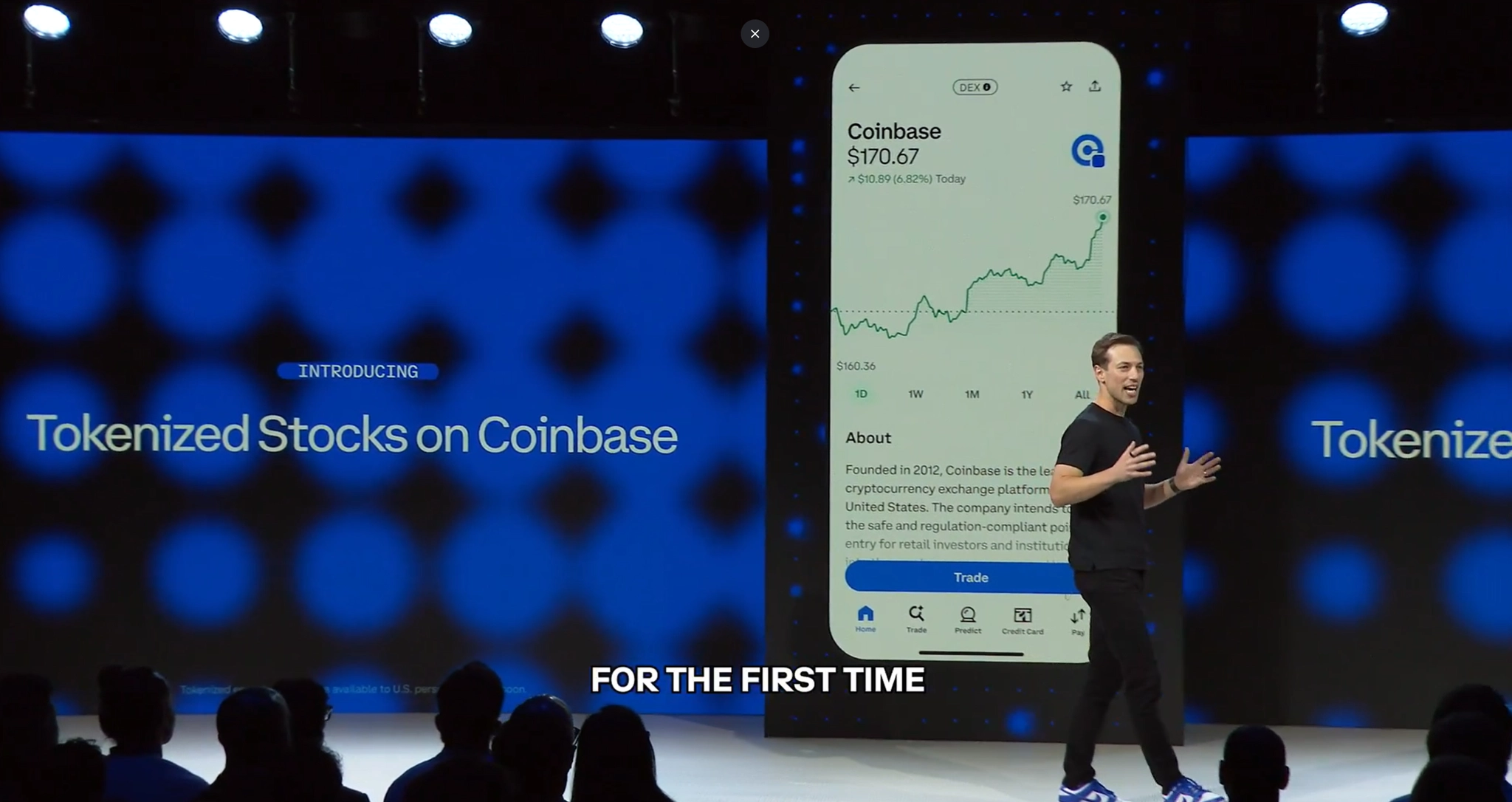
On June 16, Coinbase previewed the launch of tokenized stocks at its product showcase. The product entered a pilot phase in July, and more recently, the assets started being used across protocols on Base, including Aerodrome. They are now available as tradable assets for regular users.
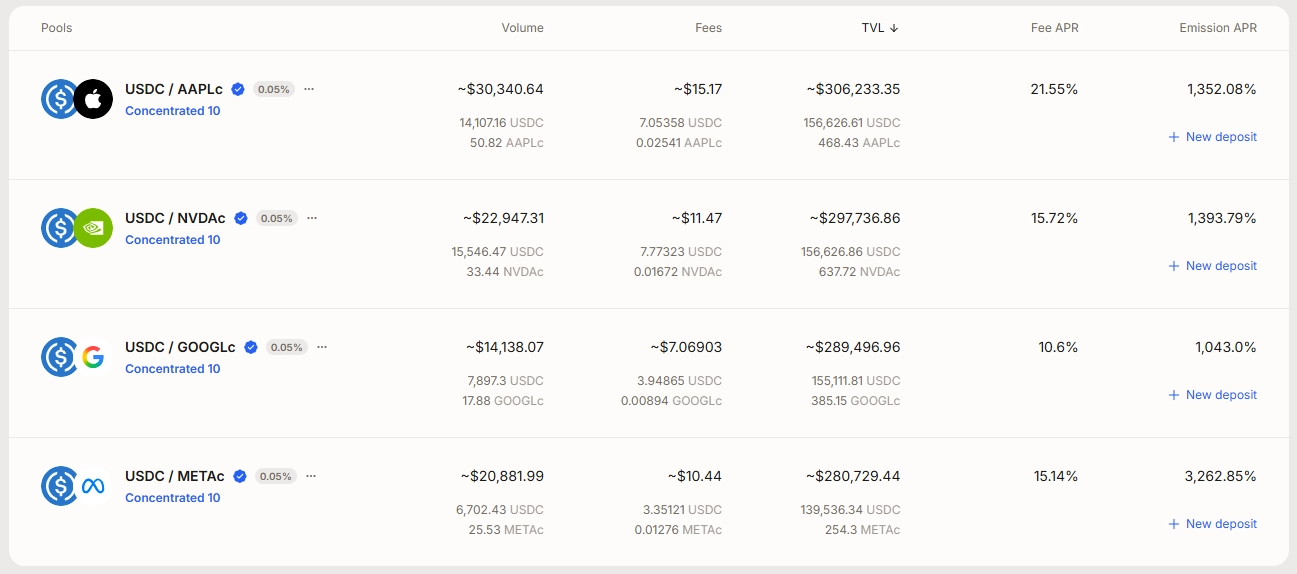
Source: Aerodrome
At the time, Coinbase emphasized three points. It claimed that it would 1) be the first to launch 2) tokenized stocks backed 1:1 by real shares, and 3) that these tokens would provide “true ownership.”
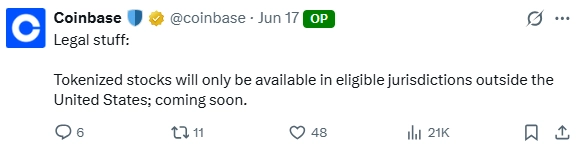
Source: X (@coinbase)
But right below the post was a somewhat contradictory disclaimer stating that the service would not be available in the United States.
Why is that contradictory?
Today, there are only two main tokenization models that can pass through actual ownership rights in the underlying shares: the issuer-sponsored model used by Securitize, and the custodial model used by DTCC and Dinari. Both can legally operate in the U.S.
The tokenization models that generally cannot operate in the U.S. today are the linked security model and the security-based swap model. These structures tokenize stocks indirectly through an SPV or offshore entity, which means the token itself cannot inherit direct ownership of the underlying shares.
For that reason, I, along with others including Galaxy’s head of research, raised what I think was a reasonable question at the time: “Is Coinbase actually tokenizing stocks through an SPV?”
Source: Coinbase
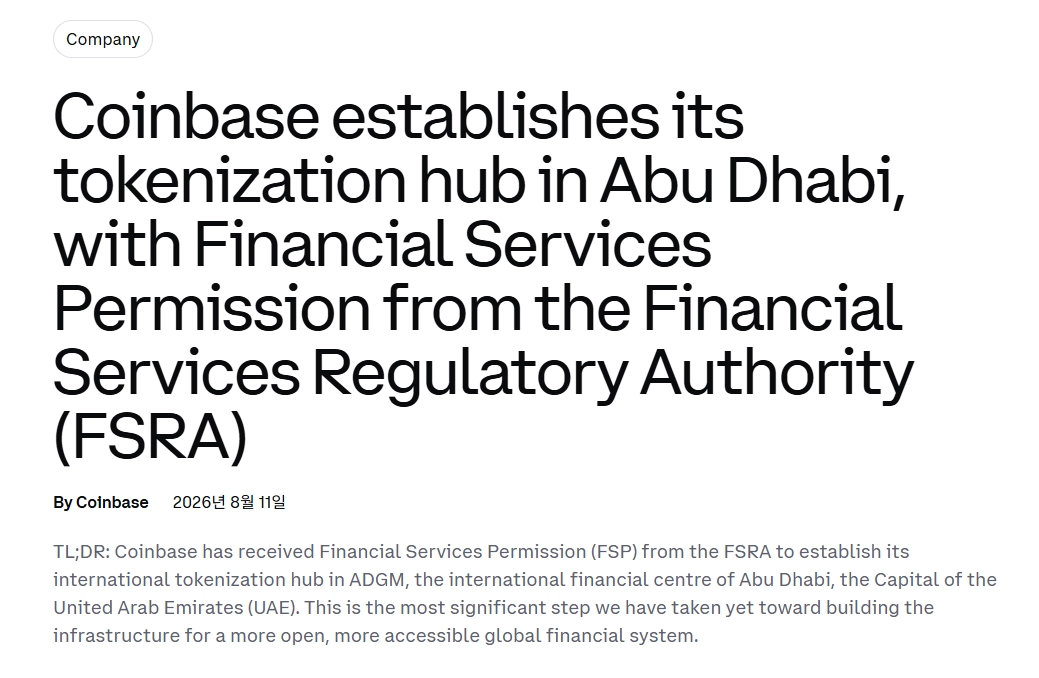
Once Coinbase’s tokenized stocks actually launched, it turned out that they were indeed using an offshore SPV structure. In other words, Coinbase is not tokenizing the shares directly. An offshore SPV holds the shares, and a certificate representing the economic rights to those shares is then tokenized.
That is quite different from the “true ownership” Coinbase originally emphasized. But this is where things get interesting.
Coinbase announced that, with approval from the ADGM’s FSRA, it would establish an international tokenization hub in ADGM, the international financial free zone in Abu Dhabi. And the SPV Coinbase set up for its stock tokenization business is indeed located in ADGM.
What does that remind you of? Binance’s bStocks.
Source: rwa.xyz
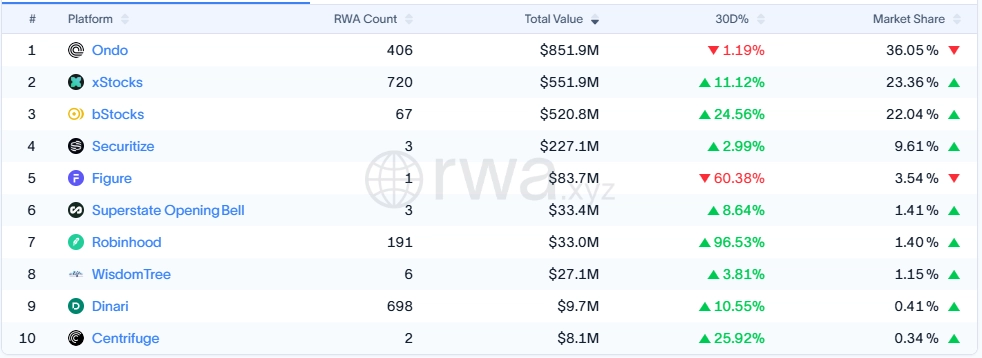
Beyond offering equity-linked perpetual futures on its CEX, Binance recently started tokenizing stocks through a separate offshore SPV and distributing them on BNB Chain through a product called bStocks.
bStocks has grown rapidly, helped by CZ’s support and integrations with memecoins. In a short period of time, it became the third-largest issuer in the tokenized stock sector by issuance volume, behind Ondo and xStocks.

Just like Coinbase, Binance’s bStocks are issued using an ADGM SPV and the ADGM regulatory framework.
So why are the world’s largest CEXs turning to ADGM for tokenized stocks?
2. Why Traditional Stock Tokenization Is So Complicated
To understand why these firms are choosing ADGM, it helps to look at the tokenization structures used by existing linked-security platforms such as Ondo Global Markets, Backed Finance’s xStocks, and Robinhood Stock Tokens.
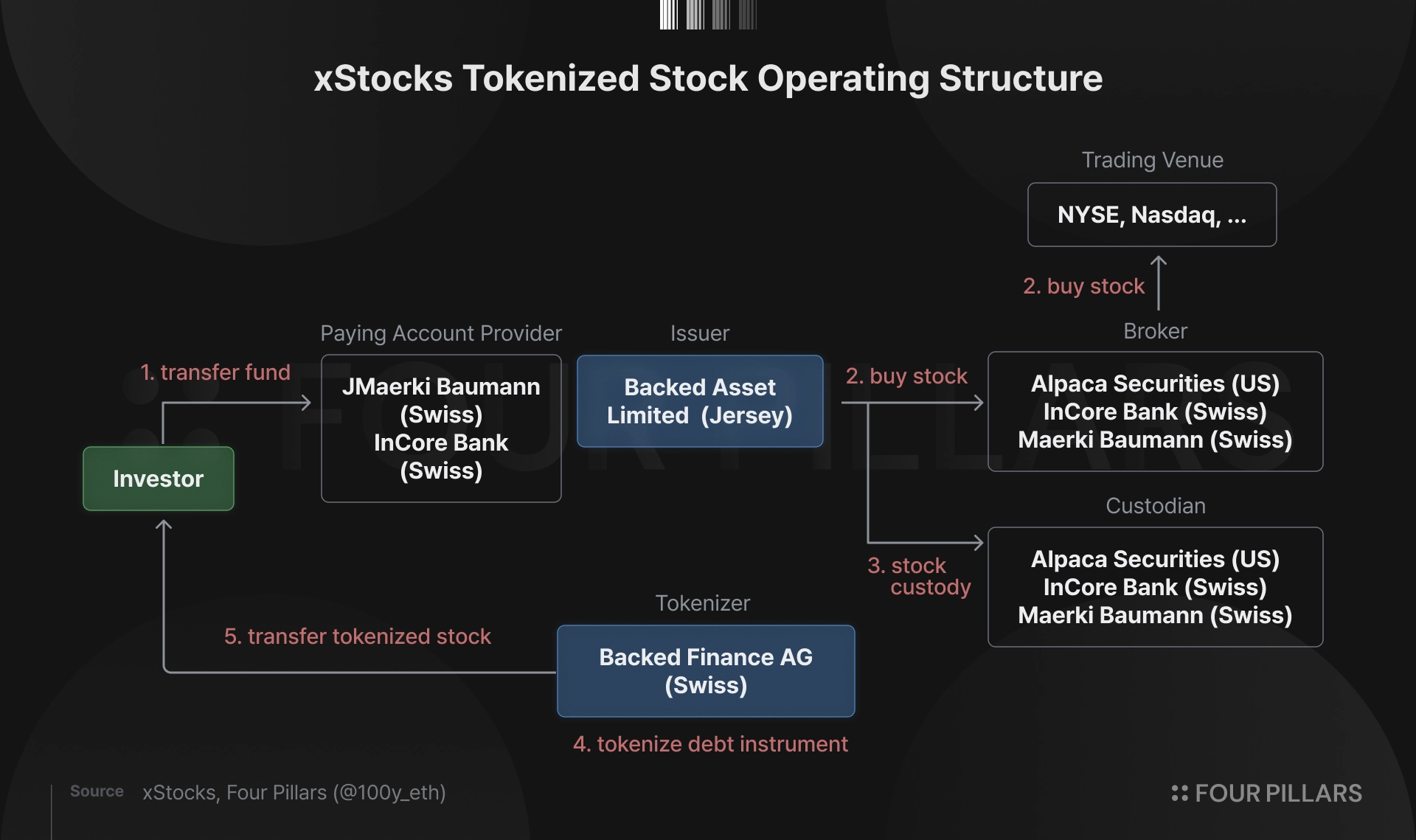
The diagram above shows how Backed Finance issues xStocks.
Backed Finance operates an SPV in Jersey called Backed Asset Limited. A user who wants to issue xStocks sends funds to the SPV. The SPV then acquires shares through a U.S. broker and holds them with custodians in the U.S. and Switzerland. A certificate representing those shares is then tokenized and distributed by Backed Finance AG in Switzerland.
This naturally raises two questions:
- What are the legal rights attached to the token, and how are they linked to the underlying shares?
- How can the token legally be offered and distributed in the market?
The answer to the first question is the Swiss DLT Act.
xStocks are structured to comply with the requirements for ledger-based securities under Article 973d et seq. of the Swiss Code of Obligations. As a result, the token inherits the rights attached to the certificate, allowing token holders to receive the economic rights linked to the shares held by the SPV, including returns and dividends. In other words, the token and the economic rights of the security are linked 1:1.
The answer to the second question is prospectus approval from Liechtenstein’s FMA.
Because Liechtenstein is part of the EEA, once the FMA approves a prospectus, the security can also be distributed across other EEA countries through the passporting regime.
Put together, xStocks has a fairly complex structure. The SPV is in Jersey, the legal rights of the token are established under Swiss law, and the distribution approval comes from Liechtenstein.
3. ADGM Lets You Do It All in One Place
Even when Coinbase or Binance tokenize stocks through a linked-security structure in ADGM, the basic architecture is not that different from xStocks or Ondo.
The SPV still acquires the shares, and a certificate carrying the economic rights to those shares is tokenized.
What makes ADGM different is that it can solve three key pieces within a single jurisdiction:
- SPV incorporation
- A clear legal basis for the token
- Distribution and offering
From an operator’s perspective, this is clearly more convenient than having to simultaneously navigate the regulations of Liechtenstein, Switzerland, and the SPV jurisdiction just to launch one tokenized stock product.
Legal basis
Existing linked-security platforms typically structure tokenized stocks under the Swiss DLT Act so that the token is linked 1:1 to the underlying certificate.
ADGM takes a different approach through its Digital Asset Framework.
If a token itself has the economic and legal characteristics of a security, the FSRA can treat it as a Digital Security and apply the existing securities regulatory framework directly.
Coinbase and Binance’s tokenized stocks effectively have the characteristics of certificates, so the FSRA classifies and regulates them as securities.
Distribution framework
Source: ADGM
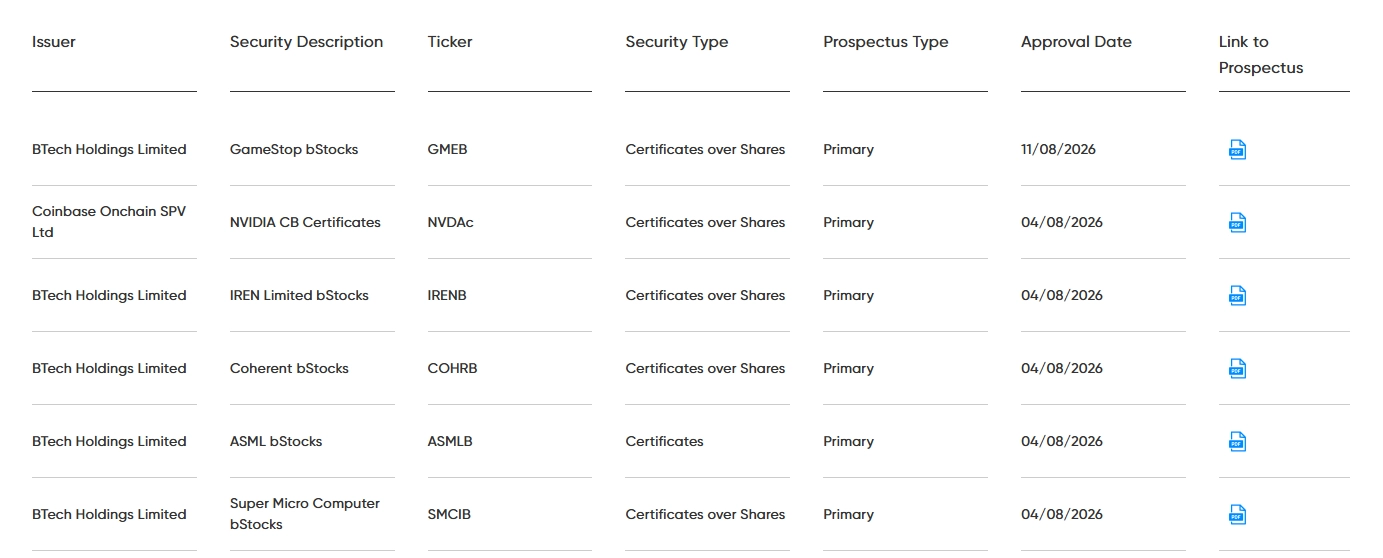
Most existing linked-security platforms obtain prospectus approval for their tokenized stocks from Liechtenstein’s FMA, which allows them to distribute those securities across the EU and EEA.
In ADGM, the FSRA is responsible for reviewing and approving prospectuses for tokenized securities.
Once the prospectus is approved, the security can be publicly offered in ADGM. The issuer can then pursue listing, and if RIE approval is also obtained, the security can be traded on an ADGM-regulated exchange.
4. Other Reasons ADGM Is Attractive
I was also curious what else makes ADGM attractive to tokenization businesses, so I asked Ganesh Mahidhar from Further, an Abu Dhabi-based VC and one of Four Pillars’ proud investors.
He highlighted four points:
- Strong regulatory credibility: ADGM and the FSRA are generally viewed as more stringent regulators than traditional offshore SPV jurisdictions such as Cayman or BVI. From an institutional investor perspective, ADGM is also seen as a more credible financial hub.
- Deemed Securities framework: The FSRA focuses on the substance of the product rather than the form, such as whether it uses a token or DLT. If the economic rights and obligations resemble those of a traditional security, the asset can be treated as a security within the same regulatory framework, which simplifies compliance.
- Stronger link between onchain rights and legal rights: ADGM legally recognizes Ledger-Based Securities and Digital Securities, which allows tokens to be linked directly to actual securities rights rather than being treated as a simple digital representation.
- Existing regional presence: Binance is already regulated in ADGM, while Coinbase has also been expanding its presence in the Middle East. That makes ADGM a natural choice for leveraging existing regulatory relationships and infrastructure.
5. Could ADGM Become the Next Tokenization Hub?
Coinbase and Binance, two of the largest exchanges in the world, have now launched tokenized stock products through ADGM. Based on these examples, ADGM has already shown that it can be an attractive jurisdiction for tokenization businesses.
As the RWA sector grows, demand for tokenization will only increase. The key question now is whether more companies will choose to build their tokenization businesses around ADGM.
The author of this report may have personal holdings or financial interests in assets or tokens discussed herein. However, the author affirms that no transactions have conducted using material non-public information obtained in the course of research or drafting. This report is intended solely for general information purposes and does not constitute legal, business, investment, or tax advice. It should not be used as a basis for making any investment decisions or as guidance for accounting, legal, or tax matters. Any references to specific assets or securities are made for informational purposes only and should not be construed as an offer, solicitation, or recommendation to invest. The opinions expressed herein are those of the author and may not reflect the views of any affiliated institutions, organizations, or individuals. The opinions and analyses expressed herein are subject to change without prior notice. In addition, beyond the individual disclosures included in each report, Four Pillars, may hold existing or prospective investments in some of the assets or protocols discussed herein. Furthermore, FP Validated, a division of Four Pillars, may already be operating as a node in certain networks or protocols discussed herein or may do so in the future. Please see below links in the footer for FP Validated's participating network disclosures and for broader disclosure details.


