1. Cashcat, A Midsummer Night's Dream
If I had to pick the hottest keywords in the crypto community in July 2026, they would easily be Cashcat and Noxa. Noxa was a token launchpad built on the Robinhood Chain, and Cashcat was by far the biggest meme token launched through it.
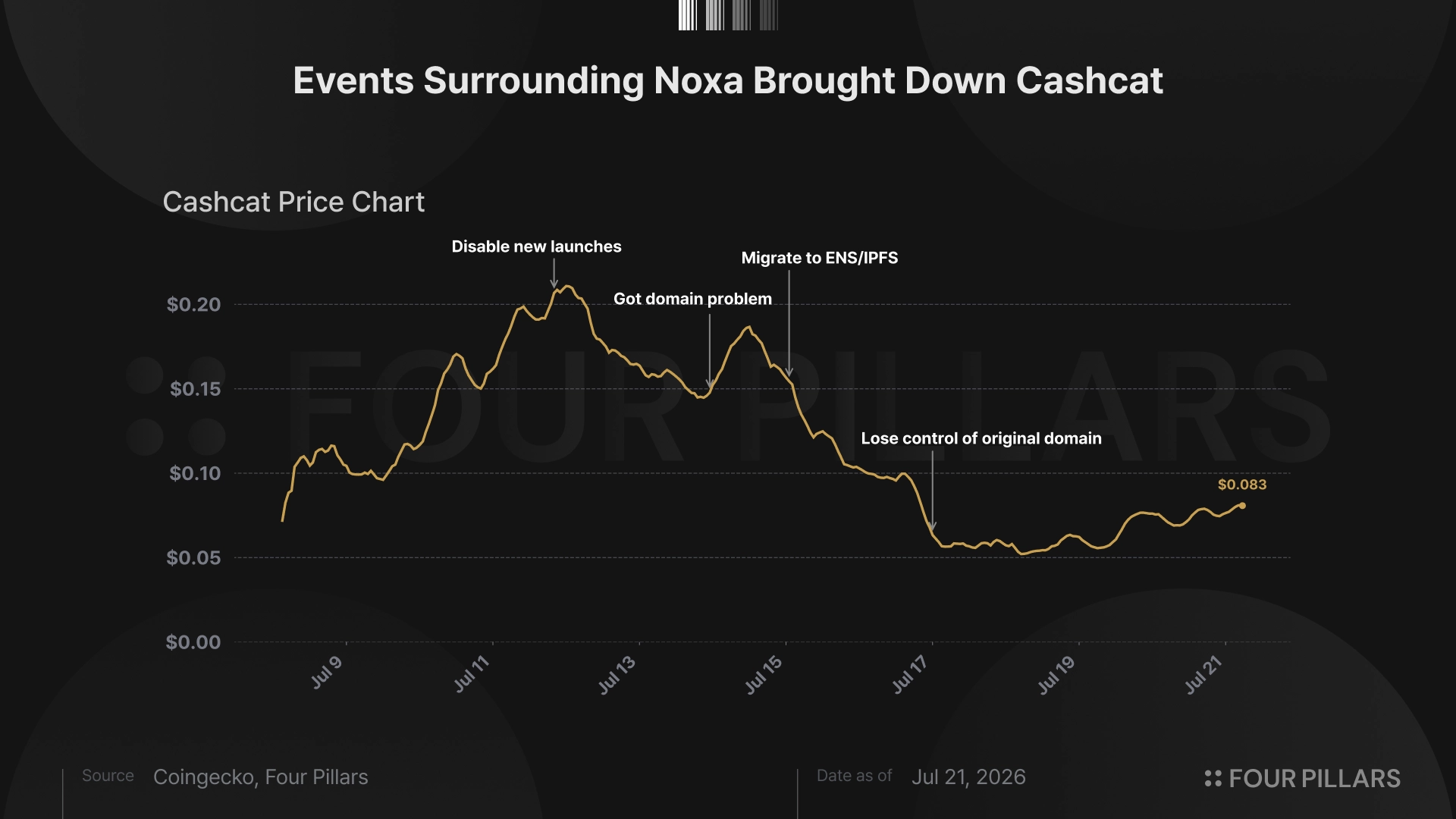
Cashcat came with an interesting story. It was said to be one of the names Robinhood's co-founders had considered in the company's early days. After the Robinhood Chain mainnet went live, the token exploded from a market cap of under $1 million to over $100 million in just one week, eventually peaking at around $220 million. It looked like the next big meme coin success story. But that story did not last very long, largely because of Noxa.
While Noxa was the leading token launchpad on the Robinhood Chain, its design was a bit different from Pump, the dominant launchpad on Solana. Pump starts with a bonding curve and migrates liquidity to an LP once the token reaches a certain market cap. Noxa took a different route by placing liquidity directly into a Uniswap V3 LP pool from day one.
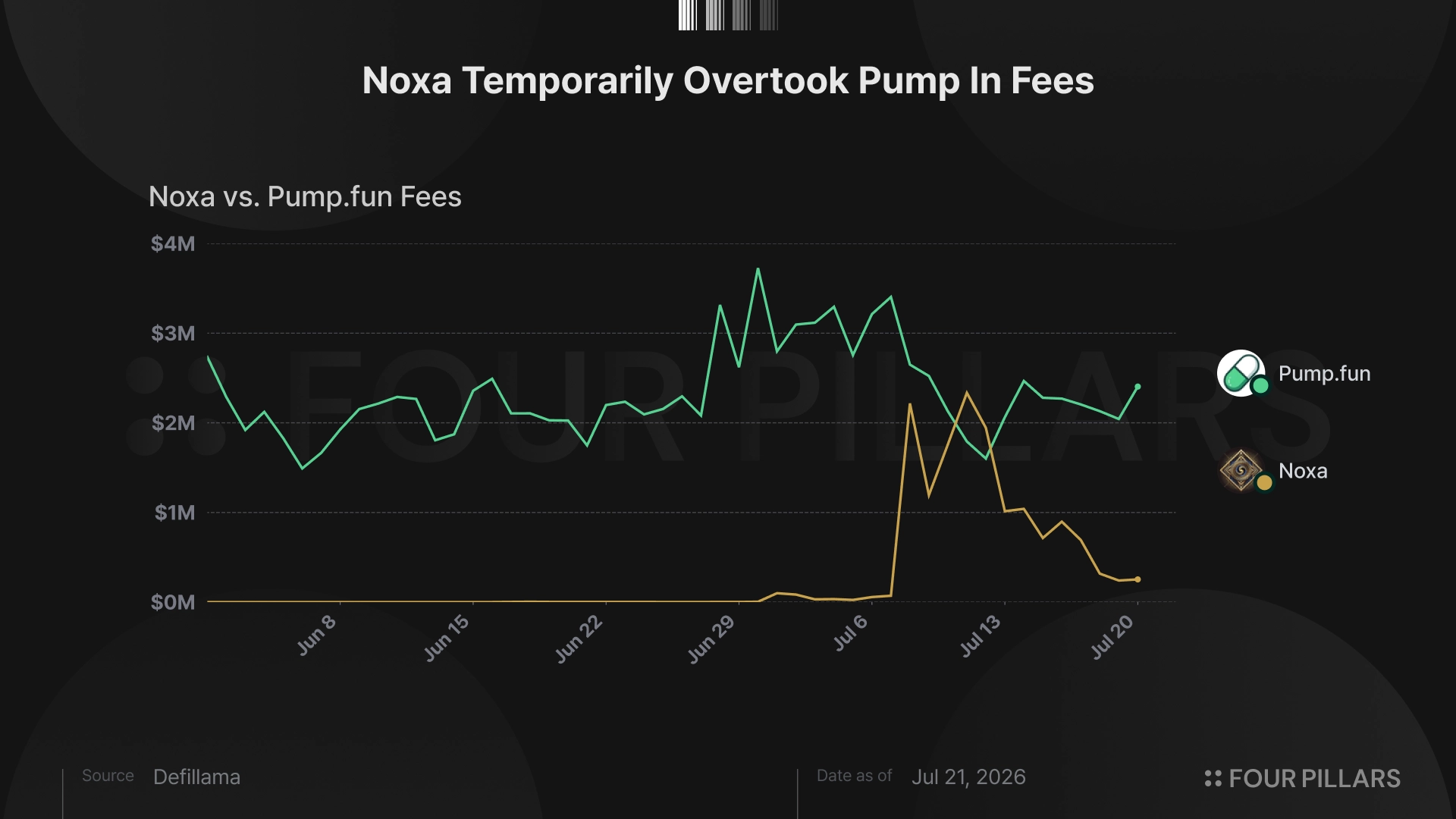
Led by Cashcat, the Robinhood Chain meme coin ecosystem grew at an incredible pace, and Noxa captured most of that momentum. Starting on July 8, trading volume surged, with the platform processing between $100 million and $250 million in daily volume. On July 11 and 12, it generated $2.33 million and $1.94 million in daily fees, even surpassing Pump on Solana. For a protocol on a brand new chain, those numbers were pretty remarkable.
Unfortunately, a series of events surrounding Noxa quickly brought the Cashcat hype to an end. On July 11, Noxa paused new token launches to reduce spam. Then things got even worse on July 13, when domain issues made the website inaccessible. The team tried to migrate to an ENS and IPFS based domain, but after tweeting on July 17 that they had lost control of the original domain, they stopped communicating altogether.
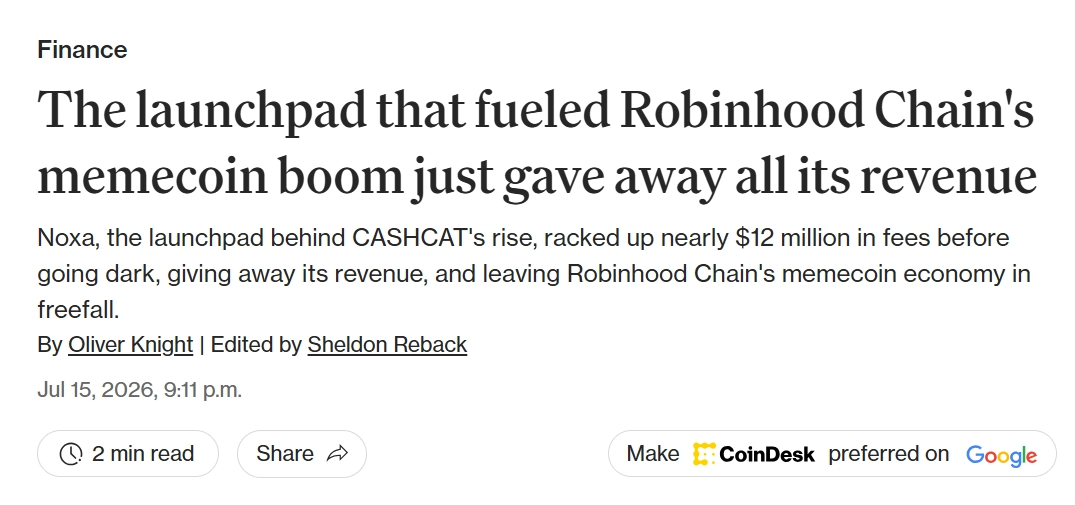
A paused product, an inaccessible website, and a lost domain are exactly the kind of things that make users suspect a soft rug. It was hard to believe that the team behind a product generating $2 million to $3 million in daily fees could suddenly disappear without an explanation. With no clear information available, CoinDesk published an article claiming that Noxa had made $12 million before vanishing, and Cashcat's price quickly collapsed.
2. Did Noxa Really Disappear?
To be fair, there is still no definitive proof that Noxa actually disappeared. The team blamed domain issues, while the community and media largely assumed it was a soft rug. Interestingly, on-chain data paints a different picture. A article by The Smart Ape on X covers this in detail, and here are the key takeaways:
- Only 35% of Noxa's fees went to the platform. The $12 million figure mentioned by CoinDesk referred to total fees generated. Based on on-chain data, the team's actual revenue was closer to $2.8 million. Those funds are still sitting on-chain and were never sent to exchanges or mixers.
- Noxa even renewed its ENS domain registration for another 100 years. If the team had planned to rug, spending around $16,000 to secure the project's domain for a century would not make much sense.
- The team gradually reduced its share of platform fees from 35% to 25%, and eventually all the way down to 0%.
- Looking at the domain history, hosting records, and other available evidence, it seems more likely that the team genuinely ran into domain issues, failed to communicate properly, and eventually disappeared. That looks quite different from a typical soft rug.
3. After Noxa
Whether Noxa was a soft rug or a project that genuinely wanted to recover, the outcome was ultimately the same. The team failed to communicate with users, Cashcat crashed, and the momentum behind the Robinhood Chain meme coin ecosystem faded almost overnight.
So, is the Robinhood Chain meme coin story over? Did the ecosystem, which was supposed to be all about tokenized stocks, end up missing both tokenized stocks and the meme coin opportunity? The data suggests otherwise.
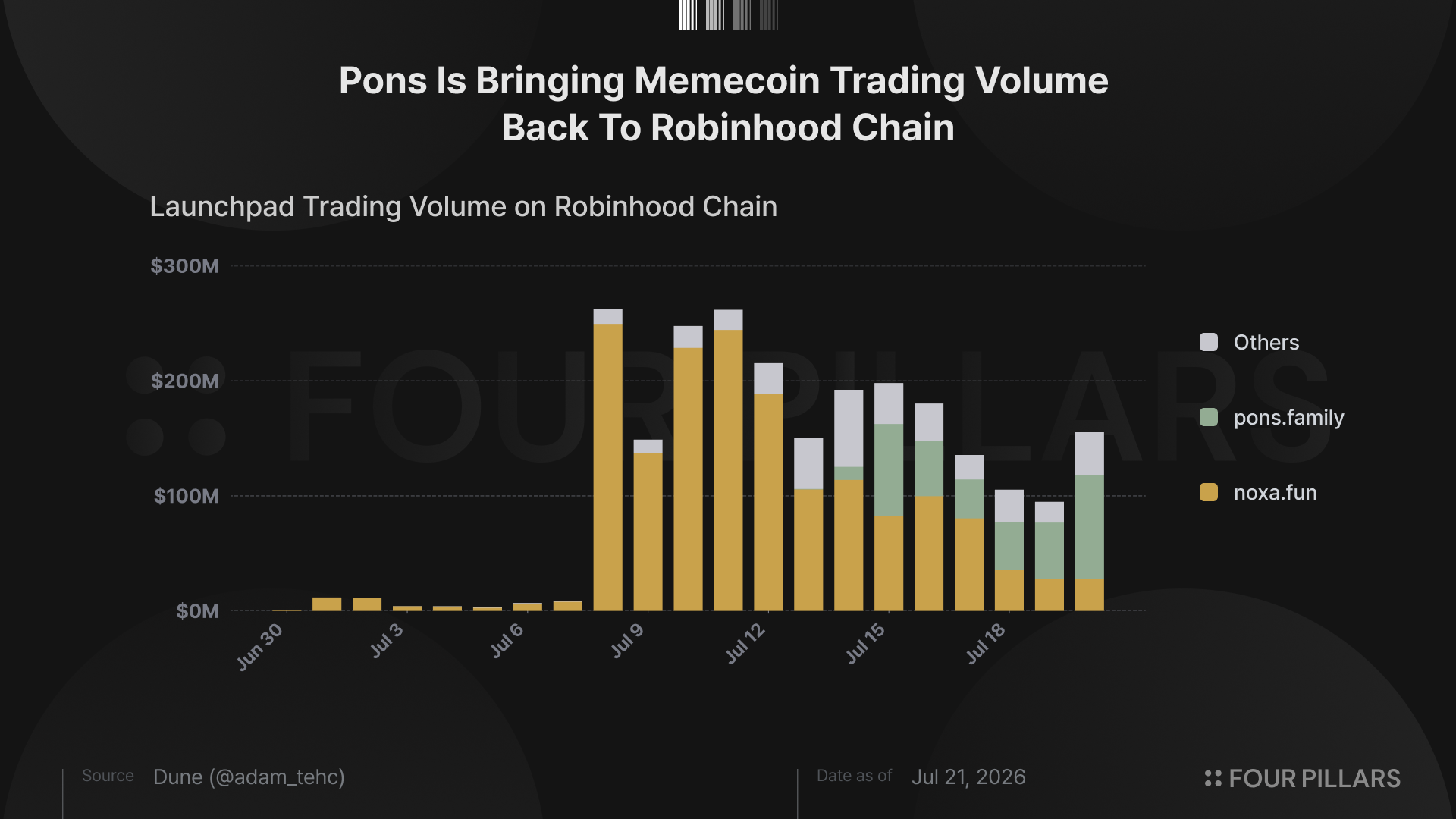
Trading volume for tokens launched through Noxa definitely dropped, and overall meme coin activity cooled off. However, things started picking up again with the arrival of a new launchpad called Pons.
Pons was created by Ozzy in just one day after Noxa stopped allowing new token launches. Thanks to perfect timing, a Pump-style launch mechanism, and extremely fast execution, it quickly gained traction. Today, Pons accounts for 58.1% of meme coin trading on the Robinhood Chain and has become the main driver behind the ecosystem's recovery. At one point, even the PONS token surged after Robinhood CEO Vlad followed the Pons founder on X.
Although Noxa ultimately failed, it also played a huge role in bringing liquidity into the Robinhood Chain ecosystem. Protocol TVL on the chain climbed to around $454 million, putting it above OP Mainnet and roughly on par with Sui. Stablecoin market cap on the chain also reached $425 million.
That liquidity could become the foundation for Robinhood's bigger vision of tokenized stocks. There are still not many protocols that make use of Stock Tokens on the Robinhood Chain, but the total value of Stock Tokens has steadily climbed to around $18 million. If new protocols allow tokenized stocks to be used as collateral for lending or as margin for trading, the ecosystem could have plenty of room to grow.
The rise and fall of Noxa feels like the kind of growing pains that many new blockchain networks go through. Every new ecosystem runs into setbacks before it matures. The Robinhood Chain has already built a strong meme coin community, and now it has a chance to expand into tokenized stocks as well. The next question is whether Pons can kick off a second meme coin frenzy, and whether new protocols built around Stock Tokens can unlock the next stage of growth. It will be interesting to see how that plays out.
The author of this report may have personal holdings or financial interests in assets or tokens discussed herein. However, the author affirms that no transactions have conducted using material non-public information obtained in the course of research or drafting. This report is intended solely for general information purposes and does not constitute legal, business, investment, or tax advice. It should not be used as a basis for making any investment decisions or as guidance for accounting, legal, or tax matters. Any references to specific assets or securities are made for informational purposes only and should not be construed as an offer, solicitation, or recommendation to invest. The opinions expressed herein are those of the author and may not reflect the views of any affiliated institutions, organizations, or individuals. The opinions and analyses expressed herein are subject to change without prior notice. In addition, beyond the individual disclosures included in each report, Four Pillars, may hold existing or prospective investments in some of the assets or protocols discussed herein. Furthermore, FP Validated, a division of Four Pillars, may already be operating as a node in certain networks or protocols discussed herein or may do so in the future. Please see below links in the footer for FP Validated's participating network disclosures and for broader disclosure details.