


Table of Contents
Researcher

*This is a joint research initiative on “Asia CEX Research” with SurfAI. (Link to the Announcement)
The CEX plays a different role in Asia than in the West. Retail traders tend to rely on exchanges rather than taking sovereignty over their own assets through non-custodial wallets. That reliance grew strongest in Korea, where regulation restricted the on/off ramp to only 5 licensed CEX.
1. Korea CEX is the Only Door to Crypto.
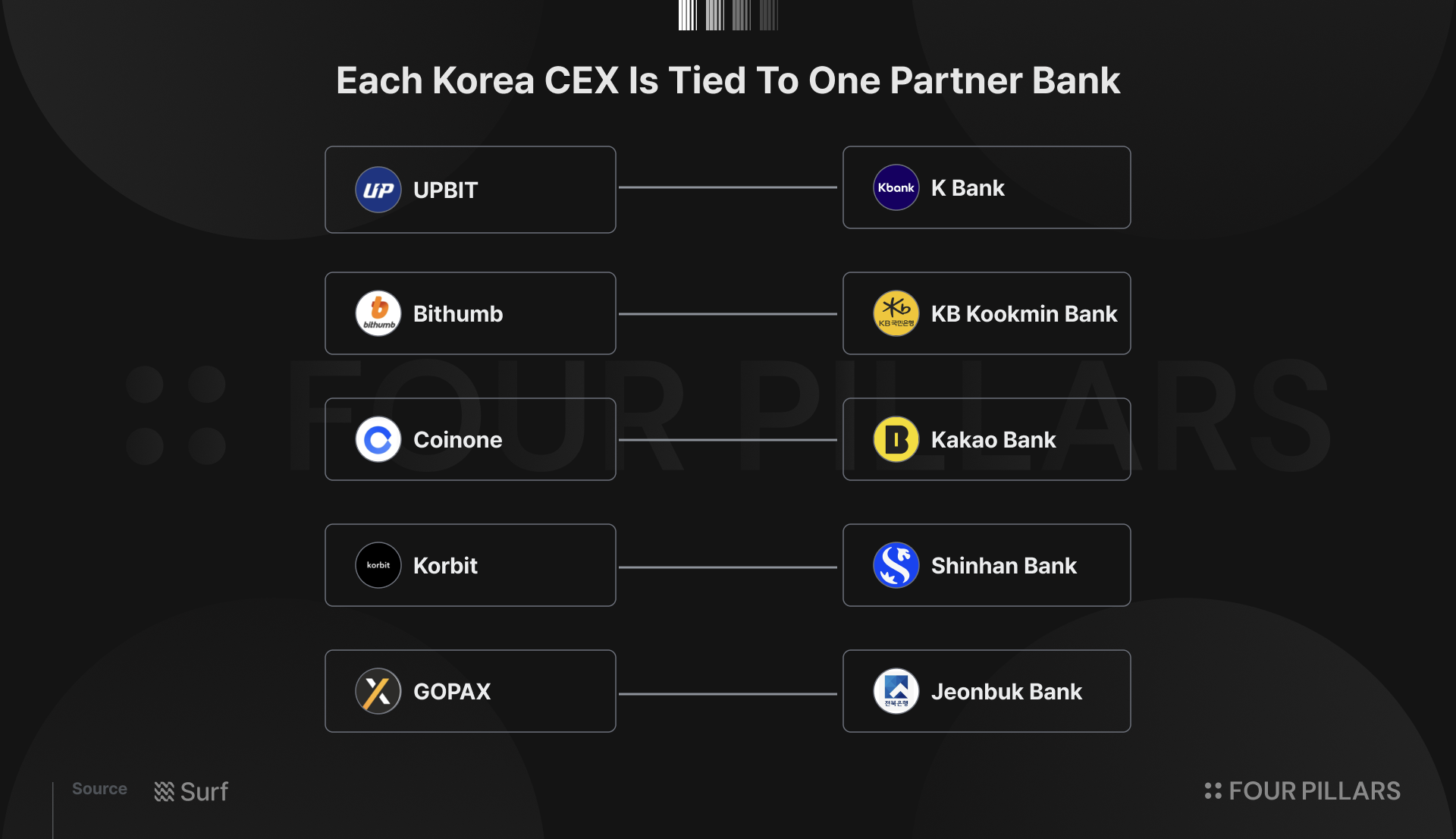
Converting Korean won into crypto, and back out again, runs through a single tightly controlled channel, a CEX account linked to a real name verified bank account at the one bank each exchange is permitted to partner with.
Ever since the Financial Services Commission's real name system took effect on January 30, 2018, deposits and withdrawals are allowed only between a user's bank account and an exchange account opened at the same bank. There are no third party transfers, no anonymous virtual accounts, and originally no foreigners or minors.
Every virtual asset service provider (VASP) must register with the Korea Financial Intelligence Unit (KoFIU) before operating in Korea. Registration itself demands an ISMS certification from the Korea Internet and Security Agency plus full AML compliance systems, yet clearing that bar only permits crypto to crypto trading.
Opening a KRW market requires one more credential, a real name banking contract. Banks bear the compliance risk of these contracts, so they grant them sparingly, and most registered VASPs remain coin only venues. In the end, only five exchanges cleared both gates, VASP registration and a real name banking contract, to offer fiat to crypto conversion. Each is locked to a single partner bank.
2. TradFi Is Absorbing CEX, at the Bottom of the Cycle
For years, Korea's crypto exchanges and its traditional financial institutions lived in separate worlds, kept apart by the long standing regulatory principle of separating finance from crypto.
That principle is called Finance and Crypto Separation(금가분리) was never fully codified in law, but financial authorities consistently enforced it, and banks and brokers were effectively barred from operating crypto businesses. In 2026 that line started to get blurred. Within roughly four months, three of Korea's Big 4 exchanges each took on a major TradFi shareholder.
Now an exchange is no longer valued merely as a trading fee machine, but as a customer touchpoint and liquidity venue for the next phase of Korean finance: won pegged stablecoins, custody, and RWA products. Buying equity is the fastest way for a bank or broker to secure a VASP foothold, an existing user base, and deep KRW liquidity before full regulatory clarity arrives under the Digital Asset Basic Act (DABA).
The scramble is also a race against the clock. The Financial Services Commission is expected to cap any single major shareholder's stake in a crypto exchange at 20% under DABA, agreed on March 3, 2026. Over the past four months, there have been two major events. Later this year, another the key case to pay attention is whether the merger between Upbit and Naver Financial will go through.
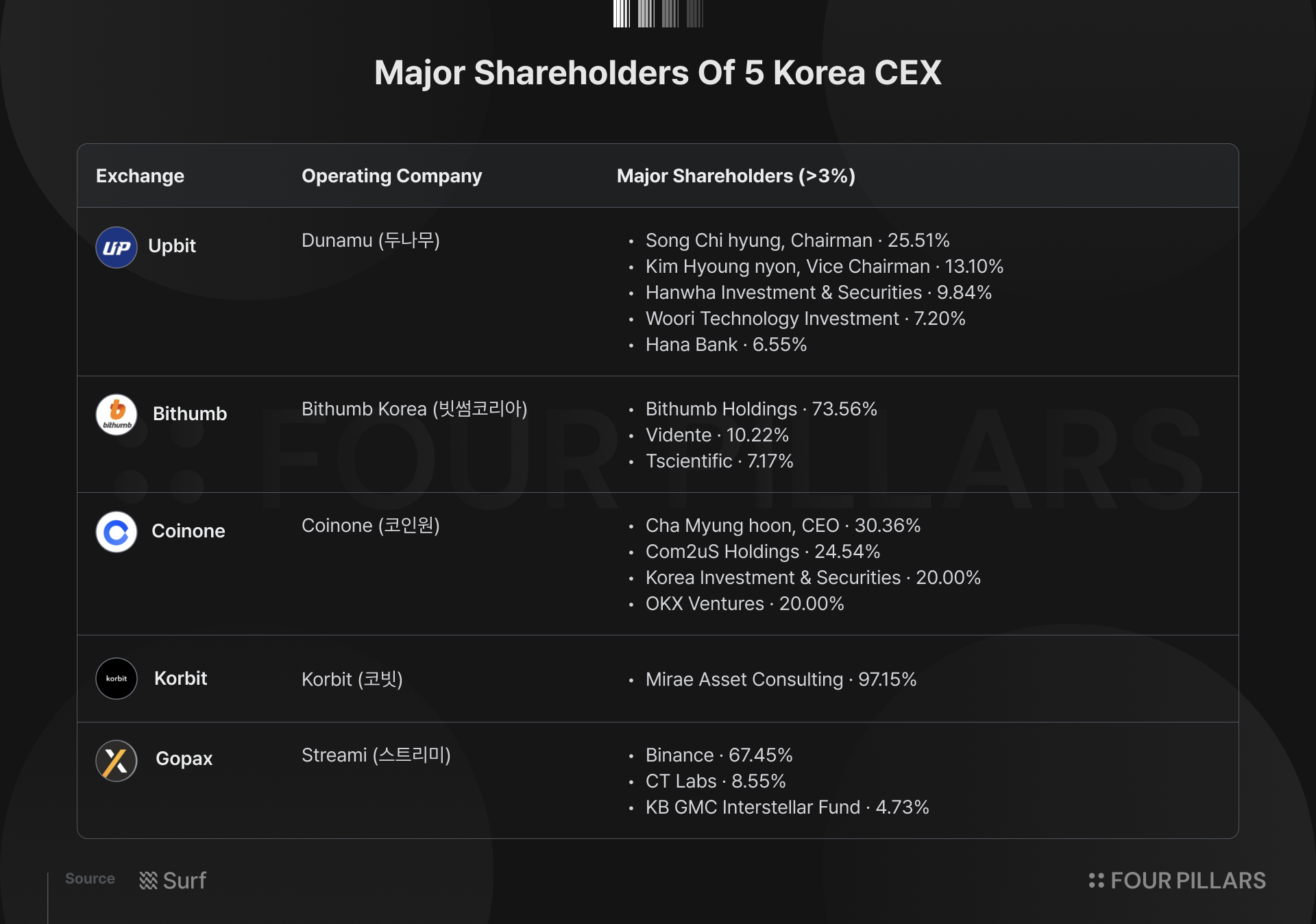
- Case 1: Korbit and Mirae Asset, the First Mover (Feb 2026). Mirae Asset, Korea's largest securities firm, acquired 91.7% of Korbit for about $92M, buying out NXC and SK Square. It also announced to acquire additional 5.42%, leading up to 97.15%. With Korbit's market share at about 1%, it was a bet on infrastructure for the license, custody, and experience, rather than volume.
- Case 2: Upbit and Hana Financial, the Largest and Meaningful Deal (May 2026). Hana Financial Group agreed to buy a 6.55% stake in Dunamu, from Kakao Investment for about $667M. This was the country's first major equity deal between a traditional banking group and a digital asset firm.
- Case 3: Coinone, OKX Ventures, and Korea Investment & Securities (May 2026). OKX Ventures and Korea Investment & Securities (KIS) each invested about $53M for a 19.6% stake in Coinone, Korea's third largest exchange, split two ways to stay under the expected 20% DABA cap while the CEO keeps management control.
3. Too Big to Ignore
What TradFi is buying is not a fee stream but the won denominated on/off ramp itself. In a market where only five licensed CEXs can convert KRW into crypto, owning exchange equity means owning the pipe between Korean retail savings and digital assets.
Seen this way, the volume slump barely matters to the acquirers, because the value of a legally protected channel is structural rather than cyclical.
Acquisition is also the fastest license. Building a VASP registration and a real name banking contract from scratch would take a bank or broker years, with no guarantee that regulators or partner banks would ever say yes.
Also, the acquirable inventory is running out. Korbit is taken, Coinone is in play, and Upbit and Bithumb are both too large and can be potentially capped at 20% ownership under the expected DABA rule. Expect the remaining deals to close at valuations that look irrational on fee metrics but entirely rational as strategic options on the KRW ramp.
Now crypto is too big to ignore for traditional finance companies.
The author of this report may have personal holdings or financial interests in assets or tokens discussed herein. However, the author affirms that no transactions have conducted using material non-public information obtained in the course of research or drafting. This report is intended solely for general information purposes and does not constitute legal, business, investment, or tax advice. It should not be used as a basis for making any investment decisions or as guidance for accounting, legal, or tax matters. Any references to specific assets or securities are made for informational purposes only and should not be construed as an offer, solicitation, or recommendation to invest. The opinions expressed herein are those of the author and may not reflect the views of any affiliated institutions, organizations, or individuals. The opinions and analyses expressed herein are subject to change without prior notice. In addition, beyond the individual disclosures included in each report, Four Pillars, may hold existing or prospective investments in some of the assets or protocols discussed herein. Furthermore, FP Validated, a division of Four Pillars, may already be operating as a node in certain networks or protocols discussed herein or may do so in the future. Please see below links in the footer for FP Validated's participating network disclosures and for broader disclosure details.


