


Table of Contents
Researcher

[News] Project Hangang Expands from a Stablecoin Alternative to a Discussion on Government Bond Tokenization
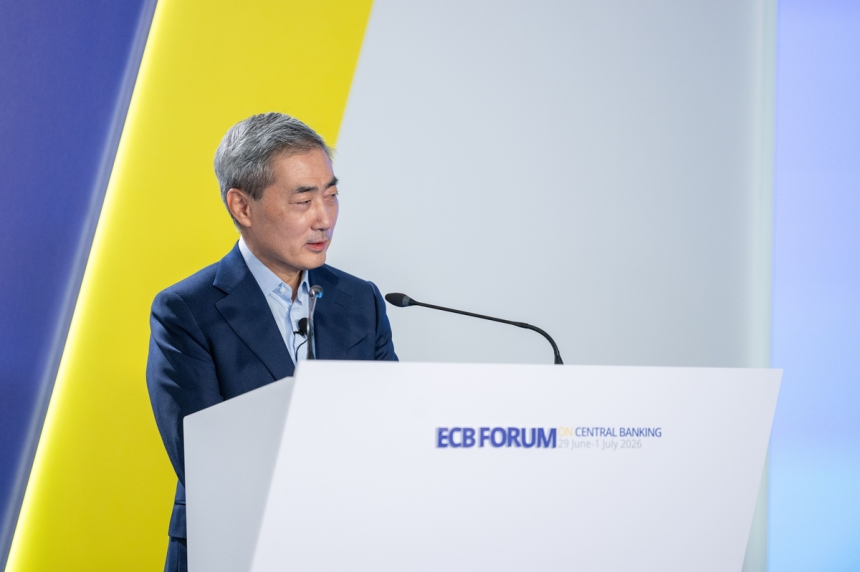
Bank of Korea Governor Hyun Song Shin presented a paper titled Practical Implementation of a Unified Ledger: Lessons from Project Hangang at the European Central Bank Forum in Sintra, Portugal, on July 1. The paper proposed a structure in which institutional digital money and private bank deposits are settled on a single ledger based on central bank trust. The Bank of Korea described this as a direction that strengthens the public monetary system rather than private stablecoins.
On the same day, Governor Shin also mentioned the need to tokenize assets such as government bonds. He explained tokenization not simply as moving money into numbers on a screen, but as embedding transaction conditions and execution rules together. This suggests that payment and settlement experiments could expand from deposit tokenization to asset tokenization involving government bonds and equities.
Ledger Insights noted that the Bank of Korea’s Project Hangang paper barely addressed privacy issues. Seven banks participated in Phase 1 of Project Hangang, and participation expanded to nine banks in Phase 2. The fact that the Bank of Korea directly released the paper on the international stage suggests that this experiment has moved beyond research and onto the agenda for future financial infrastructure reform.
[Commentary] Not a Stablecoin Alternative, but a Redesign of Bank Ledgers
The Bank of Korea’s latest announcement should be read not as simple CBDC research, but as an attempt to redesign the ledger structure of the banking system. The core idea is to connect central bank money and bank deposits on a single unified ledger. This is not merely a defensive logic aimed at blocking private stablecoins. Rather, it is closer to a public infrastructure strategy that seeks to place deposits, government bonds, and settlement conditions within the same execution environment.
Structurally, Project Hangang is moving from issuance to use. If Phase 1 confirmed the feasibility of interbank settlement and tokenized deposits, this announcement opened the path to bringing assets such as government bonds and equities onto the ledger as well. However, the criticism that privacy has not been sufficiently addressed is important. A unified ledger increases efficiency, but where transaction information and authority are allocated becomes central to trust.
From a comparative perspective, Korea has brought central bank-led ledger design to the international stage before legalizing private stablecoins. Japan is bringing stablecoin use into the institutional framework through its amended Payment Services Act and private payment service providers, while Hong Kong is handling licensing and the tokenized bond market in parallel. Among the three, Korea is taking the most public-ledger-centered approach. This appears to be a choice to digitize a bank-centered financial system while keeping issuance authority and settlement unity anchored to the central bank.
The question going forward is whether Project Hangang can move beyond experimentation and become actual market infrastructure. If government bond tokenization is included, the scope expands beyond payments and settlement to government cash management and securities settlement. At that point, the allocation of authority among banks, the Korea Securities Depository, and financial regulators will also need to be clarified. If privacy and governance conditions are properly aligned, Korea’s unified ledger could become not a stablecoin alternative, but the starting point for public digital financial infrastructure.
The author of this report may have personal holdings or financial interests in assets or tokens discussed herein. However, the author affirms that no transactions have conducted using material non-public information obtained in the course of research or drafting. This report is intended solely for general information purposes and does not constitute legal, business, investment, or tax advice. It should not be used as a basis for making any investment decisions or as guidance for accounting, legal, or tax matters. Any references to specific assets or securities are made for informational purposes only and should not be construed as an offer, solicitation, or recommendation to invest. The opinions expressed herein are those of the author and may not reflect the views of any affiliated institutions, organizations, or individuals. The opinions and analyses expressed herein are subject to change without prior notice. In addition, beyond the individual disclosures included in each report, Four Pillars, may hold existing or prospective investments in some of the assets or protocols discussed herein. Furthermore, FP Validated, a division of Four Pillars, may already be operating as a node in certain networks or protocols discussed herein or may do so in the future. Please see below links in the footer for FP Validated's participating network disclosures and for broader disclosure details.


