


Table of Contents
Researcher

1. Taiwan's Virtual Asset Service Act and Its Separated Stablecoin Regime
This week, Taiwan finally gained its own foundational law for crypto assets. It targets enforcement as early as the beginning of 2027. The new law divides virtual asset service providers (VASPs) into seven categories, including exchanges, custody, and lending, and requires a separate license application for each category. Its core is the shift from a simple registration system to a licensing system, tightening supervision.
The most notable item is the stablecoin regulation. The law clearly distinguishes between New Taiwan dollar-pegged stablecoins and foreign stablecoins. A stablecoin issued within Taiwan is institutionally valid only if pegged to a fiat currency, and the issuer must obtain approval from both the Central Bank of Taiwan and the Financial Supervisory Commission (FSC).
Reserve assets must be held 100% in safe assets such as government bonds and New Taiwan dollar legal tender, kept in a separate trust, and paying interest to holders is prohibited. As the entities capable of meeting these requirements are effectively narrowed to banks, the structure has become a conservative, bank-centered one.
Meanwhile, USDT and USDC are treated as commodities (regulated commodity) in Taiwan. Their classification is clarified as regulated tradable assets rather than currency or a means of payment. They can be circulated only after being listed on a legal exchange within Taiwan and receiving the FSC's consent. It is a structure that does not block their use itself but strictly controls their distribution path.
Under this legal framework, Taiwan opens the asset function of dollar stablecoins (holding and trading them) while closing the currency function (paying and settling with them). They can be traded, but the path for them to enter the New Taiwan dollar payment order and be used like money is blocked. This carries three policy implications:
- Defending monetary sovereignty: By not recognizing dollar stablecoins as a domestic means of payment, it separates private dollarization from the New Taiwan dollar payment order.
- Separation from payment infrastructure: By placing foreign stablecoins as regulated assets traded on exchanges, it allows circulation but restricts their expansion into merchant payment and remittance infrastructure.
- Investor management and AML strengthening: By allowing circulation only through licensed exchanges, it makes it easier for authorities to manage listing reviews, transaction tracking, delisting, and customer verification procedures.
2. Four Ways Asian Countries Approach USDC and USDT
Taiwan's stablecoin legislation once again brings to mind the direction Asia shares. Asian countries institutionally pin down USDT and USDC, which had been in a gray zone, as foreign dollar assets rather than onshore currency, and seek to handle them within regulated distribution paths.
Placing the major Asian jurisdictions side by side, the only country that fully bans USDT and USDC is roughly China, while the rest mostly converge on controlling the distribution path. The difference is classified by how narrowly they open that path.
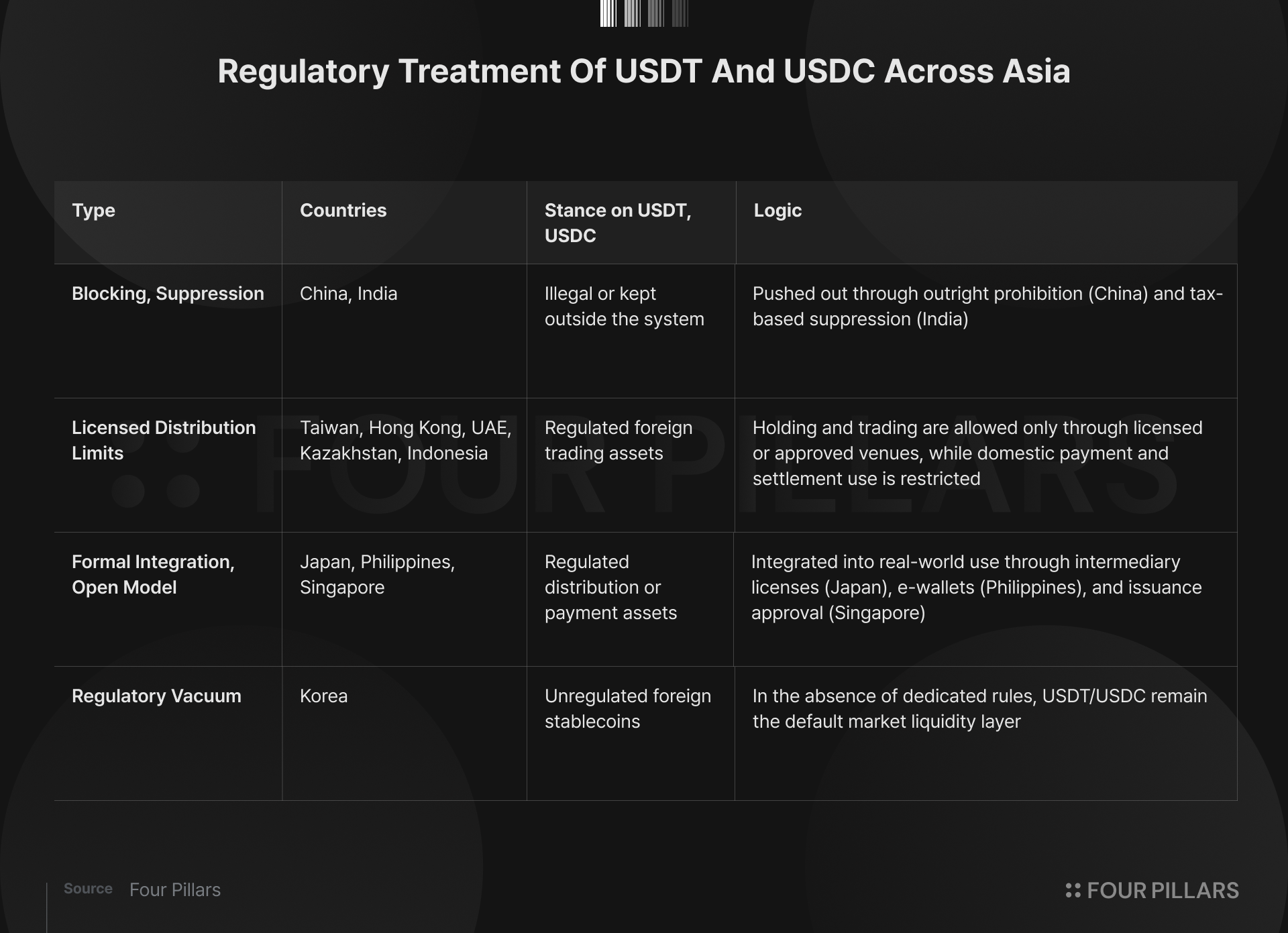
Depending on the purpose of regulation and whether a domestic currency-based alternative exists, each country's approach divides into several types:
- Blocking, suppression: To defend monetary sovereignty and foreign exchange stability, they push dollar stablecoins out of payment and investment. China, viewing dollar claims circulating outside the renminbi payment network as a threat to the system, imposed an outright ban, while India suppressed transaction incentives through a 30% tax and a 1% TDS.
- Licensed distribution limits: They define USDT and USDC as assets rather than currency. Holding and trading are allowed within licensed exchanges or special zones, but entry into merchant payment and domestic settlement networks is blocked.
- Formal integration, open model: Rather than excluding USDT and USDC, they bring them within regulated distribution paths. Japan brought in USDC as a foreign-issued electronic payment instrument under the Payment Services Act, alongside its yen lineup (JPYC, JPYSC, Project Pax). The Philippines opened real-world use through e-wallets, and Singapore through issuance approval.
- Regulatory vacuum: Rules do not yet exist. In Korea, with no won stablecoin and legislation delayed, USDT and USDC filled that empty space first.
On closer look, there are also exceptions that accept dollar stablecoins fairly actively. Japan, holding the reserve currency yen, has little concern that its monetary standing would be shaken even if dollar stablecoins enter to some degree, and the Philippines, which relies on overseas remittance capital for 8% of GDP, finds it aligned with its interests to bring them in as a remittance corridor.
Singapore, in a financial hub position, opened even issuance. Conversely, the weaker a currency's standing or the greater the dollarization pressure, the higher the defensive threshold for an emerging economy.
3. What Will Asian Countries' Consolidated Stance Mean for Dollar Stablecoins
Regulation is sharpening the calculus that separates issuers into onshore and offshore. In Asia, where most jurisdictions are wrapping up their regulatory groundwork, the line between stablecoins that remain within the system and those that do not will grow clearer within one to two years.
Also, though we lump them together as dollar stablecoins, the ones actually affected by each country's policy are USDT and USDC, which hold 80% of the market. The variables shaking this oligopoly are emerging simultaneously from both regulation and the market, and the dollar stablecoin landscape has accordingly been shaking hard of late. Going forward, the two issuers' oligopoly, the share between the two, and the rise of non-dollar stablecoins are likely to move faster than expected.
The start was shown first in Europe. Circle obtained a license and brought USDC within the MiCA regime, becoming the only large dollar stablecoin available for circulation to European retail. Tether, on the other hand, did not apply for MiCA authorization, and from late 2024 through the first half of 2025, it was delisted in sequence from EU-regulated exchanges such as Coinbase, Kraken, and Binance.
Of course, USDT does not remain only offshore. Tether is also attempting to enter the regulated system by separately introducing USAT, a compliance-oriented dollar stablecoin timed to the enforcement of the US GENIUS Act.
The same overhaul will soon proceed in Asia as well. Beginning with Korea, where USDT dominates exchanges without dedicated regulation, once the gate of licensed exchange listing and distribution review is set up, USDT and USDC will split toward either being integrated into the system or being filtered out, rather than being left in the unregulated state they are in now.
Accordingly, the points to watch going forward in the USDT and USDC landscape are as follows:
- USDT and USDC look at different markets: USDC has already entered the regulated system in MiCA and Japan, while USDT has remained offshore. The more jurisdictions that allow only licensed distribution increase, the more easily the compliance-complete USDC clears the listing threshold, while USDT, which even refused MiCA, is excluded. The actual effect of regulation may not be lowering the dominance of dollar stablecoins, but rather handing USDT's market over to USDC.
- The market's division is also becoming clearer: In crypto trading and DeFi, dollar stablecoins remain the base currency. This is because liquidity is everything, and the scale of non-dollar stablecoins is markedly small. On the other hand, within the regulated system, Japan's JPYC and Singapore's XSGD (StraitsX) are taking hold as real use cases, and institutional payments too, apart from global banking, are shifting away from USDT and USDC toward deposit tokens and institutional pilots. All are means optimized for each country's financial infrastructure. In the end, as the market splits, the stablecoin landscape also divides into a dollar base layer and domestic currency plus deposit tokens.
- Pressure comes from outside regulation too: When OUSD (Open USD) launched together with partners including Coinbase, the market reacted to it as negative news for Circle. If this consortium model, in which reserve asset revenue is shared with distribution partners rather than monopolized by the issuer, spreads, cracks will form in the revenue base of USDT and USDC. In addition, how each country's regulators receive this initiative, and whether they accept it, is a meaningful point to watch.
The author of this report may have personal holdings or financial interests in assets or tokens discussed herein. However, the author affirms that no transactions have conducted using material non-public information obtained in the course of research or drafting. This report is intended solely for general information purposes and does not constitute legal, business, investment, or tax advice. It should not be used as a basis for making any investment decisions or as guidance for accounting, legal, or tax matters. Any references to specific assets or securities are made for informational purposes only and should not be construed as an offer, solicitation, or recommendation to invest. The opinions expressed herein are those of the author and may not reflect the views of any affiliated institutions, organizations, or individuals. The opinions and analyses expressed herein are subject to change without prior notice. In addition, beyond the individual disclosures included in each report, Four Pillars, may hold existing or prospective investments in some of the assets or protocols discussed herein. Furthermore, FP Validated, a division of Four Pillars, may already be operating as a node in certain networks or protocols discussed herein or may do so in the future. Please see below links in the footer for FP Validated's participating network disclosures and for broader disclosure details.


