

![Memecoins and Tokenized Stocks, Under One Roof [FP Weekly 29]](/_next/image?url=https%3A%2F%2Fkrotgrfjzckvumudxopj.supabase.co%2Fstorage%2Fv1%2Fobject%2Fpublic%2Fassets%2Fimg%2Fcontent%2Farticle%2Fnotion-import%2F2xu585mrivb732.png&w=3840&q=75)
Table of Contents
- 1. Major News
- [Crypto] Robinhood Chain Sees Onchain Volume Surge on Memecoin Frenzy Led by CashCat
- [Institution] EU Reviews Rules for Offshore Stablecoins and Tokenized Assets After MiCA Takes Full Effect
- Others
- 2. Data Spotlight
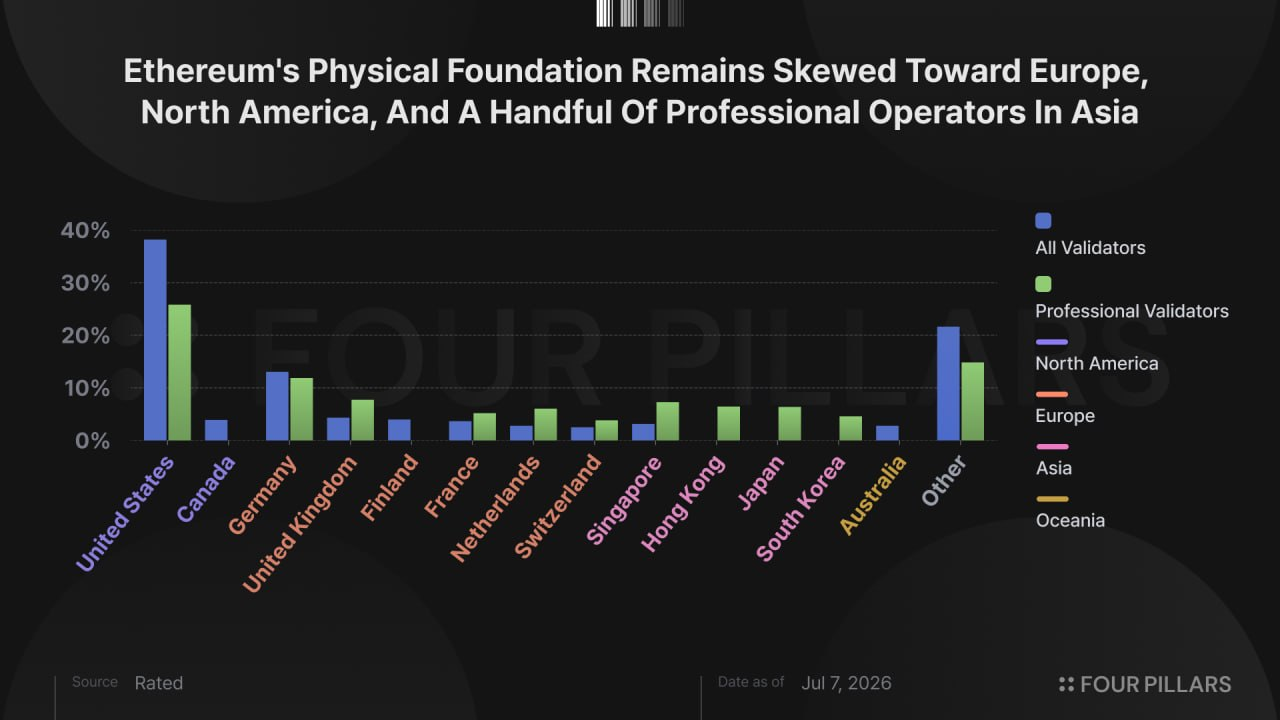
- Is Ethereum really a "world" computer? (Link)
- 3. Four Pillars Weekly
- : : Ondo Perps: The Productive Capital Thesis (Link)
- : : Cadence: Monad's Answer to MEV (Link)
- : : Collector Crypt Has One Question Left (ft. fact-checked by CC) (Link)
- Comments
- 4. Macro & Onchain Metrics
Researcher

1. Major News
[Crypto] Robinhood Chain Sees Onchain Volume Surge on Memecoin Frenzy Led by CashCat
What Happened?
Robinhood Chain, whose mainnet Robinhood launched on July 1, climbed into the top tier of networks by onchain trading volume within a week of launch. Robinhood Chain is an Ethereum L2 built on the Arbitrum stack, introduced as a chain for tokenized stocks and RWAs, with Uniswap, 1inch, and Morpho integrated from day one.
However, what defined the first week's scorecard was not tokenized stocks but memecoins. On July 8, Robinhood Chain's daily DEX volume reached roughly $564M, about a 10x jump in a single day from roughly $59M the day before. Uniswap founder Hayden Adams noted that Robinhood Chain posted the highest Uniswap volume of any chain other than Ethereum mainnet. Daily active addresses reached roughly 193K, of which more than 140K were new wallets. Over 16K tokens were created in a 24-hour span.
The epicenter of the surge is the memecoin $CASHCAT. It is a community-created token built around CashCat, a name Robinhood considered in its early days, with no official ties to the company. Right after CEO Vlad Tenev remarked that Robinhood Chain is being built for RWAs but works great for memes too, the token's price jumped more than 10x in a day and its market cap crossed $100M. CASHCAT alone generated roughly $98M in daily volume, and on the same day Pump.fun added support for Robinhood Chain tokens, opening a path for Solana users to flow in without bridging.
In contrast, the onchain footprint of tokenized assets, the chain's original purpose, stands at roughly $12.6M across some 100 listed securities. A single memecoin's market cap is 8x the size of the chain's entire RWA market.
Researcher's Comment
Robinhood Chain's early traction has reignited the Ethereum bull case. In this volume surge, what deserves more attention than the memecoins themselves is the path of capital and demand flowing toward Ethereum. According to Token Terminal, more than $70M of ETH was bridged to Robinhood Chain in the first week alone. With a traditional brokerage that commands a large customer base and its own distribution choosing an Ethereum L2, the assessment is that Ethereum's standing as the settlement layer for tokenized assets has strengthened further.
However, whether ecosystem expansion translates directly into ETH value appreciation is a separate question. The settlement costs Robinhood Chain pays to Ethereum are negligible, so value return through fee burns is limited. This is why the criticism that L2s are parasitic to the L1 persists. Instead, Ethereum's share of the upside rests on its monetary role, namely how widely ETH is used as the base trading pair, bridge asset, and collateral asset across the L2 ecosystem. Fees can be measured immediately, but monetary effects only become visible after market structure settles in. This is also where bulls and bears diverge while looking at the same data.
Separately from Ethereum, Robinhood's move resembles the path Coinbase already validated with Base. Base, too, saw memecoins and speculative trading account for a large share of transactions in its early days, but grew into one of the largest L2s on the back of the users and liquidity accumulated through that phase.
Robinhood also knows there is no faster way to solve a new chain's cold start problem than speculation. CEO Tenev dismissing memecoins as assets without utility, then responding positively to meme trading days later, reads as a shift in stance after confirming the early liquidity effect.
At least for now, speculation is less the purpose of Robinhood Chain than a customer acquisition tool. The bigger picture lies in the expansion of the business model. A brokerage that has sold order flow through PFOF now internalizes trade execution and settlement infrastructure by running its own sequencer, and its retail customers' onchain activity flows directly into its own revenue. Sequencer revenue, at an annualized run rate of roughly $14M based on the first week's peak, is still small, but it adds another case of exchanges and brokerages expanding revenue streams through their own chains.
The verdict will come after the memecoin cycle cools. The first indicator that will decide the fate of this expansion is how many of this week's 140K new wallets convert to the still-small tokenized stock market.
[Institution] EU Reviews Rules for Offshore Stablecoins and Tokenized Assets After MiCA Takes Full Effect
What Happened?
As of July 1, the transitional period under Europe's crypto-asset regulation MiCA(Markets in Crypto-Assets Regulation) ended and the framework entered full application. During the grandfathering window of up to 18 months that began in December 2024, existing operators could continue business on national registrations alone, but the European Securities and Markets Authority(ESMA) made clear in April that there would be no further extension. Any operator now serving EU clients without a CASP(Crypto-Asset Service Provider) authorization is in breach of EU law and must wind down operations in an orderly manner or exit the EU market.
The scale of the market cleanup was substantial. An estimated 1,100 to 1,300 operators were actively doing business across the EU before MiCA, but as of late June, only around 200 authorized providers appeared on ESMA's register. Roughly 80% of existing operators reached the end of the transitional period without authorization.
The most direct changes appeared in the exchange market. Coinbase, Kraken, OKX, and Bitpanda secured CASP authorizations in member states and can now serve the entire EU, while Binance failed to obtain authorization in time, suspended services for EU clients, and guided users through withdrawals. Authorized exchanges have moved to absorb departing customers, with Coinbase offering incentives to clients transferring assets from other platforms.
The reshuffling of the stablecoin market began earlier. Tether declined to apply for authorization, citing that the high bank deposit ratio required of large e-money tokens(EMT) is incompatible with how it manages reserves. As a result, USDT was delisted from major EU exchanges. In contrast, Circle's USDC and EURC established themselves as EMTs meeting MiCA requirements through the company's French entity.
The European Commission launched a consultation for the MiCA review on May 20, ahead of the transitional period's end. The submission deadline is September 30, and based on the input, the Commission is due to deliver a report on MiCA's application by June 2027, accompanied by legislative amendments if it judges revisions necessary.
Researcher's Comment
The fact that the review began even before the transitional period ended reflects a shift in the object of regulation rather than a failure of MiCA. MiCA was designed in 2023 with crypto-native assets and EU-based operators in mind. Three years on, the market's center of gravity has moved to dollar stablecoins issued offshore and to tokenized securities, and both sit outside MiCA's design scope.
As a result, what full application filtered out was small and mid-sized European operators, while the dollar stablecoins the framework set out to govern continue to circulate from offshore. With 95% of stablecoins worldwide pegged to the dollar and 2025 transaction volume reaching roughly $33T, the US dollar stablecoin strategy, now backed by the institutional foundation of the GENIUS Act, can only read as a monetary sovereignty problem from Europe's standpoint.
Accordingly, the review covers the full breadth of MiCA, from stablecoin and CASP rules to DeFi, tokenized deposits, and the legal nature of tokens. Two issues stand out:
- Multi-issuance risk in stablecoins: When the same stablecoin is issued by both an EU entity and an offshore entity, the tokens are indistinguishable in the market, but reserves, supervision, and redemption obligations are divided by jurisdiction. In a crisis, it is unclear which issuer must redeem how much of the supply, and whether EU supervisors can access offshore reserves. The review directly asks whether this multi-issuance structure should continue to be permitted and whether current safeguards are sufficient.
- Legal nature of tokens and property rights: Tokenized stocks and bonds fall under existing capital markets rules such as MiFID II and MiFIR, but whether holding a token constitutes legal ownership, and how transfers, custody, collateralization, and insolvency claims are handled, varies by member state law. As the tokenization market grows, the relationship between onchain records and legal rights needs to be settled before debates over regulatory scope.
The point to watch is whether the amendments impose equivalence requirements on third-country issuers. If the chosen direction requires offshore issuers to meet MiCA-equivalent standards or establish an EU entity, dollar stablecoin issuers that have served European users without an EU entity will face the double burden of meeting both the US regime for foreign issuers and the European regime for offshore issuers. Asia faces the same question. How to bring offshore dollar stablecoins into the domestic regulatory perimeter is a shared task for Japan, Hong Kong, and Korea, and the design of MiCA 2.0 is likely to serve as the reference baseline for these regulators. The direction of the amendments after the consultation closes in September, particularly the equivalence framework and the treatment of tokenized assets, is the first variable shaping the global regulatory landscape in 2027.
Others
Crypto
- BNB Chain develops a new L1 for AI agent trading, targeting a 2027 mainnet launch
- Aave Labs launches Stable Vaults, offering predictable stablecoin yields for mainstream users
- Bonzo Lend suffers a roughly $9.05 million exploit linked to a vulnerability in Supra’s oracle verifier
- Summer.fi halts Lazy Summer vaults following a $6 million exploit
Institution
- Circle receives final OCC approval to establish Circle National Trust
- Swift launches a blockchain-based shared ledger pilot for tokenized deposits with 17 global banks
- U.S. SEC includes planned rule changes for crypto exchanges and broker-dealers in its 2026 regulatory agenda
- Coinbase secures a U.K. investment services license to offer derivatives and equity trading
- Kraken seeks a banking license in Europe
Tech
- Ethereum Foundation highlights AI agents’ potential to detect bugs while noting their high false-positive rate
- BitGo introduces quantum-resistant protection for institutional Bitcoin wallets
- Ethereum developers back Vitalik Buterin’s long-term rebuilding vision but call for faster execution
- Privy and Jito jointly develop FullSend, a Solana transaction inclusion tool
Investment
- Paradigm raises a $1.2 billion fourth fund targeting frontier technologies including crypto, AI, and robotics
- Gauntlet raises $125 million in a Series C round solely backed by SBI Holdings
- EDX Markets raises $76 million in a Series C round solely backed by SBI Holdings
- Securitize explores acquisitions using its $400 million war chest following its public listing
- Strategy sells 3,588 Bitcoin to raise approximately $216 million
Asia
- Reserve Bank of India moves to prohibit financial institutions from gaining exposure to crypto assets and privately issued stablecoins
- Hyundai Card completes its first live stablecoin remittance PoC using Avalanche and Tether
- Sony Bank receives conditional OCC approval to establish a U.S. trust bank for issuing a dollar-backed stablecoin
- Japan’s SBI Holdings expands its investment in crypto market infrastructure through sole-backed investments in Gauntlet and EDX Markets
2. Data Spotlight
Is Ethereum really a "world" computer? (Link)
3. Four Pillars Weekly
: : Ondo Perps: The Productive Capital Thesis (Link)
- Ondo Perps is the first derivatives platform to enable the use of tokenized equities as margin, eliminating the forced-sell problem that fragments capital across every other platform. Traders can post SPYon and QQQon directly as collateral with the spot exposure stays intact while the capital becomes productive.
- The SGX enclave architecture is a deliberate trust midpoint between CEX and on-chain. Off-chain matching runs inside hardware-encrypted memory the operator cannot access, verified by an attestor network with split key material.
- $1.12B in cumulative volume and $14.8M in open interest within twenty days.
: : Cadence: Monad's Answer to MEV (Link)
- Category Labs, the developer behind Monad, has released Cadence, a Multiple Concurrent Proposers (MCP) consensus protocol. Unlike earlier multi-proposer designs, which paid two extra communication rounds per block for a separate aggregation stage, Cadence embeds multiple proposers into consensus itself and finalizes blocks with the same three-round optimal latency as single-leader consensus.
- Cadence shortens consensus through Extreme Pipelining. Because each block is handled in an independent consensus instance that makes no reference to the previous block, the block interval is fully decoupled from network latency. In a simulation with Monad mainnet's 200 validators, under a 100ms block interval, transactions were included in a proposal within an average of 50ms, with finalization taking an average of 219ms and speculative finality 167ms.
- While Solana's Constellation layers a multi-proposer structure on top of the Alpenglow consensus protocol as a preprocessor, Monad's Cadence redesigns consensus from a blank slate. The difference between the two approaches ultimately comes down to whether to pay extra communication rounds.
- Combining a multi-proposer structure with an encrypted mempool is an attempt to remove, at the protocol level, the very preconditions of MEV: monopoly and information asymmetry. This departs from Ethereum's path of marketizing MEV through auctions. If Cadence is actually deployed, the outlook becomes uncertain for Monad's MEV-coupled liquid staking model, which has resold the leader's ordering rights through auctions and folded the proceeds into staking yields. The excess returns of liquid staking will be restructured from private auction revenue into open fee revenue, and the arena of competition over residual ordering policy will likely shift from the protocol level to the application level.
: : Collector Crypt Has One Question Left (ft. fact-checked by CC) (Link)
- Collector Crypt is a velocity business. The gacha machines keep close to 5 cents of every dollar that passes through them and have for 15 months, through a five-folding of volume to $200.5M a month.
- Every card pulled faces four doors, and the split between them is the business. Nearly everything goes straight back to the machine, with 71.8% of June volume in turbo mode. Keeps run at 1 to 2.5% of rip value, physical redemptions at 2.4 to 3.1% of GMV, and P2P marketplace trading under 1%.
- The same gacha machines increasingly run under other brands. June broke the one-anchor pattern, 21 partner storefronts producing $1.18M with five above $70K each, on the roughly 6% of GMV partners represent.
- The vault is the hidden second business. $23M of below-market inventory has appreciated quietly since token launch, and it ties the machine’s take, the exit spread, and the treasury to a single variable, card prices.
- The token wraps all of it. A Panama foundation holds the IP, the cards, and the treasury, the float trades near 1x machine gross margin, and the same operational wallet that pays machine sellbacks has been funding CARDS buybacks for over a month, verified on-chain, while the mechanism a holder could underwrite remains undocumented.
Comments
- What Changed in the New Ethereum Strawmap
- Technology’s Double-Edged Sword: Prediction Market or Manipulation Market?
4. Macro & Onchain Metrics
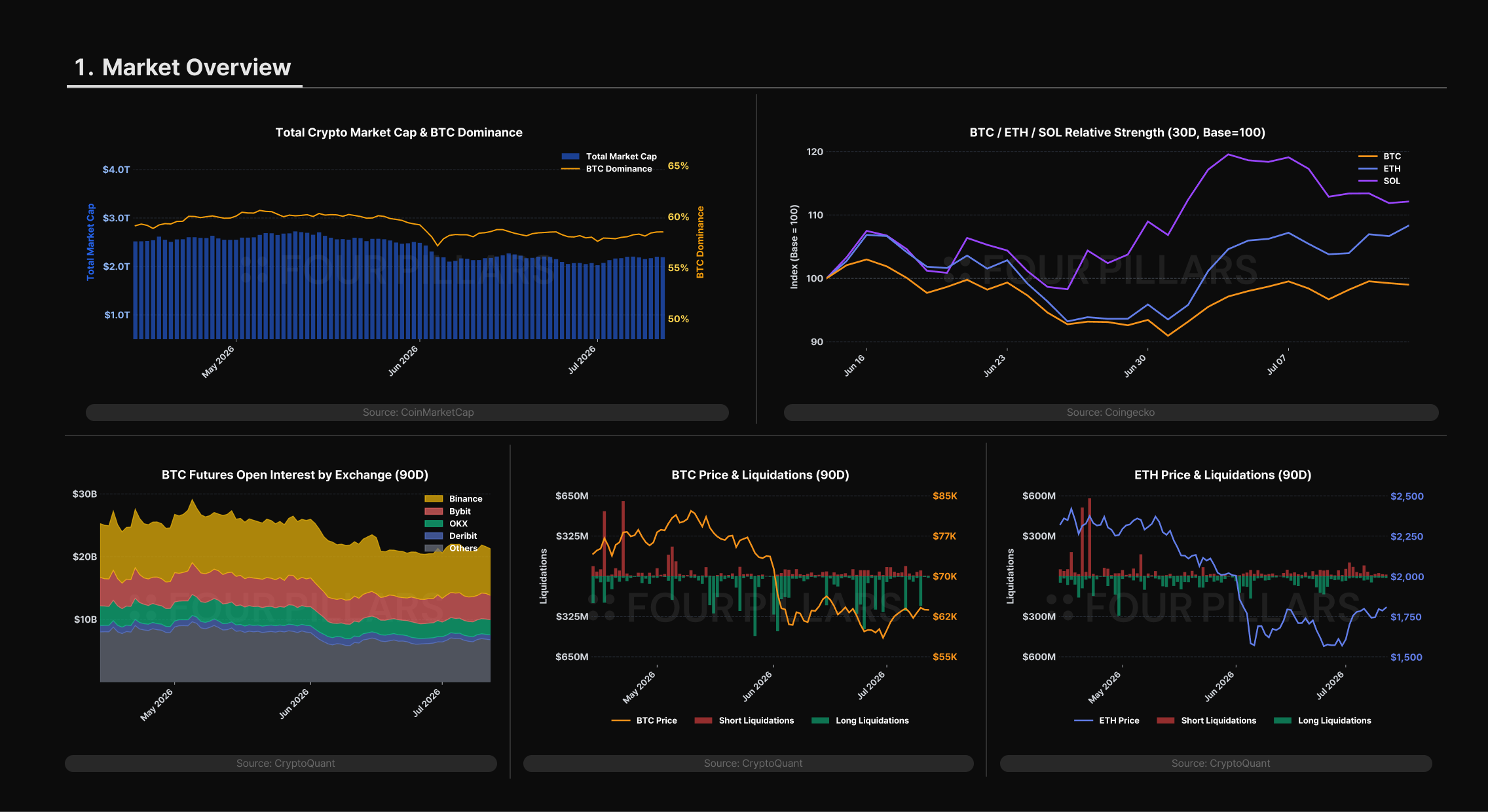
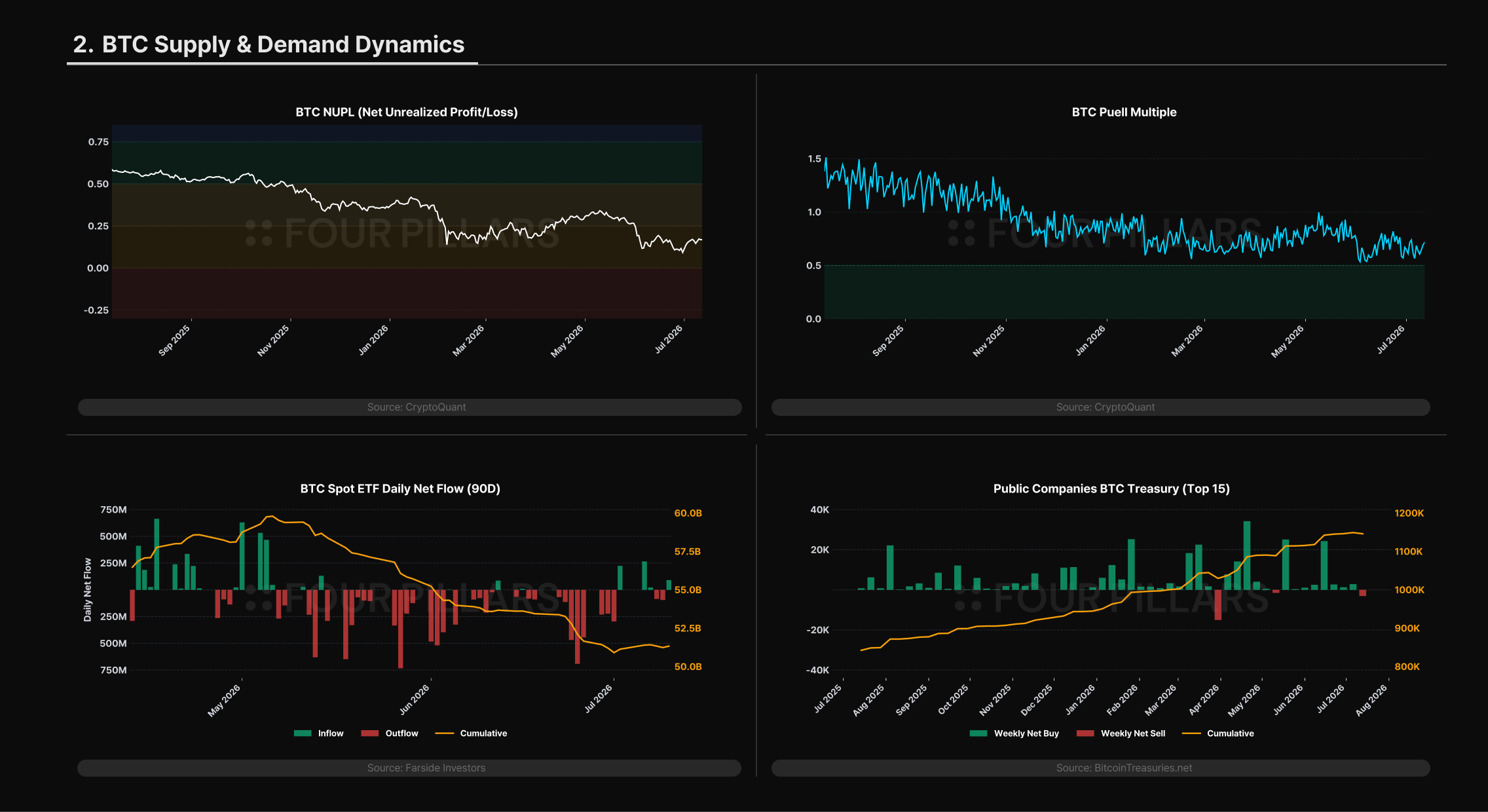
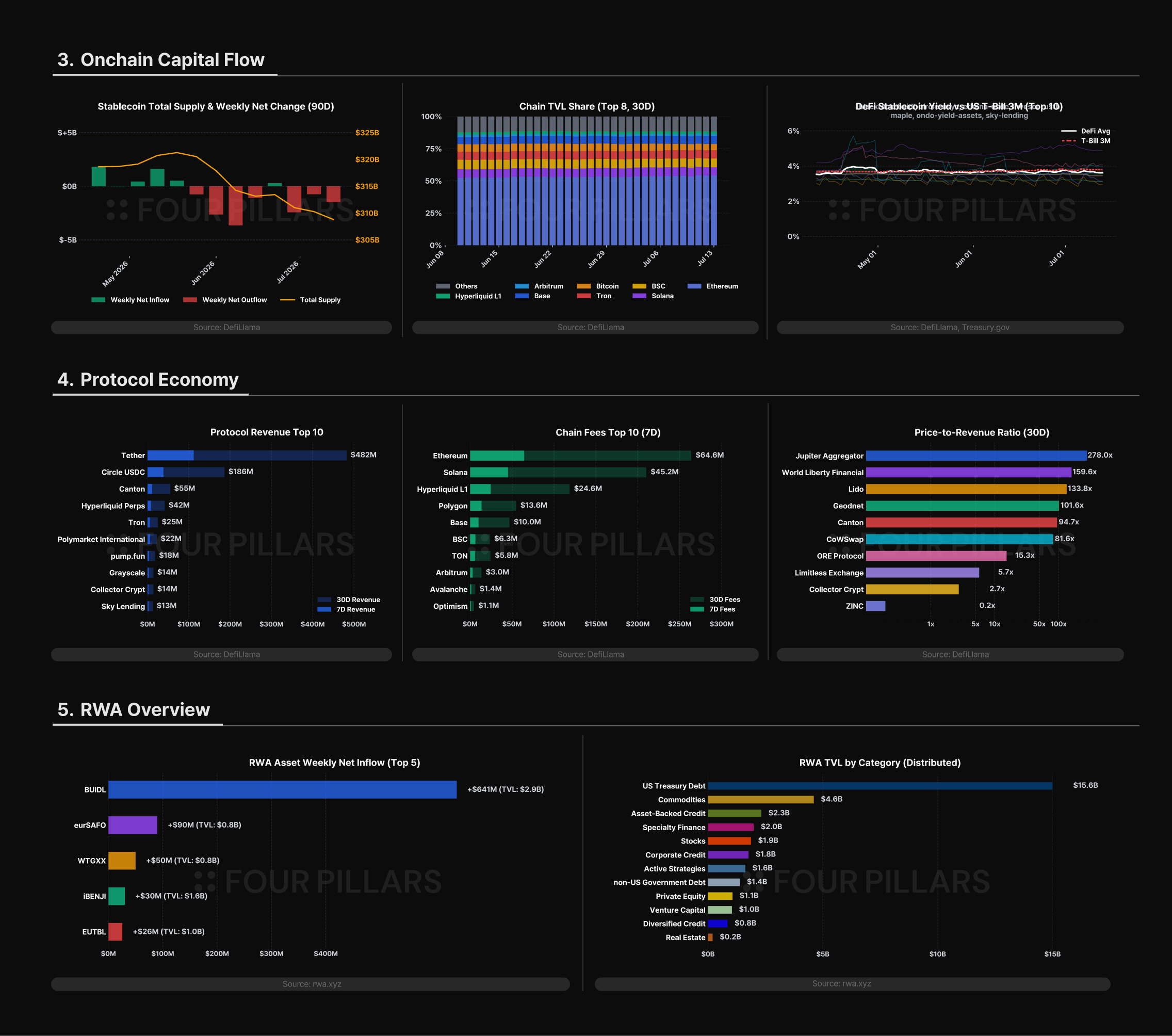
Some of the charts below are powered by CryptoQuant. For those interested in exploring the underlying data in greater detail, CryptoQuant provides access to a comprehensive suite of onchain and market analytics used by institutional participants.
The author of this report may have personal holdings or financial interests in assets or tokens discussed herein. However, the author affirms that no transactions have conducted using material non-public information obtained in the course of research or drafting. This report is intended solely for general information purposes and does not constitute legal, business, investment, or tax advice. It should not be used as a basis for making any investment decisions or as guidance for accounting, legal, or tax matters. Any references to specific assets or securities are made for informational purposes only and should not be construed as an offer, solicitation, or recommendation to invest. The opinions expressed herein are those of the author and may not reflect the views of any affiliated institutions, organizations, or individuals. The opinions and analyses expressed herein are subject to change without prior notice. In addition, beyond the individual disclosures included in each report, Four Pillars, may hold existing or prospective investments in some of the assets or protocols discussed herein. Furthermore, FP Validated, a division of Four Pillars, may already be operating as a node in certain networks or protocols discussed herein or may do so in the future. Please see below links in the footer for FP Validated's participating network disclosures and for broader disclosure details.
![No CLARITY Act, No Problem
[FP Weekly 42]](/_next/image?url=https%3A%2F%2Fkrotgrfjzckvumudxopj.supabase.co%2Fstorage%2Fv1%2Fobject%2Fpublic%2Fassets%2Fimg%2Fcontent%2Farticle%2Fnotion-import%2Fl44zlxmv4r9yqa.png&w=3840&q=75)

![CLARITY Act Fails, the SEC Steps In [FP Weekly 39]](/_next/image?url=https%3A%2F%2Fkrotgrfjzckvumudxopj.supabase.co%2Fstorage%2Fv1%2Fobject%2Fpublic%2Fassets%2Fimg%2Fcontent%2Farticle%2Fnotion-import%2Fmqlpp6muat2oq6.png&w=3840&q=75)

![CLARITY Act Faces the Senate, $LAPTOP Faces Reality [FP Weekly 38]](/_next/image?url=https%3A%2F%2Fkrotgrfjzckvumudxopj.supabase.co%2Fstorage%2Fv1%2Fobject%2Fpublic%2Fassets%2Fimg%2Fcontent%2Farticle%2Fnotion-import%2Fc3ygeemu0lqxb5.png&w=3840&q=75)