


Table of Contents


On July 5, Vitalik Buterin published an update to the strawmap, reflecting the outcome of a meeting of core Ethereum researchers in Berlin. Comparing the previous version (February 25) with this one (June 26), four changes stand out.
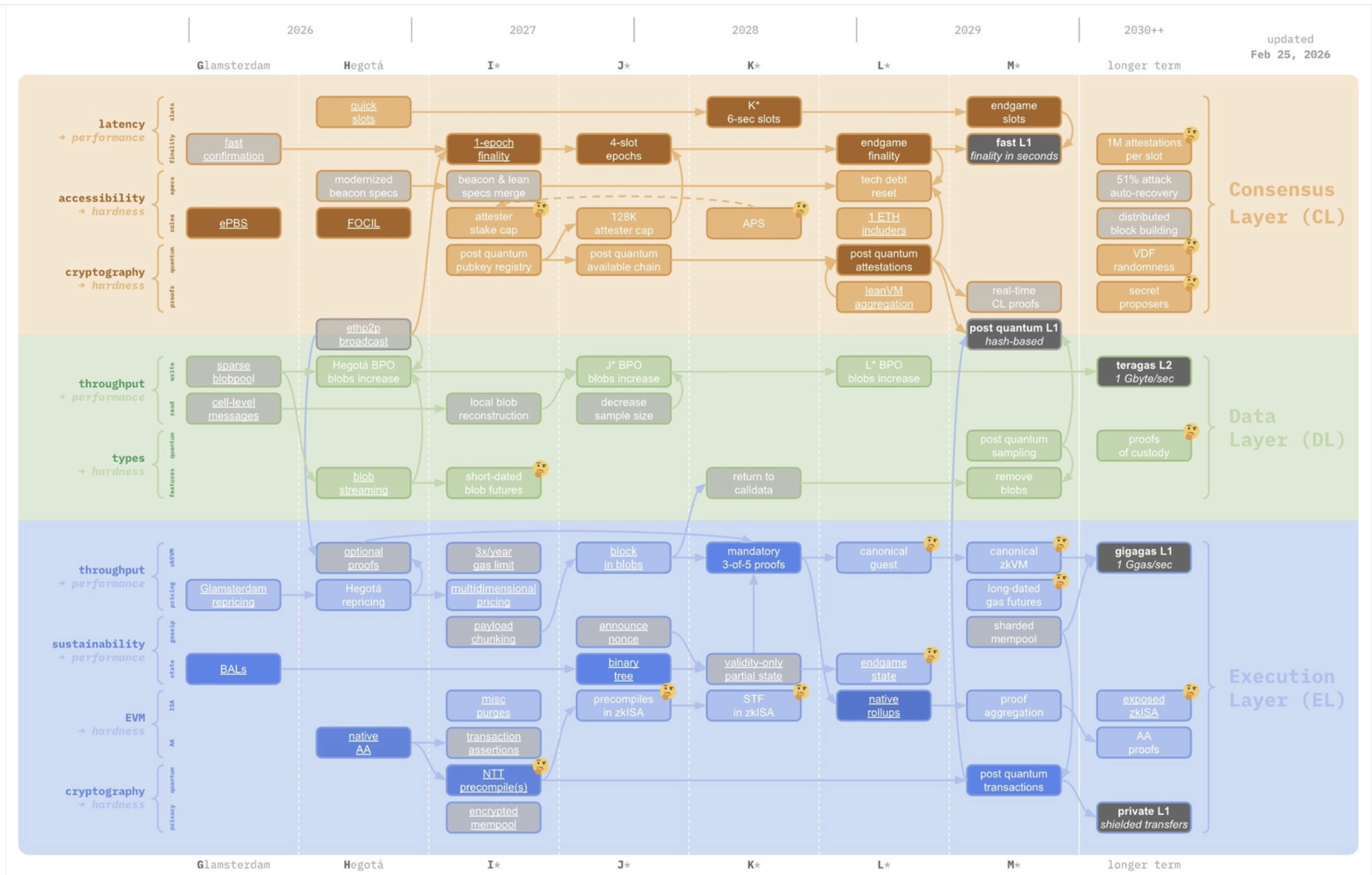
Feb 25, 2026 Strawmap
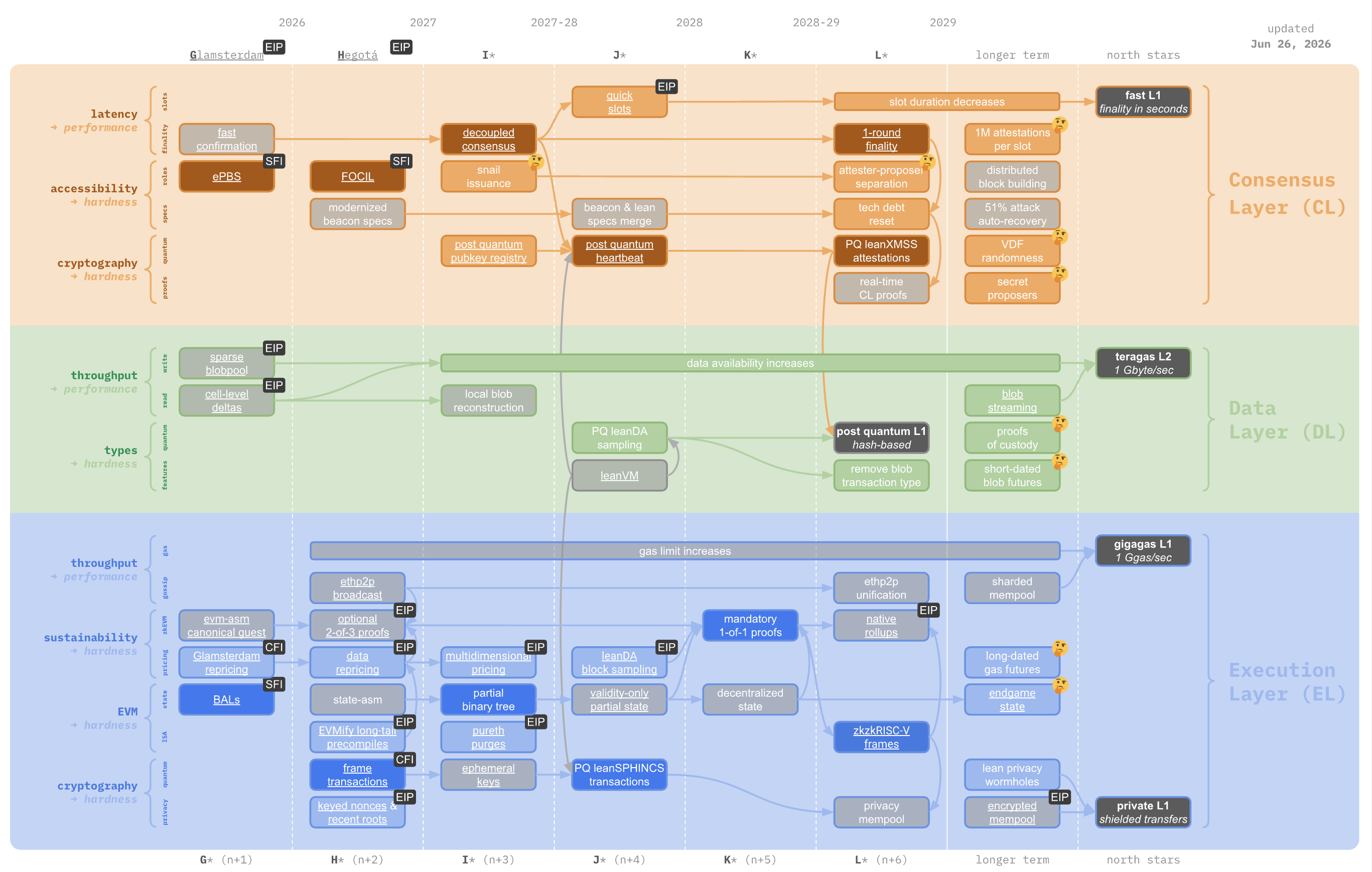
Jul 26, 2026 New Strawmap
Timeline
The previous map laid out seven hard forks stretching past 2030. The new version finishes with six forks by 2029. Fewer forks, and an earlier finish line. The column labels now span two years, like "2027-28" and "2028-29," which can be read as a plan to ship more than one fork per year. The new map splits the same goals into shorter cycles and more frequent forks.
Quantum resistance
The post-quantum L1 target moved up from M*, previously slated for the second half of 2029, to L* in 2028-2029. The old map also labeled its quantum items with vague names like "post quantum attestations." The direction existed, but no specific schemes had been chosen. The new version names the actual cryptographic schemes: leanXMSS (attestation signatures), leanSPHINCS (transaction signatures), and leanDA (data sampling).
In the X post introducing the update, Vitalik said finalizing a quantum-safe blob design has become urgent. With the quantum threat approaching faster than expected, Ethereum is pulling quantum resistance forward on its priority list.
Consensus and proofs
On the consensus layer, the old path of shrinking epochs to speed up finality (1-epoch finality → 4-slot epochs) is gone, replaced by decoupled consensus and 1-round finality. The idea is to separate the chain that keeps appending blocks from the procedure that finalizes them, then cut that procedure down to a single round. Rather than incremental improvement, the plan now rebuilds the structure itself.
The ZK proof section of the execution layer also changed substantially. The previous version relied on proofs from multiple provers, requiring a majority to agree (3-of-5). The new roadmap builds a formally verified canonical EVM implementation (evm-asm canonical guest) and requires a single proof against it (1-of-1). Instead of reducing risk by cross-checking several proofs, the plan is to mathematically guarantee the thing being verified. zkzkRISC-V appears on the map as a new VM candidate. It is too early to call RISC-V the winner, though; leanISA and RISC-V are both still in the running.
The strawmap also now includes reduced ETH issuance (snail issuance). This is the first time monetary policy has appeared explicitly on the technical roadmap. The strawmap is not a finalized plan, however, and issuance is a contentious topic, so whether this ships remains to be seen.
State
Endgame state, previously placed at 2029, slipped to longer term. In its place, new state types (keyed nonces, decentralized state, and others) moved into earlier forks. The approach leaves the existing state structure alone and adds a separate kind of state that is limited in what it can do but scales far better (e.g. 2TB of dynamic state plus 100TB of the new type).
Vitalik called this the most disruptive part of the plan and said it needs feedback from application developers, so expect it to keep changing.
Wrapping up
The character of the strawmap document itself changed since February. Gas limit and blob count increases are now drawn as continuous bands, which better reflects how that work actually gets done. Items in the upcoming Glamsterdam and Hegotá forks now carry SFI (Scheduled For Inclusion) and CFI (Considered For Inclusion) badges showing their EIP status. If the February strawmap was a rough sketch, this version is a roadmap wired into the actual implementation and fork-decision process.
This update settles debates that had been left open, and it reorganizes and sharpens both the schedule and the priorities. It is still not a finalized roadmap, and some argue even the 3-4 year window is too slow. But given how much changed between the February and June versions, the fact that the discussion got this concrete in about four months may be the bigger story.
The author of this report may have personal holdings or financial interests in assets or tokens discussed herein. However, the author affirms that no transactions have conducted using material non-public information obtained in the course of research or drafting. This report is intended solely for general information purposes and does not constitute legal, business, investment, or tax advice. It should not be used as a basis for making any investment decisions or as guidance for accounting, legal, or tax matters. Any references to specific assets or securities are made for informational purposes only and should not be construed as an offer, solicitation, or recommendation to invest. The opinions expressed herein are those of the author and may not reflect the views of any affiliated institutions, organizations, or individuals. The opinions and analyses expressed herein are subject to change without prior notice. In addition, beyond the individual disclosures included in each report, Four Pillars, may hold existing or prospective investments in some of the assets or protocols discussed herein. Furthermore, FP Validated, a division of Four Pillars, may already be operating as a node in certain networks or protocols discussed herein or may do so in the future. Please see below links in the footer for FP Validated's participating network disclosures and for broader disclosure details.


