

![Journey Toward Tokenized Stocks [FP Weekly 30]](/_next/image?url=https%3A%2F%2Fkrotgrfjzckvumudxopj.supabase.co%2Fstorage%2Fv1%2Fobject%2Fpublic%2Fassets%2Fimg%2Fcontent%2Farticle%2Fnotion-import%2Fvlq144mrur6b4t.png&w=3840&q=75)
Table of Contents
Researcher

1. Major News
[Crypto] The Noxa Fiasco
What Happened?
Robinhood Chain launched on July 1, 2026, as an Ethereum Layer 2 network for tokenized equities and real-world assets. However, its early growth was driven not by stock tokens, but by memecoin trading. The combination of low fees, fast transaction processing, and major DeFi infrastructure such as Uniswap quickly attracted speculative capital. Within roughly two weeks of the mainnet launch, the network had recorded billions of dollars in DEX trading volume. At the time, tokenized assets on the network amounted to only around $13 million, while memecoins and stablecoins accounted for most of the activity. In effect, memecoin traders seeking early liquidity opportunities on a new chain arrived before the onchain financial market envisioned by Robinhood could take shape.
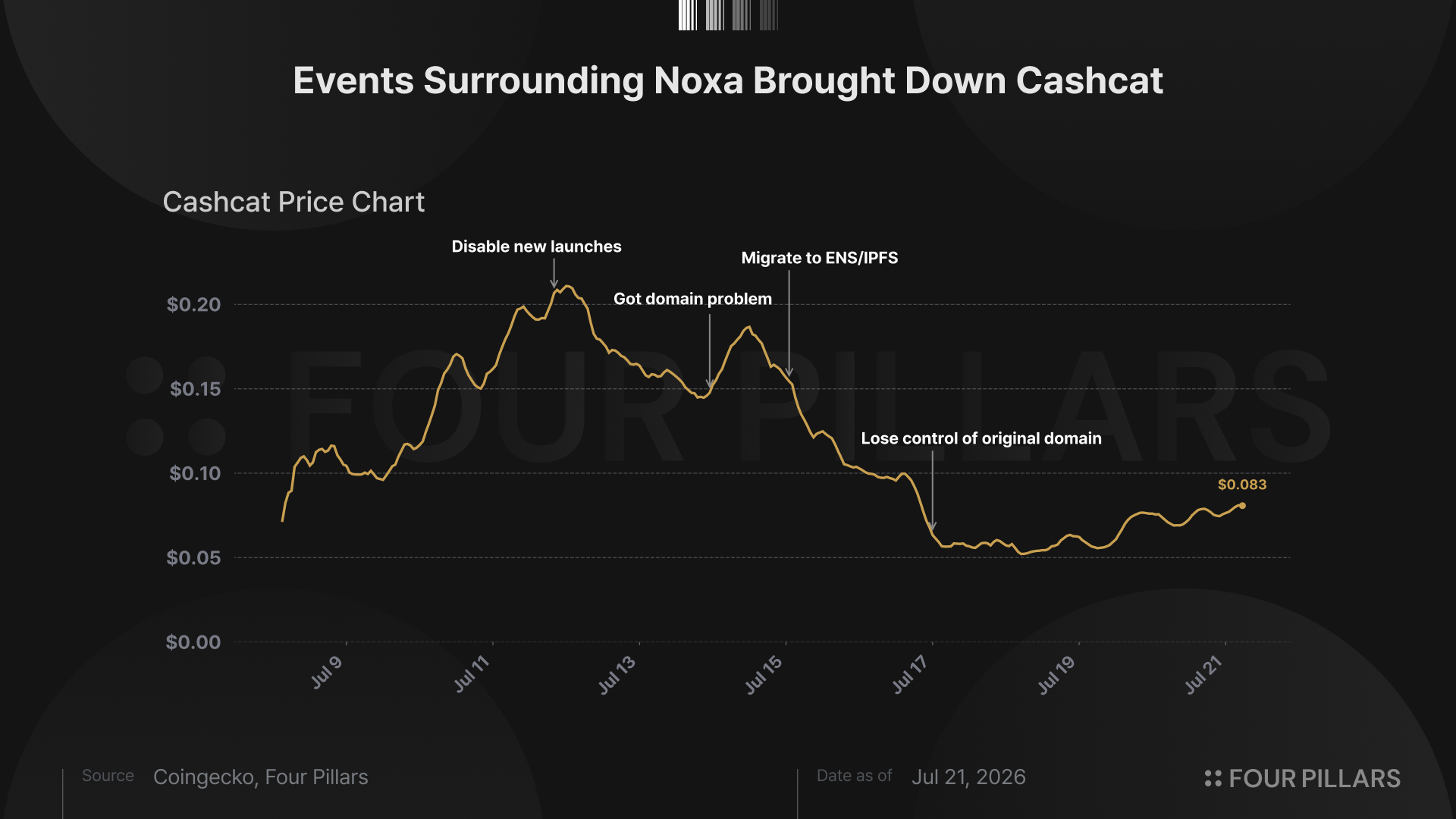
At the center of this frenzy was Cashcat, a token launched through the Noxa token launchpad. Cashcat attracted attention because of a narrative linking it to Robinhood's former mascot or an early candidate for the company's name. Its market capitalization surpassed $100 million within a week and reached a peak of $220 million. Daily trading volume also climbed to around $100 million, prompting the launch of numerous follow-on memecoins. Cashcat became more than just another memecoin. It emerged as the representative asset attracting Robinhood Chain's early users and liquidity.
Alongside Cashcat's rapid rise, Noxa quickly became the dominant token launchpad on Robinhood Chain. Noxa generated approximately $2.33 million and $1.94 million in fees on July 11 and July 12, respectively, and at one point surpassed Solana's Pump.fun in daily fee generation. However, as token duplication and bot spam increased, Noxa suspended new token issuance on July 11. Website and domain issues followed, and official communication ceased, fueling suspicions that the team had collected its fee revenue and disappeared in what the market described as a soft rug. In the trust-dependent memecoin market, the launchpad's operational shutdown and opaque response placed simultaneous pressure on Cashcat's price and the ecosystem's trading volume.
However, the claim that Noxa actually misappropriated funds has not yet been established as fact. According to publicly available onchain analysis, the approximately $12 million cited by CoinDesk appears to have been closer to total transaction fees, while the amount that could have accrued to the Noxa team was significantly smaller. Evidence that team-related funds had not been transferred to exchanges or mixers, that the fee allocation was reduced from 35% to 25% and eventually to 0%, and that the project's ENS registration had been extended for a long period has also been cited as inconsistent with the rug pull hypothesis. This suggests that the incident may have resulted from a combination of poor domain management and communication failures rather than a deliberate soft rug. However, as the team has yet to provide a sufficient explanation regarding its identity and fund management practices, the suspicions have not been fully resolved.
Researcher’s Comment
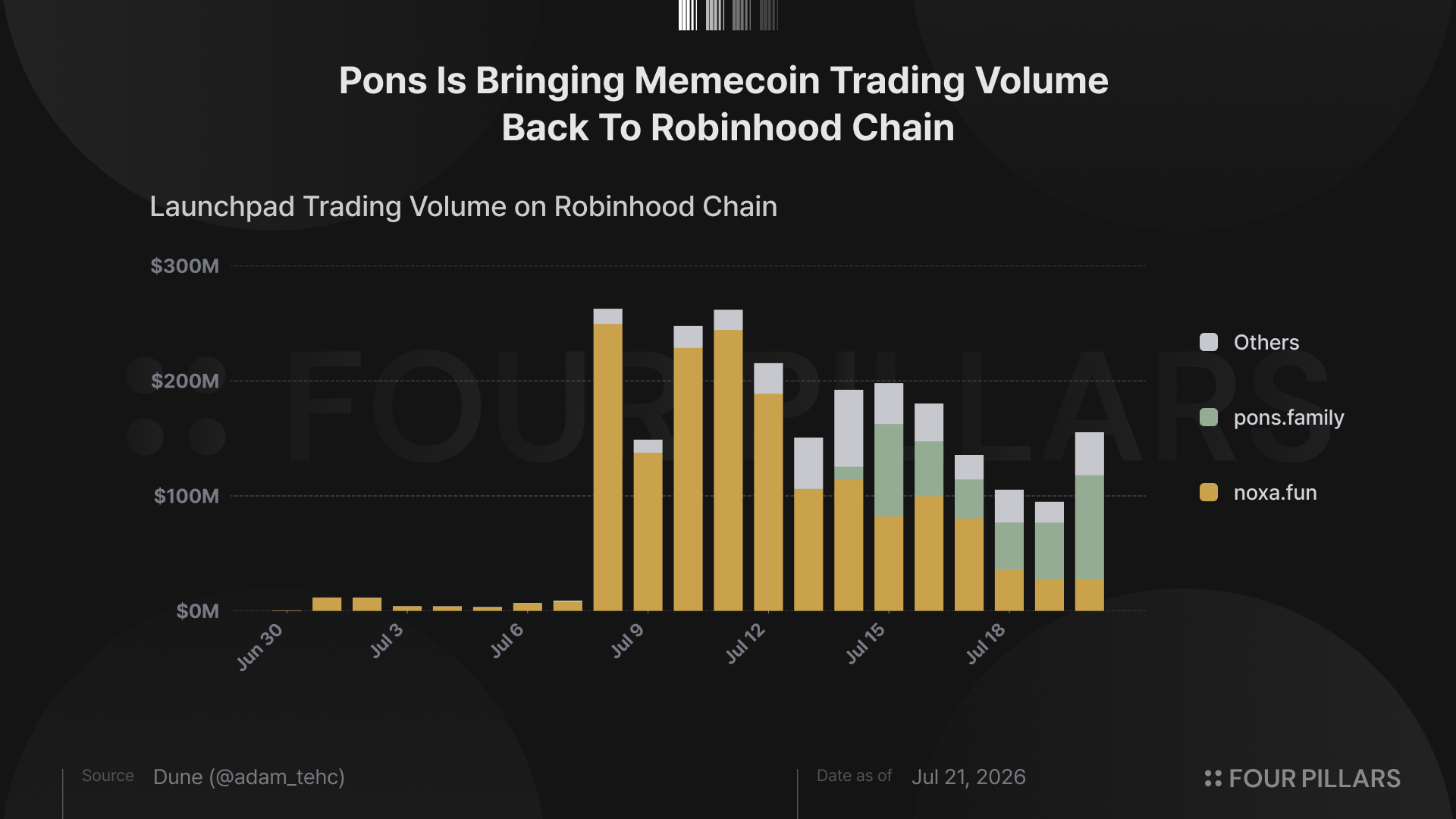
It is true that the sharp decline in trading volume for tokens launched through Noxa significantly weakened overall memecoin trading on Robinhood Chain for a period of time. However, the market has recently begun to regain momentum following the emergence of a new launchpad called Pons. Pons was developed by Ozzy in just one day immediately after Noxa suspended new token issuance. The platform grew rapidly due to the timing of its launch, a structure borrowing from Pump's mechanism, and its fast execution. Pons currently processes 58.1% of memecoin trading on Robinhood Chain and has emerged as the ecosystem's new center. In particular, the price of the PONS token surged after it became known that Robinhood CEO Vlad had followed the founder of Pons.
Noxa ultimately failed in terms of service operations and trust building. Paradoxically, however, it also served as a catalyst for attracting large-scale liquidity to Robinhood Chain. The total value locked across Robinhood Chain protocols increased to approximately $454 million, surpassing OP Mainnet and reaching a level similar to Sui. The market capitalization of stablecoins on the chain also grew to approximately $425 million.
This accumulated liquidity could provide the foundation for the tokenized equity ecosystem that Robinhood ultimately aims to build. There are still only a limited number of protocols on Robinhood Chain that allow Stock Tokens to be used in practical applications, but the total value of Stock Tokens has steadily increased to approximately $18 million. If protocols emerge that allow tokenized equities to be used as collateral for lending or as margin for derivatives trading, the related market could expand rapidly.
Noxa's rapid rise and collapse can be viewed as a typical growing pain experienced by emerging networks. The incident damaged Robinhood Chain's initial momentum, but it also demonstrated that the ecosystem could reorganize around new services without remaining dependent on a single platform. Robinhood Chain has now established a foundation from which it can expand beyond the memecoin market into a stock token ecosystem. It will be important to watch whether Pons can drive a second phase of memecoin enthusiasm and whether the emergence of protocols using Stock Tokens can catalyze meaningful growth in the tokenized equity market.
[Institution] DTCC Conducts Live Production Trades of Tokenized Securities
What Happened?
On July 15, DTCC, a core clearing and settlement infrastructure provider for the U.S. financial market, conducted its first limited operation involving the tokenization and trading of equities, ETFs, and U.S. Treasuries in a live production environment. More than 20 financial institutions and technology companies participated, including JPMorgan, Goldman Sachs, BlackRock, Vanguard, and the NYSE. The tokenized assets were used for collateral transfers, repo transactions, central counterparty margin payments, equity trading, and asset transfers.
What distinguished these transactions from previous blockchain pilots was that DTCC tokenized securities actually held at DTC in a production environment, rather than using a testnet or simulated assets. Instead of issuing separate synthetic assets or price-tracking tokens, DTCC converted existing securities into digital twins on a blockchain. The tokenized securities retained the same legal ownership rights, dividends, voting rights, and investor protections as the original securities, and could also be converted back into traditional book-entry form.
In one practical example, JPMorgan tokenized a portion of its Invesco QQQ Trust ETF holdings custodied at DTC and used the assets as collateral to satisfy central counterparty margin requirements at CME Group. Transactions and collateral arrangements involving the SPDR S&P 500 ETF Trust, U.S. Treasuries, and individual equities were also processed. The transactions were settled separately on Hyperledger Besu, DTCC's private blockchain, and Canton Network, an institution-focused network.
In December 2025, DTCC received a no-action letter from the SEC permitting it to operate a limited tokenization service for three years. Eligible assets include highly liquid securities such as Russell 1000 constituents, ETFs tracking major indices, and short-term, medium-term, and long-term U.S. Treasury securities. Following these limited production transactions, DTCC plans to officially launch the service in October 2026. DTC currently holds and services more than $114 trillion in securities.
Researcher’s Comment
The significance of this case does not simply lie in the fact that equities were traded on a blockchain. More importantly, DTC, the central securities depository for the U.S. equity market, directly tokenized real securities already held in its custody and used them in the collateral and settlement operations of existing financial institutions.
Many tokenized equities introduced to the market so far have resembled wrapper structures in which a custodian holds the underlying shares while a third party issues a token representing only their economic value. These tokens may track a stock's price, but whether investors possess direct legal ownership or voting rights in the underlying shares varies depending on the structure.
DTCC's approach is different. It converts securities recorded on DTC's existing books into token form while preserving the existing framework for legal ownership, dividends, voting rights, and corporate action processing. Put simply, these are not tokens that track the price of a stock. They are closer to an alternative settlement format for equities that already exist within the traditional market infrastructure.
The advantages of this structure are clear. Existing financial institutions can use tokenized assets without abandoning the legal rights and risk management frameworks with which they are already familiar, resulting in relatively low transition costs for regulatory approval and institutional adoption. In particular, the main focus of these transactions was not round-the-clock equity trading, but collateral mobility. JPMorgan's use of tokenized QQQ as central counterparty margin suggests that early demand for tokenization may first emerge in institutional collateral management and capital efficiency rather than in retail trading.
However, these transactions did not prove that there is commercial demand for the tokenized asset market. They demonstrated that such transactions are technically and operationally possible in a production environment. Questions remain regarding how much cost reduction can actually be achieved compared with existing systems, whether sufficient trading volume will emerge, and how liquidity across different blockchains will be integrated.
The key question going forward will not be whether securities will be tokenized. It will be who maintains the official ownership ledger, which networks are used for settlement, and which assets secure onchain liquidity first. Through these transactions, DTCC made it clear that it has no intention of being excluded from the center of that structure.
Others
Crypto
- Tempo Introduces Receive Policies
- Onchain Pokémon cards come to Solana-based DEX Jupiter
- MegaETH sunsets Mega Mafia accelerator program, noting 'most' of its successful apps left
- Coinbase's Jesse Pollak hands Base app leadership to Cobie after admitting social bets fell short
Institution
- Galaxy blends Aave, Morpho and other DeFi rates in new GOFR crypto borrowing product
- Visa Introduces Platform for Stablecoin Minting, Movement and Management
Tech
- Ostium pauses trading after apparent $18 million vault exploit
- Allbridge Core pauses protocol after $1.65 million flash loan exploit: onchain analysts
Investment
- Tether leads $7 million round in Pact Labs to boost USAT stablecoin adoption
- Dragonfly, FirstMark lead $38 million Series A for stablecoin startup Velocity with support from Coinbase, Ripple and more
- Ark Invest adds $14 million in Circle shares while selling Robinhood
- Citadel Securities invests $400 million in Crypto.com at $20 billion valuation
- MoonPay acquires Y Combinator-backed crypto deposits startup Glide in all-equity deal
Asia
- Bank of Thailand audits high-volume stablecoin trades to crack down on illicit finance: report
- Japan passes key bill recognizing crypto as financial product, lowering tax rate
2. Four Pillars Weekly
: : DoubleZero: A New Internet for New Finance (Link)
- New financial systems like onchain markets, and prediction markets have reached a point where they require dedicated infrastructure beyond the limitations of the internet protocol designed 30 years ago. BGP, the routing protocol that has governed internet traffic since the early 1990s, was designed to minimize cost, not to minimize latency. It delivers data on a 'least cost' basis. DoubleZero presents a new paradigm that enables access to high performance, that maintains decentralization by taking advantage of underutilized fiber capacity from various network contributors.
- DoubleZero has successfully stood up a purpose-built network that significantly improves global communication and data transfer. DoubleZero is the first to apply multicast technology to blockchain, solving the inefficiency of repeatedly transmitting identical data to thousands of nodes and reducing network bandwidth usage.
- DoubleZero implemented fair reward distribution model to network contributors based on actual performance contributions through smart contract-based automation and a Shapley value model, without central administrators. Today, over 460+ Solana mainnet validators are connected to DoubleZero, achieving up to 78.1% round-trip time improvements on specific paths compared to the public internet.
Comments
- Technology’s Double-Edged Sword: Prediction Market or Manipulation Market?
- The Prisoner's Dilemma Between Circle and Coinbase
- Back to Base: Jesse Pollak’s Next Big Bet
3. Macro & Onchain Metrics
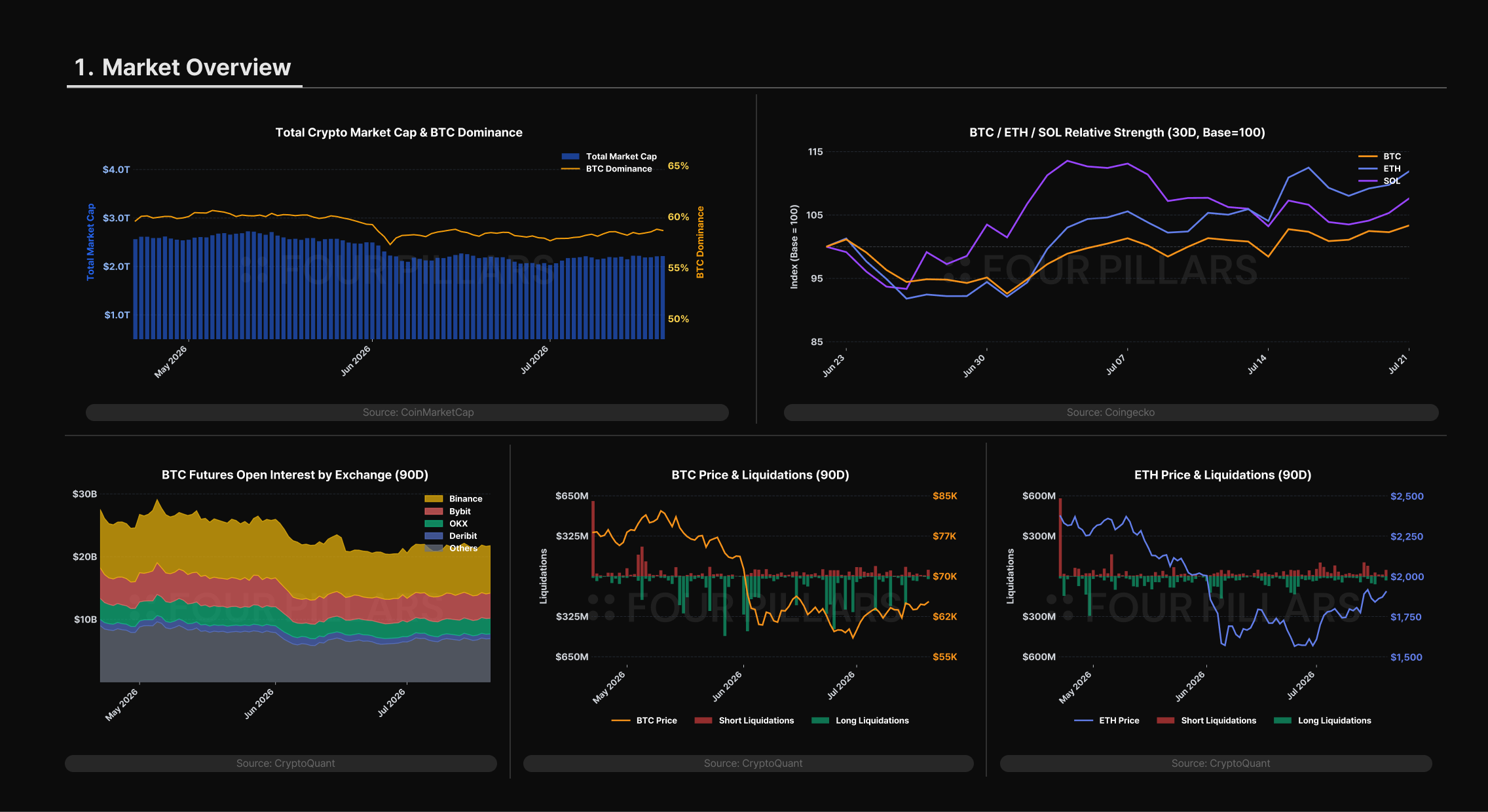
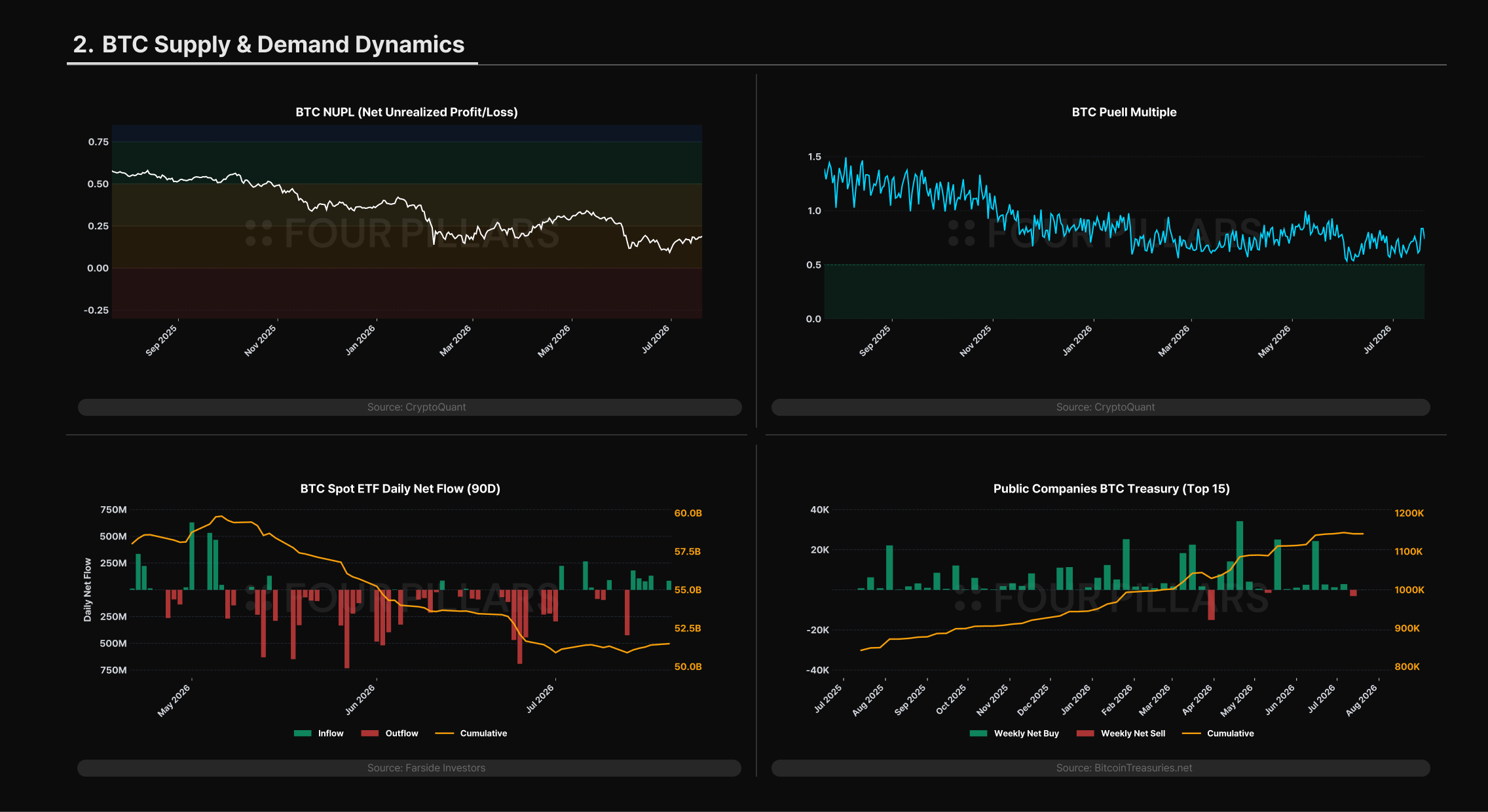
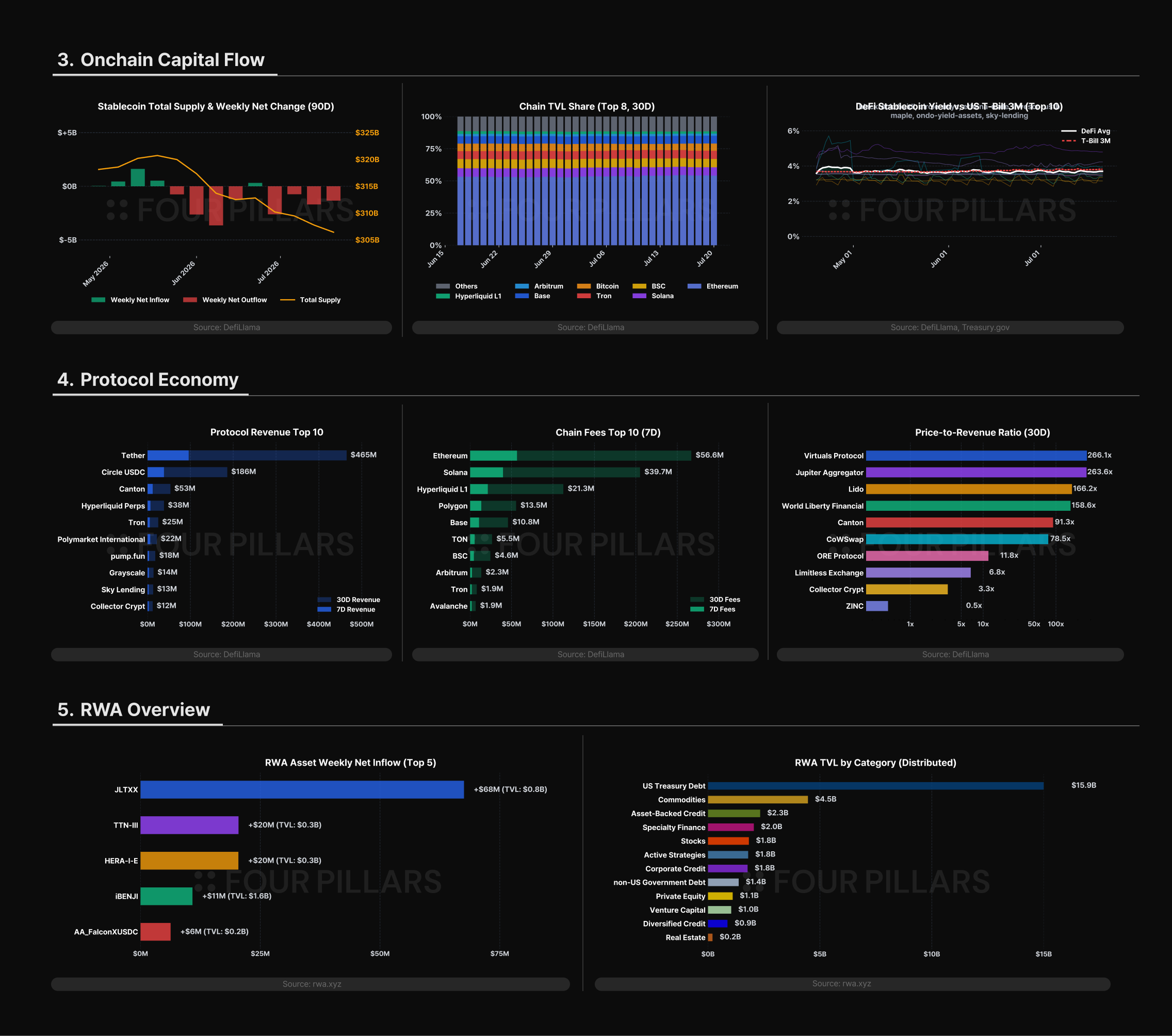
Some of the charts below are powered by CryptoQuant. For those interested in exploring the underlying data in greater detail, CryptoQuant provides access to a comprehensive suite of onchain and market analytics used by institutional participants.
The author of this report may have personal holdings or financial interests in assets or tokens discussed herein. However, the author affirms that no transactions have conducted using material non-public information obtained in the course of research or drafting. This report is intended solely for general information purposes and does not constitute legal, business, investment, or tax advice. It should not be used as a basis for making any investment decisions or as guidance for accounting, legal, or tax matters. Any references to specific assets or securities are made for informational purposes only and should not be construed as an offer, solicitation, or recommendation to invest. The opinions expressed herein are those of the author and may not reflect the views of any affiliated institutions, organizations, or individuals. The opinions and analyses expressed herein are subject to change without prior notice. In addition, beyond the individual disclosures included in each report, Four Pillars, may hold existing or prospective investments in some of the assets or protocols discussed herein. Furthermore, FP Validated, a division of Four Pillars, may already be operating as a node in certain networks or protocols discussed herein or may do so in the future. Please see below links in the footer for FP Validated's participating network disclosures and for broader disclosure details.
![Equity Markets Still Cold on Tokenized Stocks, DATs [FP Weekly 43]](/_next/image?url=https%3A%2F%2Fkrotgrfjzckvumudxopj.supabase.co%2Fstorage%2Fv1%2Fobject%2Fpublic%2Fassets%2Fimg%2Fissues%2Fequity-markets-still-cold-on-tokenized-stocks-dats-fp-weekly-43.png%3Ft%3D1792399234196&w=3840&q=75)

![No CLARITY Act, No Problem
[FP Weekly 42]](/_next/image?url=https%3A%2F%2Fkrotgrfjzckvumudxopj.supabase.co%2Fstorage%2Fv1%2Fobject%2Fpublic%2Fassets%2Fimg%2Fcontent%2Farticle%2Fnotion-import%2Fl44zlxmv4r9yqa.png&w=3840&q=75)

![CLARITY Act Fails, the SEC Steps In [FP Weekly 39]](/_next/image?url=https%3A%2F%2Fkrotgrfjzckvumudxopj.supabase.co%2Fstorage%2Fv1%2Fobject%2Fpublic%2Fassets%2Fimg%2Fcontent%2Farticle%2Fnotion-import%2Fmqlpp6muat2oq6.png&w=3840&q=75)